Clodura.AI vs Soleadify (2026): Which B2B Data Tool Wins?
Clodura.AI and Soleadify both promise clean B2B contact data, but they solve different problems. Here's an honest, side-by-side breakdown of pricing, accuracy, and coverage to help you pick.
Searching for a cloduraai vs soleadify breakdown? You are picking a B2B data provider, and these two names keep coming up. They look alike on a pricing page. But they are built for different jobs. Choose wrong and you overpay for a sales suite you won't use. Or you buy a business directory that can't map the buying committee at a large enterprise.
This is a neutral, side-by-side comparison. No hype. No "both are amazing" filler. Here is where each tool wins, where each one struggles, and where a focused email tool beats both.
TL;DR: cloduraai vs soleadify at a glance#
- Clodura.AI is a full sales-intelligence platform: a large B2B contact database, direct dials, technographics, buying-intent signals, and a built-in email cadence tool. Best for outbound teams selling into mid-market and enterprise.
- Soleadify is a company-first database with unusually deep coverage of small and local businesses across many countries. Best when you need to reach SMBs, agencies, restaurants, clinics, and long-tail verticals.
- Data model differs at the root: Clodura indexes people at companies. Soleadify indexes businesses (including ones with no LinkedIn footprint) and attaches contacts where it can.
- Pricing: both gate volume and features behind higher tiers. Neither is cheap once you scale credits. Watch export limits, not just the headline price.
- If your main need is verified email addresses, a dedicated finder like Tomba Email Finder is faster and cheaper than paying platform prices for data you'll only email once.
What is Clodura.AI?#
Clodura.AI is a sales-intelligence and prospecting platform. Think of it as a database plus an outreach cockpit bolted together. You search its contact database and filter by title, industry, company size, and tech stack. Then you push contacts into a sequence without leaving the tool.
Its strengths are the extras around the data: buying-intent signals, org charts, direct-dial phone numbers, and a native email sequencer with basic deliverability tooling. That appeals to teams who want one login instead of stitching together a database, a phone finder, and a sending tool.
The trade-off is that you pay for the whole suite. If you already run Outreach, Salesloft, or Instantly, half of Clodura's value is redundant. At that point you are really buying it for the raw contact data.

What is Soleadify?#
Soleadify is a business-data platform with a different center of gravity. It does not lead with named decision-makers at big tech firms. Instead it maps companies, including the millions of small and local businesses that never show up cleanly in LinkedIn-derived databases.
Is your ICP "dentists in Texas," "independent hotels in Portugal," or "marketing agencies under 50 people in the UK"? Then Soleadify's coverage of the long tail is genuinely strong. It pulls firmographic detail, categories, and contact points (business emails, phones, social profiles) for verticals most sales-intelligence tools ignore.
The flip side is that it is company-first. So individual-level targeting inside large enterprises is thinner. You will find the business. You may not always get the specific VP of Procurement with a verified direct email.
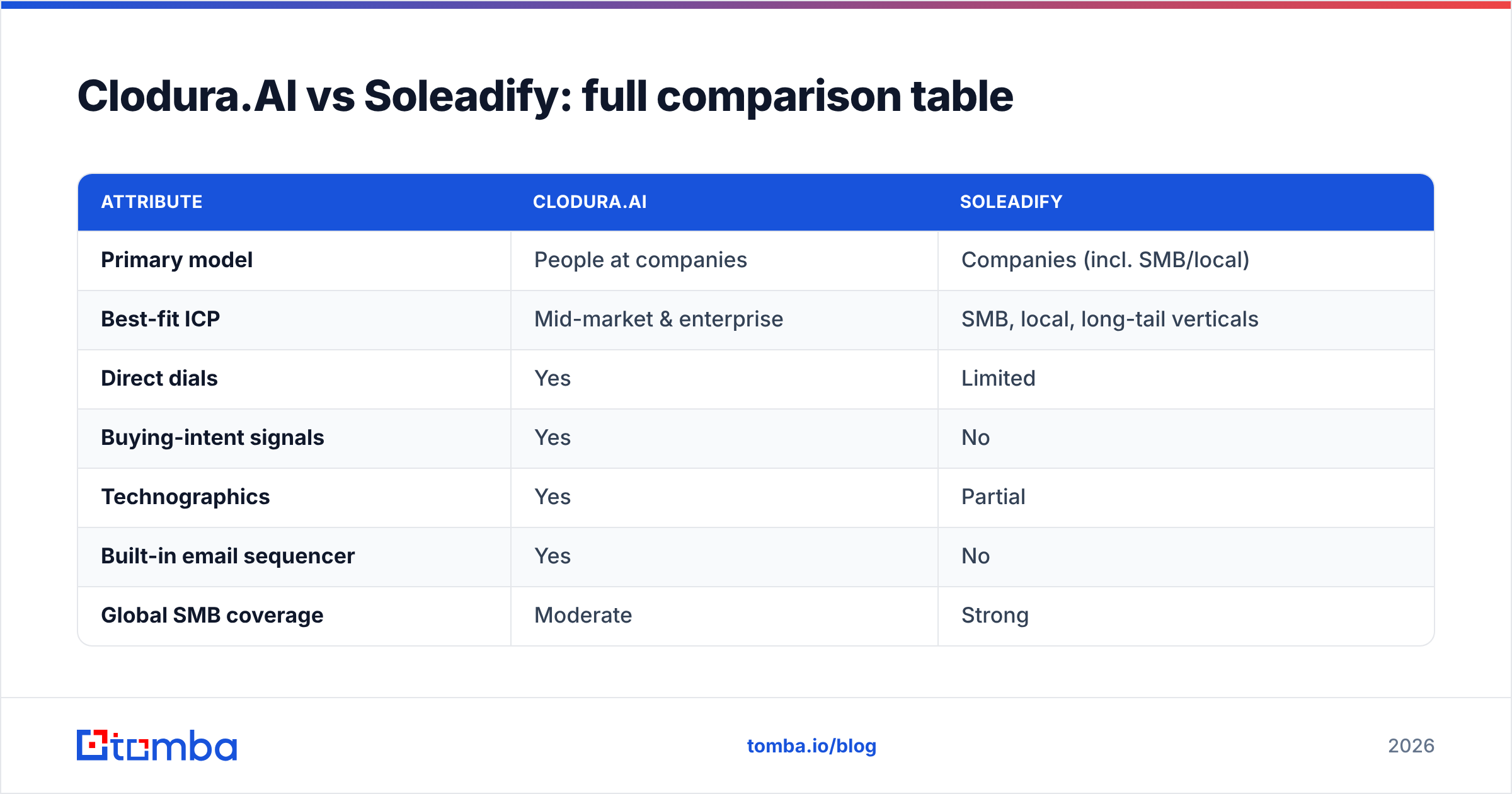
cloduraai vs soleadify: full comparison table#
| Attribute | Clodura.AI | Soleadify |
|---|---|---|
| Primary model | People at companies | Companies (incl. SMB/local) |
| Best-fit ICP | Mid-market & enterprise | SMB, local, long-tail verticals |
| Direct dials | Yes | Limited |
| Buying-intent signals | Yes | No |
| Technographics | Yes | Partial |
| Built-in email sequencer | Yes | No |
| Global SMB coverage | Moderate | Strong |
| Email verification | Built-in | Basic |
| Entry pricing | Free tier + paid plans | Paid plans (quote-based tiers) |
| Export/credit limits | Tiered, watch caps | Tiered, watch caps |
Both vendors change plans often. So confirm current numbers on clodura.ai and soleadify.com before you commit. One pattern rarely changes: the headline price is not the real price. Credit ceilings, export caps, and per-seat costs decide your true cost per usable contact.
Is Clodura.AI better than Soleadify for accuracy?#
It depends on who you are targeting. This is the crux of the decision.
For enterprise and mid-market contacts, Clodura.AI usually returns more complete records: title, department, direct dial, and a verified work email. Its intent layer also helps you prioritize accounts that are in-market. That matters more than raw record count.
For small and local businesses, Soleadify is often more accurate. It simply covers companies the other databases don't have at all. A record that exists and is 85% correct beats a "verified" record that doesn't exist.
Neither tool escapes the universal B2B data problem: staleness. People change jobs every 12 to 18 months, and no database refreshes fast enough. So teams that care about bounce rate run every list through a dedicated email verifier before sending, no matter which provider sourced it. Treat the platform's "verified" badge as a starting point, not a guarantee.
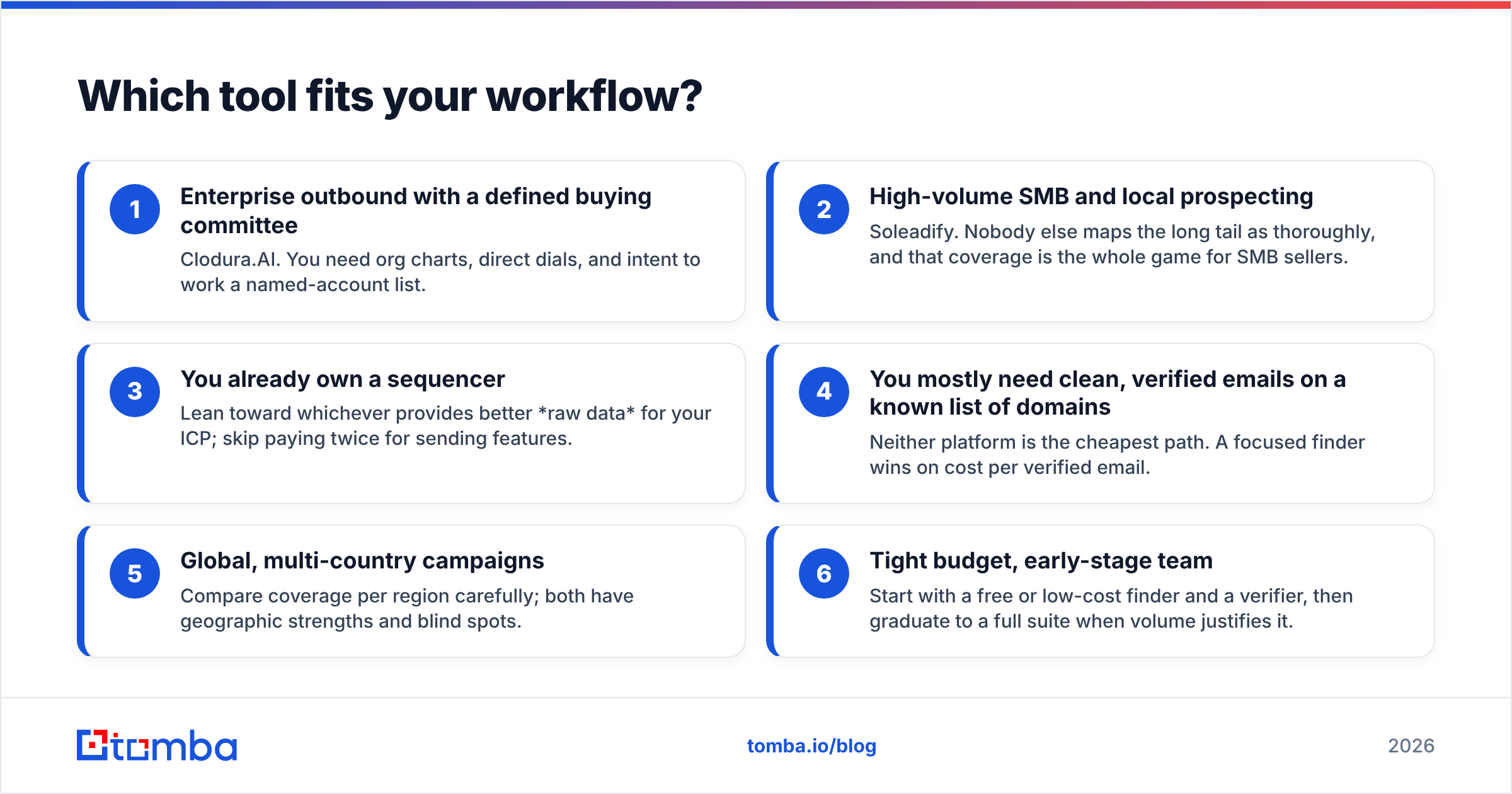
Which tool fits your workflow?#
Match the tool to the motion, not the marketing.
- Enterprise outbound with a defined buying committee — Clodura.AI. You need org charts, direct dials, and intent to work a named-account list.
- High-volume SMB and local prospecting — Soleadify. Nobody else maps the long tail as thoroughly, and that coverage is the whole game for SMB sellers.
- You already own a sequencer — Lean toward whichever provides better raw data for your ICP. Skip paying twice for sending features.
- You mostly need clean, verified emails on a known list of domains — Neither platform is the cheapest path. A focused finder wins on cost per verified email.
- Global, multi-country campaigns — Compare coverage per region carefully. Both have geographic strengths and blind spots.
- Tight budget, early-stage team — Start with a low-cost finder and a verifier. Graduate to a full suite when volume justifies it.
How do the two compare on price and value?#
On a cloduraai vs soleadify cost comparison, value is not price per plan. It is price per contact you can actually use after bounces, missing fields, and out-of-ICP records are stripped out.
Clodura.AI's suite pricing makes sense when you use the sequencer, intent, and dials together. If you only extract and export contacts, you are paying platform margins for a spreadsheet. Soleadify's value climbs sharply if your ICP lives in its long-tail coverage. It drops if you're chasing enterprise VPs it doesn't specialize in.
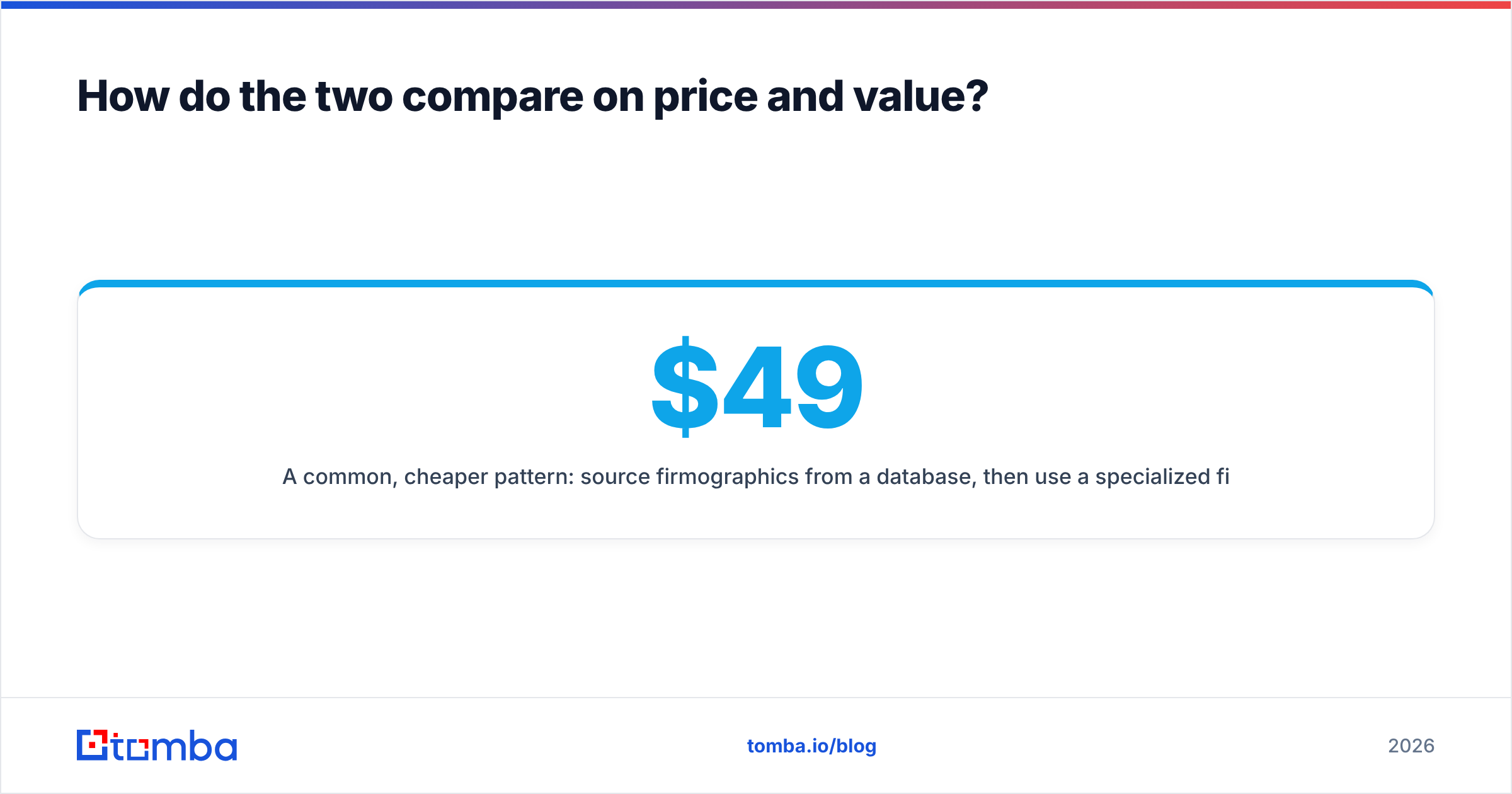
There is a common, cheaper pattern. Source firmographics from a database. Then use a specialized finder and verifier to fill and clean the actual sending column. You can even run this at scale with a bulk email finder, so you're not paying enterprise-suite rates for every address. Compare that stack's total against a single platform bill before you sign an annual contract. See Tomba pricing for a reference point: Free (25 searches/mo), Starter $49/mo, Growth $99/mo, and Pro $249/mo.

Where does a dedicated email finder fit in?#
Both Clodura.AI and Soleadify are databases first. They are strong when you don't yet know who to contact and you want the platform to surface accounts and people. But a lot of outbound starts the opposite way. You already have a list of target companies or names. You just need the right, deliverable email.
That is a different job, and a focused tool does it better and cheaper:
- You have a company but no contacts — run a domain search to pull every discoverable address at that domain with role labels.
- You have a name and a company — the email finder returns the specific address with a confidence score.
- You have a messy list — verify it in bulk to cut bounces before they wreck your sender reputation.
You are not really choosing "database vs finder." Mature teams use both: a database to discover accounts, and a finder-and-verifier to make the contact data deliverable.
Clodura.AI vs Soleadify: pros and cons#
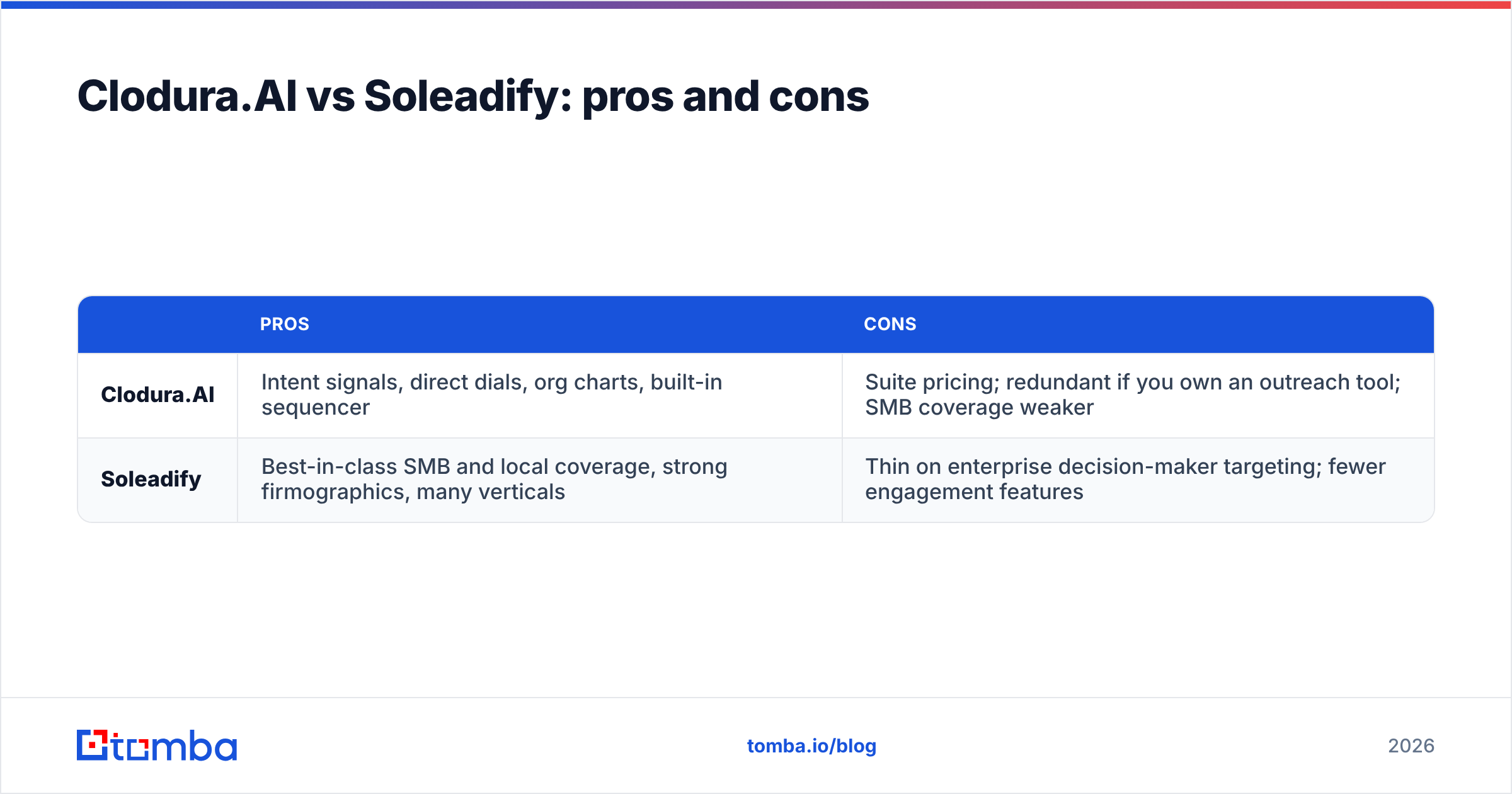
| Pros | Cons | |
|---|---|---|
| Clodura.AI | Intent signals, direct dials, org charts, built-in sequencer | Suite pricing; redundant if you own an outreach tool; SMB coverage weaker |
| Soleadify | Best-in-class SMB and local coverage, strong firmographics, many verticals | Thin on enterprise decision-maker targeting; fewer engagement features |
Want independent reviews before deciding? Cross-check both on G2, where buyers report real-world data accuracy and support quality. Weight recent reviews heavily. Data vendors improve and regress fast.
The verdict: which should you choose?#
The cloduraai vs soleadify choice comes down to your ICP.
Choose Clodura.AI if you sell into mid-market or enterprise, want intent and direct dials, and value having discovery plus sequencing under one roof.
Choose Soleadify if your ICP is small or local businesses and long-tail verticals, where its coverage is hard to match.
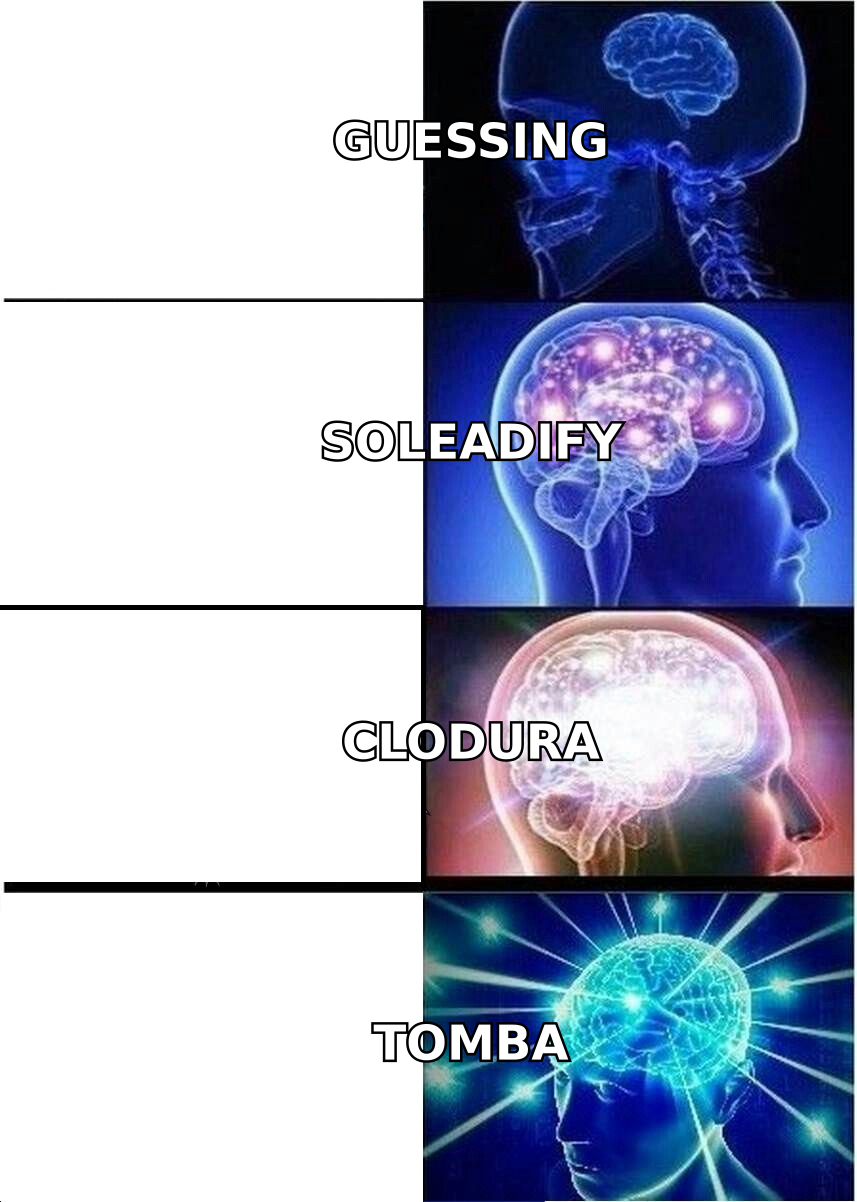
Choose neither as your whole stack if your real bottleneck is deliverable emails on companies you already know. In that case, the cheapest reliable path is a dedicated finder plus a verifier, layered under whichever database you adopt.
Get deliverable emails without paying suite prices#
Whichever platform you shortlist, your emails still have to land. Start with the Tomba Email Finder to turn company domains and names into verified, deliverable addresses. Then verify your full list before every send. It plugs into the same workflow via the Tomba API, Chrome extension, and Google Sheets. So you can source from Clodura.AI or Soleadify and let Tomba handle the accuracy layer. The free tier lets you test coverage on your own ICP before you spend a dollar, with no annual contract required.
Related guides#
Ready to find emails that actually work?
Join 150,000+ professionals who stopped guessing and started sending. Free credits on signup — no credit card required.
Get the Tomba newsletter
Practical outbound tactics and product updates — once every two weeks.
About the author