Clodura.ai vs Sparklane (2026): Which Sales Tool Wins?
Clodura.ai and Sparklane both promise better B2B prospecting data—but they solve different problems. Here's an honest breakdown of accuracy, pricing, and fit, plus where each one leaves gaps.
Clodura.ai vs Sparklane comes down to one question you won't see on either homepage. Do you need a self-serve prospecting database that hands you contacts and sequences? Or a predictive engine that tells you which accounts to chase next? On a feature grid, they look like rivals. In practice, they solve two different halves of your pipeline.
This is a neutral breakdown. We weigh accuracy, pricing, workflow fit, and the gaps each tool leaves. By the end, you can decide which one—if either—belongs in your stack for 2026.
TL;DR: Clodura.ai vs Sparklane at a glance#
- Clodura.ai is a self-serve B2B sales intelligence platform. It bundles a contact database (~600M+ contacts, direct dials, org charts) with email verification and cold-email sequencing. It fits SMB and mid-market SDR teams that want data and outreach in one login.
- Sparklane is a predictive lead-generation and account-intelligence platform. It aims at European mid-market and enterprise buyers. Its edge is AI-scored account picks and business signals, not raw contact volume.
- Accuracy is the real battleground. Both refresh data often, but neither publishes an audited email-validity rate. Verify before you send, whichever you pick.
- Pricing favors Clodura for transparency (published tiers, free plan). Sparklane is quote-based and skews enterprise.
- The honest gap: both are broad platforms. If your only pain is finding and verifying accurate emails, a dedicated tool like Tomba is cheaper and more precise than a full suite.
What is Clodura.ai?#
Clodura.ai bills itself as an all-in-one sales prospecting platform. The pitch is simple: skip stitching together a database tool, a verifier, and a sequencer. Do it all in one place.
Core capabilities:
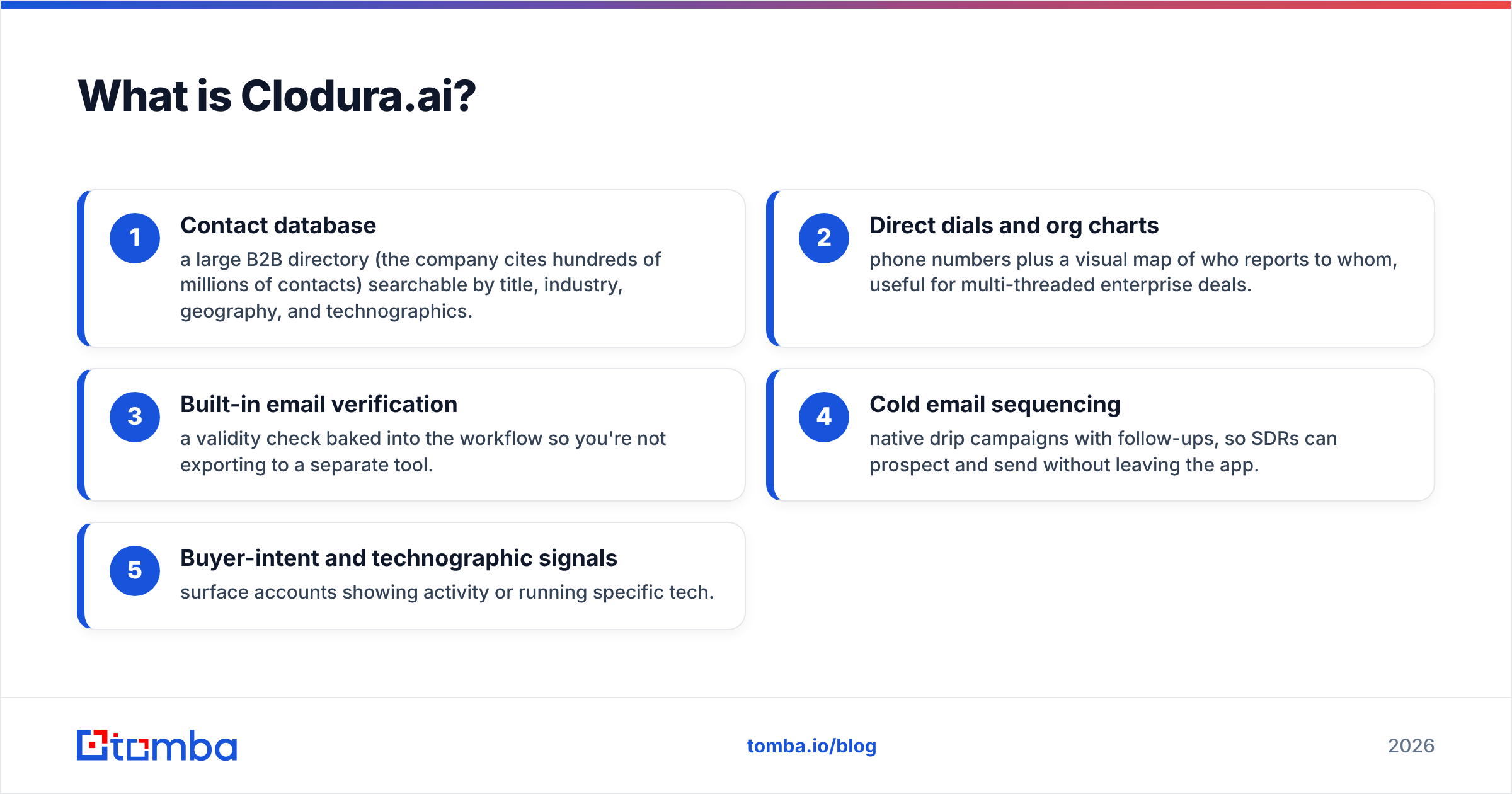
- Contact database — a large B2B directory (the company cites hundreds of millions of contacts) you can search by title, industry, geography, and technographics.
- Direct dials and org charts — phone numbers plus a visual map of who reports to whom. This helps with multi-threaded enterprise deals.
- Built-in email verification — a validity check baked into the workflow, so you don't export to a separate tool.
- Cold email sequencing — native drip campaigns with follow-ups, so SDRs can prospect and send without leaving the app.
- Buyer-intent and technographic signals — surface accounts that show activity or run specific tech.
The center of gravity is volume plus workflow. You buy reach and the power to act on it right away. That makes Clodura a fit for smaller teams that don't want to buy four tools. You can see how it frames itself on the Clodura.ai homepage.
What is Sparklane?#
Sparklane is a predictive lead-generation platform with deep roots in the European market, especially France. It doesn't lead with "here are 600 million contacts." It leads with "here are the accounts most likely to buy from you right now."
Core capabilities:
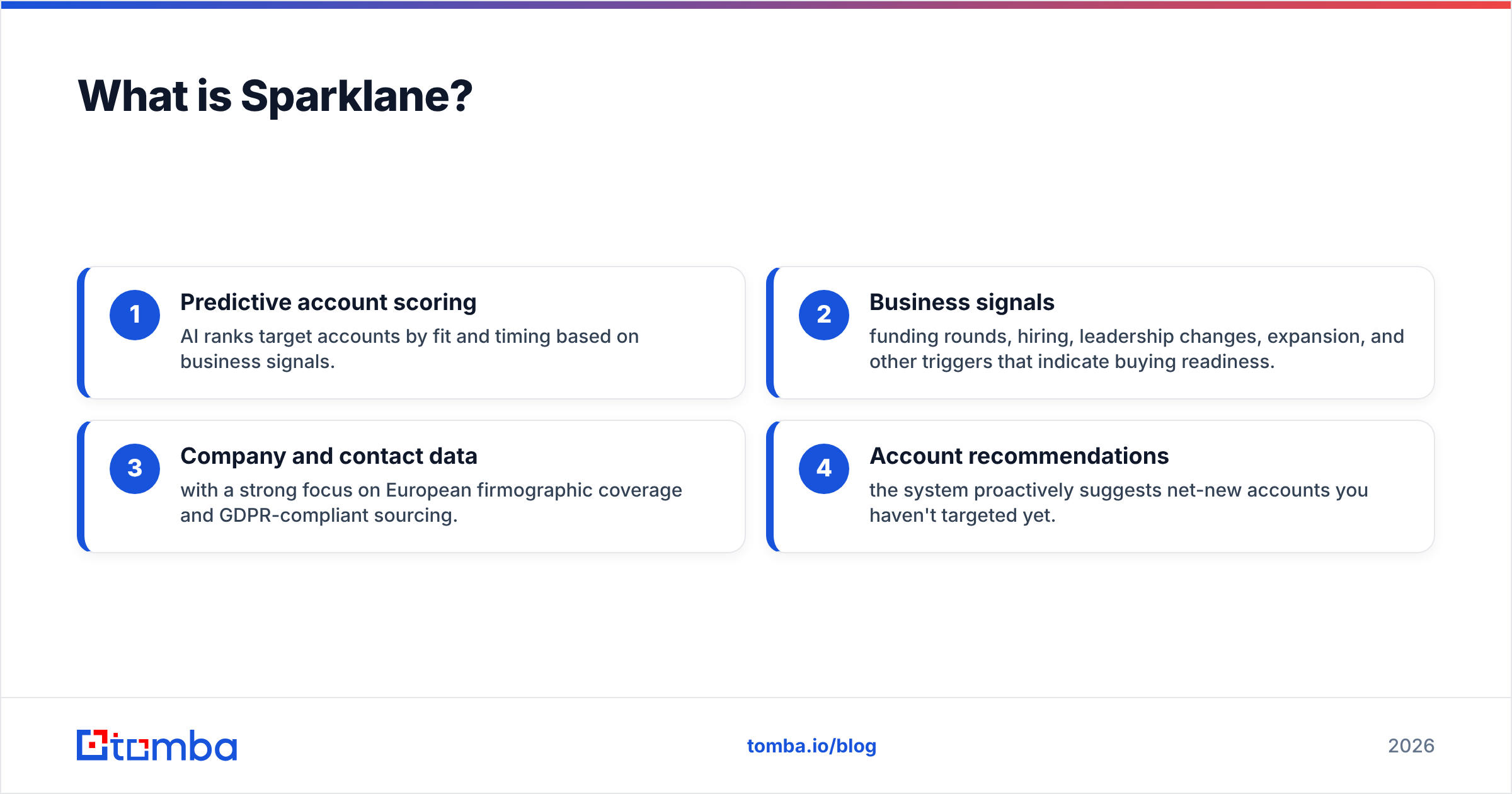
- Predictive account scoring — AI ranks target accounts by fit and timing, based on business signals.
- Business signals — funding rounds, hiring, leadership changes, and expansion. Each one hints at buying readiness.
- Company and contact data — with a strong focus on European firmographic coverage and GDPR-compliant sourcing.
- Account recommendations — the system suggests net-new accounts you haven't targeted yet.
Sparklane is less about handing you a raw list. It narrows a big universe down to the accounts worth your reps' time. That's a genuinely different job than Clodura's. Their approach is detailed on the Sparklane site.
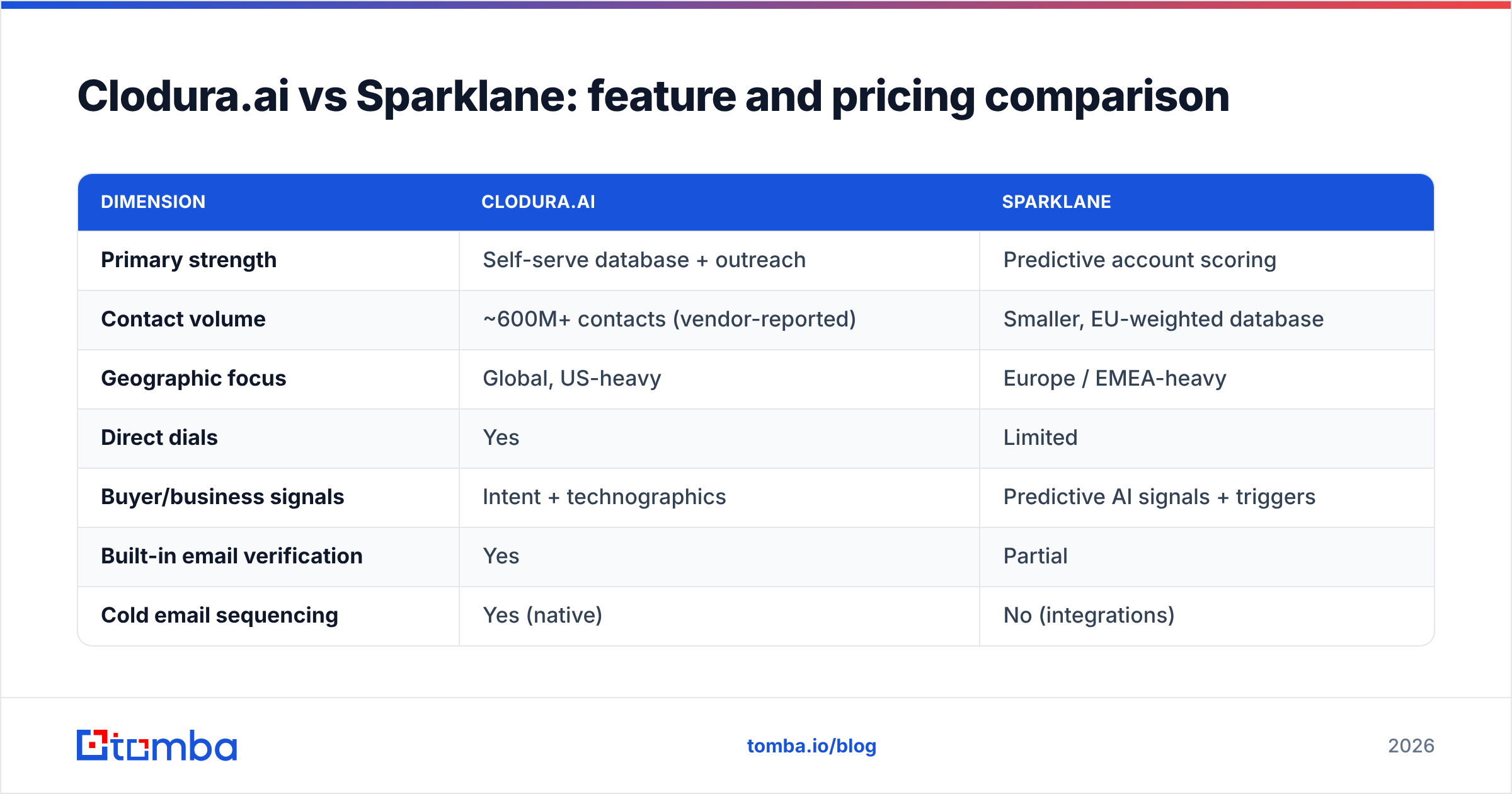
Clodura.ai vs Sparklane: feature and pricing comparison#
Here's the side-by-side. Treat coverage numbers as vendor-reported, not independently audited.
| Dimension | Clodura.ai | Sparklane |
|---|---|---|
| Primary strength | Self-serve database + outreach | Predictive account scoring |
| Contact volume | ~600M+ contacts (vendor-reported) | Smaller, EU-weighted database |
| Geographic focus | Global, US-heavy | Europe / EMEA-heavy |
| Direct dials | Yes | Limited |
| Buyer/business signals | Intent + technographics | Predictive AI signals + triggers |
| Built-in email verification | Yes | Partial |
| Cold email sequencing | Yes (native) | No (integrations) |
| Pricing model | Published tiers + free plan | Quote-based / demo-first |
| Best-fit buyer | SMB & mid-market SDR teams | Mid-market & enterprise, EU |
| GDPR posture | Compliant, US-first design | GDPR-native, EU-first design |
The pattern is clear. Clodura wins on breadth, transparency, and doing outreach in one place. Sparklane wins on precise targeting and European data governance. Neither is strictly "better." They're built for different motions.
Is Clodura.ai or Sparklane more accurate?#
Neither vendor publishes a third-party-audited deliverability rate. So anyone claiming a hard "X% accurate" number is just repeating marketing copy. Here's what you can actually judge:
- Refresh cadence. Both re-verify data on a rolling basis. B2B contact data decays fast. Research from vendors like ZoomInfo has long pegged annual decay at 20–30% as people change jobs. A record that was accurate in January can be dead by June.
- Coverage vs. accuracy trade-off. Clodura's larger database means more matches. But larger databases tend to carry more stale or unverifiable rows. Sparklane's tighter, EU-focused set can be fresher within its region. It will also miss contacts outside it.
- Catch-all domains. Both struggle with catch-all servers. These servers accept every address, which inflates "valid" counts without confirming a real inbox.
The practical takeaway is simple. Whichever platform you choose, run a verification pass before any send. That's why a standalone email verifier still earns its place next to a suite tool. It catches the bounces the platform's own check waves through, including catch-all traps.
Which tool fits your sales motion?#
Match the tool to how your team actually sells, not to the longest feature list.
Choose Clodura.ai if:
- You're an SMB or mid-market team that wants data and sequencing in one subscription.
- Your market is global or US-centric, and you need volume plus direct dials.
- You want transparent, self-serve pricing you can start on today.
- Your SDRs live inside one tool and hate context-switching.
Choose Sparklane if:
- You sell into European mid-market or enterprise, and GDPR-native sourcing is non-negotiable.
- You have more target accounts than reps, and you need AI to pick the shortlist.
- You already own a sequencer or CRM and want an intelligence layer on top, not a replacement.
- Timing signals like funding, hiring, and expansion drive your outreach.
Choose neither—go dedicated—if:
- Your real bottleneck is simply finding and verifying accurate work emails at a fair price. Paying for a full prospecting suite to solve a data-finding problem is overkill.
Where both platforms leave gaps#
No suite is complete. Three gaps show up again and again in reviews on G2 and in day-to-day use:
- Verification isn't bulletproof. Built-in checks cut bounces but don't erase them. Catch-all and role-based addresses slip through most. A dedicated verifier as a second gate protects your sender reputation.
- Enrichment depth varies. Firmographic and contact fields can be thin outside each tool's home region. A focused data enrichment step fills the holes before records hit your CRM.
- Cost scales awkwardly. Suite pricing bundles features you may not use. If you only need emails by domain and name, you pay for sequencing and intent data you'll ignore.
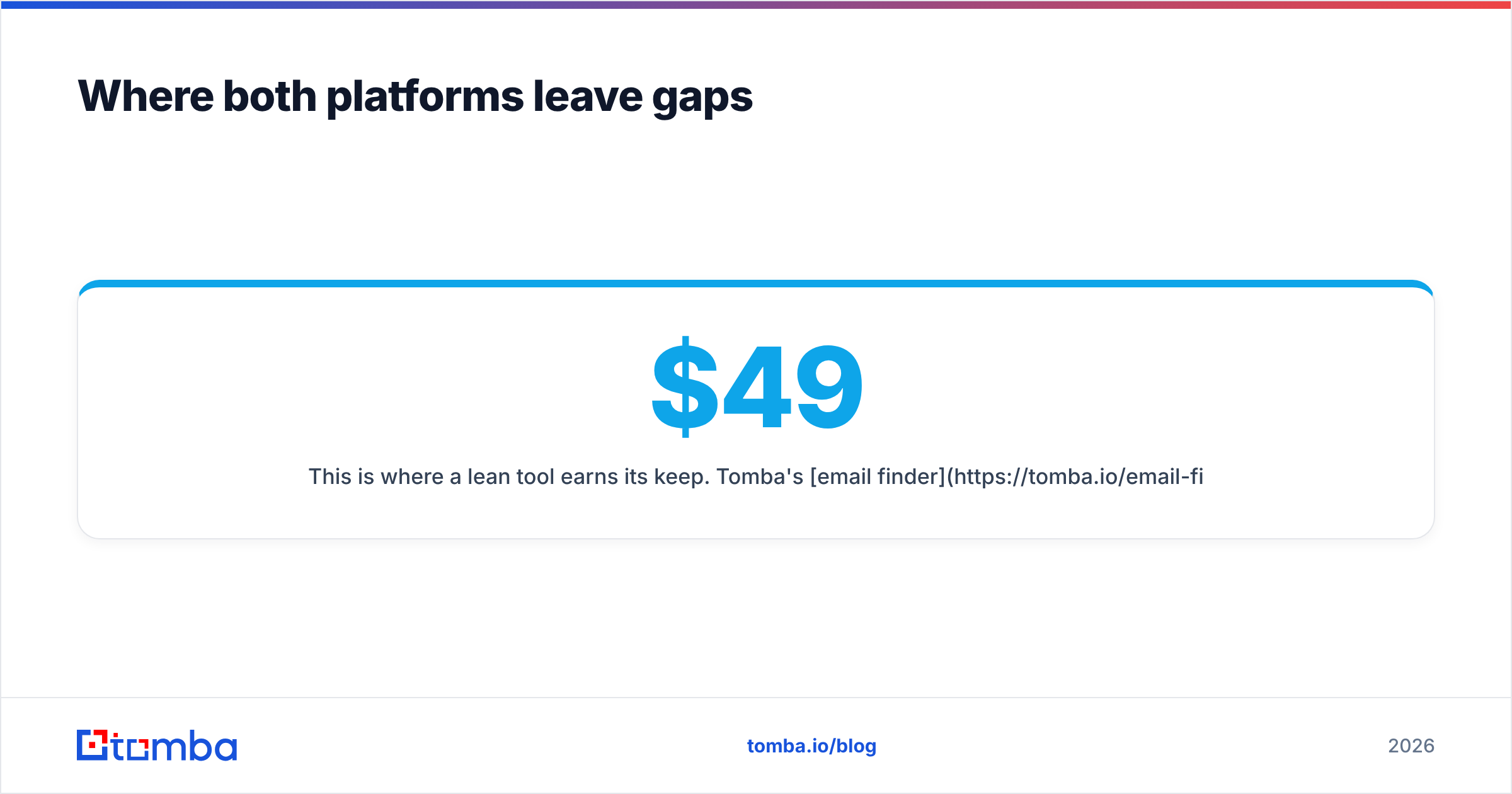
This is where a lean tool earns its keep. Tomba's email finder and bulk email finder do one job. They find and confirm professional emails by name, company, or domain, at a fraction of a full-suite seat. Transparent Tomba pricing starts with a free tier (25 searches/mo). From there it runs Starter at $49/mo, Growth at $99/mo, and Pro at $249/mo, with an API for teams that want to wire it into their own workflow.
How to test Clodura.ai vs Sparklane before you commit#
Don't buy on a demo. Run a controlled bake-off instead:
- Build one identical target list — the same 100 accounts and personas for both tools.
- Export what each finds — contacts, emails, direct dials, and signals.
- Verify independently — push every email through a neutral verifier. Record the real valid rate, not the platform's self-reported one.
- Score coverage vs. your ICP — count how many of your accounts each tool actually covered, not the vendor's global claim.
- Compare true cost per usable contact — divide the plan price by verified, in-ICP contacts. This number, not the sticker price, is what matters.
That fifth step is where the surprises happen. A cheaper tool that returns fewer but cleaner records often beats a pricey one that pads counts with unverifiable rows.
The verdict: Clodura.ai vs Sparklane#
Most self-serve SDR teams want a database plus outreach in one place. For them, Clodura.ai is the more practical pick. It offers broader data, transparent pricing, and native sequencing. European enterprise teams whose problem is prioritization, not volume, will find a stronger fit in Sparklane. Its predictive scoring and GDPR-native sourcing are built for that job.
But be honest about your real bottleneck. Maybe it isn't "which accounts?" or "how do I sequence?" Maybe it's simply "I need accurate emails I can trust." If so, a full suite is the expensive answer to a narrow question.
That's the case for keeping a specialist in the mix. Whether you run Clodura, Sparklane, or nothing yet, plug in the Tomba Email Finder. It finds and verifies professional emails by domain, name, or company. Start free with 25 searches a month, then scale on transparent plans. Stop paying suite prices to solve a data-finding problem. Verify first, send second, and let your close rate do the arguing.
Related guides#
Ready to find emails that actually work?
Join 150,000+ professionals who stopped guessing and started sending. Free credits on signup — no credit card required.
Get the Tomba newsletter
Practical outbound tactics and product updates — once every two weeks.
About the author