Cloduraai vs Supersend (2026): Full Feature and Pricing Comparison
Clodura.ai bundles a B2B database with sequencing; Supersend focuses on multichannel outreach automation. Here's an honest breakdown of which one fits your team in 2026.
The Cloduraai vs Supersend choice comes down to two jobs: finding the right people and reaching them. The two tools sit at opposite ends of that workflow. That makes the match-up trickier — and more useful — than comparing two near-identical products.
This guide breaks down what each tool does. You'll see where they truly overlap, where the overlap is just marketing, and which one earns your budget in 2026.
TL;DR — Cloduraai vs Supersend at a glance#
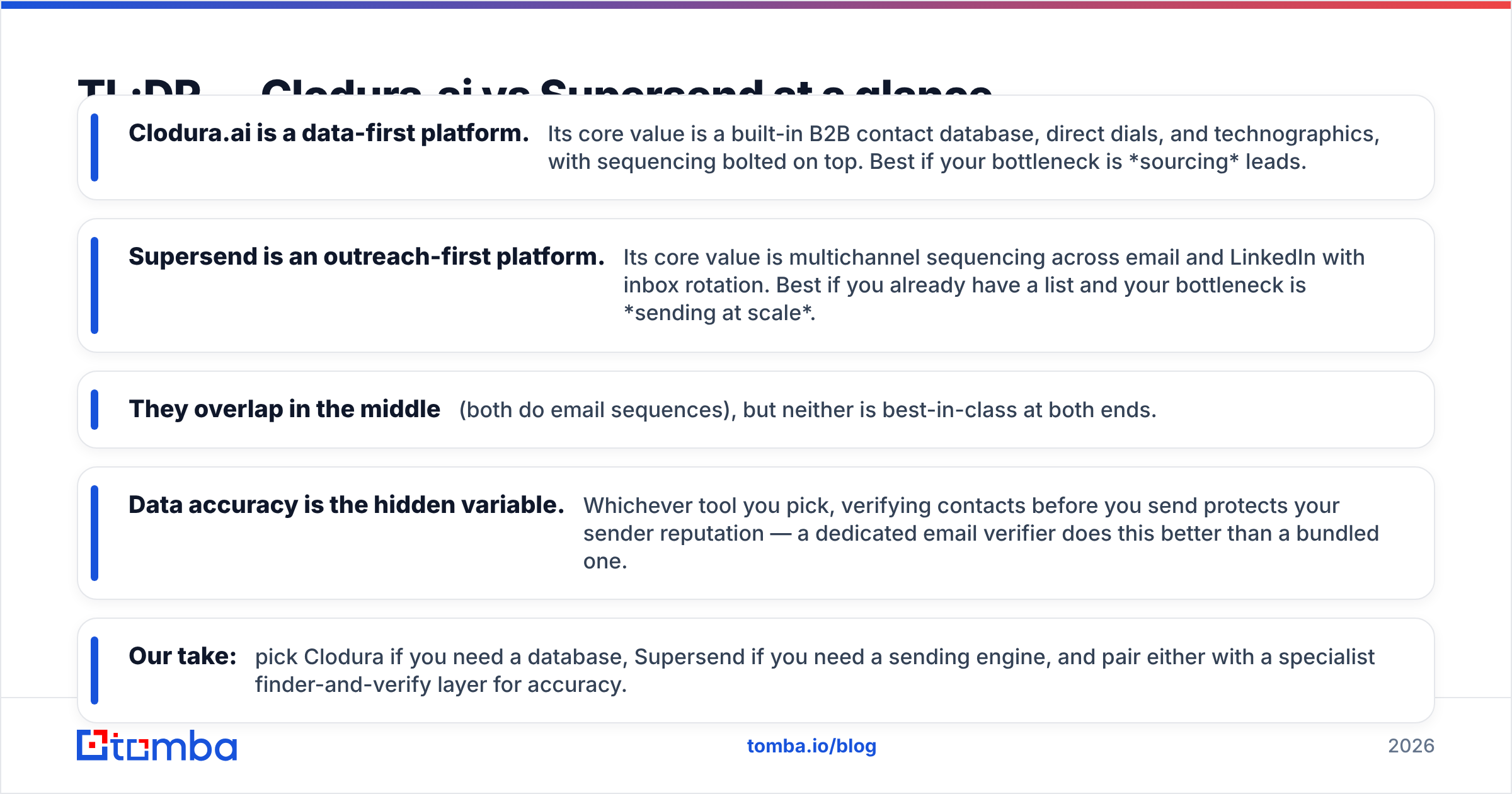
- Clodura.ai is a data-first platform. Its core value is a built-in B2B contact database, direct dials, and technographics, with sequencing bolted on top. Best if your bottleneck is sourcing leads.
- Supersend is an outreach-first platform. Its core value is multichannel sequencing across email and LinkedIn with inbox rotation. Best if you already have a list and your bottleneck is sending at scale.
- They overlap in the middle (both do email sequences), but neither is best-in-class at both ends.
- Data accuracy is the hidden variable. Whichever tool you pick, verify contacts before you send. It protects your sender reputation — and a dedicated email verifier does this better than a bundled one.
- Our take: pick Clodura if you need a database, Supersend if you need a sending engine, and pair either with a specialist finder-and-verify layer for accuracy.
What is Clodura.ai?#
Clodura.ai is a B2B sales intelligence and engagement platform. The pitch is "all-in-one." You get a database of company and contact records, buyer-intent signals, technographic filters, direct-dial phone numbers, and an email sequencing module. The idea is to prospect and send without leaving the tool.
Think of it like a grocery store that also lends you a shopping cart. The main reason you walk in is the shelves — the contact data. The cart (sequencing) is handy, but it's not why you chose the store.
Clodura leans heavily on its database size and its intent data. For teams that don't already pay for a data provider like ZoomInfo or Apollo, that bundle is the appeal: one subscription instead of three. You can read verified opinions on Clodura's G2 profile to see how buyers rate the data.
Where it gets weaker is outreach depth. The sequencing feels like a feature built to keep you inside the ecosystem, not a category leader. If your outbound is high-volume and multichannel, you'll hit the ceiling fast.
What is Supersend?#
Supersend is a cold outreach automation tool built for volume and multichannel campaigns. It focuses on the sending half of prospecting: email sequences, LinkedIn automation, inbox rotation across many accounts, a unified inbox, and deliverability tooling.
If Clodura is the grocery store, Supersend is the delivery fleet. It assumes you already have addresses to ship to. Then it optimizes the trucks, the routes, and the timing.
Supersend's strength is running many inboxes at once. Spreading volume this way protects your email deliverability. That's genuinely useful for agencies and teams sending thousands of touches a week. The Supersend site frames the product around multichannel sequences, not data.
The trade-off: Supersend has no native, large-scale B2B database like Clodura's. You bring the list. So your data-sourcing problem stays unsolved, and you'll bolt on a finder or a data vendor to feed it.
Cloduraai vs Supersend: side-by-side comparison#
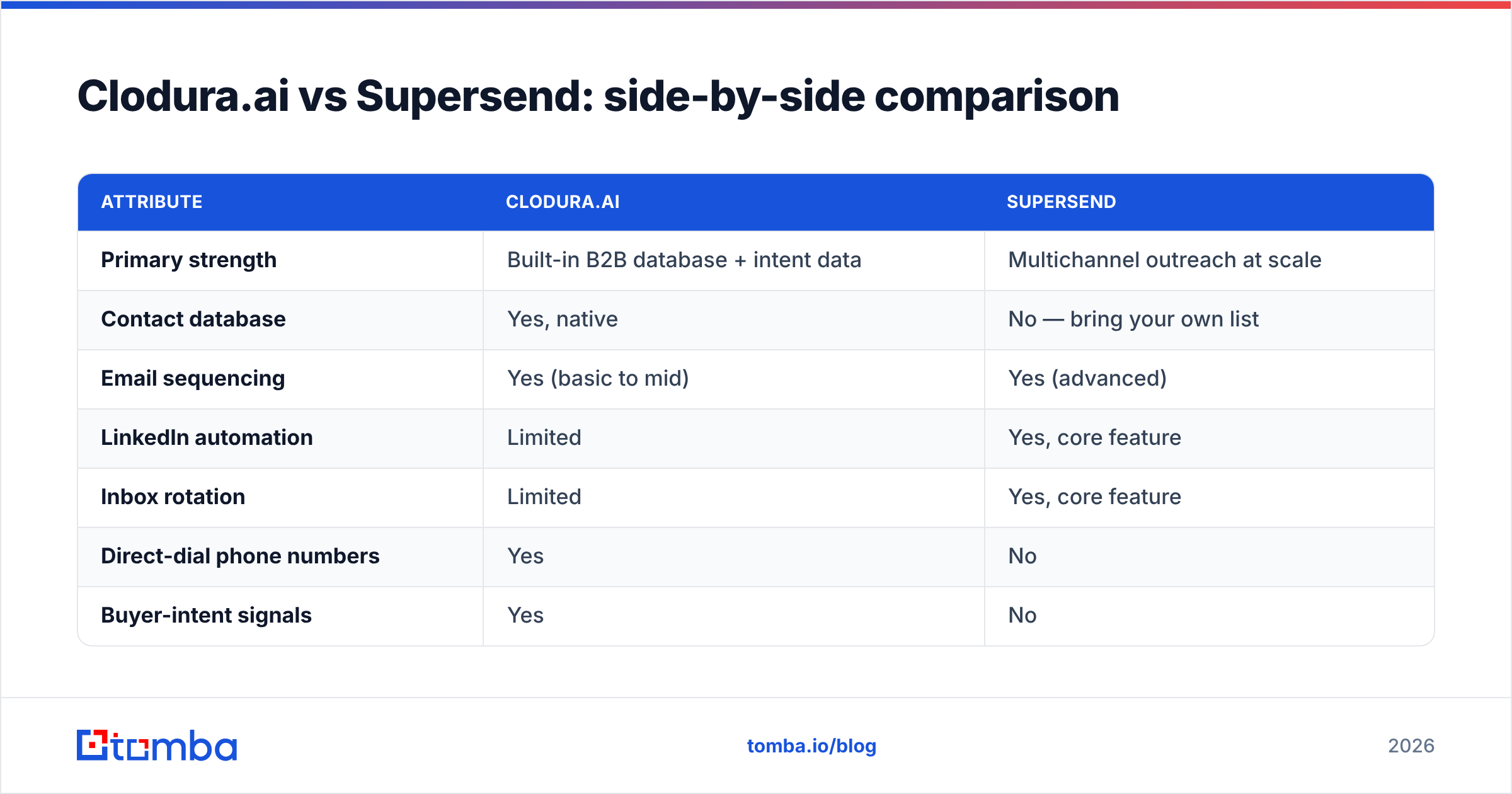
Here's the honest breakdown. Neither column is a clean sweep — they're built for different jobs.
| Attribute | Clodura.ai | Supersend |
|---|---|---|
| Primary strength | Built-in B2B database + intent data | Multichannel outreach at scale |
| Contact database | Yes, native | No — bring your own list |
| Email sequencing | Yes (basic to mid) | Yes (advanced) |
| LinkedIn automation | Limited | Yes, core feature |
| Inbox rotation | Limited | Yes, core feature |
| Direct-dial phone numbers | Yes | No |
| Buyer-intent signals | Yes | No |
| Deliverability tooling | Basic | Strong |
| Best for | Teams without a data provider | Teams with a list who send high volume |
| Free option | Free tier available | Trial-based |
The pattern is clear. Clodura wins the find column, and Supersend wins the send column. Force either tool to do the other job, and you'll hit the wall its design was never built to remove.
Is Clodura.ai better than Supersend for finding leads?#
Yes — for sourcing net-new contacts, Clodura.ai is the stronger tool. That's its entire reason to exist. Supersend simply doesn't ship a comparable native database.
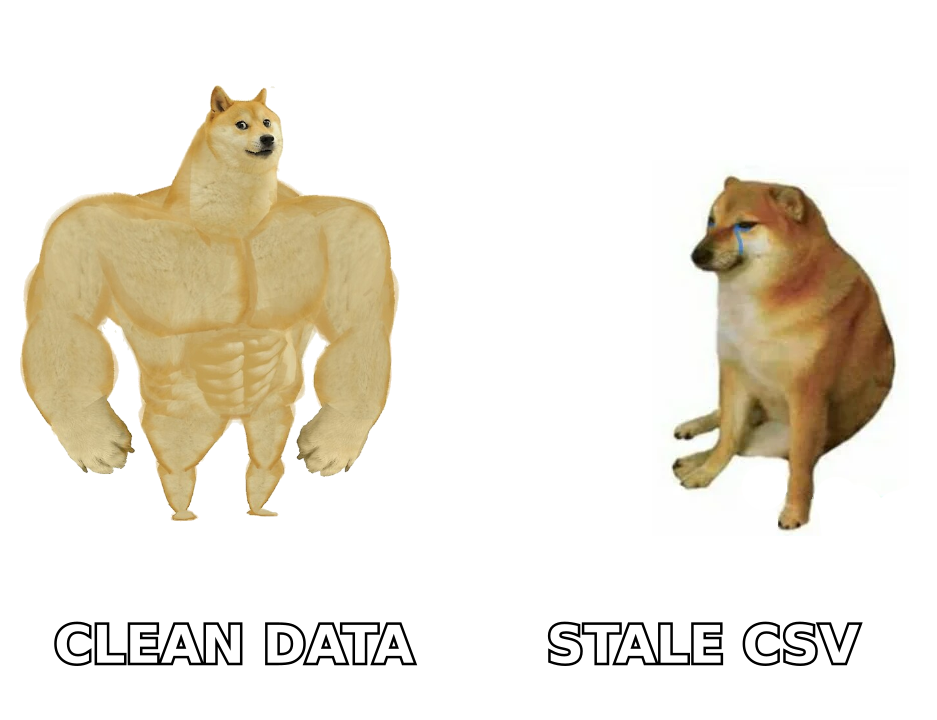
But "better at finding" comes with a caveat every SDR knows: bundled databases decay. B2B contacts churn at roughly 30% a year as people change jobs. A record that was accurate when the vendor scraped it can bounce three months later. That's true of Clodura, ZoomInfo, and every provider. It's physics, not a knock on any brand.
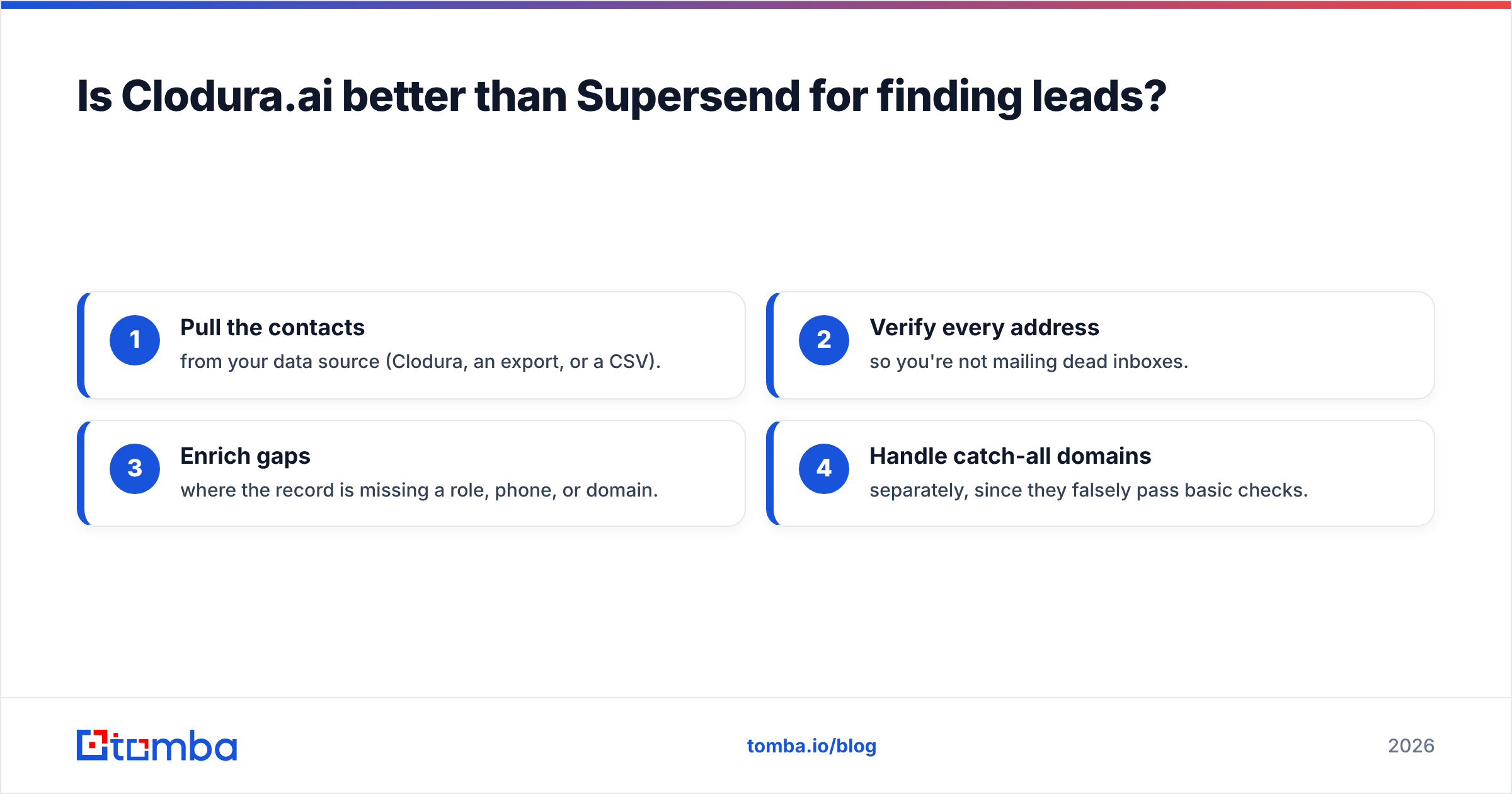
So smart teams treat any bundled database as a first draft, not the final list. Before a single send:
- Pull the contacts from your data source (Clodura, an export, or a CSV).
- Verify every address so you're not mailing dead inboxes.
- Enrich gaps where the record is missing a role, phone, or domain.
- Handle catch-all domains separately, since they falsely pass basic checks.
A dedicated tool like Tomba's email finder plus a real verification pass catches the bounces a bundled export won't. Pairing a catch-all verifier with your list is the step most people skip. It's also the one that saves your domain.
Is Supersend better than Clodura.ai for outreach?#
Yes — if you send at volume across channels, Supersend is the better engine. Inbox rotation and LinkedIn automation are first-class here, not afterthoughts.
Here's why it matters. Sending 2,000 cold emails from one inbox torches your sender reputation fast. Supersend spreads that volume across many warmed inboxes, so no single sender looks abusive to spam filters. Clodura's sequencer can send email, but it isn't built for that kind of distributed, high-throughput motion.
That said, volume without accuracy is a liability. A powerful engine firing at an unverified list just hits more spam traps, faster. Supersend gives you the truck fleet. It doesn't check whether the addresses are real. That verification step is on you — and it belongs before the list enters the sequence.
Clodura.ai vs Supersend pricing: which is cheaper?#
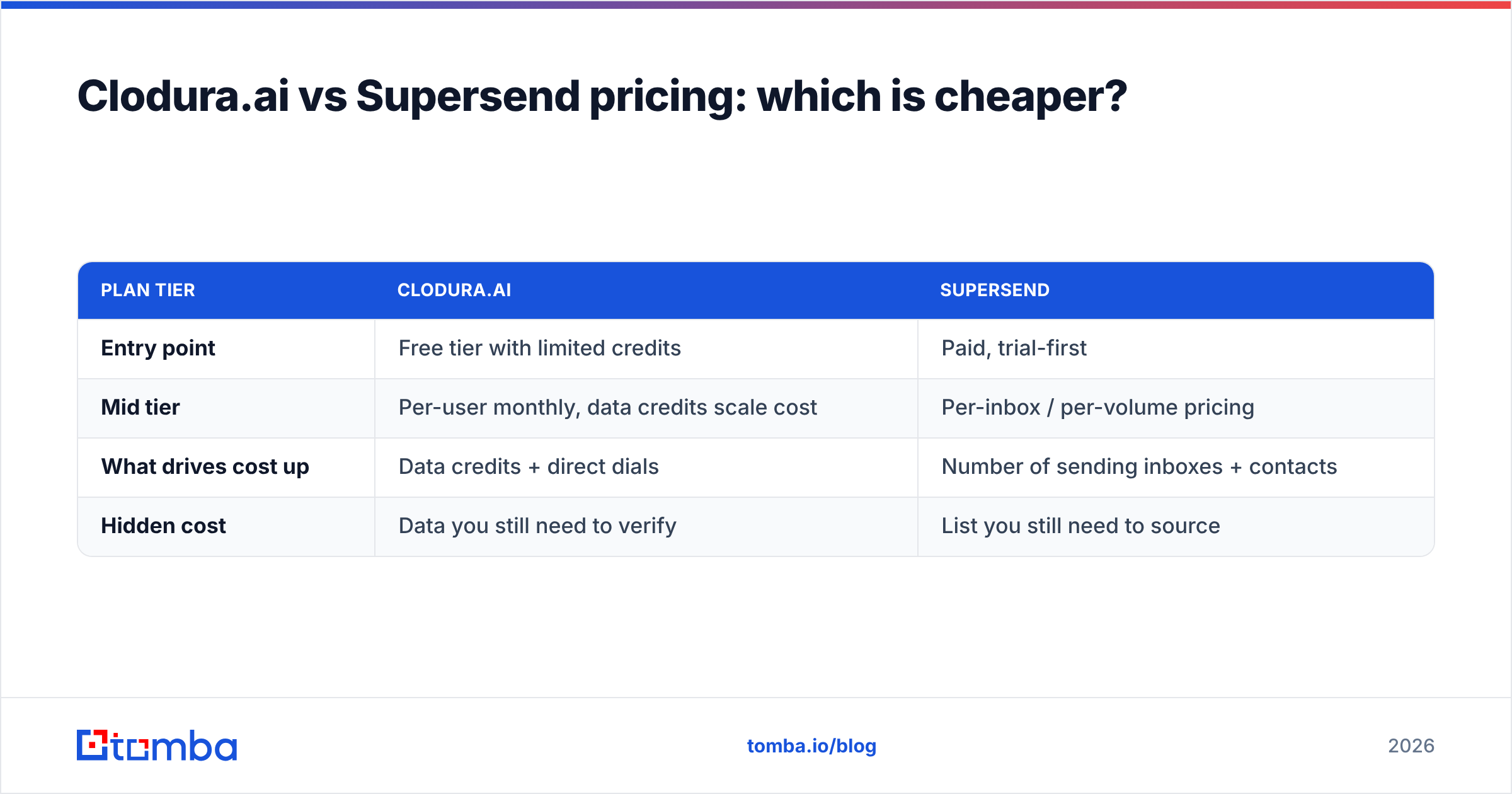
Both tools price by usage and seats, and both change their tiers often. Always confirm on the vendor's own page before you commit. As a directional comparison:
| Plan tier | Clodura.ai | Supersend |
|---|---|---|
| Entry point | Free tier with limited credits | Paid, trial-first |
| Mid tier | Per-user monthly, data credits scale cost | Per-inbox / per-volume pricing |
| What drives cost up | Data credits + direct dials | Number of sending inboxes + contacts |
| Hidden cost | Data you still need to verify | List you still need to source |
Notice the "hidden cost" row — it's the real story. With Clodura, you pay for data you should still verify. With Supersend, you pay for sending but still need to source and clean a list. Either way, a lean specialist layer for finding and verifying contacts fills the gap. You avoid a bigger all-in-one contract.
For reference, a focused finder-and-verify tool like Tomba runs a Free tier at 25 searches/month, then Starter at $49/mo and Growth at $99/mo. You can see the full breakdown on the Tomba pricing page. That's often cheaper than upgrading a bundled suite just to unlock more data credits.
When should you use Clodura.ai?#
Choose Clodura.ai when:
- You have no data provider yet. The bundled database is the single biggest reason to buy it.
- You sell into markets where intent signals matter. Clodura's buyer-intent and technographic filters help you time outreach.
- You need direct dials alongside email for a phone-and-email motion. A dedicated phone finder can supplement here too.
- Your outbound volume is modest and the built-in sequencer is "good enough."
Skip Clodura if you already pay for a data vendor and only need better sending — you'd be paying twice for the database.
When should you use Supersend?#
Choose Supersend when:
- You already have a list or a reliable way to build one.
- You send high volume and need inbox rotation to survive spam filters.
- LinkedIn is a real channel for you, not an afterthought.
- You run an agency managing many clients' campaigns from one dashboard.
Skip Supersend if your actual problem is finding people. A great sending engine can't fix an empty pipeline.
What's the smarter setup for most teams?#
The honest answer most vendors won't tell you: the best stack is usually not one all-in-one tool. It's a focused data-and-verification layer feeding a focused outreach engine.
Here's how that looks in practice:
- Source and verify with a specialist. Use a domain search to find every contact at a target company, then verify each address so bounces never enter your sequences.
- Enrich thin records with roles, phones, and social profiles via data enrichment so your personalization has something to work with.
- Send through whichever engine fits — Supersend for high-volume multichannel, Clodura's sequencer for lighter lifts.
This way you never over-pay for a bundled database you don't trust, or a sending engine firing blind. You control accuracy at the point where it matters most — before the send.
Cloduraai vs Supersend: the verdict#
- Pick Clodura.ai if your bottleneck is finding leads and you don't already own a data subscription. The bundle earns its keep for data-poor teams.
- Pick Supersend if your bottleneck is sending — you have a list, you push volume, and you need multichannel with inbox rotation.
- Pick neither as your accuracy layer. Both bundle "good enough" verification; neither is a specialist. That gap is where deliverability quietly dies.
The two tools aren't really competitors. They're two halves of one workflow. The mistake is buying one and expecting it to do the other half well.
Close the accuracy gap before you send#
Whichever platform you choose, the leads are only as good as the data behind them. A stale database bounces. A catch-all domain fools a basic checker. And one bad send can drag your sender reputation down for weeks.
Start every campaign with contacts you can actually trust. The Tomba Email Finder finds professional emails by domain, name, or company and verifies them before they ever hit your Clodura or Supersend sequence — so your outreach engine fires at real inboxes, not dead ends. Try it free with 25 searches a month, then scale on the $49/mo Starter plan when you're ready to go bigger.
Related guides#
Ready to find emails that actually work?
Join 150,000+ professionals who stopped guessing and started sending. Free credits on signup — no credit card required.
Get the Tomba newsletter
Practical outbound tactics and product updates — once every two weeks.
About the author