Clodura.ai vs Winmo: B2B Sales Intelligence Compared (2026)
Clodura.ai and Winmo both sell B2B intelligence, but they solve very different problems. Here's an honest, side-by-side breakdown of data, pricing, and fit — plus where a dedicated email finder beats both.
Choosing between Clodura.ai and Winmo comes down to one question: do you need broad, self-service prospecting data or deep, ad-industry relationship intelligence? They get lumped together as "sales intelligence," but they aim at different buyers. This breakdown shows exactly where each one wins — and where a focused email finder like Tomba does the contact-data job better than either.
TL;DR — Clodura.ai vs Winmo at a glance#
- Clodura.ai is a self-service B2B prospecting platform: a large contact database, buyer-intent signals, email sequencing, and verification built for SDRs and small-to-mid outbound teams.
- Winmo is a specialist sales intelligence tool for the advertising, media, and marketing-services world — who spends on ads, which agencies hold which accounts, and when budgets move.
- Pricing transparency differs sharply. Clodura.ai publishes plans and a free tier; Winmo runs on quote-based annual contracts with no public list price.
- Neither is a pure email finder. If your core need is accurate, verifiable email addresses at low cost, a dedicated tool such as Tomba Email Finder delivers better cost-per-contact than a full platform seat.
- Rule of thumb: pick Winmo if you sell to advertisers/agencies, pick Clodura.ai for general B2B outbound, and bolt on a specialist finder for contact accuracy.
What is Clodura.ai?#
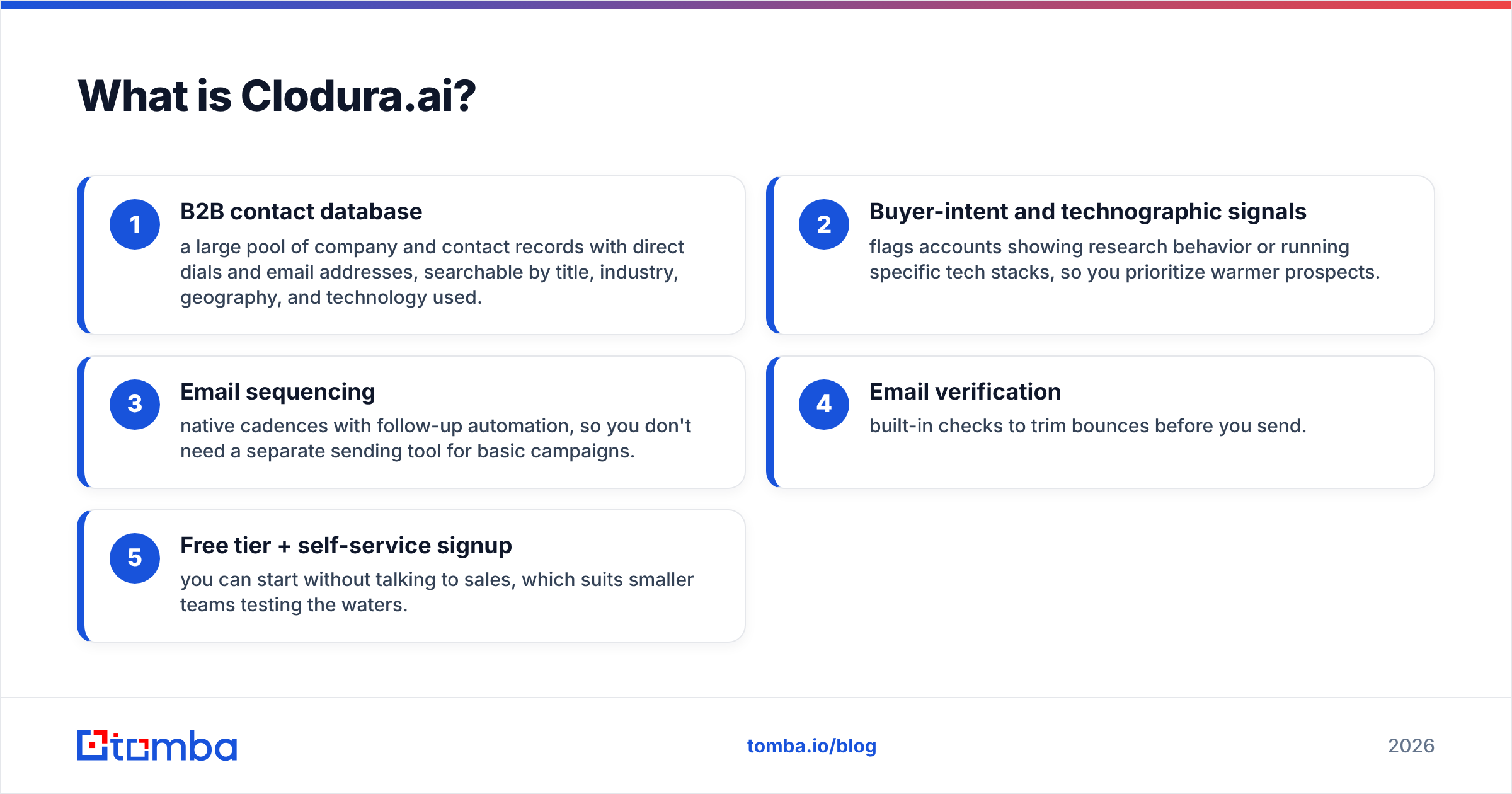
Clodura.ai is an all-in-one sales prospecting platform aimed at outbound teams that want data and outreach in one place. Think of it as a Swiss Army knife for an SDR: the database, the intent signals, the sequencer, and the verifier all live under one login, so you can go from "build a list" to "send a sequence" without switching tools.
Its core pieces:
- B2B contact database — a large pool of company and contact records with direct dials and email addresses, searchable by title, industry, geography, and technology used.
- Buyer-intent and technographic signals — flags accounts showing research behavior or running specific tech stacks, so you prioritize warmer prospects.
- Email sequencing — native cadences with follow-up automation, so you don't need a separate sending tool for basic campaigns.
- Email verification — built-in checks to trim bounces before you send.
- Free tier + self-service signup — you can start without talking to sales, which suits smaller teams testing the waters.
Clodura.ai's positioning is horizontal: it doesn't care whether you sell software, staffing, or logistics. That breadth is its strength and its weakness — coverage is wide but not deep in any one vertical. You can read the vendor's own overview on clodura.ai, and real buyer reviews on G2 give a sense of where data accuracy lands in practice.
What is Winmo?#
Winmo is a vertical sales intelligence platform built for one job: helping people who sell advertising, media, sponsorship, and marketing services find and time their pitches. Where Clodura.ai is a wide net, Winmo is a spear.
If your buyers are brand marketers, media buyers, or agencies, Winmo answers questions general databases can't:
- Who owns the ad budget at a given brand — the actual decision-maker, not a generic "marketing" contact.
- Which agency holds which account — the brand-to-agency relationships that decide where pitches should go.
- When accounts are in play — spend shifts, agency reviews, and executive moves that signal a window to reach out.
- Historical spend patterns — so you can size an opportunity before you invest time in it.
Winmo's data is curated and relationship-focused rather than scraped-at-scale. That editorial depth is exactly why ad-sales teams pay for it — and also why it costs more and covers a narrower slice of the market. Winmo publishes its capabilities on winmo.com, but you won't find a price tag there; it's an annual, quote-based product.
Clodura.ai vs Winmo: full comparison table#
| Attribute | Clodura.ai | Winmo |
|---|---|---|
| Primary use case | General B2B outbound prospecting | Advertising / media / agency sales |
| Data model | Broad, horizontal database | Curated, vertical relationship data |
| Buyer-intent signals | Yes (intent + technographics) | Yes (spend shifts, account moves) |
| Email sequencing | Built-in | Not a core focus |
| Email verification | Built-in | Limited |
| Free tier | Yes | No |
| Pricing transparency | Public plans | Quote-based, annual contract |
| Best for | SDRs, SMB–mid outbound teams | Ad-sales, sponsorship, agency BD |
| Weakness | Shallow vertical depth | Narrow market, higher cost |
The table makes the split obvious: these tools rarely compete for the same buyer. The real decision is which problem you have, not which tool is better.
Is Clodura.ai better than Winmo?#
Neither is universally better — they're built for different buyers. Clodura.ai wins on breadth, price transparency, and self-service; Winmo wins on depth within advertising and media. Forcing a single winner is the wrong frame.
Choose Clodura.ai when:
- You sell across many industries and need volume plus workflow (list → sequence → verify) in one seat.
- You want a free tier and public pricing benchmarks before committing budget.
- Your team is SDR-heavy and values an all-in-one over best-of-breed.
Choose Winmo when:
- Your entire book of business is advertisers, agencies, or media/sponsorship buyers.
- Timing intelligence — knowing when an account is in play — is worth more to you than raw record count.
- You can justify an annual contract and don't need self-service onboarding.
Where both stumble is the same place most full platforms do: contact-data freshness at scale. Broad databases decay fast, and curated ones cover fewer people. That's the gap a dedicated finder fills.
Where does a dedicated email finder fit in?#
Platforms sell you a database seat; an email finder sells you accurate contacts on demand — and that difference shows up in your bounce rate and your bill. Even if you run Clodura.ai or Winmo for discovery and signals, you'll often want a verification-first layer to confirm addresses before you send.
Here's the practical division of labor:
- Discovery — use Clodura.ai (broad) or Winmo (ad vertical) to find accounts and decision-makers.
- Contact resolution — use an email finder to get the exact, current email for those people from their name and company domain.
- Validation — run an email verifier to strip risky addresses so your sender reputation stays clean.
- Enrichment — push confirmed contacts into your CRM with data enrichment so reps aren't working stale rows.
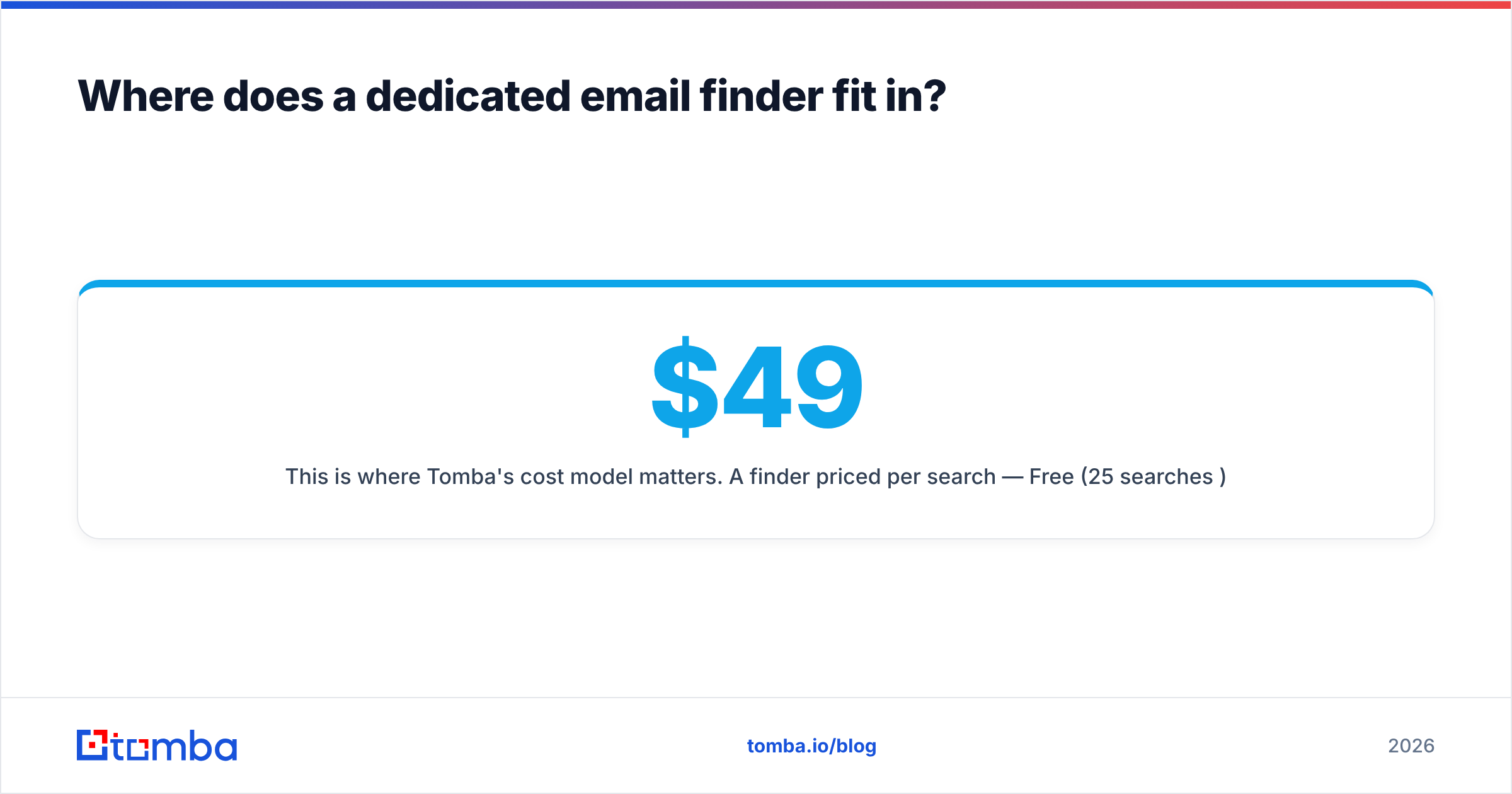
This is where Tomba's cost model matters. A finder priced per search — Free (25 searches/mo), Starter at $49/mo, Growth at $99/mo, and Pro at $249/mo — lets you pay for the contacts you actually pull instead of a flat platform license. For teams that already own a discovery tool, that's a far cheaper way to keep contact data accurate than upgrading a full seat.
How do the three approaches compare on cost and coverage?#
Think of it like buying transportation. Clodura.ai is a versatile crossover — decent at most trips. Winmo is a specialized delivery truck — unbeatable on one route, overkill everywhere else. A dedicated finder is a fuel card — it doesn't replace the vehicle, it makes every mile cheaper.
| Approach | What you pay for | Coverage | Cost profile |
|---|---|---|---|
| Clodura.ai | All-in-one platform seat | Wide, all industries | Public tiers, mid-range |
| Winmo | Curated vertical intelligence | Deep in ad/media only | High, annual, quote-only |
| Tomba (finder + verifier) | Searches + verifications used | Broad email/contact resolution | Usage-based from $49/mo |
The takeaway: these aren't strictly either/or. Many teams run a discovery platform and a specialist finder, because the finder pays for itself the first time it prevents a batch of bounces from wrecking a domain's sender reputation.
What about data accuracy and deliverability?#
Accuracy is where the "one platform to rule them all" pitch tends to leak. Large horizontal databases like Clodura.ai's carry impressive record counts, but any at-scale database drifts as people change jobs. Winmo's curated model is more accurate within its lane, but the lane is narrow. In both cases, the safe move is to verify before you send, not to trust the source blindly.
A verification-first workflow looks like this:
- Pull the candidate contact from your discovery tool.
- Re-find or confirm the email with a finder that returns a confidence score and source signals.
- Verify the address — catch invalids, catch-alls, and role accounts — using a tool like Tomba's catch-all verifier.
- Only then load into your sequencer.
Skipping steps 2 and 3 is how teams with expensive data subscriptions still post 8–12% bounce rates. Coverage and accuracy are not the same metric, and only accuracy protects your inbox placement.
Which should you choose?#
Match the tool to your buyer, then add a finder for contact accuracy. Here's the short version:
- You sell advertising, media, or agency services → Winmo. Nothing else matches its account-timing intelligence in that vertical, and the premium is justified when your whole pipeline depends on it.
- You run general B2B outbound across industries → Clodura.ai. The all-in-one workflow, free tier, and transparent plans make it a sensible default for SDR teams.
- Your bottleneck is accurate, verifiable emails at low cost → a dedicated finder, regardless of which discovery platform you keep. This is the layer both platforms under-serve.
Most winning stacks aren't "Clodura.ai or Winmo." They're "the right discovery tool for my market, plus a finder-and-verifier that keeps every contact clean." You can pull direct dials the same way with a phone finder, so your reps have more than one channel to reach the accounts you surface.
The bottom line#
Clodura.ai and Winmo aren't really rivals — they're specialists for different sales motions. Clodura.ai gives broad, self-service prospecting with sequencing built in; Winmo gives unmatched depth for anyone selling into advertising and media. Pick based on who you sell to, not on a feature-count shootout.
Whichever you choose, don't let the discovery tool double as your accuracy tool. Layer in Tomba Email Finder to turn the names your platform surfaces into verified, ready-to-send contacts — starting free with 25 searches a month and scaling to $49/mo when you're ready. It's the cheapest insurance you can buy for your outbound: clean data, protected sender reputation, and a cost that tracks the contacts you actually use.
Related guides#
// get started
Find, verify and enrich your first contacts today
Start on the free plan with 25 searches a month, then scale when your team is ready.
Free plan · No credit card required · GDPR & CCPA
// about the author