Clodura.ai vs ZoomInfo (2026): Which B2B Data Tool Wins?
ZoomInfo dominates enterprise, but Clodura.ai undercuts it hard on price. We compare data accuracy, features, and real annual costs so you can pick the right B2B intelligence tool for your team.
Choosing between Clodura.ai and ZoomInfo usually comes down to one uncomfortable question: how much are you willing to pay for B2B contact data, and how much of that data do you actually use? ZoomInfo is the category giant with the deepest database on the market. Clodura.ai is the scrappy challenger that packages prospecting, sequencing, and intent into a fraction of the price. Both claim accuracy. Only one fits a lean sales team's budget.
This comparison cuts through the sales-deck gloss. You'll get concrete pricing, data-quality trade-offs, and a clear recommendation by team type — plus where a focused tool beats paying for a platform you'll half-use.
TL;DR: Clodura.ai vs ZoomInfo#
- ZoomInfo wins on raw database depth, intent data, and enterprise integrations — but starts around $15,000/year and locks you into annual contracts with steep overages.
- Clodura.ai delivers a 600M+ contact database, built-in email sequencing, and a genuinely usable free tier for a fraction of ZoomInfo's cost — best for SMBs and mid-market teams.
- Data accuracy is close enough that price and workflow fit should decide it for most buyers, not a mythical "our data is cleaner" claim.
- If you mainly need verified emails on demand without a platform commitment, a dedicated email finder like Tomba covers that job at a lower entry price.
- Pick ZoomInfo for enterprise ABM at scale; pick Clodura.ai for cost-conscious outbound; pick a specialist tool when you only need contact data, not a full suite.
What is Clodura.ai?#
Clodura.ai is an all-in-one sales intelligence and prospecting platform aimed at SMB and mid-market outbound teams. It bundles a B2B contact database (600M+ contacts, 120M+ direct dials by its own numbers), email verification, buyer-intent signals, an org-chart mapper, and a built-in email sequencer. The pitch is simple: find prospects, verify their contact details, and start emailing them without stitching three tools together.
The platform leans on automation. You can build a list by filters — industry, headcount, technology used, geography — then push those contacts straight into a cadence. For a team that wants to run outbound without buying a separate sales-engagement tool, that consolidation is the main draw. You can see the full feature set on the Clodura.ai site.

What is ZoomInfo?#
ZoomInfo is the enterprise standard for B2B data and go-to-market intelligence. Its database is the largest in the category, and its reputation is built on breadth: firmographics, technographics, org charts, verified direct dials, and a deep intent-data layer through its acquisition of Bombora-style signals and its own Streaming Intent product.
ZoomInfo isn't just a database — it's a platform. Sales, marketing, and operations teams use it for account scoring, website visitor de-anonymization, conversation intelligence (Chorus), and workflow automation. That scope is exactly why it commands enterprise pricing. You're not buying contacts; you're buying an infrastructure layer for your entire revenue org. The official product breakdown lives at zoominfo.com.
The catch is well documented across G2 reviews: annual-only contracts, credit limits that force upsells, and a sales process that can feel heavier than the software.
Clodura.ai vs ZoomInfo: The core comparison#
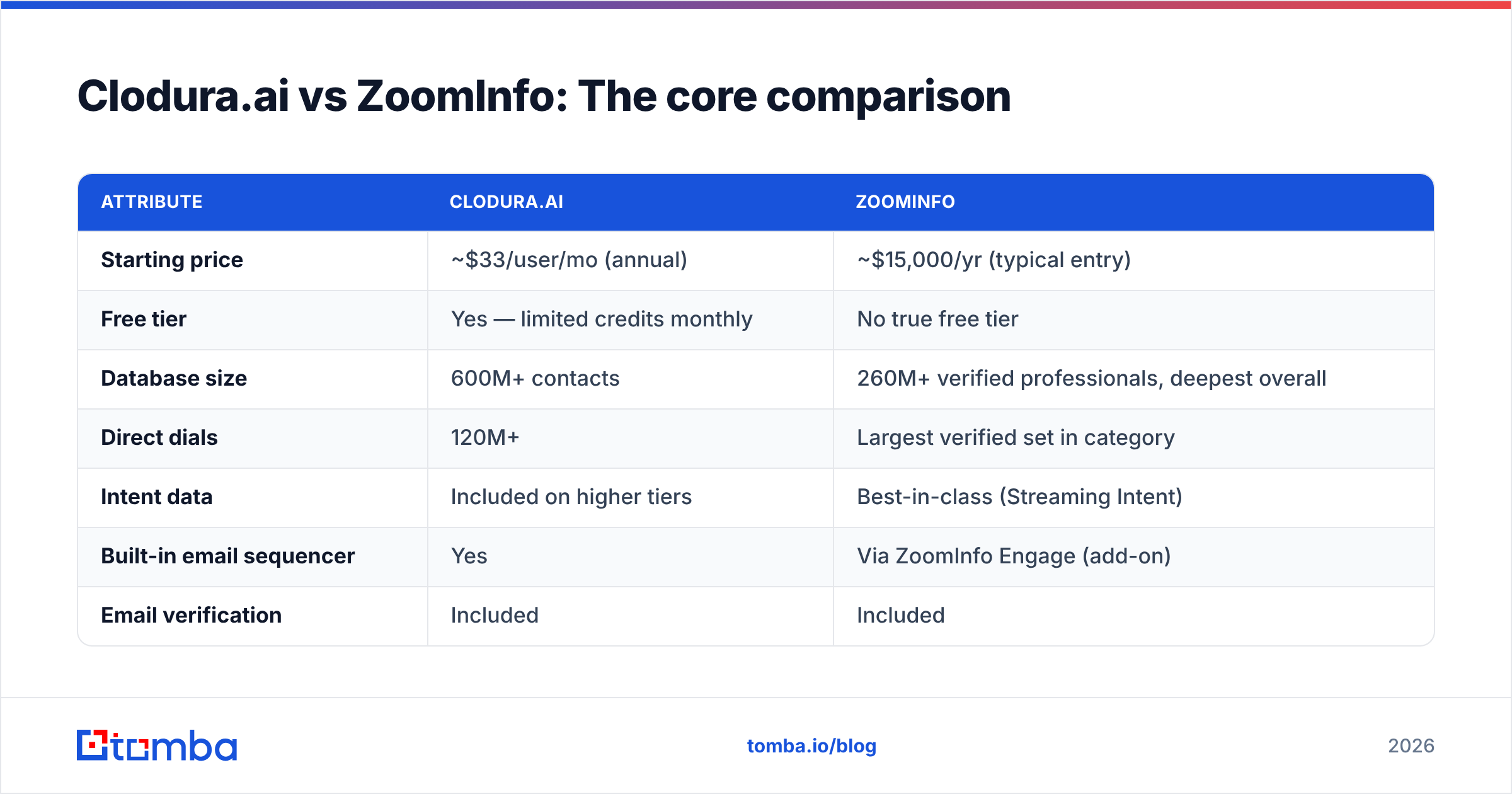
Here's how the two stack up on the attributes that actually change your decision.
| Attribute | Clodura.ai | ZoomInfo |
|---|---|---|
| Starting price | ~$33/user/mo (annual) | ~$15,000/yr (typical entry) |
| Free tier | Yes — limited credits monthly | No true free tier |
| Database size | 600M+ contacts | 260M+ verified professionals, deepest overall |
| Direct dials | 120M+ | Largest verified set in category |
| Intent data | Included on higher tiers | Best-in-class (Streaming Intent) |
| Built-in email sequencer | Yes | Via ZoomInfo Engage (add-on) |
| Email verification | Included | Included |
| Contract | Monthly or annual | Annual only |
| Best fit | SMB / mid-market outbound | Enterprise ABM & RevOps |
The headline is the price gap. ZoomInfo's entry point sits where Clodura.ai's top tier looks like a rounding error. For that premium you get more data depth and a heavier intent layer — value that enterprise teams extract, and that most small teams never touch.
Is Clodura.ai's data as accurate as ZoomInfo's?#
Short answer: close, with ZoomInfo holding a measurable edge on hard-to-source records like direct dials and senior-exec emails.
Both platforms verify emails before serving them, and both decay over time — no B2B database is static, because people change jobs constantly. Independent accuracy tests generally land ZoomInfo a few points ahead on coverage and on the toughest segments (enterprise executives, niche industries), while Clodura.ai holds its own on standard mid-market contacts.
The practical takeaway: for most SMB outbound motions, the accuracy difference won't move your reply rate. Where ZoomInfo pulls ahead is edge coverage — the obscure title at the obscure company that Clodura simply may not have. If your ICP is mainstream, you're paying an enterprise premium for records you rarely need.
Whichever tool you choose, run contacts through a dedicated email verifier before a big send. Verifying at the point of send — not at the point of purchase — is what actually protects your sender reputation, because data ages between the two.
Which is better for pricing and contracts?#
Clodura.ai wins on flexibility, decisively.
ZoomInfo's model is built for annual commitments. You buy a credit allotment, you consume it, and overages or expansions become a new negotiation. Reviewers routinely flag the credit ceiling as the hidden cost — you sign for a number, then discover your team burns through it by Q3. The floor of ~$15,000/year also prices out most teams under 20 reps before the demo even ends.
Clodura.ai offers monthly billing, transparent per-user tiers, and a free plan that lets you test the data before paying. For a bootstrapped or PLG-motion company, that difference is existential: you can start, prove ROI, and scale spend with revenue instead of committing a year upfront.

If your objection to ZoomInfo is purely the contract, note that the "platform vs. specialist" question matters here too. A lot of teams buy ZoomInfo for one job — pulling verified emails — and pay platform prices for it. In that case, a focused tool plus your existing CRM often beats both.
When should you skip both and use a specialist tool?#
Buy a platform when you'll use the platform. Buy a specialist when you won't.
Here's the honest breakdown of when a full suite is overkill:
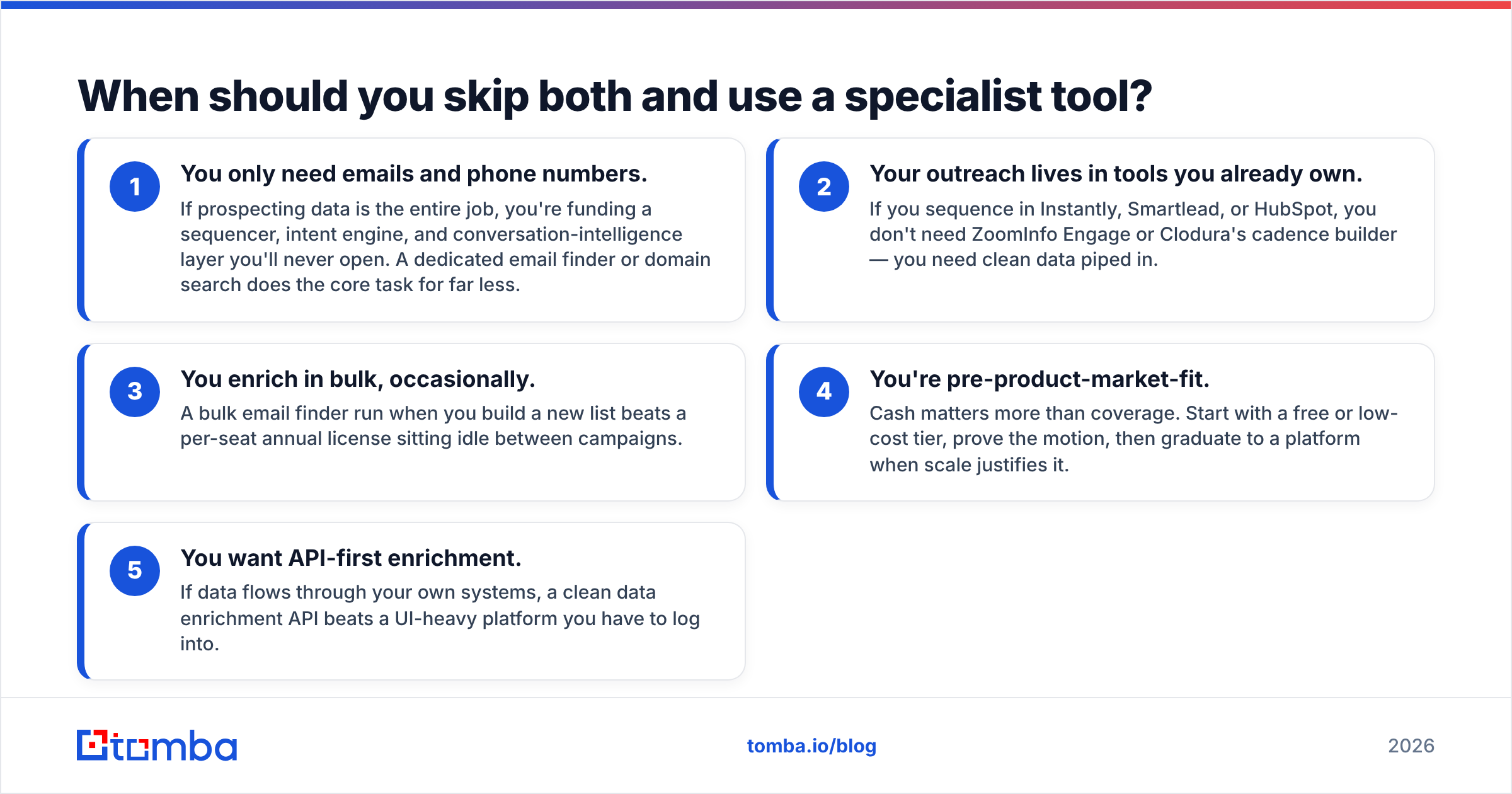
- You only need emails and phone numbers. If prospecting data is the entire job, you're funding a sequencer, intent engine, and conversation-intelligence layer you'll never open. A dedicated email finder or domain search does the core task for far less.
- Your outreach lives in tools you already own. If you sequence in Instantly, Smartlead, or HubSpot, you don't need ZoomInfo Engage or Clodura's cadence builder — you need clean data piped in.
- You enrich in bulk, occasionally. A bulk email finder run when you build a new list beats a per-seat annual license sitting idle between campaigns.
- You're pre-product-market-fit. Cash matters more than coverage. Start with a free or low-cost tier, prove the motion, then graduate to a platform when scale justifies it.
- You want API-first enrichment. If data flows through your own systems, a clean data enrichment API beats a UI-heavy platform you have to log into.
This is where Tomba fits the conversation. It isn't trying to be ZoomInfo — it's the focused data layer for teams that want verified professional emails by name, domain, or company, at a starter price of $49/mo rather than five figures a year. You can see the full Tomba pricing breakdown; the free tier gives you 25 searches a month to test accuracy before you commit a dollar.
Clodura.ai vs ZoomInfo: Feature depth compared#
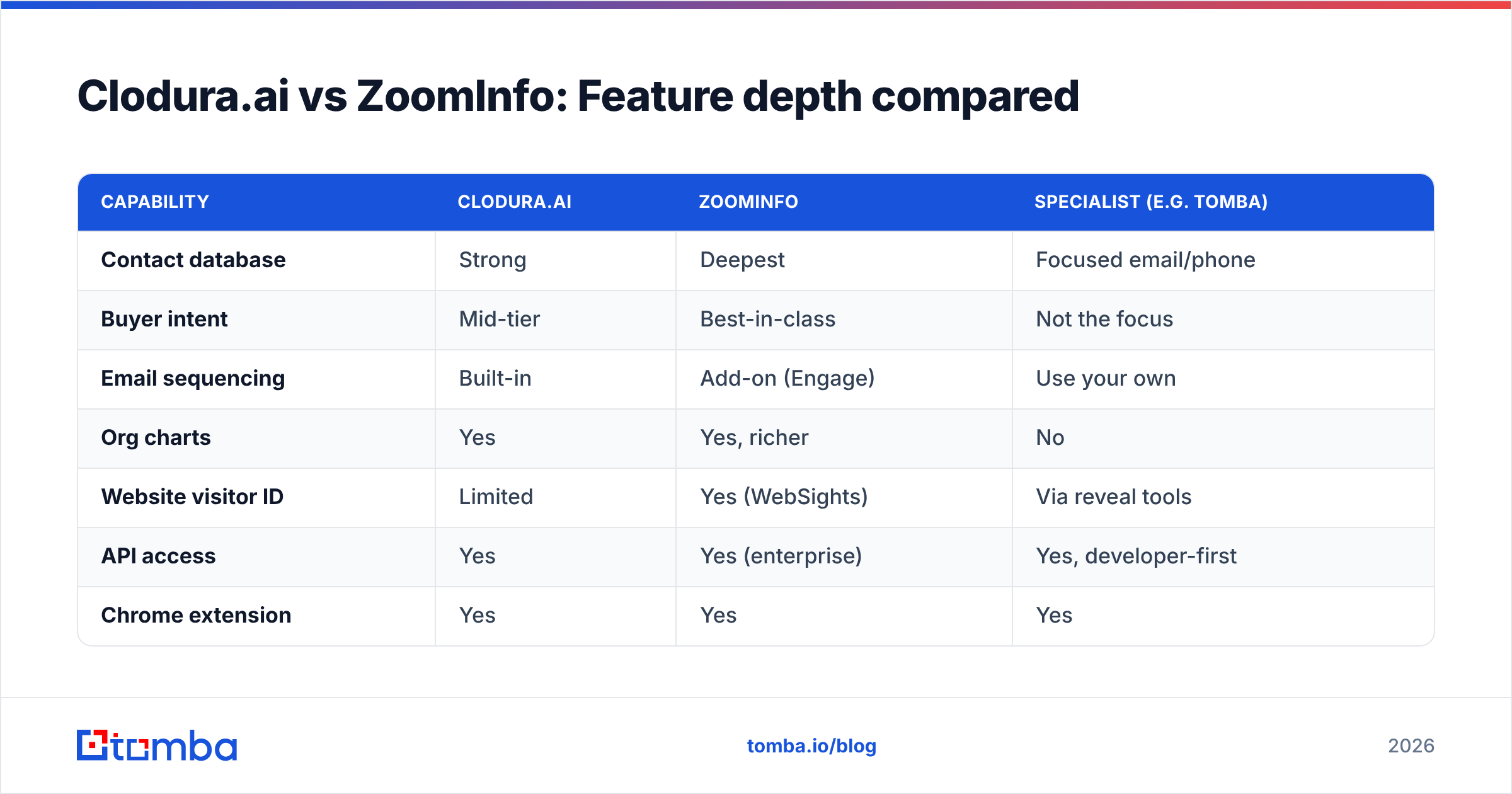
Beyond data, the two platforms diverge on what they wrap around it.
| Capability | Clodura.ai | ZoomInfo | Specialist (e.g. Tomba) |
|---|---|---|---|
| Contact database | Strong | Deepest | Focused email/phone |
| Buyer intent | Mid-tier | Best-in-class | Not the focus |
| Email sequencing | Built-in | Add-on (Engage) | Use your own |
| Org charts | Yes | Yes, richer | No |
| Website visitor ID | Limited | Yes (WebSights) | Via reveal tools |
| API access | Yes | Yes (enterprise) | Yes, developer-first |
| Chrome extension | Yes | Yes | Yes |
| Entry cost | Low | High | Lowest |
ZoomInfo's advantage is depth-plus-breadth: everything a RevOps team needs in one contract. Clodura.ai's advantage is a competent version of most of that at SMB prices. A specialist's advantage is that it does one thing cleanly and integrates everywhere — no platform lock-in, no seats you don't use.
Notice what's not on either platform's critical path for a small team: intent data and visitor de-anonymization are powerful for enterprise ABM, and close to irrelevant if you're a five-person team sending 200 emails a week. Don't pay for the tier that unlocks features your motion can't consume.
Which tool should you choose?#
Match the tool to the motion, not the marketing.
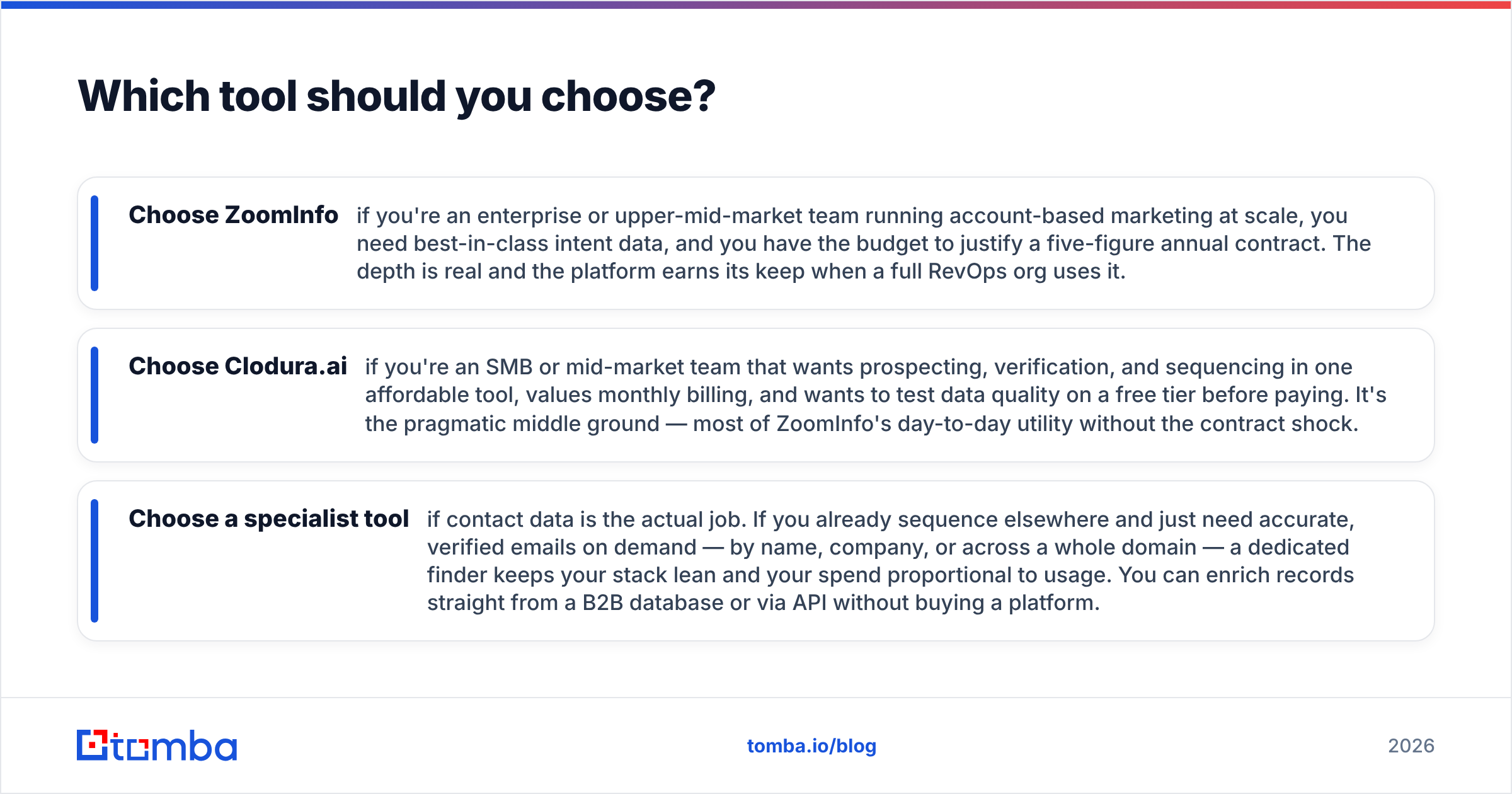
Choose ZoomInfo if you're an enterprise or upper-mid-market team running account-based marketing at scale, you need best-in-class intent data, and you have the budget to justify a five-figure annual contract. The depth is real and the platform earns its keep when a full RevOps org uses it.
Choose Clodura.ai if you're an SMB or mid-market team that wants prospecting, verification, and sequencing in one affordable tool, values monthly billing, and wants to test data quality on a free tier before paying. It's the pragmatic middle ground — most of ZoomInfo's day-to-day utility without the contract shock.
Choose a specialist tool if contact data is the actual job. If you already sequence elsewhere and just need accurate, verified emails on demand — by name, company, or across a whole domain — a dedicated finder keeps your stack lean and your spend proportional to usage. You can enrich records straight from a B2B database or via API without buying a platform.
The mistake to avoid is buying the biggest platform "to be safe." Unused seats and burned credits are the most common regret in B2B data spend — bigger is only better when you use it.
Frequently asked questions#
Is Clodura.ai cheaper than ZoomInfo? Yes, significantly. Clodura.ai starts around $33/user/month with monthly options and a free tier, while ZoomInfo typically starts near $15,000/year on annual-only contracts. For most SMBs, Clodura.ai is a fraction of the cost.
Does ZoomInfo have better data than Clodura.ai? ZoomInfo has the deepest database and an edge on hard-to-source records like senior-exec direct dials and niche industries. For mainstream mid-market contacts, the gap narrows to the point where price and workflow should decide your choice.
Can I use just an email finder instead of either platform? Yes, if contact data is your only real need. Tools like Tomba find and verify professional emails by name or domain and integrate with your existing CRM and sequencer — no platform contract required.
Do these tools verify emails automatically? Both Clodura.ai and ZoomInfo verify emails, but data decays after purchase. Re-verify lists at send time with a dedicated verifier to protect deliverability.
The bottom line#
ZoomInfo is the right call when you're an enterprise team that will actually use its depth and intent engine. Clodura.ai is the smarter buy for SMB and mid-market teams that want most of that value without the five-figure contract. And if you strip the decision down to its core — you need accurate, verified B2B emails, not a full platform — the leanest option wins.
That's exactly where Tomba fits. Use the Tomba Email Finder to pull verified professional emails by name, company, or across an entire domain, starting at $49/mo with a free tier to test accuracy first. Keep your sequencer, keep your CRM, and pay only for the data you actually use. Start free, verify before you send, and scale spend with results — not with a contract you signed in January.
Related guides#
// get started
Find, verify and enrich your first contacts today
Start on the free plan with 25 searches a month, then scale when your team is ready.
Free plan · No credit card required · GDPR & CCPA
// about the author