How to Close More Leads in 2026: A Practical Playbook
Most reps lose deals in the messy middle, not the pitch. Here's a concrete, data-backed system to close more leads in 2026 — from clean contact data to disciplined follow-up.
You do not have a lead problem. You have a leak problem.
Most teams chase more traffic, more ad spend, and bigger lists when the real money is already sitting in the pipeline they built last month. The leads came in, got one email, and quietly went cold. Closing more of them is usually cheaper and faster than finding new ones — if you fix the process instead of just adding volume.
This is a practical, no-fluff guide to close more leads in 2026: how to prioritize, reach the right person, follow up without being annoying, and remove the friction that kills otherwise-winnable deals.
TL;DR#
- The bottleneck is the middle, not the top. Most leads are lost between "interested" and "signed," not at the pitch. Fix follow-up and routing before you buy more traffic.
- Bad data caps your close rate. If 20–30% of your contacts bounce or point to the wrong person, no script saves you. Clean, verified data is the foundation.
- Speed and persistence win. Responding in minutes and following up 5–8 times beats a "perfect" one-shot email almost every time.
- Segment, then personalize. Generic blasts train buyers to ignore you. Tiered, relevant outreach converts.
- Measure conversion per stage. You cannot fix a leak you cannot see. Track stage-by-stage drop-off, not just the final number.
Why do most leads never close?#
Because they die in the handoff, not the pitch. A lead fills out a form or replies to a cold email, then waits. By the time a rep follows up hours or days later, the buying intent has cooled. Research on lead response consistently shows that contacting a lead within the first few minutes dramatically increases the odds of connecting versus waiting even an hour.
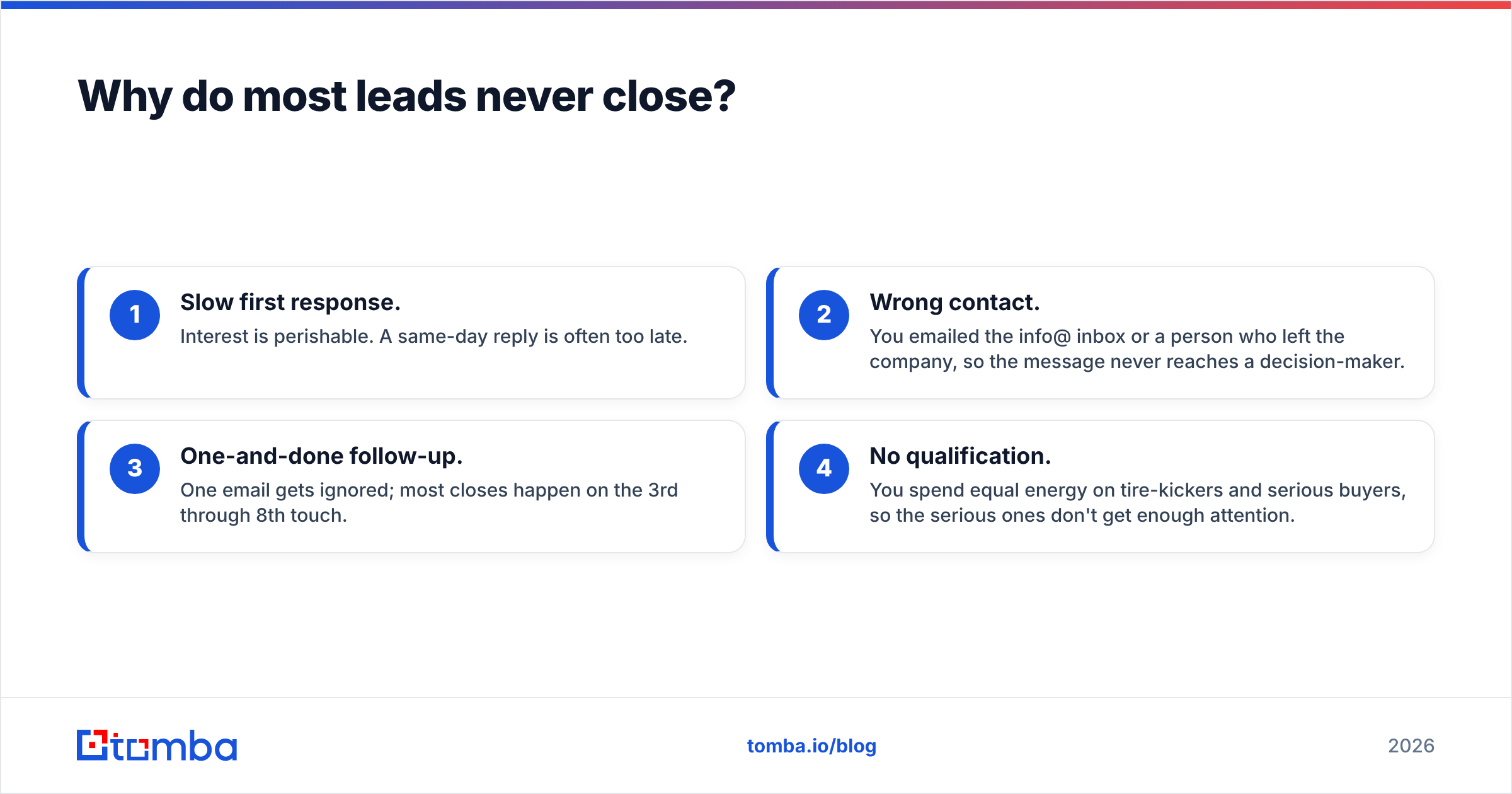
There are four recurring reasons leads stall:
- Slow first response. Interest is perishable. A same-day reply is often too late.
- Wrong contact. You emailed the info@ inbox or a person who left the company, so the message never reaches a decision-maker.
- One-and-done follow-up. One email gets ignored; most closes happen on the 3rd through 8th touch.
- No qualification. You spend equal energy on tire-kickers and serious buyers, so the serious ones don't get enough attention.
Notice that none of these are "the rep isn't persuasive enough." Closing more leads is mostly an operations problem wearing a sales costume.
What actually moves the close rate?#
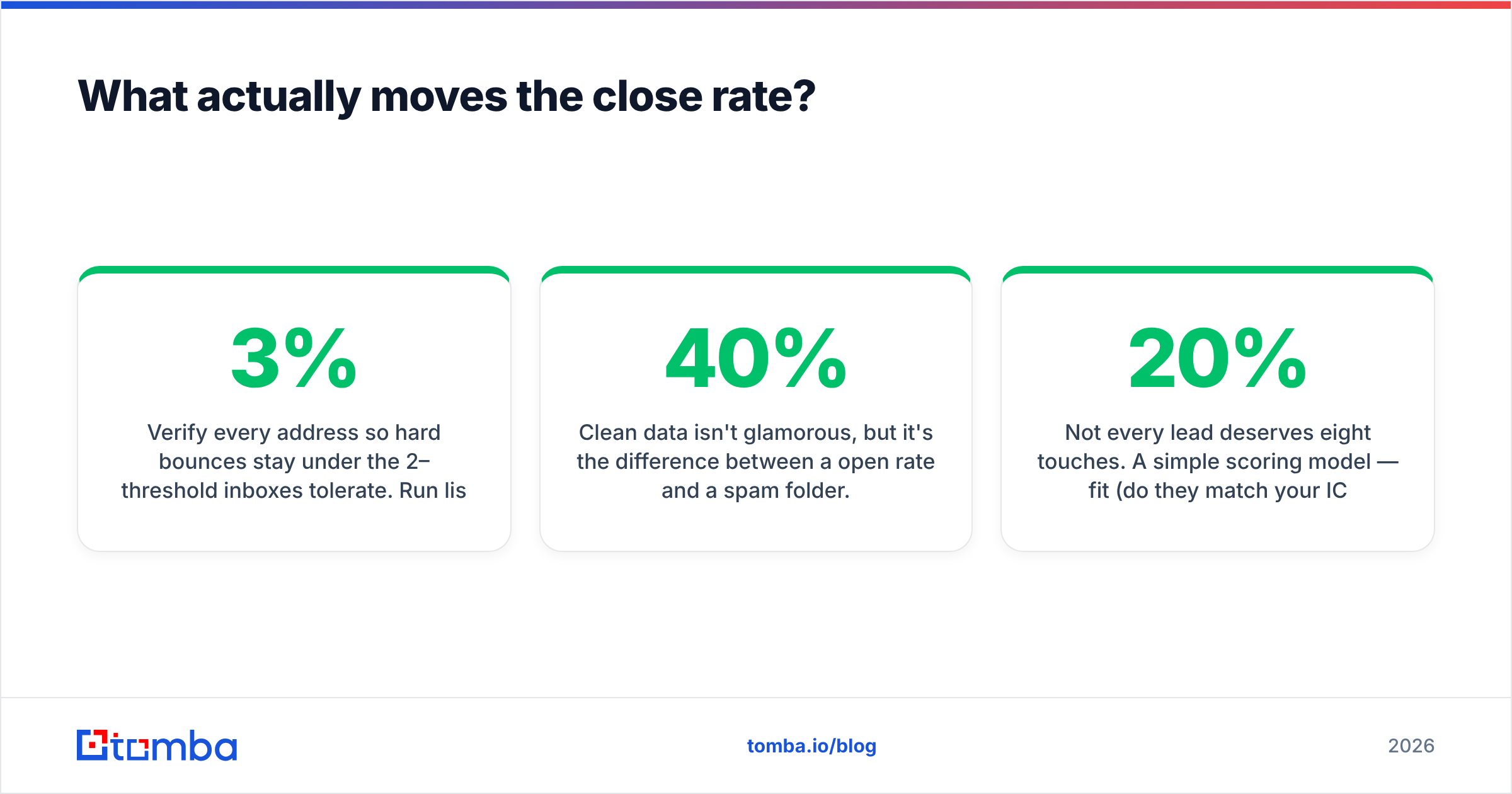
Four levers, in order of impact for most B2B teams: data quality, response speed, follow-up discipline, and qualification. Get these right and the "closing techniques" you read about start working, because they're finally aimed at the right person at the right time.
1. Fix your data first#
Your outreach can only be as good as the contact behind it. If a chunk of your list bounces, routes to a shared inbox, or names someone who changed jobs, you're burning time and hurting your sender reputation before a single word gets read.
Before you scale outreach:
- Find the real decision-maker's address, not a generic catch-all. A tool like an email finder resolves a name and company into a verified professional email.
- Verify every address so hard bounces stay under the 2–3% threshold inboxes tolerate. Run lists through an email verifier before you send.
- Enrich the record with title, company size, and phone so you can segment and prioritize. Data enrichment turns a bare email into a scoreable lead.
Clean data isn't glamorous, but it's the difference between a 40% open rate and a spam folder. It also protects your email deliverability, which quietly determines whether any of your work is even seen.
2. Respond while intent is hot#
Speed compounds. According to widely cited lead-response research summarized by HubSpot, the odds of qualifying a lead drop sharply after the first few minutes. Build for speed:
- Route inbound leads to an available rep automatically instead of a round-robin that sits overnight.
- Use templated-but-personal first replies so reps aren't writing from scratch.
- Trigger an instant notification the moment a high-intent action happens (demo request, pricing page visit, reply).
3. Follow up like it's your job — because it is#
The single most common reason a winnable lead doesn't close: the rep gave up. A disciplined 5–8 touch cadence across email, phone, and one social touch outperforms a single "great" message almost every time. Vary the angle — a question, a resource, a customer proof point — so each touch adds value instead of just saying "just checking in."
4. Qualify so you spend time where it pays#
Not every lead deserves eight touches. A simple scoring model — fit (do they match your ICP?) plus intent (are they showing buying signals?) — lets you pour energy into the 20% of leads that produce 80% of revenue. Even a lightweight lead scoring rubric beats treating every inbox the same.
How do these approaches compare?#
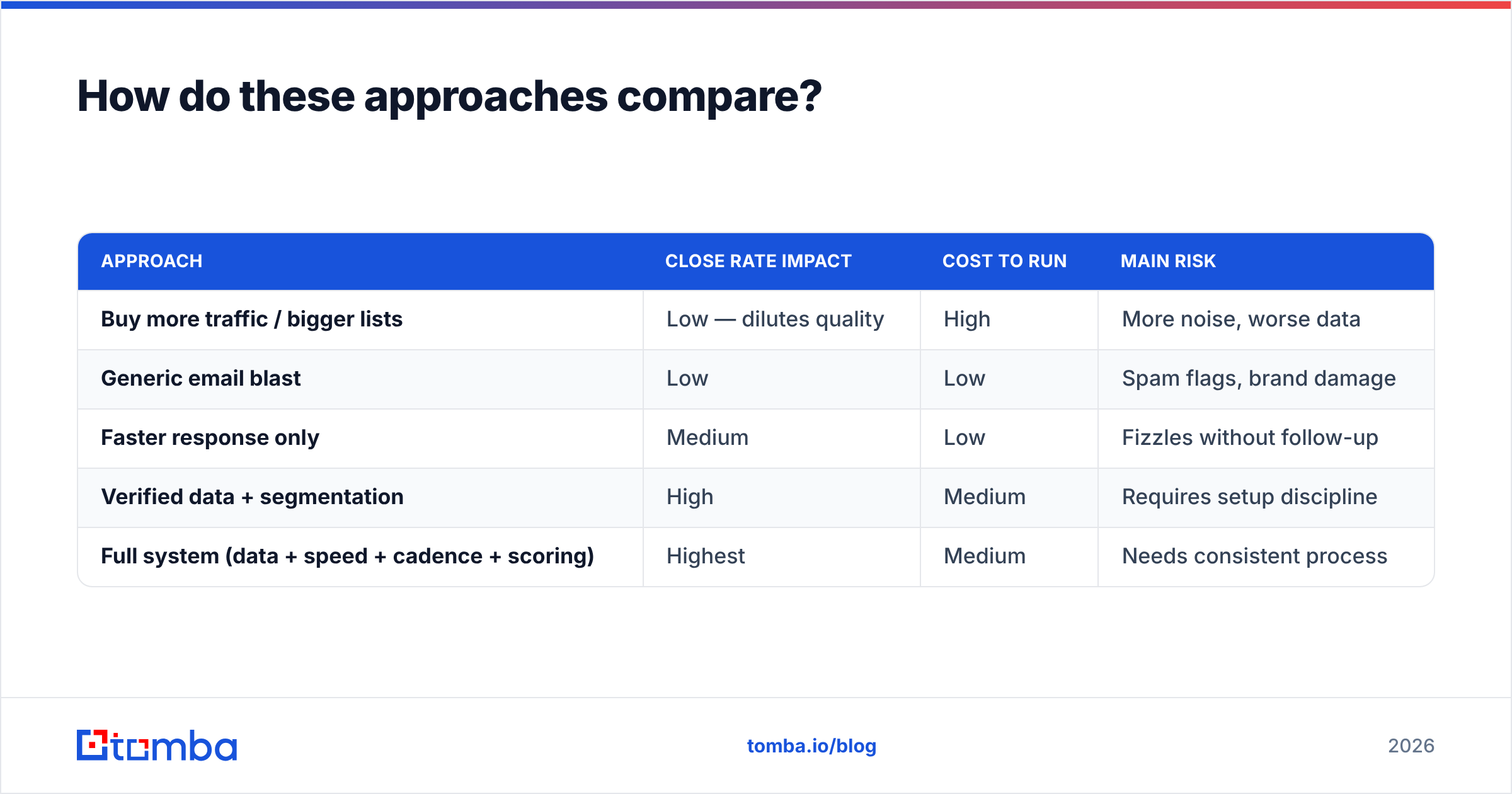
Here's how the common ways teams try to close more leads stack up. The difference between "spray and pray" and a data-driven system is not effort — it's where the effort lands.
| Approach | Close rate impact | Cost to run | Main risk |
|---|---|---|---|
| Buy more traffic / bigger lists | Low — dilutes quality | High | More noise, worse data |
| Generic email blast | Low | Low | Spam flags, brand damage |
| Faster response only | Medium | Low | Fizzles without follow-up |
| Verified data + segmentation | High | Medium | Requires setup discipline |
| Full system (data + speed + cadence + scoring) | Highest | Medium | Needs consistent process |
The pattern is clear: the cheapest reliable gains come from cleaning data and tightening process, not from spending more at the top of the funnel.
What does a lead-closing stack look like in 2026?#
You don't need fifteen tools. You need four capabilities that work together: source clean contacts, verify them, reach out on a cadence, and track conversion. Here's how a lean stack maps to the job.
- Find & verify contacts — an email finder plus email verification so every send lands. This is the foundation the rest sits on.
- Enrich & segment — contact enrichment to add title, industry, and company size for scoring and tiering.
- Outreach & cadence — a sequencer or CRM that enforces multi-touch follow-up so nothing slips.
- Multichannel reach — a phone finder for the leads that respond better to a call than a cold email.
For teams doing this at volume, a bulk email finder plus API access removes the manual copy-paste that quietly caps how many leads a rep can work in a day. If you're pulling contacts straight from prospect research, the Tomba Chrome extension finds and verifies as you browse.
How do you build a repeatable closing process?#
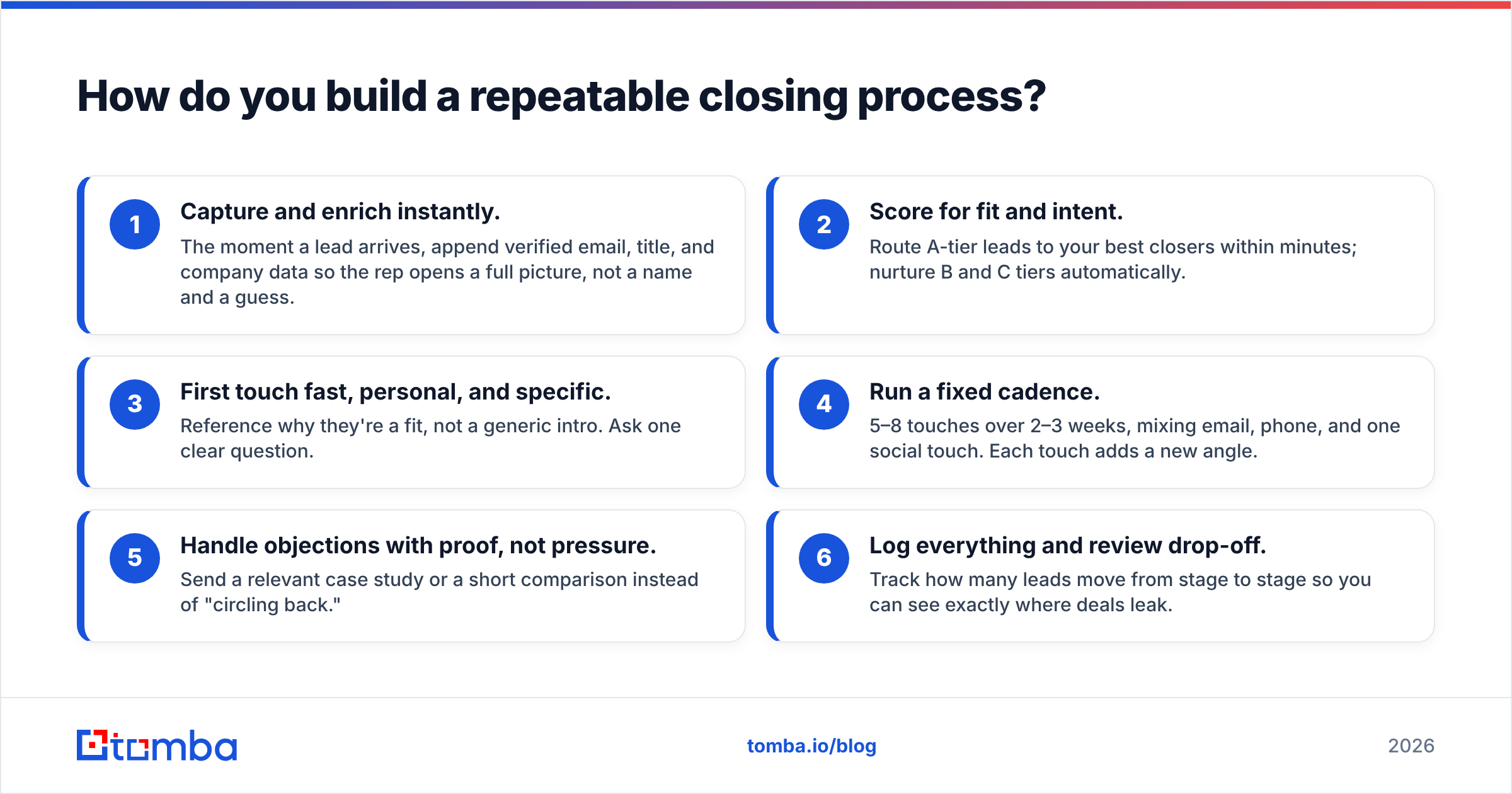
Turn the levers above into a checklist your team runs on every lead. Repeatability is what separates a lucky quarter from a predictable one.
- Capture and enrich instantly. The moment a lead arrives, append verified email, title, and company data so the rep opens a full picture, not a name and a guess.
- Score for fit and intent. Route A-tier leads to your best closers within minutes; nurture B and C tiers automatically.
- First touch fast, personal, and specific. Reference why they're a fit, not a generic intro. Ask one clear question.
- Run a fixed cadence. 5–8 touches over 2–3 weeks, mixing email, phone, and one social touch. Each touch adds a new angle.
- Handle objections with proof, not pressure. Send a relevant case study or a short comparison instead of "circling back."
- Log everything and review drop-off. Track how many leads move from stage to stage so you can see exactly where deals leak.
The magic isn't any single step — it's doing all six consistently. Most teams do two of them well and wonder why the number won't move.
How do you measure whether it's working?#
Stop looking only at the final close rate. It's a lagging number that hides the real problem. Instead, track conversion between each stage: lead → contacted, contacted → qualified, qualified → meeting, meeting → close. When you see the biggest drop-off between "contacted" and "qualified," you know the problem is data or targeting — not your closer. When the drop is "meeting → close," it's a pitch or pricing issue.
A few metrics worth watching weekly:
- Bounce rate — over 3% means your data hygiene needs work.
- Response rate — track your email response rate; under 5% on cold outreach usually signals targeting or copy problems, not volume problems.
- Touches-to-close — if most closes happen on touch 5, but your reps stop at touch 2, that's your leak.
- Speed-to-first-contact — measured in minutes, not hours.
Instrument these and the fix usually becomes obvious. You're not guessing anymore; you're patching a specific leak.
Common mistakes that quietly kill your close rate#
- Sending before verifying. One dirty list can tank your sender reputation for weeks. Verify first, always.
- Personalizing the wrong thing. "I loved your recent post" is noise. "You're hiring three SDRs, so onboarding speed probably matters" is signal.
- Confusing activity with progress. 200 sends to the wrong people is worse than 40 to the right ones. Third-party benchmarks on G2 consistently show that data accuracy, not send volume, tracks with pipeline quality.
- Abandoning leads too early. The follow-up you skipped is the deal your competitor closed.
- No single source of truth. If lead data lives in five spreadsheets, nobody trusts it, and nobody works it.
Is more data or better data the answer?#
Better data, almost every time. Doubling your list while keeping a 25% bounce rate just doubles your problems. Halving that bounce rate while keeping the same list often produces more meetings than a new ad campaign — at a fraction of the cost. That's why the teams that close more leads obsess over accuracy, deliverability, and routing before they touch their ad budget. You'll find a deeper breakdown of sourcing options and pricing details worth comparing when you scope your own stack.
The uncomfortable truth: most "we need more leads" conversations are really "we're wasting the leads we have" conversations. Fix the leak first.
Close more leads by fixing the foundation first#
Start where the leverage is highest: your data. Verified, enriched contacts feed faster responses, sharper segmentation, and follow-up that actually reaches a human who can say yes. Everything else — cadence, scripts, scoring — only works when the contact behind it is real.
If you want to close more leads this quarter, put the right email in front of the right person before you write a single line of outreach. The Tomba Email Finder turns a name and company into a verified, ready-to-contact address, so your reps spend their time closing instead of chasing dead ends. Start on the free tier (25 searches/month), and scale to a paid plan from $49/month once you see the pipeline move. Fix the foundation, and the close rate follows.
Related guides#
// get started
Find, verify and enrich your first contacts today
Start on the free plan with 25 searches a month, then scale when your team is ready.
Free plan · No credit card required · GDPR & CCPA
// about the author