The Sales Close Process in 2026: A Step-by-Step Playbook
A repeatable close process turns 'hope the deal lands' into a predictable outcome. Here are the seven stages, the metrics that matter, and the tools that keep momentum from stalling.
Closing is not a moment. It is the last few stages of a system you either built on purpose or stumbled into by accident. Reps who "have a knack for closing" almost always have a repeatable close process underneath the charisma — they just never wrote it down. This guide writes it down.
TL;DR#
- The close process is a repeatable sequence, not a single high-pressure ask at the end of a call. It spans qualification through signature.
- Deals die from ambiguity, not objections. Unclear next steps, hidden decision-makers, and vague timelines kill more pipeline than price ever will.
- Seven stages carry a deal from "qualified" to "closed-won": qualify, discover, align on value, build the business case, handle objections, negotiate, and confirm the close.
- Measure the process, not just the outcome. Stage conversion, sales cycle length, and slippage tell you where deals stall.
- Tooling removes friction — accurate contact data, a clean CRM, and a mutual action plan keep momentum from leaking between stages.
What is a close process?#
A close process is the defined, repeatable set of steps a sales team follows to move a qualified opportunity to a signed deal. Think of it like a commercial flight. The "close" everyone celebrates is the landing, but the landing is only safe because of the flight plan, the descent checklist, and air traffic control clearing the runway. Skip those and you are not closing — you are crashing with extra steps.
Technically, the close process is the back half of your broader sales process and pipeline. Prospecting and outreach fill the top of the funnel; the close process governs everything from "this is a real opportunity" to "the contract is executed." It sits inside your CRM as a series of stages, each with an entry condition, an exit condition, and an owner.
The distinction that matters: a sales technique ("assume the sale," "create urgency") is a tactic you deploy inside a stage. A close process is the architecture that tells you which stage you are in and what has to be true to advance. Techniques without a process are why forecasts miss.

Why do most deals stall before the close?#
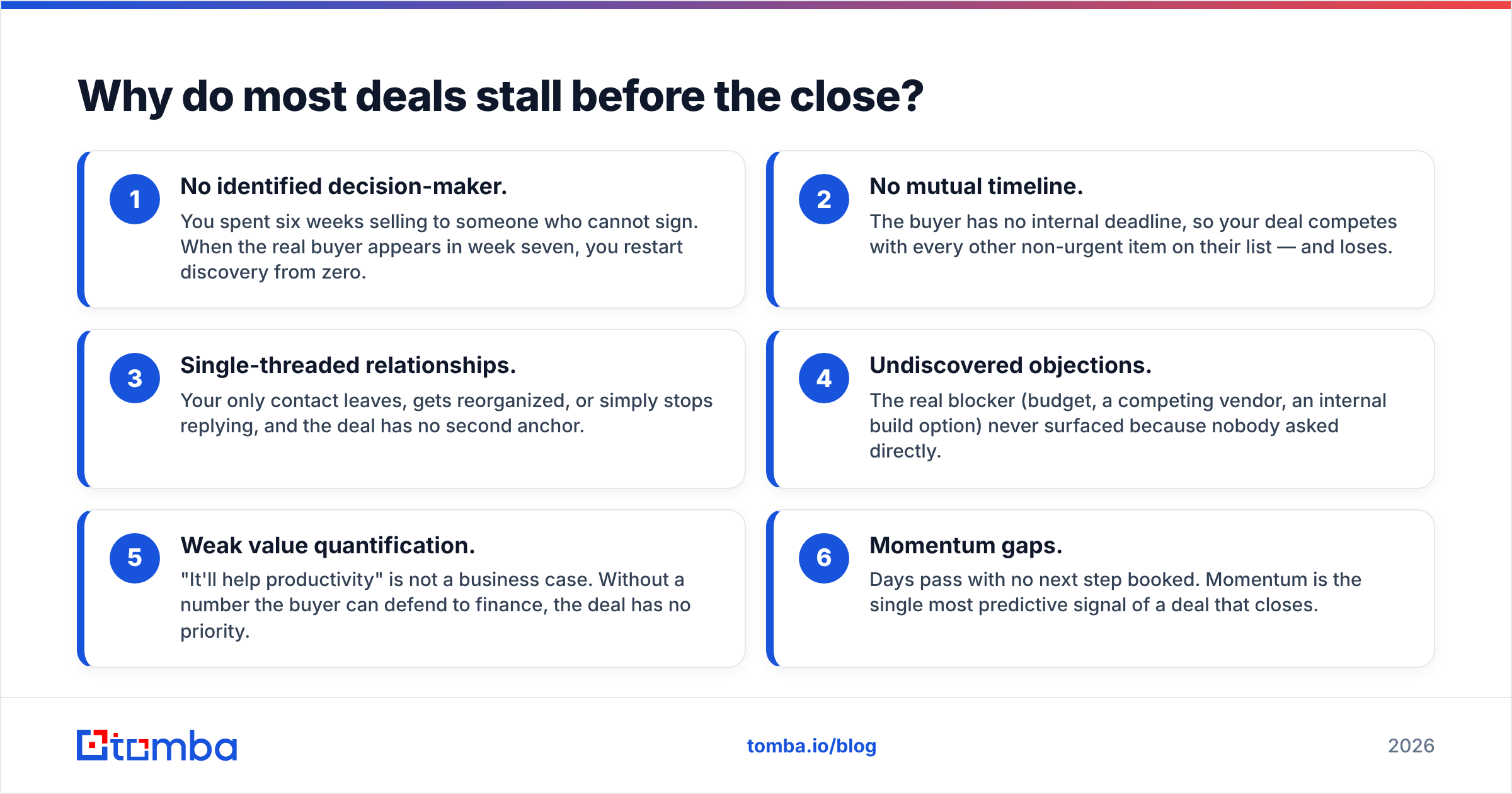
Deals rarely die because the buyer said a hard "no." They die in the gray zone — the follow-up that never comes, the champion who goes quiet, the "let's circle back next quarter" that never circles back. Here are the recurring failure modes:
- No identified decision-maker. You spent six weeks selling to someone who cannot sign. When the real buyer appears in week seven, you restart discovery from zero.
- No mutual timeline. The buyer has no internal deadline, so your deal competes with every other non-urgent item on their list — and loses.
- Single-threaded relationships. Your only contact leaves, gets reorganized, or simply stops replying, and the deal has no second anchor.
- Undiscovered objections. The real blocker (budget, a competing vendor, an internal build option) never surfaced because nobody asked directly.
- Weak value quantification. "It'll help productivity" is not a business case. Without a number the buyer can defend to finance, the deal has no priority.
- Momentum gaps. Days pass with no next step booked. Momentum is the single most predictive signal of a deal that closes.
According to HubSpot's sales research, the length of your sales cycle and the number of stakeholders involved are among the strongest predictors of whether a deal closes at all. The fix for every item above is the same: a process that forces these questions to be answered before a deal is allowed to advance.
What are the stages of a strong close process?#
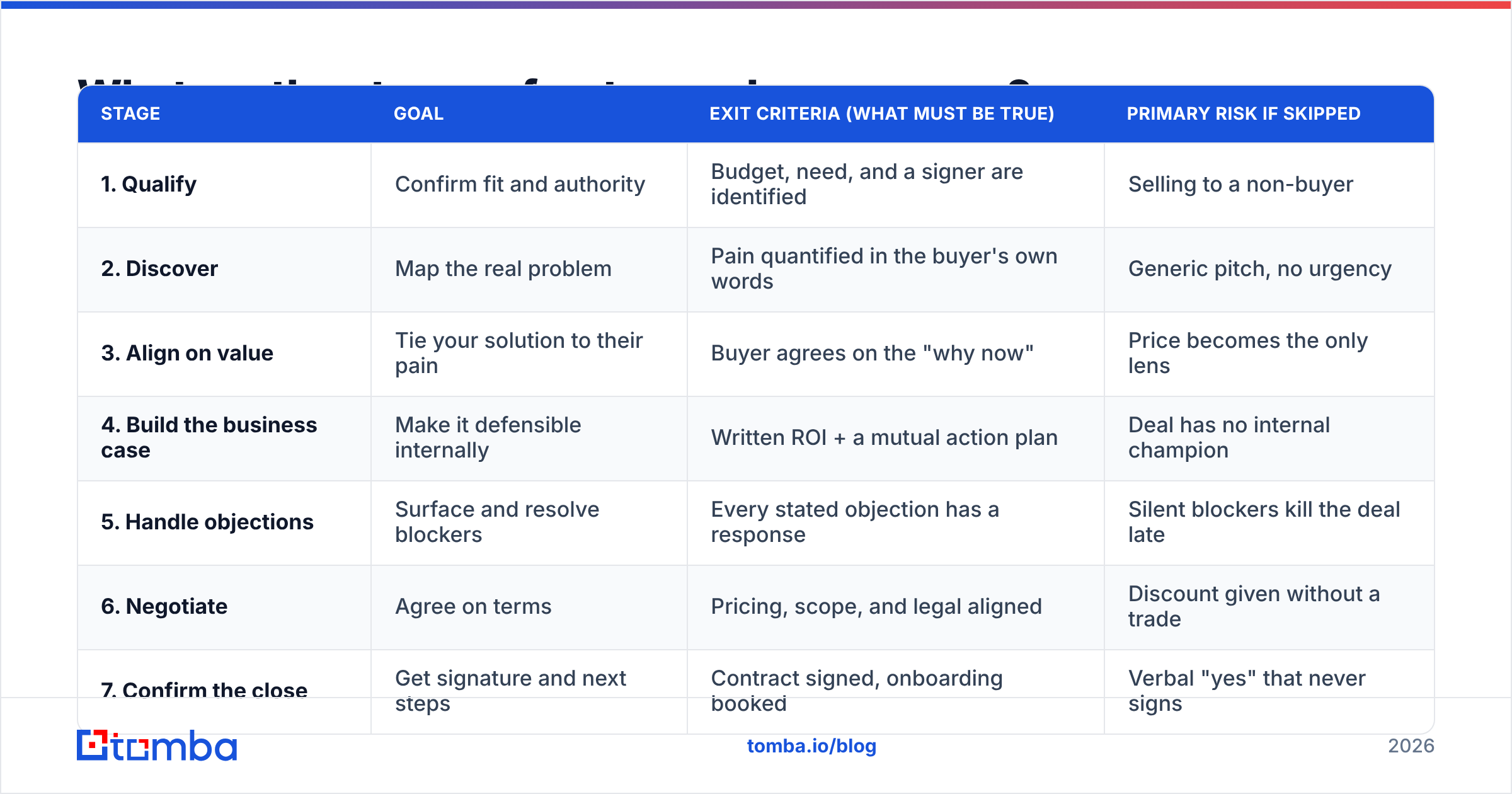
Below is a seven-stage model. Adapt the names to your business, but keep the entry/exit discipline. Each stage should have a clear "what must be true to move forward" gate.
| Stage | Goal | Exit criteria (what must be true) | Primary risk if skipped |
|---|---|---|---|
| 1. Qualify | Confirm fit and authority | Budget, need, and a signer are identified | Selling to a non-buyer |
| 2. Discover | Map the real problem | Pain quantified in the buyer's own words | Generic pitch, no urgency |
| 3. Align on value | Tie your solution to their pain | Buyer agrees on the "why now" | Price becomes the only lens |
| 4. Build the business case | Make it defensible internally | Written ROI + a mutual action plan | Deal has no internal champion |
| 5. Handle objections | Surface and resolve blockers | Every stated objection has a response | Silent blockers kill the deal late |
| 6. Negotiate | Agree on terms | Pricing, scope, and legal aligned | Discount given without a trade |
| 7. Confirm the close | Get signature and next steps | Contract signed, onboarding booked | Verbal "yes" that never signs |
1. Qualify#
Qualification is where you earn the right to spend time. Frameworks like BANT, MEDDIC, or SPICED all exist to answer one question: is this a real, winnable deal with a person who can say yes? The most common qualification miss is authority. Before you invest in a demo, confirm you can reach the actual decision-maker — and if you can't, find them. Accurate contact data matters here; a phone finder or verified email for the economic buyer often shortcuts weeks of gatekeeping.
2. Discover#
Discovery is not a form to fill in. It is the stage where you get the buyer to articulate their pain in their own words, with a number attached. "We lose about 10 hours a week to manual data entry" is a discovery win. "They seem interested" is not. Write down the exact phrasing the buyer uses — you will repeat it back in the business case.
3. Align on value#
Now connect your solution to the specific pain you uncovered. This is where you move the conversation off price. If the buyer only ever talks about cost, discovery was too shallow. Value alignment reframes the deal as "what does solving this problem earn you," not "what does your product cost."
4. Build the business case#
The business case is the artifact your champion uses to sell internally when you are not in the room. It should include the quantified pain, the projected return, and a mutual action plan — a shared, dated list of the steps both sides will take to reach signature. The mutual action plan is the single highest-leverage document in modern B2B closing because it makes the timeline explicit and shared.
5. Handle objections#
Good objection handling starts before the objection. Ask directly: "What would stop this from happening?" Surfacing blockers early beats discovering them the day before the projected close. Common late-stage objections — legal review, security approval, a competing internal build — take weeks to resolve, so you want them on the table in stage five, not stage seven.
6. Negotiate#
Negotiation is a trade, not a giveaway. Every concession should buy you something: a faster close, a longer term, a case study, a bigger seat count. Discounting to "just get it done" trains buyers to wait for the discount and erodes your win rate over time.
7. Confirm the close#
The close is confirmed when the contract is signed and the next step (onboarding, kickoff) is booked — not when someone says "sounds good." Always leave a call with a scheduled next action. A deal with no next step on the calendar is a deal that is already slipping.
How do you measure a close process?#
You cannot improve what you only measure at the finish line. Track the process, not just the win. These are the metrics that tell you where a close process leaks:
- Stage conversion rate — the percentage of deals that advance from each stage to the next. A cliff at one stage tells you exactly where reps get stuck.
- Sales cycle length — median days from qualified to closed-won. Rising cycle length is an early warning that deals are stalling.
- Slippage rate — the share of deals that push to a later close date than forecast. High slippage means your timelines are wishful, not mutual.
- Win rate — closed-won divided by total closed. Segment it by lead source, deal size, and rep to find what actually works.
- Average deal value — watch this against discount frequency to catch margin erosion.
Salesforce's State of Sales research consistently finds that high-performing teams are far more likely to have a formally defined and consistently followed sales process than underperformers. The measurement is what makes it "followed" instead of "documented and ignored."
Close process vs. sales methodology: what's the difference?#
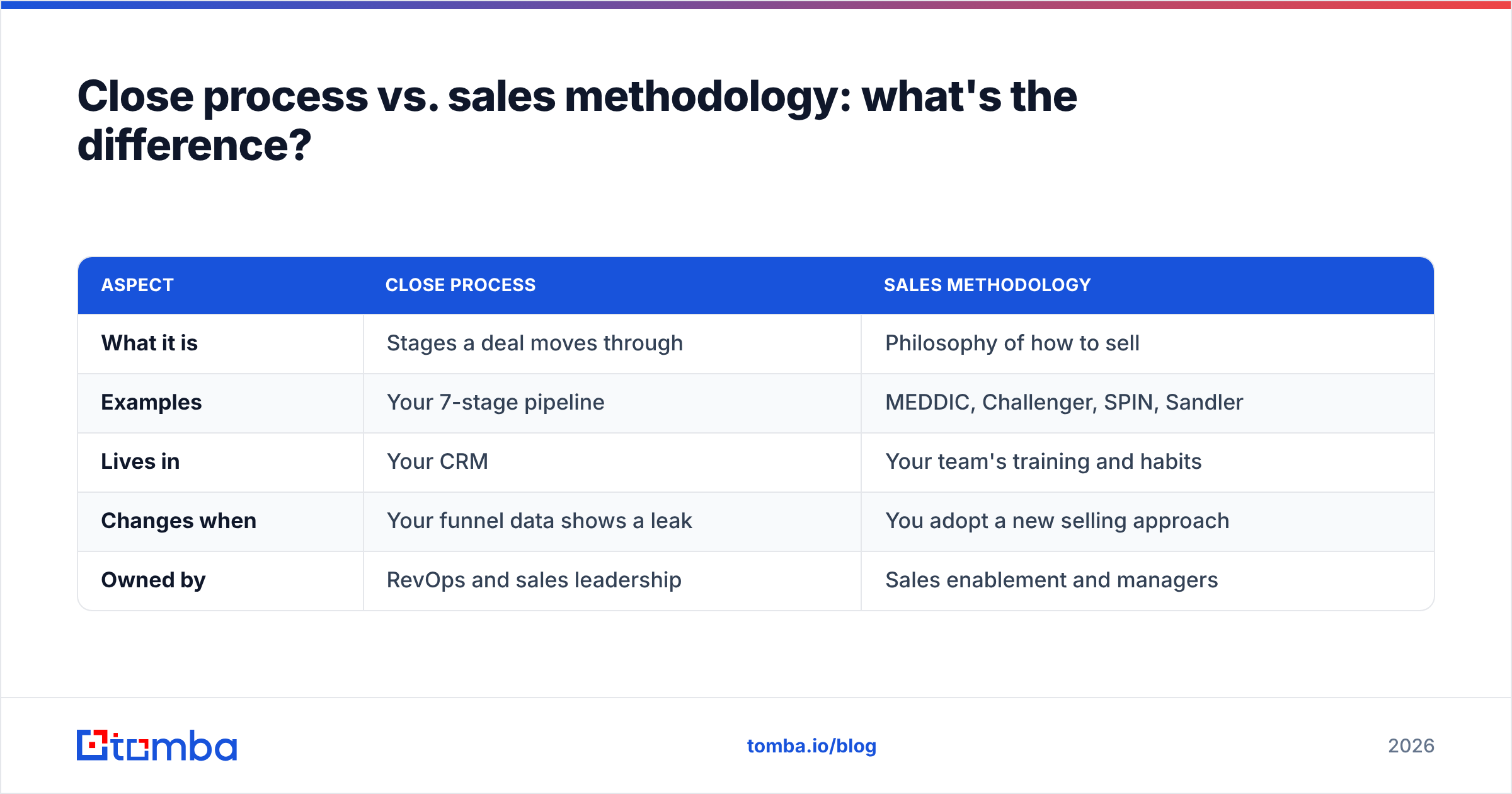
These terms get used interchangeably and they should not be. A methodology is a philosophy of how to sell; a close process is the operational sequence your deals move through. You run a methodology inside a process.
| Aspect | Close process | Sales methodology |
|---|---|---|
| What it is | Stages a deal moves through | Philosophy of how to sell |
| Examples | Your 7-stage pipeline | MEDDIC, Challenger, SPIN, Sandler |
| Lives in | Your CRM | Your team's training and habits |
| Changes when | Your funnel data shows a leak | You adopt a new selling approach |
| Owned by | RevOps and sales leadership | Sales enablement and managers |
The practical takeaway: pick one methodology and standardize it, then encode its qualification and value questions into your CRM stages. A methodology floating free of a process is just a workshop everyone forgets by the next quarter. A process without a methodology is a set of empty boxes with no guidance on how to fill them.
What tools support a modern close process?#
Tools do not close deals — reps do. But the right stack removes the friction that causes momentum gaps. Here is what to have in place:
A clean CRM with enforced stages. If your reps can drag a deal to "negotiation" without meeting the exit criteria, your pipeline is fiction. Configure required fields per stage.
Accurate contact and account data. Multi-threading a deal means reaching more than one stakeholder, which means you need current contact details for each of them. Tomba's email finder and data enrichment help you find and verify the additional decision-makers a deal needs before it can safely advance. Single-threaded deals are fragile; enrichment is how you add the second and third thread.
Mutual action plan documents. Whether it is a shared doc, a Notion page, or a purpose-built tool, the dated shared plan is non-negotiable for complex deals.
Conversation and forecast intelligence. Recording tools and pipeline analytics surface which deals are actually progressing versus which are just aging in place.
For teams doing outbound at volume, keeping contact data fresh across a whole book of accounts is its own workflow — a bulk email finder or the Tomba API lets you enrich and re-verify contacts in batches so your CRM doesn't rot between quarters. Bounced emails to a stakeholder mid-deal are an avoidable momentum killer, and G2's sales software category is full of tools that exist purely to prevent that kind of leak.
How do you actually improve your close rate?#
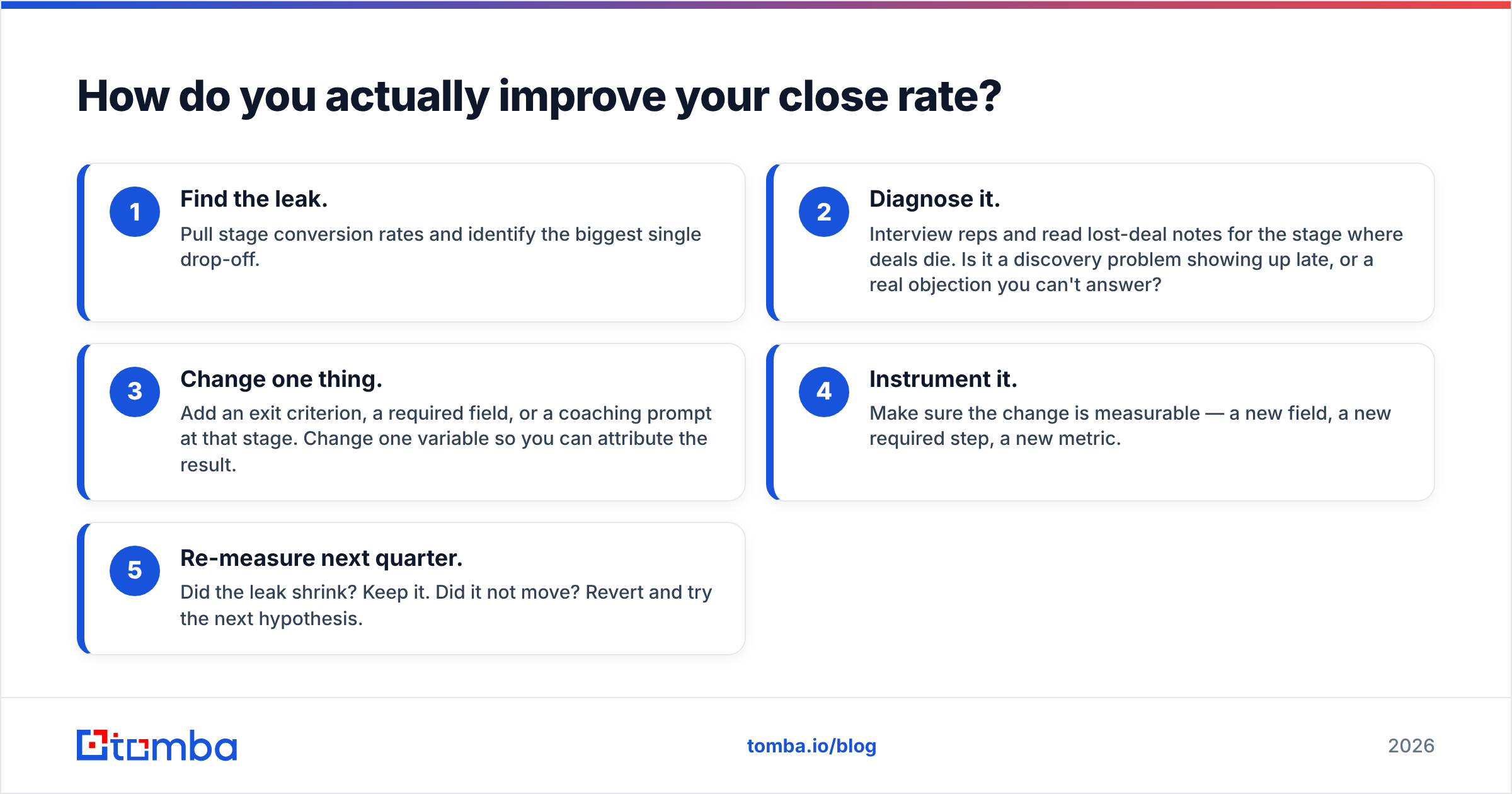
Improving a close process is an iteration loop, not a one-time fix. Run this quarterly:
- Find the leak. Pull stage conversion rates and identify the biggest single drop-off.
- Diagnose it. Interview reps and read lost-deal notes for the stage where deals die. Is it a discovery problem showing up late, or a real objection you can't answer?
- Change one thing. Add an exit criterion, a required field, or a coaching prompt at that stage. Change one variable so you can attribute the result.
- Instrument it. Make sure the change is measurable — a new field, a new required step, a new metric.
- Re-measure next quarter. Did the leak shrink? Keep it. Did it not move? Revert and try the next hypothesis.
The teams that compound their win rate year over year are not the ones with the smoothest talkers. They are the ones treating the close process as a system to debug, one stage at a time. "Always be closing" is dead advice; "always be qualifying and always be measuring" is what actually moves the number.
Frequently asked questions#
What is the difference between closing and the close process? Closing is the act of getting a commitment. The close process is the repeatable sequence of stages — from qualification to signature — that makes that commitment predictable rather than lucky.
How long should a close process take? It depends entirely on deal size and complexity. A self-serve SaaS deal might close in days; a six-figure enterprise deal can take six months or more. What matters is that your median cycle length is stable or shrinking, not that it hits a specific number.
What's the most important stage? Discovery and business-case building. Deals are usually won or lost long before the negotiation — by whether you quantified the pain and armed a champion to sell internally on your behalf.
Do I need a formal methodology? You need one consistent one. Which framework matters far less than whether your whole team follows the same one and encodes it into your CRM stages.
Close more of what's already in your pipeline#
A close process only works if the contact data behind it is accurate — the second decision-maker you need to multi-thread a deal is worthless if you can't reach them. That is where the Tomba Email Finder fits into your close process: find and verify the additional stakeholders a deal needs, enrich accounts in bulk, and stop losing momentum to bounced emails at the worst possible moment. Start free with 25 searches a month, and check the Tomba pricing plans — Starter at $49/mo — when you are ready to scale it across your whole pipeline.
Related guides#
// get started
Find, verify and enrich your first contacts today
Start on the free plan with 25 searches a month, then scale when your team is ready.
Free plan · No credit card required · GDPR & CCPA
// about the author