How to Close the Deal: The 2026 B2B Sales Closing Playbook
Closing isn't a magic word at the end of a pitch — it's the sum of every step before it. Here's a concrete, no-fluff playbook for how to close the deal in 2026.
Closing a deal feels like the hardest part of selling because it's the most visible one. It's where the "yes" or "no" lands, where quota is made or missed, and where nervous reps reach for a scripted trick they read on LinkedIn. But the truth is less dramatic and more useful: the close is a lagging indicator of everything you did before it.
This playbook breaks down how to close the deal in 2026 — the process, the techniques that still work, the ones that backfire, and the unglamorous data-and-discovery work that quietly does most of the closing for you.
TL;DR#
- The close is built upstream. Deals are won or lost in discovery and qualification, not in a last-minute clever line.
- Modern buyers hate pressure. High-pressure "always be closing" tactics have measurably lower win rates than consultative, low-friction closes.
- Objections are buying signals, not rejections — treat them as requests for more information or reassurance.
- A clear next step beats a hard ask. The most reliable close is a mutually agreed action, documented in writing.
- Bad contact data quietly kills deals before you ever reach the close. Reaching the real decision-maker with verified contact details is a closing skill most reps ignore.
What does "close the deal" actually mean in 2026?#
To close the deal means to move a qualified prospect from "interested" to a signed, committed decision — a contract, a purchase order, a start date. That's the textbook definition. The practical definition matters more: closing is removing the last reasons a ready buyer has to say "not yet."
That reframing changes how you sell. If the buyer isn't ready, no closing technique will help — you're pushing a rope. If they are ready, your job is to reduce friction: clarify the terms, quiet the last objection, and give them a clean path to yes.
Old-school sales training treated the close as a confrontation you win through willpower. The 2026 version is closer to project management: you and the buyer are jointly de-risking a decision, and the "close" is simply the moment the risk drops below their threshold.
Why do most deals really get lost?#
Most reps blame the close. The data points somewhere else. According to Gartner's research on B2B buying, buyers now spend the majority of their journey researching independently and only a fraction of their time with any single sales rep. By the time you're "closing," the buyer has already formed most of their opinion.
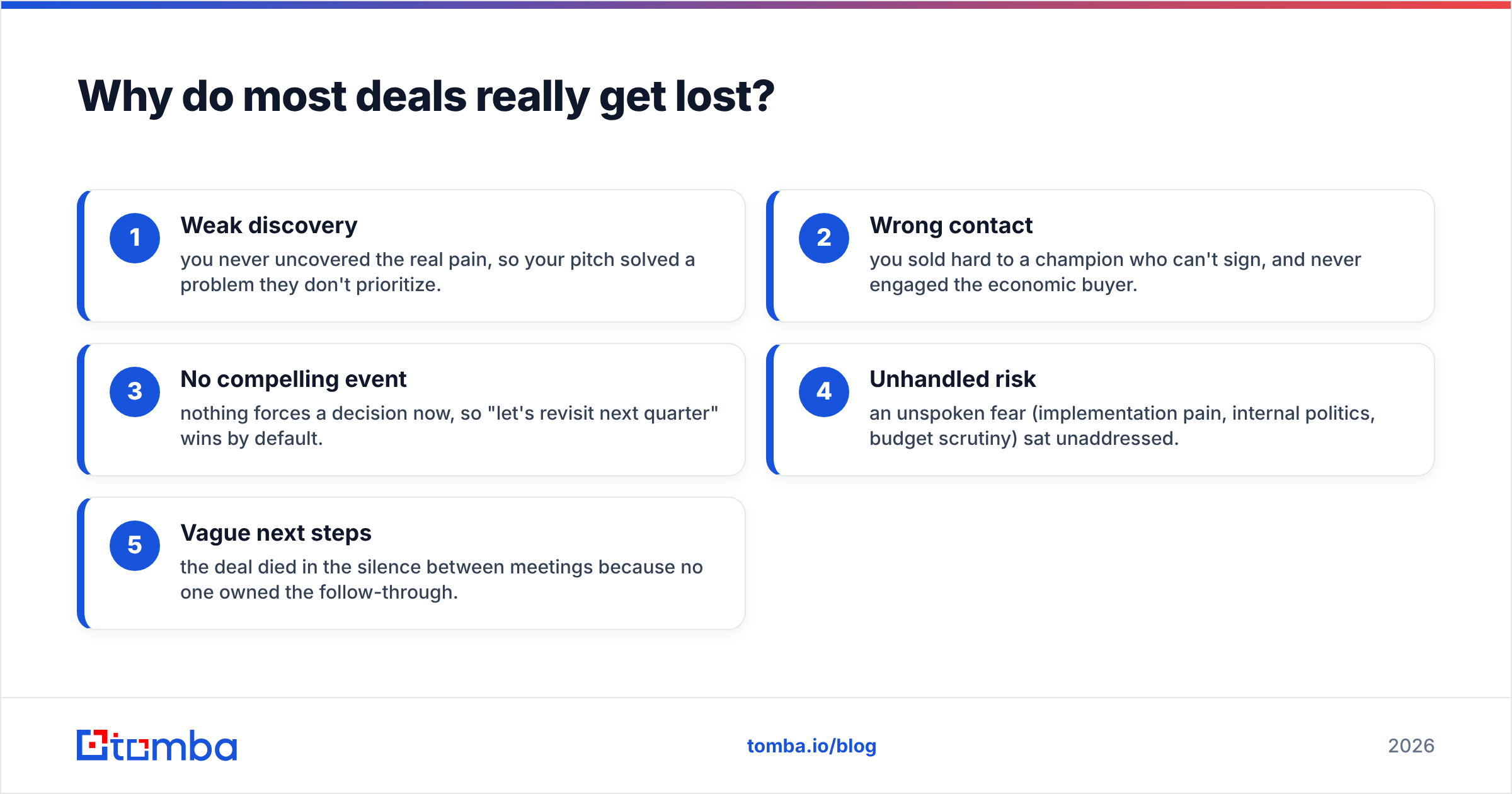
Deals leak at predictable points:
- Weak discovery — you never uncovered the real pain, so your pitch solved a problem they don't prioritize.
- Wrong contact — you sold hard to a champion who can't sign, and never engaged the economic buyer.
- No compelling event — nothing forces a decision now, so "let's revisit next quarter" wins by default.
- Unhandled risk — an unspoken fear (implementation pain, internal politics, budget scrutiny) sat unaddressed.
- Vague next steps — the deal died in the silence between meetings because no one owned the follow-through.
Notice that four of the five have nothing to do with your closing line. Fix these upstream and the close gets almost boring — in the best way.
What are the closing techniques that still work?#
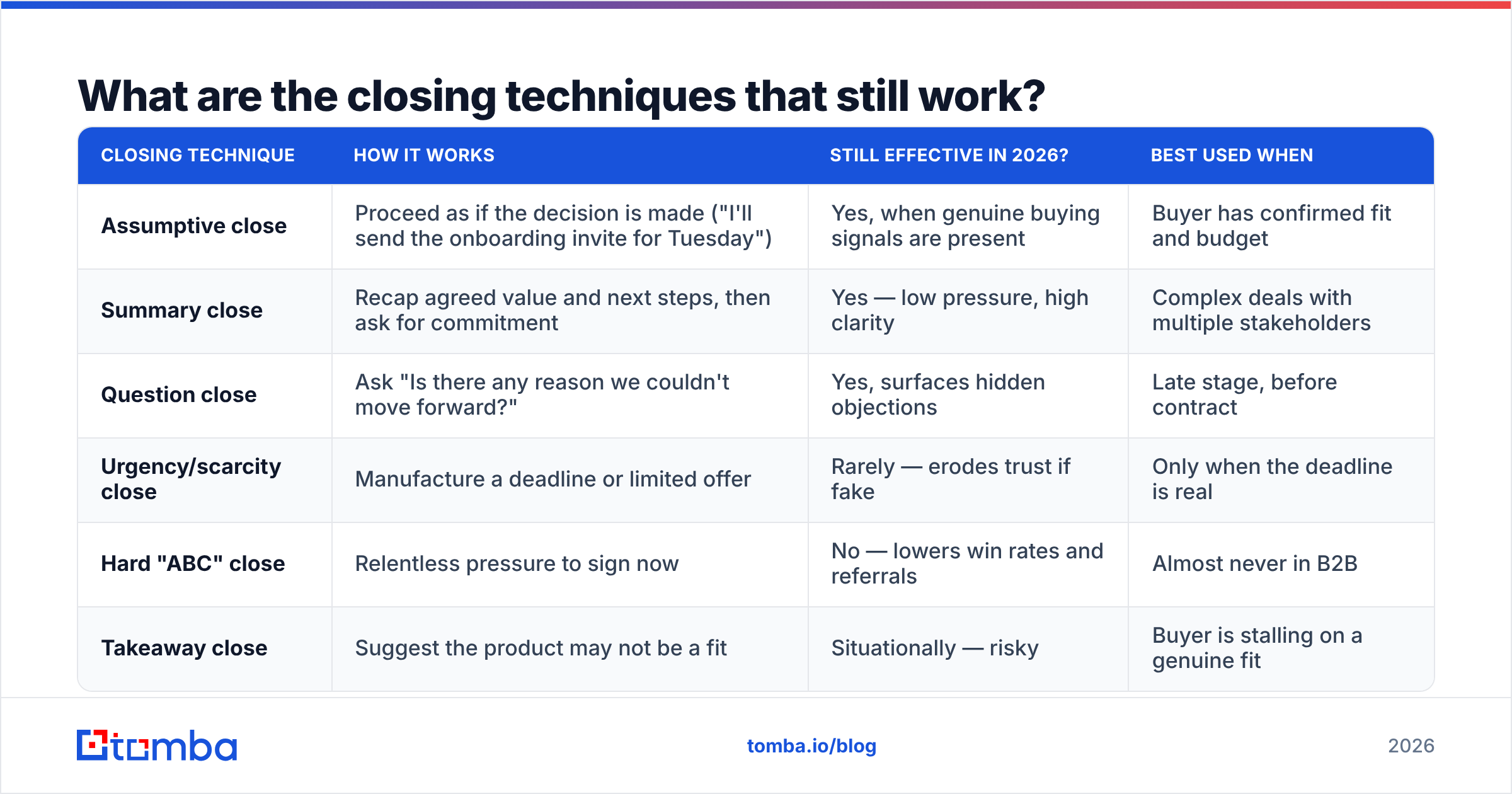
Plenty of "classic" closes are gimmicks that today's buyers see coming a mile away. A few, reframed for a consultative sale, still earn their place. Here's an honest comparison.
| Closing technique | How it works | Still effective in 2026? | Best used when |
|---|---|---|---|
| Assumptive close | Proceed as if the decision is made ("I'll send the onboarding invite for Tuesday") | Yes, when genuine buying signals are present | Buyer has confirmed fit and budget |
| Summary close | Recap agreed value and next steps, then ask for commitment | Yes — low pressure, high clarity | Complex deals with multiple stakeholders |
| Question close | Ask "Is there any reason we couldn't move forward?" | Yes, surfaces hidden objections | Late stage, before contract |
| Urgency/scarcity close | Manufacture a deadline or limited offer | Rarely — erodes trust if fake | Only when the deadline is real |
| Hard "ABC" close | Relentless pressure to sign now | No — lowers win rates and referrals | Almost never in B2B |
| Takeaway close | Suggest the product may not be a fit | Situationally — risky | Buyer is stalling on a genuine fit |
The pattern is clear: techniques that add clarity and respect the buyer's autonomy survive. Techniques built on pressure and manufactured fear don't — they may win a quarter and lose the renewal.
How do you handle objections without getting defensive?#
Treat every objection as a question in disguise. "It's too expensive" usually means "I'm not yet convinced of the ROI." "We're happy with our current vendor" often means "Give me a reason worth the switching cost." Defensiveness answers the words; good selling answers the underlying concern.
A simple, repeatable framework:
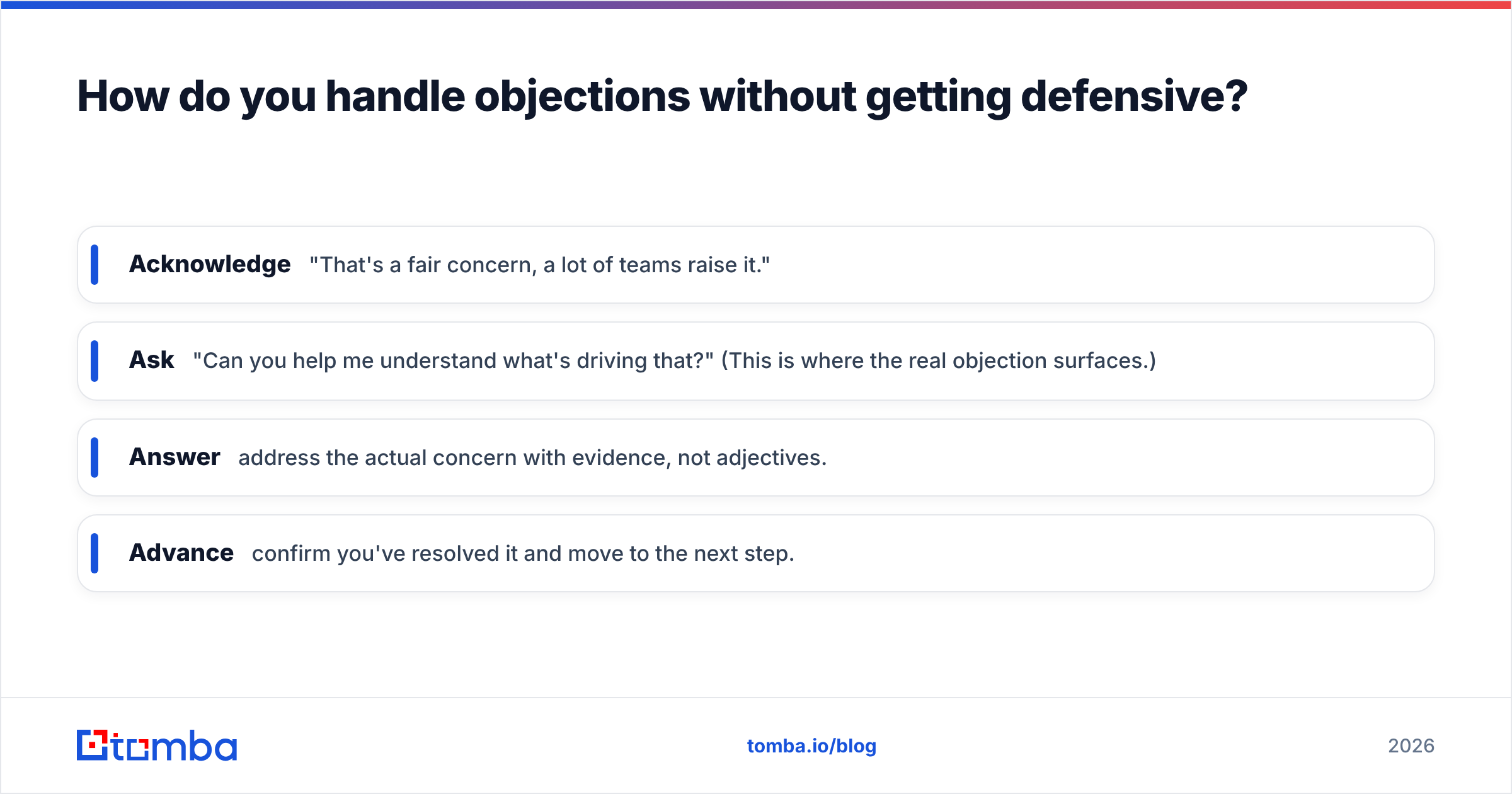
- Acknowledge — "That's a fair concern, a lot of teams raise it."
- Ask — "Can you help me understand what's driving that?" (This is where the real objection surfaces.)
- Answer — address the actual concern with evidence, not adjectives.
- Advance — confirm you've resolved it and move to the next step.
The most underrated move is the pause. After you answer, stop talking. Reps lose deals by nervously stacking three more points on top of a perfectly good answer, accidentally reopening doubt. Silence signals confidence.
For a deeper look at how objection-handling ties into pipeline health, the fundamentals of a healthy sales process and pipeline matter more than any single rebuttal — a well-qualified deal simply has fewer objections to handle.
Why does contact data decide deals before you ever pitch?#
Here's the closing skill nobody puts on a slide: you can't close a deal with someone you never actually reached.
A staggering share of outbound never lands because the email bounced, the number was dead, or the "decision-maker" left the company eight months ago. You can have a flawless discovery framework and a bulletproof objection playbook, and it all evaporates if your outreach hits a stale inbox. Reaching the economic buyer — not just a friendly champion — is often the single highest-leverage move in a stuck deal.
This is where clean, verified data pays off before the pitch even starts. Using an email finder to reach the right person, and an email verifier to confirm the address is live, means your carefully built messaging actually arrives. If you're prospecting into whole accounts, a domain search surfaces the other stakeholders you'll need to bring along — because in B2B, you rarely close a deal by convincing one person.
Think of it like a courtroom. Your argument can be airtight, but if the summons never reaches the judge, the case is dismissed by default. Contact accuracy is your summons.
How do you build a repeatable closing process?#
A "closing process" isn't a script — it's a sequence of small commitments that make the final yes almost inevitable. Each stage earns the right to the next.
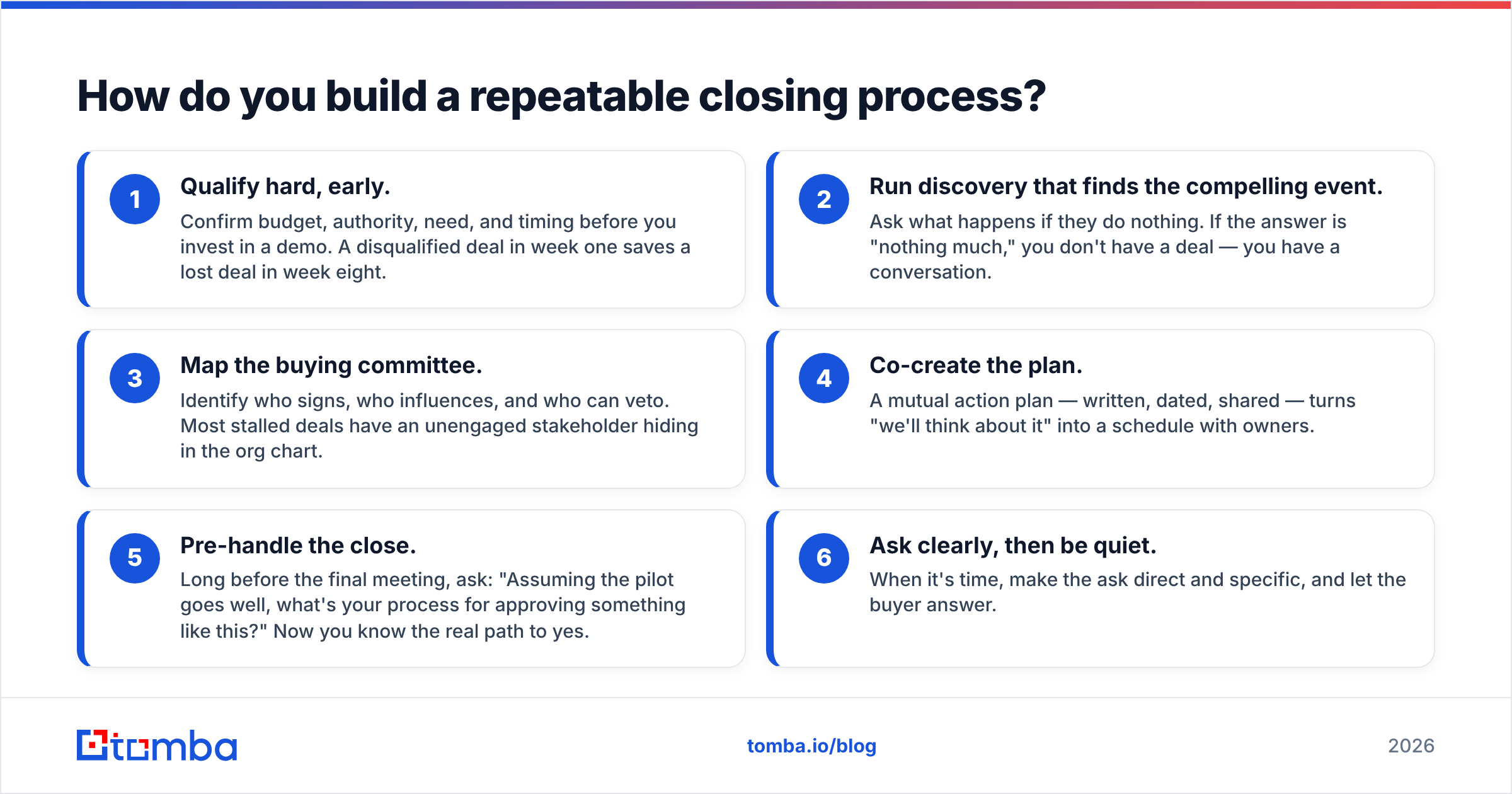
- Qualify hard, early. Confirm budget, authority, need, and timing before you invest in a demo. A disqualified deal in week one saves a lost deal in week eight.
- Run discovery that finds the compelling event. Ask what happens if they do nothing. If the answer is "nothing much," you don't have a deal — you have a conversation.
- Map the buying committee. Identify who signs, who influences, and who can veto. Most stalled deals have an unengaged stakeholder hiding in the org chart.
- Co-create the plan. A mutual action plan — written, dated, shared — turns "we'll think about it" into a schedule with owners.
- Pre-handle the close. Long before the final meeting, ask: "Assuming the pilot goes well, what's your process for approving something like this?" Now you know the real path to yes.
- Ask clearly, then be quiet. When it's time, make the ask direct and specific, and let the buyer answer.
The reps who consistently close aren't smoother talkers. They just do the boring middle steps that everyone else skips.
What tools actually help you close more deals?#
Tooling won't fix a bad process, but the right stack removes friction from a good one. The categories that matter for closing:
- Accurate contact data — so outreach reaches real decision-makers. Verified emails and B2B phone numbers mean fewer dead ends.
- A CRM you actually update — so next steps never fall through the cracks. Salesforce and HubSpot both anchor this for most teams.
- Data enrichment — so every record carries the context (title, company size, tech stack) you need to tailor the close.
- Mutual action plan templates — shared docs that keep both sides accountable to the timeline.
The connective tissue across all of these is data quality. A CRM full of bounced emails and outdated titles doesn't help you close; it helps you waste cycles. Feeding clean, enriched records into your pipeline — through data enrichment and disciplined verification — is unglamorous work that shows up directly in your win rate.
How do you know when a deal is ready to close?#
Watch for genuine buying signals rather than polite interest. Real signals include: the buyer introduces you to additional stakeholders, asks detailed implementation or pricing questions, requests references, or starts negotiating terms rather than fit. When the conversation shifts from "should we?" to "how would this work?", the deal has crossed the line.
Contrast that with false signals: enthusiastic language with no next-step commitment, "this looks great, let me loop back," or endless requests for more information without any decision movement. Enthusiasm is cheap; commitment is expensive. Chase the commitment.
If you're unsure, use the question close: "Is there anything standing between us and moving forward next week?" The answer either surfaces a final objection you can handle or confirms you're clear to close. Either way, you've learned the truth — which beats guessing.
Frequently asked questions#
What's the best closing line? There isn't one. The most reliable "line" is a clear, specific ask for a defined next step after you've resolved objections. Clarity outperforms cleverness.
How many touches does it take to close a B2B deal? It varies widely by deal size, but complex deals typically involve many touches across multiple stakeholders. The number matters less than reaching the right people — which is why verified contact data is foundational.
Is discounting a good way to close? Rarely as a first move. Leading with a discount trains buyers to wait for one and signals your price was inflated. Trade concessions for commitments (a longer term, a case study, a faster start) instead of giving them away.
How do I close a deal that's gone quiet? Re-establish the compelling event and offer a specific, low-friction next step. If it's truly dead, a respectful takeaway ("Should I close this out on our end?") often revives it or frees you to move on.
Close more deals by fixing what happens before the close#
The uncomfortable, freeing truth: you don't get better at closing by memorizing more closes. You get better by qualifying harder, discovering deeper, engaging the whole buying committee, and — critically — making sure your outreach reaches the real decision-makers in the first place.
That last part is where most pipelines silently leak, and it's the easiest to fix. Start with the contact data. Tomba's Email Finder helps you reach the exact person who can say yes — with verified, deliverable addresses so your best messaging actually lands. Pair it with the email verifier to keep bounces near zero, and check the Tomba pricing plans (free tier included, Starter at $49/mo) to find the fit for your team. Fix the top of the process, and the close takes care of itself.
Related guides#
Ready to find emails that actually work?
Join 150,000+ professionals who stopped guessing and started sending. Free credits on signup — no credit card required.
Get the Tomba newsletter
Practical outbound tactics and product updates — once every two weeks.
About the author