Closed Lost Deal Recovery: How to Win Back Lost Deals in 2026
Most closed-lost deals aren't dead — they're mistimed. Here's a practical closed lost deal recovery playbook to re-qualify, re-engage, and reclaim revenue your team already worked for.
Closed-lost is the most underrated pipeline your team already owns. Every deal marked "lost" cost you research, discovery calls, demos, and proposals — and then you walked away. But most of those deals didn't die on the merits. They stalled on timing, budget freezes, a champion who left, or a competitor who got there first. Closed lost deal recovery is the discipline of systematically bringing those deals back into an active buying conversation.
TL;DR#
- Closed lost deal recovery is a repeatable process for re-qualifying and re-engaging deals you previously marked lost — not random "just checking in" emails.
- Roughly 20–30% of closed-lost deals are recoverable within 6–18 months, because the loss reason was usually timing or circumstance, not a hard "no."
- The highest-ROI recovery targets are deals lost to no decision, budget/timing, or a champion departure — not deals lost to a clear feature gap.
- You need clean loss-reason data, fresh contact data (people change jobs), and a trigger-based cadence — not a mass blast.
- Tools like a reliable email finder and data enrichment matter because the person who told you "no" 12 months ago may not even work there anymore.
What is closed lost deal recovery?#
Closed lost deal recovery is the practice of re-opening previously lost opportunities when the conditions that caused the loss have changed. Think of it like a restaurant keeping the phone numbers of parties it had to turn away on a fully-booked Friday. You don't call them that night — you call when a table opens up and the reason for the "no" no longer applies.
In sales terms, a "closed lost" deal is any opportunity that entered your pipeline, progressed through at least one qualification stage, and then exited without a purchase. Recovery is not the same as re-prospecting a cold account. You already have context: who the buyer was, what they cared about, what objection killed the deal, and what your competitor promised. That context is exactly what makes recovery cheaper and faster than net-new lead generation.
The mistake most teams make is treating every lost deal as equally recoverable. It isn't. A deal lost because your product genuinely can't do what the buyer needs is a bad recovery target until your roadmap changes. A deal lost because "we don't have budget until next fiscal year" is a calendar reminder, not a rejection.

Why do most closed-lost deals stay dead?#
Because nobody owns them. Once a deal flips to closed-lost in the CRM, it falls out of every active report, every forecast, and every rep's daily task list. The win rate conversation moves on to open pipeline, and the lost deal becomes a graveyard entry.
There are three structural reasons recovery rarely happens on its own:
- No loss-reason hygiene. If your closed-lost reasons are a free-text field full of "went dark" and "no budget," you can't segment recoverable from unrecoverable. Recovery starts with clean, categorical loss data.
- Stale contact data. The average B2B contact changes roles every ~2–3 years. The champion who loved you may have left; the blocker who killed the deal may be gone too. Without refreshed data you're emailing a ghost.
- No trigger. Recovery works when something changed — new funding, a leadership hire, a competitor's price increase, a product release that closes the old gap. Without a trigger, a recovery email is just noise.
According to HubSpot's sales research, following up persistently and with relevance is one of the biggest separators between average and top performers — and closed-lost is the most relevance-rich follow-up pool you have.
Which closed-lost deals are actually worth recovering?#
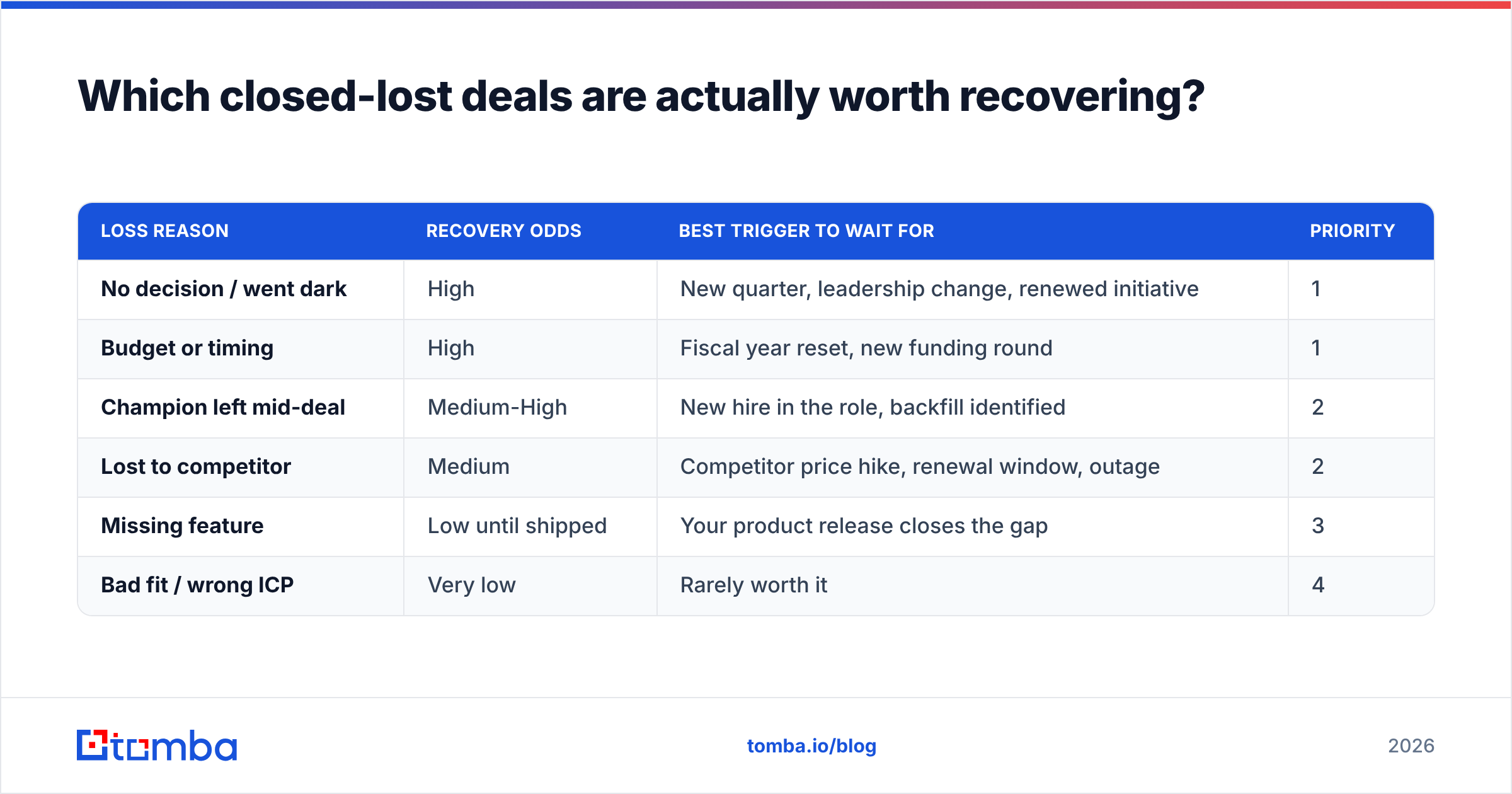
Not all of them. Score your closed-lost list before you touch it. Here's a simple framework for triaging recovery targets by loss reason.
| Loss reason | Recovery odds | Best trigger to wait for | Priority |
|---|---|---|---|
| No decision / went dark | High | New quarter, leadership change, renewed initiative | 1 |
| Budget or timing | High | Fiscal year reset, new funding round | 1 |
| Champion left mid-deal | Medium-High | New hire in the role, backfill identified | 2 |
| Lost to competitor | Medium | Competitor price hike, renewal window, outage | 2 |
| Missing feature | Low until shipped | Your product release closes the gap | 3 |
| Bad fit / wrong ICP | Very low | Rarely worth it | 4 |
The pattern is clear: prioritize deals where the buyer wanted to buy but couldn't, and deprioritize deals where the buyer decided you were wrong. Recovering the first group is a timing exercise. Recovering the second requires your offering to have genuinely changed.
A useful rule of thumb: if a deal reached proposal or negotiation before dying, it's a strong recovery candidate. The buyer invested real time; the relationship existed. Deals that died in early discovery are closer to cold prospecting and belong in a different motion.
How do you build a closed-lost recovery process?#
Run it as a five-step loop, not a one-off campaign.
1. Segment by loss reason. Pull every closed-lost deal from the last 6–24 months and bucket them using the table above. If your loss reasons are messy, this is the moment to clean them. Gartner and other analysts consistently tie forecast accuracy to CRM data quality — the same discipline pays off here. (See Gartner's sales research for why data hygiene compounds.)
2. Refresh the contact data. Before you send anything, verify that your contacts still exist and still work there. Re-run each account through a domain search to find current employees, then confirm each address with an email verifier so you're not torching your sender reputation on dead mailboxes. If your champion left, this step surfaces their replacement — often a warmer entry point than the original blocker.
3. Identify a trigger. Map each recoverable deal to the event that would make re-engagement relevant: a funding announcement, a new VP hire, a competitor's public stumble, or a product update on your side. No trigger, no send.
4. Re-qualify before you re-pitch. The single biggest recovery error is picking up exactly where the deal left off. Circumstances changed — that's why you're back. Open by re-qualifying: is the initiative still alive, is there budget now, who owns the decision today? Treat it as a fresh discovery informed by history, not a resurrected proposal.
5. Measure and feed it back. Track recovery rate by loss reason so you learn which segments actually convert. Feed that back into step one next quarter.

What should a closed-lost recovery message say?#
Lead with the change, not the ask. A recovery email that says "just circling back to see if you're ready now" gets ignored because it puts the work on the buyer. A recovery email that says "you mentioned budget was the blocker last spring — two things changed that I think fix that" earns a reply because it does the connecting for them.
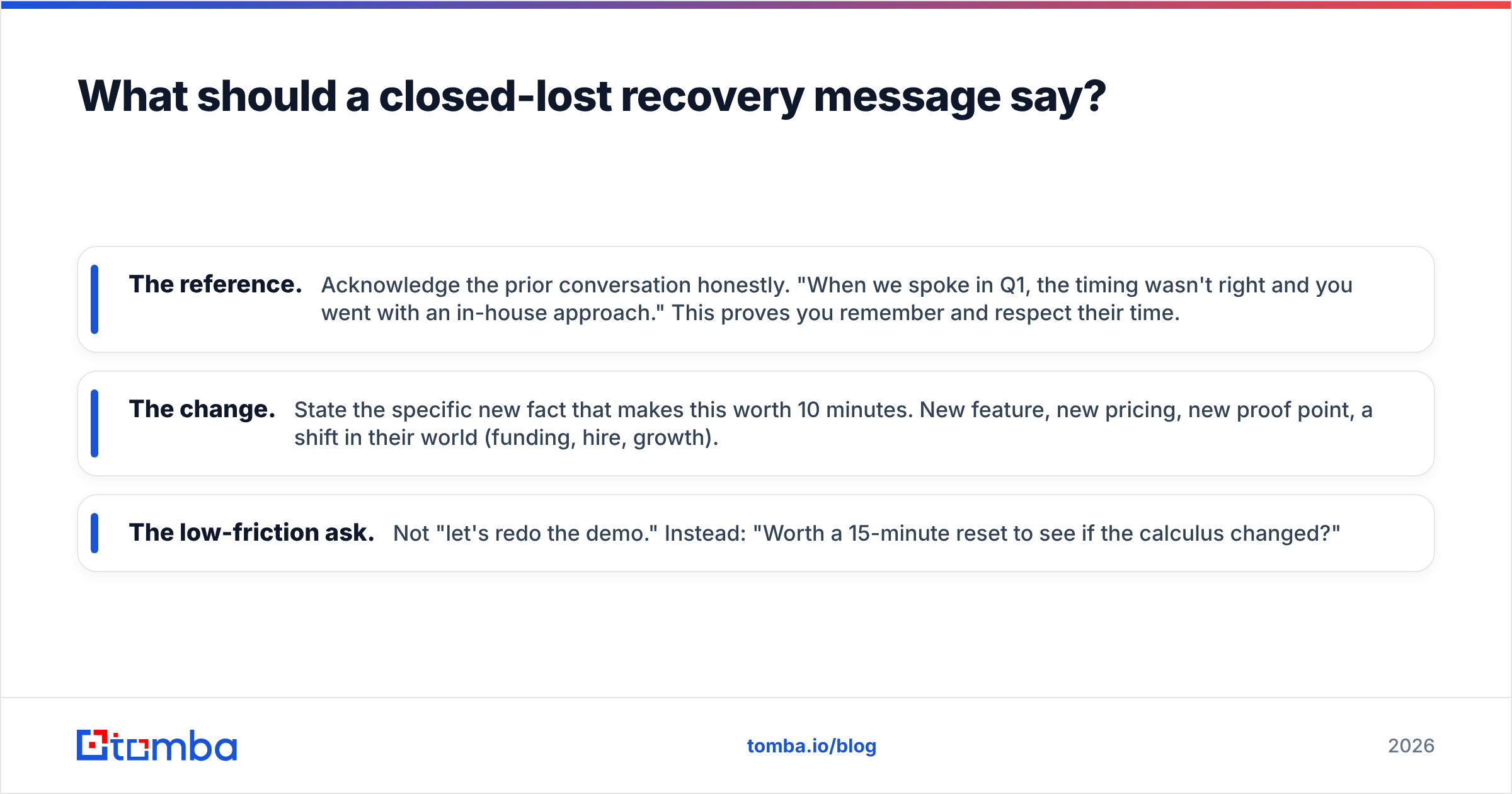
A strong recovery sequence has three beats:
- The reference. Acknowledge the prior conversation honestly. "When we spoke in Q1, the timing wasn't right and you went with an in-house approach." This proves you remember and respect their time.
- The change. State the specific new fact that makes this worth 10 minutes. New feature, new pricing, new proof point, a shift in their world (funding, hire, growth).
- The low-friction ask. Not "let's redo the demo." Instead: "Worth a 15-minute reset to see if the calculus changed?"
Keep it short, keep it specific, and personalize with the account's current reality — not the reality from when the deal died. If you're re-engaging at scale, a good response rate depends far more on relevance and timing than on volume. For subject lines and framing, our cold email templates library is a useful starting point you can adapt to a win-back angle.
Closed-lost recovery vs. net-new prospecting: which wins?#
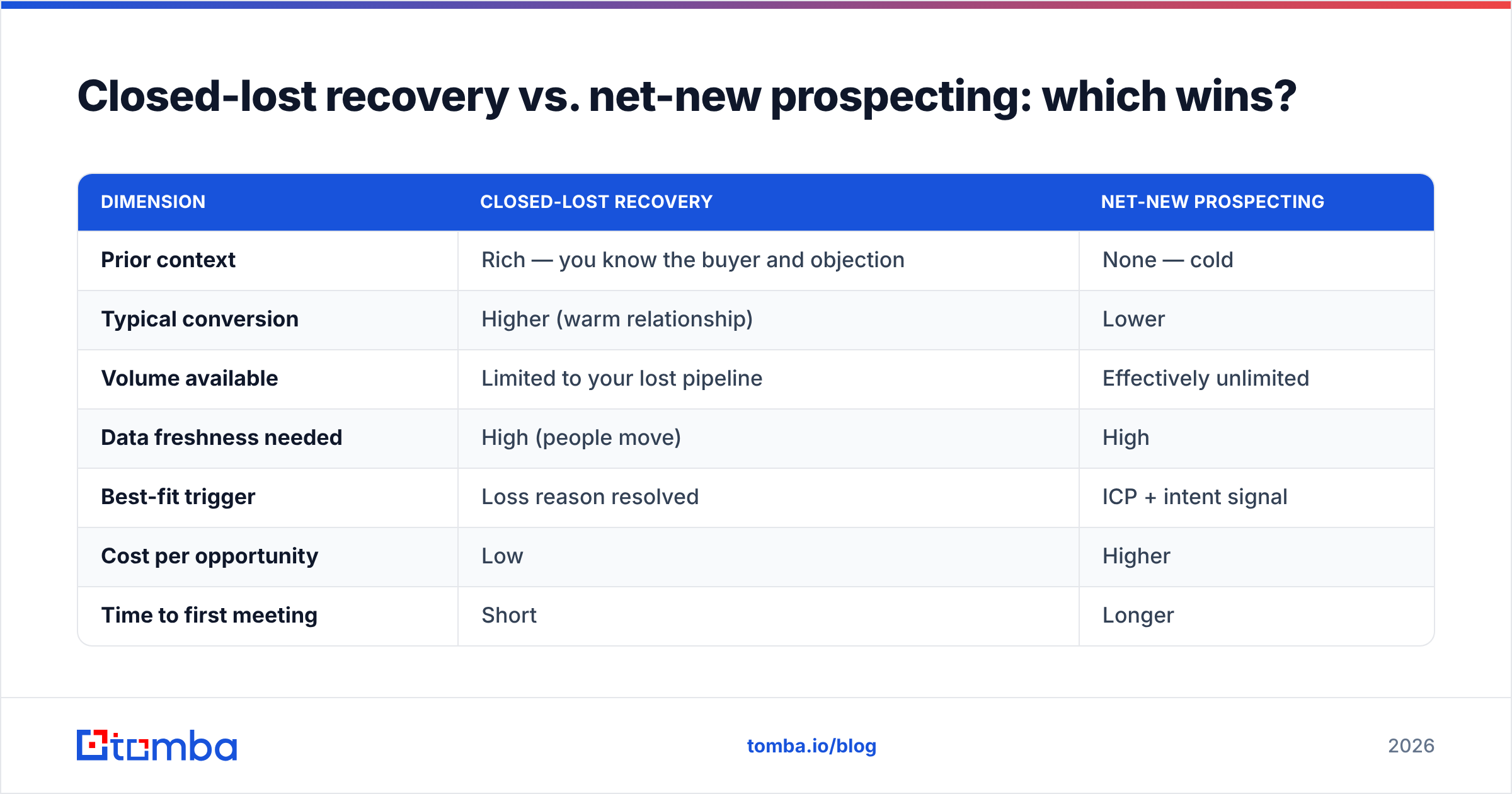
Both belong in your motion, but they solve different problems. Recovery is a higher-conversion, lower-volume play; net-new is the opposite. Here's how they compare on the dimensions that matter for pipeline planning.
| Dimension | Closed-lost recovery | Net-new prospecting |
|---|---|---|
| Prior context | Rich — you know the buyer and objection | None — cold |
| Typical conversion | Higher (warm relationship) | Lower |
| Volume available | Limited to your lost pipeline | Effectively unlimited |
| Data freshness needed | High (people move) | High |
| Best-fit trigger | Loss reason resolved | ICP + intent signal |
| Cost per opportunity | Low | Higher |
| Time to first meeting | Short | Longer |
The takeaway: recovery is the first place a resource-constrained team should look, because the cost per re-opened opportunity is a fraction of net-new. But recovery pipeline is finite. Once you've worked your recoverable segment, growth comes from net-new. The best-run teams cycle recovery quarterly and run net-new continuously.
What tools and data do you need to run recovery at scale?#
Three things: clean loss data, fresh contact data, and a cadence tool. Your CRM handles the first and third — the missing piece for most teams is keeping contact data current across a list of deals that went cold months ago.
That's where accurate contact discovery earns its keep. When you reopen a 12-month-old deal, expect that a meaningful share of your original contacts have moved on. You'll need to:
- Find the current decision-maker at the account (roles change, teams reorg).
- Confirm the email is deliverable before you send, so you protect sender reputation.
- Enrich the account with current firmographics so your trigger detection is accurate.
For a repeatable version of this, run your recovery list through a bulk email finder to refresh contacts in one pass, then validate the results. G2 and Capterra reviews of contact-data tools consistently flag data accuracy and freshness as the deciding factor — see G2's category comparisons if you're evaluating options, because a recovery motion built on stale data fails before the first send.
How do you measure closed-lost recovery success?#
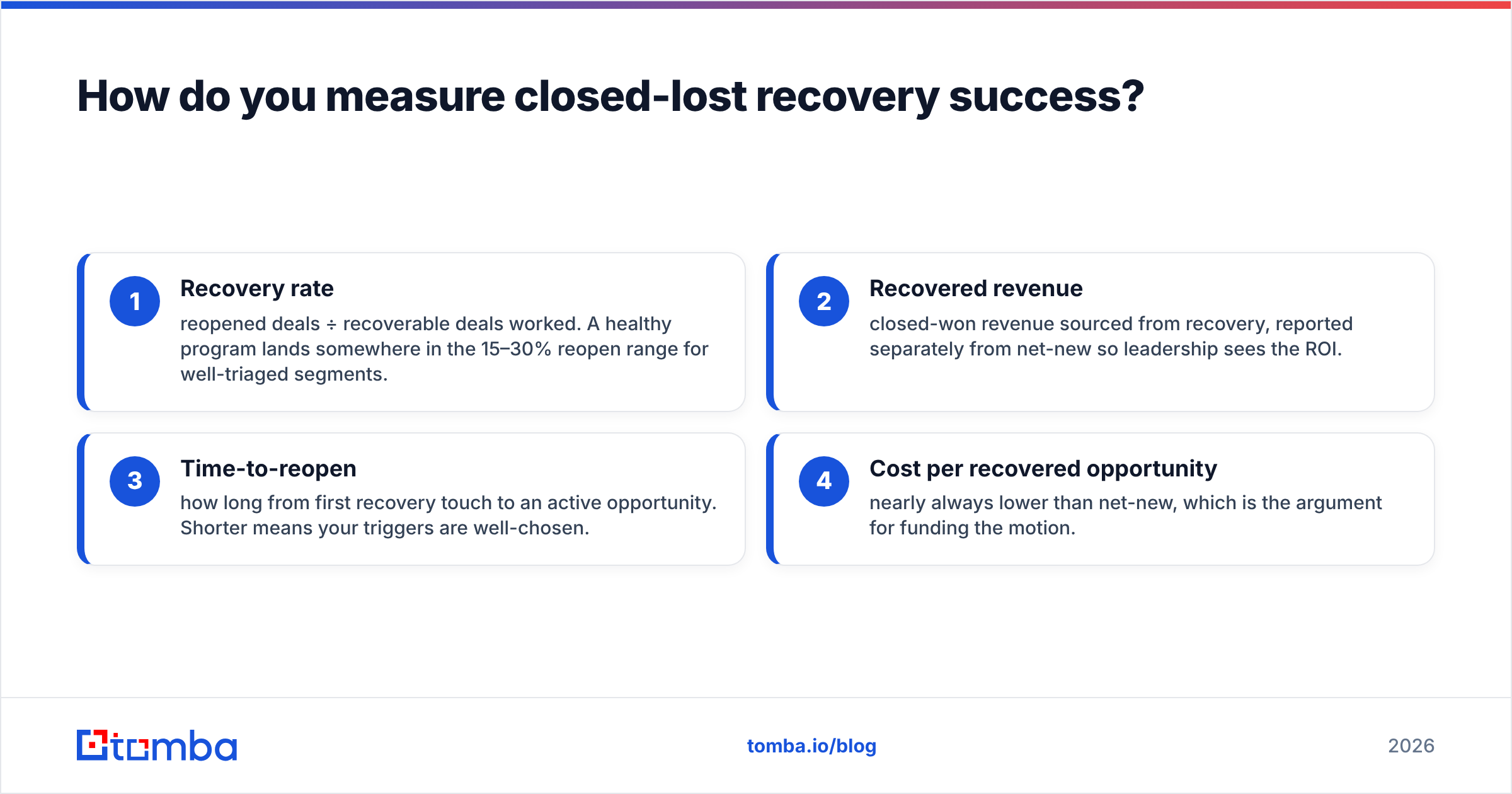
Track four metrics, and track them by loss reason so the numbers are actionable:
- Recovery rate — reopened deals ÷ recoverable deals worked. A healthy program lands somewhere in the 15–30% reopen range for well-triaged segments.
- Recovered revenue — closed-won revenue sourced from recovery, reported separately from net-new so leadership sees the ROI.
- Time-to-reopen — how long from first recovery touch to an active opportunity. Shorter means your triggers are well-chosen.
- Cost per recovered opportunity — nearly always lower than net-new, which is the argument for funding the motion.
If your recovery rate is near zero, the problem is almost always upstream: bad loss-reason data or stale contacts, not bad messaging. Fix the data first.
Common mistakes that kill recovery programs#
- Blasting the whole closed-lost list. Untriaged mass sends annoy good-fit buyers and burn your domain. Segment first.
- Reopening bad-fit deals. If they were never your ICP, they still aren't. Recovery is not a second chance to force a mismatch.
- Emailing dead contacts. Skipping verification tanks deliverability and hides your real recovery signal in a pile of bounces.
- Picking up mid-proposal. The world changed — re-qualify, don't resurrect.
- No owner. If recovery isn't someone's explicit job with a target, it won't happen. Assign it.
Turn dead pipeline into won-back revenue#
Closed-lost is not a graveyard — it's a warm list you already paid to build. The teams that win it back do three things well: they keep clean loss-reason data, they refresh contacts before they reach out, and they wait for a real trigger before they send. Everything else is message craft on top of that foundation.
The step most teams get wrong is the data. When you reopen an aging deal, the original contact may be gone and the original email may bounce. Start your recovery motion by refreshing every account with the Tomba Email Finder — find the current decision-maker, verify the address, and enrich the account so your triggers are accurate. You can begin on the free tier (25 searches/month) and scale into the Starter plan at $49/mo as your recovery list grows; see full Tomba pricing for details. Clean data in, won-back revenue out.
Related guides#
Ready to find emails that actually work?
Join 150,000+ professionals who stopped guessing and started sending. Free credits on signup — no credit card required.
Get the Tomba newsletter
Practical outbound tactics and product updates — once every two weeks.
About the author