Closed Won Meaning: What It Is and Why It Matters in Sales
Closed won is the stage where a deal becomes real revenue. Here's what it actually means, how it differs from closed lost, and how to log it cleanly in your CRM.
Closed won is one of those phrases every sales team says out loud but few define the same way. Ask three reps what it means and you'll get three answers — a signed contract, a verbal yes, or "the deal moved to the last column in the pipeline." Those differences matter, because closed won is the single stage that turns forecasted pipeline into recognized revenue.
This guide gives you a clean, no-fluff definition of the closed won meaning, shows how it sits against closed lost and open opportunities, and explains how to log it consistently so your forecast stays honest.
TL;DR#
- Closed won means a deal has been finalized in your favor — the prospect agreed to buy and the opportunity is marked as revenue in your CRM.
- It is a terminal stage: once an opportunity is closed won, it no longer counts as active pipeline.
- The opposite is closed lost, where the deal ends without a purchase.
- Your win rate is calculated from closed won divided by all closed deals — so sloppy logging quietly corrupts every forecast you build.
- Clean contact and account data is what makes closed won repeatable, not accidental.
What is the closed won meaning in sales?#
Closed won is the deal stage that marks an opportunity as successfully sold. It's the moment a prospect stops being a prospect and becomes a customer, and the opportunity value moves from "expected" to "earned."
Think of your pipeline like a checkout line at a store. Every shopper in line is an open opportunity — they might buy, they might walk out. Closed won is the receipt printing. It's not the intention to buy, not the friendly nod during a demo. It's the finalized commitment: signed order form, accepted quote, processed payment, or whatever your business treats as the point of no return.
The exact trigger varies by company. For a self-serve SaaS product, closed won might fire automatically when a credit card clears. For enterprise sales, it usually means a countersigned contract. The important thing is that your team agrees on one definition and applies it every single time. A shared definition of closed won is what keeps the same deal from being celebrated twice or logged three different ways.
Where closed won sits in the pipeline#
A typical B2B pipeline runs through discovery, qualification, proposal, and negotiation before it reaches a terminal stage. Closed won and closed lost are the two exits. Everything before them is "open" and counts toward your active forecast; everything at those two stages is "closed" and drops out of the working pipeline.
That terminal quality is the whole point. Once a deal is closed won, it stops inflating your open pipeline number and starts feeding your revenue and win-rate reports instead.
How is closed won different from closed lost?#
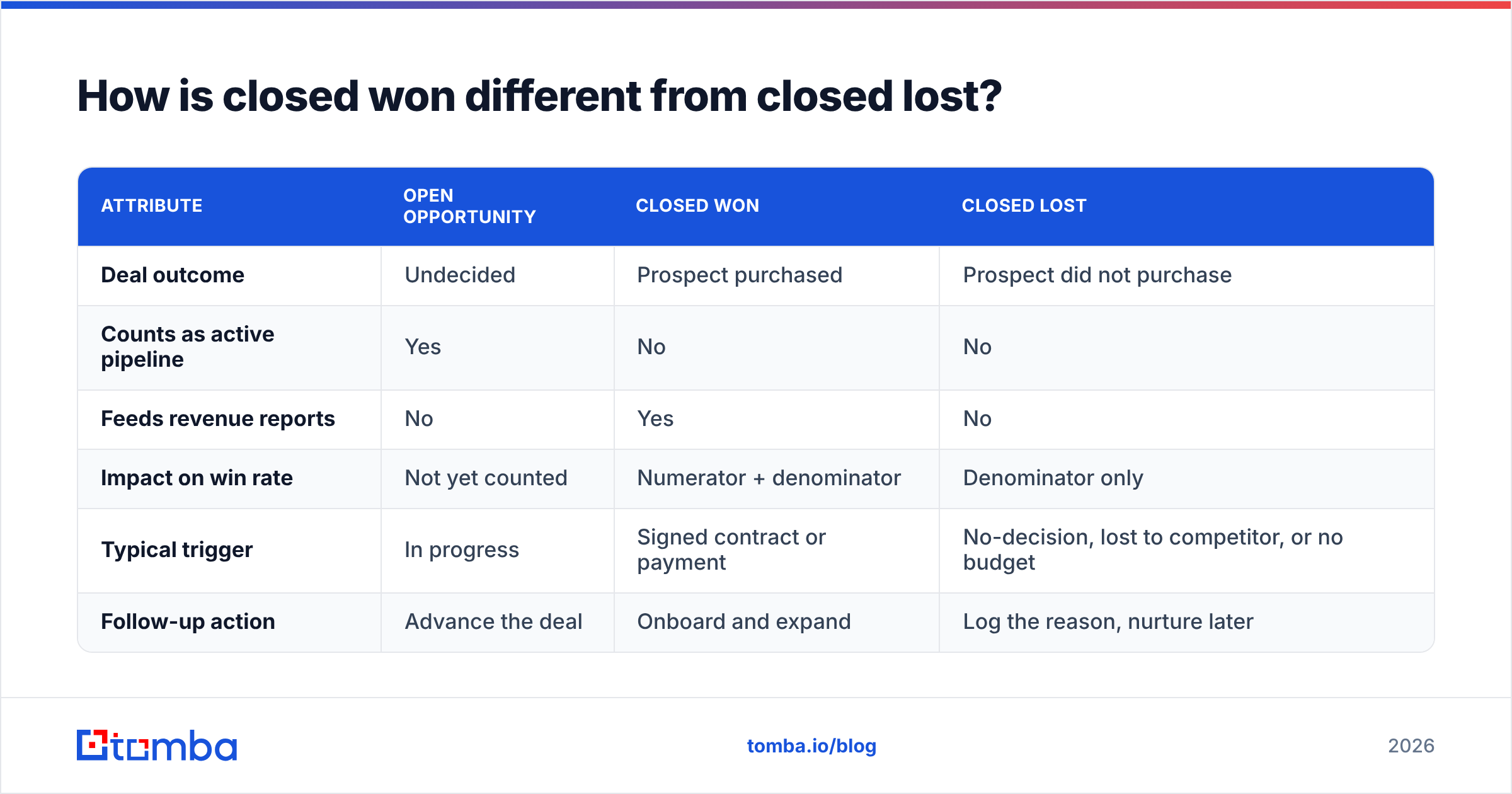
Closed won and closed lost are both endpoints — one is revenue, the other is a learning opportunity. They share the "closed" label because both remove the deal from active pipeline, but they mean opposite outcomes.
| Attribute | Open opportunity | Closed won | Closed lost |
|---|---|---|---|
| Deal outcome | Undecided | Prospect purchased | Prospect did not purchase |
| Counts as active pipeline | Yes | No | No |
| Feeds revenue reports | No | Yes | No |
| Impact on win rate | Not yet counted | Numerator + denominator | Denominator only |
| Typical trigger | In progress | Signed contract or payment | No-decision, lost to competitor, or no budget |
| Follow-up action | Advance the deal | Onboard and expand | Log the reason, nurture later |
The most common mistake is treating closed lost as a dead end. A well-documented loss reason — price, timing, competitor, no budget — is data you can act on. Feed those reasons back into your targeting and messaging, and last quarter's closed lost becomes next quarter's closed won. HubSpot's own sales pipeline guidance makes the same point: the stages only help you if the definitions behind them are consistent.
Why does the closed won meaning matter for your forecast?#
Because every revenue and performance metric you report is built on top of it. If closed won is logged inconsistently, the numbers above it are fiction.
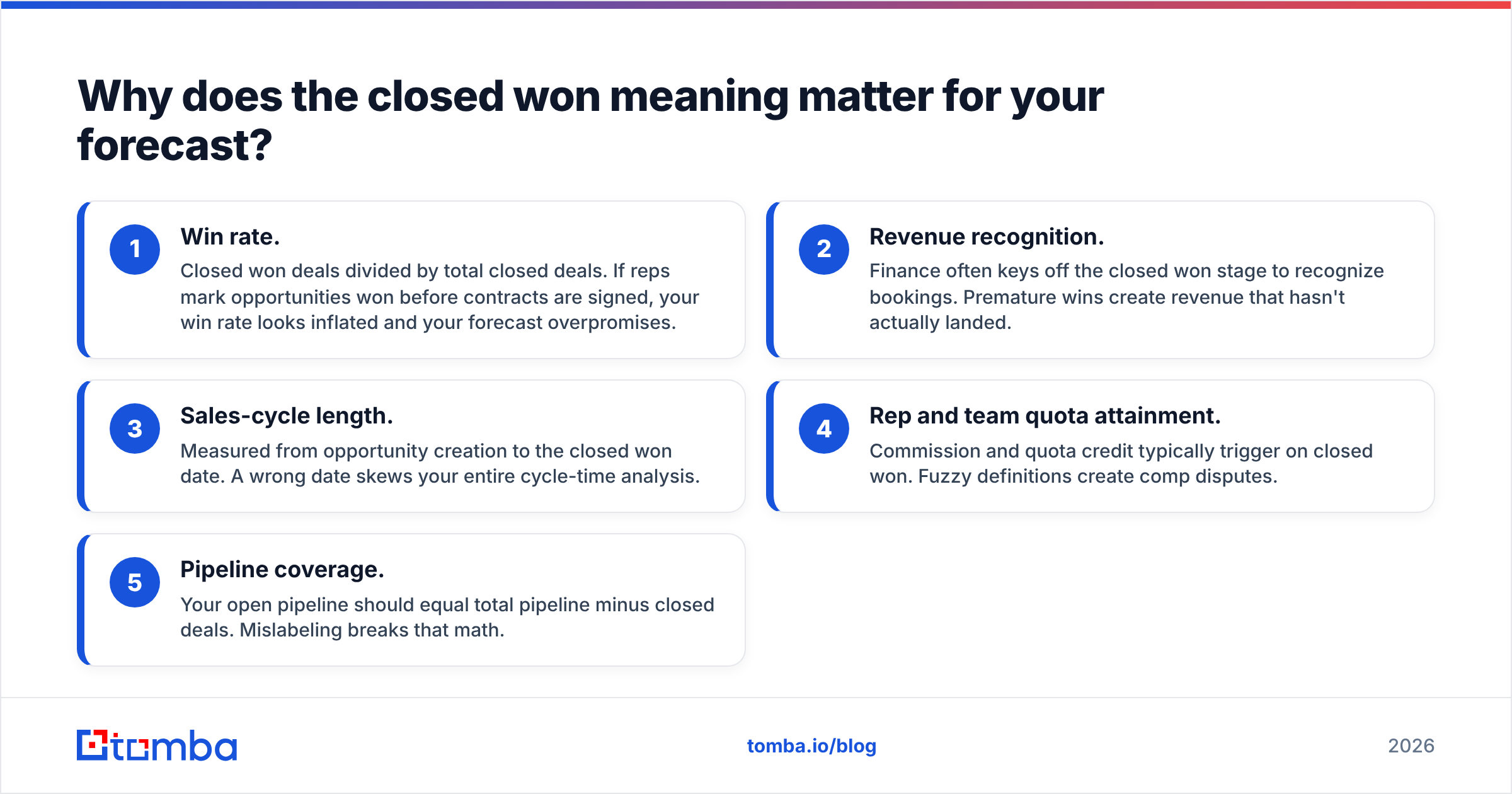
Here are the metrics that depend directly on a clean closed won definition:
- Win rate. Closed won deals divided by total closed deals. If reps mark opportunities won before contracts are signed, your win rate looks inflated and your forecast overpromises.
- Revenue recognition. Finance often keys off the closed won stage to recognize bookings. Premature wins create revenue that hasn't actually landed.
- Sales-cycle length. Measured from opportunity creation to the closed won date. A wrong date skews your entire cycle-time analysis.
- Rep and team quota attainment. Commission and quota credit typically trigger on closed won. Fuzzy definitions create comp disputes.
- Pipeline coverage. Your open pipeline should equal total pipeline minus closed deals. Mislabeling breaks that math.
Salesforce, whose platform popularized the "Closed Won" and "Closed Lost" stage names, treats these as hard stage transitions for exactly this reason — see their opportunity stages documentation. Analysts at Gartner consistently find that forecast accuracy is one of the top pain points for revenue leaders, and inconsistent stage hygiene is a root cause.

What makes a deal reach closed won faster?#
Closed won is downstream of everything you do earlier in the funnel — the cleaner your inputs, the more predictable the outcome. You cannot will a deal to close, but you can remove the friction that stalls it.
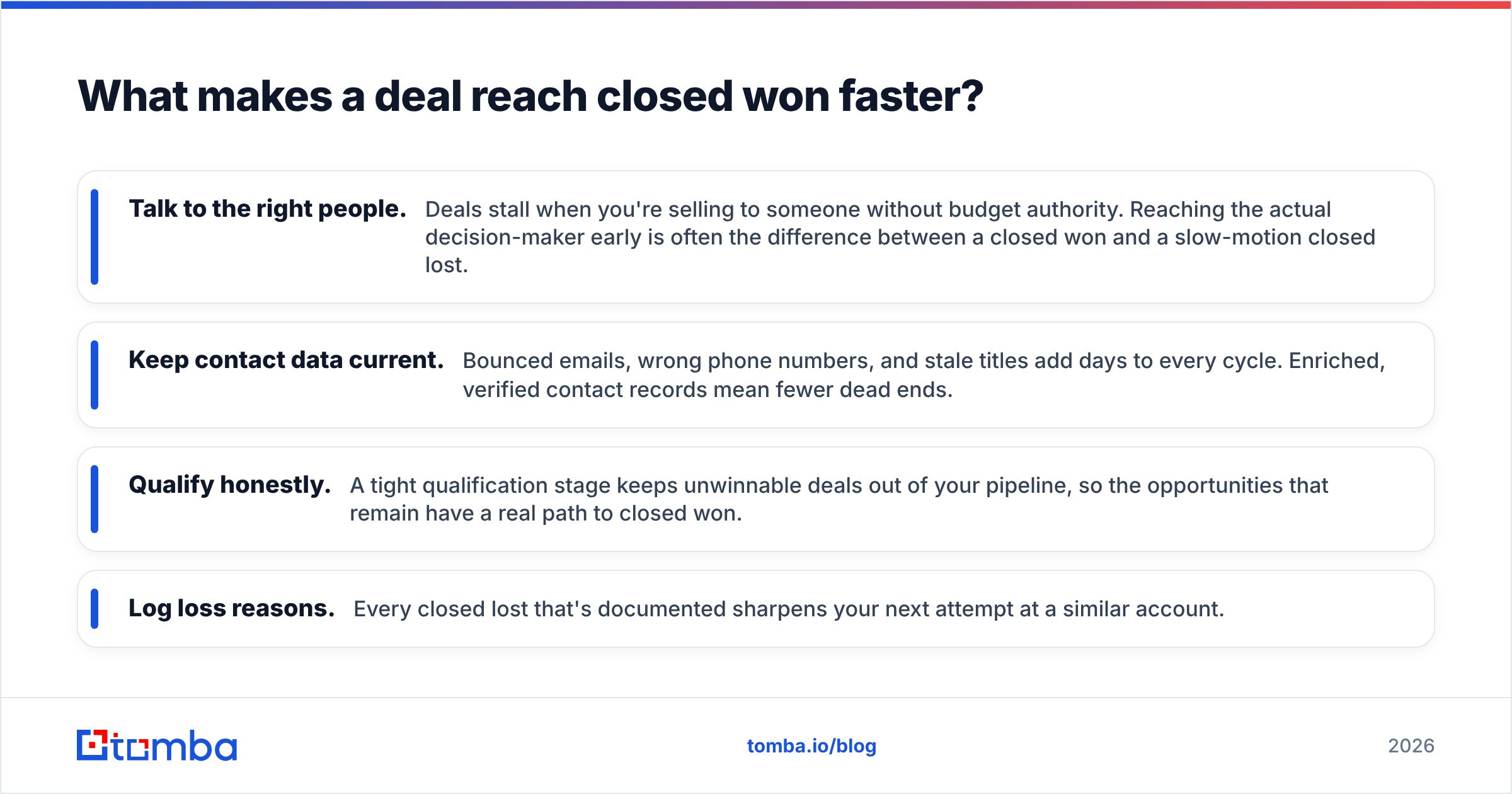
- Talk to the right people. Deals stall when you're selling to someone without budget authority. Reaching the actual decision-maker early is often the difference between a closed won and a slow-motion closed lost.
- Keep contact data current. Bounced emails, wrong phone numbers, and stale titles add days to every cycle. Enriched, verified contact records mean fewer dead ends.
- Qualify honestly. A tight qualification stage keeps unwinnable deals out of your pipeline, so the opportunities that remain have a real path to closed won.
- Log loss reasons. Every closed lost that's documented sharpens your next attempt at a similar account.
This is where data quality quietly decides your win rate. If your reps spend the first week of every deal chasing a valid email or a direct line, that's time not spent closing. Tools that help you find email addresses for verified decision-makers, or enrich leads with accurate firmographics, compress the front of the funnel — which is exactly where most closed won delays are born.
How should you log closed won in your CRM?#
Consistently, with a shared trigger, and never before the money is real. Here's a practical checklist your whole team can follow.
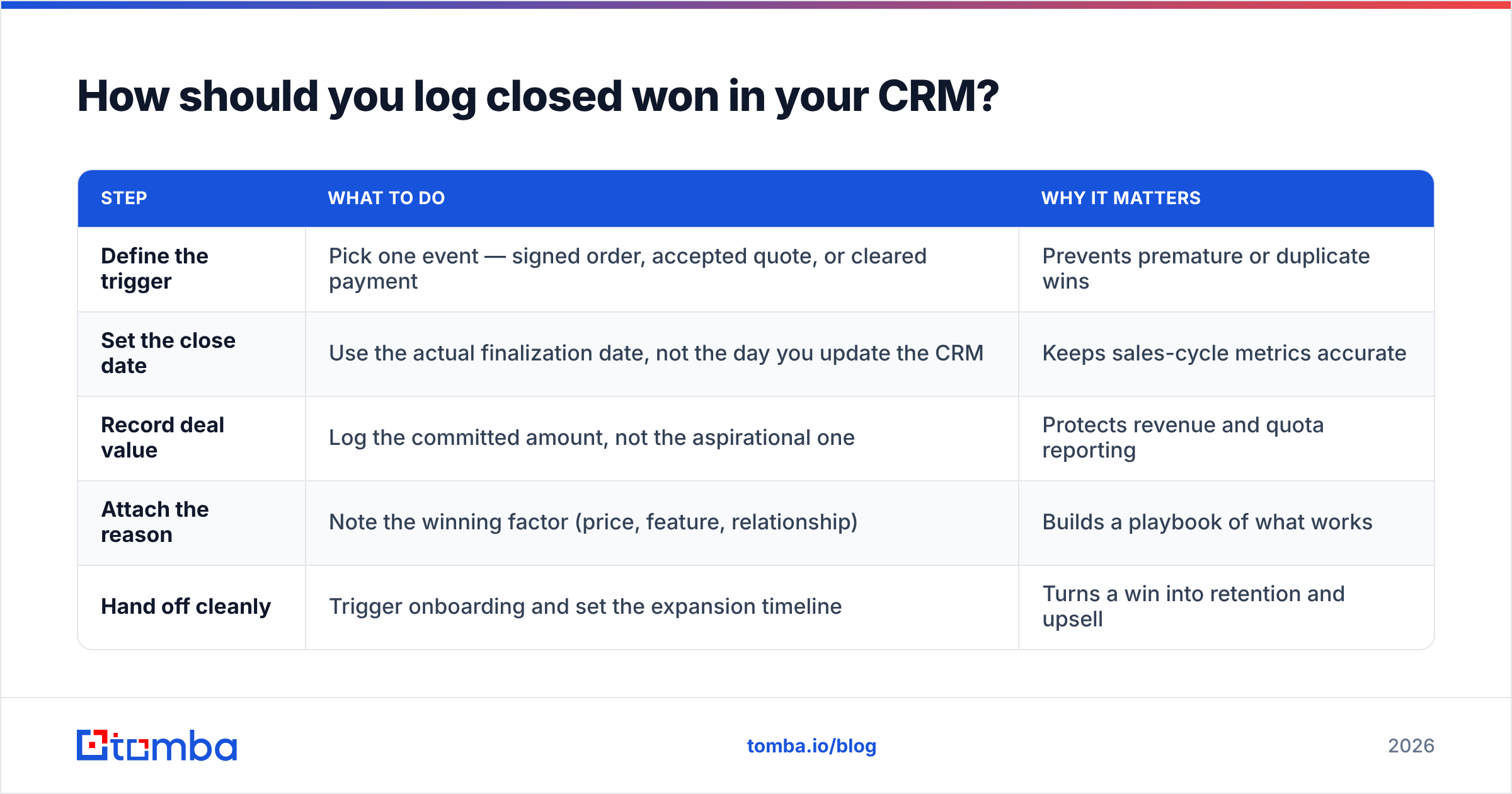
| Step | What to do | Why it matters |
|---|---|---|
| Define the trigger | Pick one event — signed order, accepted quote, or cleared payment | Prevents premature or duplicate wins |
| Set the close date | Use the actual finalization date, not the day you update the CRM | Keeps sales-cycle metrics accurate |
| Record deal value | Log the committed amount, not the aspirational one | Protects revenue and quota reporting |
| Attach the reason | Note the winning factor (price, feature, relationship) | Builds a playbook of what works |
| Hand off cleanly | Trigger onboarding and set the expansion timeline | Turns a win into retention and upsell |
A few rules keep this from drifting:
- One definition per organization. Not per rep, not per region. Document it in your CRM's stage description so nobody has to guess the closed won meaning.
- No backdating to hit a number. Moving a deal's close date to land it in the current quarter is the fastest way to destroy forecast trust.
- Audit periodically. Pull a sample of closed won deals each month and confirm each has a real signed artifact behind it.
If you run revenue operations, this hygiene is your job to enforce. RevOps teams that standardize stage definitions across the go-to-market motion see cleaner forecasts and fewer end-of-quarter surprises. And because your CRM is the system of record, the data feeding it — contacts, companies, verified emails — has to be trustworthy before closed won means anything at all.
What happens after a deal is closed won?#
The win is a starting line, not a finish line. Closing the deal earns you a customer; keeping and growing that customer is where most of the lifetime value lives.
Immediately after closed won, three things should happen:
- Handoff to onboarding or customer success with full context — what the customer bought, why, and who the stakeholders are.
- Expansion planning. Note upsell and cross-sell opportunities while the relationship is warm.
- Referral and case-study capture. A fresh closed won customer is your best source of social proof and warm introductions.
Treating closed won as the end of the relationship is how companies churn revenue they worked hard to win. The best revenue teams loop the outcome back into targeting: which closed won profiles renew, expand, and refer — and how do you find more accounts that look exactly like them.
Common questions about closed won#
Is closed won the same as a signed contract? Usually, but not always. For enterprise deals a countersigned contract is the trigger; for self-serve products it may be a cleared payment. Define it once and stick to it.
Can a closed won deal be reopened? Rarely, and it should be discouraged. If a "won" deal falls through, most teams create a new opportunity rather than reopening the old one, so historical win-rate math stays intact.
Does closed won mean the cash is in the bank? Not necessarily. Closed won marks the commitment to buy; collection and revenue recognition are separate finance steps. This is why premature wins are so damaging — they imply money that hasn't arrived.
Who owns the closed won definition? RevOps or sales operations should own it, with finance aligned, so bookings and quota credit reconcile cleanly.
The bottom line#
Closed won means a deal is finalized in your favor and counted as revenue — nothing more, nothing less. Its power comes from consistency: when every rep applies the same trigger and logs the same date, your win rate, forecast, and quota reports all tell the truth. When they don't, every number downstream is quietly wrong.
The fastest way to create more closed won deals is to fix the front of the funnel — reach the right decision-makers with accurate contact data before your competitors do. Tomba's Email Finder helps your team find and verify professional email addresses by name, domain, or company, so reps spend less time hunting for contacts and more time closing them. Start on the free tier (25 searches a month) and see how much faster clean data moves a deal from open to closed won.
Related guides#
// get started
Find, verify and enrich your first contacts today
Start on the free plan with 25 searches a month, then scale when your team is ready.
Free plan · No credit card required · GDPR & CCPA
// about the author