Closing Email Phrases That Get Replies (2026 Guide + Examples)
The last line of your email decides whether you get a reply or a ghost. Here are the closing email phrases that actually move deals forward — plus the ones quietly killing your response rate.
Your body copy can be perfect, but the last two lines are where the reply is won or lost. A vague "let me know your thoughts" hands the reader an easy exit. A specific, low-friction ask gives them one obvious next step. This guide breaks down the closing email phrases that consistently earn replies, the ones that quietly tank your response rate, and how to match the sign-off to the situation.
TL;DR#
- The close is a CTA, not a courtesy. Every email should end with one clear, specific, easy-to-answer request — not a polite fade-out.
- Specific beats open-ended. "Are you free Thursday at 2pm ET?" outperforms "let me know when works" because it removes decisions for the reader.
- Match the phrase to the relationship. Cold prospects, warm leads, and internal colleagues each need a different tone and level of directness.
- Kill the reply-killers. "Just checking in," "circling back," and "thoughts?" are filler that signal low effort and get ignored.
- The sign-off is not the close. "Best regards" is your signature line; the closing phrase is the sentence before it that drives action.
Why do closing email phrases decide whether you get a reply?#
Because the end of an email is the part people act on. Readers skim the middle and stop at the last line, where their brain asks a single question: "What do I do now?" If the answer is unclear, the default action is to do nothing — and nothing is what most vague emails get.
Think of your email like a checkout page. You can have a beautiful product and a persuasive description, but if the "Buy" button is hidden or asks for ten form fields, the cart gets abandoned. Your closing phrase is the button. The clearer and lower-friction it is, the more people click.
There is also a psychological driver called the recency effect: people best remember the last thing they read. Whatever tone and request you leave them with sets the emotional frame for their reply. End with confident specificity and you get a confident reply. End with apologetic hedging ("sorry to bother you again...") and you invite hesitation.
If you want to see how much your close matters in raw numbers, track your response rate across two versions of the same email with different closings. In most cold and warm campaigns, the closing line moves reply rates more than any single edit to the body.
Wait — that's the wrong kind of asking. Here's the meme:
What makes a strong closing email phrase?#
Three things: it is specific, it is easy to say yes to, and it fits the relationship. Strip any of those and the phrase weakens.
- Specificity. Name a date, a decision, or a resource. "Does Tuesday or Wednesday work better for a 15-minute call?" beats "let's find time to chat."
- Low friction. The ideal ask can be answered in one word or one click. Binary questions (this or that? yes or no?) convert best because they require no drafting from the reader.
- A single ask. One email, one request. Two questions split attention and usually get zero answers.
- Reader-centered framing. Lead with their benefit, not your need. "So you can hit your Q3 targets" lands better than "so I can close this deal."
- Confidence without pressure. Assume the next step is reasonable. "Happy to send times" reads better than "if it's not too much trouble, maybe we could possibly..."
- A matching sign-off. The sign-off (Best, Cheers, Thanks) should mirror the formality of the ask and the relationship.
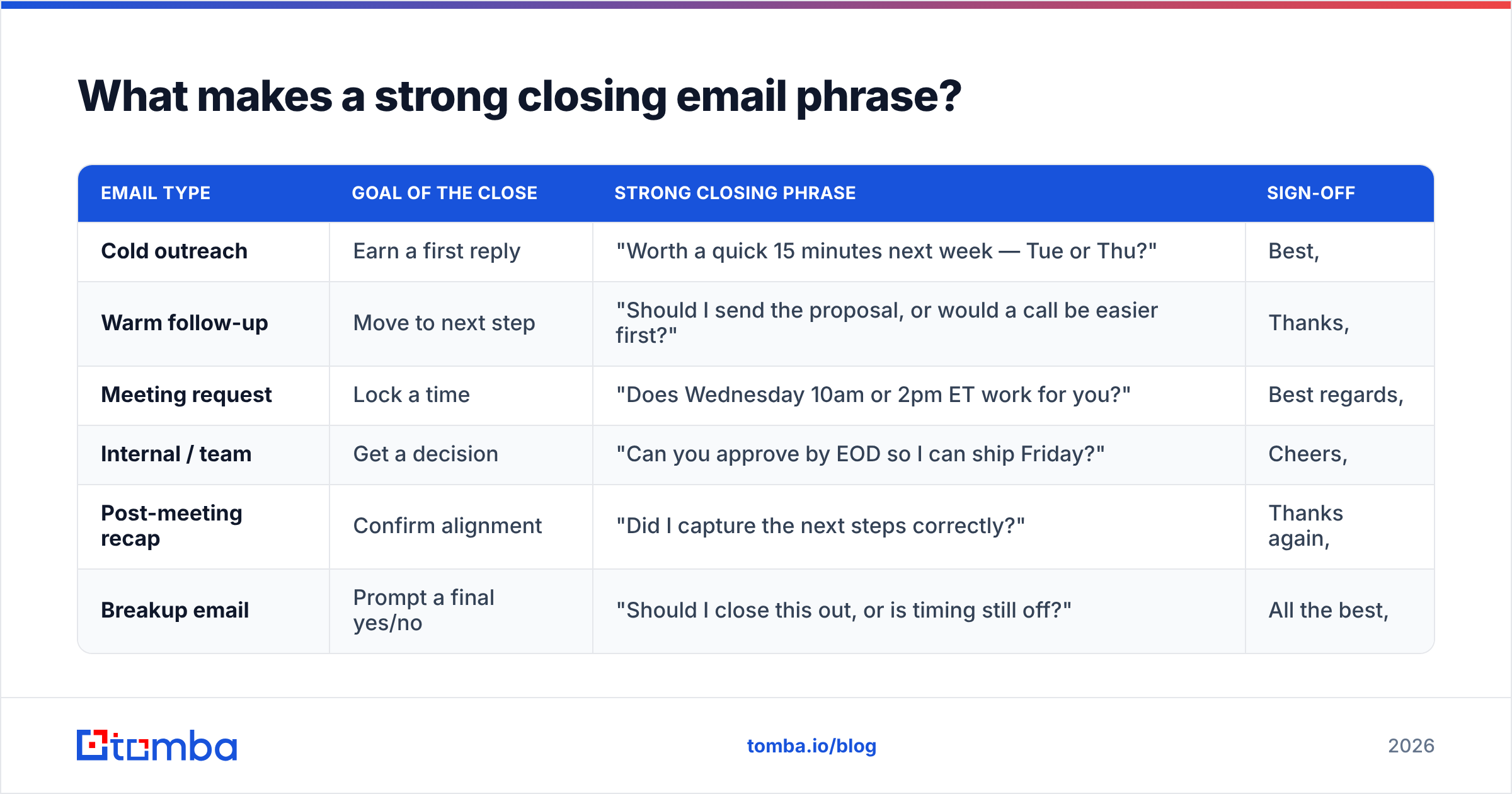
Here is how those elements map to different email types, so you can pick the right close instead of defaulting to the same line every time.
| Email type | Goal of the close | Strong closing phrase | Sign-off |
|---|---|---|---|
| Cold outreach | Earn a first reply | "Worth a quick 15 minutes next week — Tue or Thu?" | Best, |
| Warm follow-up | Move to next step | "Should I send the proposal, or would a call be easier first?" | Thanks, |
| Meeting request | Lock a time | "Does Wednesday 10am or 2pm ET work for you?" | Best regards, |
| Internal / team | Get a decision | "Can you approve by EOD so I can ship Friday?" | Cheers, |
| Post-meeting recap | Confirm alignment | "Did I capture the next steps correctly?" | Thanks again, |
| Breakup email | Prompt a final yes/no | "Should I close this out, or is timing still off?" | All the best, |
Notice that every "strong closing phrase" ends in a question mark or a clear directive. That is not an accident — a question is an open loop the reader feels compelled to close.
Which closing email phrases actually get replies?#
The ones that give the reader a specific, effortless next action. Below are proven closers grouped by intent. Copy them, swap in your details, and test them against whatever you use now.
To book a meeting
- "Are you free for 15 minutes Thursday at 2pm ET? If not, I'll send a couple of other times."
- "Would a quick call this week or next be more useful?"
- "Here's my calendar link — grab whatever slot works: [link]."
To get a decision or answer
- "Is this a priority for you this quarter, yes or no? Totally fine either way."
- "Which option fits better — the monthly plan or the annual one?"
- "Should I loop in your ops lead, or are you the right person for this?"
To advance a warm deal
- "Want me to send the contract, or would you rather walk through it live first?"
- "What's the one thing you'd need to see to move forward?"
To close a follow-up gracefully
- "If now isn't the right time, just reply 'not now' and I'll check back next quarter."
- "I'll assume the timing's off unless I hear otherwise — no hard feelings."
These work because they respect the reader's time and hand them a decision they can make in seconds. For more ready-to-use structures, pair these closers with proven email templates so the entire message pulls in one direction. And if you're writing at volume, a tool like cold email AI can draft variants of the same close so you can split-test which phrasing wins.
Major sales orgs publish similar guidance. HubSpot's research on sales email best practices consistently finds that specific, single-ask closings outperform open-ended ones, and Salesforce's sales resources echo the point: the clearer the next step, the shorter the sales cycle.
Which closing phrases quietly kill your reply rate?#
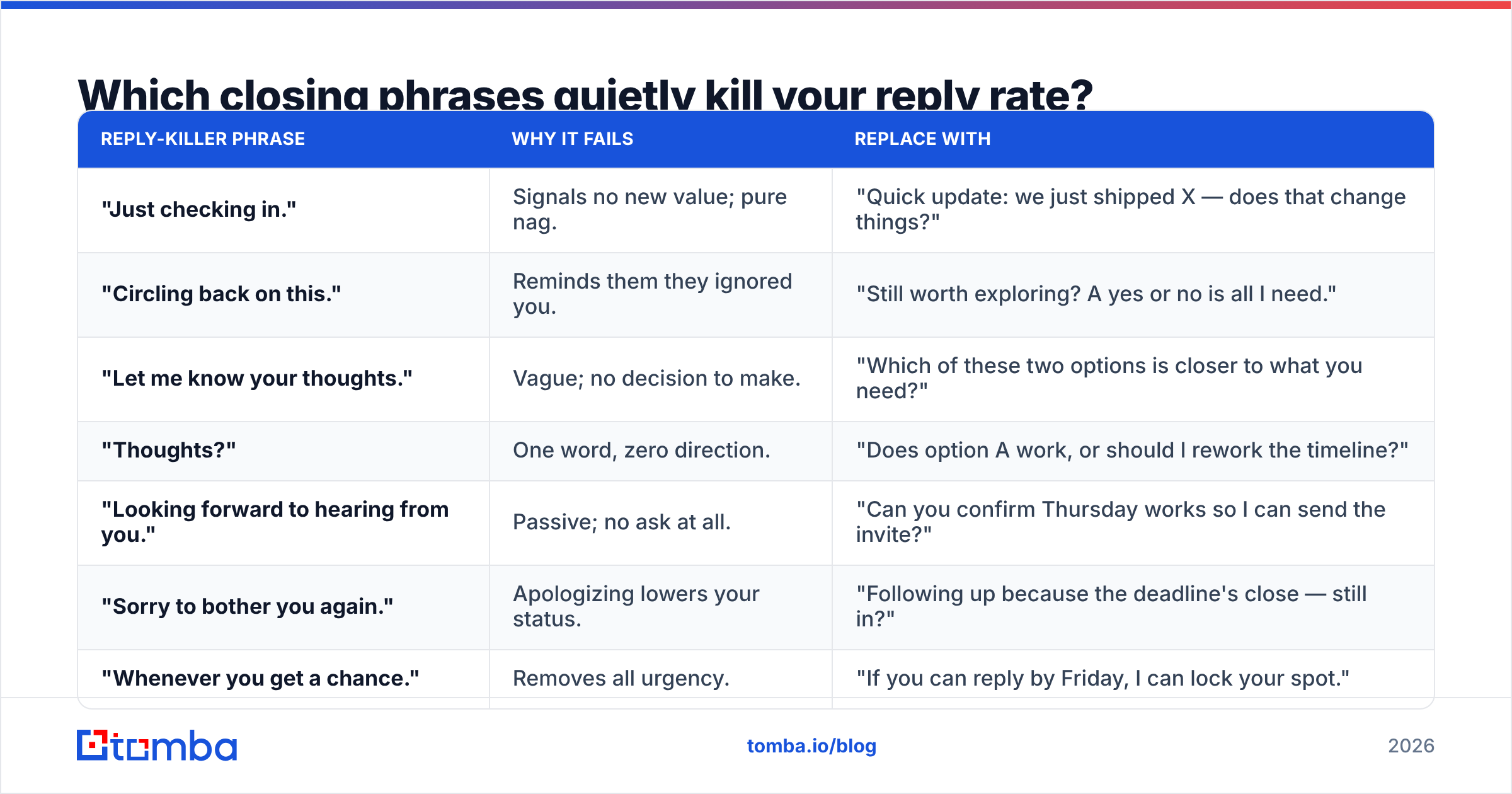
The polite-but-empty ones that give the reader nothing to act on. These phrases feel safe, which is exactly why they fail — they ask for zero commitment and get zero response.
| Reply-killer phrase | Why it fails | Replace with |
|---|---|---|
| "Just checking in." | Signals no new value; pure nag. | "Quick update: we just shipped X — does that change things?" |
| "Circling back on this." | Reminds them they ignored you. | "Still worth exploring? A yes or no is all I need." |
| "Let me know your thoughts." | Vague; no decision to make. | "Which of these two options is closer to what you need?" |
| "Thoughts?" | One word, zero direction. | "Does option A work, or should I rework the timeline?" |
| "Looking forward to hearing from you." | Passive; no ask at all. | "Can you confirm Thursday works so I can send the invite?" |
| "Sorry to bother you again." | Apologizing lowers your status. | "Following up because the deadline's close — still in?" |
| "Whenever you get a chance." | Removes all urgency. | "If you can reply by Friday, I can lock your spot." |
| "Hope this finds you well." | Filler; not a close at all. | (Cut it entirely and end with a real ask.) |
The pattern is obvious once you see it: reply-killers describe your action ("checking in," "circling back") while strong closers request their action ("can you confirm," "which option"). Rewrite any phrase that centers you into one that centers them.
Sending "just checking in" for the fourth time and being shocked by zero replies is the most avoidable outcome in sales. The fix costs nothing: end with a real question.
How should the closing phrase change for cold vs. warm emails?#
Cold emails need to earn permission; warm emails need to reduce friction. That difference should show up in your last line.
In a cold email, you have no relationship equity, so the close must be tiny and easy. Ask for a micro-commitment: a yes/no, a single reply, or 15 minutes — never a 60-minute demo or a big decision. Lead with their outcome and make declining painless, because giving people an easy "no" paradoxically increases replies (including the yes's).
- Cold, strong: "Worth a quick look? Reply 'yes' and I'll send a 2-minute overview."
- Cold, weak: "Let me know if you'd like to schedule a comprehensive product walkthrough."
In a warm email — someone who replied, met with you, or downloaded something — you can be more direct and ask for a bigger next step, because you've earned it. Reference the prior context so the close feels continuous.
- Warm, strong: "Great chatting Tuesday — should I send the contract, or would a quick call with your team be more useful first?"
- Warm, weak: "Just following up to see if you had any thoughts on our conversation."
The bridge between the two is data. You can't send a warm, specific close if you emailed the wrong person, so getting an accurate address up front matters as much as the wording. A reliable email finder ensures your carefully written close actually reaches a decision-maker instead of bouncing — because the best closing line in the world can't fix a dead inbox.
What about the sign-off — does "Best regards" still matter?#
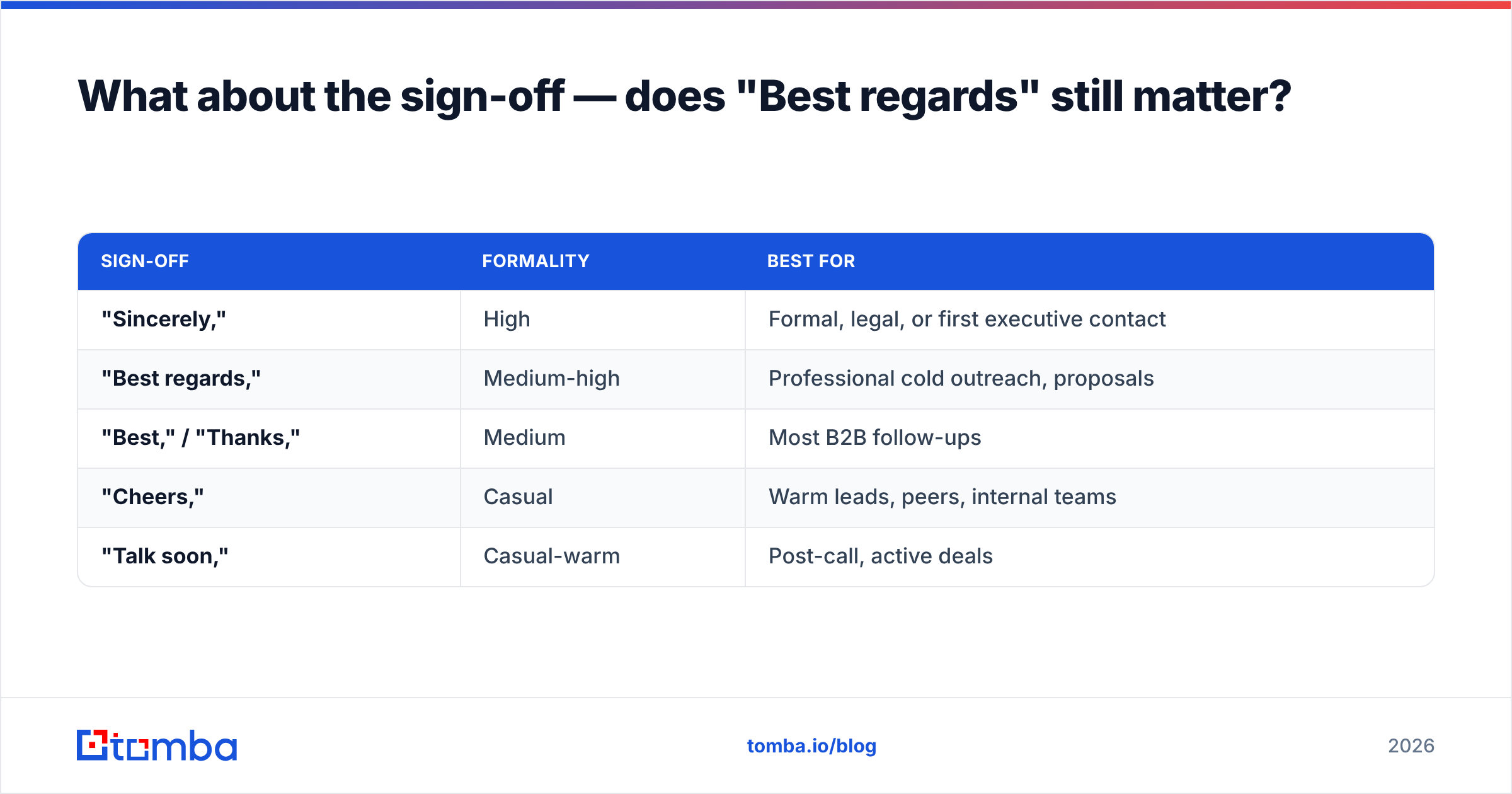
Yes, but less than the sentence above it. The sign-off sets tone; the closing phrase drives action. Get the phrase right first, then match the sign-off to formality.
For a quick reference on tone, the general rules of email etiquette still hold: more formal for first contact and senior stakeholders, more casual as the relationship warms. Here's a practical ladder.
| Sign-off | Formality | Best for |
|---|---|---|
| "Sincerely," | High | Formal, legal, or first executive contact |
| "Best regards," | Medium-high | Professional cold outreach, proposals |
| "Best," / "Thanks," | Medium | Most B2B follow-ups |
| "Cheers," | Casual | Warm leads, peers, internal teams |
| "Talk soon," | Casual-warm | Post-call, active deals |
A few rules that hold across all of them: keep it consistent within a thread, don't stack redundant closings ("Thanks in advance, Best regards"), and never let the sign-off contradict the ask — "Cheers" under a formal contract request feels off, and "Sincerely" on a friendly nudge feels stiff.
How do you test and improve your closing phrases?#
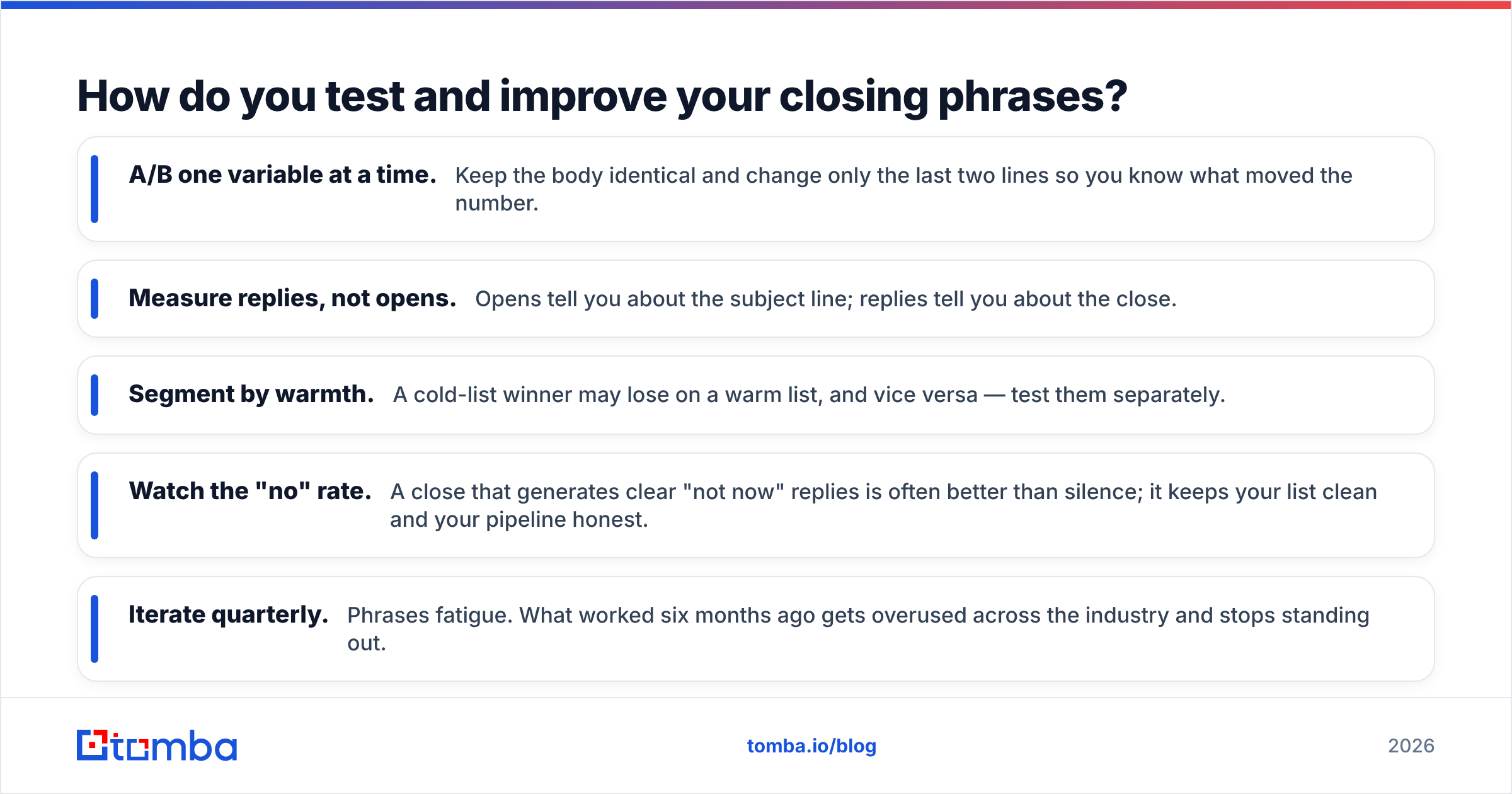
Treat closers like subject lines: pick two, send them to comparable segments, and measure replies. The close is one of the highest-leverage single-variable tests you can run because it changes reader behavior directly.
- A/B one variable at a time. Keep the body identical and change only the last two lines so you know what moved the number.
- Measure replies, not opens. Opens tell you about the subject line; replies tell you about the close.
- Segment by warmth. A cold-list winner may lose on a warm list, and vice versa — test them separately.
- Watch the "no" rate. A close that generates clear "not now" replies is often better than silence; it keeps your list clean and your pipeline honest.
- Iterate quarterly. Phrases fatigue. What worked six months ago gets overused across the industry and stops standing out.
Log the results somewhere durable. Even a simple spreadsheet tracking "closing phrase → reply rate" will, within a few weeks, tell you which lines are pulling their weight and which are dead. G2's sales software reviews are full of teams reporting the same finding: the smallest copy changes at the end of an email produce the largest swings in engagement.
The bottom line#
Great closing email phrases share a single DNA: they hand the reader one specific, effortless action framed around their benefit. Cut the polite filler, drop the self-centered "just checking in," and end every email with a real question or a clear next step. Then test relentlessly — the close is the cheapest, fastest lever you have on reply rate.
Of course, the sharpest closing line only works if it reaches the right inbox. Before you obsess over your last sentence, make sure the email itself is deliverable. Use the Tomba Email Finder to find and verify accurate professional addresses by name, domain, or company — so every reply-worthy close you write actually lands in front of a real decision-maker. Start free with 25 searches a month, and see how much your response rate climbs when your best phrases finally reach the people who can say yes.
Related guides#
// get started
Find, verify and enrich your first contacts today
Start on the free plan with 25 searches a month, then scale when your team is ready.
Free plan · No credit card required · GDPR & CCPA
// about the author