Closing Phrases for Sales: 40+ Lines That Win the Deal
The exact closing phrases for sales that move a hesitant buyer to yes — with scripts for email and calls, timing rules, and the weak lines quietly killing your deals.
TL;DR
- The best closing phrases for sales are short, assume the sale, and hand the buyer one clear next step instead of a vague "let me know."
- Weak closers ("Just following up," "Let me know your thoughts") stall deals because they put all the work on the prospect.
- Different channels need different closes: email closes ask for a specific reply, call closes ask for a decision, and both work better when framed around the buyer's timeline.
- Timing beats wording. A great line at the wrong moment reads as pushy; the same line after you've confirmed value feels natural.
- You can't close a deal you never started — accurate contact data is the unglamorous first half of every closing script.
What Makes a Closing Phrase Actually Work?#
A closing phrase works when it removes friction, not when it sounds clever. Think of it like holding a door open: you're not shoving the person through, you're just making the next step effortless so saying yes is easier than saying "maybe later."
Three qualities separate a real closer from filler:
- It assumes forward motion. "When would you like to start?" outperforms "Do you want to start?" because it frames the decision as how, not if.
- It asks for one specific action. "Can you reply with a yes and I'll send the contract today?" beats "Let me know your thoughts" because there's zero ambiguity about what happens next.
- It's earned. A close only lands after the buyer has felt the value. Drop it too early and you sound like a telemarketer; drop it after a genuine "this could help us" and it feels like a natural conclusion.
Sales research backs this up. Gong's analysis of sales calls consistently shows that deals advance when reps make clear, confident next-step requests rather than trailing off politely. Politeness that avoids the ask is the single most common reason good conversations die.
What Are the Best Closing Phrases for Sales Emails?#
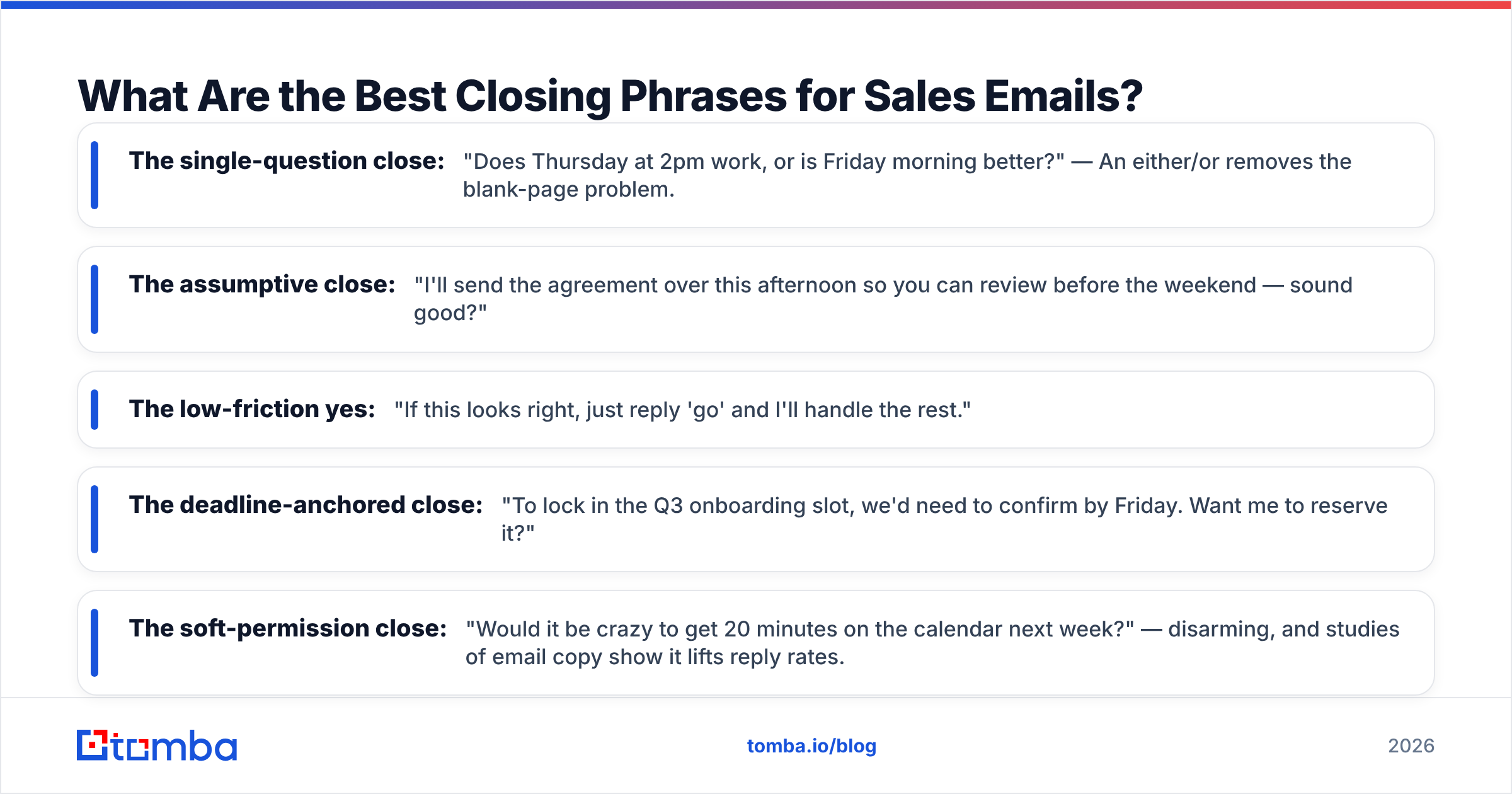
The best closing phrases for sales emails do one job: make replying a 10-second decision. Buyers skim. If your final line requires them to think, they'll close the tab and mean to get back to you — which is the same as no.
Use these depending on where the deal sits:
- The single-question close: "Does Thursday at 2pm work, or is Friday morning better?" — An either/or removes the blank-page problem.
- The assumptive close: "I'll send the agreement over this afternoon so you can review before the weekend — sound good?"
- The low-friction yes: "If this looks right, just reply 'go' and I'll handle the rest."
- The deadline-anchored close: "To lock in the Q3 onboarding slot, we'd need to confirm by Friday. Want me to reserve it?"
- The soft-permission close: "Would it be crazy to get 20 minutes on the calendar next week?" — disarming, and studies of email copy show it lifts reply rates.
Notice none of them end with "Let me know." Every one names the action, the time, or the word you want back. If you want to build a reusable library of these, a set of tested cold email templates will save you rewriting the same close from scratch every campaign.
For a sharper open-to-close flow, pair your closing line with a strong subject line — a weak subject means nobody reads far enough to see your beautiful close. A subject line generator helps you A/B the top of the funnel while you refine the bottom.
Closing Phrases for Sales Calls vs. Emails: What's the Difference?#
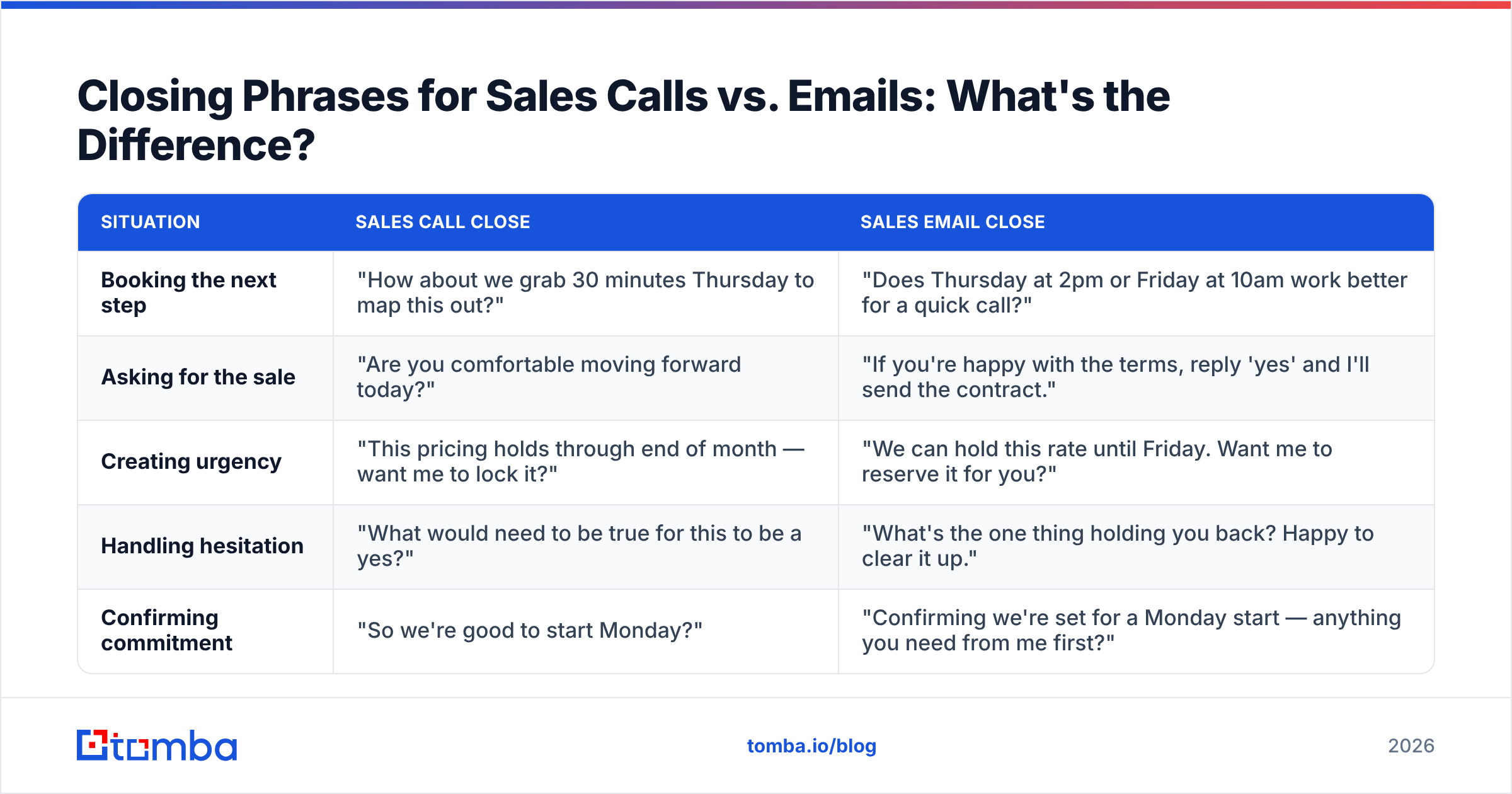
On a call you're closing for a decision; in an email you're closing for a reply. That single distinction changes the wording. A call gives you tone, pauses, and the ability to handle an objection in real time, so you can be more direct. Email has no second chances, so you lower the stakes of the yes.
Here's how the same intent translates across channels:
| Situation | Sales call close | Sales email close |
|---|---|---|
| Booking the next step | "How about we grab 30 minutes Thursday to map this out?" | "Does Thursday at 2pm or Friday at 10am work better for a quick call?" |
| Asking for the sale | "Are you comfortable moving forward today?" | "If you're happy with the terms, reply 'yes' and I'll send the contract." |
| Creating urgency | "This pricing holds through end of month — want me to lock it?" | "We can hold this rate until Friday. Want me to reserve it for you?" |
| Handling hesitation | "What would need to be true for this to be a yes?" | "What's the one thing holding you back? Happy to clear it up." |
| Confirming commitment | "So we're good to start Monday?" | "Confirming we're set for a Monday start — anything you need from me first?" |
The call column is more direct because you can read the room. The email column is softer and always specifies time or the exact word to send back. Match the close to the medium and your conversion climbs without changing anything else about your pitch.
Which Closing Phrases Should You Stop Using?#
Stop using any phrase that transfers the effort to the buyer. These four are the worst offenders, and they're everywhere:
- "Just following up." It signals nothing new is coming and asks the buyer to do the remembering. Replace it with a reason: "Following up with the ROI numbers you asked about."
- "Let me know your thoughts." Infinite scope, zero deadline. Replace with a single question.
- "No pressure, but…" It flags pressure the moment you deny it, and it undercuts your own confidence. Cut it entirely.
- "Whenever you get a chance." You've just told the buyer this isn't urgent, so it never will be. Give a soft timeframe instead.
The pattern is clear: vague, deferential, effort-shifting language feels polite but performs badly. HubSpot's sales research has documented for years that specificity and a clear ask outperform passive hedging on reply and close rates. Being respectful and being clear are not opposites.

How Do You Match a Closing Phrase to the Buyer's Stage?#
Match the close to how much the buyer has committed, not to how eager you are. A common mistake is firing a hard close at a prospect who's still in the "interesting, but who are you?" phase. It's like proposing marriage on a first date — the words aren't wrong, the timing is.
Use this quick map:
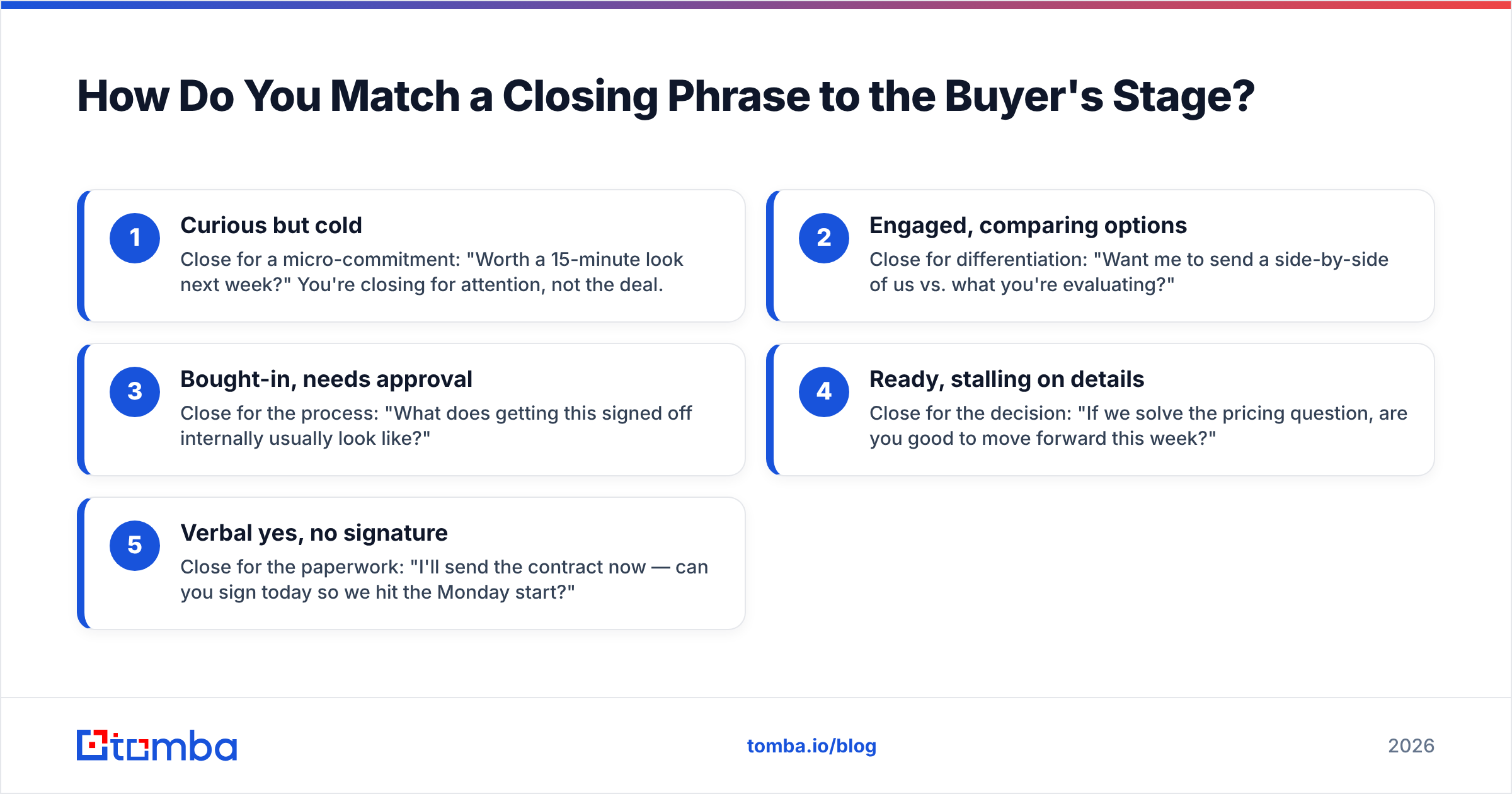
- Curious but cold — Close for a micro-commitment: "Worth a 15-minute look next week?" You're closing for attention, not the deal.
- Engaged, comparing options — Close for differentiation: "Want me to send a side-by-side of us vs. what you're evaluating?"
- Bought-in, needs approval — Close for the process: "What does getting this signed off internally usually look like?"
- Ready, stalling on details — Close for the decision: "If we solve the pricing question, are you good to move forward this week?"
- Verbal yes, no signature — Close for the paperwork: "I'll send the contract now — can you sign today so we hit the Monday start?"
Each stage has its own natural close. Skip stages and even a perfect phrase feels off. When you track how prospects move through these steps, your response rate becomes the signal that tells you which close to use next.
Can You Close a Deal You Never Started?#
No — and this is the half of closing nobody frames on motivational posters. Every closing phrase in this article assumes one thing: your message actually reached a real decision-maker at a valid address. The most persuasive close on earth converts at zero percent if it bounced, landed in a shared inbox, or went to someone who left the company eight months ago.
That's the quiet leak in most pipelines. Reps polish their closing lines while a third of their outreach never gets read. Before you obsess over wording, make sure the fundamentals are solid:
- You're emailing a verified, deliverable address, not a guessed pattern.
- You reached the right role — the person who can actually say yes.
- Your sender reputation is clean so the message lands in the primary inbox where a close can even be seen.
This is where accurate contact data does the unglamorous work. Finding the correct professional email up front means your killer close reaches a human who can act on it. Tools like the Tomba Email Finder exist to close that first gap, and verifying the address with an email verifier before you send protects both deliverability and the time you spent writing.
A Ready-to-Use Bank of Closing Phrases for Sales#
Here's a reference bank you can adapt. Change the specifics, keep the structure.
Assumptive closes
- "I'll get the onboarding email out today so you can start Monday."
- "When would you like the team to kick off?"
- "Let's put Thursday on the calendar to finalize."
Question closes
- "What would need to happen for this to be an easy yes?"
- "Is there any reason we couldn't move forward this week?"
- "On a scale of one to ten, how close are we?"
Urgency closes (use honestly)
- "This slot is open through Friday — want me to hold it?"
- "Locking pricing before the new rates take effect — should I?"
Low-friction closes
- "Reply 'yes' and I'll handle everything from here."
- "Would it be unreasonable to get 20 minutes next week?"
Objection-surfacing closes
- "What's the one thing making you hesitate?"
- "If price weren't a factor, would this be a fit?"
The strongest reps don't memorize all forty. They internalize the shapes — assume, ask, anchor, lower friction — and improvise the exact words in the moment. That flexibility is what makes a close sound human instead of scripted.
How Do You Practice Closing Without Sounding Scripted?#
Practice the intent, not the transcript. If you memorize lines word-for-word, you'll deliver them like a hostage reading a statement. Instead, drill the decision each close is trying to trigger, then say it in your own voice.
Three habits that help:
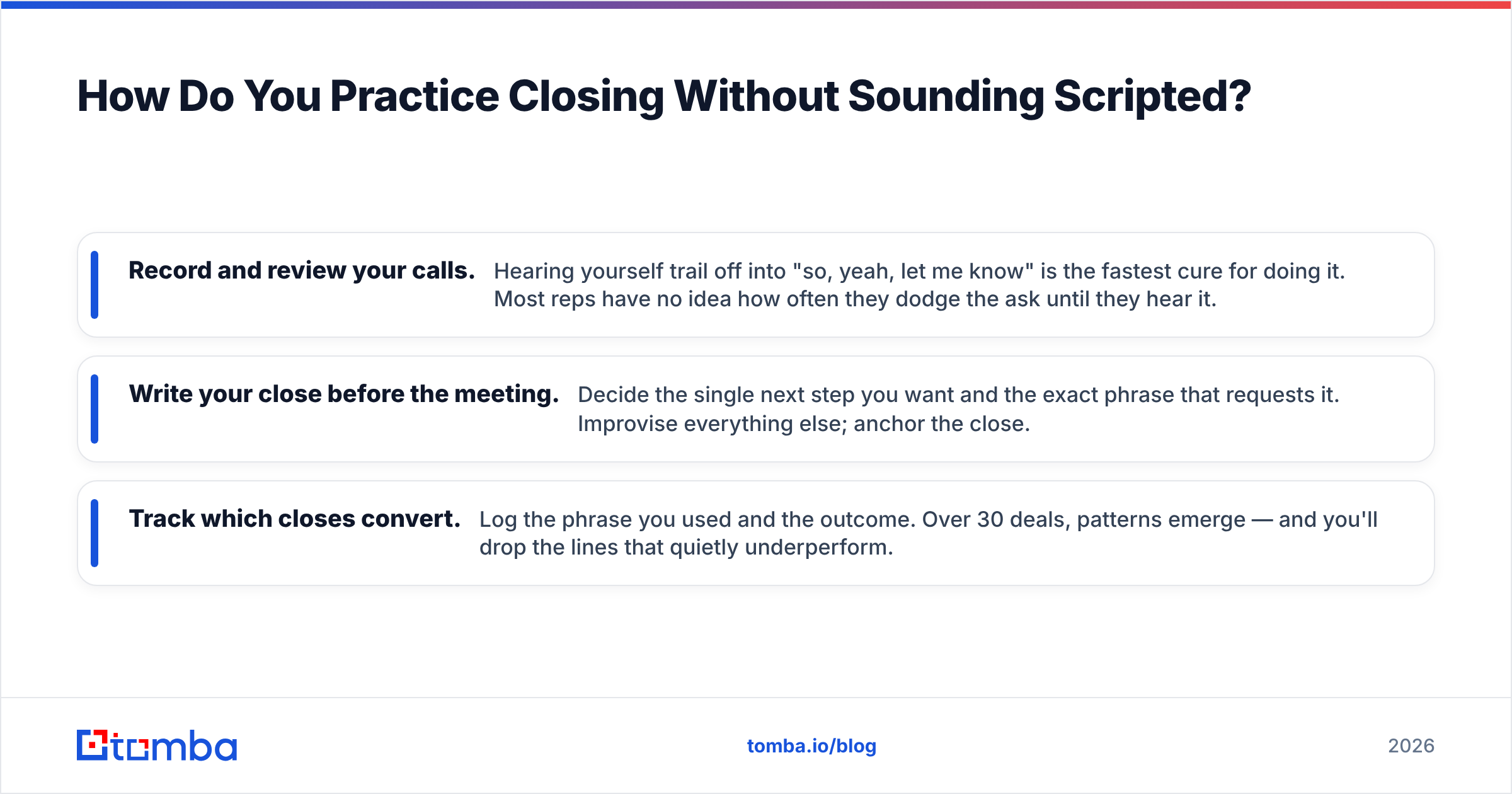
- Record and review your calls. Hearing yourself trail off into "so, yeah, let me know" is the fastest cure for doing it. Most reps have no idea how often they dodge the ask until they hear it.
- Write your close before the meeting. Decide the single next step you want and the exact phrase that requests it. Improvise everything else; anchor the close.
- Track which closes convert. Log the phrase you used and the outcome. Over 30 deals, patterns emerge — and you'll drop the lines that quietly underperform.
Great closing is a skill, not a personality trait. The "natural closer" you admire is usually just someone who asked clearly, thousands of times, until it stopped feeling awkward. You can build the same muscle, and category leaders like Salesforce publish enablement material that reinforces the same fundamentals: clarity, timing, and a defined next step.
Turn Better Closes Into Booked Revenue#
A sharp closing phrase is worth nothing if it never reaches the person who can sign. Before your next campaign, make sure every message lands in front of a real, verified decision-maker — then let your improved closes do their job. The Tomba Email Finder helps you find and confirm professional email addresses by name, company, or domain, so the closing lines you just refined actually get read.
Start free with 25 searches a month, and when you're ready to scale outreach, Tomba pricing begins at $49/month for the Starter plan. Fix the first half of closing — reaching the right inbox — and every phrase in this guide gets a fair shot at a yes.
Related guides#
Ready to find emails that actually work?
Join 150,000+ professionals who stopped guessing and started sending. Free credits on signup — no credit card required.
Get the Tomba newsletter
Practical outbound tactics and product updates — once every two weeks.
About the author