Closing Ratio: How to Calculate, Benchmark, and Improve It
Your closing ratio tells you whether your pipeline is healthy or leaking revenue. Here's how to calculate it, what a good number looks like in 2026, and the levers that actually move it.
TL;DR
- Your closing ratio is deals won divided by total qualified opportunities, expressed as a percentage. It's the single clearest signal of whether your sales process converts.
- A "good" closing ratio depends heavily on your model: SMB inbound teams often see 20–30%, complex B2B enterprise deals land closer to 15–25%, and cold outbound frequently sits under 10%.
- Low close rates are usually a lead-quality or qualification problem long before they're a "reps need to sell harder" problem.
- The fastest lever most teams ignore: feeding accurate, verified contact data into the top of the funnel so reps spend time on winnable deals.
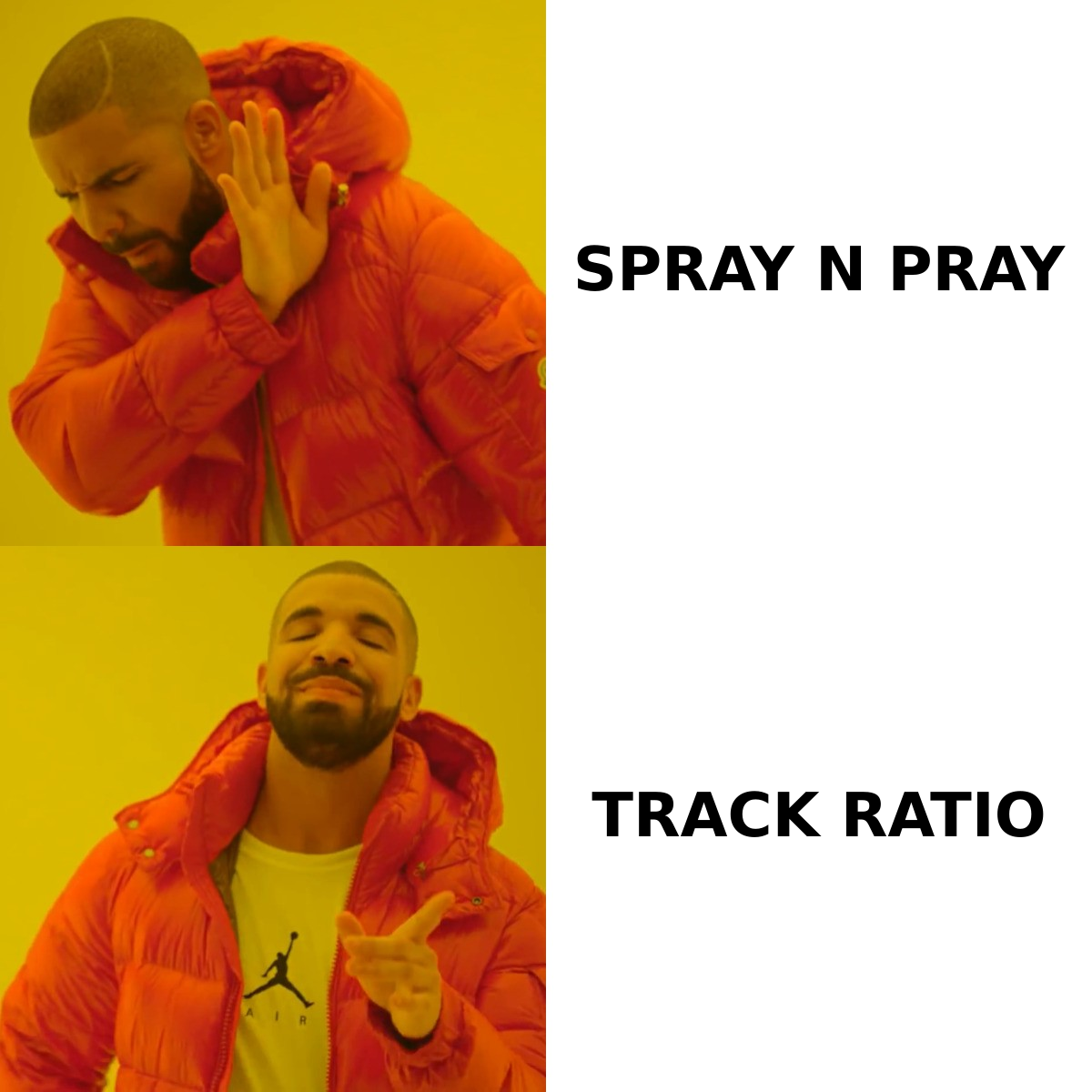
- Track closing ratio by stage, by source, and by rep — a single blended number hides where you're actually leaking.
What is a closing ratio?#
Your closing ratio is the percentage of qualified opportunities that turn into closed-won deals. Think of it like a basketball shooting percentage: it's not how many shots you took, it's how many actually went in. A rep who takes 100 shots and makes 20 has the same closing ratio as one who takes 10 and makes 2 — the ratio strips out volume and exposes efficiency.
The basic formula is simple:
Closing Ratio = (Deals Won ÷ Total Qualified Opportunities) × 100
If your team worked 80 qualified opportunities last quarter and closed 20, your closing ratio is 25%. That number becomes the backbone of nearly every forecast, capacity plan, and quota you'll set.
The word "qualified" is doing heavy lifting here. If you divide wins by every lead that ever entered your CRM — including tire-kickers, wrong-fit companies, and dead emails — you'll get a depressingly low number that tells you almost nothing. The denominator has to be opportunities a reasonable rep would actually try to close.
How do you calculate closing ratio correctly?#
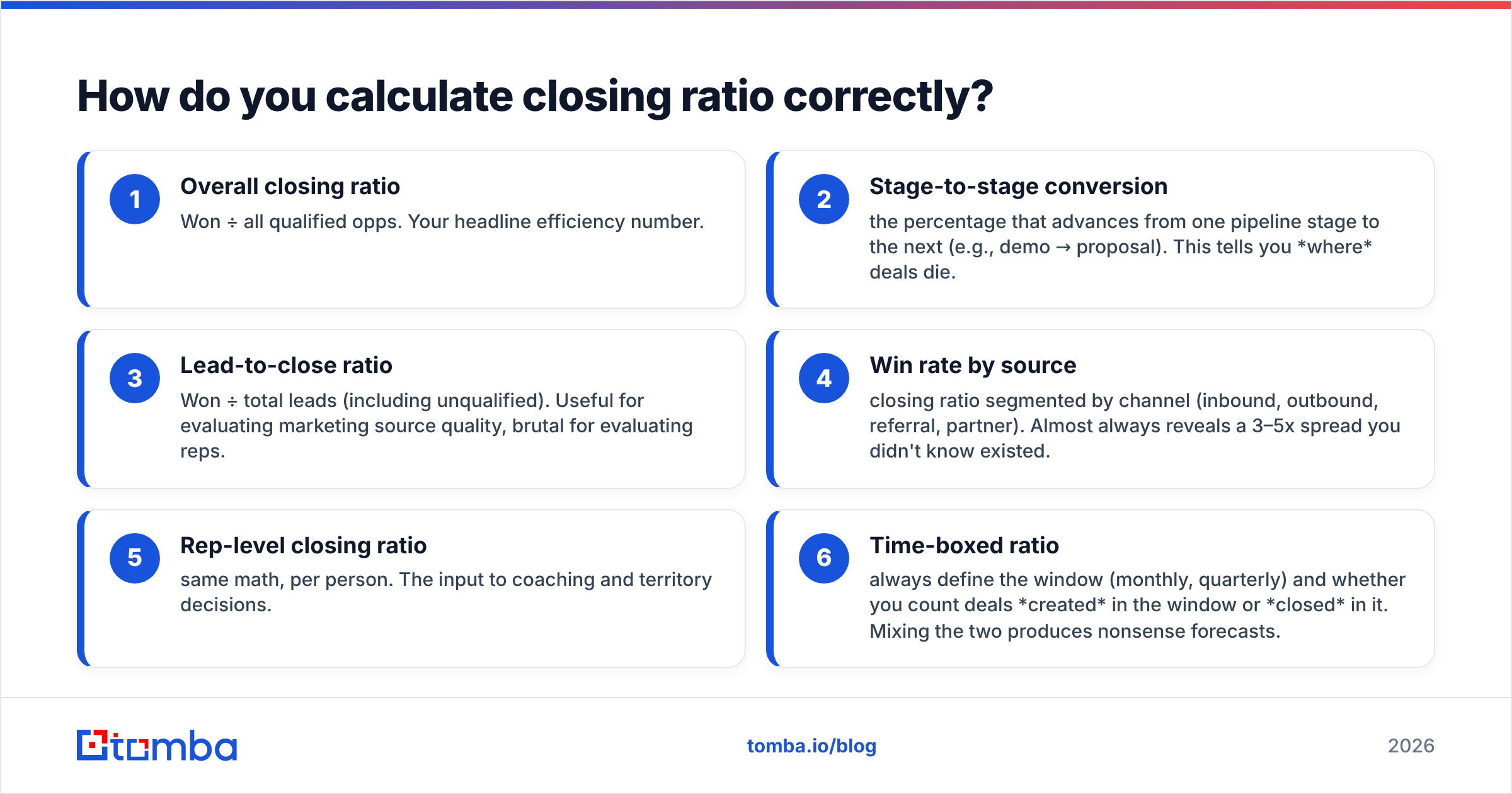
The trap most teams fall into isn't the arithmetic — it's inconsistent inputs. Here are the variations worth tracking, because each answers a different question.
- Overall closing ratio — Won ÷ all qualified opps. Your headline efficiency number.
- Stage-to-stage conversion — the percentage that advances from one pipeline stage to the next (e.g., demo → proposal). This tells you where deals die.
- Lead-to-close ratio — Won ÷ total leads (including unqualified). Useful for evaluating marketing source quality, brutal for evaluating reps.
- Win rate by source — closing ratio segmented by channel (inbound, outbound, referral, partner). Almost always reveals a 3–5x spread you didn't know existed.
- Rep-level closing ratio — same math, per person. The input to coaching and territory decisions.
- Time-boxed ratio — always define the window (monthly, quarterly) and whether you count deals created in the window or closed in it. Mixing the two produces nonsense forecasts.
The rule: pick your definitions once, write them down, and make every dashboard use the same denominator. A closing ratio that means something different in two reports is worse than no metric at all.
What is a good closing ratio in 2026?#
Short answer: there's no universal "good" number — context sets the bar. A 12% closing ratio on cold enterprise outbound can be excellent, while 12% on warm inbound demo requests is a fire alarm. What matters is comparing like-for-like: same motion, same segment, same source.
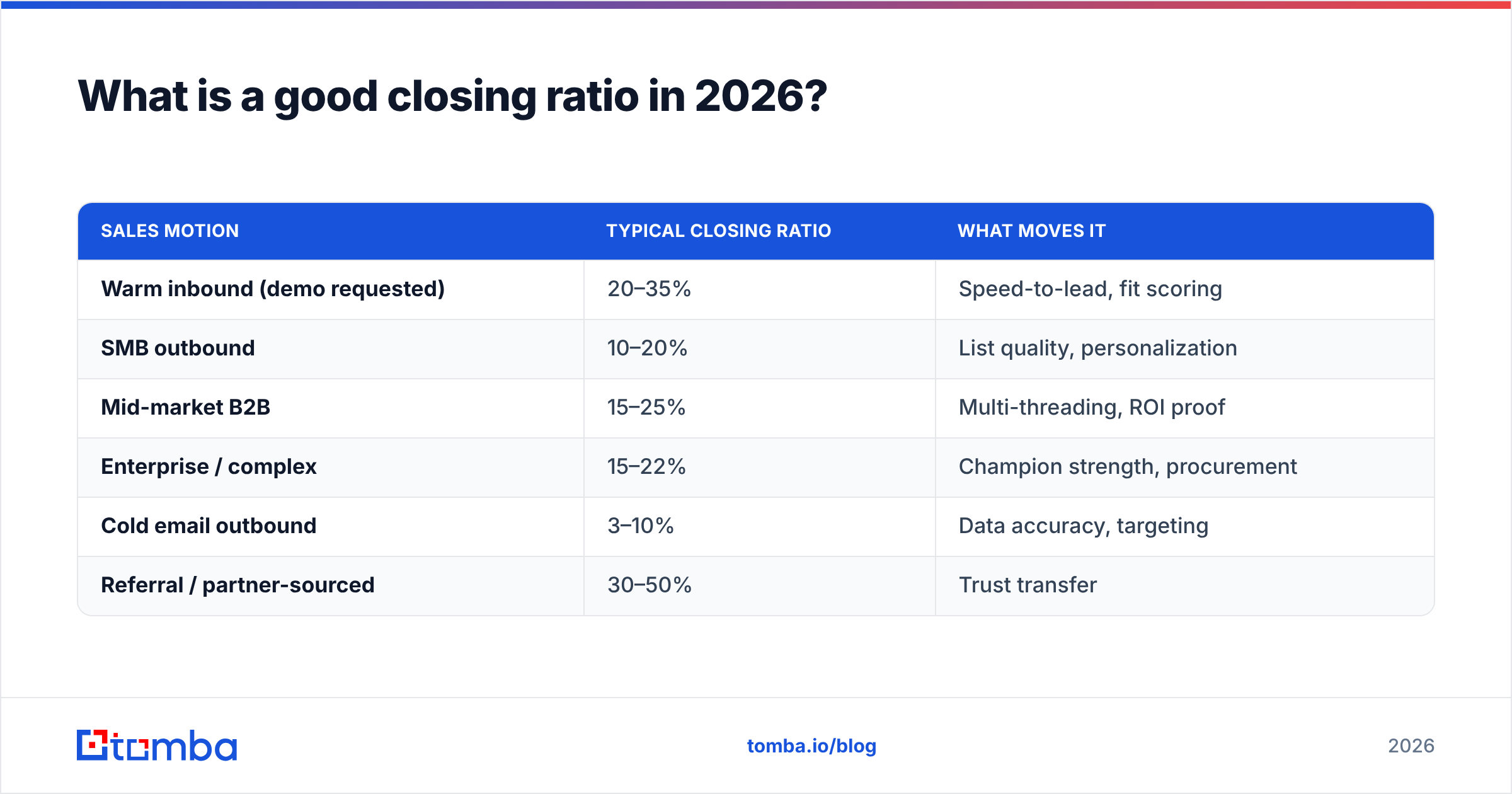
That said, here are realistic reference ranges based on widely reported B2B sales data. Treat them as orientation, not gospel.
| Sales motion | Typical closing ratio | What moves it |
|---|---|---|
| Warm inbound (demo requested) | 20–35% | Speed-to-lead, fit scoring |
| SMB outbound | 10–20% | List quality, personalization |
| Mid-market B2B | 15–25% | Multi-threading, ROI proof |
| Enterprise / complex | 15–22% | Champion strength, procurement |
| Cold email outbound | 3–10% | Data accuracy, targeting |
| Referral / partner-sourced | 30–50% | Trust transfer |
Notice the pattern: the warmer and better-qualified the opportunity, the higher the ratio. That's not a coincidence, and it's the key to improving your own number. According to research summarized by firms like Gartner and peer-review platforms like G2, buying groups in complex B2B deals now involve six to ten stakeholders — which is exactly why single-threaded deals collapse late and drag your ratio down.
Benchmark against yourself first. A closing ratio trending from 18% to 24% over three quarters is a healthier signal than hitting some external "average" once.
Why is your closing ratio low? (It's usually not effort)#
Before you push reps to "close harder," diagnose the funnel. Most closing-ratio problems trace back to one of these, in rough order of frequency:
- Bad-fit leads at the top. If half your opportunities were never going to buy, your ratio is capped no matter how good your reps are.
- Weak qualification. Deals get marked "qualified" to pad pipeline, inflating the denominator with wishful thinking.
- Bad contact data. Reps chase bounced emails, wrong titles, and people who left the company — burning cycles that never become deals.
- Single-threading. One champion goes dark and the deal dies. In modern B2B, you need three or more contacts inside the account.
- No urgency / weak discovery. Reps demo before they understand the pain, so "no decision" wins more than any competitor.
- Slow follow-up. Speed-to-lead collapses when the first touch lands hours or days late.
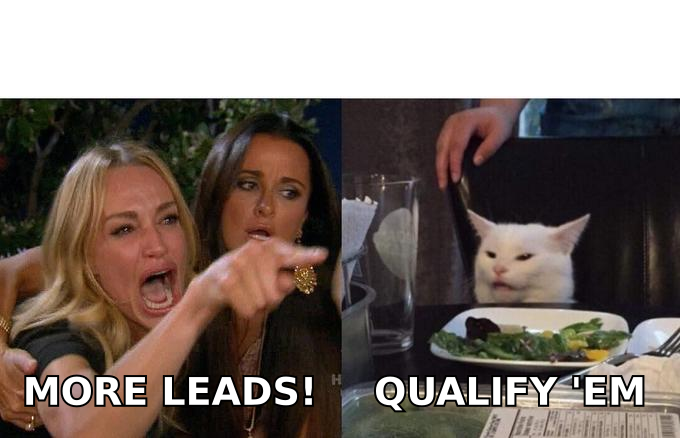
Here's the uncomfortable truth: the biggest lever is often the quality of the list, not the skill of the seller. You can coach objection handling all day, but if the contact was never a decision-maker — or the email never landed — the ratio won't move. This is where clean, verified prospect data quietly earns its keep. Getting a valid, deliverable address for the right person with a tool like an email finder means reps spend their limited hours on contacts who can actually say yes.
How do you improve your closing ratio?#
Improving closing ratio is mostly about improving inputs, then tightening process. Rank your effort this way.
1. Fix the top of the funnel first#
A higher closing ratio often starts before a rep ever gets involved. Tighten your ICP, add fit-scoring, and — critically — make sure the contacts you're working are real, current, and reachable. Bouncing emails and dead numbers don't just waste time; they drag down email deliverability and sender reputation, which quietly shrinks every future campaign's reach. Running your list through an email verifier before outreach removes the invalid contacts that would otherwise pad your denominator with zero-chance opportunities.
2. Qualify harder, not softer#
Adopt a consistent framework (MEDDIC, BANT, or your own) and be willing to disqualify. A smaller, cleaner pipeline with a 30% closing ratio beats a bloated one at 12%. Every opportunity you correctly disqualify raises the ratio and frees selling time.
3. Multi-thread every deal#
Map the buying group and build relationships with three-plus stakeholders. Deals with multiple engaged contacts are far more resilient when a champion changes jobs or goes quiet. Use data enrichment to fill in the org chart around your primary contact so you're never one dropped email away from a dead deal.
4. Compress speed-to-lead#
Inbound leads contacted within five minutes convert dramatically better than those touched an hour later. Automate routing and first-touch so no qualified opportunity sits cold.
5. Coach on the stage that leaks most#
Use your stage-to-stage conversion data to find the single biggest drop-off — say, demo → proposal — and concentrate coaching there. Blanket "sell better" advice wastes effort; surgical fixes at the leaky stage move the whole ratio.
Levers ranked by effort vs. impact#
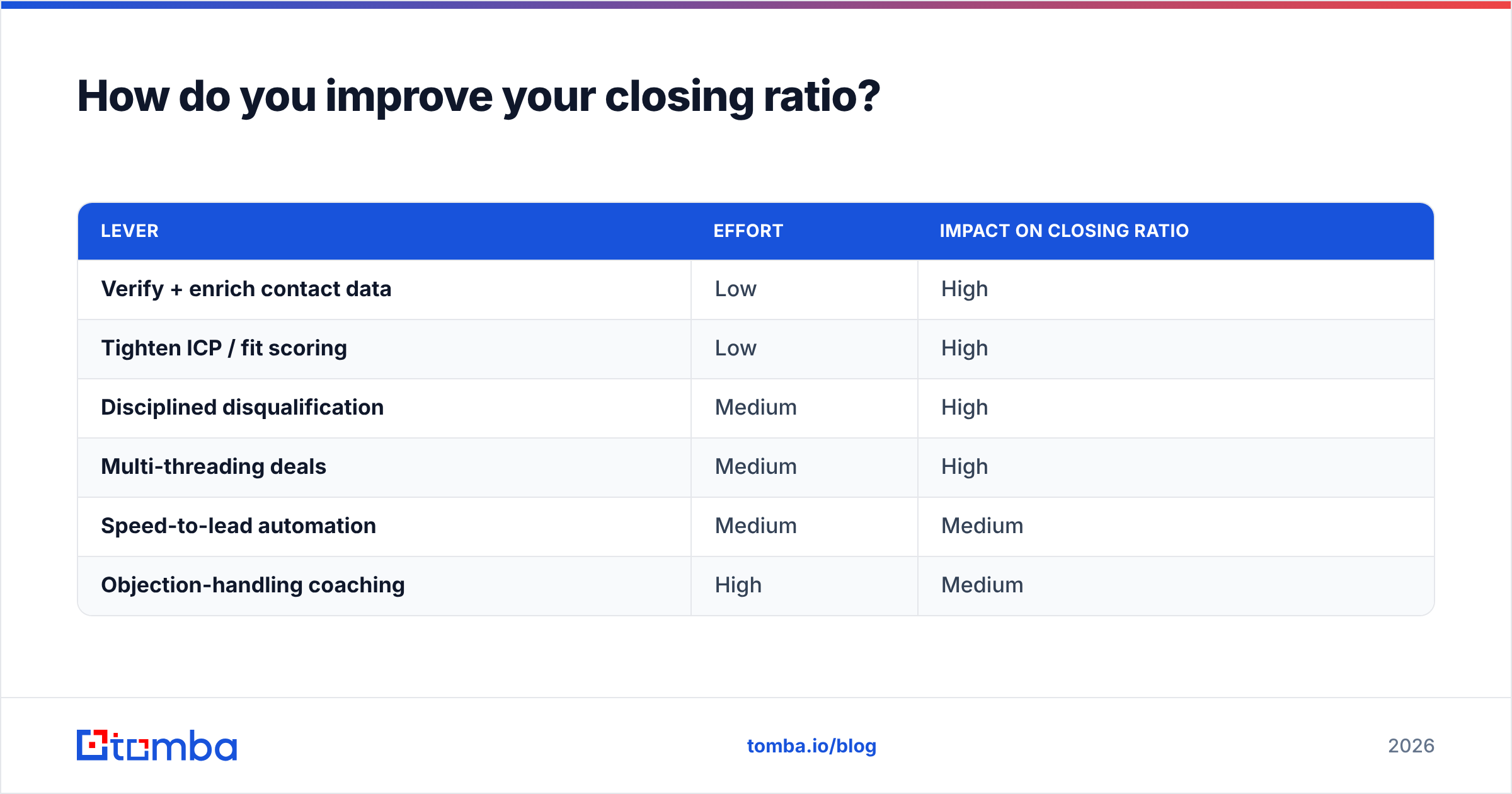
| Lever | Effort | Impact on closing ratio |
|---|---|---|
| Verify + enrich contact data | Low | High |
| Tighten ICP / fit scoring | Low | High |
| Disciplined disqualification | Medium | High |
| Multi-threading deals | Medium | High |
| Speed-to-lead automation | Medium | Medium |
| Objection-handling coaching | High | Medium |
The top rows are where most teams find the fastest wins — and they're the ones least likely to be on the sales leader's whiteboard, because they live in operations and data, not in the pep talk.
How does closing ratio fit with your other sales metrics?#
Closing ratio is one gauge on the dashboard, not the whole engine. Read it alongside:
- Win rate — often used interchangeably with closing ratio, though some teams define win rate as won ÷ (won + lost), excluding open deals. Pick one definition and stick to it.
- Average deal size — a rising closing ratio with shrinking deals may mean you're only closing easy, small business.
- Sales cycle length — a higher ratio that comes from a much longer cycle can hurt overall throughput.
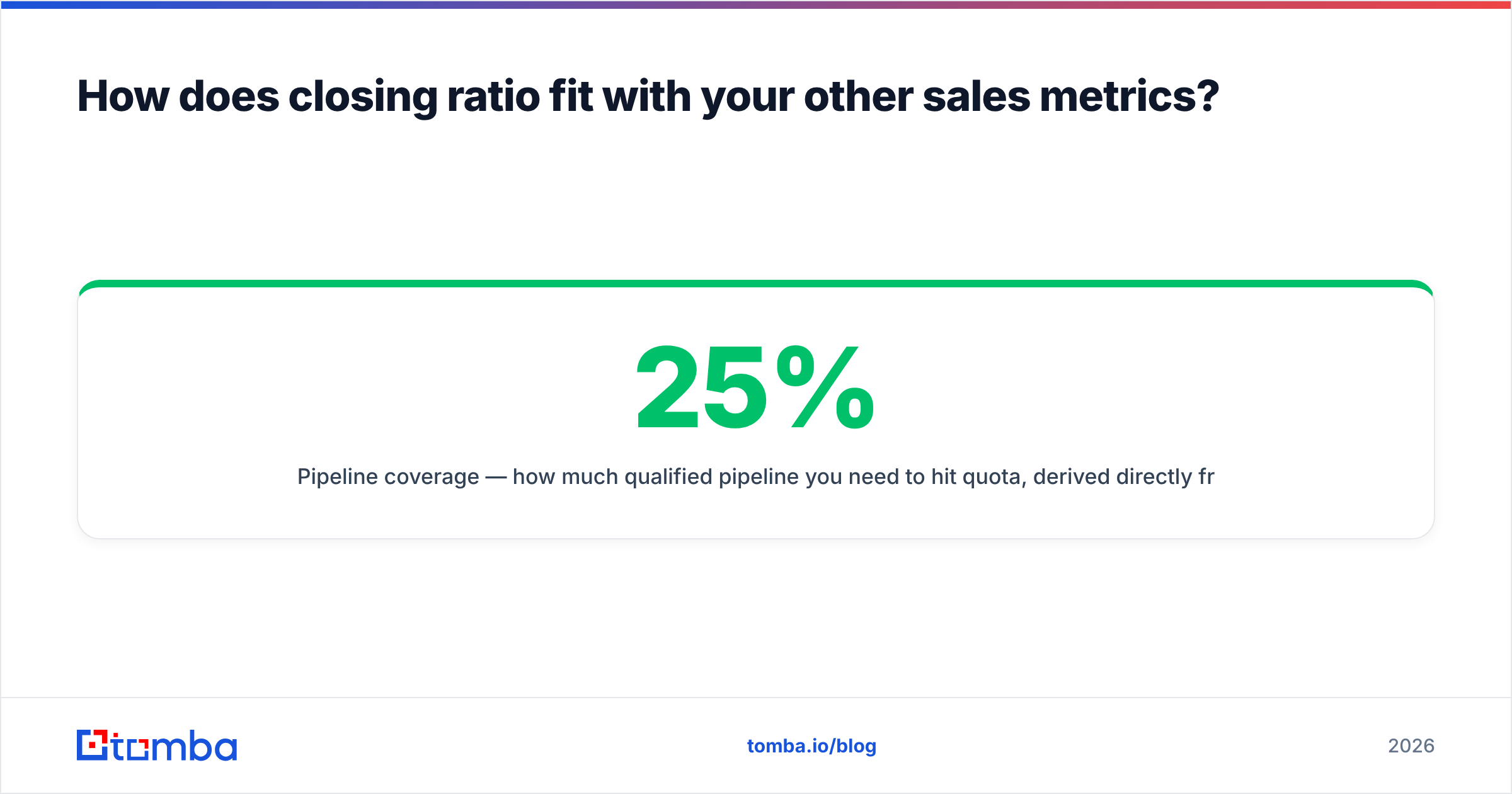
- Pipeline coverage — how much qualified pipeline you need to hit quota, derived directly from your closing ratio. At a 25% ratio you need 4x coverage; at 20% you need 5x.
The interaction that matters most: closing ratio × deal size × cycle length ÷ ramp = your real revenue capacity. Improving the ratio is usually the cheapest of those levers to pull, because it doesn't require hiring, discounting, or waiting.
For teams building out their reporting, it's worth reviewing how established CRMs like HubSpot structure win-rate and conversion reporting — you don't need to reinvent the definitions, just apply them consistently and feed them clean data.
Common closing-ratio mistakes to avoid#
- Reporting one blended number. Segment by source, segment by rep, or you'll optimize the average while a channel bleeds out.
- Gaming the denominator. If reps learn that marking deals "unqualified" inflates their ratio, they'll do it. Audit qualification, not just outcomes.
- Ignoring "no decision" losses. These often outnumber competitive losses and signal a discovery or urgency gap, not a pricing one.
- Chasing external benchmarks over your own trend. Your quarter-over-quarter direction is more actionable than any industry average.
- Letting stale data quietly cap the ceiling. Contact accuracy decays roughly 2–3% per month as people change jobs. A list that was clean in January is meaningfully worse by summer.
The bottom line#
Your closing ratio is a mirror for your entire go-to-market motion. When it's low, resist the urge to blame reps first — check whether the opportunities were ever winnable, whether the contacts were real, and whether qualification was honest. The highest-leverage improvements usually happen upstream: better targeting, verified data, and disciplined qualification, all of which shrink a bloated denominator and lift the ratio without a single new hire.
If your close rate is stuck because reps are burning hours on bounced emails and wrong contacts, start there. The Tomba Email Finder gets you verified, professional email addresses for the actual decision-makers in your target accounts — so more of your pipeline is winnable before a rep ever opens a call. It's free to try (25 searches a month), with paid plans starting at $49/mo; you can see full Tomba pricing if you're scaling outbound. Feed the top of your funnel better data, and your closing ratio has room to climb.
Related guides#
// get started
Find, verify and enrich your first contacts today
Start on the free plan with 25 searches a month, then scale when your team is ready.
Free plan · No credit card required · GDPR & CCPA
Get the Tomba newsletter
Product and data updates
// about the author