Closing Sales in 2026: A Practical Guide to Winning More Deals
Closing sales isn't a magic phrase at the end of a call — it's the payoff of a process. Here are the closing techniques, signals, and data habits that win more deals in 2026.
TL;DR
- Closing sales is not one clever line at the end of a call — it's the natural result of qualifying, discovery, and handling objections earlier in the process.
- The best closers talk less and listen more: they earn the close by surfacing the buyer's real problem and quantifying the cost of inaction.
- Modern closing techniques (assumptive, summary, trial, takeaway) still work, but only when you've read the buying signals correctly.
- Bad data kills deals before you ever get to "close." Reaching the right decision-maker with accurate contact info matters more than any script.
- Track a small set of metrics — win rate, sales-cycle length, and stage conversion — so you can fix the leak instead of blaming the pitch.
What does "closing sales" actually mean in 2026?#
Closing sales means getting a qualified buyer to commit — sign, pay, or start — after you've proven your product solves a problem worth solving. That's it. The mystique around "the close" as a single dramatic moment is mostly sales-training folklore.
Think of closing like landing a plane. The touchdown gets all the attention, but a safe landing is 99% approach: altitude, speed, and alignment set up long before the wheels hit the runway. If discovery was sloppy and the buyer was never qualified, no closing line saves the deal. If everything upstream was clean, the close is almost anticlimactic.
In 2026, buyers arrive more informed than ever. They've read the reviews on G2, compared pricing, and often shortlisted you before your first call. That shifts the closer's job from "convince" to "confirm and de-risk." Your edge is no longer information — it's clarity, timing, and trust.
Why do most deals stall before the close?#
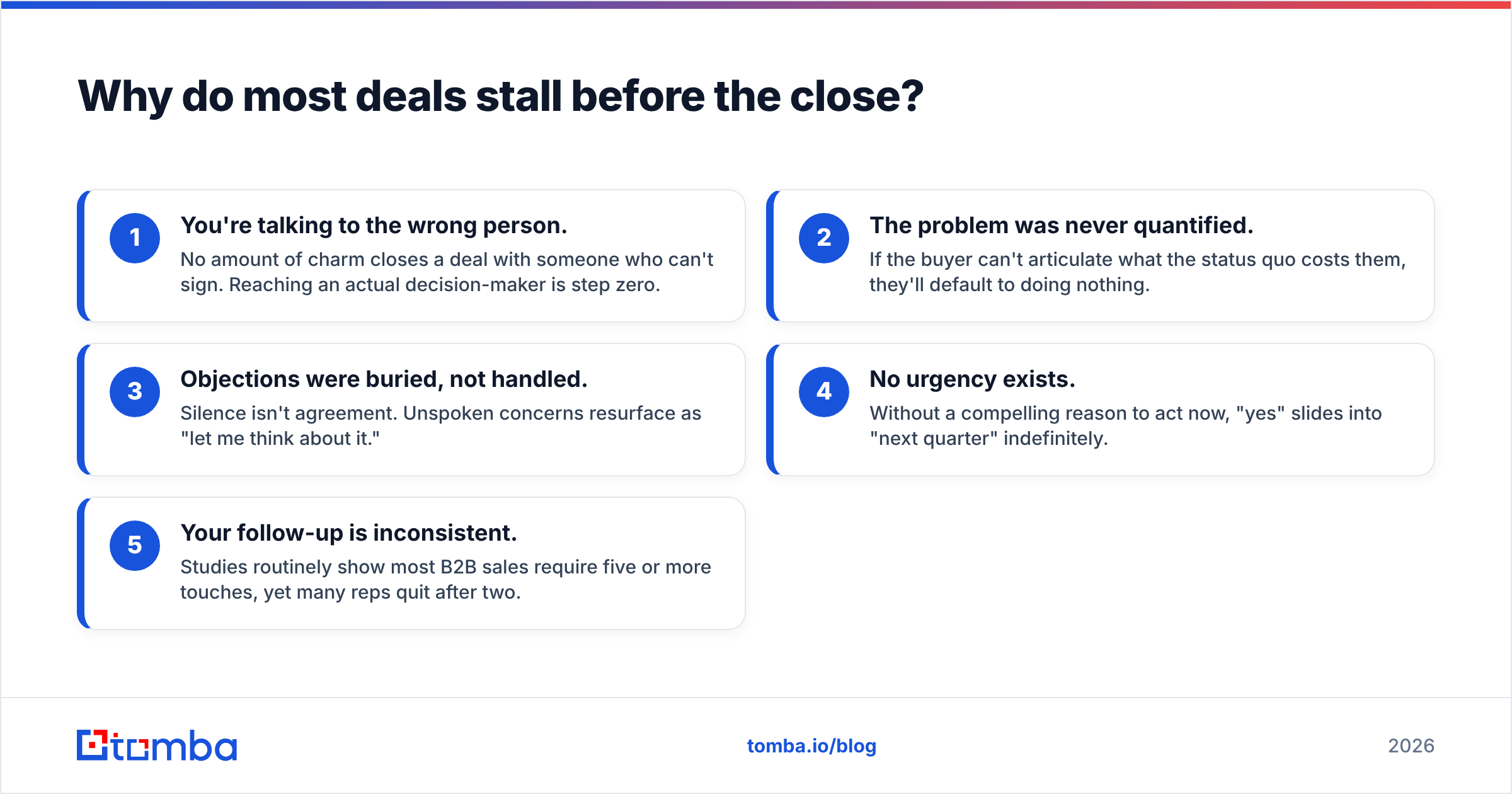
Most deals die from problems that have nothing to do with your closing skills. Here are the usual culprits:
- You're talking to the wrong person. No amount of charm closes a deal with someone who can't sign. Reaching an actual decision-maker is step zero.
- The problem was never quantified. If the buyer can't articulate what the status quo costs them, they'll default to doing nothing.
- Objections were buried, not handled. Silence isn't agreement. Unspoken concerns resurface as "let me think about it."
- No urgency exists. Without a compelling reason to act now, "yes" slides into "next quarter" indefinitely.
- Your follow-up is inconsistent. Studies routinely show most B2B sales require five or more touches, yet many reps quit after two.
Notice that only the last one is about persistence. The rest are about process. Fix the process and closing gets dramatically easier.
What are the closing techniques that still work?#
Closing "techniques" are really just clean ways to ask for the commitment once the buyer is ready. Use them as tools, not tricks. Here are the ones that hold up:
- The assumptive close. You proceed as if the decision is made: "I'll get the onboarding scheduled for the 15th — does morning or afternoon work?" It works when buying signals are strong and reduces friction by removing the awkward yes/no moment.
- The summary close. You recap the agreed value before asking: "So you'll cut manual data entry by ~8 hours a week, get the integrations you flagged, and stay under budget. Ready to move forward?" Reinforces the decision with the buyer's own reasons.
- The trial close. A temperature check mid-conversation: "How does that sound so far?" It surfaces objections early, while you still have room to address them.
- The takeaway close. You gently remove an option: "The annual plan might be more than you need — the starter tier could be a better fit for now." Counterintuitively, scaling back can rebuild trust and re-engage a hesitant buyer.
- The urgency close. Tied to a real deadline or incentive, never a fake one. Manufactured scarcity destroys trust the moment it's exposed.
The through-line: every technique assumes you've already done the qualifying work. A trial close on an unqualified lead just tells you faster that they were never going to buy.
How do you read buying signals correctly?#
Buying signals are the buyer telling you they're ready — usually before they say it out loud. Miss them and you either close too early (and get a "no") or too late (and lose momentum). Watch for:
- Verbal signals: questions about implementation, pricing specifics, contract terms, or "what happens after we sign?"
- Behavioral signals: looping in colleagues, asking for a proposal in writing, requesting references, or shortening their response times.
- Emotional signals: shifting from "if we did this" to "when we do this."
When you hear a "when," stop selling and start closing. Continuing to pitch past the buying signal is one of the most common — and costly — closing mistakes. You talk the buyer right back out of a decision they'd already made.
Which closing method fits which deal? A comparison#
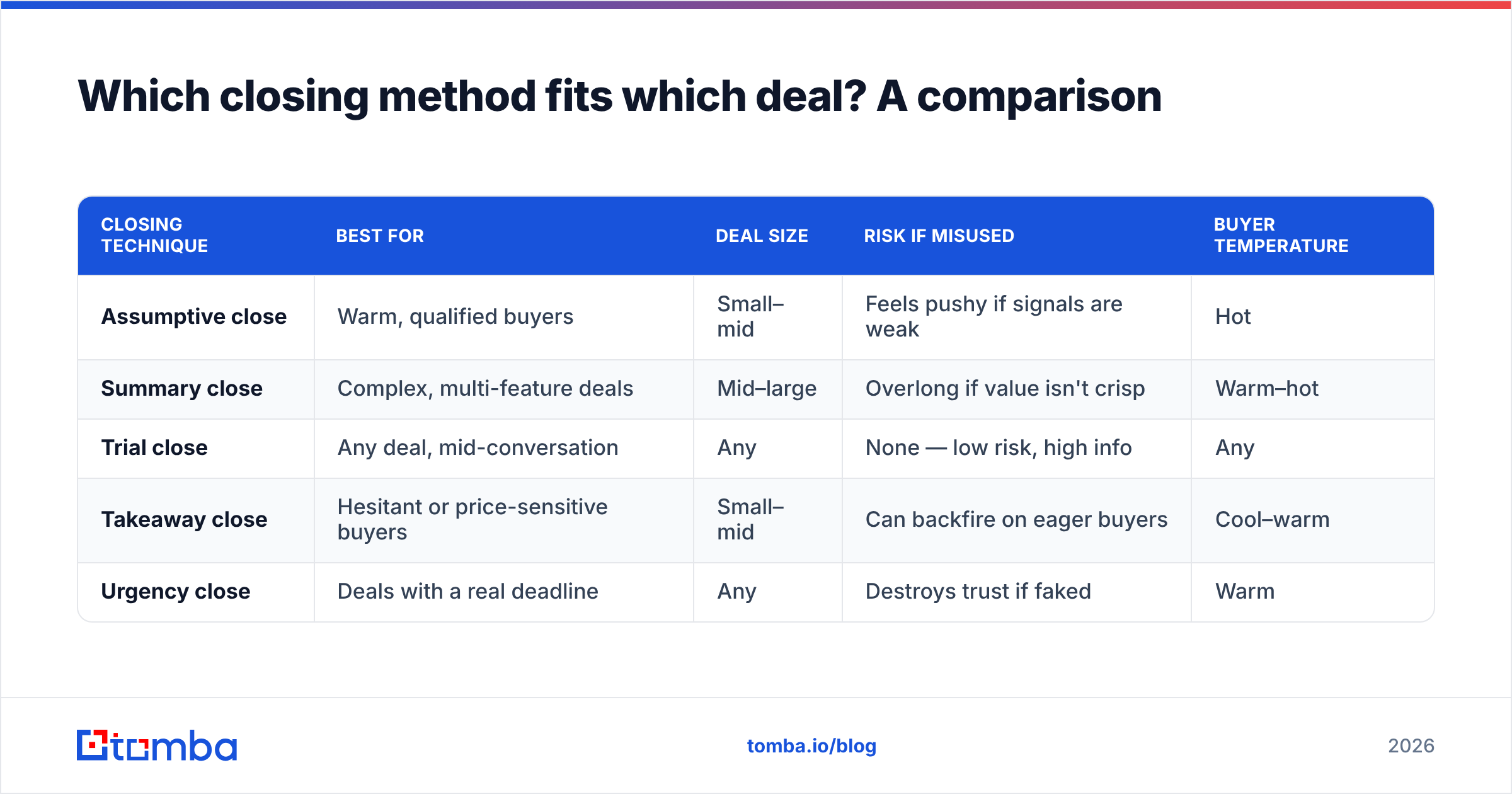
Not every technique fits every situation. Match the method to deal size, buyer temperature, and cycle length:
| Closing technique | Best for | Deal size | Risk if misused | Buyer temperature |
|---|---|---|---|---|
| Assumptive close | Warm, qualified buyers | Small–mid | Feels pushy if signals are weak | Hot |
| Summary close | Complex, multi-feature deals | Mid–large | Overlong if value isn't crisp | Warm–hot |
| Trial close | Any deal, mid-conversation | Any | None — low risk, high info | Any |
| Takeaway close | Hesitant or price-sensitive buyers | Small–mid | Can backfire on eager buyers | Cool–warm |
| Urgency close | Deals with a real deadline | Any | Destroys trust if faked | Warm |
The trial close is the one to over-use — it's free information with almost no downside. The urgency close is the one to handle with tongs.
Why does data quality decide whether you ever get to close?#
You cannot close a deal you never start, and you never start the deals where you can't reach the buyer. This is where most closing advice goes quiet — and where the real leverage lives.
Picture two reps working identical territories. Rep A pulls a list of 500 "contacts" riddled with outdated emails, generic info@ addresses, and wrong titles. Rep B works 300 verified decision-maker emails with direct phone numbers. Rep A spends the week bouncing off gatekeepers and hard-bouncing emails. Rep B has real conversations. Same skills, wildly different close rates — because the inputs were different.
Accurate contact data does three things for closing:
- Gets you to the signer faster, compressing the sales cycle.
- Protects your sender reputation, so your follow-ups actually land in the inbox instead of spam. (Deliverability is its own discipline — see email deliverability for the fundamentals.)
- Personalizes the approach, because enriched data tells you who you're really talking to.
This is why a reliable email finder and an email verifier belong in your closing stack, not just your prospecting stack. A verified list means fewer bounces, more connects, and a shorter path from first touch to signature. When you need to reach a whole buying committee at one account, a domain search surfaces the other stakeholders who quietly decide whether your deal closes.
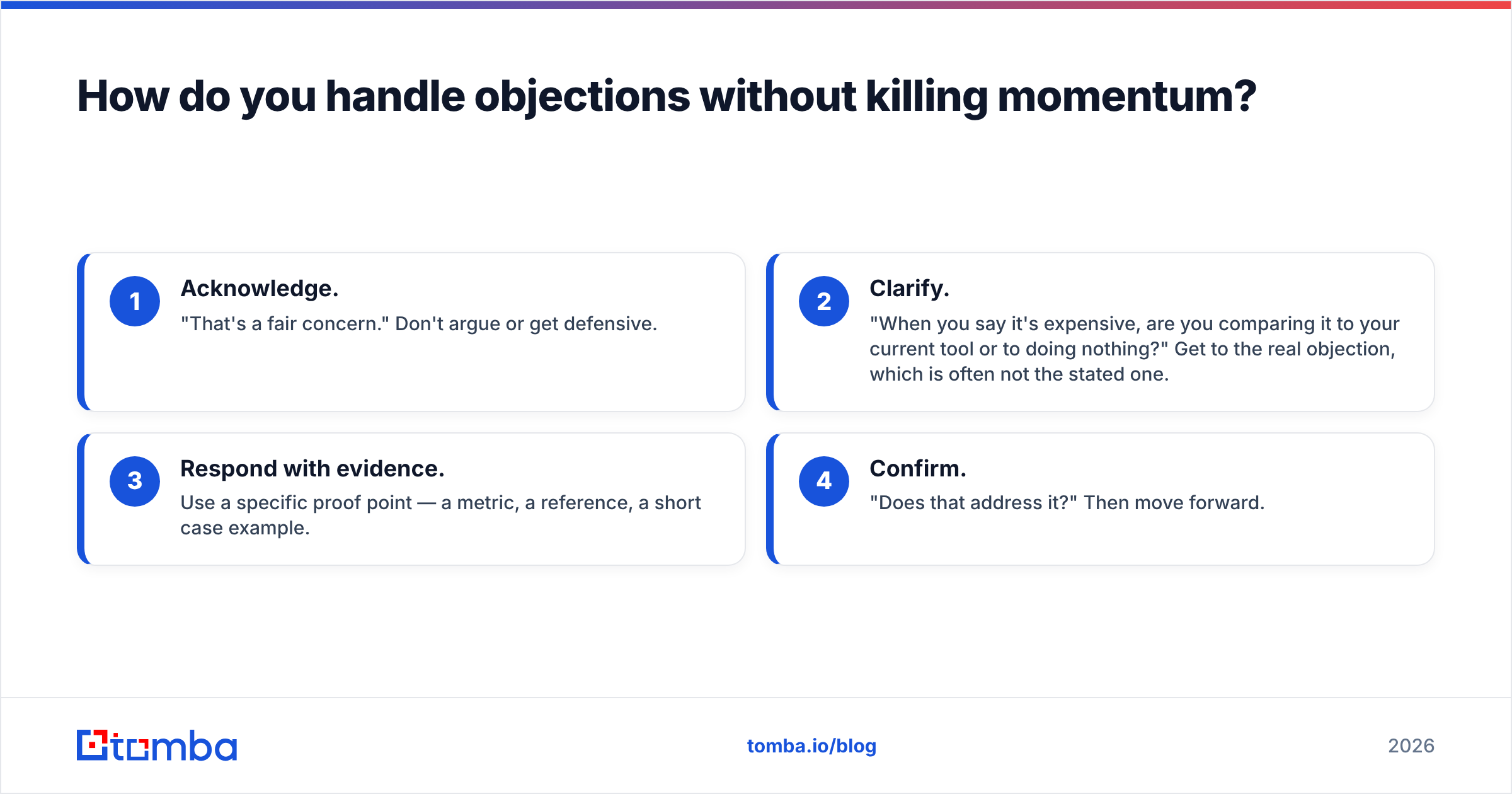
How do you handle objections without killing momentum?#
Objections aren't rejections — they're requests for more information or reassurance. The goal is to address them without breaking the forward motion of the deal. A simple, durable framework:
- Acknowledge. "That's a fair concern." Don't argue or get defensive.
- Clarify. "When you say it's expensive, are you comparing it to your current tool or to doing nothing?" Get to the real objection, which is often not the stated one.
- Respond with evidence. Use a specific proof point — a metric, a reference, a short case example.
- Confirm. "Does that address it?" Then move forward.
The most common objections cluster into four buckets — price, timing, authority, and trust. Price objections are frequently timing or value objections in disguise. Timing objections often mean urgency was never established. Authority objections mean you're talking to the wrong person (back to data quality). Trust objections mean you moved to the close before you earned it.
When you hear "let me think about it," treat it as an unfinished objection, not a soft no. Ask: "Of course — what's the one thing you're still weighing?" That single question rescues more stalled deals than any closing script.
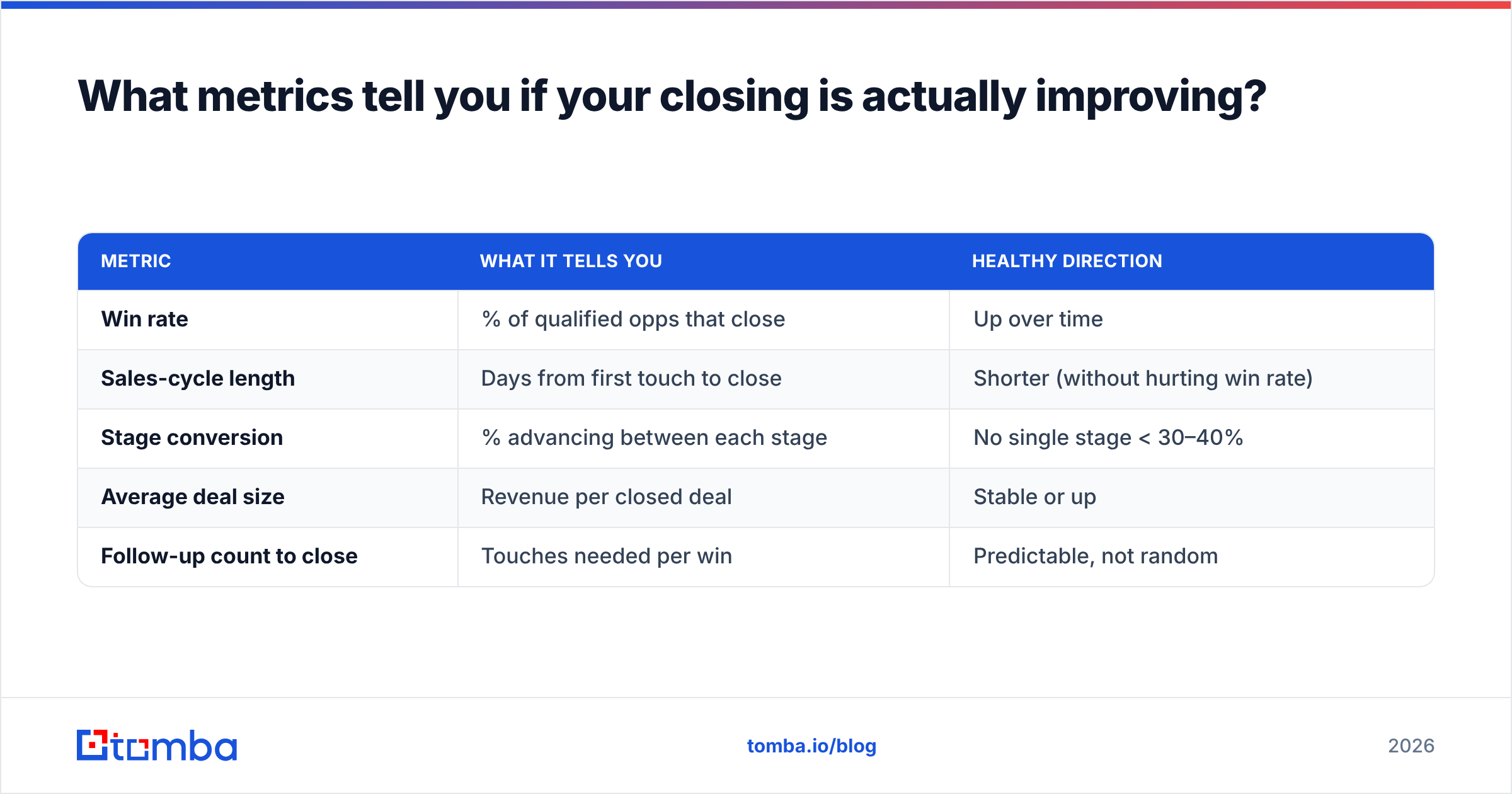
What metrics tell you if your closing is actually improving?#
You can't improve what you don't measure, and "I'm just not a good closer" is not a diagnosis. Track a tight set of numbers so you can see exactly where deals leak:
| Metric | What it tells you | Healthy direction |
|---|---|---|
| Win rate | % of qualified opps that close | Up over time |
| Sales-cycle length | Days from first touch to close | Shorter (without hurting win rate) |
| Stage conversion | % advancing between each stage | No single stage < 30–40% |
| Average deal size | Revenue per closed deal | Stable or up |
| Follow-up count to close | Touches needed per win | Predictable, not random |
If your win rate is fine but your cycle is long, you likely have a qualifying or urgency problem. If deals cluster and die at one specific stage, that's a coaching target, not a mystery. For a deeper look at the headline number, this breakdown of win rate is a useful reference. And if you want the industry framing on how sales orgs structure their process, HubSpot's sales resources and Salesforce's guidance are solid, vendor-neutral starting points.
What does a modern closing workflow look like end to end?#
Here's how the pieces fit together in practice — from raw prospect to signature:
- Identify the right account and the right people. Don't guess at who signs. Map the buying committee before you dial.
- Enrich and verify contact data. Confirm titles, get direct emails and phone numbers, and verify them so your outreach lands. Tools like a phone finder and contact enrichment cut wasted effort here.
- Run disciplined discovery. Quantify the problem in the buyer's own numbers. This is where the close is actually won.
- Trial-close early and often. Surface objections while they're cheap to handle.
- Match the closing technique to the moment. Assumptive for hot buyers, takeaway for hesitant ones.
- Follow up like it matters — because it does. Persistent, value-add follow-up separates closed deals from "went dark."
The reps who consistently close aren't the smoothest talkers. They're the ones whose pipeline is built on accurate data and a repeatable process, so the close is the easy part.
Frequently asked questions#
Is closing a skill you're born with? No. Closing is a learnable process. Natural rapport helps, but win rate is driven by qualifying, discovery, and follow-up discipline — all of which are trainable.
What's the single biggest closing mistake? Continuing to pitch after the buyer has already given a buying signal. Learn to stop selling and ask for the commitment.
How many follow-ups should I send before giving up? More than you think. Most B2B wins take five or more touches. The key is that each follow-up adds value, not just "checking in."
Does cold email still work for closing deals in 2026? Yes — when it reaches a real, verified decision-maker and lands in the inbox. Deliverability and data quality decide whether cold outreach ever gets to the closing stage at all.
Close more of the deals you already have#
The fastest way to close more sales isn't a new script — it's making sure every conversation is with the right person, reachable through verified contact data, so your closing skills actually get a chance to work. Start there.
Tomba's Email Finder helps you reach the actual decision-maker with accurate, verified emails — so fewer messages bounce, more land, and more conversations reach the close. Pair it with the email verifier to protect your sender reputation, and check the Tomba pricing plans (a free tier with 25 searches/month, Starter at $49/mo, and Growth at $99/mo) to find the fit for your team. Build the pipeline right, and closing takes care of itself.
Related guides#
Ready to find emails that actually work?
Join 150,000+ professionals who stopped guessing and started sending. Free credits on signup — no credit card required.
Get the Tomba newsletter
Practical outbound tactics and product updates — once every two weeks.
About the author