Closing Salutations for Emails: 25+ Sign-Offs That Get Replies
Your sign-off is the last thing a prospect reads before deciding to reply. Here are 25+ closing salutations for emails ranked by tone, formality, and reply rate—plus the ones to retire.
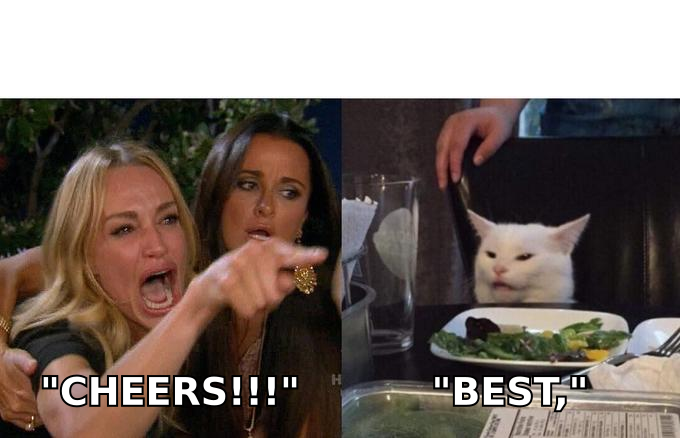
You spend twenty minutes crafting a cold email, nail the subject line, personalize the opener—and then close with "Cheers!!!" and undo half your credibility in one line. The closing salutation is the last thing a reader processes before they decide to reply, ignore, or mark as spam. It carries more weight than its size suggests.
This guide breaks down the closing salutations for emails that actually earn replies, the ones that quietly cost you deals, and how to match your sign-off to context, audience, and channel.
TL;DR#
- A closing salutation (or valediction) is the word or phrase before your name—"Best regards," "Thanks," "Talk soon"—that signals tone and relationship distance.
- "Best regards," "Thanks," and "Best" are the safest high-reply performers across cold, warm, and internal email.
- Skip "Cheers" in formal B2B, "Sincerely" in casual threads, and anything with three exclamation points.
- Match formality to context: first-touch cold email leans neutral-professional; a fifth reply to a warm lead can loosen up.
- A weak sign-off won't save a bad email—but a mismatched one will sink a good one. Fix the whole sequence, not just the last line.
What is a closing salutation in an email?#
A closing salutation is the sign-off phrase that sits between your message body and your name. Think of it as the handshake at the end of a conversation: a firm, appropriate one leaves a good final impression, while a limp or overly aggressive one lingers awkwardly. In email etiquette this is formally called a valediction—the complementary close that mirrors the greeting you opened with.
The salutation does three jobs at once:
- Signals formality — "Sincerely" and "Yo" occupy opposite ends of a spectrum, and readers decode that instantly.
- Sets relationship distance — "Warm regards" implies familiarity; "Regards" keeps things transactional.
- Cues the next action — "Talk soon" and "Looking forward to your thoughts" gently prompt a reply in a way that "Best" does not.
Get all three aligned with your actual relationship and the reader barely notices—which is the goal. Get them misaligned and you create friction the recipient can't quite name but still feels.
Which closing salutations for emails work best?#
There's no single "best" sign-off—there's the best sign-off for a context. Still, decades of email data and etiquette research converge on a short list of reliable performers. HubSpot's analysis of sign-offs and reply rates consistently shows gratitude-based closes outperforming neutral ones, and formal-but-warm closes beating both stiff and overly casual extremes (HubSpot's breakdown of email sign-offs is a solid primary source).
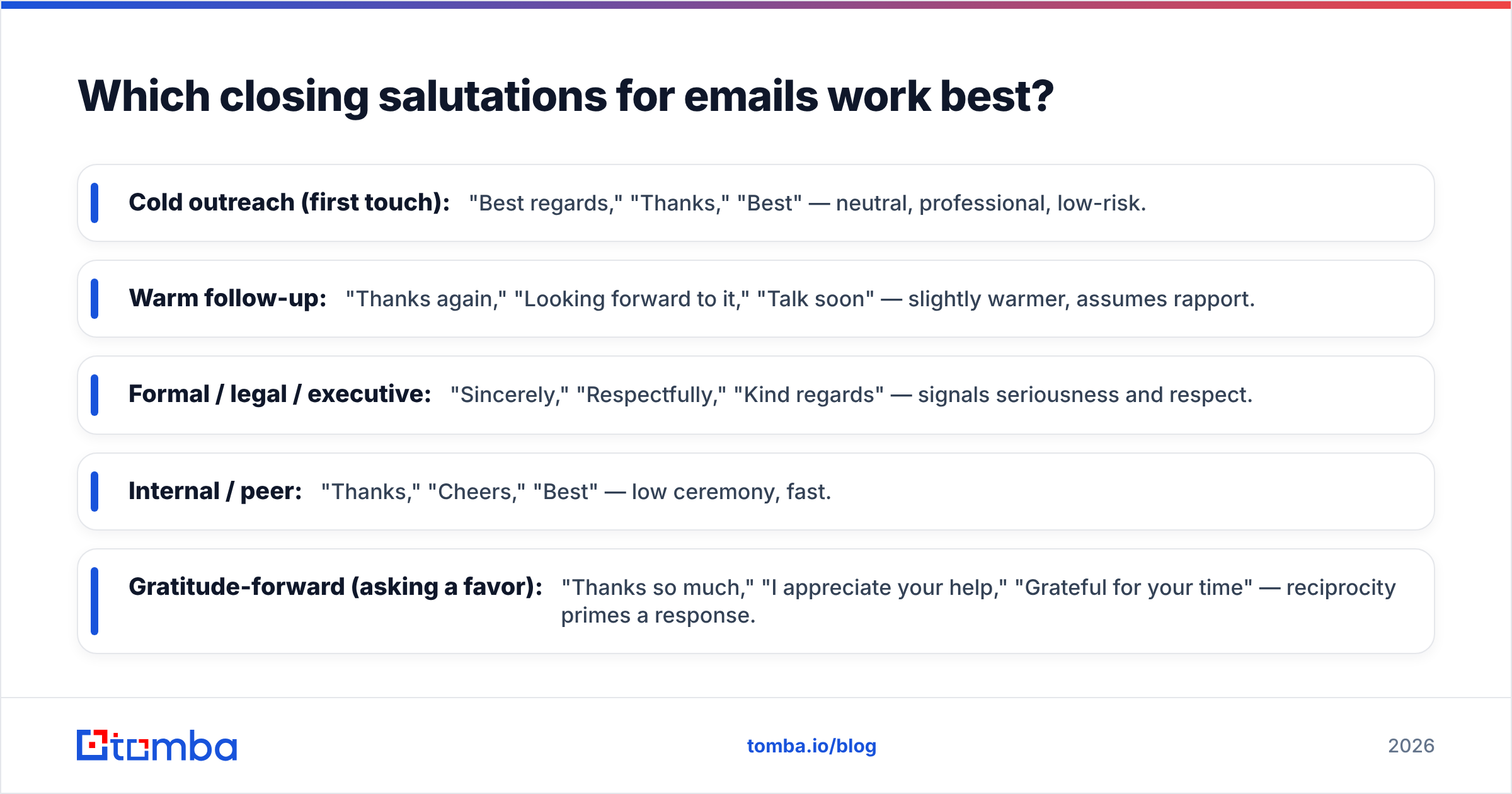
Here's a working shortlist by scenario:
- Cold outreach (first touch): "Best regards," "Thanks," "Best" — neutral, professional, low-risk.
- Warm follow-up: "Thanks again," "Looking forward to it," "Talk soon" — slightly warmer, assumes rapport.
- Formal / legal / executive: "Sincerely," "Respectfully," "Kind regards" — signals seriousness and respect.
- Internal / peer: "Thanks," "Cheers," "Best" — low ceremony, fast.
- Gratitude-forward (asking a favor): "Thanks so much," "I appreciate your help," "Grateful for your time" — reciprocity primes a response.
Notice how many of these lean on "thanks." Gratitude is the safest bet in almost any professional context because it's warm without being familiar, and it subtly frames the reader as someone doing you a small kindness by reading.
What's the difference between formal and casual email closings?#
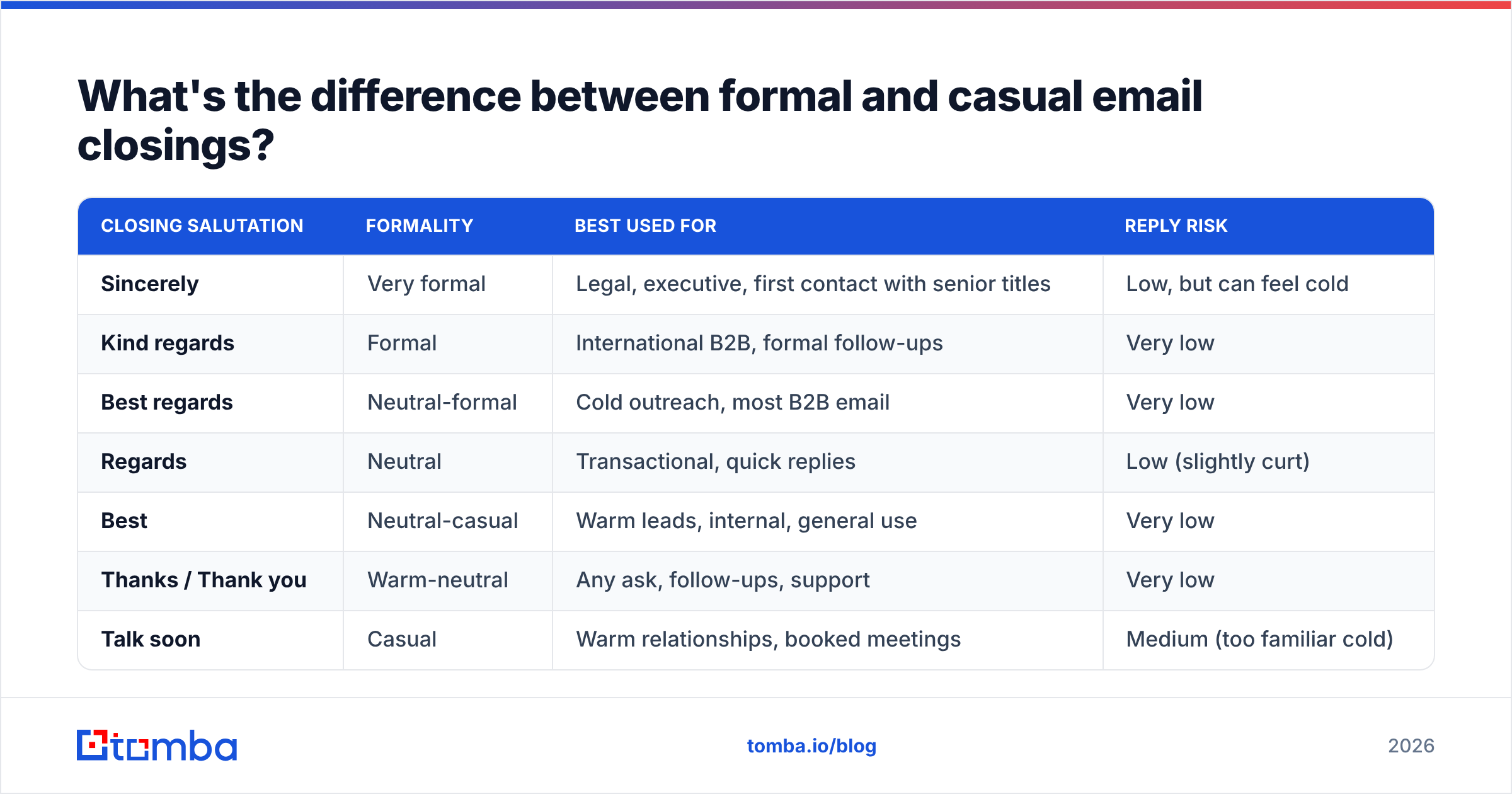
Formality is the axis most people get wrong. A closing that's too formal reads as cold or robotic in a friendly thread; one that's too casual reads as unprofessional in a first-touch cold email. The table below maps common closing salutations for emails to formality level, ideal use case, and reply-risk.
| Closing salutation | Formality | Best used for | Reply risk |
|---|---|---|---|
| Sincerely | Very formal | Legal, executive, first contact with senior titles | Low, but can feel cold |
| Kind regards | Formal | International B2B, formal follow-ups | Very low |
| Best regards | Neutral-formal | Cold outreach, most B2B email | Very low |
| Regards | Neutral | Transactional, quick replies | Low (slightly curt) |
| Best | Neutral-casual | Warm leads, internal, general use | Very low |
| Thanks / Thank you | Warm-neutral | Any ask, follow-ups, support | Very low |
| Talk soon | Casual | Warm relationships, booked meetings | Medium (too familiar cold) |
| Cheers | Casual | Peers, UK/AU audiences, informal | Medium (unprofessional cold) |
| Sent from my iPhone | None | Nothing intentional | High (looks lazy) |
| Have a blessed day | Personal | Almost never in B2B | High (polarizing) |
The pattern: the middle of the table—"Best regards," "Best," "Thanks"—is where you're safest. The edges are where you either freeze the reader out or overshare.
One practical rule: match the formality of your close to the formality of your open. If you greeted with "Hi Sarah," don't close with "Respectfully yours." If you opened "Dear Dr. Chen," don't end with "Cheers." Mismatched bookends feel jarring even when the body is perfect. If you're building repeatable outreach, lock this consistency into your reusable cold email templates so every send stays on-tone.
Which email sign-offs should you avoid?#
Some closings actively hurt you. They either date you, undercut authority, or trigger the exact opposite of the response you want. Retire these:
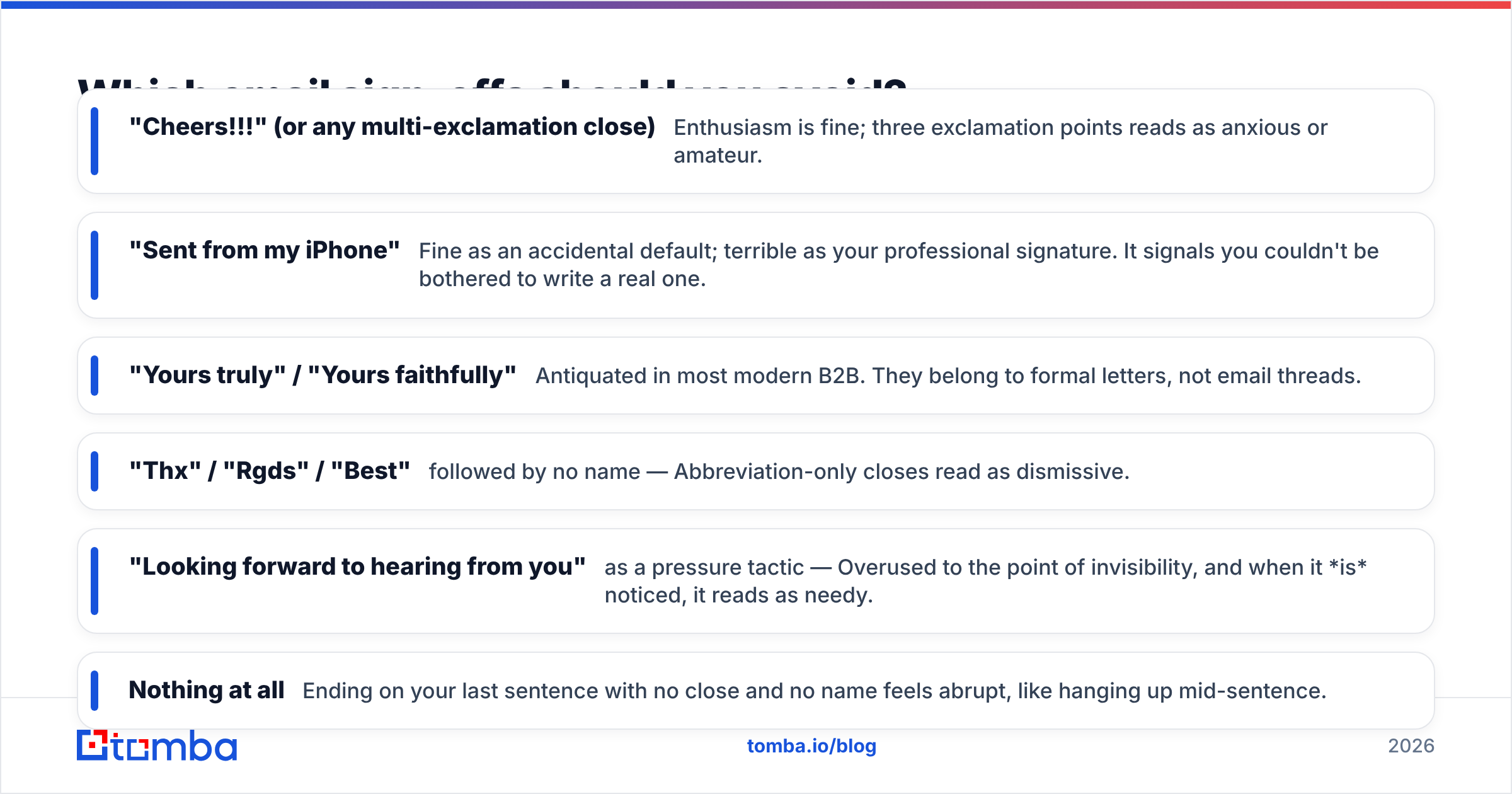
- "Cheers!!!" (or any multi-exclamation close) — Enthusiasm is fine; three exclamation points reads as anxious or amateur.
- "Sent from my iPhone" — Fine as an accidental default; terrible as your professional signature. It signals you couldn't be bothered to write a real one.
- "Yours truly" / "Yours faithfully" — Antiquated in most modern B2B. They belong to formal letters, not email threads.
- "Thx" / "Rgds" / "Best" followed by no name — Abbreviation-only closes read as dismissive.
- "Looking forward to hearing from you" as a pressure tactic — Overused to the point of invisibility, and when it is noticed, it reads as needy.
- Nothing at all — Ending on your last sentence with no close and no name feels abrupt, like hanging up mid-sentence.
The through-line: avoid anything that makes the reader question your professionalism or feel managed. A sign-off should reassure, not pressure.
How does your sign-off affect email reply rates?#
Your closing salutation won't rescue a bad email, but it measurably shifts the odds on a good one. The mechanism is simple: the sign-off is the last thing in working memory when the reader decides whether to act. A warm, low-friction close leaves them slightly more inclined to reply; a cold or awkward one adds a hair of resistance. Across thousands of sends, that hair compounds into a real difference in response rate.
Three factors amplify the effect:
- Gratitude closes ("Thanks," "I appreciate it") consistently edge out neutral closes because reciprocity is a strong social prime—people feel a mild pull to respond to someone who thanked them.
- Question-adjacent closes ("Looking forward to your thoughts") outperform flat closes because they cue an action, though overuse dulls them.
- Consistency with your signature block matters more than the specific word. A clean, named, professional close beats a clever one that clashes with a broken or missing signature.
That last point is where a lot of otherwise-good outreach falls apart. If your sign-off is polished but your signature is a wall of mismatched fonts or a bare name with no title, the mismatch reads as sloppy. Standardize your block with an email signature generator so the close and the credentials underneath it feel like one deliberate unit.
What are the best closing salutations by scenario?#
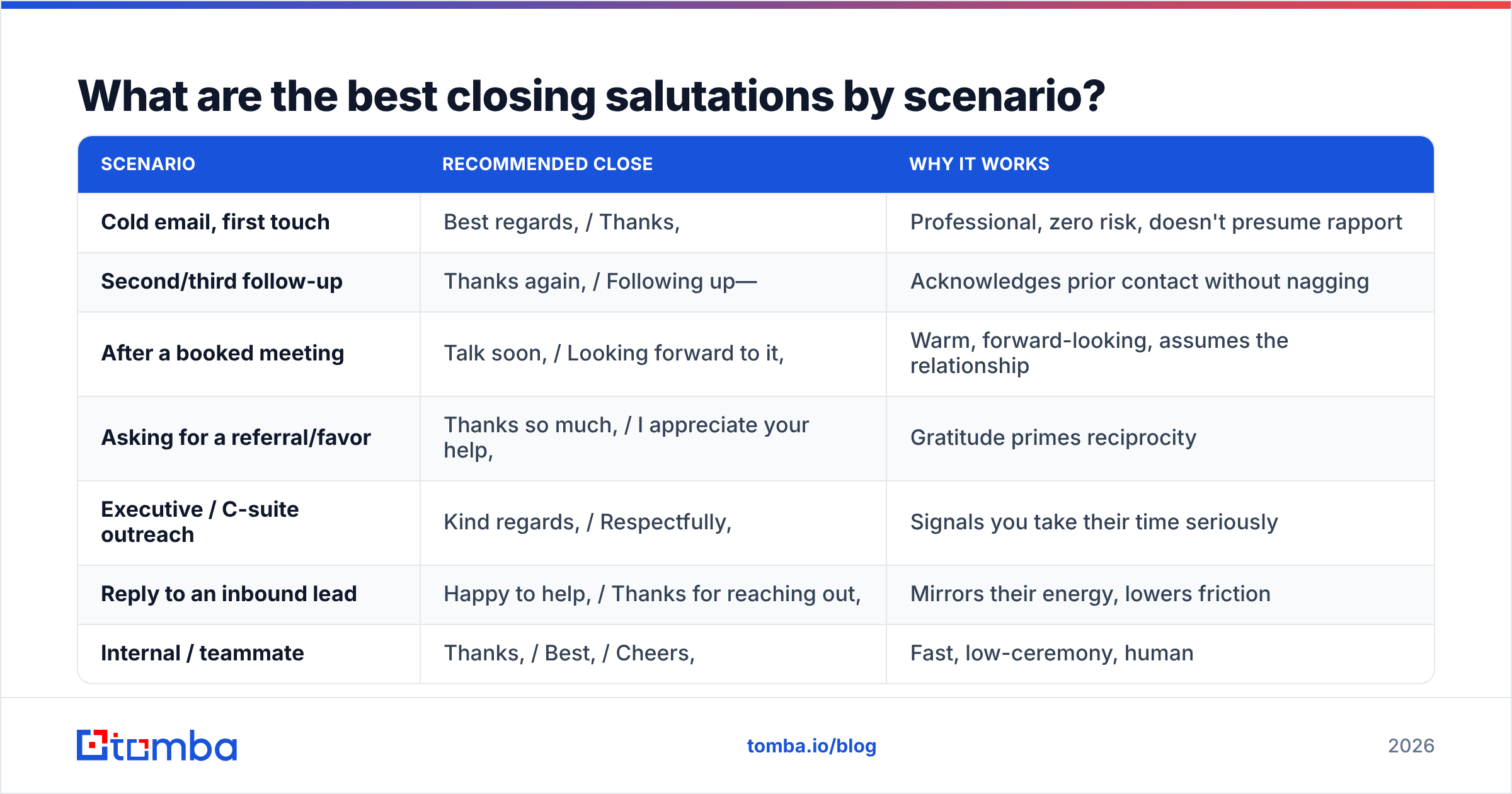
Rather than memorize a list, map the close to the moment. Here's a scenario-driven reference you can lift directly:
| Scenario | Recommended close | Why it works |
|---|---|---|
| Cold email, first touch | Best regards, / Thanks, | Professional, zero risk, doesn't presume rapport |
| Second/third follow-up | Thanks again, / Following up— | Acknowledges prior contact without nagging |
| After a booked meeting | Talk soon, / Looking forward to it, | Warm, forward-looking, assumes the relationship |
| Asking for a referral/favor | Thanks so much, / I appreciate your help, | Gratitude primes reciprocity |
| Executive / C-suite outreach | Kind regards, / Respectfully, | Signals you take their time seriously |
| Reply to an inbound lead | Happy to help, / Thanks for reaching out, | Mirrors their energy, lowers friction |
| Internal / teammate | Thanks, / Best, / Cheers, | Fast, low-ceremony, human |
| Apology / service recovery | Sincerely, / With apologies, | Formal weight matches the stakes |
If you run outbound at volume, don't reinvent the close every time. Pick two or three defaults—say, "Best regards" for cold and "Thanks again" for follow-ups—and let context tell you when to deviate. Consistency reads as competence; novelty in a sign-off almost never pays off.
How do you write a strong email closing, step by step?#
A complete closing has three parts, and each one should be intentional:
- The transition line — One sentence that hands off the action. "Let me know if a 15-minute call next week works" beats a cold jump to the sign-off.
- The salutation — The context-matched phrase from the tables above, followed by a comma.
- The signature block — Full name, title, company, and one contact method. No more, no less for cold email.
Put together, a clean B2B closing looks like this:
Happy to send over a short case study if it's useful—just say the word.
Best regards,
Jordan Rivera
Account Executive, Northwind Labs
jordan@northwind.io
Notice there's no "Sent from my iPhone," no triple exclamation, no antique "Yours faithfully." The transition line does the persuading; the salutation stays out of the way; the block establishes credibility. That's the whole job.
If you want to pressure-test tone before you hit send, tools like G2's software reviews can point you to sign-off and tracking utilities, but honestly, the fastest fix is a checklist: right formality, matched to the greeting, named signature, no filler.
Does the sign-off matter more than the email itself?#
No—and this is the most important caveat in the guide. The sign-off is a multiplier, not a foundation. A perfect "Best regards" on a generic, irrelevant, poorly targeted email still gets ignored. The single biggest lever on reply rate isn't the last line; it's whether you reached the right person with a relevant message in the first place.
That's a targeting and data problem, not a copywriting one. If half your cold emails bounce or land in the inboxes of people who left the company two years ago, no sign-off on earth will save your reply rate. Getting verified, current contact data upstream is what makes the downstream polish—including your closing salutation—actually count.
So the honest priority order is:
- Right person, verified email — foundation.
- Relevant, personalized message — the substance.
- Clean structure, strong close — the finish.
Nail all three and your closing salutation becomes the quiet, confident handshake it's supposed to be.
Frequently asked questions#
Is "Best regards" too formal for a cold email? No—"Best regards" is the safest default for first-touch cold email. It reads as professional without being stiff, and almost no recipient will react negatively to it.
Should I use a different sign-off in a follow-up than in the first email? Yes, slightly. Your first email should stay neutral-professional ("Best regards," "Thanks"). By the second or third touch you can warm up to "Thanks again" or "Following up—" to acknowledge the ongoing thread.
Is "Cheers" unprofessional? It depends on audience. "Cheers" is normal among UK/Australian professionals and in casual internal threads, but it can read as too informal in a first-touch cold email to a senior US executive. When in doubt, use "Best" or "Thanks."
Do I need a closing salutation at all in a quick reply? For fast internal back-and-forth, you can drop to just "Thanks," or even nothing. For any external or first-contact email, always include a close and your name—omitting it reads as abrupt.
Fix the foundation before you polish the close#
A great closing salutation is the finishing touch on outreach that's already aimed at the right person. Before you obsess over "Best" versus "Best regards," make sure the email is landing in a real, current inbox. Tomba's Email Finder helps you find and verify professional email addresses by name, domain, or company—so your carefully worded sign-off reaches a decision-maker who can actually reply, not a dead address.
Start on the free tier with 25 searches a month, then scale to Starter at $49/mo when your outbound picks up. Get the targeting right, keep the close clean, and let every email you send do its full job.
Related guides#
Ready to find emails that actually work?
Join 150,000+ professionals who stopped guessing and started sending. Free credits on signup — no credit card required.
Get the Tomba newsletter
Practical outbound tactics and product updates — once every two weeks.
About the author