Cloudee Pricing, Reviews, Pros and Cons (2026 Breakdown)
A neutral, numbers-first look at Cloudee pricing, real user reviews, and the honest pros and cons — plus a cheaper email finder alternative to weigh before you commit your budget.
Cloudee is pitched as an all-in-one way to find and enrich B2B contacts. But the pricing page raises more questions than it answers. Credits, seats, "custom" tiers, and vague overage rules make it hard to know what you'll really pay. This is a neutral, numbers-first guide to Cloudee pricing, reviews, pros and cons. We cover the real costs, what users say after a few months, and the trade-offs that matter before you buy.
TL;DR: Cloudee pricing, reviews, pros and cons#
- Cloudee pricing is credit-based. So the sticker price rarely matches your real monthly cost. Verification, enrichment, and extra seats all add up.
- Reviews are mixed. Users praise the interface and onboarding. But complaints keep coming back to data accuracy, credit burn, and slow support on lower tiers.
- Biggest pro: a clean, all-in-one workflow. Finding and enrichment live in one dashboard.
- Biggest con: unpredictable costs. On some plans, credits are spent even on failed or unverified lookups.
- Cheaper alternative: Tomba starts at $49/mo. It has a free tier, transparent credits, and a built-in email verifier, so you don't pay twice.
What is Cloudee and who is it for?#
Cloudee positions itself as a B2B contact and lead-intelligence platform. You search for a company or person. It returns professional email addresses, job titles, and firmographic data you can push into a CRM. In practice, it competes with email finders and enrichment tools, not full sales-engagement suites. Think "find the contact and its details," not "run the whole sequence."
The typical buyer is a small-to-mid outbound team, a solo founder, or a RevOps person enriching an existing list. If that's you, the pricing structure matters more than the feature list. Contact tools live and die on cost-per-usable-record, not cost-per-credit.
One thing to settle early: an email tool is only as good as its verification. A cheap credit means nothing if half the addresses bounce. Keep that lens on as we go through the numbers.
How much does Cloudee pricing actually cost?#
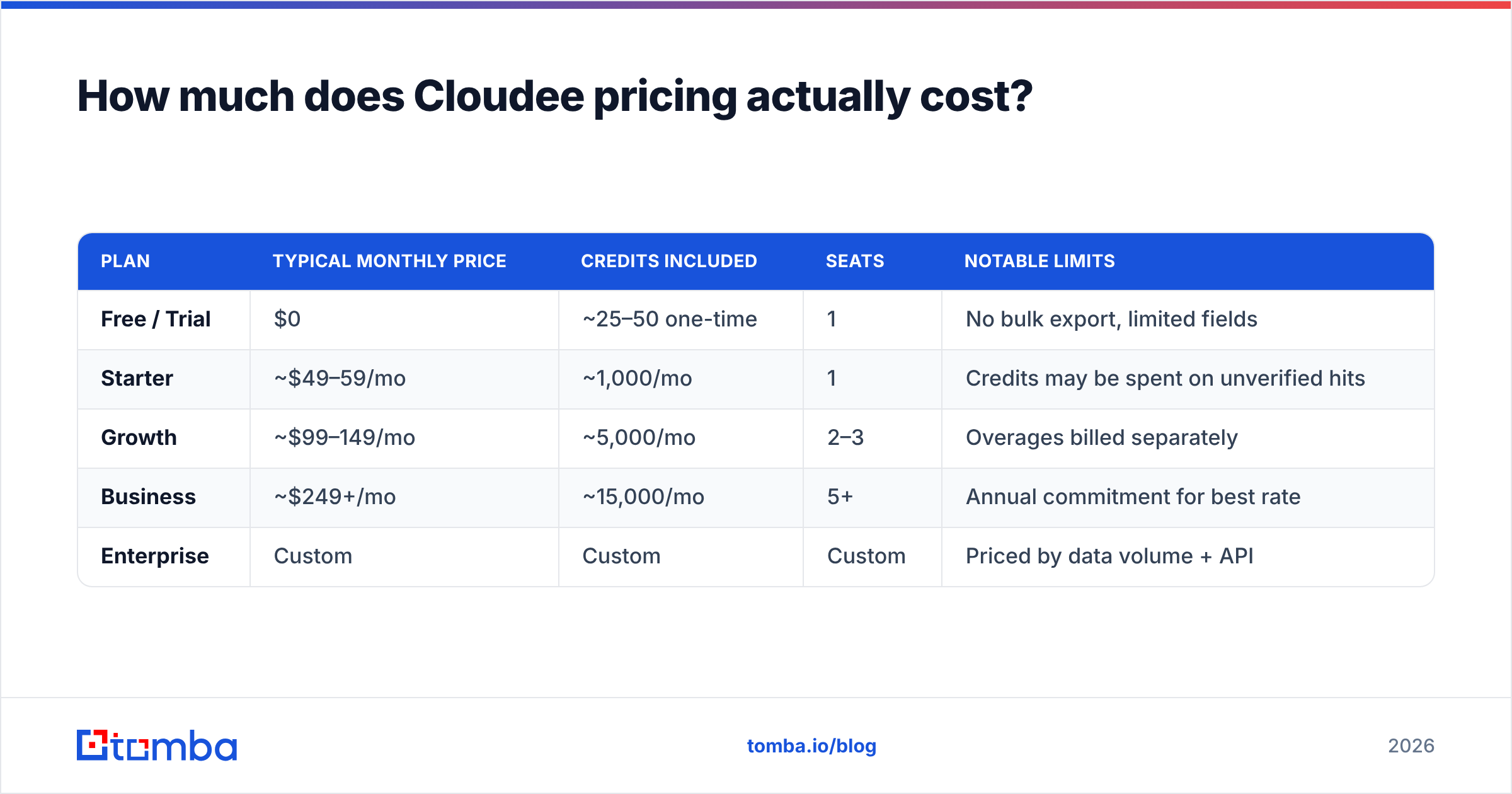
Cloudee prices on credits, like most tools in this space. One lookup or enrichment consumes one or more credits. Each plan bundles a fixed monthly allotment. The published tiers usually look like the table below. Treat the exact figures as directional, since vendors change them often. The structure is the point.
| Plan | Typical monthly price | Credits included | Seats | Notable limits |
|---|---|---|---|---|
| Free / Trial | $0 | ~25–50 one-time | 1 | No bulk export, limited fields |
| Starter | ~$49–59/mo | ~1,000/mo | 1 | Credits may be spent on unverified hits |
| Growth | ~$99–149/mo | ~5,000/mo | 2–3 | Overages billed separately |
| Business | ~$249+/mo | ~15,000/mo | 5+ | Annual commitment for best rate |
| Enterprise | Custom | Custom | Custom | Priced by data volume + API |
The trap in credit pricing isn't the headline number. It's the effective cost per usable email. Here's what quietly inflates the bill:
- Credits burned on failures. On some plans, a risky or catch-all address still costs a credit. You pay for guesses.
- Verification sold separately. If finding and verifying are two line items, your real cost per confirmed contact can double.
- Seat multiplication. Team plans charge per seat. A 4-person SDR pod can jump a tier for headcount, not usage.
- Overage rates. Run out mid-month and you often buy top-up credits at a worse per-unit price.
- Annual lock-in. The advertised low price is often the annual-prepaid rate. Month-to-month costs more.
Before you compare Cloudee to anything, do this math: (monthly price + expected overages) ÷ verified, deliverable contacts you'll actually email. That number is your real price, not the plan name. For a clear baseline, Tomba pricing publishes credits per tier with no separate verification billing. That makes the same math easy.
What do Cloudee reviews say?#
Pull the reviews across G2 and Capterra and a clear pattern shows up. The sentiment splits into what people love in month one and what frustrates them by month three.
What reviewers consistently praise:
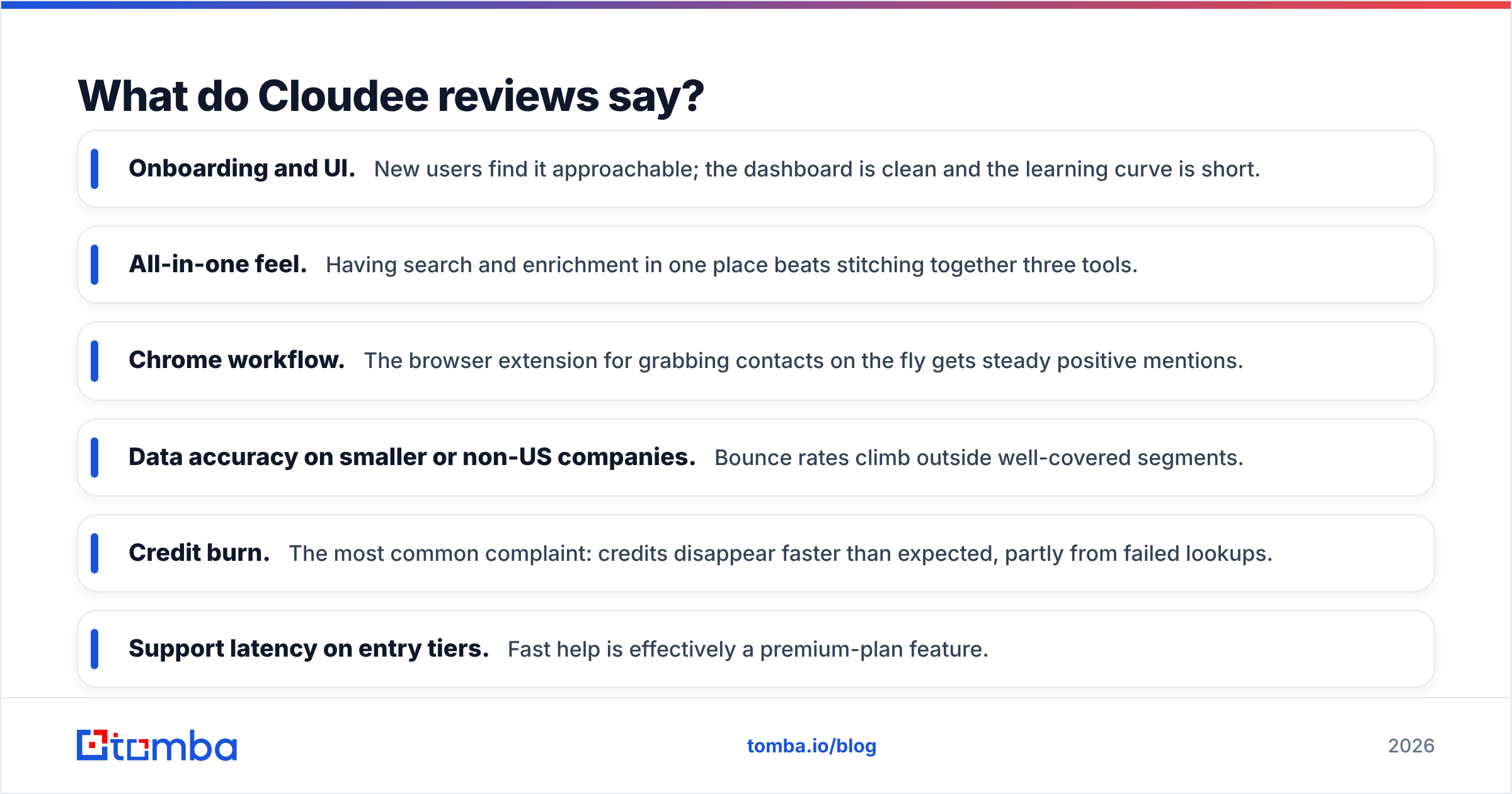
- Onboarding and UI. New users find it approachable. The dashboard is clean and the learning curve is short.
- All-in-one feel. Search and enrichment in one place beats stitching together three tools.
- Chrome workflow. The browser extension for grabbing contacts gets steady praise.
What reviewers consistently criticize:
- Data accuracy on smaller or non-US companies. Bounce rates climb outside well-covered segments.
- Credit burn. The top complaint: credits vanish faster than expected, partly from failed lookups.
- Support latency on entry tiers. Fast help is effectively a premium-plan feature.
- Export and integration friction. Some users report clunky CRM syncs and rate limits on bulk jobs.
None of this makes Cloudee a bad tool. It makes it a typical one. And it tells you exactly where to stress-test it during a trial.
How accurate is Cloudee's data?#
Accuracy is the whole game. B2B data decays fast — roughly 22–30% of contact data goes stale each year as people change jobs. A finder that isn't always re-verifying is selling you last year's org chart.

When you test Cloudee's accuracy, ignore the marketing percentage and run your own check:
- Pull 100 contacts from companies where you already have verified emails.
- Measure the match rate (how many it found). Then measure the bounce rate (how many actually deliver).
- Repeat for a non-US segment and an SMB segment, where most tools weaken.
A strong tool clears 95%+ deliverability on verified results. Does Cloudee return lots of "accept-all" or "unknown" statuses that still cost credits? Factor that into the price-per-usable-email number from earlier. This is why a standalone email verifier matters. It lets you filter risky addresses before they hit your sending domain and drag down your email deliverability.
What are the pros and cons of Cloudee?#
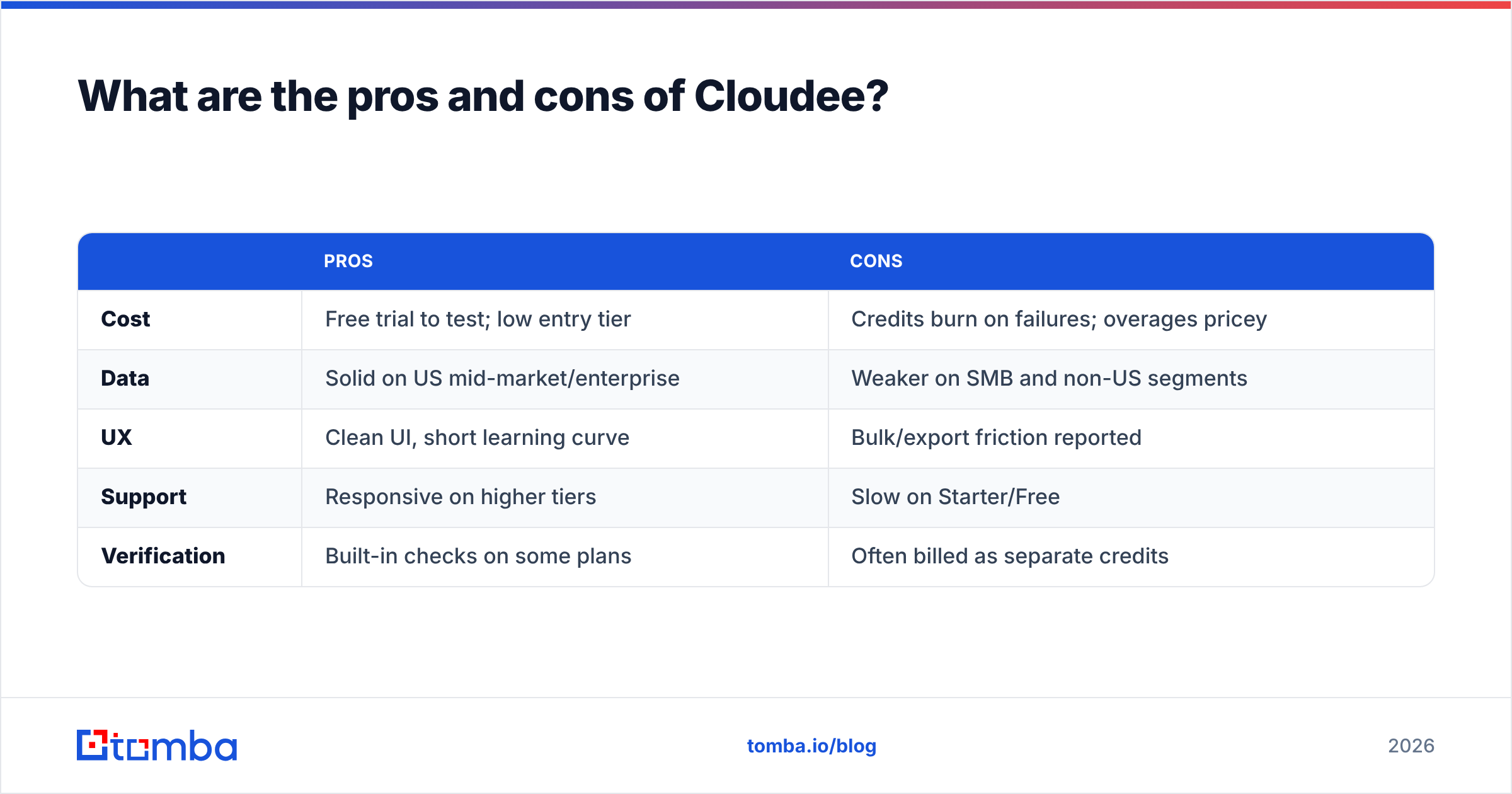
Here's the honest ledger, stripped of hype.
| Pros | Cons | |
|---|---|---|
| Cost | Free trial to test; low entry tier | Credits burn on failures; overages pricey |
| Data | Solid on US mid-market/enterprise | Weaker on SMB and non-US segments |
| UX | Clean UI, short learning curve | Bulk/export friction reported |
| Support | Responsive on higher tiers | Slow on Starter/Free |
| Verification | Built-in checks on some plans | Often billed as separate credits |
The pros in plain terms: Cloudee is easy to adopt and pleasant to use. It consolidates a workflow that would otherwise need several subscriptions. For a US-focused team at moderate volume, it can be a reasonable pick.
The cons in plain terms: cost predictability is the weak spot. Failed-lookup charges, separate verification billing, and per-seat pricing all add up. The amount you pay can drift well above the sticker. That's exactly the complaint that shows up in longer-term reviews.
How does Cloudee compare to alternatives?#
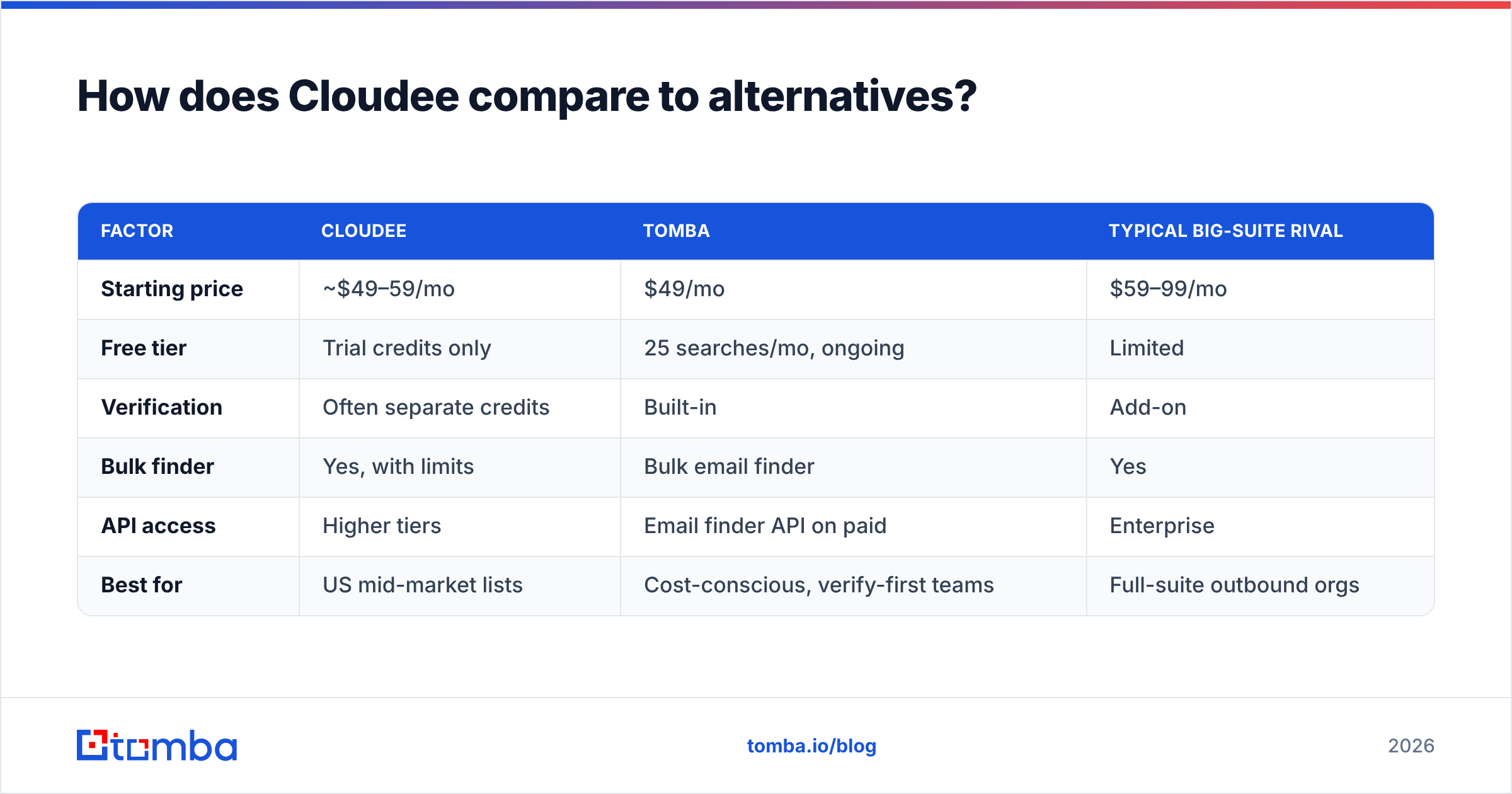
Most teams shopping Cloudee also look at Apollo, RocketReach, and Tomba. The deciding factors are almost always the same three: cost transparency, verification included vs. add-on, and a free tier for testing.

| Factor | Cloudee | Tomba | Typical big-suite rival |
|---|---|---|---|
| Starting price | ~$49–59/mo | $49/mo | $59–99/mo |
| Free tier | Trial credits only | 25 searches/mo, ongoing | Limited |
| Verification | Often separate credits | Built-in | Add-on |
| Bulk finder | Yes, with limits | Bulk email finder | Yes |
| API access | Higher tiers | Email finder API on paid | Enterprise |
| Best for | US mid-market lists | Cost-conscious, verify-first teams | Full-suite outbound orgs |
The practical read: do you want the widest all-in-one platform, with price predictability as a secondary concern? Then a big suite like Apollo may fit. Is your priority paying only for contacts you can actually email? Then a verify-first tool with a standing free tier is the safer spend. Tomba sits in that second camp — $49/mo Starter, $99/mo Growth, $249/mo Pro, and a permanent free tier of 25 searches. You can benchmark accuracy before paying a cent. Compare it on the Tomba pricing page.
Is Cloudee worth it in 2026?#
Short answer: it depends on your data mix and your tolerance for variable billing. Cloudee is worth it if you sell mainly to US mid-market and enterprise accounts. It suits teams that value a polished all-in-one interface and have steady volume, so overages won't surprise them. In that lane, it's a legitimate, well-liked tool.
It's harder to justify in other cases. Do you prospect internationally or into SMBs? Do you run tight, predictable budgets? Do you want verification bundled rather than metered? Those are the exact conditions where credit-burn complaints turn into real dollars. That's where a transparent, verify-first alternative usually wins on cost-per-usable-contact.
Whatever you choose, don't buy on the sticker price. Run a 100-contact accuracy test, measure the bounce rate, and divide your monthly cost by the contacts that actually deliver. That single number ends most of these debates.
Frequently asked questions#
Does Cloudee have a free plan? It usually offers a free trial with a small one-time credit allotment, not an ongoing free tier. If a standing free tier matters to you, note that Tomba's free plan gives 25 searches per month indefinitely.
Why do my Cloudee credits run out so fast? The most common cause is credits spent on failed, catch-all, or unverified lookups, plus separate verification charges. Track your credit-to-verified-contact ratio during the trial.
Is Cloudee's data accurate? It's generally strong for US mid-market and enterprise contacts. It's weaker for SMB and non-US segments. Always run your own bounce-rate test before committing.
What's the cheapest reliable alternative? For cost-conscious teams, Tomba starts at $49/mo. Verification is built in, and a free tier lets you test first — see Tomba pricing for the full breakdown.
The bottom line — and a cheaper way to find emails#
Cloudee is a capable, approachable contact tool with one recurring catch. Your real cost is hard to predict, and reviews reflect that. Judge it on cost-per-verified-contact, not the plan name. And pressure-test its accuracy on your real target segments before you scale spend. That's the honest read on Cloudee pricing, reviews, pros and cons.
If you want that predictability from day one, try the Tomba Email Finder. You get accurate, verified professional emails by name, domain, or company. A built-in verifier means you never pay twice for a clean list. The starting price is a transparent $49/mo, and a free tier lets you benchmark it against Cloudee on your own data. Find the emails, confirm they deliver, and only then decide where your budget belongs.
Related guides#
// get started
Find, verify and enrich your first contacts today
Start on the free plan with 25 searches a month, then scale when your team is ready.
Free plan · No credit card required · GDPR & CCPA
// about the author