CloudTalk vs RingCentral: The Honest 2026 Comparison
CloudTalk vs RingCentral, compared on price, call features, and CRM fit — so you can pick the right business phone system without overpaying for seats you won't use.
Choosing a business phone system is one of those decisions that quietly shapes your whole sales motion. Pick wrong and you're locked into per-seat pricing, clunky dialers, and CRM sync that breaks every other week. CloudTalk and RingCentral are two of the most common finalists — but they solve different problems. This is the honest, side-by-side breakdown.
TL;DR — CloudTalk vs RingCentral in five bullets#
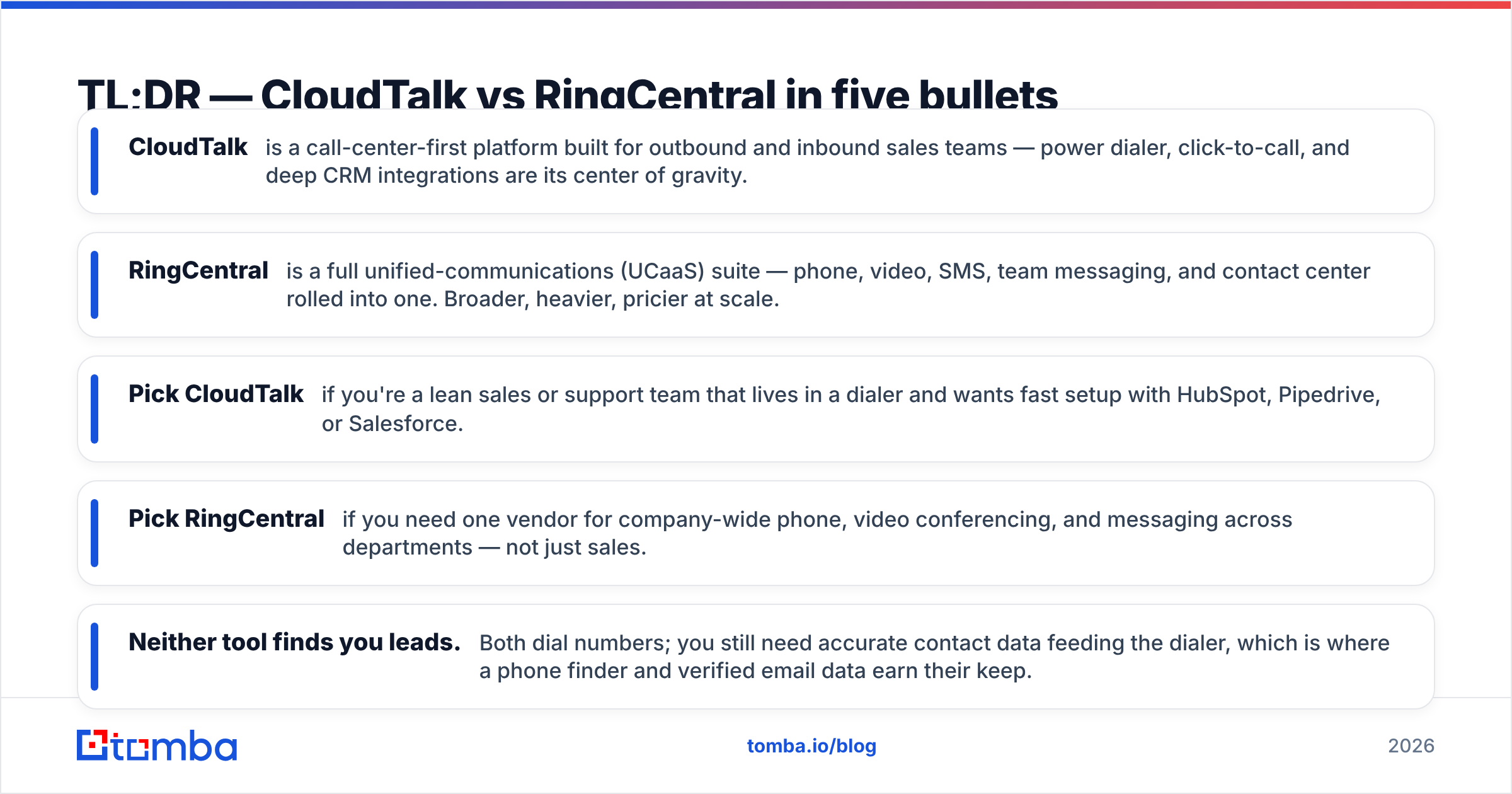
- CloudTalk is a call-center-first platform built for outbound and inbound sales teams — power dialer, click-to-call, and deep CRM integrations are its center of gravity.
- RingCentral is a full unified-communications (UCaaS) suite — phone, video, SMS, team messaging, and contact center rolled into one. Broader, heavier, pricier at scale.
- Pick CloudTalk if you're a lean sales or support team that lives in a dialer and wants fast setup with HubSpot, Pipedrive, or Salesforce.
- Pick RingCentral if you need one vendor for company-wide phone, video conferencing, and messaging across departments — not just sales.
- Neither tool finds you leads. Both dial numbers; you still need accurate contact data feeding the dialer, which is where a phone finder and verified email data earn their keep.
What is CloudTalk, and who is it for?#
CloudTalk is a cloud-based call center and business phone platform aimed squarely at sales and support teams. Its pitch is simple: get reps dialing faster, log everything in your CRM automatically, and give managers real-time call analytics without a hardware PBX.
The core strengths are the outbound tools — a power dialer that burns through call lists, click-to-call from any web page, call recording, IVR, and skills-based routing. CloudTalk supports local numbers in 160+ countries, which matters if you run international outbound and want to show a local caller ID.
Where CloudTalk shines is focus. It doesn't try to be your video-conferencing tool or your company intranet. It's a dialer with a good CRM story. That narrowness is a feature for a 5–50 seat sales org, and a limitation if you also need Zoom-style meetings and company-wide messaging.
What is RingCentral, and who is it for?#
RingCentral (RingEX, plus RingCentral Contact Center) is a unified communications platform. Think of it as the Swiss Army knife: one login for cloud phone, HD video meetings, SMS/MMS, team chat, fax, and — through its Contact Center product — full omnichannel support with workforce management.
It's built for organizations that want to consolidate vendors. Instead of paying separately for a phone system, a video tool, and a messaging app, RingCentral bundles them. For a 200-person company where marketing, support, finance, and sales all need reliable comms, that consolidation is genuinely valuable.
The tradeoff is that the sales-dialer experience is a module inside a much larger suite. Serious outbound teams often bolt on RingCentral's dialer or integrate a dedicated one, whereas CloudTalk is the dialer. RingCentral is also enterprise-grade on compliance and uptime, with a global carrier network — the kind of thing procurement teams care about.
CloudTalk vs RingCentral: how do they compare feature by feature?#
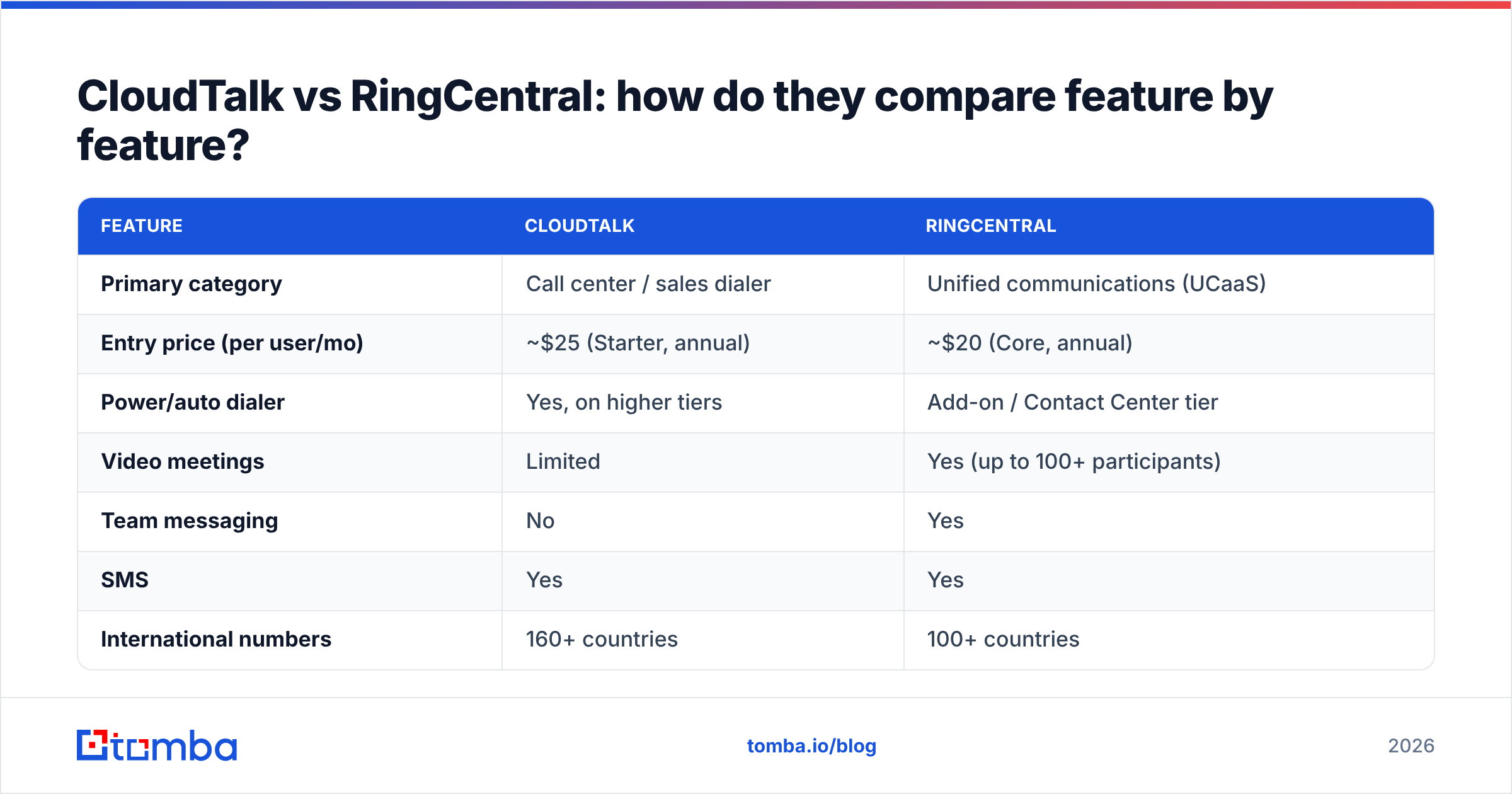
Here's the head-to-head on the attributes that actually decide the purchase. Prices are entry-level list prices and shift with billing term, seat count, and promotions — always confirm on the vendor's current pricing page.
| Feature | CloudTalk | RingCentral |
|---|---|---|
| Primary category | Call center / sales dialer | Unified communications (UCaaS) |
| Entry price (per user/mo) | ~$25 (Starter, annual) | ~$20 (Core, annual) |
| Power/auto dialer | Yes, on higher tiers | Add-on / Contact Center tier |
| Video meetings | Limited | Yes (up to 100+ participants) |
| Team messaging | No | Yes |
| SMS | Yes | Yes |
| International numbers | 160+ countries | 100+ countries |
| CRM integrations | HubSpot, Pipedrive, Salesforce, Zoho | HubSpot, Salesforce, and more |
| Best fit | Sales & support teams (5–50 seats) | Whole-company comms, enterprise |
| Contact center | Native focus | Separate product (RingCX) |
The pattern is clear: CloudTalk is deeper on the dialer, RingCentral is broader on communication. If you only measured "how good is the outbound calling workflow out of the box," CloudTalk tends to win with sales teams. If you measured "how many communication needs does one contract cover," RingCentral wins.
Is CloudTalk cheaper than RingCentral?#
It depends on what you're actually buying. On a pure per-seat entry price, the two are close — RingCentral's Core plan can look cheaper on paper. But the real cost lives in the tiers.
CloudTalk's most useful sales features (power dialer, advanced analytics, unlimited concurrent calls) sit on its Expert/Custom plans. RingCentral's dialer and contact-center capabilities live in RingCX or higher UCaaS tiers, which climb fast per seat. A few rules of thumb:
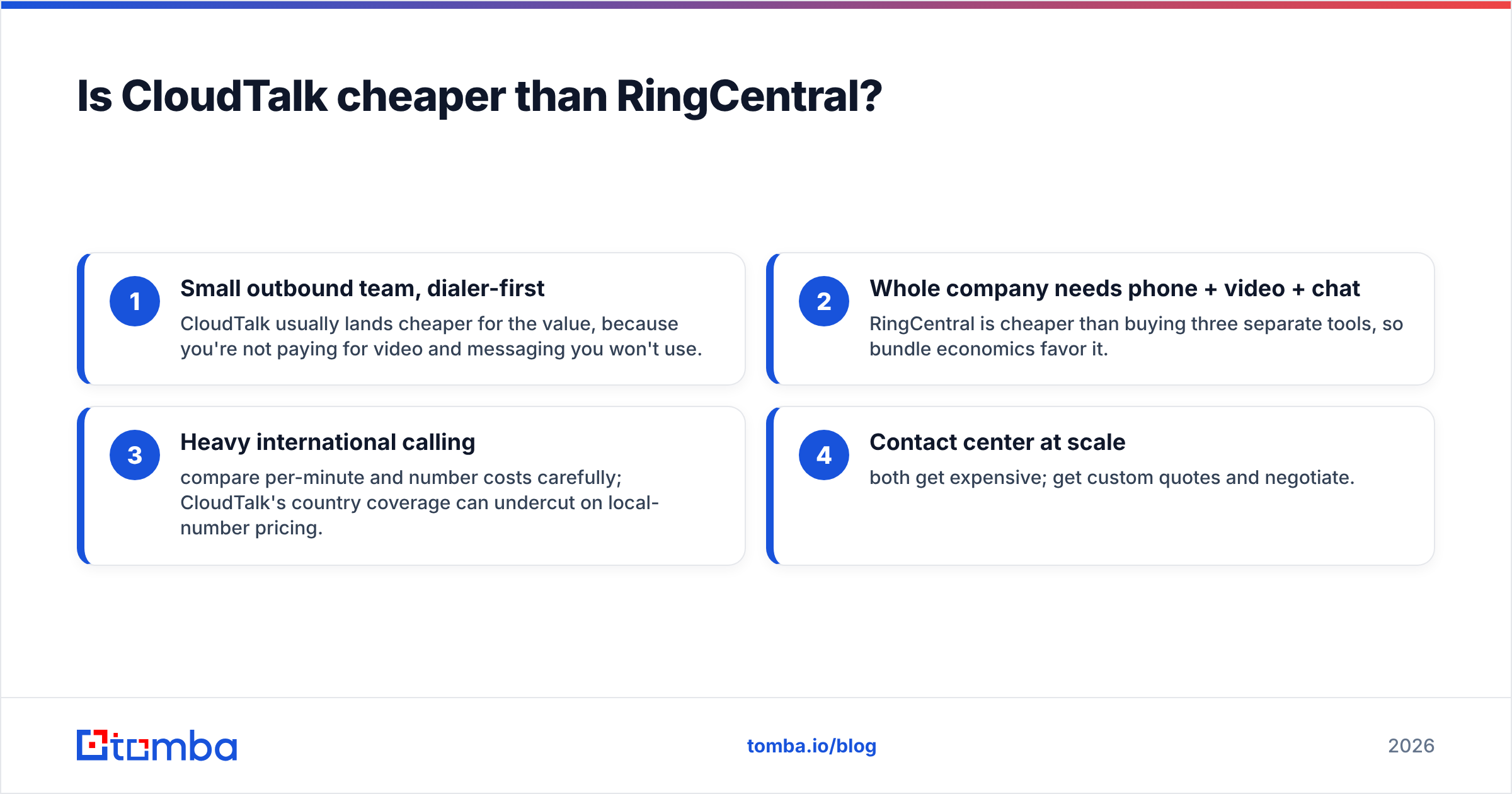
- Small outbound team, dialer-first — CloudTalk usually lands cheaper for the value, because you're not paying for video and messaging you won't use.
- Whole company needs phone + video + chat — RingCentral is cheaper than buying three separate tools, so bundle economics favor it.
- Heavy international calling — compare per-minute and number costs carefully; CloudTalk's country coverage can undercut on local-number pricing.
- Contact center at scale — both get expensive; get custom quotes and negotiate.
Don't anchor on the sticker price. Model your real seat count times the tier you actually need to do the job. That's the number that matters.
How do the CRM integrations and workflows differ?#
Both integrate with the big CRMs, but the philosophy differs. CloudTalk treats the CRM as the system of record and pushes every call, recording, and disposition into it automatically — the rep barely leaves HubSpot or Pipedrive. Click-to-call from a contact record, auto-logging, and two-way sync are table stakes for CloudTalk.
RingCentral integrates broadly too, and its ecosystem is larger (Microsoft Teams, Google Workspace, hundreds of apps in its gallery). But because it's a comms suite, the CRM-dialer loop can feel less native than CloudTalk's laser-focused sales workflow.
Here's the thing both tools quietly depend on: the quality of the data going in. A power dialer calling stale or wrong numbers just burns rep hours faster. Before you obsess over dialer speed, make sure the underlying contact records are accurate. Running numbers through a phone validator and keeping email data clean with an email verifier does more for connect rates than any auto-dialer setting.

What do real reviews say about CloudTalk and RingCentral?#
On peer-review sites, the split mirrors the positioning. CloudTalk earns praise for ease of setup, call quality, and responsive support — with occasional notes about integration edge cases and pricing on the top tier. RingCentral scores well on reliability, breadth, and enterprise features — with the common critique being complexity, support wait times at scale, and contracts that are easier to enter than exit.
You can dig into current, verified user feedback on G2 and cross-check the official capability claims on the CloudTalk and RingCentral sites before you commit. Read the 3-star reviews, not the 5-star ones — that's where the real tradeoffs surface.
Which should you choose: CloudTalk or RingCentral?#
Use this quick decision guide:
- Choose CloudTalk if: you're a sales or support team, outbound calling is central, you want fast CRM-native setup, and you don't need company-wide video/messaging from the same vendor.
- Choose RingCentral if: you're consolidating communication tools across an organization, you need video + chat + phone + SMS in one contract, and enterprise reliability and compliance are non-negotiable.
- Choose neither (yet) if: your connect rates are low because of bad data — no phone system fixes a broken list. Fix the data first.
Both are solid products. The mistake isn't picking the "wrong" one — it's paying for a tier of capability you never use, or feeding a great dialer with garbage numbers.
Why data quality beats dialer choice#
A dialer is a multiplier. Point it at accurate, verified contacts and it amplifies a good motion. Point it at guessed emails and disconnected numbers and it amplifies waste — faster.
That's the layer CloudTalk and RingCentral don't own. Before your reps hit "dial," you need a reliable way to find the right decision-maker, confirm the number, and enrich the record so the CRM shows who's actually worth calling. Tomba sits upstream of both tools: use the email finder and phone finder to build clean lists, then enrich leads with firmographic context so your dialer time goes to the accounts that matter.
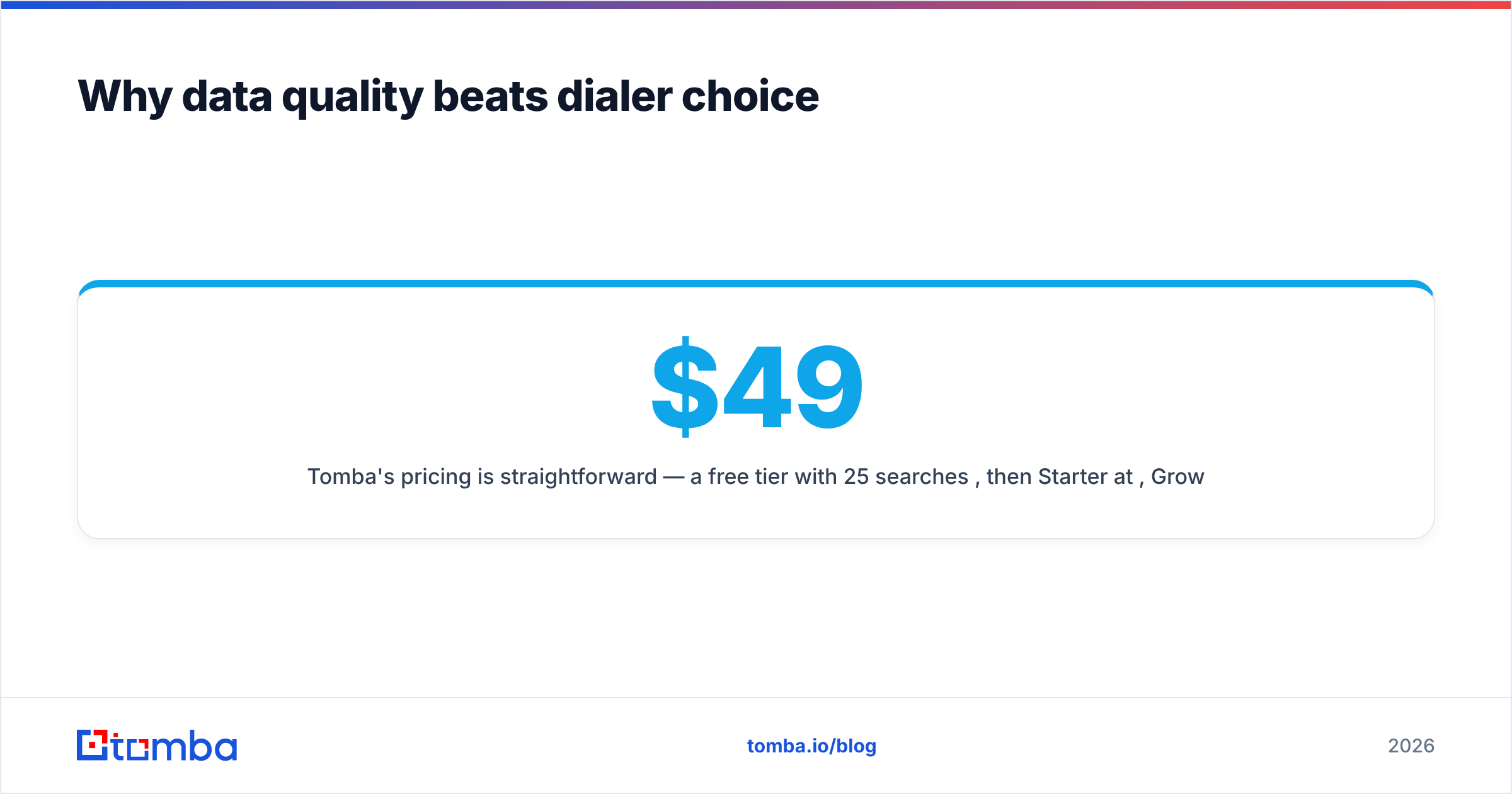
Tomba's pricing is straightforward — a free tier with 25 searches per month, then Starter at $49/mo, Growth at $99/mo, and Pro at $249/mo — so you can test the data quality before scaling. See full Tomba pricing for the current tiers.
The bottom line#
CloudTalk wins for focused, dialer-first sales and support teams that want CRM-native calling without the bloat. RingCentral wins for organizations consolidating phone, video, and messaging across departments with enterprise-grade reliability. Match the tool to your actual need — not to the longer feature list — and don't overpay for seats or modules you won't touch.
Then feed whichever you pick with accurate contacts. Start free with the Tomba Email Finder to build verified lead lists your new phone system can actually convert — and stop burning dialer minutes on data that was never going to answer.
Related guides#
Ready to find emails that actually work?
Join 150,000+ professionals who stopped guessing and started sending. Free credits on signup — no credit card required.
Get the Tomba newsletter
Practical outbound tactics and product updates — once every two weeks.
About the author