Cloze vs Close (2026): Which CRM Actually Fits Your Team?
Cloze and Close solve different problems: one nurtures relationships, the other closes deals at volume. Here's an honest breakdown of pricing, features, and which CRM fits your workflow in 2026.
The names look almost identical, but Cloze and Close are built for two very different kinds of seller. Pick the wrong one and you'll either fight your CRM every day or pay for features your team never touches. This breakdown cuts through the naming confusion so you can choose fast.
TL;DR: Cloze vs Close in 30 seconds#
- Close (close.com) is a sales-first CRM built for outbound and inside sales teams that live in calls, emails, and pipelines. Built-in dialer, sequences, and reporting.
- Cloze (cloze.com) is a relationship-management CRM that automatically logs every touchpoint and reminds you to follow up. Great for relationship-led roles like real estate, consulting, and account management.
- Close wins for high-volume outbound teams that need a dialer, sequences, and pipeline reporting in one tool.
- Cloze wins for solo operators and relationship-driven pros who want automatic contact history without manual data entry.
- Neither tool finds or verifies contact data well on its own; both work best paired with a dedicated email finder so your pipeline starts with real addresses.
What is Close?#
Close is a CRM designed around one job: helping salespeople close more deals with less busywork. Instead of bolting communication tools onto a contact database, Close puts the phone, email, and SMS directly inside the CRM. A rep can call a lead, log the outcome, trigger a follow-up email, and advance the deal stage without switching tabs.
It's aimed squarely at SMB and mid-market inside sales teams — the kind running structured outbound motions with SDRs and AEs. If your day is measured in dials, connects, and demos booked, Close speaks your language. Its native power dialer and predictive dialer are genuine differentiators; most CRMs make you pay for a third-party integration to get the same thing.
Close also leans hard into reporting. Activity comparison, funnel metrics, and leaderboard-style dashboards are first-class citizens, which makes it easy for a sales manager to see who's working and what's converting.
What is Cloze?#
Cloze is a relationship manager that happens to be a CRM. Its core promise is automation of the boring part: it connects to your email, calendar, and phone, then silently builds a complete history of every person you interact with. You don't log calls or type notes about who you met — Cloze assembles that timeline for you.
Where Close optimizes for deal velocity, Cloze optimizes for not dropping the ball on a relationship. It nudges you when you haven't talked to an important contact in a while, surfaces context before a meeting, and keeps track of the "soft" network that drives referral-based business. That makes it a favorite among realtors, financial advisors, consultants, and founders who sell through relationships rather than sequences.
The trade-off: Cloze is lighter on hard sales infrastructure. There's no native power dialer built for cranking through call lists, and its pipeline and team-reporting features are simpler than what an outbound sales org expects.

Cloze vs Close: side-by-side comparison#
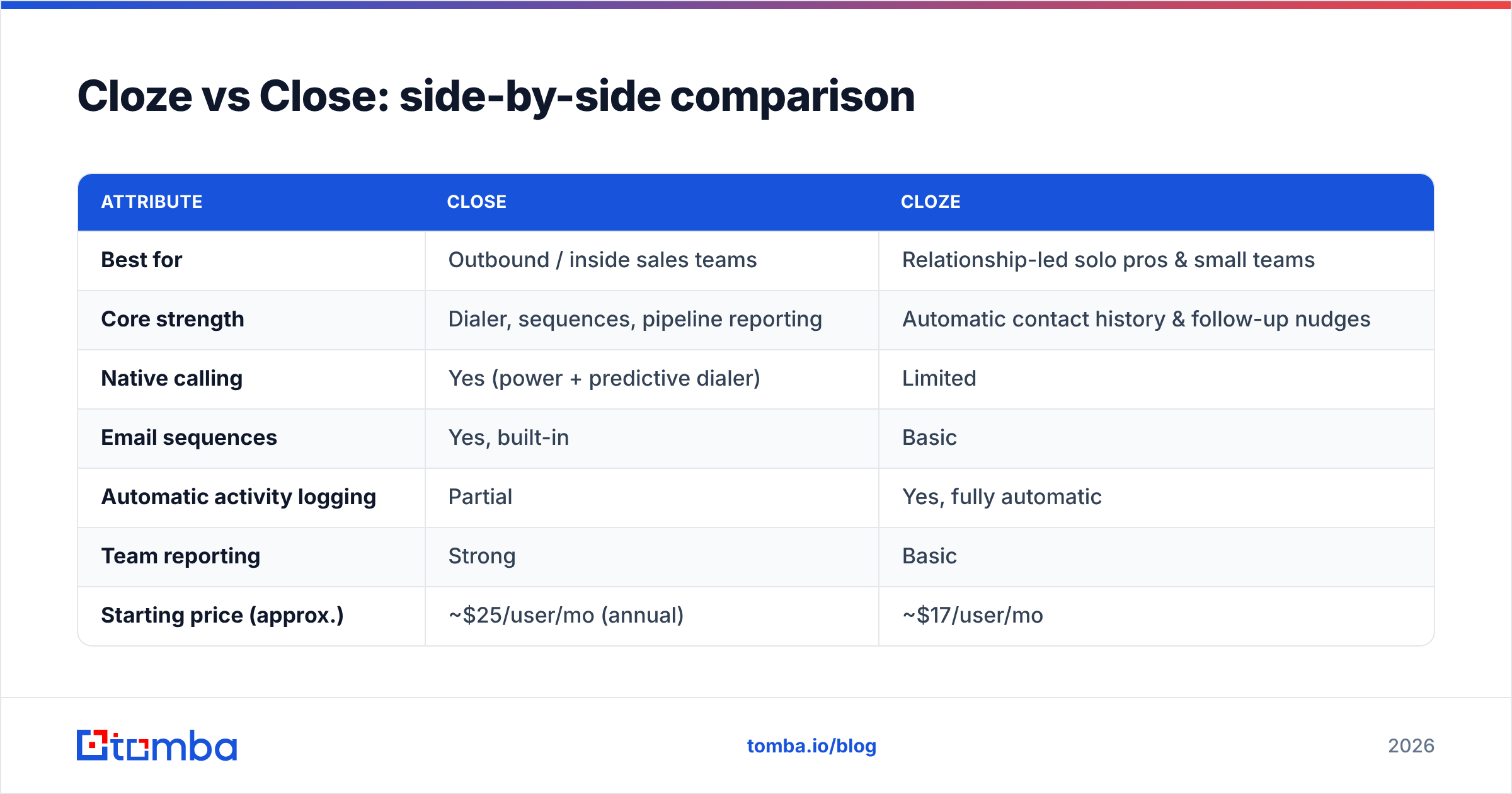
Here's how the two stack up on the attributes that actually change your day-to-day.
| Attribute | Close | Cloze |
|---|---|---|
| Best for | Outbound / inside sales teams | Relationship-led solo pros & small teams |
| Core strength | Dialer, sequences, pipeline reporting | Automatic contact history & follow-up nudges |
| Native calling | Yes (power + predictive dialer) | Limited |
| Email sequences | Yes, built-in | Basic |
| Automatic activity logging | Partial | Yes, fully automatic |
| Team reporting | Strong | Basic |
| Starting price (approx.) | ~$25/user/mo (annual) | ~$17/user/mo |
| Free tier | 14-day trial | Free trial |
| Learning curve | Moderate | Low |
Pricing shifts over time and by billing term, so confirm current numbers on each vendor's site before you buy. The structural difference matters more than the exact dollar figure: Close charges for a sales engine, Cloze charges for an always-on relationship assistant.
Is Close better than Cloze?#
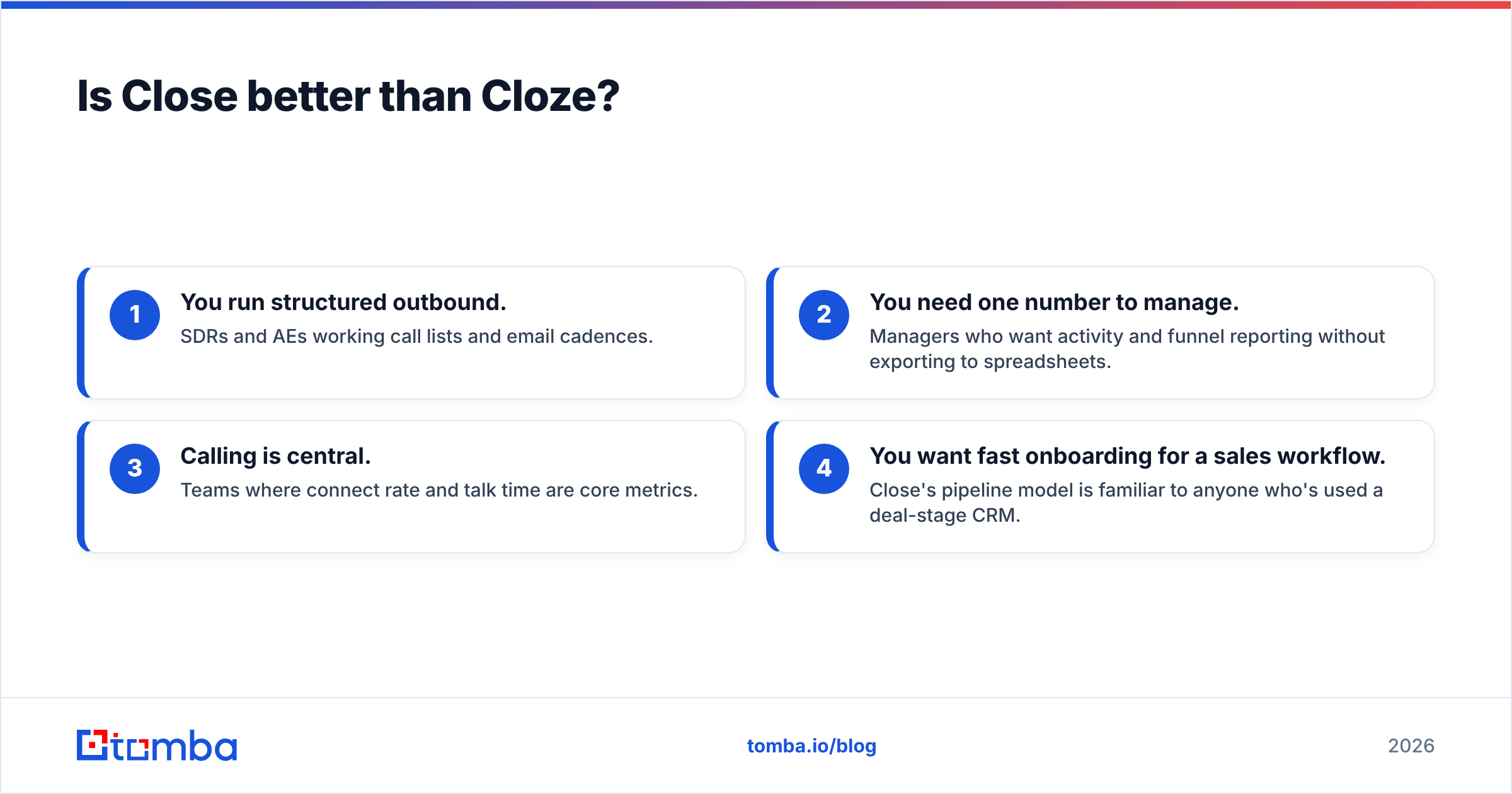
Close is better if you run a sales team. The moment you have reps making outbound calls, chasing a defined pipeline, and reporting to a manager on activity and conversion, Close's built-in dialer and sequence engine pay for themselves. You stop stitching together a dialer, an email tool, and a CRM — and you stop losing data in the gaps between them.
Consider Close when:
- You run structured outbound. SDRs and AEs working call lists and email cadences.
- You need one number to manage. Managers who want activity and funnel reporting without exporting to spreadsheets.
- Calling is central. Teams where connect rate and talk time are core metrics.
- You want fast onboarding for a sales workflow. Close's pipeline model is familiar to anyone who's used a deal-stage CRM.
Where Close falls short: it's overkill for a solo consultant, and it expects you to do the prospecting elsewhere. Close manages deals well but it isn't a data source — you still need to bring verified contacts in.
Is Cloze better than Close?#
Cloze is better if your business runs on relationships, not sequences. For a realtor juggling 300 past clients, or a consultant whose next project comes from someone they met two years ago, the killer feature is that Cloze remembers everyone and everything automatically. No manual logging, no "I forgot to follow up" — the system does the remembering.
Choose Cloze when:
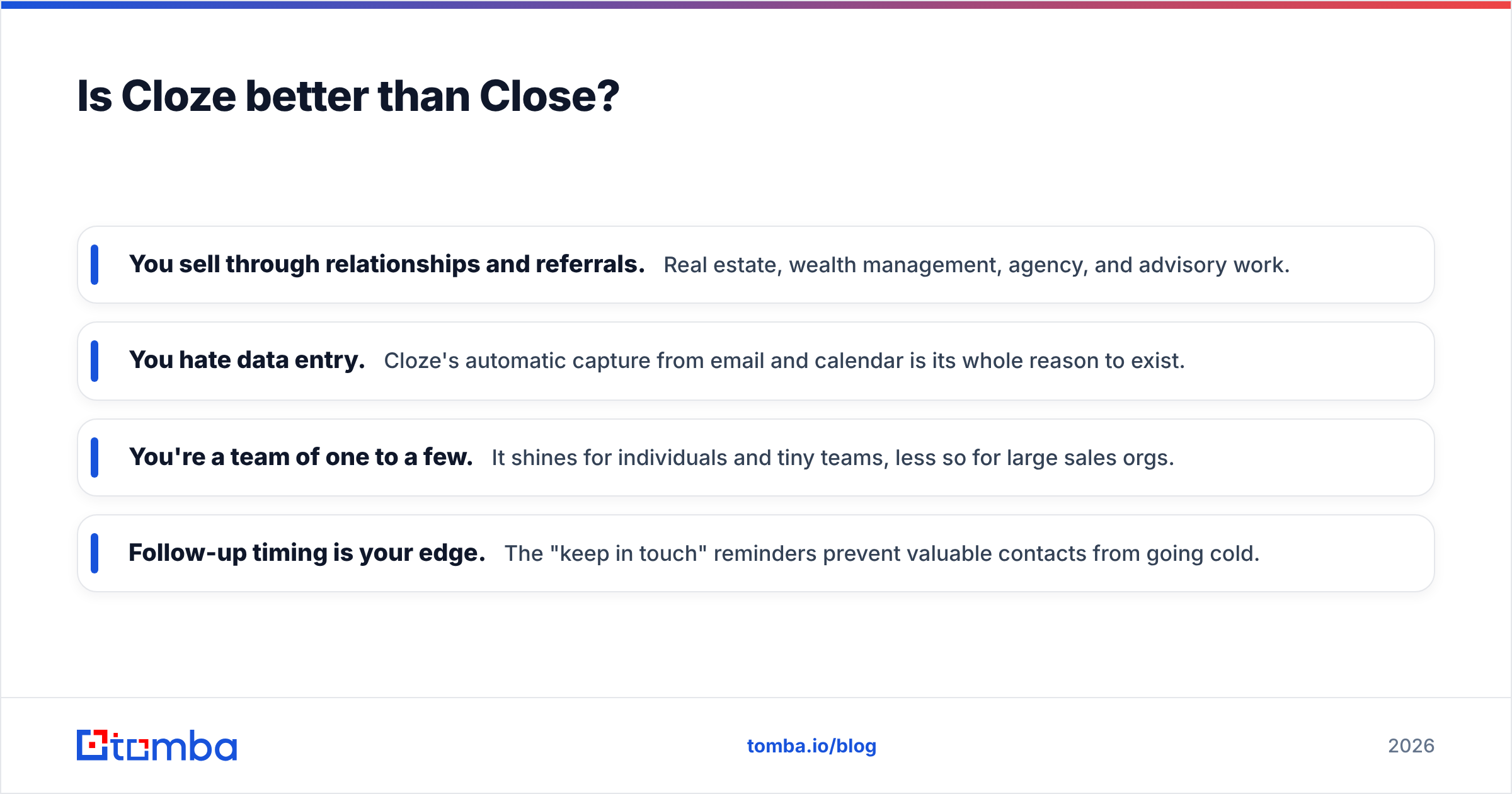
- You sell through relationships and referrals. Real estate, wealth management, agency, and advisory work.
- You hate data entry. Cloze's automatic capture from email and calendar is its whole reason to exist.
- You're a team of one to a few. It shines for individuals and tiny teams, less so for large sales orgs.
- Follow-up timing is your edge. The "keep in touch" reminders prevent valuable contacts from going cold.
Where Cloze falls short: it's not built for high-volume dialing or sophisticated team analytics. Drop a 10-person outbound team into Cloze and they'll quickly miss Close's dialer and reporting.
What both CRMs get wrong (and how to fix it)#
Here's the honest part neither vendor emphasizes: a CRM is only as good as the contact data you put into it. Cloze can build a beautiful relationship timeline, and Close can run a flawless sequence — but if the email address bounces or the phone number is dead, the workflow collapses before it starts.
This is the single most common reason CRM rollouts underperform. Teams migrate in, then discover half their records are stale, duplicated, or missing key fields. Garbage in, garbage out.
Two fixes matter:
- Start clean. Before importing a prospecting list, run it through an email verifier to strip out invalid and risky addresses. This protects your sender reputation and keeps your bounce rate low — critical whether you're sending Close sequences or Cloze follow-ups.
- Enrich as you go. When you add a company to your pipeline, use domain search to pull the right decision-makers' emails instead of guessing at
firstname@company.com. Layering contact enrichment on top fills in titles, socials, and company data your CRM needs to segment properly.
Neither Cloze nor Close is a prospecting or data-hygiene tool. Treat them as the system of record, and put a dedicated data layer in front. According to CRM adoption research aggregated on G2, data quality and user adoption — not feature count — are the top predictors of whether a CRM investment pays off.
Which one should you actually pick?#
Match the tool to your motion, not the other way around.
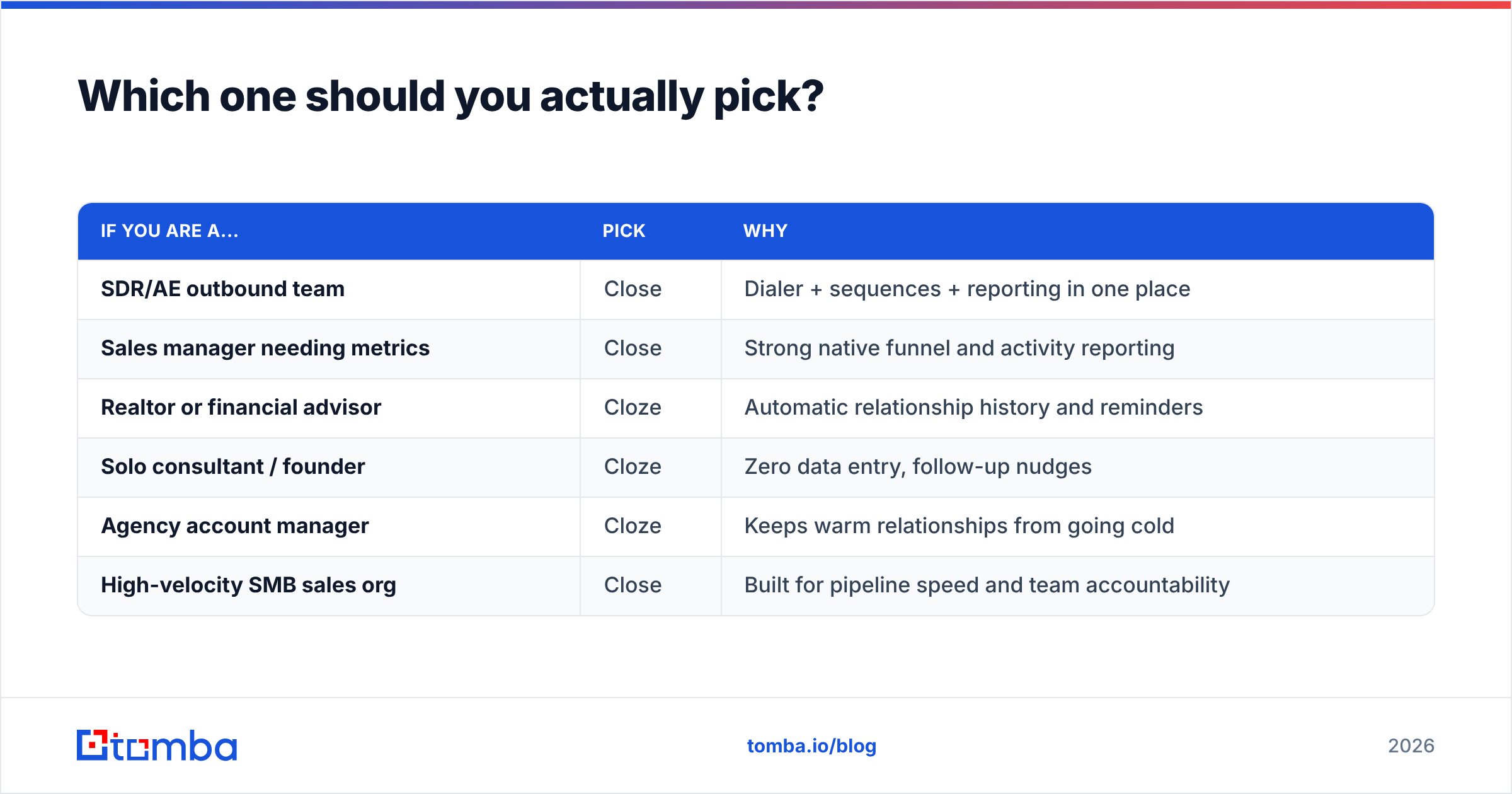
| If you are a... | Pick | Why |
|---|---|---|
| SDR/AE outbound team | Close | Dialer + sequences + reporting in one place |
| Sales manager needing metrics | Close | Strong native funnel and activity reporting |
| Realtor or financial advisor | Cloze | Automatic relationship history and reminders |
| Solo consultant / founder | Cloze | Zero data entry, follow-up nudges |
| Agency account manager | Cloze | Keeps warm relationships from going cold |
| High-velocity SMB sales org | Close | Built for pipeline speed and team accountability |
If you're genuinely torn, ask one question: is my next deal more likely to come from a cold list I work systematically, or from a warm relationship I need to nurture over time? Cold list points to Close. Warm network points to Cloze.
And if you're comparing these two because you're unhappy with a bigger, pricier platform, note that both are frequently evaluated as lighter alternatives to enterprise suites. If cost is the driver, also weigh what you'll spend on data — you can review transparent Tomba pricing to budget the prospecting layer separately from the CRM itself.
Cloze vs Close: the bottom line#
Close is a sales engine; Cloze is a relationship engine. They're not really competitors so much as tools for two different jobs that happen to sound alike. Outbound teams that live in the dialer should choose Close. Relationship-driven professionals who want their CRM to run itself should choose Cloze.
But whichever you pick, remember the part the CRM won't do for you: sourcing accurate, verified contact data to feed the machine. That's where your pipeline is won or lost long before a deal stage or a follow-up reminder ever matters.
Start with data your CRM can trust#
Before you commit to Close or Cloze, make sure the contacts flowing into it are real. The Tomba Email Finder locates verified professional email addresses by name, domain, or company — so every record you push into your new CRM starts with a deliverable address instead of a guess. Pair it with the built-in verifier to keep bounce rates low and your sender reputation intact. Start free with 25 searches a month, then scale up as your pipeline grows. Your CRM is only as strong as the data behind it — give it a clean foundation from day one.
Related guides#
// get started
Find, verify and enrich your first contacts today
Start on the free plan with 25 searches a month, then scale when your team is ready.
Free plan · No credit card required · GDPR & CCPA
// about the author