Cloze vs HubSpot (2026): Which CRM Actually Wins for You?
Cloze automates relationship tracking; HubSpot runs your whole go-to-market. Here's an honest, feature-by-feature breakdown of which CRM fits your team in 2026.
Choosing a CRM is really a bet on how your team works. Cloze bets that relationships run on context and quiet automation. HubSpot bets that revenue runs on one connected platform. Both are right — for different teams. This breakdown cuts through the marketing so you can pick the one you won't regret in six months.
TL;DR: Cloze vs HubSpot in 30 seconds#
- Cloze is a relationship-intelligence CRM that auto-captures every email, call, and meeting, then reminds you who's going cold. Best for solo operators, agents, advisors, and small relationship-driven teams.
- HubSpot is a full go-to-market platform — CRM plus marketing, sales, service, and CMS hubs. Best for growing teams that need pipelines, automation, and reporting under one roof.
- Pricing gap is real: Cloze runs roughly $17–$29/user/month. HubSpot is free to start but climbs fast once you add paid seats and hubs.
- The deciding question: Do you need automatic relationship tracking (Cloze) or a scalable revenue engine with marketing muscle (HubSpot)?
- Both share one weakness: a CRM is only as good as the contact data inside it — garbage in, garbage out.
What is Cloze and who is it for?#
Cloze is a "smart CRM" built around one idea: you shouldn't have to log anything. It connects to your email, calendar, phone, and social accounts, then silently builds a timeline for every contact. Think of it like a personal chief of staff who remembers every conversation you've ever had and taps you on the shoulder before an important relationship goes quiet.
Because of that design, Cloze shines for people whose pipeline is their relationships — real estate agents, financial advisors, consultants, recruiters, and founders doing their own outreach. It scores contacts by how "at risk" they are, nudges you to follow up, and keeps context handy without manual data entry.
The tradeoff: Cloze is not trying to be a marketing platform. There's no landing-page builder, no sophisticated lead-scoring workflows across a big team, and reporting is lightweight compared to enterprise tools. It's a relationship keeper, not a revenue operating system.

What is HubSpot and who is it for?#
HubSpot started as a marketing tool and grew into a complete customer platform. Its free CRM is genuinely useful, and around it sit five paid "hubs" — Marketing, Sales, Service, Content, and Operations — that share one contact database. If Cloze is a chief of staff, HubSpot is the whole operations department: it captures leads, nurtures them with email sequences, routes them to reps, tracks deals, and reports on the entire funnel.
That breadth is HubSpot's superpower and its cost. Teams that want marketing automation, custom pipelines, forms, chatbots, and board-ready dashboards get everything in one login. But you pay for it — in dollars and in setup time. Small teams often buy more platform than they'll use in year one.
HubSpot fits scaling startups and SMBs with a real marketing motion, multiple reps, and a need for handoffs between marketing, sales, and support. You can read more about the platform on HubSpot's official site.
Cloze vs HubSpot: the head-to-head comparison#
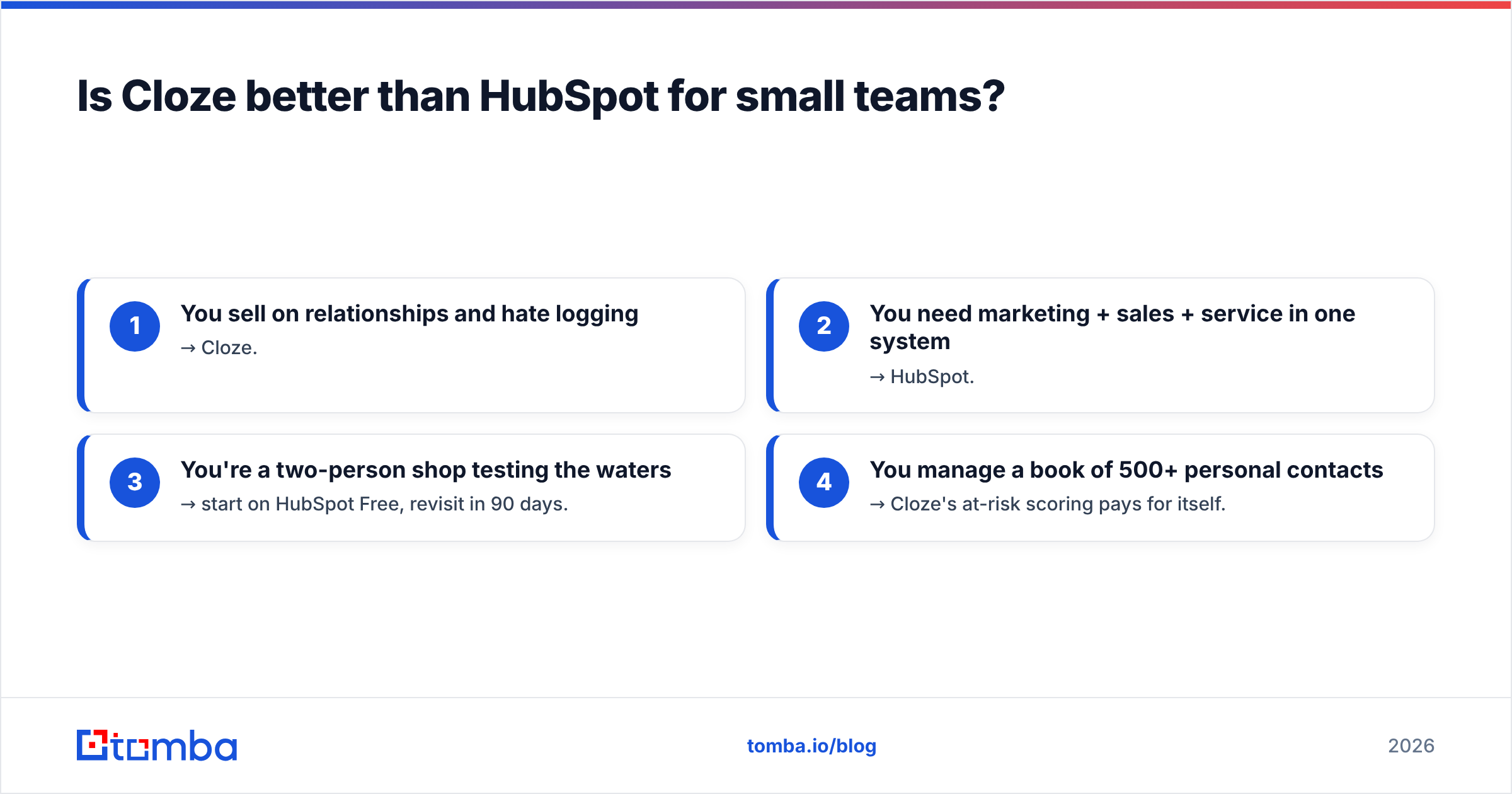
Here's where the two actually diverge. Prices are approximate 2026 list rates and shift with promotions and seat counts — always confirm current numbers before you commit.
| Feature | Cloze | HubSpot |
|---|---|---|
| Core model | Relationship-intelligence CRM | Full GTM platform (CRM + hubs) |
| Free tier | Trial only | Free CRM (limited) |
| Entry paid price | ~$17/user/mo | ~$20/user/mo (Sales Hub Starter) |
| Pro/Growth tier | ~$29/user/mo | ~$100+/user/mo (Professional) |
| Auto activity capture | Yes — email, call, meeting, social | Partial (email + logged activity) |
| Marketing automation | No | Yes (Marketing Hub) |
| Custom pipelines & reporting | Basic | Advanced |
| Best-fit team size | 1–10 relationship sellers | 5–500+ multi-function teams |
| Learning curve | Low | Moderate to high |
The pattern is clear: Cloze wins on effortless relationship tracking and predictable low pricing; HubSpot wins on breadth, scalability, and marketing power. Neither "beats" the other outright — they're built for different jobs.

Is Cloze better than HubSpot for small teams?#
For a solo operator or a tight relationship-driven team, Cloze is often the better daily experience. Reps who hate CRMs usually hate them for one reason: data entry. Cloze removes that friction almost entirely. You work your inbox and phone like normal, and the CRM fills itself in. Adoption problems mostly vanish because there's nothing to adopt.
HubSpot's free CRM is tempting for the same crowd because it costs nothing to start. But the value of HubSpot shows up when you turn on the paid hubs — and that's also when the bill arrives. If you're not going to use marketing automation, sequences, and multi-stage pipelines, you're paying for a platform to do a job Cloze does more elegantly.
Decision rule of thumb:
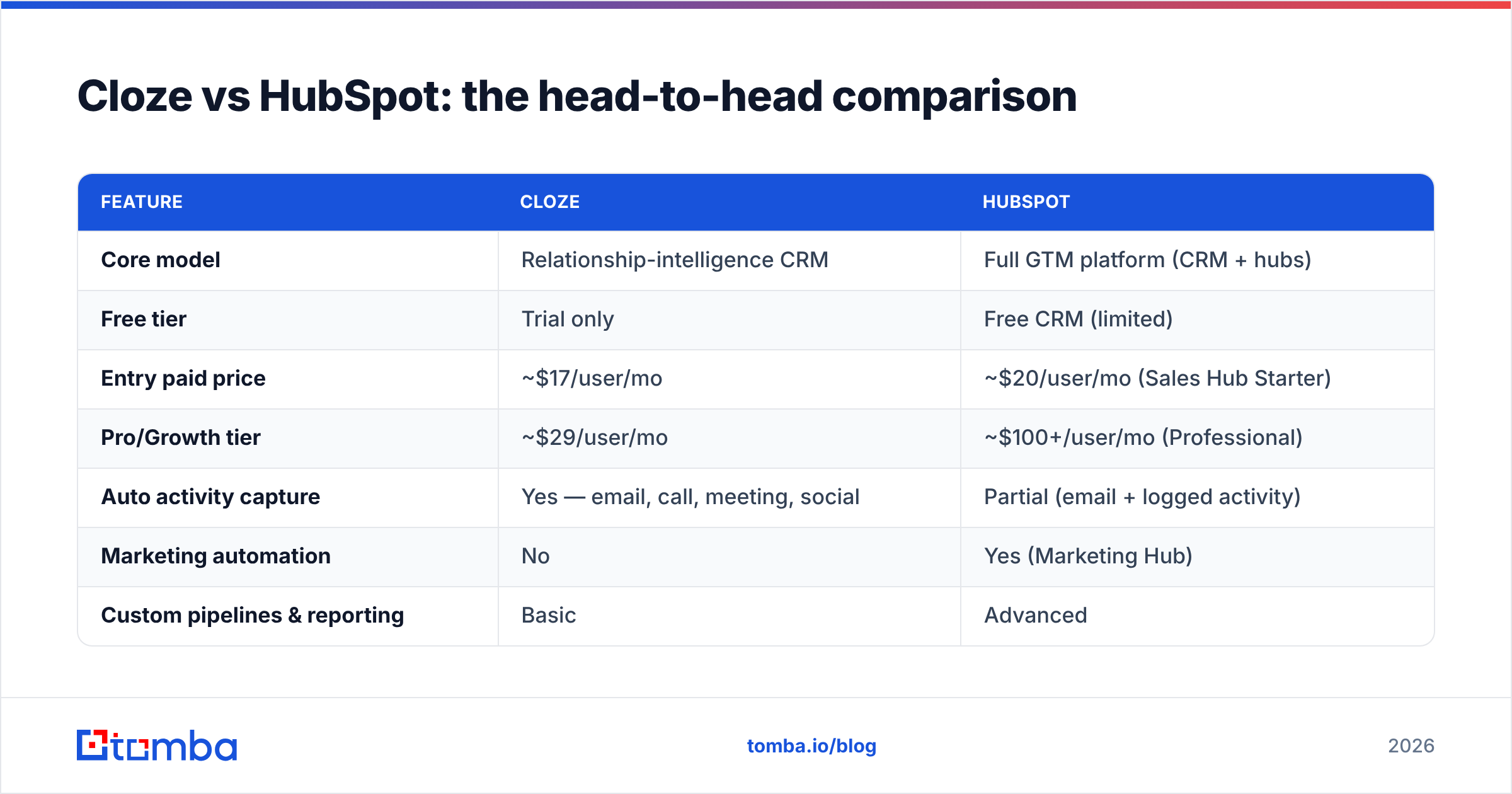
- You sell on relationships and hate logging → Cloze.
- You need marketing + sales + service in one system → HubSpot.
- You're a two-person shop testing the waters → start on HubSpot Free, revisit in 90 days.
- You manage a book of 500+ personal contacts → Cloze's at-risk scoring pays for itself.
Is HubSpot better than Cloze for scaling companies?#
Yes — once you cross from "closing relationships" to "building a revenue machine," HubSpot pulls ahead. Custom pipelines, deal automation, lead routing, attribution reporting, and a shared record across marketing, sales, and support are things Cloze simply doesn't attempt. When five reps need to hand off leads, when marketing needs to nurture 10,000 contacts, when leadership wants a funnel dashboard — that's HubSpot territory.
HubSpot also has a deeper integration ecosystem and a large app marketplace, which matters as your stack grows. The catch is real cost creep: contact-tier pricing on Marketing Hub can jump sharply as your database grows, and Professional-tier onboarding fees are common. Independent reviews on G2 consistently praise the platform's power while flagging price and complexity — read them before you sign an annual contract.
The problem both Cloze and HubSpot share#
Here's the part neither vendor leads with: a CRM does not find or clean your contact data. Cloze can auto-log a conversation, and HubSpot can nurture a lead — but only if you already have a correct email address in the record. Bounced emails, missing decision-makers, and stale phone numbers quietly wreck both systems. Automation on top of bad data just automates the mistakes faster.
This is where your prospecting stack matters more than the CRM debate. Before a contact ever reaches Cloze or HubSpot, you need verified, accurate contact details. That's the job of a dedicated email finder — not a CRM. Feeding clean data in is what makes either platform actually perform.

A practical pre-CRM checklist:
- Find the right person. Use domain search to pull the decision-makers at a target company, not just a generic info@ inbox.
- Verify before you import. Run addresses through an email verifier so bounces never touch your sender reputation.
- Enrich the record. Add titles, phone numbers, and social profiles with data enrichment so Cloze's scoring and HubSpot's segmentation have something to work with.
- Sync it in. Push clean contacts into either CRM via native or Zapier-style integrations.
Do this once at the top of the funnel and both Cloze and HubSpot get dramatically more useful.
How do Cloze and HubSpot handle data quality?#
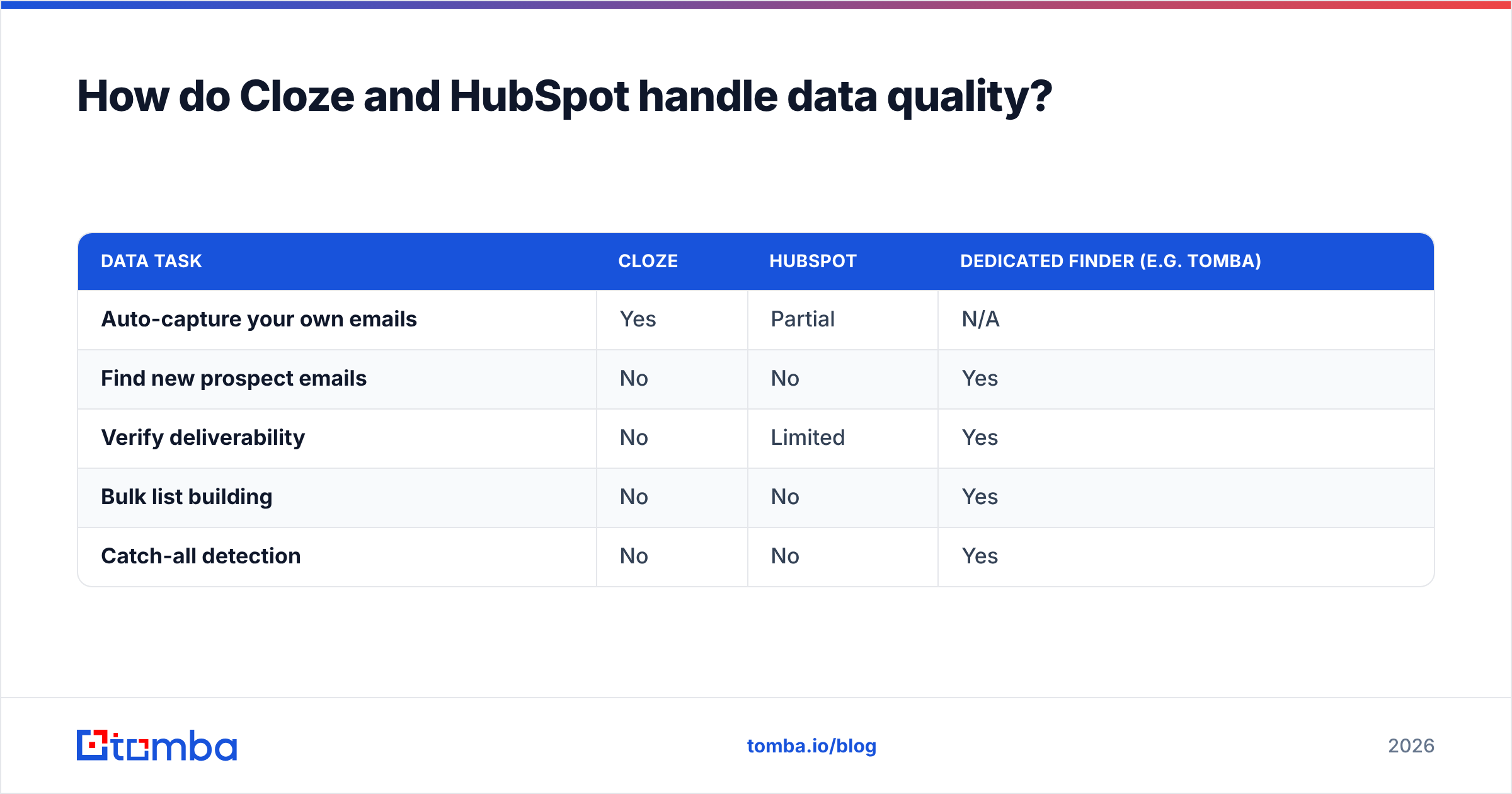
Neither tool is a data provider. Cloze organizes the data that flows through your own accounts; HubSpot stores and segments the data you or your forms put in. Both offer light enrichment features, but neither is designed to source and verify B2B contacts at scale. If your outbound depends on reaching people you don't already email, you'll want a purpose-built finder feeding the CRM.
| Data task | Cloze | HubSpot | Dedicated finder (e.g. Tomba) |
|---|---|---|---|
| Auto-capture your own emails | Yes | Partial | N/A |
| Find new prospect emails | No | No | Yes |
| Verify deliverability | No | Limited | Yes |
| Bulk list building | No | No | Yes |
| Catch-all detection | No | No | Yes |
The takeaway: pick your CRM for how your team works, then pair it with a real data layer. The catch-all verifier and bulk email finder exist precisely because CRMs assume the data is already correct.
Pricing: which CRM is cheaper in 2026?#
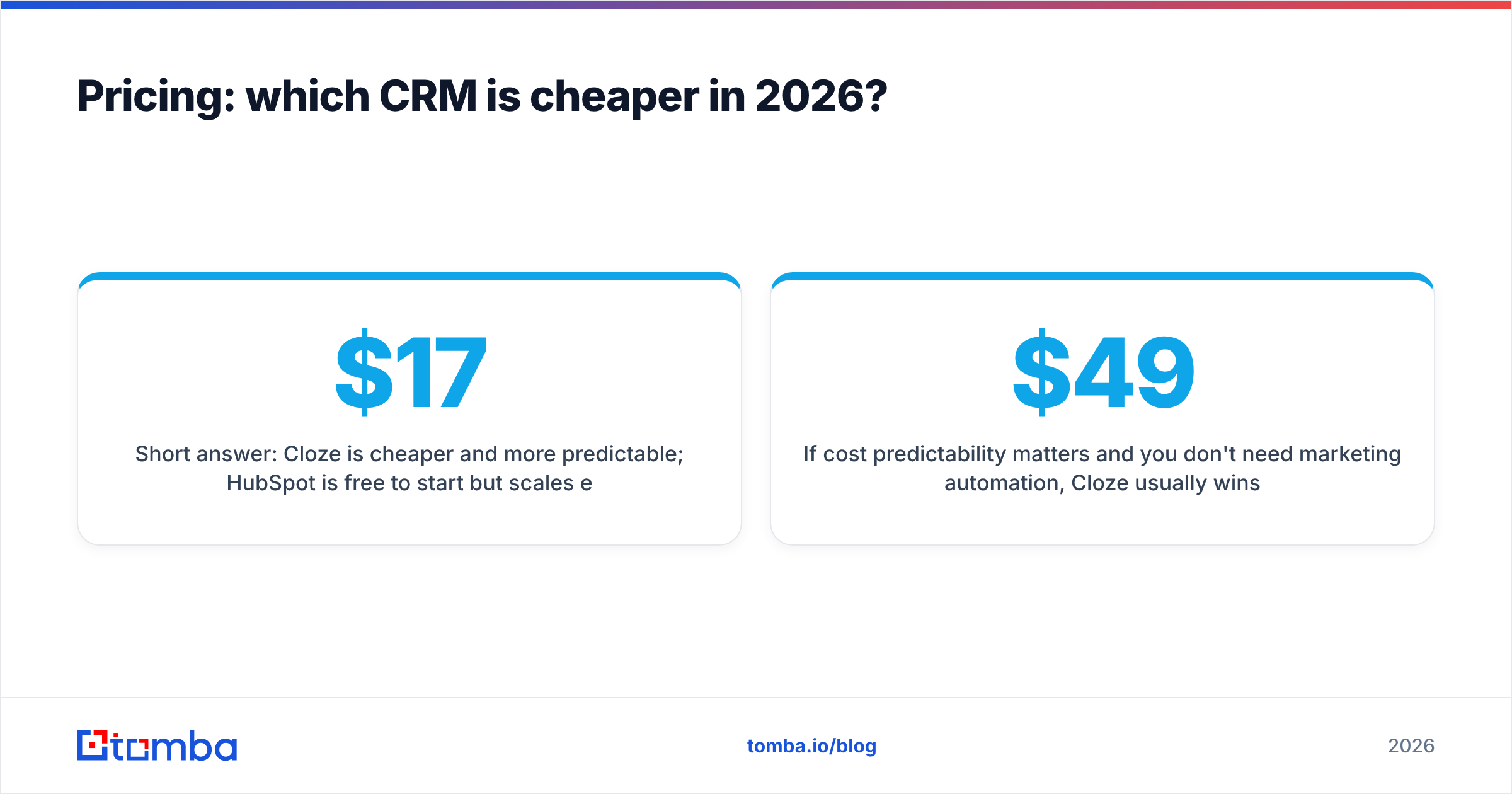
Short answer: Cloze is cheaper and more predictable; HubSpot is free to start but scales expensively. Cloze's flat per-seat pricing (roughly $17–$29/user/month) makes budgeting simple. HubSpot's model layers seat costs, hub costs, and contact-tier costs — so two companies on "HubSpot" can pay wildly different amounts.
If cost predictability matters and you don't need marketing automation, Cloze usually wins the math. If you're consolidating three or four tools into one platform, HubSpot's bundle can be worth the premium. Compare total cost of ownership, not sticker price — and factor in the data tooling you'll add regardless of which CRM you choose. For reference on how affordable dedicated data tooling can be, see Tomba pricing, which starts free and runs $49/mo for the Starter plan.
Final verdict: Cloze or HubSpot?#
Choose Cloze if you're a relationship-driven seller — agent, advisor, consultant, recruiter, or founder — who wants a CRM that logs itself and warns you before contacts go cold. Choose HubSpot if you're scaling a team that needs marketing automation, structured pipelines, and unified reporting across the whole customer journey.
But make the real decision first: your CRM is downstream of your data. Whichever platform you pick, its performance is capped by the quality of the contacts you feed it. Start by finding and verifying the right people, then let Cloze or HubSpot do what it does best.
Ready to fix the input side? Put accurate, verified contacts into your CRM from day one with the Tomba Email Finder — find professional emails by domain, name, or company, verify them before they ever hit your pipeline, and give Cloze or HubSpot the clean data both platforms quietly depend on.
Related guides#
Ready to find emails that actually work?
Join 150,000+ professionals who stopped guessing and started sending. Free credits on signup — no credit card required.
Get the Tomba newsletter
Practical outbound tactics and product updates — once every two weeks.
About the author