Cloze vs Salesforce (2026): Which CRM Actually Fits You?
Cloze automates relationship tracking; Salesforce scales to enterprise complexity. Here's an honest, side-by-side breakdown to help you pick the right CRM in 2026.
Choosing between Cloze and Salesforce is really a choice between two philosophies of what a CRM should do. One quietly watches your inbox and calendar and builds your pipeline for you. The other hands you an enterprise-grade platform you configure into whatever your revenue org needs. Picking wrong costs you months of onboarding — or a system nobody updates.
TL;DR — Cloze vs Salesforce in 30 seconds#
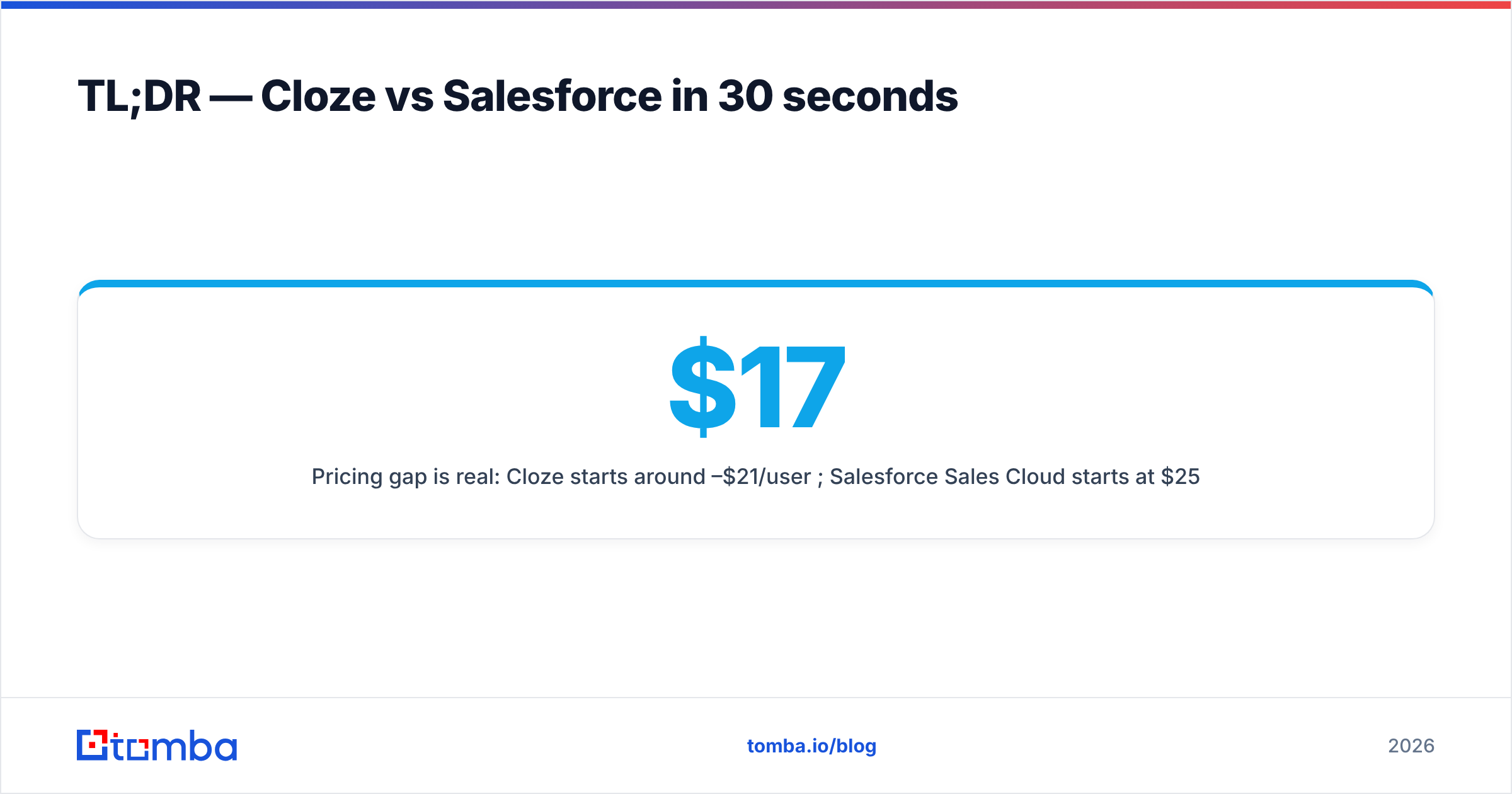
- Cloze is a relationship-focused, AI-driven CRM that auto-logs email, calls, and meetings so reps stop doing manual data entry. Best for solopreneurs, agencies, and small teams.
- Salesforce is the enterprise standard — endlessly customizable, deeply integrated, and built for complex, multi-team pipelines. Best for scaling and enterprise orgs.
- Pricing gap is real: Cloze starts around $17–$21/user/month; Salesforce Sales Cloud starts at $25 and climbs fast with add-ons.
- Setup effort: Cloze works in a day; Salesforce often needs an admin or consultant.
- Both are only as good as your data. Whichever you pick, feed it accurate contacts with a tool like the Tomba Email Finder or your pipeline rots.
What is Cloze?#
Cloze is a CRM built around relationships rather than records. Think of it as an assistant who reads every email, notes every meeting, and remembers the last time you talked to someone — without you typing a thing. It connects to your email, calendar, phone, and social accounts, then automatically assembles a unified timeline for each contact and company.
The pitch is simple: the best CRM is the one you don't have to maintain. Cloze scores your relationships, nudges you when you're going silent with an important contact, and surfaces "who needs attention today" so nothing slips. For a founder juggling 300 relationships or an agency owner managing clients, that automation is the whole value.
Where Cloze is deliberately lighter is heavy sales-process machinery — territory management, complex forecasting hierarchies, and enterprise approval flows aren't its home turf. It optimizes for keeping in touch, not for orchestrating a 40-person sales floor.
What is Salesforce?#
Salesforce is the platform that defined modern CRM. It's less a product and more an ecosystem: Sales Cloud, Service Cloud, Marketing Cloud, a massive AppExchange marketplace, and a customization layer deep enough to model almost any business process. If you can describe your sales motion, you can build it in Salesforce.
That flexibility is the reason it dominates the enterprise. According to G2 and analyst rankings, Salesforce remains the market-share leader in CRM by a wide margin, and its integration catalog is unmatched. For teams that need custom objects, granular permissions, multi-currency forecasting, and a reporting engine that answers any question leadership asks, nothing else comes close.
The tradeoff is complexity. Salesforce assumes you'll invest in setup, and often in an admin or partner to run it. Data entry is largely manual unless you bolt on automation tools. Costs stack quickly once you add seats, editions, and the inevitable add-ons.
Cloze vs Salesforce: the core differences#
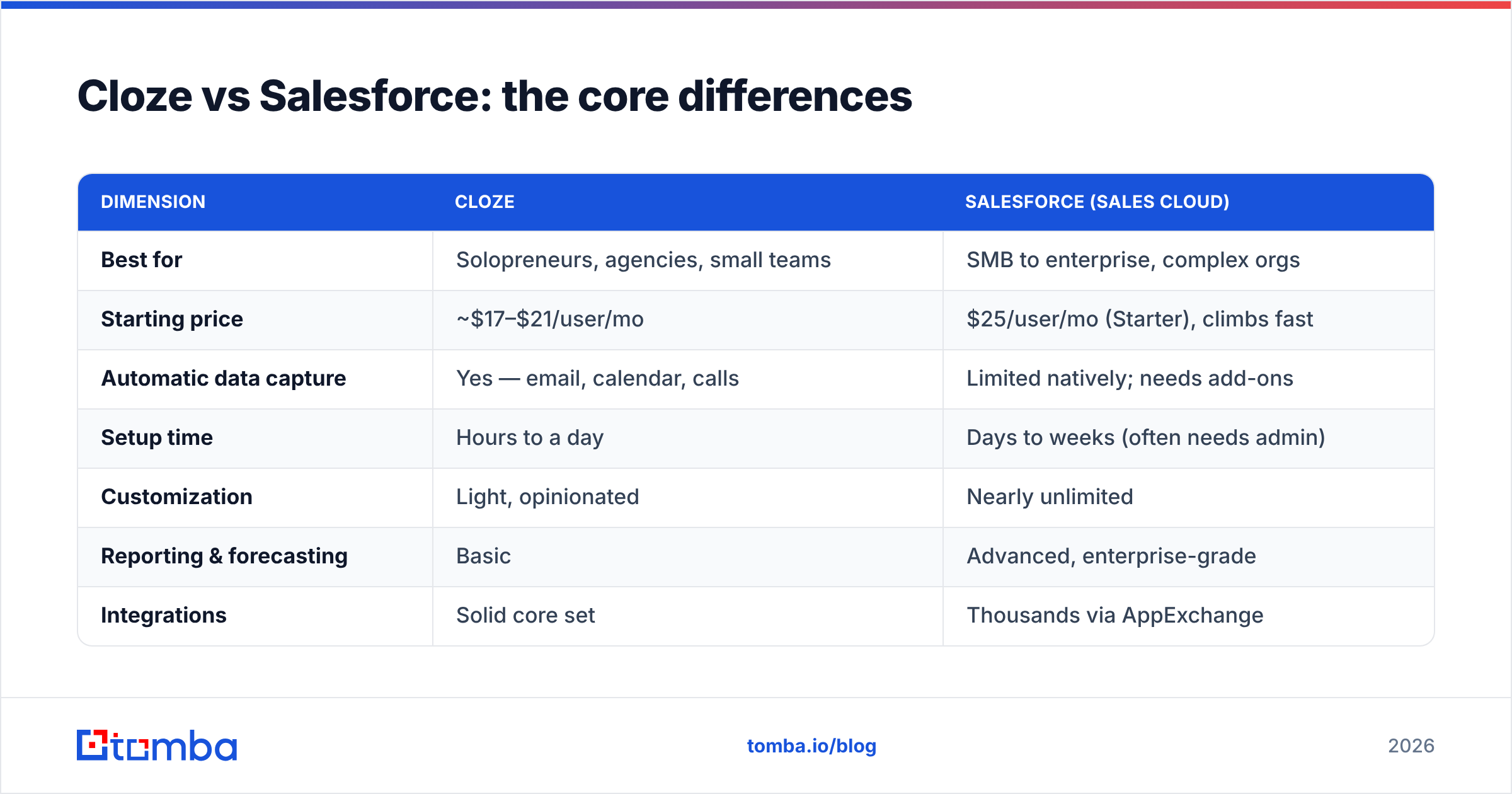
Here's the honest side-by-side. The right answer depends entirely on team size and process complexity.
| Dimension | Cloze | Salesforce (Sales Cloud) |
|---|---|---|
| Best for | Solopreneurs, agencies, small teams | SMB to enterprise, complex orgs |
| Starting price | ~$17–$21/user/mo | $25/user/mo (Starter), climbs fast |
| Automatic data capture | Yes — email, calendar, calls | Limited natively; needs add-ons |
| Setup time | Hours to a day | Days to weeks (often needs admin) |
| Customization | Light, opinionated | Nearly unlimited |
| Reporting & forecasting | Basic | Advanced, enterprise-grade |
| Integrations | Solid core set | Thousands via AppExchange |
| Learning curve | Gentle | Steep |
| Mobile experience | Excellent (relationship-first) | Full-featured but heavier |
The pattern is clear: Cloze wins on effortlessness and time-to-value; Salesforce wins on depth and scale.
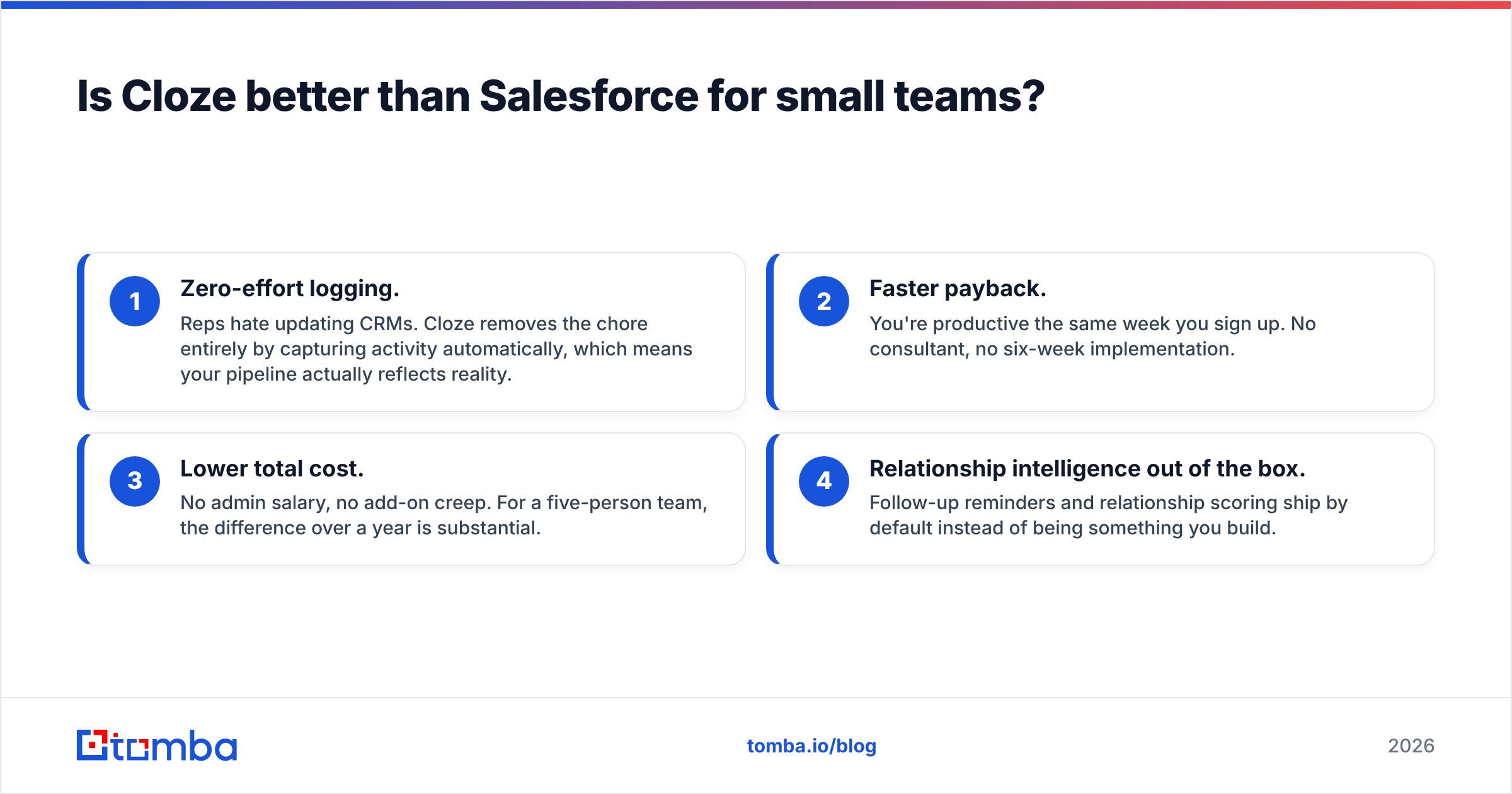
Is Cloze better than Salesforce for small teams?#
For small teams, Cloze is often the better fit — and here's why in plain terms.
- Zero-effort logging. Reps hate updating CRMs. Cloze removes the chore entirely by capturing activity automatically, which means your pipeline actually reflects reality.
- Faster payback. You're productive the same week you sign up. No consultant, no six-week implementation.
- Lower total cost. No admin salary, no add-on creep. For a five-person team, the difference over a year is substantial.
- Relationship intelligence out of the box. Follow-up reminders and relationship scoring ship by default instead of being something you build.
Salesforce can do all of this too — but you'll configure or buy your way there. For a lean team, that overhead rarely pays off until you outgrow the simpler tool.
Is Salesforce better than Cloze for scaling companies?#
Yes — once complexity crosses a threshold, Salesforce pulls ahead decisively.
When you have multiple teams, custom sales stages, quota hierarchies, and leadership demanding pipeline analytics, Cloze's simplicity becomes a ceiling. Salesforce's custom objects, workflow automation (Flow), and reporting depth are built exactly for that world. Its AppExchange marketplace lets you extend into marketing, support, CPQ, and analytics without leaving the platform.
The rule of thumb: if your process needs a diagram to explain, you probably need Salesforce. If it fits on a sticky note, Cloze will feel like a relief.
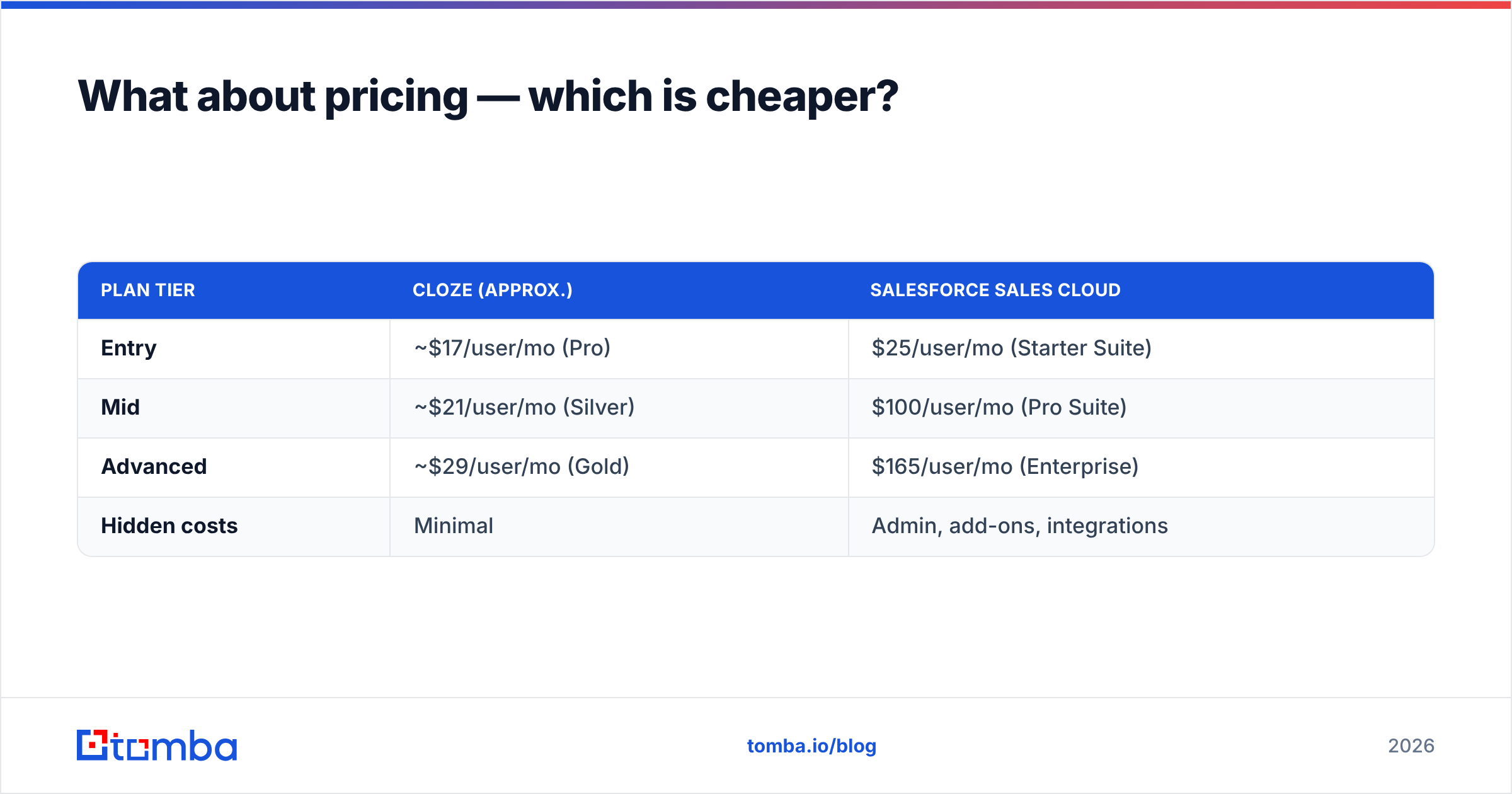
What about pricing — which is cheaper?#
Cheaper depends on how you count. Sticker price favors Cloze; total cost of ownership widens the gap further for small teams but narrows for large ones getting full platform value.
| Plan tier | Cloze (approx.) | Salesforce Sales Cloud |
|---|---|---|
| Entry | ~$17/user/mo (Pro) | $25/user/mo (Starter Suite) |
| Mid | ~$21/user/mo (Silver) | $100/user/mo (Pro Suite) |
| Advanced | ~$29/user/mo (Gold) | $165/user/mo (Enterprise) |
| Hidden costs | Minimal | Admin, add-ons, integrations |
Salesforce's real cost isn't the seat price — it's the ecosystem around it: an admin, premium support, and the add-ons you'll want once you're deep in. Budget for those honestly before you commit. Compare that against a tool like Tomba, where Tomba pricing stays flat and predictable for the data layer that feeds either CRM.

The thing both tools depend on: data quality#
Here's what neither vendor puts on the pricing page — your CRM is only as valuable as the data inside it. A perfectly configured Salesforce org full of bounced emails and stale contacts is worse than a spreadsheet, and Cloze's relationship scoring is meaningless if half your contacts are wrong.
This is where your workflow matters more than your logo choice. Before a contact ever enters Cloze or Salesforce, you want it verified and enriched:
- Find the right person. Use an email finder to source decision-maker addresses by name and company instead of guessing.
- Verify before you send. Run new contacts through an email verifier so you're not padding your CRM with hard bounces that wreck sender reputation.
- Enrich the record. Layer in job titles, company data, and social profiles with data enrichment so reps open a full picture, not a blank name field.
- Push it in automatically. If you're on Salesforce, the Salesforce integration moves verified contacts straight into your org.
Do this once at the top of the funnel and both CRMs get dramatically more useful. Skip it, and no amount of automation or customization saves you.
Which should you choose in 2026?#
Match the tool to your stage, not the hype.
Choose Cloze if you:
- Run a small team, agency, or solo practice
- Live in your inbox and hate manual data entry
- Value relationship follow-up over pipeline forecasting
- Want to be live this week, not next quarter
Choose Salesforce if you:
- Have (or are building) a multi-team revenue org
- Need custom objects, advanced reporting, and forecasting
- Rely on a wide integration ecosystem
- Have budget for setup and ongoing administration
There's no universally "better" CRM here — only the one that fits how you actually sell. Cloze rewards teams that want automation without overhead. Salesforce rewards teams that need power and are willing to invest to unlock it.
The bottom line#
Cloze and Salesforce solve different problems. Cloze is the quiet assistant that keeps small teams close to their relationships with almost zero maintenance. Salesforce is the industrial platform that scales to whatever complexity your org throws at it. Start with your team size and process complexity, and the choice usually makes itself.
Whichever you land on, don't skip the layer underneath. A CRM without clean, verified contacts is an expensive filing cabinet. Feed it accurate, enriched data from the start with the Tomba Email Finder — find real decision-maker emails, verify them before they hit your pipeline, and let Cloze or Salesforce do what it does best on a foundation that's actually correct. Start free with 25 searches a month and see the difference clean data makes.
Sources: Salesforce, Cloze, G2 CRM Category
Related guides#
Ready to find emails that actually work?
Join 150,000+ professionals who stopped guessing and started sending. Free credits on signup — no credit card required.
Get the Tomba newsletter
Practical outbound tactics and product updates — once every two weeks.
About the author