How to Write a Coffee Chat Email That Actually Gets a Reply
A coffee chat email only works when it respects the reader's time and gives them an easy yes. Here are the templates, timing, and tactics that turn cold asks into booked conversations.
Booking a coffee chat is less about charm and more about respect for someone else's calendar. A good coffee chat email makes saying yes almost effortless: it is short, specific, and asks for the smallest reasonable slice of time. A bad one buries a vague ask under three paragraphs of flattery and gets archived in seconds.
This guide breaks down exactly what to write, when to send it, and how to follow up, with templates you can adapt today.
TL;DR#
- A coffee chat email should be under 120 words, name a specific reason you're reaching out, and propose one low-friction ask (15 minutes, a virtual call, or a reply to two questions).
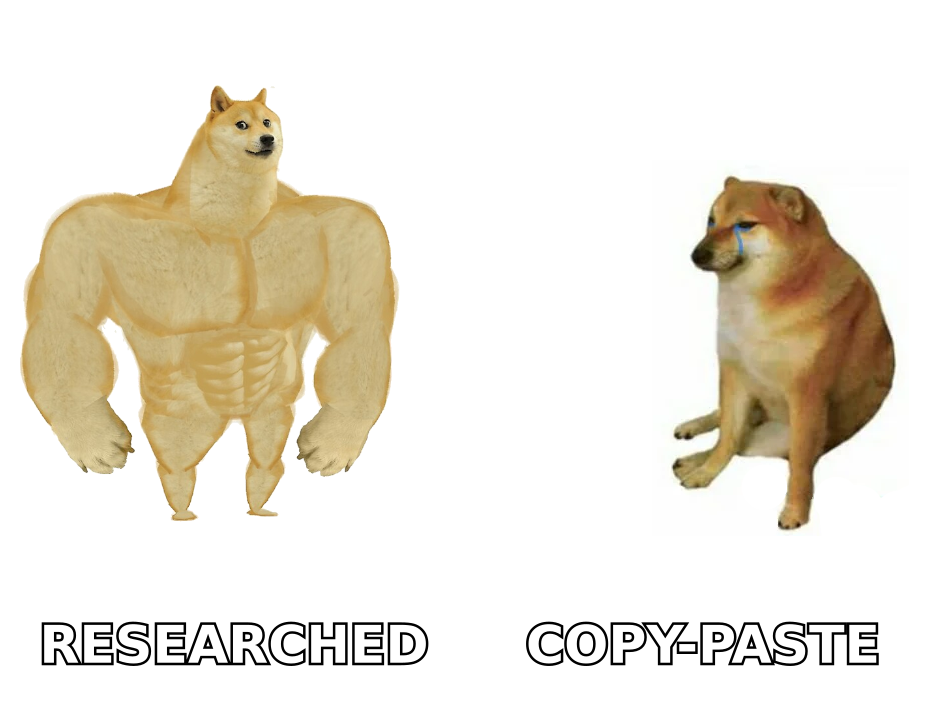
- Personalization beats volume. One researched, relevant note outperforms fifty copy-paste requests.
- Subject lines that state the ask plainly ("15 min to ask about your move into RevOps?") outperform clever ones.
- The reply rate lives or dies on getting the message to the right inbox — a wrong or guessed address kills the whole effort.
- Follow up once after 4–6 business days, then let it go.
What is a coffee chat email?#
A coffee chat email is a short, informal request to talk with someone — usually over coffee, a video call, or a phone call — to learn from their experience, explore a career path, or build a genuine professional relationship. It is not a sales pitch and not a job application. Think of it like asking a neighbor for directions: you want a few minutes of their local knowledge, not a commitment to walk you the whole way.
The format shows up everywhere in modern careers: a new grad emailing an alum, a founder reaching out to an investor, a marketer messaging someone who just switched into a role they want. The mechanics are the same. You're a stranger (or near-stranger) asking a busy person to trade their time for your curiosity, so the entire email has to earn that trade quickly.
The difference between a coffee chat email and cold outreach is intent. Cold outreach wants a transaction. A coffee chat wants a conversation. Blur that line — sneak a pitch into a "quick chat" — and you burn the relationship on the first contact.
What makes a coffee chat email actually work?#
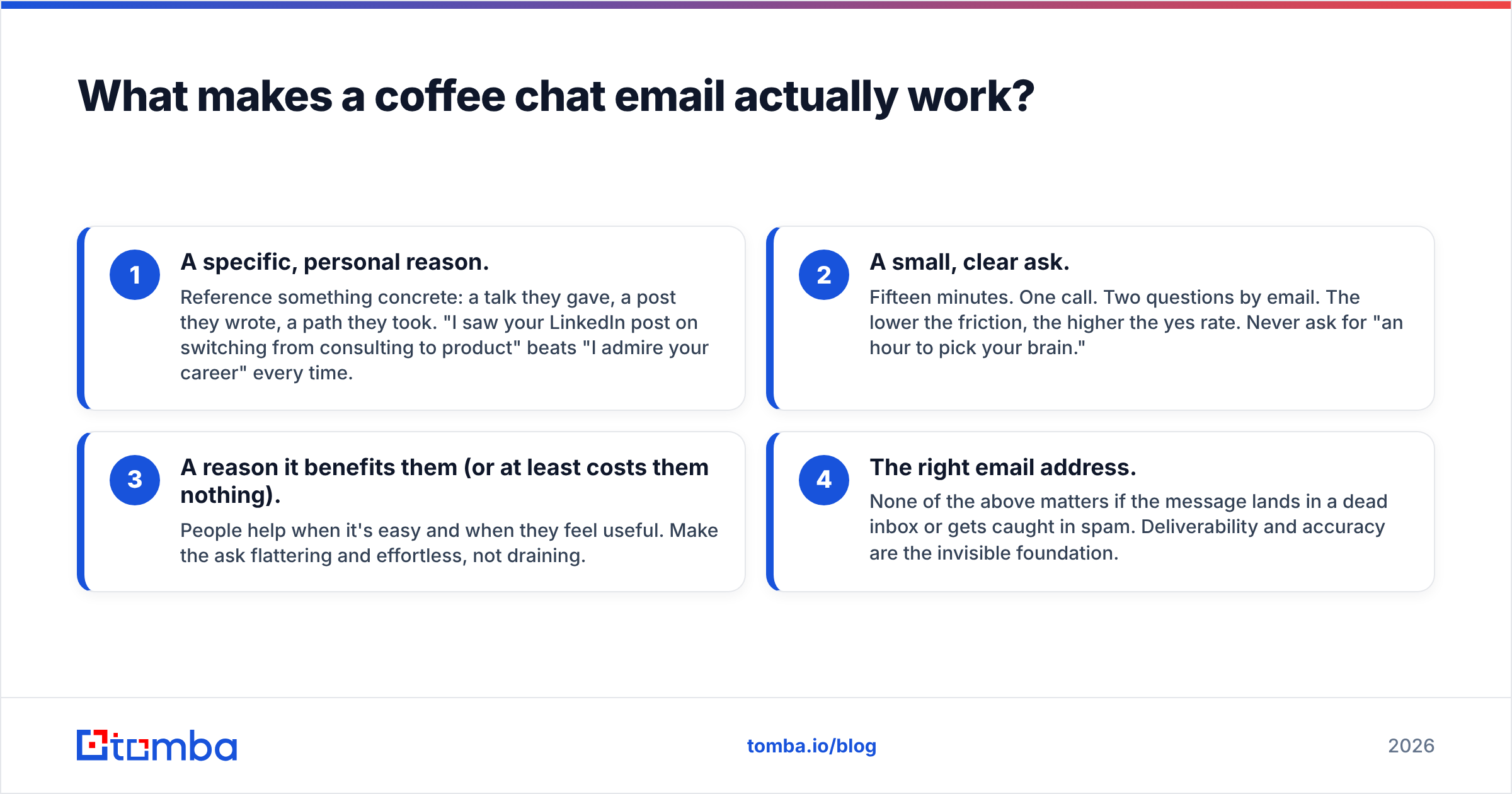
Four things separate emails that get replies from emails that get ignored. Here they are in order of impact:
- A specific, personal reason. Reference something concrete: a talk they gave, a post they wrote, a path they took. "I saw your LinkedIn post on switching from consulting to product" beats "I admire your career" every time.
- A small, clear ask. Fifteen minutes. One call. Two questions by email. The lower the friction, the higher the yes rate. Never ask for "an hour to pick your brain."
- A reason it benefits them (or at least costs them nothing). People help when it's easy and when they feel useful. Make the ask flattering and effortless, not draining.
- The right email address. None of the above matters if the message lands in a dead inbox or gets caught in spam. Deliverability and accuracy are the invisible foundation.
That last point is where most people quietly fail. They spend twenty minutes crafting the perfect note and then send it to firstname@company.com because they guessed the format. If you're reaching out at any scale, use a real email finder to confirm the address instead of playing format roulette.
What's the ideal coffee chat email structure?#
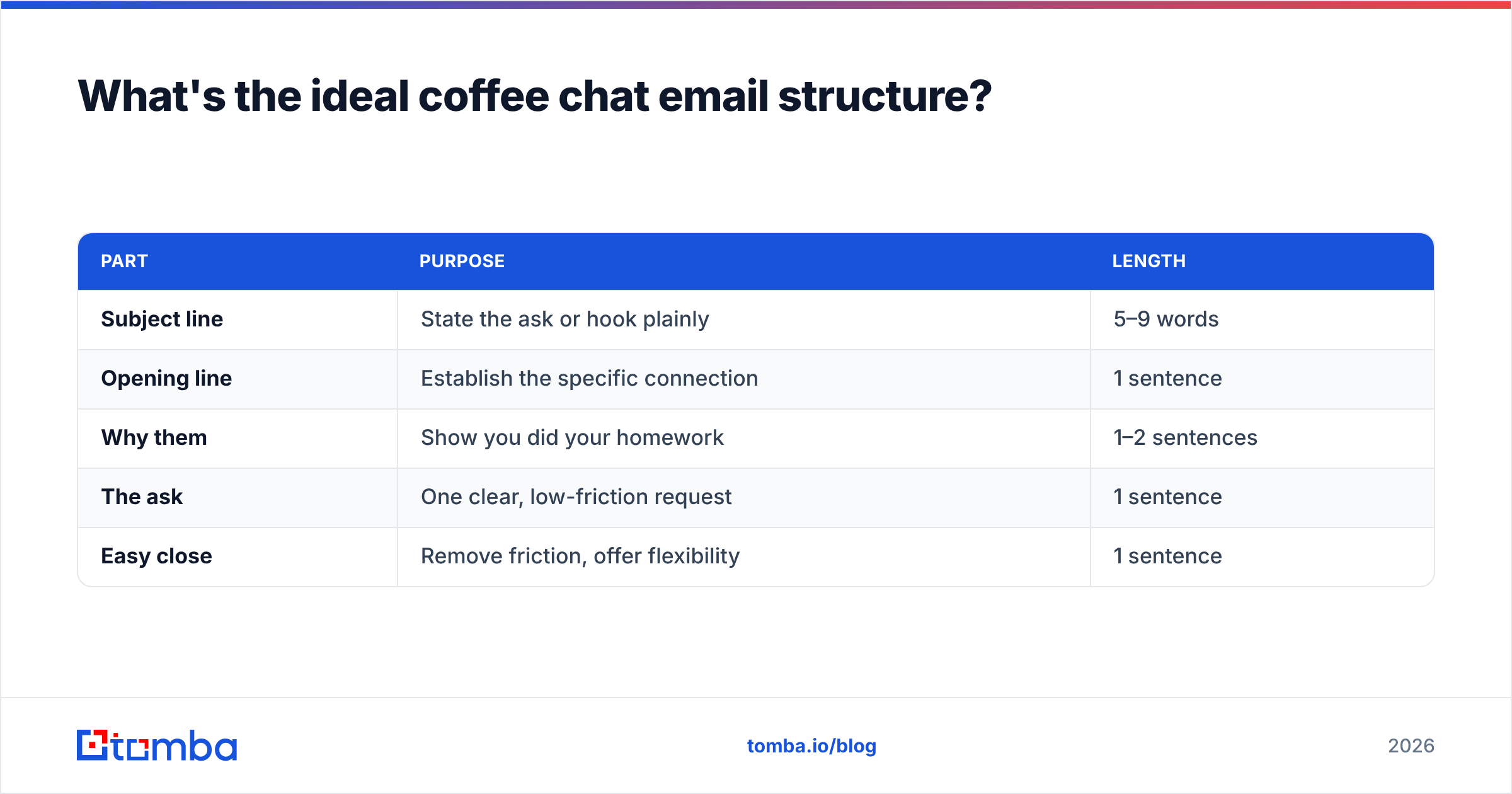
Keep it to five parts and roughly 90–120 words. Longer emails signal you'll also want a longer meeting.
| Part | Purpose | Length |
|---|---|---|
| Subject line | State the ask or hook plainly | 5–9 words |
| Opening line | Establish the specific connection | 1 sentence |
| Why them | Show you did your homework | 1–2 sentences |
| The ask | One clear, low-friction request | 1 sentence |
| Easy close | Remove friction, offer flexibility | 1 sentence |
Notice what's missing: no life story, no bulleted résumé, no three-paragraph explanation of your goals. Save that for the actual conversation. The email's only job is to get the yes.
Coffee chat email templates you can steal#
Adapt the wording, but keep the structure. Each of these is under 120 words.
Template 1: The alum / shared-background ask#
Subject: Fellow [University] grad — 15 min about your path to [role]?
Hi [Name],
I'm a [current role/status] and also a [University] grad. I came across your move from [previous role] into [current role] and it's close to the path I'm trying to navigate.
Would you be open to a 15-minute call in the next couple of weeks? I'd love to hear how you made that jump and any one thing you'd do differently.
Totally understand if you're slammed — even a quick reply would mean a lot.
Thanks,
[Your name]
Template 2: The content-hook ask#
Subject: Your post on [topic] — quick question
Hi [Name],
Your [article/post/talk] on [specific topic] genuinely changed how I think about [thing]. The point about [specific detail] stuck with me.
I'm working on [related project/goal] and would love 15 minutes to ask a couple of questions. Happy to work entirely around your calendar, or to just send the questions by email if that's easier.
Either way, thanks for putting that work out there.
[Your name]
Template 3: The warm-intro follow-through#
Subject: [Mutual connection] suggested I reach out
Hi [Name],
[Mutual connection] mentioned you'd be a great person to talk to about [topic] — she spoke highly of your work on [thing].
I'm exploring [goal] and would value 15 minutes of your perspective. Would any time next week work? I'm flexible and happy to meet virtually.
Thanks so much,
[Your name]
What subject lines get coffee chat emails opened?#
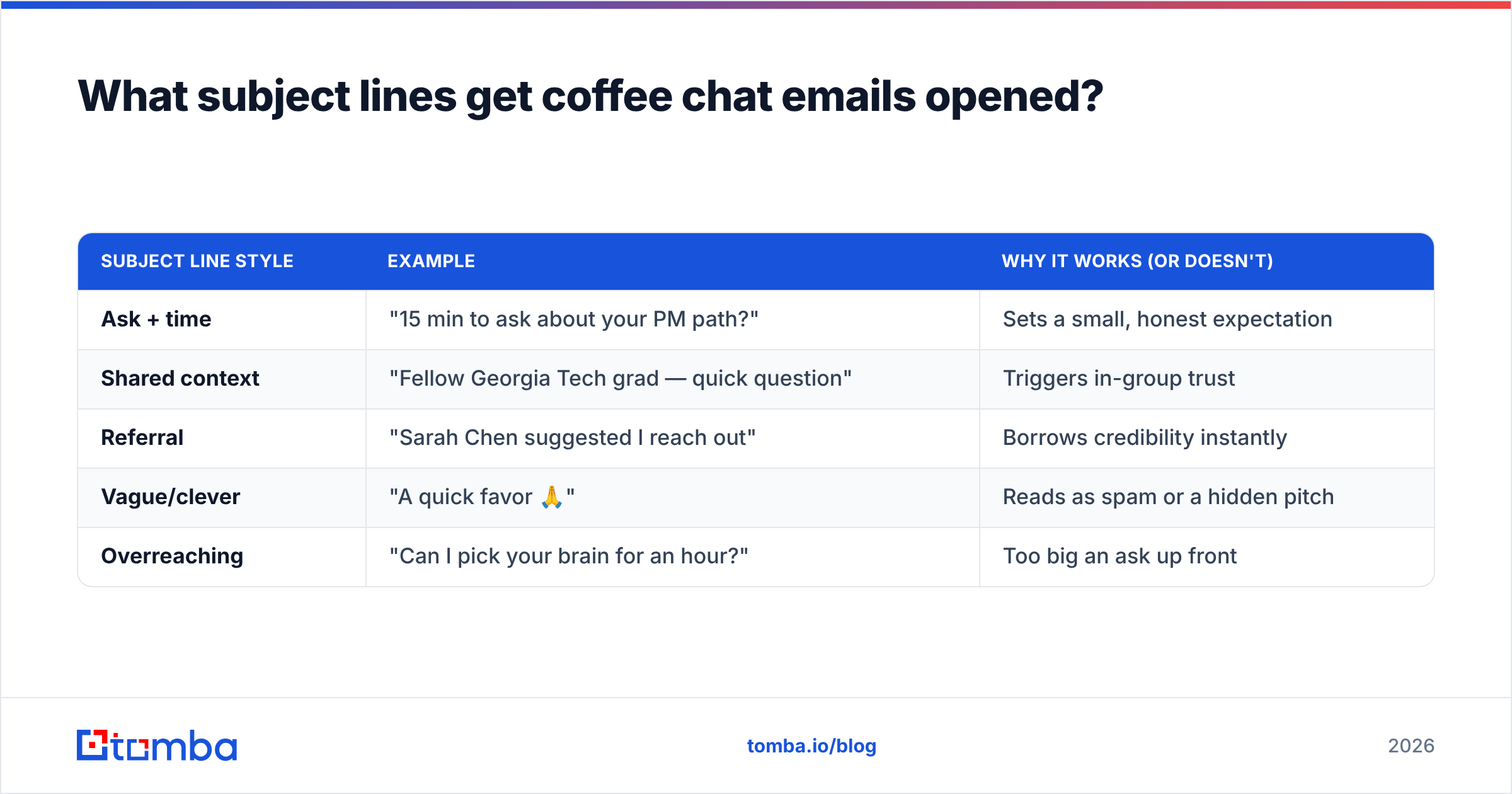
Your subject line decides whether the email is ever read. Clear beats clever. State the ask, the connection, or the time commitment — curiosity gaps and vague hooks make busy people assume it's spam.
| Subject line style | Example | Why it works (or doesn't) |
|---|---|---|
| Ask + time | "15 min to ask about your PM path?" | Sets a small, honest expectation |
| Shared context | "Fellow Georgia Tech grad — quick question" | Triggers in-group trust |
| Referral | "Sarah Chen suggested I reach out" | Borrows credibility instantly |
| Vague/clever | "A quick favor 🙏" | Reads as spam or a hidden pitch |
| Overreaching | "Can I pick your brain for an hour?" | Too big an ask up front |
A good subject line makes the size of the request obvious before the email is even opened. If you want to A/B a few options before sending, a subject line generator can help you draft variations fast.
How do you make sure the email reaches the right person?#
Here's the uncomfortable truth: the best-written coffee chat email in the world is worthless if it goes to the wrong address or lands in spam. This is the step people skip, and it silently tanks their reply rate.
Two things matter:
Accuracy. Guessing an email format ("maybe it's first.last@?") means a chunk of your outreach bounces before anyone reads it. Bounces also damage your sender reputation, which makes future emails more likely to land in spam. Verify the address first. A quick email verifier check tells you whether the mailbox actually exists before you hit send.
Deliverability. Even a valid address won't help if your domain is flagged. Basic hygiene — a warmed-up sending account, proper SPF/DKIM records, and no spammy links — keeps you out of the junk folder. Coffee chat emails are low-volume by nature, so you rarely need heavy infrastructure, but sending from a brand-new domain to fifty strangers in one afternoon is asking for trouble.
If you're reaching out to people whose emails aren't public, tools like Tomba's domain search surface verified addresses by company, and platforms such as LinkedIn help you confirm the person's current role before you write a word.
How does a coffee chat email compare to other outreach?#
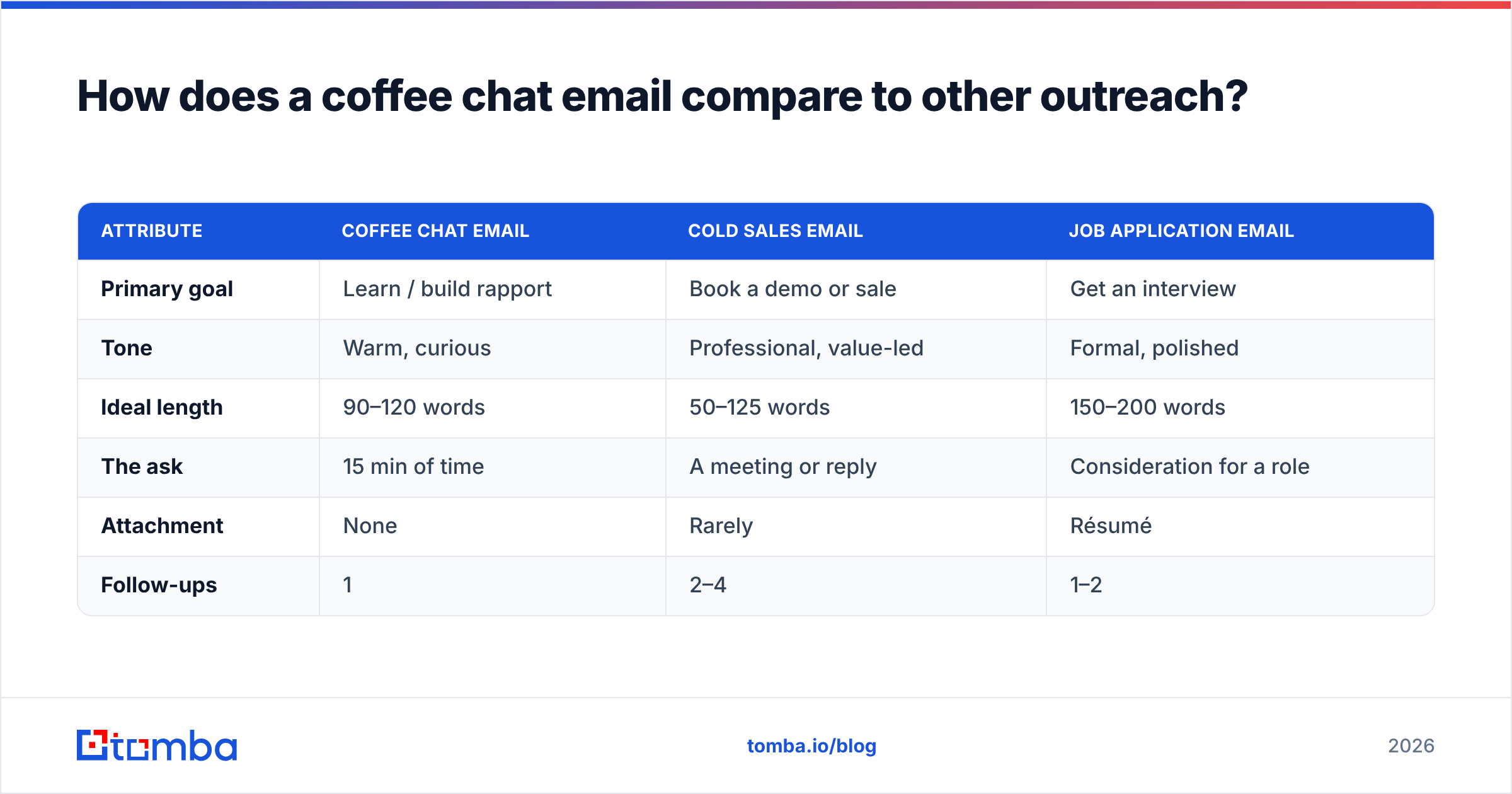
It's easy to lump all outreach together, but the goal, tone, and ask differ sharply. Matching the format to the intent is half the battle.
| Attribute | Coffee chat email | Cold sales email | Job application email |
|---|---|---|---|
| Primary goal | Learn / build rapport | Book a demo or sale | Get an interview |
| Tone | Warm, curious | Professional, value-led | Formal, polished |
| Ideal length | 90–120 words | 50–125 words | 150–200 words |
| The ask | 15 min of time | A meeting or reply | Consideration for a role |
| Attachment | None | Rarely | Résumé |
| Follow-ups | 1 | 2–4 | 1–2 |
The takeaway: a coffee chat email should feel lighter than the other two. If yours reads like a pitch or a formal application, you've drifted into the wrong lane.
When should you send it, and how do you follow up?#
Timing. Tuesday through Thursday, mid-morning, tends to get the best open rates for professional email. Avoid Monday's inbox avalanche and Friday's checked-out energy. That said, relevance beats timing — if someone just posted about a topic you care about, reach out while it's fresh.
Following up. Send exactly one follow-up if you don't hear back, 4–6 business days later. Keep it to two sentences: a gentle bump plus a reminder of the small ask. According to outreach data compiled by HubSpot, a single well-timed follow-up meaningfully lifts reply rates, while a barrage of them does the opposite.
Follow-up template:
Hi [Name], just floating this back to the top of your inbox in case it got buried. Still happy to work around your schedule for a quick 15 minutes — no worries at all if now isn't the right time.
After that, stop. One follow-up shows persistence; three shows desperation and can quietly earn you a spam mark. Silence is an answer, and respecting it protects your reputation for the next time your paths cross.
What mistakes should you avoid?#
- The bait-and-switch. Asking for a "friendly chat" and then pitching a product. It destroys trust permanently.
- The oversized ask. "Can we grab an hour?" or "Would you mentor me?" on first contact. Start tiny.
- The essay. If your email needs scrolling, it needs cutting.
- The generic template. Zero personalization reads as mass mail. One specific, true detail fixes this instantly.
- The wrong address. Guessing the format and hoping. Verify first — it's the cheapest reliability upgrade you can make.
- The over-follow-up. More than one nudge tips from persistent into annoying.
Frequently asked questions#
How long should a coffee chat email be? Aim for 90–120 words. Long enough to establish a specific connection and make one clear ask, short enough to read in under 30 seconds.
Is it "coffee chat" if it's a video call? Yes. The phrase is about the informal, low-pressure nature of the conversation, not the venue. Offering a virtual option actually raises your yes rate because it removes travel friction.
What if I don't have a mutual connection? Lead with a content hook instead. Reference something specific they created or a path they took. Genuine, specific relevance is a stronger opener than a weak name-drop.
How many people should I email? Quality over volume. Ten researched, verified, personalized emails will beat a hundred generic ones — and won't wreck your deliverability.
Send fewer, better coffee chat emails — to the right inbox#
The hard part of a coffee chat email isn't the writing; it's making sure a real, relevant person actually reads it. You can nail the tone and the ask and still get nothing back because the address was a guess or the note landed in spam.
Get the foundation right first. Use the Tomba Email Finder to pull verified professional email addresses by name, company, or domain, so every carefully written request reaches a live inbox instead of bouncing into the void. Pair it with a quick verification pass, keep your ask small and specific, and follow up exactly once. Start free with 25 searches a month, and see the Tomba pricing if you need to scale your outreach. The chats you want are one accurate email away.
Related guides#
Ready to find emails that actually work?
Join 150,000+ professionals who stopped guessing and started sending. Free credits on signup — no credit card required.
Get the Tomba newsletter
Practical outbound tactics and product updates — once every two weeks.
About the author