How to Write a Coffee Chat Follow Up Email That Gets a Reply
A coffee chat only pays off if you follow up well. Here are the timing rules, proven templates, and mistakes that quietly kill your networking momentum.
You had a great coffee chat. The conversation flowed, you got real advice, and you walked away energized. Then... nothing. Two weeks pass, the momentum fades, and the person who was ready to help barely remembers your name.
The fix is not a better conversation. It is a better coffee chat follow up email — sent fast, written short, and built to make replying easy. This guide gives you the timing rules, the exact templates, and the mistakes that quietly sink most networking outreach.
TL;DR#
- Send within 24 hours. A same-day or next-morning follow-up captures the goodwill while the conversation is still fresh in both memories.
- Keep it under 150 words. Thank, reference one specific moment, deliver on any promise, and make a single clear ask (or no ask at all).
- Personalize the one detail that proves you were listening — a book they mentioned, a challenge they named, a person they offered to introduce.
- Templates matter less than timing and specificity. Use the five below as scaffolding, not scripts.
- Track and follow up again. One unanswered note is not rejection; a polite second touch a week later doubles your reply odds.
Why does the coffee chat follow up email matter so much?#
Think of a coffee chat like planting a seed. The conversation is the planting; the follow-up is the water. Skip the water and the seed does nothing, no matter how good the soil.
Concretely, the follow-up does three jobs a great conversation alone cannot:
- It anchors you in memory. The person you met talks to dozens of people. A written note tied to a specific moment turns "someone I chatted with" into "the person who asked about my product launch."
- It creates a paper trail. Introductions, referrals, and job leads travel over email. If you are not in their inbox, you are not in the forwarding chain.
- It signals follow-through. For anyone evaluating you as a potential hire, mentee, or collaborator, a prompt, thoughtful email is direct evidence that you do what you say.
According to HubSpot's sales research, the majority of positive replies come after a timely, personalized touch rather than a generic mass message — and the same psychology applies to networking, not just sales.
When should you send a coffee chat follow up email?#
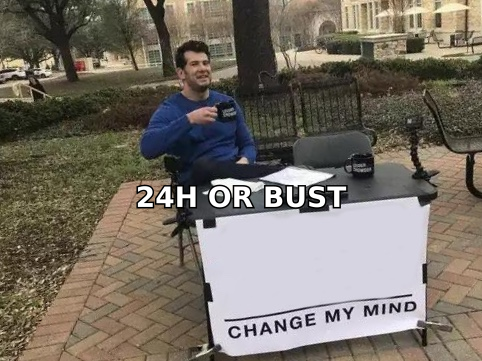
The short answer: within 24 hours, and ideally the same day.
Here is the timing logic. Memory decay is steepest in the first 24 hours after a conversation. If you email that evening or the next morning, you are both still holding the details. Wait three days and you are asking them to reconstruct a conversation they have half-forgotten — which makes replying feel like work.
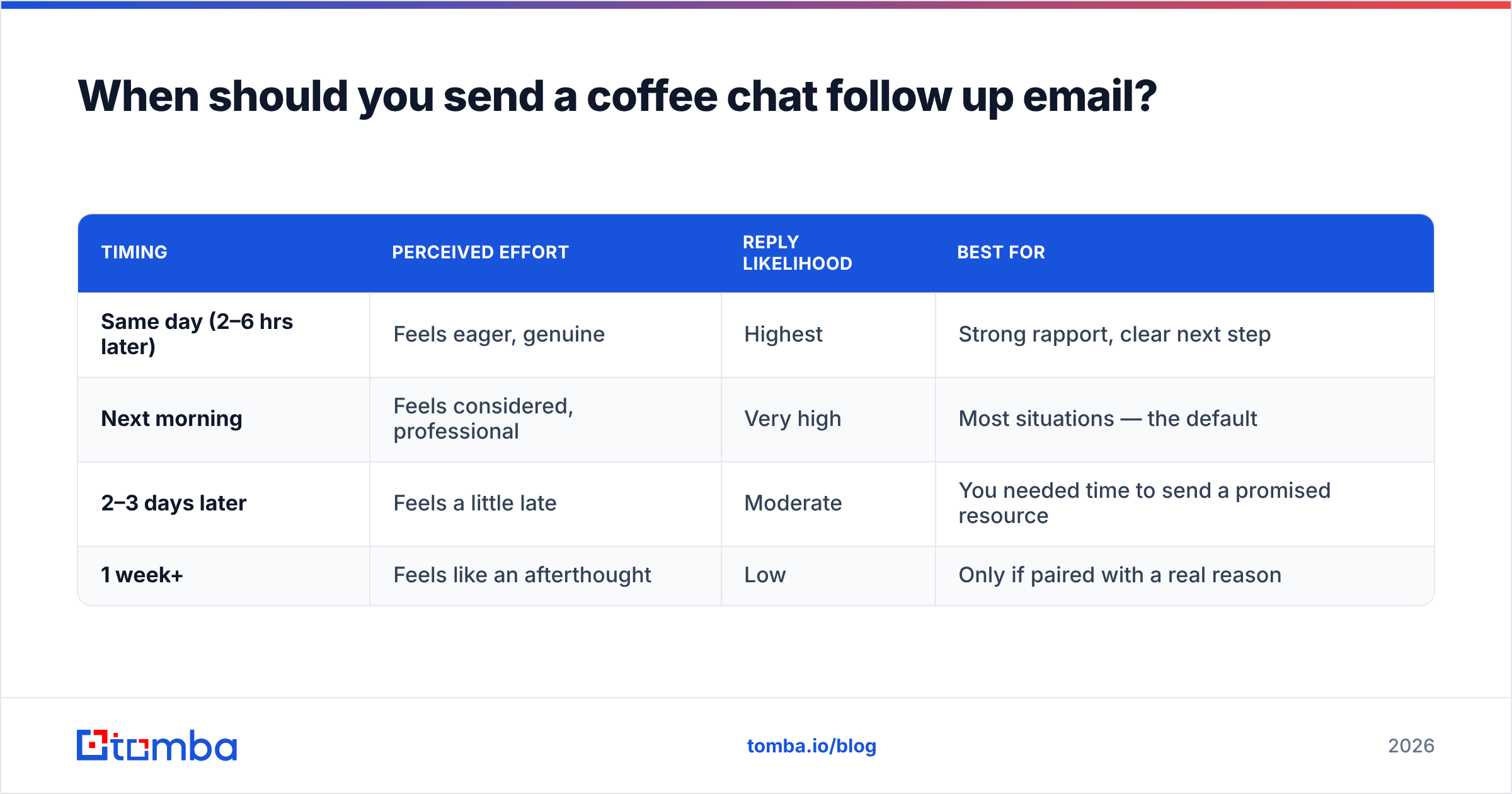
| Timing | Perceived effort | Reply likelihood | Best for |
|---|---|---|---|
| Same day (2–6 hrs later) | Feels eager, genuine | Highest | Strong rapport, clear next step |
| Next morning | Feels considered, professional | Very high | Most situations — the default |
| 2–3 days later | Feels a little late | Moderate | You needed time to send a promised resource |
| 1 week+ | Feels like an afterthought | Low | Only if paired with a real reason |
If you genuinely need time — say, you promised to send a document or make an intro — it is fine to send a quick "thank you, more to come" note first, then the substantive follow-up when it is ready. Do not let perfect be the enemy of prompt.
What should a coffee chat follow up email include?#
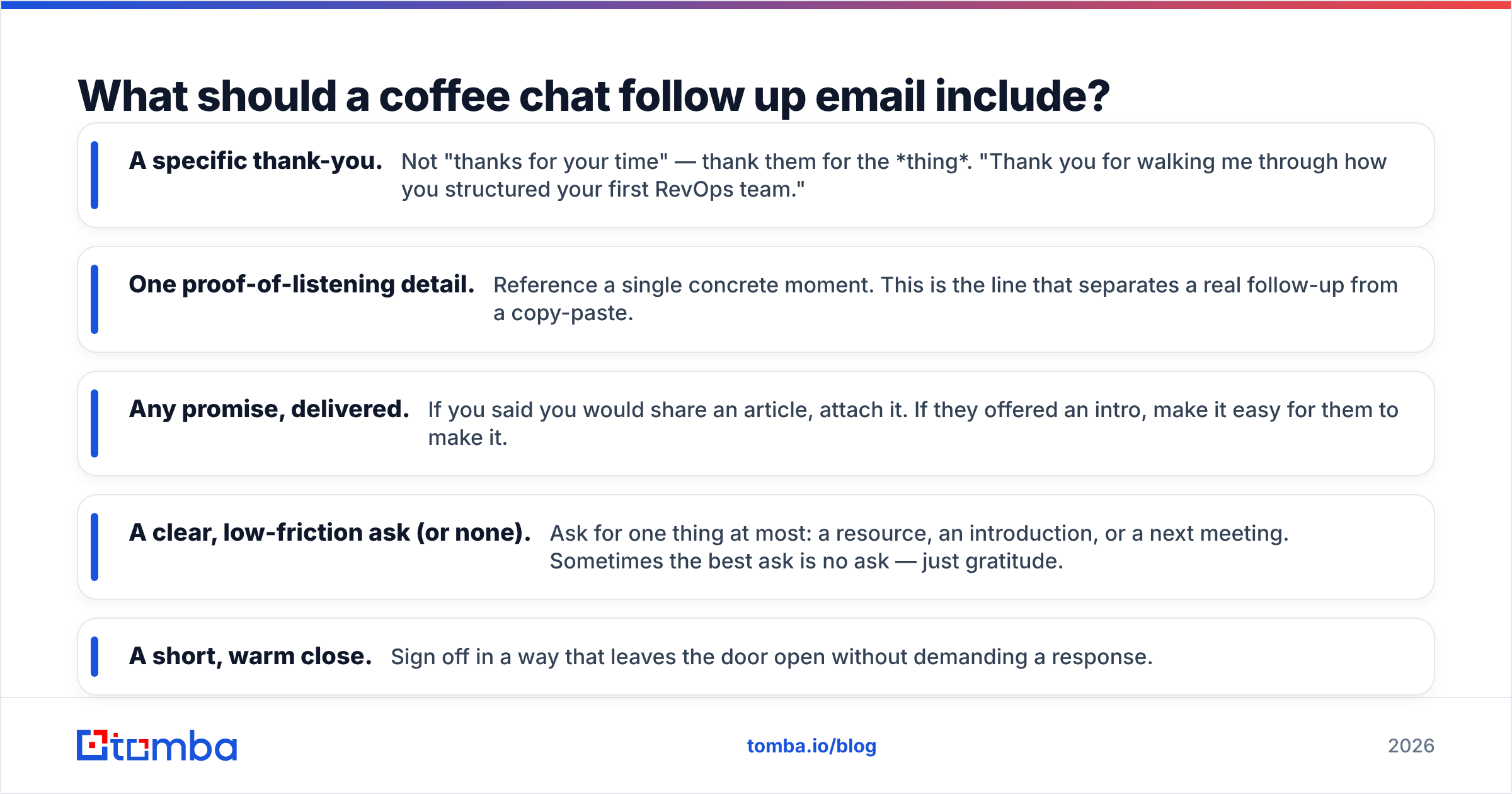
Every effective note hits the same five beats. Miss one and the email feels either cold or needy.
- A specific thank-you. Not "thanks for your time" — thank them for the thing. "Thank you for walking me through how you structured your first RevOps team."
- One proof-of-listening detail. Reference a single concrete moment. This is the line that separates a real follow-up from a copy-paste.
- Any promise, delivered. If you said you would share an article, attach it. If they offered an intro, make it easy for them to make it.
- A clear, low-friction ask (or none). Ask for one thing at most: a resource, an introduction, or a next meeting. Sometimes the best ask is no ask — just gratitude.
- A short, warm close. Sign off in a way that leaves the door open without demanding a response.
Keep the whole thing under 150 words. A wall of text signals that replying will be exhausting, and busy people triage by length.
Coffee chat follow up email templates that actually get replies#
Use these as frames. Swap in your real details — the templates do the structure, you do the specificity.
Template 1: The straightforward thank-you (no ask)#
Subject: Thank you — great talking today
Hi [Name],
Thank you for making time this morning. Your point about [specific idea] genuinely shifted how I'm thinking about [topic] — I'm going to try [concrete next step] this week because of it.
No ask here, just gratitude. I'll keep you posted on how [thing] goes, and I hope our paths cross again soon.
Best,
[Your name]
Template 2: The resource exchange#
Subject: The [resource] I mentioned
Hi [Name],
Really enjoyed our conversation about [topic]. As promised, here's the [article/tool/deck] I mentioned: [link].
Your take on [specific point] stuck with me. If it's useful, I'd love to hear what you think after you skim it — no pressure either way.
Thanks again,
[Your name]
Template 3: The warm introduction request#
Subject: Following up + a small ask
Hi [Name],
Thank you again for the advice on [topic] — the framework you shared for [specific thing] is exactly what I needed.
You mentioned you knew [person/type of person] working on [area]. If you're comfortable, I'd be grateful for an introduction. I've written a short blurb below you can forward as-is to make it easy.
[2-sentence forwardable blurb]
Completely understand if the timing isn't right. Thanks either way,
[Your name]
Template 4: The "let's stay in touch" (long game)#
Subject: Grateful for today
Hi [Name],
Thanks for the honest conversation about [topic] — especially the part about [challenge they named]. It's rare to get that candor.
I know you're heads-down on [their project], so no need to reply. I'd love to check back in a few months once I've made progress on [your goal]. Rooting for [their thing] in the meantime.
Warmly,
[Your name]
Template 5: The follow-up meeting request#
Subject: A quick follow-up on [topic]
Hi [Name],
Our chat on [topic] gave me a lot to act on. I've since [action you took], and a couple of new questions came up that I think you're uniquely suited to answer.
Would you be open to a short 20-minute call in the next couple of weeks? Here's my calendar: [link]. If not, no worries at all — I appreciate everything already.
Thanks,
[Your name]
For more reusable frames across your whole outreach flow, Tomba's free cold email templates library is a solid starting point, and its subject line generator helps you test openers before you hit send.
How do you write the subject line?#
The subject line decides whether your carefully written email gets opened at all. For a coffee chat follow-up, clarity beats cleverness every time.
Good patterns:
- "Thank you — [topic] chat" — plain, warm, instantly recognizable.
- "The [resource] I mentioned" — creates a small, honest curiosity gap.
- "Following up + a quick note" — sets expectations without sounding transactional.
Avoid vague lines like "Hello" or "Touching base," and skip anything that smells like a sales blast. You want the recipient to see your name and the subject and immediately remember the conversation. If your open and response rate on follow-ups is low, the subject line is the first place to look.
What are the most common coffee chat follow up mistakes?#
Most failed follow-ups die from one of these, not from bad luck.
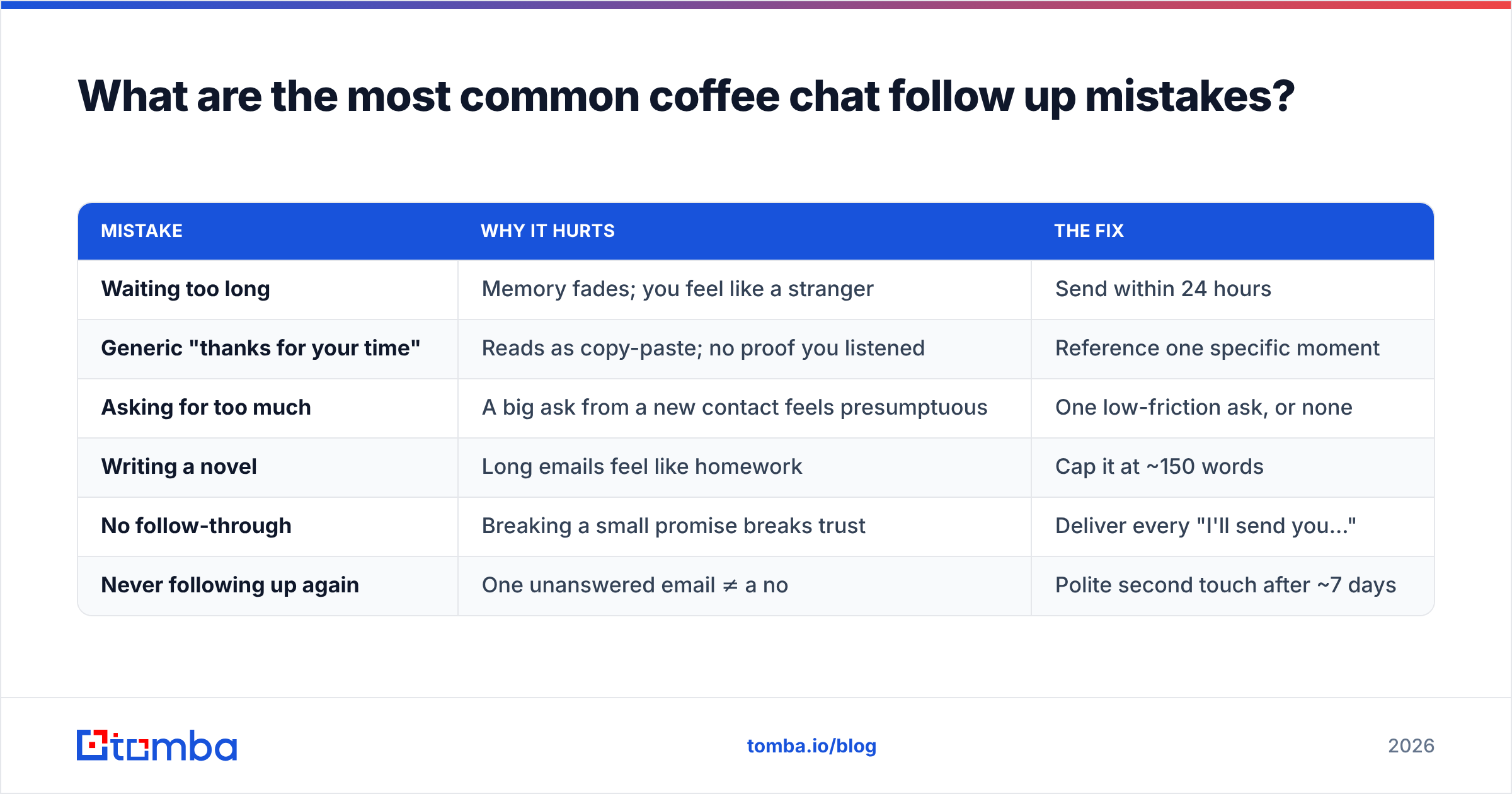
| Mistake | Why it hurts | The fix |
|---|---|---|
| Waiting too long | Memory fades; you feel like a stranger | Send within 24 hours |
| Generic "thanks for your time" | Reads as copy-paste; no proof you listened | Reference one specific moment |
| Asking for too much | A big ask from a new contact feels presumptuous | One low-friction ask, or none |
| Writing a novel | Long emails feel like homework | Cap it at ~150 words |
| No follow-through | Breaking a small promise breaks trust | Deliver every "I'll send you..." |
| Never following up again | One unanswered email ≠ a no | Polite second touch after ~7 days |
The last row is the one people get most wrong. Silence usually means your email got buried, not that the person dislikes you. A short, friendly nudge a week later — "Just floating this back to the top of your inbox in case it slipped through" — recovers a surprising number of dead threads.
What if you do not have their email address?#
This happens constantly: you met at an event, connected on LinkedIn, and never exchanged addresses. Following up in a LinkedIn DM works, but email is where introductions and referrals actually travel, so it is worth finding the right address.
The clean, professional way is to use a verified business email rather than guessing. Tools like the Tomba Email Finder let you find email addresses from a name and company domain, so your follow-up lands in the inbox instead of a message-request folder they never check. This is the same workflow used for outreach after any professional touchpoint — and it beats sending five permutations of firstname@company.com and hoping one sticks.
If you are managing many conversations at once — say, after a conference or a hiring sprint — you can also enrich a whole list of contacts in one pass instead of hunting one by one.
Coffee chat follow-up vs. cold outreach: what is different?#
It helps to remember that a follow-up is warm — you already have permission and context. That changes the rules.
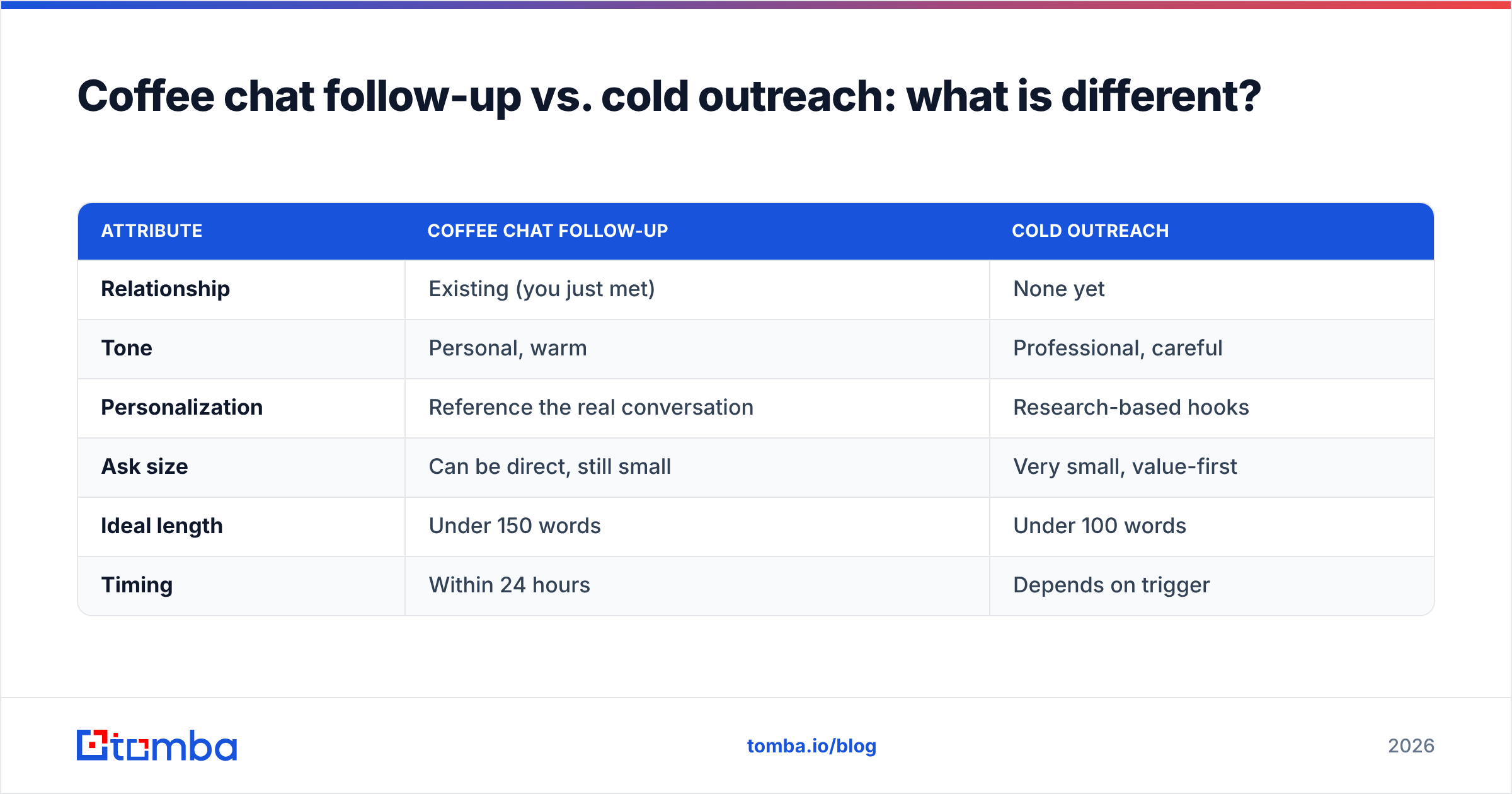
| Attribute | Coffee chat follow-up | Cold outreach |
|---|---|---|
| Relationship | Existing (you just met) | None yet |
| Tone | Personal, warm | Professional, careful |
| Personalization | Reference the real conversation | Research-based hooks |
| Ask size | Can be direct, still small | Very small, value-first |
| Ideal length | Under 150 words | Under 100 words |
| Timing | Within 24 hours | Depends on trigger |
The mistake is treating a warm follow-up like a cold pitch — stiff, over-researched, and hedged. You already earned the conversation. Write like a real person who enjoyed it.
How many times should you follow up?#
Two touches is the sweet spot for most networking situations.
- The initial follow-up within 24 hours (one of the templates above).
- One gentle nudge roughly a week later if you had a specific ask and heard nothing.
After that, back off. If the second note goes unanswered, the timing is probably wrong on their end, not a verdict on you. Keep the relationship warm in low-pressure ways — engage with their posts, share something genuinely relevant months later — rather than sending a third "just checking in." Persistence that ignores signals reads as pushy; patience that stays visible reads as professional.
This is the same restraint that separates thoughtful informational interview etiquette from spam: you are building a relationship, not running a sequence.
Put it together: your follow-up checklist#
Before you hit send on any coffee chat follow up email, run this quick check:
- Timing: Am I inside the 24-hour window?
- Thanks: Did I thank them for something specific, not generic?
- Proof: Is there one detail that shows I listened?
- Promise: Did I deliver anything I said I would?
- Ask: Is my ask singular and easy to say yes to?
- Length: Is this under 150 words?
- Subject: Would I open this?
Nail those seven and you will be in the small minority of people who turn a pleasant conversation into a lasting professional relationship.
Turn every conversation into a real connection#
A great coffee chat is only worth as much as the follow-up that comes after it. Send fast, write short, prove you listened, and make replying effortless — that is the entire game.
And when you have a name but no address, do not let a missing email end the relationship before it starts. Use the Tomba Email Finder to get a verified professional address in seconds, then send the thoughtful follow-up you already know how to write. Start free with 25 searches a month, and see how many warm conversations you can turn into open doors. You can review the full Tomba pricing when you are ready to scale your outreach.
Related guides#
Ready to find emails that actually work?
Join 150,000+ professionals who stopped guessing and started sending. Free credits on signup — no credit card required.
Get the Tomba newsletter
Practical outbound tactics and product updates — once every two weeks.
About the author