How to Write a Coffee Meeting Invite Email (2026 Templates)
A coffee meeting invite email only works when it respects the reader's time. Here are the frameworks, subject lines, and copy-paste templates that actually get a yes in 2026.
You found the right person, you have a real reason to talk, and you want 20 minutes over coffee. Then you open a blank email and freeze. The invite either sounds like a sales pitch or like you're asking a stranger for a favor with no upside for them.
A coffee meeting invite email is one of the highest-leverage messages in B2B: low commitment for the reader, high value for you if it lands. But most of them die in the inbox because they're vague, self-centered, or make the "yes" too much work. This guide fixes that with a repeatable framework, real subject lines, and templates you can paste and adapt today.
TL;DR#
- A coffee meeting invite email succeeds when the ask is small, specific, and framed around the recipient's interest — not a generic "let's connect."
- Keep it under 120 words, lead with a genuine reason you're reaching out to them, and propose two concrete time slots.
- Subject lines that mention a shared connection, a specific topic, or a location outperform "Coffee?" by a wide margin.
- Personalization beats volume: one researched invite outperforms fifty copy-paste blasts.
- Use the framework and five templates below, then verify the address before you hit send so your note actually arrives.
What makes a coffee meeting invite email work?#
The best coffee invites trade on relevance, not persistence. The reader is scanning for one thing: why should I give you my time, and how much will it cost me? Answer both in the first two sentences and you've done 80% of the job.
Three ingredients separate an accepted invite from an ignored one:
- A specific, personal reason. "I read your post on RevOps hiring and had one question" beats "I'd love to pick your brain." Vague flattery reads as a template.
- A small, defined ask. "15 minutes" is easier to grant than "coffee sometime." A bounded time commitment lowers the perceived risk of saying yes.
- A clear, low-friction next step. Offer two slots or a scheduling link. Every extra decision you push onto the reader is a chance for them to defer — and deferral usually means never.
If you nail those three, the format almost writes itself. Miss any one and even a beautifully written email stalls. For a deeper look at how phrasing moves your email response rate, the pattern is consistent: shorter, more specific asks convert better than long, hedged ones.
What should you include in the email? (The 5-part framework)#
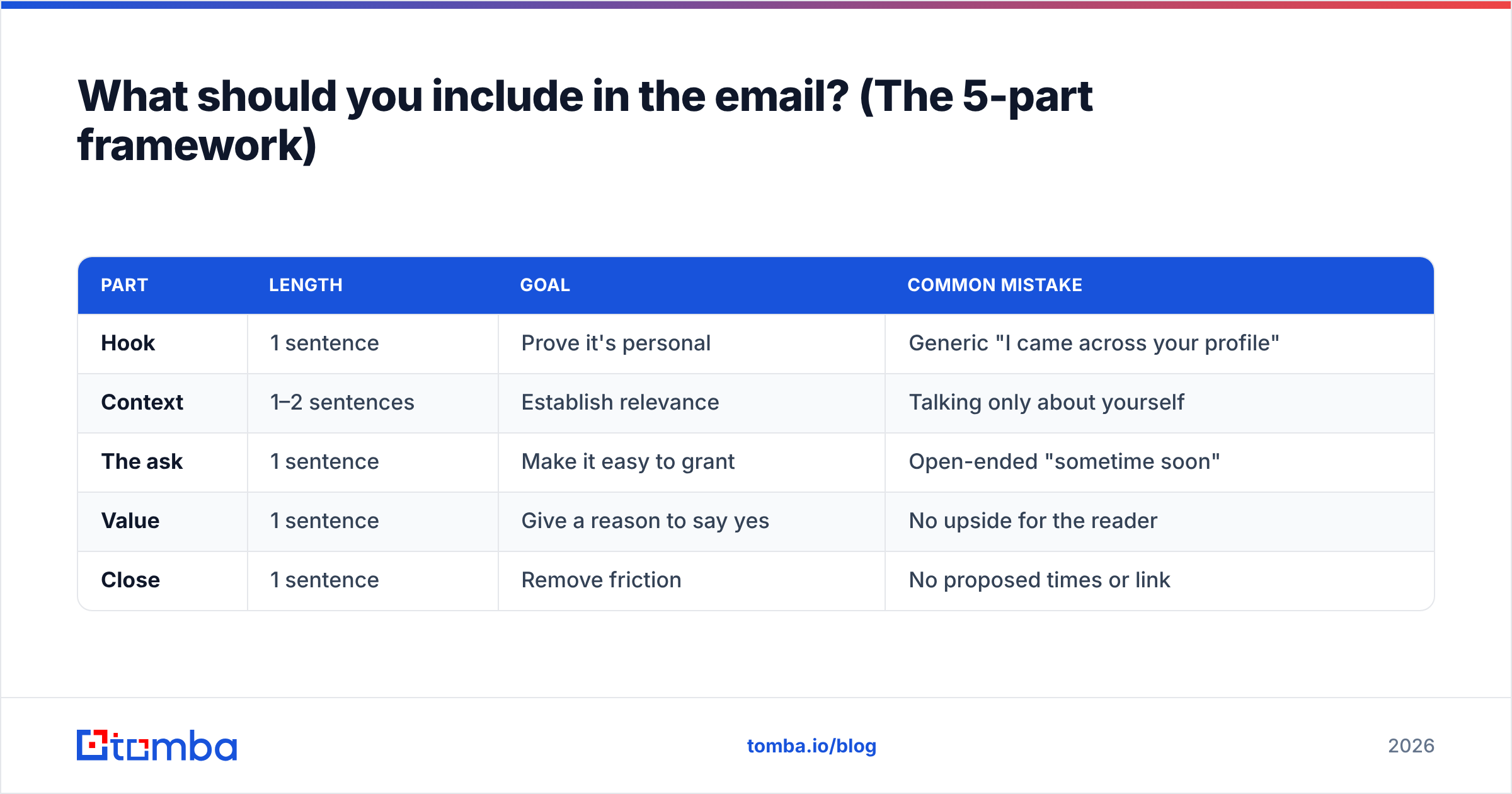
Every strong coffee meeting invite email follows the same skeleton. Memorize these five parts and you'll never stare at a blank draft again.
- Hook (1 sentence) — a specific, true reason you're writing to this person. Reference their work, a mutual contact, or a shared event.
- Context (1–2 sentences) — who you are and why the conversation is relevant to them, not just you.
- The ask (1 sentence) — the exact time commitment and format. "Could I grab 20 minutes over coffee (or a quick call)?"
- The value or angle (1 sentence) — what's in it for them, even if it's just an interesting exchange, an intro, or your perspective on something they care about.
- The close (1 sentence) — two concrete time options or a link, plus an easy out.
Here's how the parts map to word count and tone:
| Part | Length | Goal | Common mistake |
|---|---|---|---|
| Hook | 1 sentence | Prove it's personal | Generic "I came across your profile" |
| Context | 1–2 sentences | Establish relevance | Talking only about yourself |
| The ask | 1 sentence | Make it easy to grant | Open-ended "sometime soon" |
| Value | 1 sentence | Give a reason to say yes | No upside for the reader |
| Close | 1 sentence | Remove friction | No proposed times or link |
Keep the whole thing between 70 and 120 words. Anything longer signals a bigger commitment than "coffee" promises, and readers feel the mismatch.
What are the best subject lines for a coffee invite?#
Your subject line's only job is to earn the open — so be specific, not clever. Curiosity gaps and one-word teasers ("Coffee?") feel spammy from someone the reader doesn't know. Instead, name the connection, the topic, or the place.
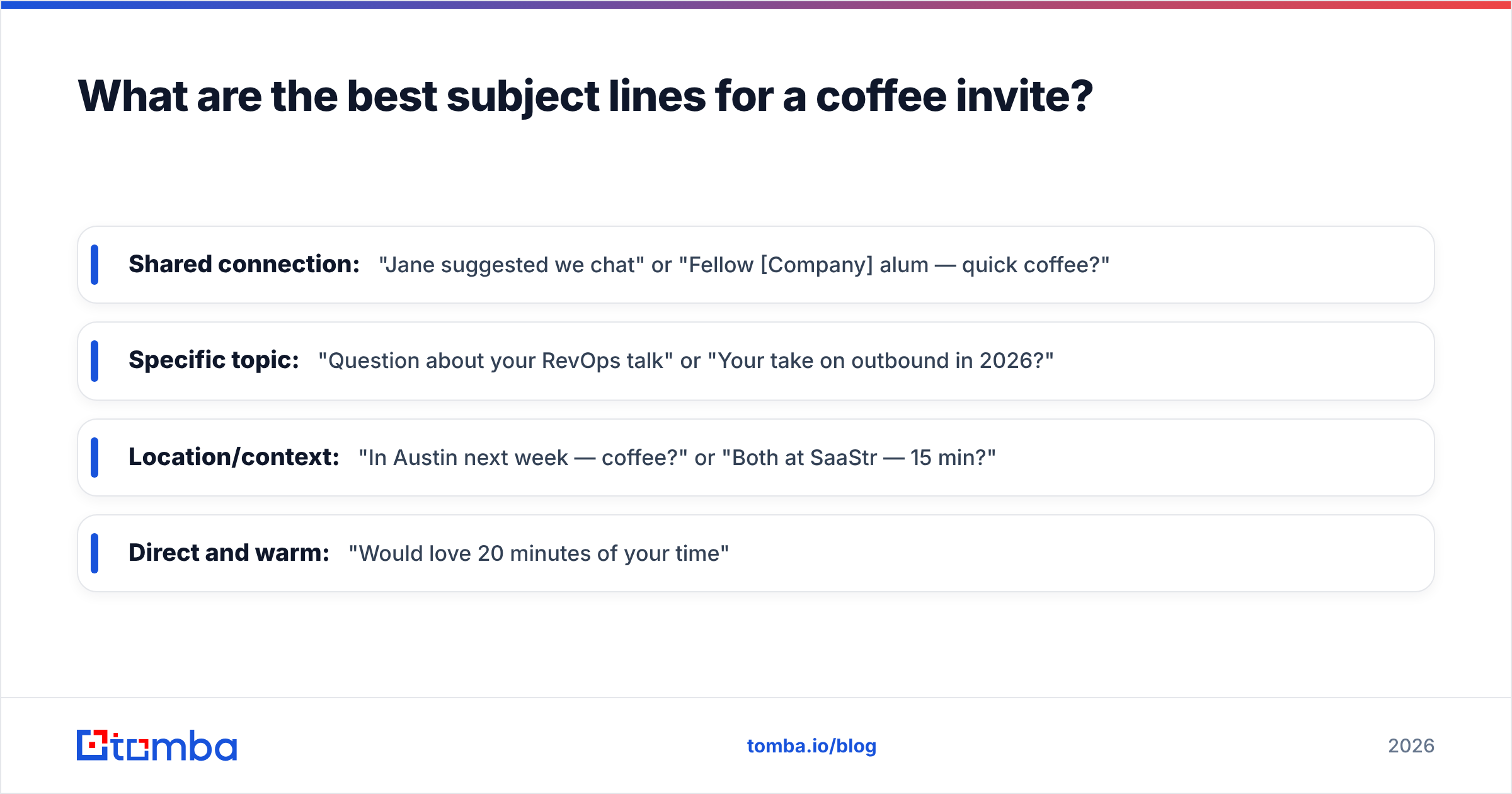
Proven patterns, with examples:
- Shared connection: "Jane suggested we chat" or "Fellow [Company] alum — quick coffee?"
- Specific topic: "Question about your RevOps talk" or "Your take on outbound in 2026?"
- Location/context: "In Austin next week — coffee?" or "Both at SaaStr — 15 min?"
- Direct and warm: "Would love 20 minutes of your time"
Avoid ALL CAPS, fake "Re:" prefixes, and anything that overpromises. If the subject sounds like a newsletter, it gets treated like one. You can pressure-test variations with a subject line generator before you commit, then pick the one that reads most like a note from a real person.
Data from teams at HubSpot and other outreach studies consistently shows personalized, specific subject lines outperform generic ones — the reader can tell in a glance whether the email was written for them or for a list.
Copy-paste coffee meeting invite email templates#
Adapt these to your voice. The bracketed parts are where personalization lives — never send them blank.
Template 1: Cold outreach (industry peer)#
Subject: Question about your [topic] post
Hi [Name],
Your recent post on [specific topic] stuck with me — especially the point about [detail]. I'm [your role] at [company], working on [related thing], and I'd value your perspective.
Could I grab 20 minutes over coffee or a quick call in the next couple of weeks? Happy to share what we're seeing on [topic] in return.
Would Tuesday at 10am or Thursday at 2pm work? No worries if the timing's off.
Thanks,
[Your name]
Template 2: Warm intro (mutual connection)#
Subject: [Mutual contact] suggested we chat
Hi [Name],
[Mutual contact] mentioned you're the person to talk to about [topic] and thought we'd hit it off. I'm exploring [goal] and would love your read on it.
Any chance I could buy you a coffee for 20 minutes? I'll work around your schedule.
Does next week work — say Wednesday morning or Friday afternoon?
Best,
[Your name]
Template 3: Networking after an event#
Subject: Great meeting you at [event]
Hi [Name],
Really enjoyed our chat about [topic] at [event] — I didn't want it to end there. I'd love to continue it over coffee before we both get swallowed by our inboxes again.
Are you free for 20 minutes next week? I can come to you, or we can do a virtual coffee if that's easier.
Cheers,
[Your name]
Template 4: Internal (reaching a colleague or exec)#
Subject: 15 minutes on [project]?
Hi [Name],
I'm leading [project] and think your experience with [area] could save us from a wrong turn. Could I grab 15 minutes over coffee this week?
I've blocked Thursday 11am and Friday 3pm — either works for me, or point me to a better time.
Thanks,
[Your name]
Template 5: Following up (no reply the first time)#
Subject: Re: coffee — still keen
Hi [Name],
Floating this back up in case it slipped past — totally understand if now's not the moment. If a 15-minute coffee still sounds useful, I'm around [day] and [day].
Either way, thanks for the work you're putting out on [topic].
[Your name]
If you send these often, save the winners as reusable email templates so your best-performing version is always one click away instead of rebuilt from memory.
How do you follow up without being annoying?#
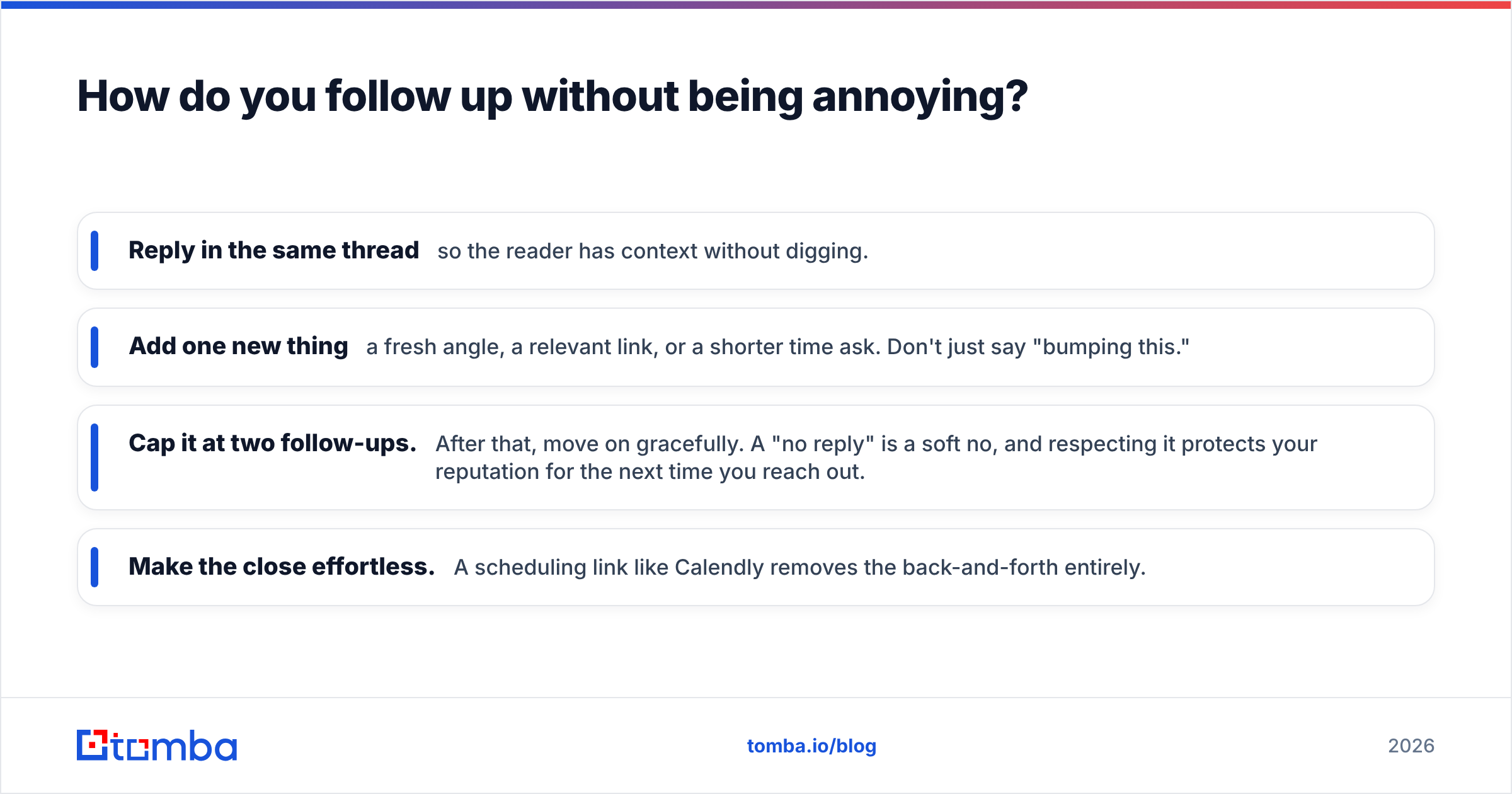
One well-timed follow-up roughly doubles your odds of a reply; a third or fourth just burns goodwill. Wait three to five business days after the first email, keep the follow-up to two sentences, and always give an easy out.
A few rules that keep follow-ups on the right side of persistent:
- Reply in the same thread so the reader has context without digging.
- Add one new thing — a fresh angle, a relevant link, or a shorter time ask. Don't just say "bumping this."
- Cap it at two follow-ups. After that, move on gracefully. A "no reply" is a soft no, and respecting it protects your reputation for the next time you reach out.
- Make the close effortless. A scheduling link like Calendly removes the back-and-forth entirely.
Common mistakes that kill coffee invites#
Even a solid template fails when these creep in:
- Making it all about you. "I want to learn from you" is a cost to the reader with no return. Frame at least one line around their interest.
- The open-ended ask. "Let me know when you're free" pushes the scheduling work onto them. Propose times.
- Over-explaining. A five-paragraph backstory signals a big commitment. Coffee should feel light.
- Sending to a bad address. The best-written invite is worthless if it bounces or lands in a catch-all void. Confirm the address is real and deliverable before you send.
- Zero personalization at scale. Blasting the same note to 200 people gets you a 200-person open rate near zero and a shot reputation. One researched email beats a hundred generic ones.
That last point is where the actual leverage is. A personalized invite requires two things: the right person and a reachable address.
How do you find and verify the right person's email?#
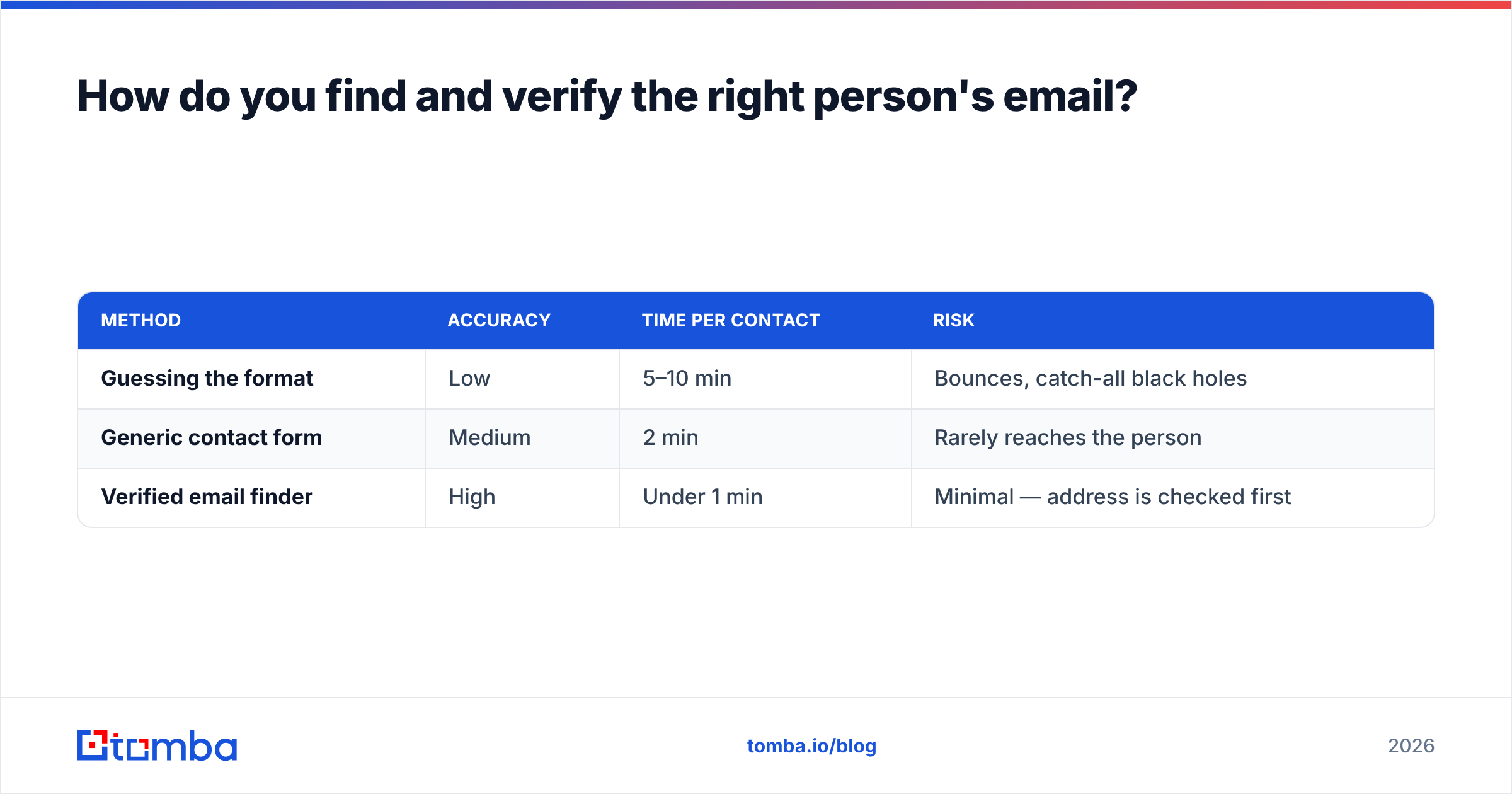
You can't invite someone to coffee if your message never reaches them — so getting a correct, verified address is step zero, not an afterthought. Guessing a format like first.last@company.com works sometimes, but a wrong guess either bounces (hurting your sender reputation) or silently disappears into a catch-all inbox.
This is where an email-finding workflow beats manual guessing:
- Find the address. Use an email finder to get a professional email from a name and company domain, backed by public sources rather than a lucky guess.
- Verify it. Run the address through an email verifier so you know it's deliverable before you invest a personalized note in it.
- Personalize and send. Now the effort you put into the hook and value actually gets a chance to work.
Compare the approaches:
| Method | Accuracy | Time per contact | Risk |
|---|---|---|---|
| Guessing the format | Low | 5–10 min | Bounces, catch-all black holes |
| Generic contact form | Medium | 2 min | Rarely reaches the person |
| Verified email finder | High | Under 1 min | Minimal — address is checked first |
Tools like G2-reviewed email finders exist precisely because deliverability is the hidden bottleneck in outreach. Getting the address right is the cheapest reliability win available — and it's the step most people skip.
Frequently asked questions#
How long should a coffee meeting invite email be? Aim for 70–120 words. Long enough to establish a real reason and a clear ask, short enough that "coffee" still feels like a small commitment.
Should I attach a calendar invite right away? No. Propose two time options or share a scheduling link, and send the formal calendar invite only after they say yes. A cold calendar invite feels presumptuous.
What if I don't have a mutual connection? Lead with a specific reference to their work — a post, talk, or project — instead. Relevance can substitute for a warm intro if it's genuinely specific.
How many follow-ups are too many? Two. One reminder after 3–5 days, one final soft note, then let it rest. A non-reply is a polite no.
Send invites that actually land#
A great coffee meeting invite email is short, specific, and built around the reader's interest — but none of that matters if the message bounces or hits a dead inbox. Start by getting the address right: use the Tomba Email Finder to pull a verified professional email from a name and domain, so every personalized invite you write reaches a real person who can say yes. Nail the address, then let the framework and templates above do the rest.
Related guides#
// get started
Find, verify and enrich your first contacts today
Start on the free plan with 25 searches a month, then scale when your team is ready.
Free plan · No credit card required · GDPR & CCPA
// about the author