Cognism vs D7 Lead Finder (2026): Which B2B Tool Wins?
Cognism and D7 Lead Finder solve very different lead problems at wildly different prices. Here's an honest breakdown of data quality, coverage, and cost, plus where a leaner tool beats both.
Choosing between Cognism and D7 Lead Finder feels like comparing a private jet to a rental van. Both move you forward, but they are built for entirely different trips, budgets, and passengers. One is an enterprise sales-intelligence platform with verified mobile numbers and compliance baked in. The other is a low-cost scraper that pulls local business listings by the thousand.
If you pick the wrong one, you either overpay for data you never use or drown in unverified leads that torch your sender reputation. This guide breaks down exactly where each tool wins so you can match the spend to the job.
TL;DR: Cognism vs D7 Lead Finder at a glance#
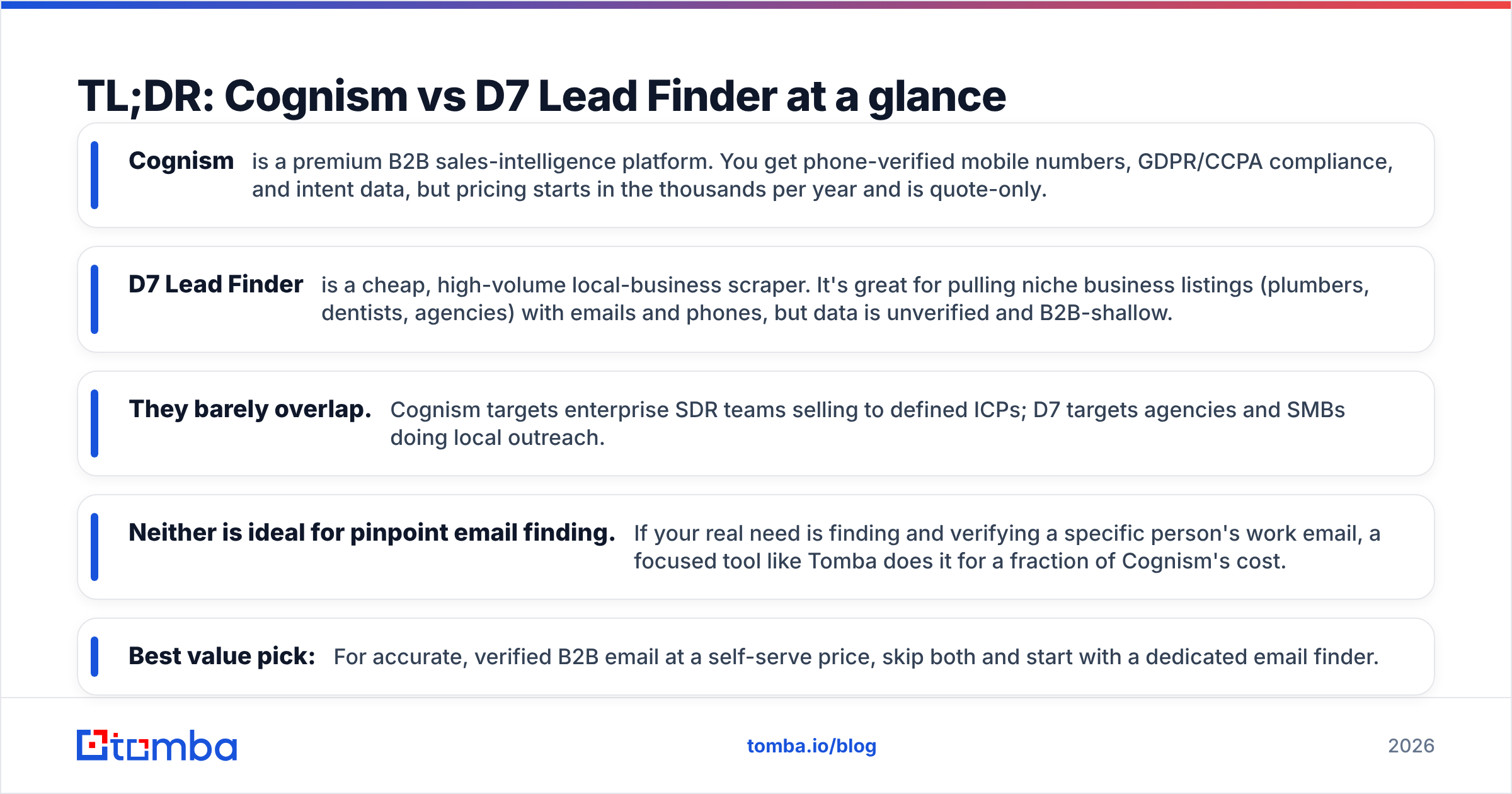
- Cognism is a premium B2B sales-intelligence platform. You get phone-verified mobile numbers, GDPR/CCPA compliance, and intent data, but pricing starts in the thousands per year and is quote-only.
- D7 Lead Finder is a cheap, high-volume local-business scraper. It's great for pulling niche business listings (plumbers, dentists, agencies) with emails and phones, but data is unverified and B2B-shallow.
- They barely overlap. Cognism targets enterprise SDR teams selling to defined ICPs; D7 targets agencies and SMBs doing local outreach.
- Neither is ideal for pinpoint email finding. If your real need is finding and verifying a specific person's work email, a focused tool like Tomba does it for a fraction of Cognism's cost.
- Best value pick: For accurate, verified B2B email at a self-serve price, skip both and start with a dedicated email finder.
What is Cognism and who is it for?#
Cognism is a sales-intelligence platform aimed at mid-market and enterprise revenue teams. Its headline feature is Diamond Data, a set of phone-verified mobile numbers that its team manually checks so your reps stop dialing dead lines. It layers on firmographics, technographics, and Bombora-powered intent signals so you can prioritize accounts that are actively researching your category.
The pitch is compliance and coverage. Cognism markets strong GDPR and CCPA alignment, notified-list checking against DNC registries, and deep European coverage that most US-first databases lack. For a team selling five-figure deals into regulated markets, that matters.
The catch is the model. Cognism is quote-only, contract-based, and typically lands in the low-to-mid five figures per year. There is no meaningful free tier and no month-to-month self-serve plan. You talk to a rep, you sign an annual deal, you onboard a team. That's a feature for enterprises and a wall for everyone else.
What is D7 Lead Finder and who is it for?#
D7 Lead Finder sits at the opposite end of the market. It's a local-business lead-generation scraper: you type a niche and a location ("dentists in Austin"), and it returns a list of businesses with whatever public contact data it can pull, including websites, emails, phone numbers, social profiles, and review counts.
The appeal is volume and price. D7 runs on cheap monthly plans and can generate thousands of local leads fast, which is exactly what SEO agencies, web-design shops, and local service marketers want when they cold-pitch small businesses in bulk.
The trade-off is quality and depth. D7 scrapes generic inbox addresses (info@, contact@, office@) rather than named decision-makers, and the data is unverified at the point of export. You're getting breadth of small businesses, not accurate individual B2B contacts. Push those lists into a cold sequence without cleaning them and your bounce rate will spike.
Cognism vs D7 Lead Finder: full comparison table#
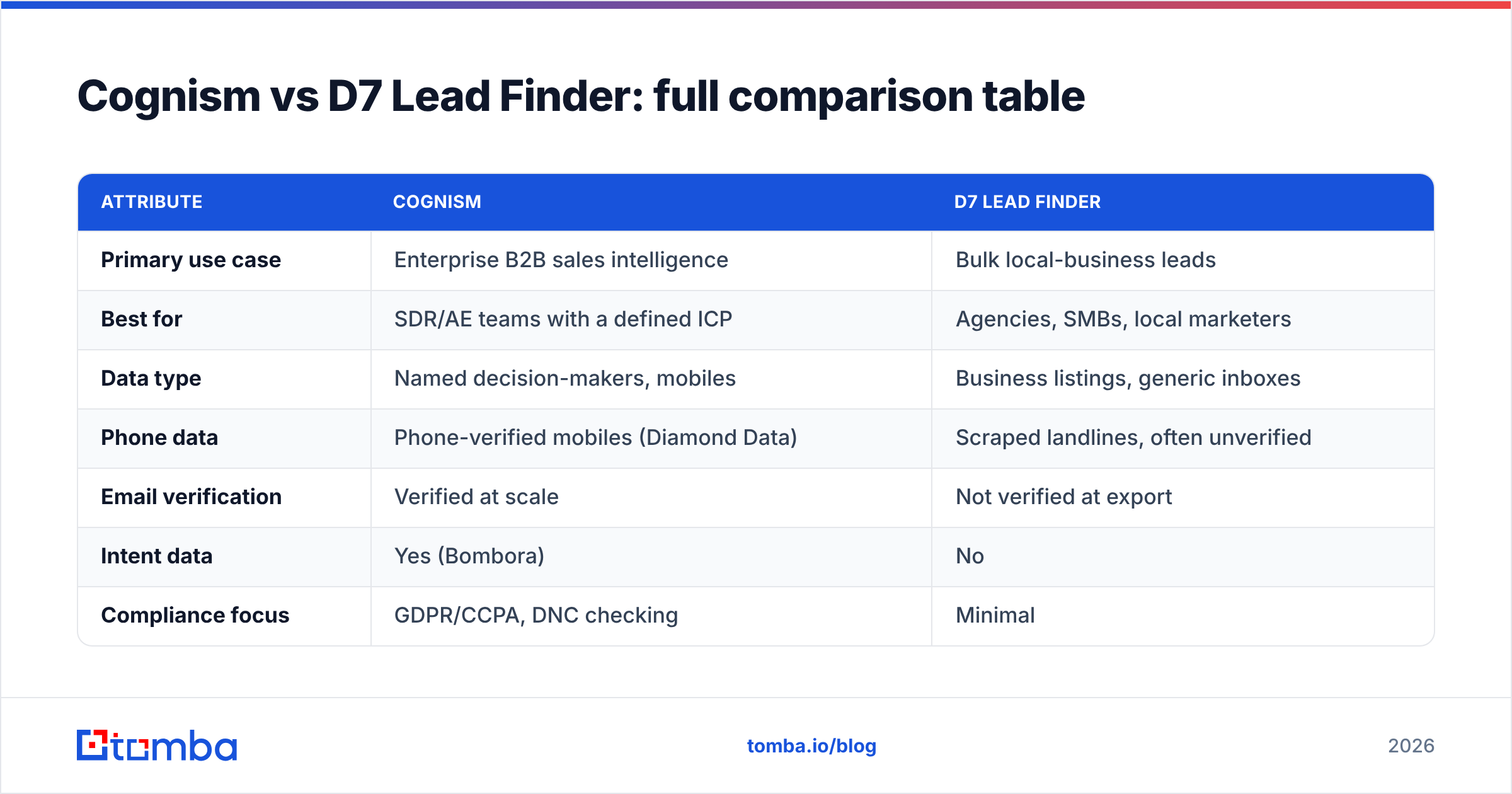
| Attribute | Cognism | D7 Lead Finder |
|---|---|---|
| Primary use case | Enterprise B2B sales intelligence | Bulk local-business leads |
| Best for | SDR/AE teams with a defined ICP | Agencies, SMBs, local marketers |
| Data type | Named decision-makers, mobiles | Business listings, generic inboxes |
| Phone data | Phone-verified mobiles (Diamond Data) | Scraped landlines, often unverified |
| Email verification | Verified at scale | Not verified at export |
| Intent data | Yes (Bombora) | No |
| Compliance focus | GDPR/CCPA, DNC checking | Minimal |
| Pricing model | Annual contract, quote-only | Low monthly subscription |
| Entry cost | Low-to-mid five figures/year | Tens of dollars/month |
| Free trial | Limited, sales-gated | Limited trial |
Is Cognism better than D7 Lead Finder?#
"Better" depends entirely on who you sell to. If you run an enterprise SDR team dialing named executives across Europe and North America, Cognism is the stronger tool, and it isn't close. Verified mobiles alone can double connect rates, and the compliance layer keeps legal off your back in regulated regions.
But if you're a three-person agency pitching local restaurants and gyms, Cognism is absurd overkill. You'd pay enterprise contract money for granular executive data you don't need. D7's cheap, high-volume local scraping is a far better match for that motion.
So the honest answer is that these tools rarely compete for the same buyer. The real question most people are actually asking is narrower: how do I get accurate contact data for the specific people I want to reach, without an enterprise contract or a pile of unverified scrapes? That's a third lane neither tool owns cleanly.
How do the two tools handle data accuracy?#
This is where the gap is widest, and where most buyers get burned.
Cognism invests heavily in accuracy. Its Diamond Data mobiles are human-verified, and email records are validated at scale, so your bounce rates stay low and your reps trust the numbers. You pay a premium precisely for that confidence.
D7 makes no such promise. Because it scrapes public listings in bulk, you inherit whatever the source had, including stale addresses, role-based inboxes, and duplicates. The volume is real, but so is the cleanup work. Before you send a single email, you should run those lists through a dedicated email verifier to strip invalids and protect your domain.

The lesson holds regardless of tool: verification is not optional. According to research shared across vendors on G2, list hygiene is one of the biggest levers on cold-email deliverability. Even Cognism's clean data benefits from a verification pass before high-stakes campaigns, and D7 data absolutely requires one.
What does each tool actually cost?#
Pricing is the clearest dividing line between these two.
Cognism does not publish prices. Expect an annual commitment, a per-seat structure, and a credit or click model layered on top depending on your package. Deals commonly start in the low five figures per year and climb with seats and data volume. You will negotiate, and you will sign a contract before you see the platform in full.
D7 Lead Finder publishes tiered monthly plans that are cheap by design, scaling with how many searches and leads you need per month. It's the kind of tool you can expense on a personal card and cancel next month.
For teams that want verified B2B data without either extreme, a self-serve tool is the middle path. Tomba's pricing is transparent and public:
- Free — 25 searches per month, no card required, good for testing accuracy on real contacts.
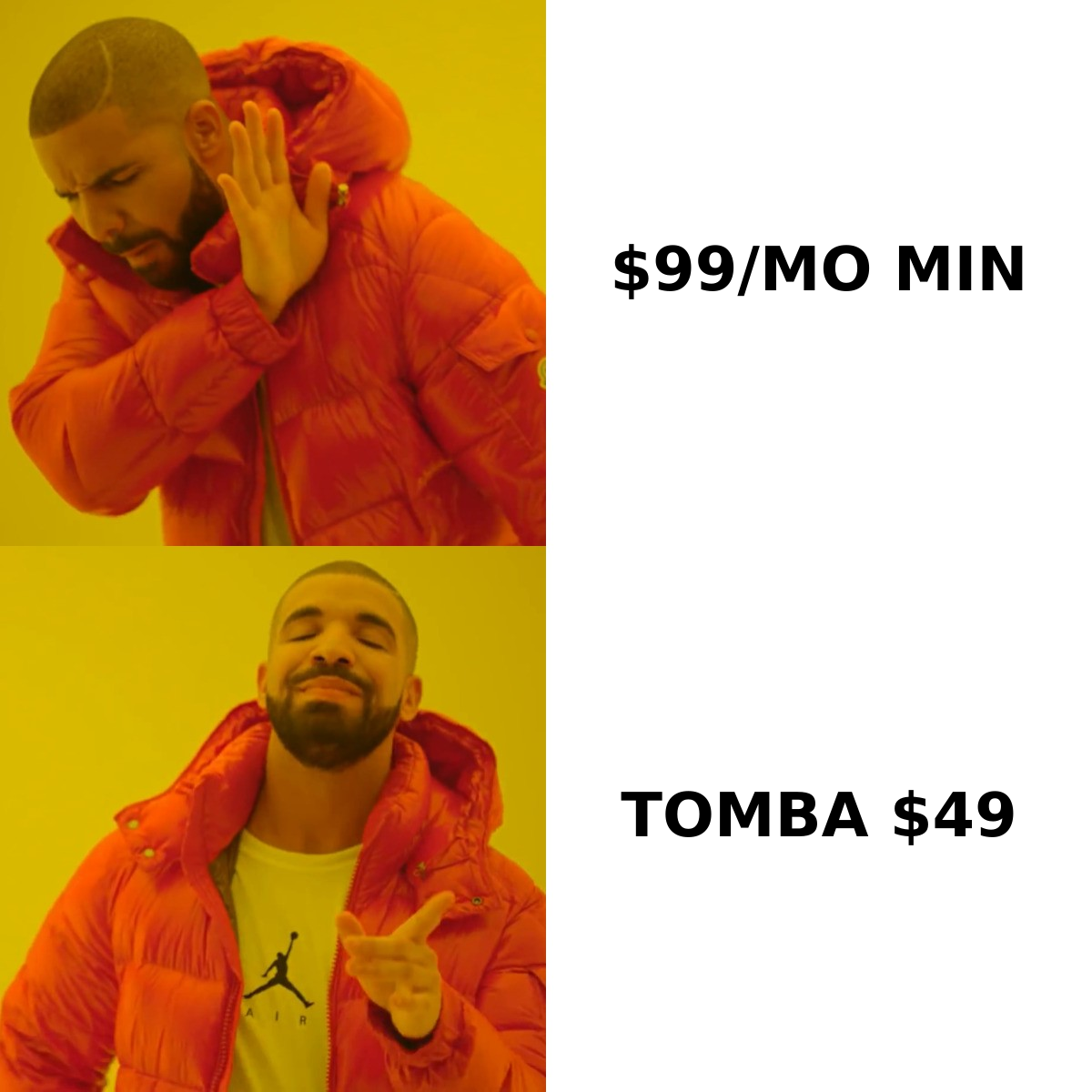
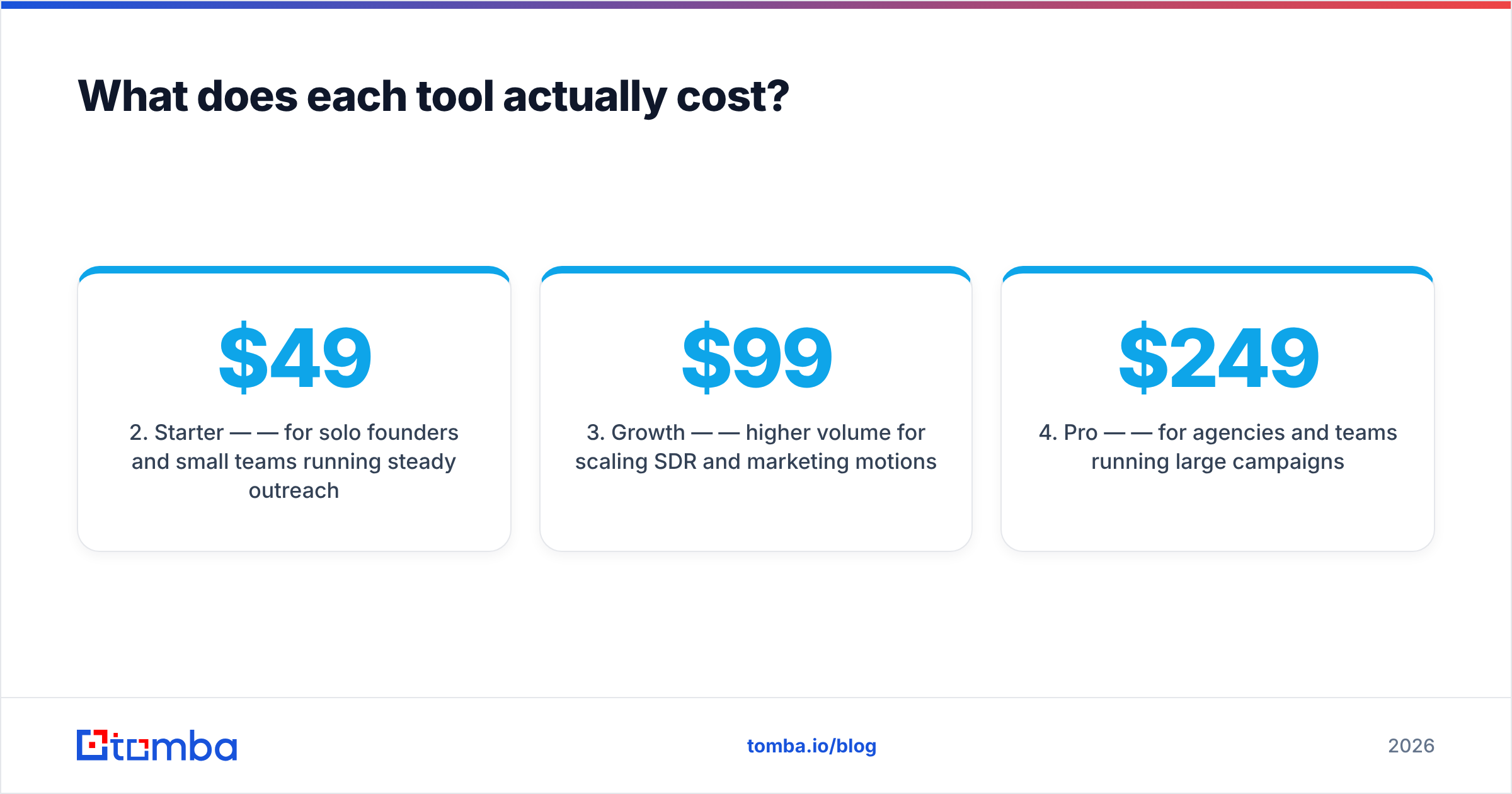
- Starter — $49/mo — for solo founders and small teams running steady outreach.
- Growth — $99/mo — higher volume for scaling SDR and marketing motions.
- Pro — $249/mo — for agencies and teams running large campaigns.
- Enterprise — custom — volume pricing and support for larger organizations.
You can start free, verify the data against contacts you already know, and only pay when it earns its keep. No sales call, no annual lock-in.
Where does a focused email finder fit in?#
Here's the practical reality: a lot of people searching "Cognism vs D7 Lead Finder" don't actually need either platform. They need to find and verify the work email of specific people or companies without an enterprise contract or a bucket of scraped local listings.
That's a different job, and it's the one Tomba is built for:
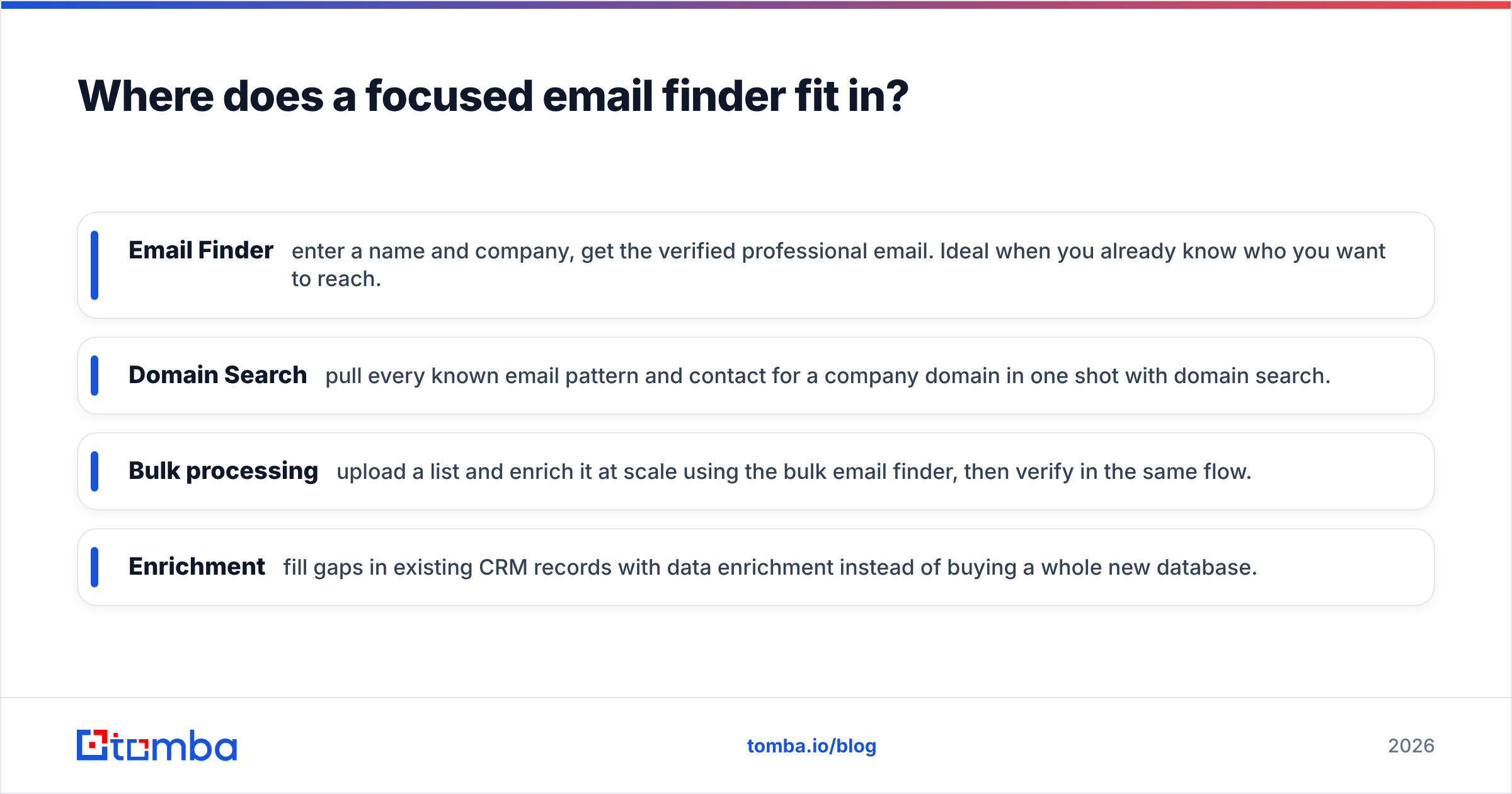
- Email Finder — enter a name and company, get the verified professional email. Ideal when you already know who you want to reach.
- Domain Search — pull every known email pattern and contact for a company domain in one shot with domain search.
- Bulk processing — upload a list and enrich it at scale using the bulk email finder, then verify in the same flow.
- Enrichment — fill gaps in existing CRM records with data enrichment instead of buying a whole new database.
Where Cognism is a full intelligence suite and D7 is a volume scraper, a focused finder is the scalpel: cheaper than Cognism, far more accurate than D7, and self-serve like neither.
Cognism vs D7 vs a dedicated email finder: which should you pick?#
Use this quick decision framework:
- Pick Cognism if you're an enterprise team selling into defined accounts, need phone-verified mobiles and intent data, sell in regulated regions, and have real budget. Check the Cognism site for current packages.
- Pick D7 Lead Finder if you do high-volume local outreach to small businesses, price is your top constraint, and you're willing to verify lists yourself. See D7's plans for details.
- Pick a dedicated email finder if you want verified, named B2B contacts on a transparent self-serve plan, without an annual contract or a scraping cleanup project.
Many teams end up combining the third option with their CRM and outreach stack rather than paying for a monolith. It keeps data costs predictable and quality high.
Is Cognism or D7 Lead Finder worth it in 2026?#
Both are worth it for the exact buyer they're built for, and wasteful for everyone else. Cognism earns its price when verified mobiles and compliance move real revenue. D7 earns its keep when cheap local volume is the entire game. The mistake is buying one because it's famous (Cognism) or cheap (D7) when your actual need is precise, verified contact data.
If that's your need, start small and prove accuracy before you scale. Spin up a free Tomba account, run the Tomba Email Finder against 25 contacts you can independently confirm, and watch the hit rate. If the data checks out, move to Starter at $49/mo and keep your outreach clean, verified, and cheap, without signing away a year of budget or babysitting a scraper. Try it free today and see how fast accurate B2B email changes your reply rate.
Related guides#
// get started
Find, verify and enrich your first contacts today
Start on the free plan with 25 searches a month, then scale when your team is ready.
Free plan · No credit card required · GDPR & CCPA
// about the author