Cognism vs Exellius (2026): B2B Data Platforms Compared
Cognism and Exellius both promise clean B2B contact data, but they solve different problems. Here's an honest breakdown of pricing, coverage, compliance, and which one actually fits your outbound motion in 2026.
Choosing a B2B data provider usually comes down to a boring truth: the logo on the invoice matters less than whether the phone rings and the email lands. Cognism and Exellius both sell "clean contact data," but they sit at different points on the build-versus-buy spectrum, and the price gap between them is wide enough to change your whole GTM budget.
This is a neutral breakdown — no vendor wrote this. If Tomba is the better fit for your use case, we'll say so; where Cognism or Exellius wins, we'll say that too.
TL;DR — Cognism vs Exellius at a glance#
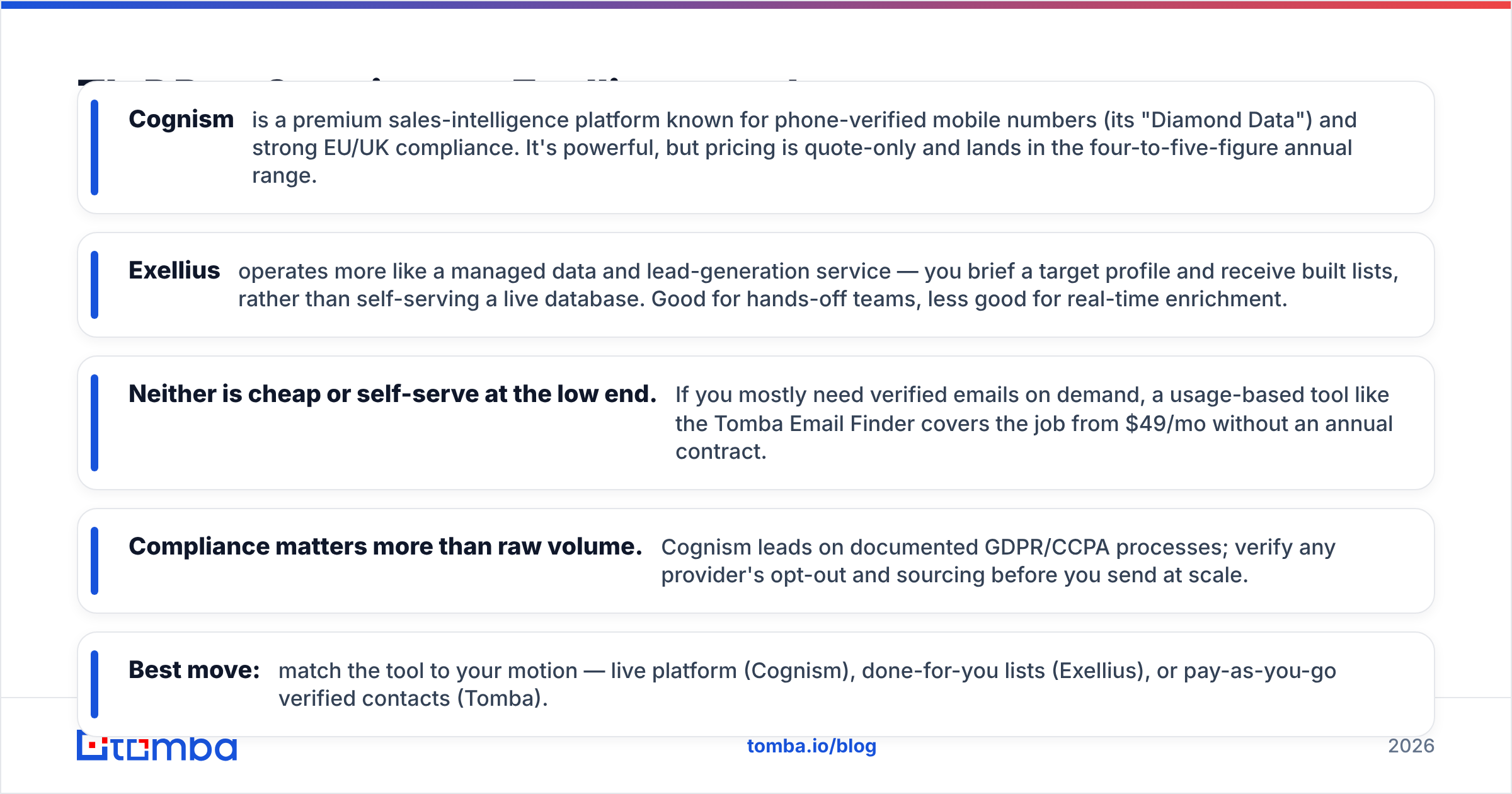
- Cognism is a premium sales-intelligence platform known for phone-verified mobile numbers (its "Diamond Data") and strong EU/UK compliance. It's powerful, but pricing is quote-only and lands in the four-to-five-figure annual range.
- Exellius operates more like a managed data and lead-generation service — you brief a target profile and receive built lists, rather than self-serving a live database. Good for hands-off teams, less good for real-time enrichment.
- Neither is cheap or self-serve at the low end. If you mostly need verified emails on demand, a usage-based tool like the Tomba Email Finder covers the job from $49/mo without an annual contract.
- Compliance matters more than raw volume. Cognism leads on documented GDPR/CCPA processes; verify any provider's opt-out and sourcing before you send at scale.
- Best move: match the tool to your motion — live platform (Cognism), done-for-you lists (Exellius), or pay-as-you-go verified contacts (Tomba).
What are Cognism and Exellius, really?#
Cognism is a sales-intelligence platform. You log in, search a live database of companies and contacts, apply filters (title, geography, tech stack, intent signals), and export or sync results to your CRM. Its headline differentiator is phone-verified mobile numbers, which it markets as "Diamond Data," plus a compliance posture built for European outbound. You can read its own positioning on cognism.com.
Exellius (Exellius Systems) sits closer to the data-services and demand-generation end of the market. Rather than a pure self-serve database, its model leans toward custom-built contact lists and lead-generation campaigns delivered to a spec you provide. That makes it appealing to teams who'd rather hand off list-building entirely than learn another platform.
The distinction is the whole story: Cognism is a tool you operate; Exellius is closer to a service you brief. One rewards teams with a dedicated ops person who wants control; the other rewards teams who want to skip the tooling and receive finished lists.

How do Cognism and Exellius compare on features and price?#
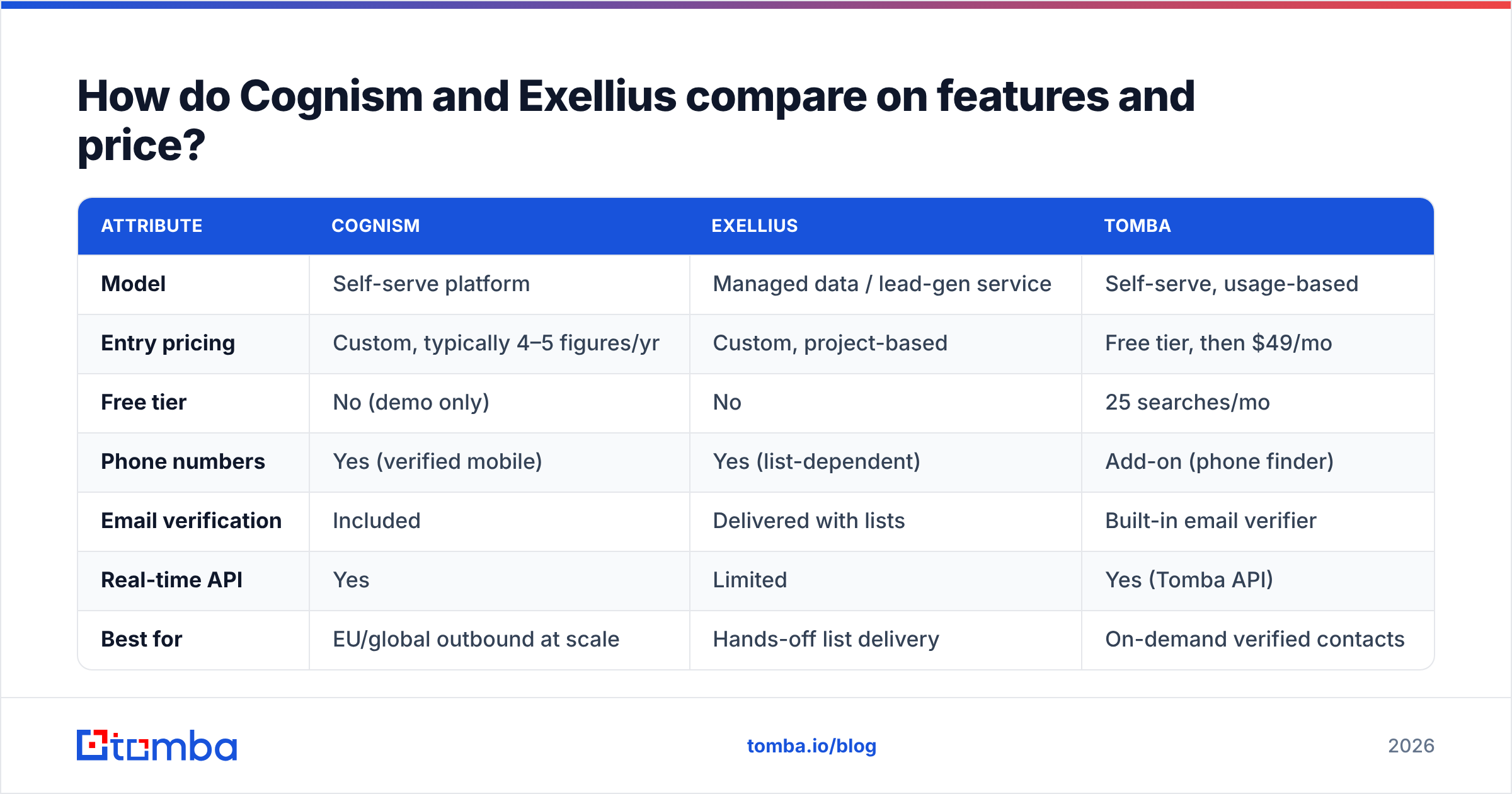
Because Exellius is quote-and-project oriented and Cognism is quote-and-seat oriented, exact numbers move around per deal. The shape below reflects how each is typically bought in 2026.
| Attribute | Cognism | Exellius | Tomba |
|---|---|---|---|
| Model | Self-serve platform | Managed data / lead-gen service | Self-serve, usage-based |
| Entry pricing | Custom, typically 4–5 figures/yr | Custom, project-based | Free tier, then $49/mo |
| Free tier | No (demo only) | No | 25 searches/mo |
| Phone numbers | Yes (verified mobile) | Yes (list-dependent) | Add-on (phone finder) |
| Email verification | Included | Delivered with lists | Built-in email verifier |
| Real-time API | Yes | Limited | Yes (Tomba API) |
| Best for | EU/global outbound at scale | Hands-off list delivery | On-demand verified contacts |
| Contract | Annual | Per project / annual | Monthly, cancel anytime |
A few honest caveats about this table:
- Pricing is directional, not quoted. Both vendors gate numbers behind a sales call, so treat the ranges as what teams commonly report, not published rates.
- "Included" verification isn't equal. Cognism verifies within its own pipeline; Exellius quality depends on the specific list build; a dedicated verifier gives you an independent check either way.
- Coverage varies by region and seniority. Cognism is strong in EMEA; US-heavy teams should benchmark a sample before committing.
- The API line is the real dividing line for anyone embedding data into product or automation — that's where a managed-list vendor struggles.
Which one has better data accuracy?#
The honest answer: you can't know until you test a sample against your own ICP — and any vendor that won't run a free sample match is telling you something.
Cognism's reputation rests on its phone verification; when its mobile numbers connect, reps notice. Exellius, as a build-to-order service, can be very accurate for a narrow, well-briefed request because a human is scoping the list — but that same model means you're trusting a delivery rather than auditing a live index.
Whichever you pick, run every list through an independent verification pass before you send. Bounces don't just waste sends; they erode sender reputation and drag down email deliverability for your whole domain. A quick pass through an email verifier catches the stale rows that even good providers miss, and independent third-party grades (see peer reviews on G2) are worth more than any vendor's own accuracy claim.

Is Cognism or Exellius better for compliance?#
Cognism has the stronger, more documented compliance story — but "documented" is the operative word for both.
Cognism markets itself heavily on GDPR and CCPA alignment, notification of prospects, and do-not-call screening for European mobile numbers. If you're running outbound into the EU or UK, that paper trail is a genuine risk reducer. Exellius, operating as a data-service provider, can also deliver compliant lists, but you should ask directly how each dataset was sourced, what opt-out mechanism backs it, and where the data physically lives.
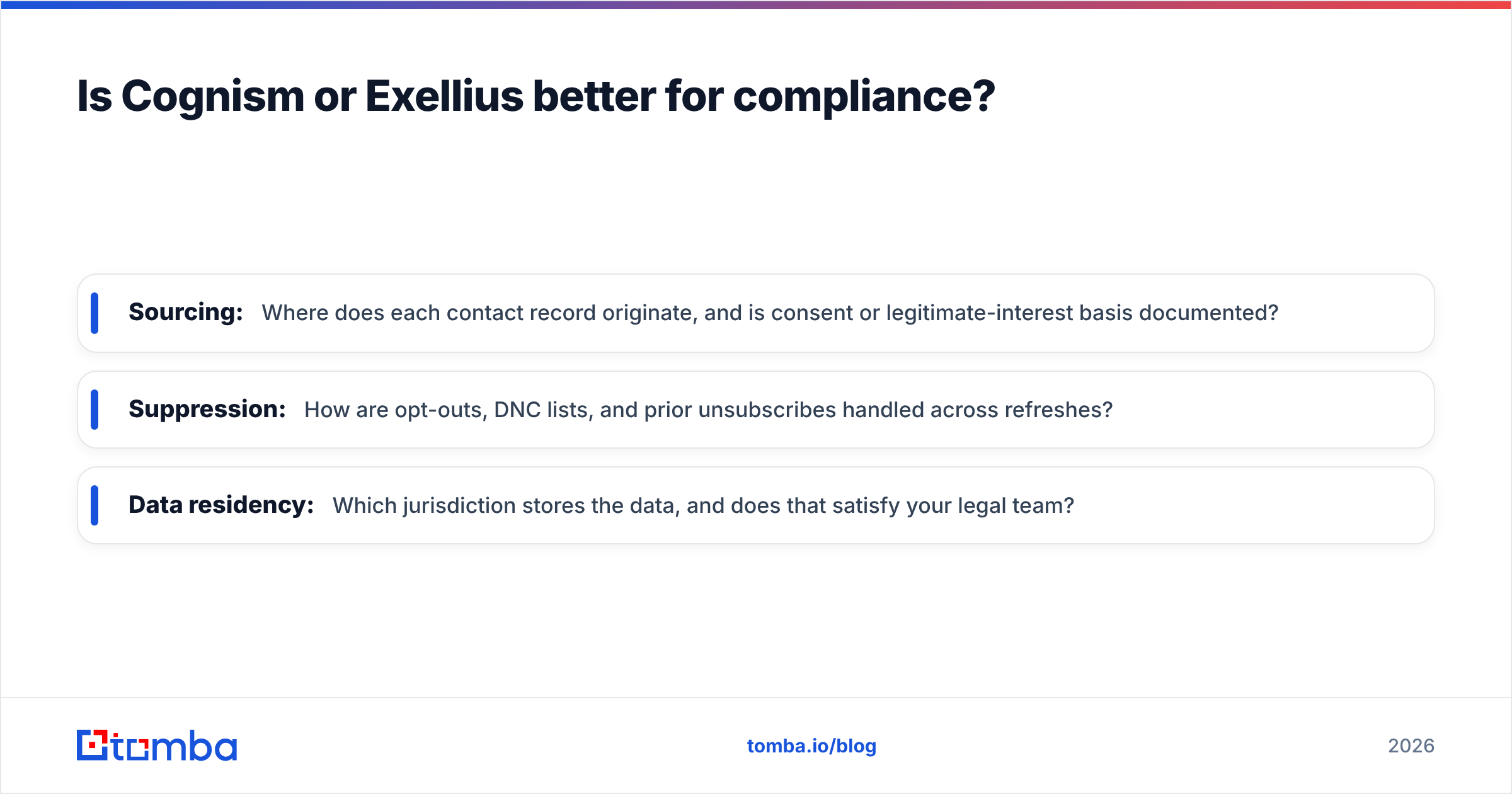
Three questions to ask either vendor before you sign:
- Sourcing: Where does each contact record originate, and is consent or legitimate-interest basis documented?
- Suppression: How are opt-outs, DNC lists, and prior unsubscribes handled across refreshes?
- Data residency: Which jurisdiction stores the data, and does that satisfy your legal team?
If a vendor can't answer these crisply, the low price or high volume won't matter when a complaint lands.
Where does Tomba fit in this comparison?#
Tomba isn't trying to be an all-in-one sales-intelligence suite — and for a lot of teams, that's exactly the point.
If your core need is "get me the verified email (and often the phone) for these people or these companies, right now, without an annual contract," a usage-based finder is a better economic fit than a platform license or a project retainer. That's the lane Tomba runs in:
- Email finder — find professional addresses by name, domain, or company, then confirm them with a built-in verification score.
- Domain search — pull every discoverable email pattern for a target company in one query.
- Data enrichment and the Tomba API — push verified contacts straight into your CRM or product workflow, the piece a managed-list service can't easily do.
- Bulk email finder — process a whole prospect list at once instead of briefing a vendor and waiting.
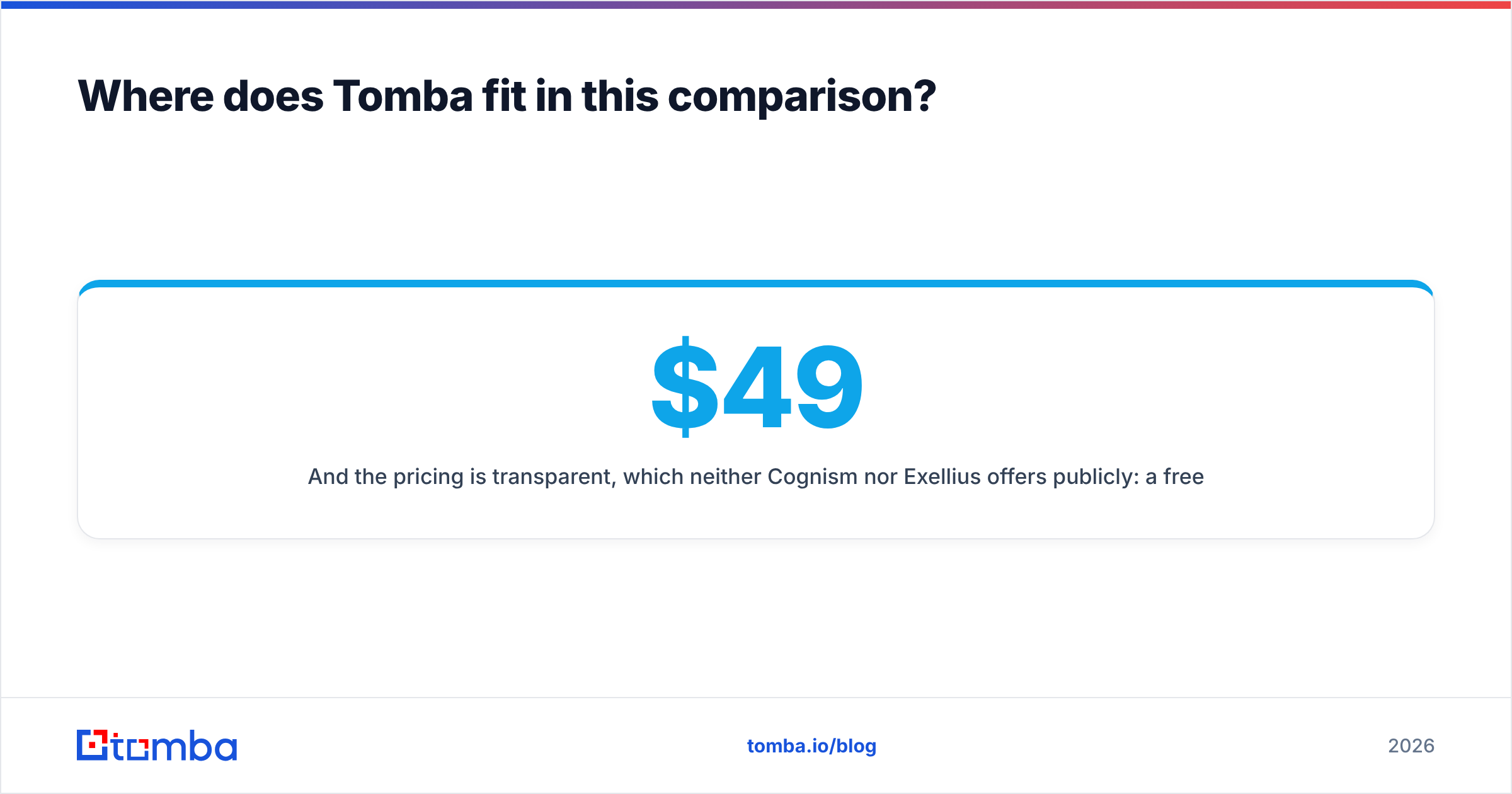
And the pricing is transparent, which neither Cognism nor Exellius offers publicly: a free tier at 25 searches/mo, then $49/mo Starter, $99/mo Growth, $249/mo Pro, and custom Enterprise. You can see the full Tomba pricing without booking a call.
The tradeoff is fair to name: Tomba doesn't sell intent data, org charts, or a managed campaign team. If you need those, Cognism (platform) or Exellius (service) may earn their premium. If you mostly need accurate contact data on demand, paying enterprise rates for capabilities you won't use is the more common mistake.
When should you choose each tool?#
Choose Cognism if you're running high-volume outbound into Europe, you value phone-verified mobiles, you have an ops person to drive the platform, and an annual four-to-five-figure budget is approved. Its compliance documentation and live database justify the price for the right team.
Choose Exellius if you'd rather not operate any tooling and want finished, briefed lists delivered to a spec — a good fit for lean teams or one-off campaigns where hands-off delivery beats self-serve control. Just pin down sourcing and refresh terms in writing.
Choose Tomba if your need is verified emails and contacts on demand, you want to start free, you don't want an annual contract, or you're an engineer embedding contact lookup into automation via API. It's also the natural pick when you already have a CRM and outreach stack and just need the missing data layer to feed them. Compare it directly against other platforms on the Apollo alternative and Clearbit alternative pages if you're mid-evaluation.
A pragmatic combination many teams land on: use Tomba for everyday, self-serve contact sourcing and verification, and layer in a premium platform only for the specific segments (say, EU mobile dials) where the extra spend clearly pays back.
The bottom line#
Cognism and Exellius are both legitimate choices — they just answer different questions. Cognism is the operate-it-yourself platform with the strongest compliance story and premium phone data. Exellius is the brief-it-and-receive-it service for teams who want lists without tooling. Both hide pricing behind a sales call, and both should be tested against your own ICP before you commit a year of budget.
If what you actually need is verified B2B contact data — fast, transparent, and without a contract — start with the Tomba Email Finder. Run your first 25 searches free, verify the results on the spot, and only scale up when the data proves itself against your list. That way the tool earns the upgrade instead of the other way around.
Related guides#
// get started
Find, verify and enrich your first contacts today
Start on the free plan with 25 searches a month, then scale when your team is ready.
Free plan · No credit card required · GDPR & CCPA
// about the author