Cognism vs Leadzenai (2026): Which B2B Data Tool Wins?
Cognism and Leadzenai both promise clean B2B contact data, but they aim at very different buyers. Here's an honest 2026 breakdown of accuracy, pricing, and the cheaper way to get verified emails.
Choosing between Cognism and Leadzenai usually comes down to one uncomfortable question: how much are you willing to pay for contact data before you've even proven the data is good? These two platforms sit on opposite ends of that spectrum. Cognism is the enterprise-grade, compliance-first heavyweight. Leadzenai is the scrappier, AI-branded, budget-friendly challenger. Below is a neutral, numbers-first breakdown so you can pick the right tool without buying the marketing.
TL;DR: Cognism vs Leadzenai at a glance#
- Cognism is built for mid-market and enterprise revenue teams that need phone-verified mobile numbers, GDPR/CCPA compliance, and CRM-native workflows — and can absorb a four-figure annual contract.
- Leadzenai targets solo founders, SMBs, and lead-gen agencies that want cheap bulk data and a lighter learning curve, with looser guarantees on accuracy and coverage.
- Accuracy is where the gap shows: Cognism's phone-verified "Diamond Data" is a genuine differentiator; Leadzenai leans on aggregated public data that ages faster.
- Pricing transparency favors Leadzenai (published plans) over Cognism (quote-only, annual commitments).
- If your real job is simply finding and verifying professional emails at a fair price, a focused tool like Tomba often beats both — you can start free and pay $49/mo instead of committing to an annual seat license.
What is Cognism?#
Cognism is a B2B sales intelligence platform aimed squarely at enterprise and mid-market go-to-market teams. Its reputation rests on two pillars: compliance and phone-verified mobile data.
On compliance, Cognism markets itself as GDPR- and CCPA-aligned, with notification and do-not-call list screening across major European markets — a real concern if you're prospecting into the UK or EU. On data, its flagship "Diamond Verified" phone numbers are human-checked, which materially raises connect rates for cold-calling teams. You can read the specifics on the Cognism website, but the short version is: this is a premium, dialer-first dataset.
Cognism also integrates deeply with Salesforce, HubSpot, Outreach, and Salesloft, and layers on intent data (via Bombora) and sales-trigger events. That makes it less of a lookup tool and more of a full revenue operations data layer.
The trade-off is cost and commitment. Cognism is quote-only, sold as annual contracts, and typically lands in the multi-thousand-dollar range per year. For a well-funded team that lives on the phone, that can pay for itself. For a two-person startup, it's overkill.
What is Leadzenai?#
Leadzenai (stylized LeadzenAI) is a lead-generation and B2B data platform that positions itself as an AI-powered, affordable alternative to the big enterprise players. Its pitch is breadth and price: pull company and contact records, find emails and phone numbers, and export lists without a sales call or an annual lock-in.
Where Cognism sells depth and verification, Leadzenai sells accessibility. Published plans, self-serve signup, and bulk export appeal to agencies, recruiters, and founders who need volume more than they need guaranteed mobile accuracy. The "AI" branding mostly refers to enrichment and search ranking rather than any radically different data-sourcing method.
The honest caveat: aggregated data platforms in this tier tend to source heavily from public web scraping and third-party feeds, which means coverage is wide but freshness varies. You'll want to run any list through an email verifier before you send, regardless of what the dashboard claims.

How accurate is the data — Cognism vs Leadzenai?#
Accuracy is the single most important axis, because bad data doesn't just waste time — it damages your sender reputation when bounces pile up.
Cognism invests in verification. Its Diamond phone numbers are human-validated, and email records are refreshed on a regular cadence. In independent reviews on G2, Cognism consistently scores well on data quality, particularly for European mobile numbers — a segment where most US-centric providers are thin.
Leadzenai offers respectable coverage for the price, but its accuracy is more variable. Because more of its data comes from aggregated and scraped sources, records go stale faster and catch-all domains are less reliably flagged. That's not a dealbreaker for high-volume outreach where you expect to filter — but it does mean verification is non-optional.

A practical middle path: use either platform for discovery, then verify every address through a dedicated tool. Running a list through a catch-all verifier before a campaign routinely strips out 10–20% of addresses that would have bounced.
Cognism vs Leadzenai: side-by-side comparison#
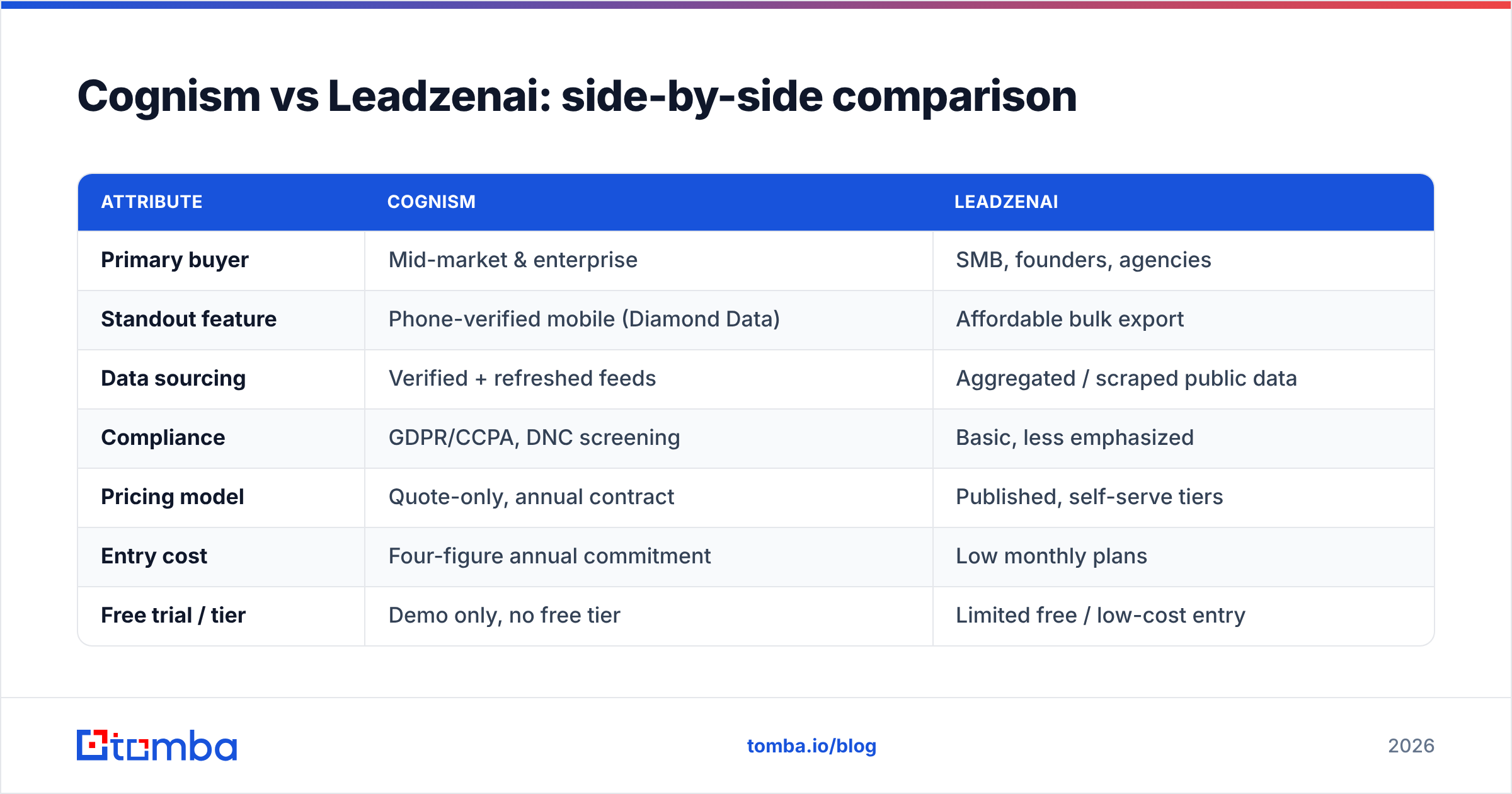
Here's the head-to-head on the attributes that actually change your buying decision.
| Attribute | Cognism | Leadzenai |
|---|---|---|
| Primary buyer | Mid-market & enterprise | SMB, founders, agencies |
| Standout feature | Phone-verified mobile (Diamond Data) | Affordable bulk export |
| Data sourcing | Verified + refreshed feeds | Aggregated / scraped public data |
| Compliance | GDPR/CCPA, DNC screening | Basic, less emphasized |
| Pricing model | Quote-only, annual contract | Published, self-serve tiers |
| Entry cost | Four-figure annual commitment | Low monthly plans |
| Free trial / tier | Demo only, no free tier | Limited free / low-cost entry |
| Best for | Cold-calling & EU prospecting | High-volume list building |
| Verification built in | Strong | Weaker — verify externally |
Which should you choose — and when?#
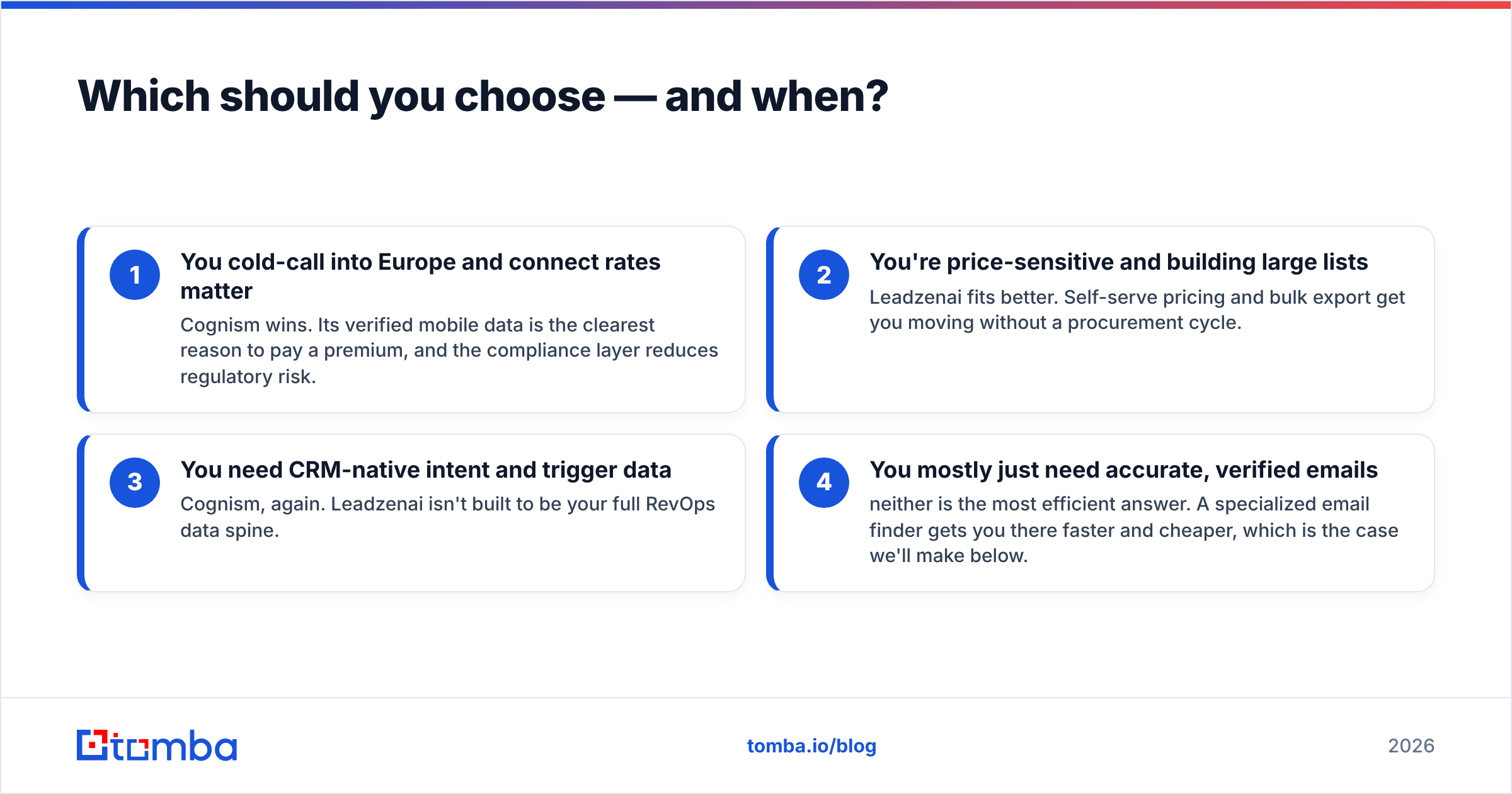
The decision usually breaks along four lines. Use these as a quick filter:
- You cold-call into Europe and connect rates matter — Cognism wins. Its verified mobile data is the clearest reason to pay a premium, and the compliance layer reduces regulatory risk.
- You're price-sensitive and building large lists — Leadzenai fits better. Self-serve pricing and bulk export get you moving without a procurement cycle.
- You need CRM-native intent and trigger data — Cognism, again. Leadzenai isn't built to be your full RevOps data spine.
- You mostly just need accurate, verified emails — neither is the most efficient answer. A specialized email finder gets you there faster and cheaper, which is the case we'll make below.
Is there a cheaper alternative to both?#
Yes — if your core need is finding and verifying professional email addresses rather than buying a full enterprise data suite, a focused finder-and-verifier stack is dramatically cheaper and often just as accurate for email specifically.
This is where Tomba fits. Instead of a quote-only annual contract (Cognism) or a broad-but-variable aggregated dataset (Leadzenai), Tomba does a few things extremely well and prices them in the open:
- Email finder — find professional emails by name, company, or domain search.
- Email verifier + catch-all handling — verify before you send, so bounces stay low.
- Bulk + API — the Tomba API and bulk tools handle list-scale work without an enterprise license.
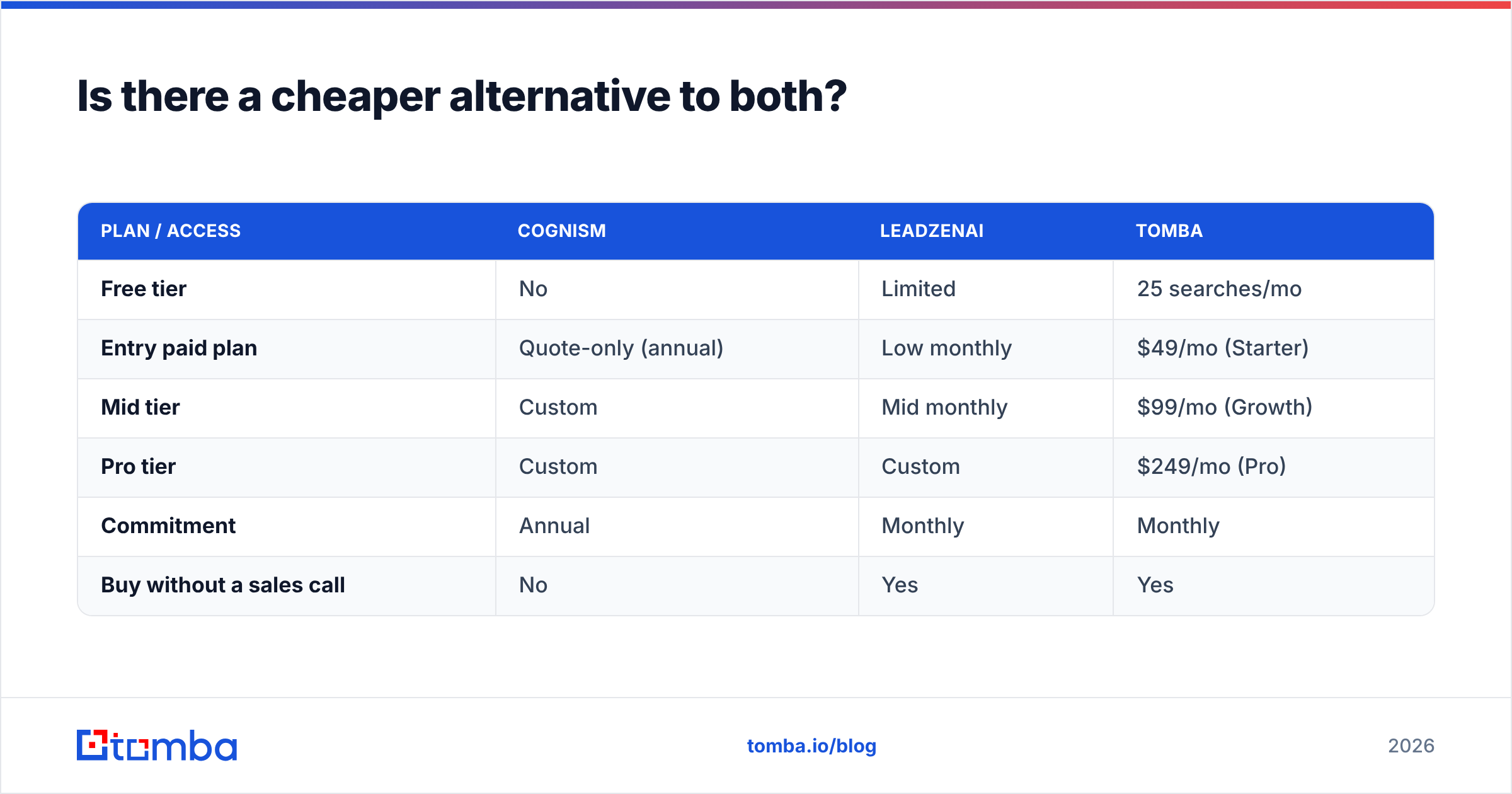
Here's how the pricing philosophy compares:
| Plan / Access | Cognism | Leadzenai | Tomba |
|---|---|---|---|
| Free tier | No | Limited | 25 searches/mo |
| Entry paid plan | Quote-only (annual) | Low monthly | $49/mo (Starter) |
| Mid tier | Custom | Mid monthly | $99/mo (Growth) |
| Pro tier | Custom | Custom | $249/mo (Pro) |
| Commitment | Annual | Monthly | Monthly |
| Buy without a sales call | No | Yes | Yes |
You can see the full breakdown on the Tomba pricing page. The point isn't that Tomba replaces every Cognism feature — it won't hand you human-verified EU mobile numbers or Bombora intent. The point is that a large share of teams buying Cognism or Leadzenai are, in practice, paying for email discovery and verification wrapped in features they rarely touch.
What do real users say?#
Patterns from public reviews on G2 and Capterra are consistent:
- Cognism praise: European mobile accuracy, connect rates, compliance confidence. Cognism gripes: price, annual lock-in, credit limits, and pressure-heavy sales cycles.
- Leadzenai praise: affordability, ease of onboarding, decent coverage for the cost. Leadzenai gripes: data freshness, occasional stale or missing records, thinner support.
Neither pattern is disqualifying. They just map to the buyer profiles above: pay more for verified depth, or pay less for accessible breadth.
How to test either tool before committing#
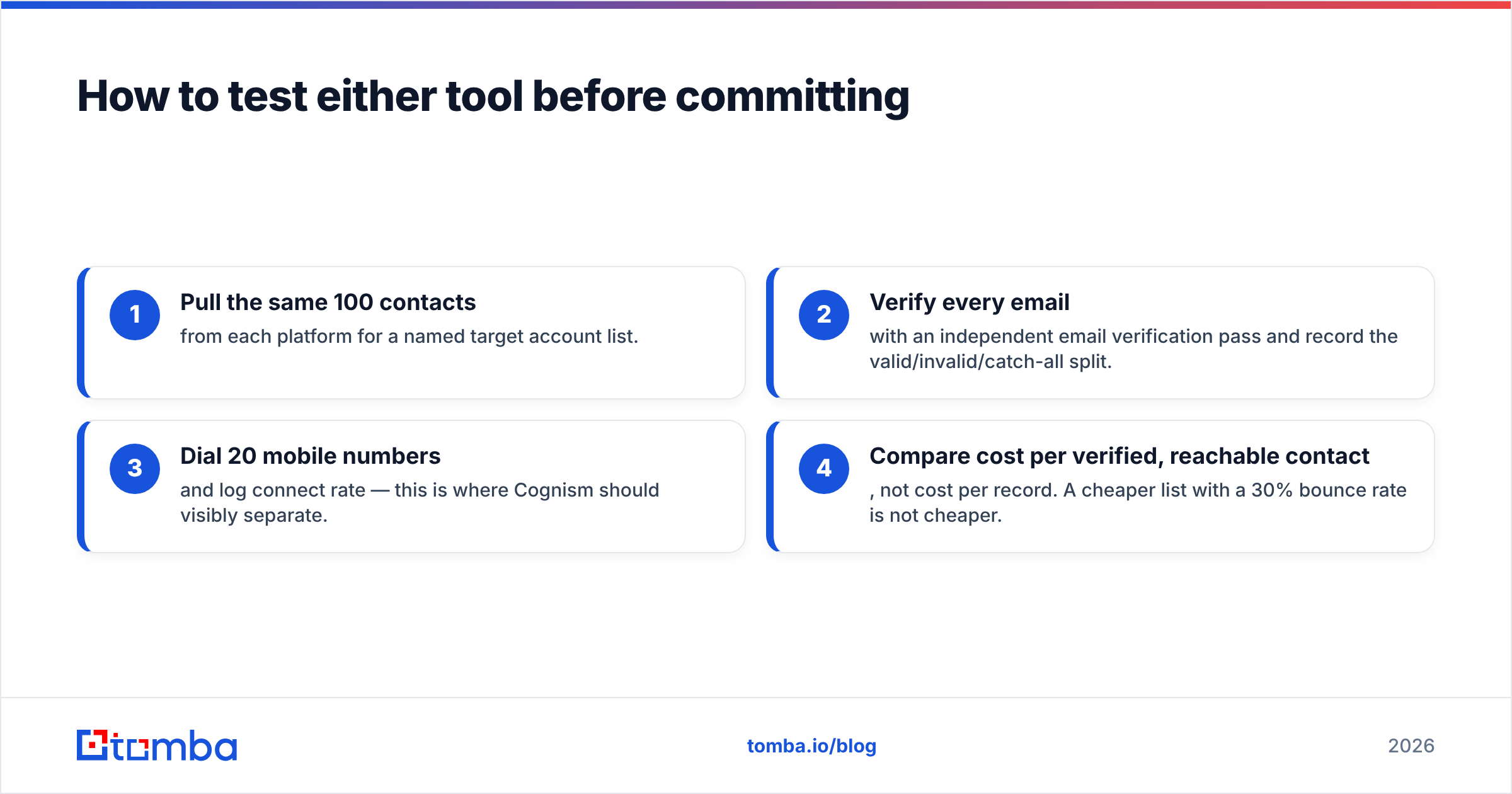
Don't buy on the demo alone. Run a controlled bake-off:
- Pull the same 100 contacts from each platform for a named target account list.
- Verify every email with an independent email verification pass and record the valid/invalid/catch-all split.
- Dial 20 mobile numbers and log connect rate — this is where Cognism should visibly separate.
- Compare cost per verified, reachable contact, not cost per record. A cheaper list with a 30% bounce rate is not cheaper.
That last metric — cost per usable contact — is the one that reframes most Cognism-vs-Leadzenai debates and, frequently, points toward a leaner finder-plus-verifier setup.
Final verdict#
Pick Cognism if you're an enterprise or mid-market team that cold-calls into Europe, needs compliance cover, and can justify an annual contract. Its verified mobile data is a real, defensible advantage.
Pick Leadzenai if you're budget-constrained, building lists at volume, and comfortable running your own verification pass on top of aggregated data.
Pick a focused tool like Tomba if your actual job is finding and verifying professional emails — you'll skip the annual commitment, start free, and pay a fraction of enterprise pricing for the part you use most.
Get verified B2B emails without the enterprise contract#
If you've read this far, your need is probably more specific than "an enterprise data platform." You need accurate emails you can trust and verify before you hit send — without a sales call or an annual seat license. Start with the Tomba Email Finder: search by name, company, or domain, verify results in the same workflow, and scale through the API when you're ready. The free tier gives you 25 searches a month to run your own bake-off against Cognism and Leadzenai — test it on your real target accounts before you spend a dollar.
Related guides#
Ready to find emails that actually work?
Join 150,000+ professionals who stopped guessing and started sending. Free credits on signup — no credit card required.
Get the Tomba newsletter
Practical outbound tactics and product updates — once every two weeks.
About the author