Cognism vs Webbula: B2B Data and Email Verification Compared
Cognism sells global B2B contact intelligence; Webbula sells email hygiene and verification. They solve different problems. Here's which one your team actually needs in 2026 — and where a leaner tool fits.
Most "Cognism vs Webbula" searches start from a wrong assumption: that these two platforms compete for the same job. They don't. Cognism is a B2B sales-intelligence engine that finds and enriches contacts at scale. Webbula is an email-hygiene and data-quality specialist that cleans and verifies the contacts you already have. Comparing them head-to-head is like comparing a fishing boat to a water-filtration plant — both touch water, but you buy them for opposite reasons.
This guide breaks down what each tool actually does, where they overlap, what they cost, and how to decide which one belongs in your stack in 2026. And because most teams over-buy on both fronts, we'll show where a focused email finder and verifier does 80% of the job for a fraction of the price.
TL;DR#
- Cognism is a global B2B prospecting and enrichment platform — phone-verified mobile numbers, intent data, and GDPR/CCPA-conscious coverage. You buy it to find buyers.
- Webbula is an email-verification and data-hygiene provider — multi-point validation, fraud and bot detection, demographic appends. You buy it to clean lists.
- They are complementary, not interchangeable: Cognism sources data, Webbula scrubs it. Many enterprises run both.
- Both are premium, annual-contract, "talk to sales" products. Neither publishes simple monthly pricing.
- If you mostly need accurate work emails plus verification without a five-figure commitment, a tool like Tomba Email Finder with a built-in email verifier covers the core need at a transparent price.
What is Cognism?#
Cognism is a sales-intelligence platform built for outbound teams that need to build and enrich pipeline across regions. Its pitch centers on Diamond Data — phone numbers that have been human-verified so reps waste less time on dead dials — plus strong coverage in EMEA where many US-first databases go thin.
Core capabilities:
- Contact and company search with firmographic, technographic, and role-based filters.
- Phone-verified mobile numbers for direct dials, a major differentiator versus scraped-only databases.
- Intent data (via Bombora) to prioritize accounts showing buying signals.
- CRM and sequencer enrichment — push clean records into Salesforce, HubSpot, Outreach, and Salesloft.
- Compliance posture tuned for GDPR/CCPA, including notified-jurisdiction checks against Do-Not-Call lists.
In short, Cognism sits at the top of the funnel. You use it to answer "who should we contact, and how do we reach them?" You can read more on the Cognism site, and independent reviews are aggregated on G2.

What is Webbula?#
Webbula is a data-quality company whose flagship is email verification and hygiene. Instead of finding new contacts, Webbula's job is to make sure the addresses you send to are real, safe, and unlikely to torch your sender reputation.
Core capabilities:
- Multi-point email validation — syntax, domain, MX, and mailbox-level checks.
- Threat and fraud detection — flags spam traps, honeypots, bots, complainers, and known malicious addresses that verification-only tools miss.
- Demographic and firmographic appends — enrich a cleaned list with additional data points.
- Deliverability protection — the real goal is keeping your bounce rate low and your domain off blocklists.
Webbula is a bottom-of-the-hygiene-funnel tool. It answers "is this list safe to send to, and what will it do to my deliverability?" Details are on the Webbula site.
Cognism vs Webbula: how do they actually differ?#
The cleanest way to see the gap is by primary job. One acquires data; the other defends data quality.
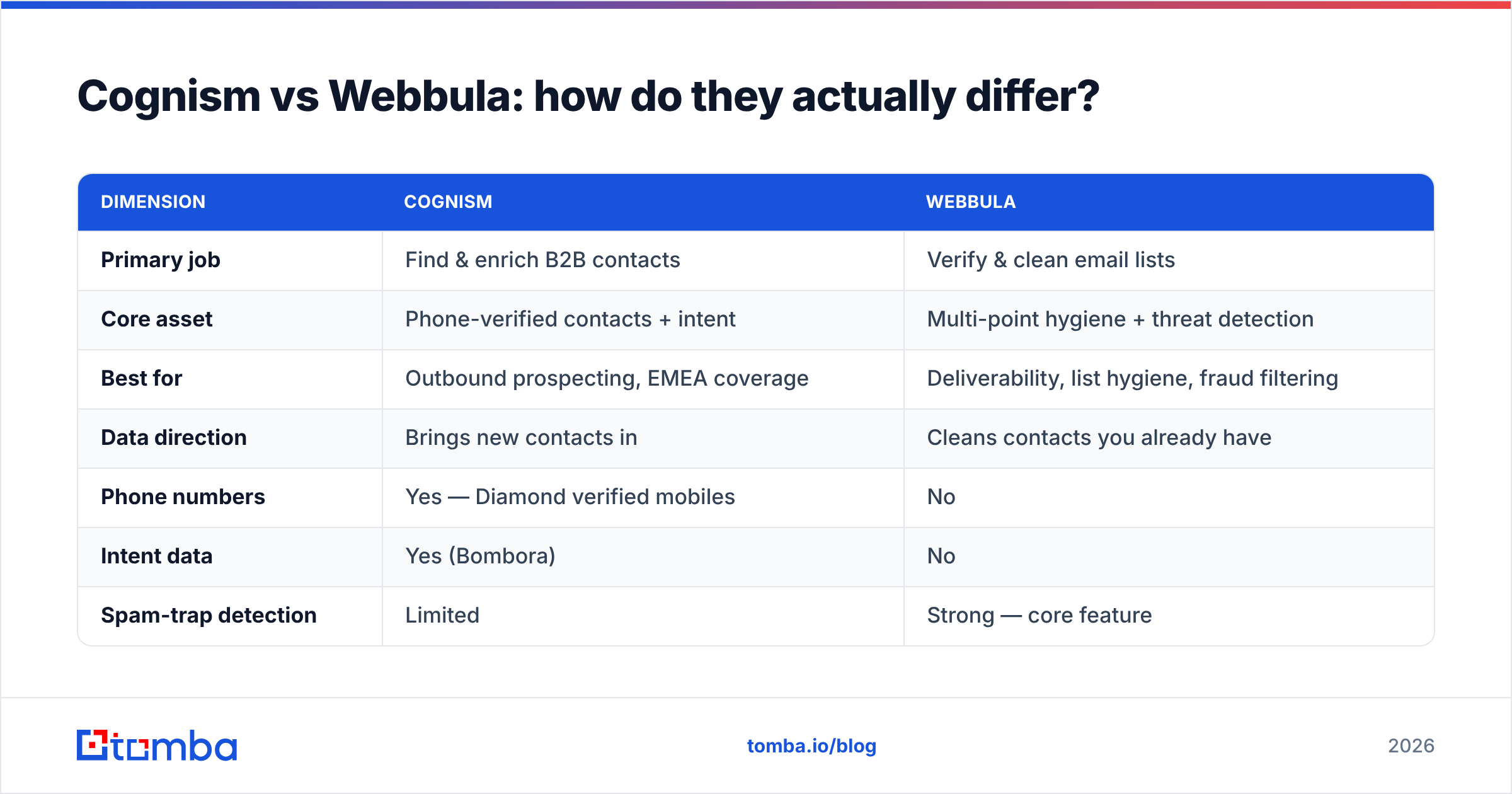
| Dimension | Cognism | Webbula |
|---|---|---|
| Primary job | Find & enrich B2B contacts | Verify & clean email lists |
| Core asset | Phone-verified contacts + intent | Multi-point hygiene + threat detection |
| Best for | Outbound prospecting, EMEA coverage | Deliverability, list hygiene, fraud filtering |
| Data direction | Brings new contacts in | Cleans contacts you already have |
| Phone numbers | Yes — Diamond verified mobiles | No |
| Intent data | Yes (Bombora) | No |
| Spam-trap detection | Limited | Strong — core feature |
| Pricing model | Annual, quote-based | Annual/volume, quote-based |
| Typical buyer | SDR/AE teams, RevOps | Email marketers, deliverability teams |
Read that table twice and the "versus" framing dissolves. If your bounce rate is fine but your pipeline is empty, Webbula won't help you. If your database is huge but half of it hard-bounces, Cognism isn't the fix. The honest answer for many teams is "neither alone" — or "both, in sequence."
Is Cognism better than Webbula?#
Cognism is better if your problem is sourcing. When reps can't find valid mobile numbers, when you're expanding into European markets, or when you want intent signals to prioritize accounts, Cognism's data depth justifies its premium. It's a growth-engine purchase.
Webbula is better if your problem is hygiene. When you've bought lists from mixed sources, when your open rates are cratering because of spam traps, or when compliance requires you to prove list quality, Webbula's threat detection is genuinely differentiated — it catches risks that a plain syntax-and-MX verifier waves through.
Neither "wins" in the abstract. The right question isn't "which is better" but "which failure is currently costing me money?" Map it:
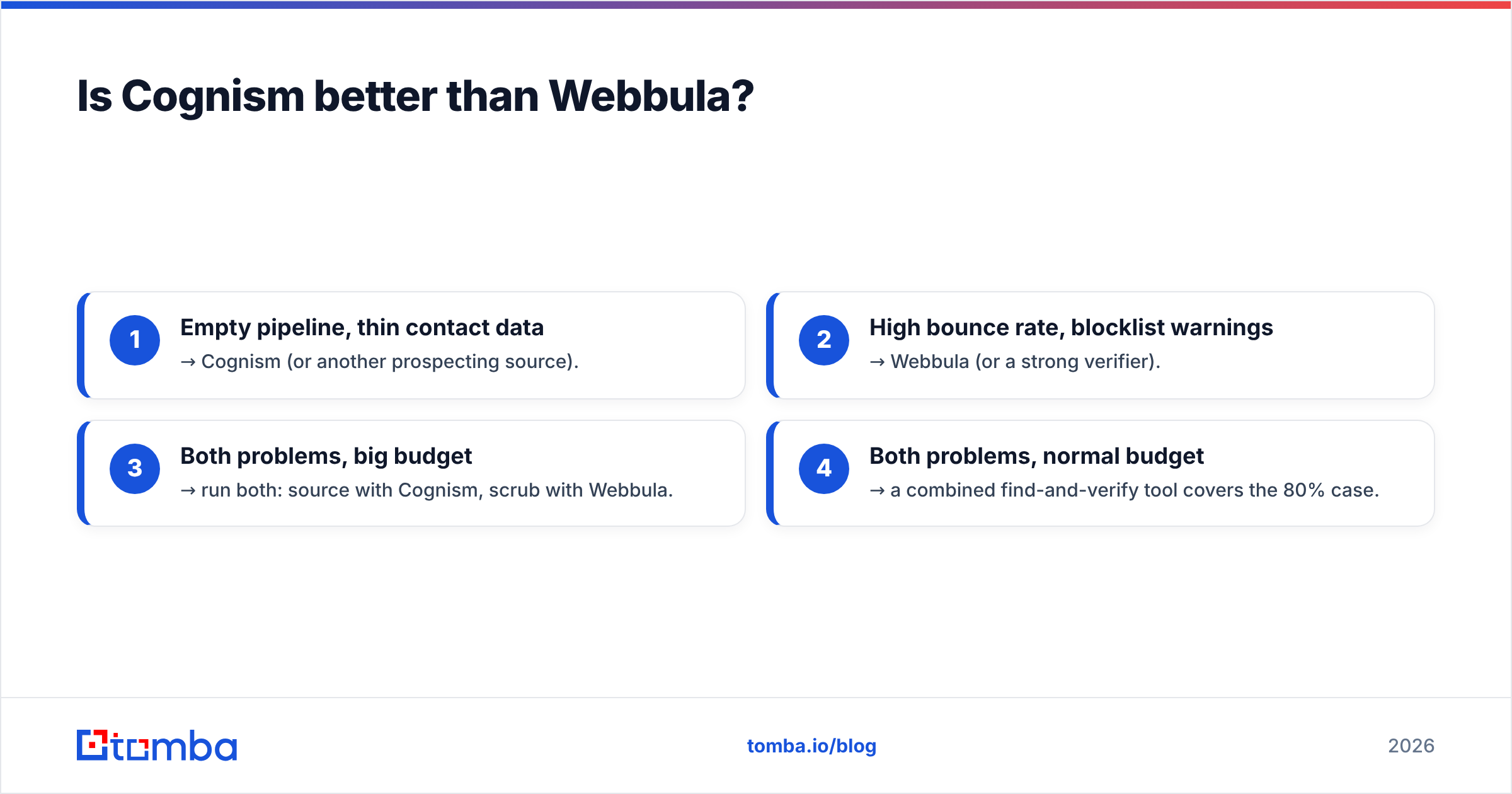
- Empty pipeline, thin contact data → Cognism (or another prospecting source).
- High bounce rate, blocklist warnings → Webbula (or a strong verifier).
- Both problems, big budget → run both: source with Cognism, scrub with Webbula.
- Both problems, normal budget → a combined find-and-verify tool covers the 80% case.
That fourth path is where most SMB and mid-market teams actually live, and it's the one neither premium vendor is priced for.
What do Cognism and Webbula cost?#
Neither publishes transparent pricing, and both steer you toward annual contracts through a sales rep. That's the norm for enterprise data — but it's also the friction point that sends smaller teams looking elsewhere.
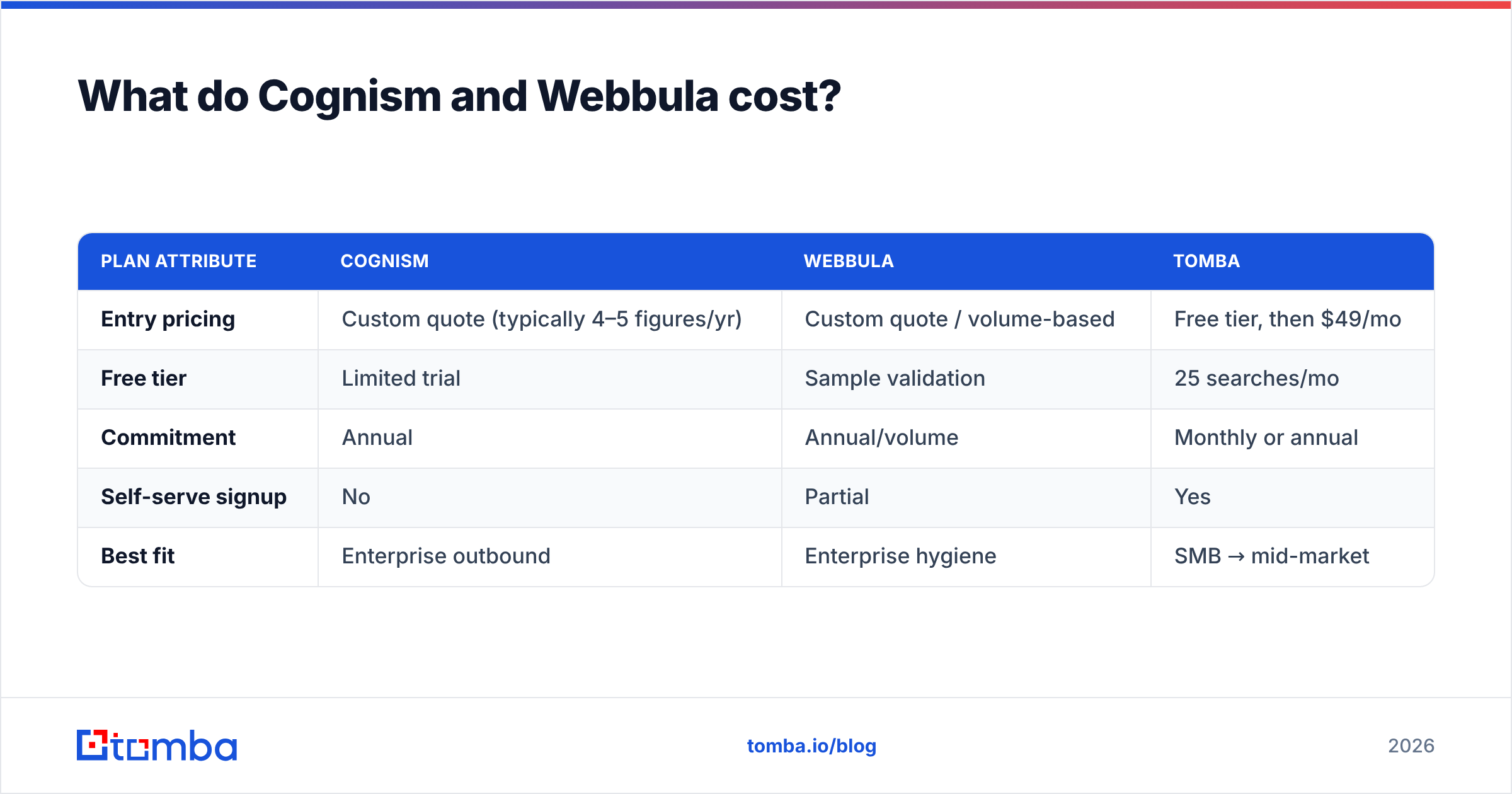
| Plan attribute | Cognism | Webbula | Tomba |
|---|---|---|---|
| Entry pricing | Custom quote (typically 4–5 figures/yr) | Custom quote / volume-based | Free tier, then $49/mo |
| Free tier | Limited trial | Sample validation | 25 searches/mo |
| Commitment | Annual | Annual/volume | Monthly or annual |
| Self-serve signup | No | Partial | Yes |
| Best fit | Enterprise outbound | Enterprise hygiene | SMB → mid-market |
Cognism's list-price reputation puts most seats well into five figures annually, often with platform fees layered on. Webbula prices on volume and use case. Both are defensible for large teams — but if you're a founder, a small SDR pod, or a marketer who just needs clean, findable emails, the annual-lock model is a poor fit. You can compare that against transparent Tomba pricing in about ten seconds, no call required.

Can one simpler tool replace both?#
For a large slice of teams, yes — because the core of both jobs is "get an accurate email address and confirm it's valid." That's exactly the workflow a modern email finder plus verifier handles end to end.
Here's how the combined need maps to a leaner stack:
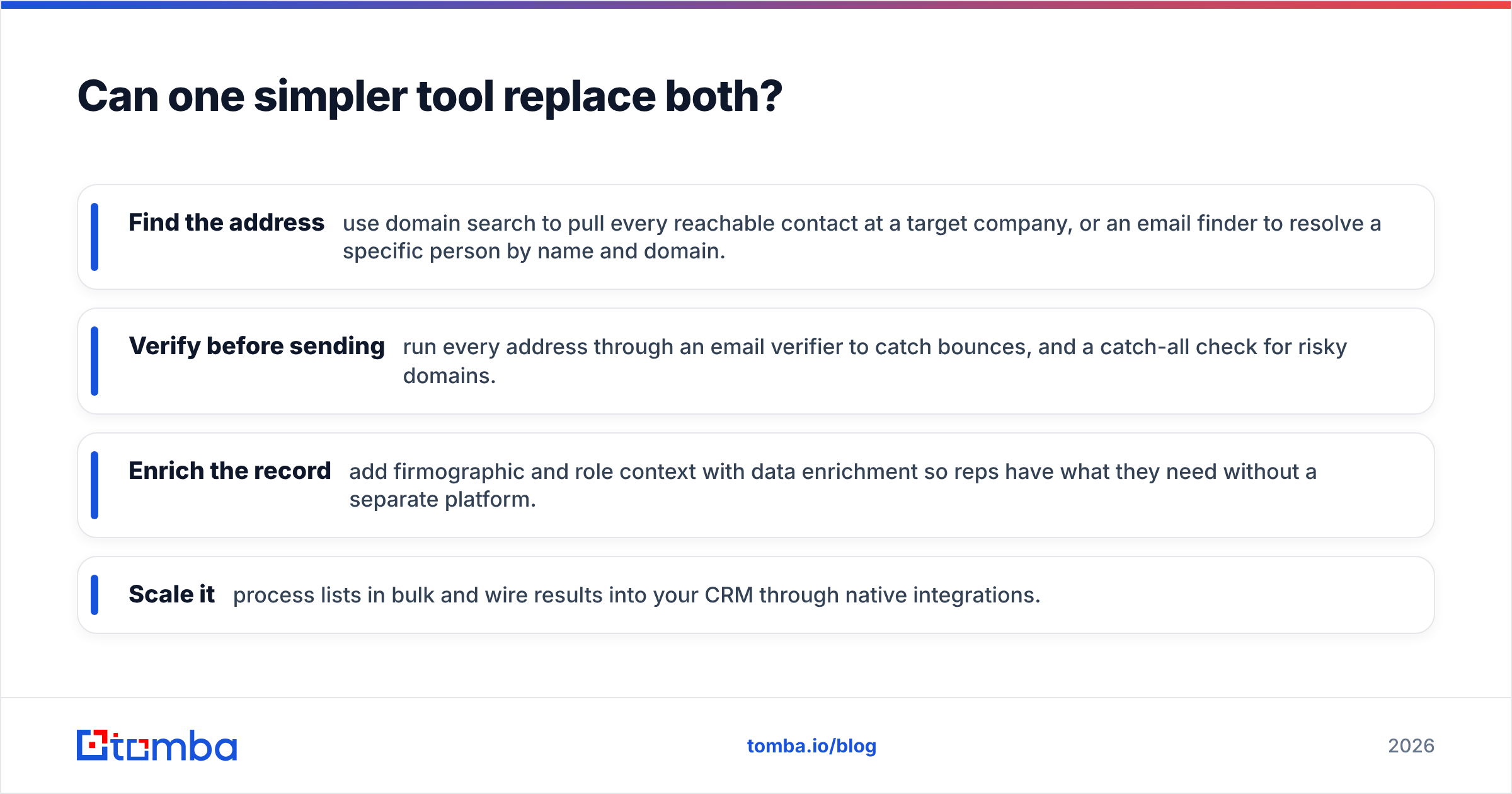
- Find the address — use domain search to pull every reachable contact at a target company, or an email finder to resolve a specific person by name and domain.
- Verify before sending — run every address through an email verifier to catch bounces, and a catch-all check for risky domains.
- Enrich the record — add firmographic and role context with data enrichment so reps have what they need without a separate platform.
- Scale it — process lists in bulk and wire results into your CRM through native integrations.
This won't replace Cognism's phone-verified mobiles or Bombora intent, and it won't replicate Webbula's dedicated spam-trap threat graph. Those are specialist strengths. But for teams whose real requirement is "accurate B2B emails I can actually send to," a single affordable tool removes two premium line items.
Where the specialist features genuinely matter — dedicated dialing at scale, deep deliverability forensics, regulated-industry fraud filtering — the premium tools earn their price. Be honest with yourself about which bucket you're in.
Cognism vs Webbula: which should you choose in 2026?#
Choose based on the job in front of you, not the brand:
- Pick Cognism if you're an outbound org that lives on phone connect rates, needs strong EMEA data, and wants intent-based account prioritization — and you can commit to an annual contract.
- Pick Webbula if you're an email marketer or deliverability lead whose primary risk is bounces, spam traps, and blocklists, and you need enterprise-grade hygiene with threat detection.
- Pick both if you're a large GTM team that sources at volume and must protect sender reputation — Cognism upstream, Webbula downstream.
- Pick a focused finder + verifier if you want accurate emails and clean verification without a five-figure commitment, monthly flexibility, and self-serve access.
The mistake to avoid is buying a top-of-funnel intelligence platform to solve a hygiene problem, or a hygiene platform to solve a pipeline problem. Diagnose the bottleneck first. The tools are excellent at their real jobs and mediocre at each other's.
The bottom line#
Cognism and Webbula aren't rivals — they're neighbors on the data supply chain. Cognism brings buyers to your door; Webbula makes sure the mail actually reaches them. Enterprises with budget and volume can justify running both. Everyone else is better served matching spend to the one problem that's actually costing them deals.
If that problem is simply "I need real, verified B2B email addresses without an annual enterprise contract," start with Tomba Email Finder. You get accurate work emails by name or domain, built-in verification to keep bounce rates low, and a B2B database to work from — on a free tier first, then plans from $49/mo with no sales call. Find, verify, and send from one place, and add a specialist tool later only if a specialist problem shows up.
Related guides#
// get started
Find, verify and enrich your first contacts today
Start on the free plan with 25 searches a month, then scale when your team is ready.
Free plan · No credit card required · GDPR & CCPA
// about the author