Cold Call Appointment Setting Script: A 2026 Playbook
A word-for-word cold call appointment setting script, plus objection rebuttals, voicemail templates, and the metrics that tell you whether your calls are actually working.
Most cold calls die in the first ten seconds — not because the product is wrong, but because the rep opened with a monologue instead of a reason to keep listening. A cold call appointment setting script fixes that by giving you a repeatable structure: earn attention, create relevance, handle the reflex objection, and ask for a specific time. This playbook gives you the exact words, the branches, and the numbers to judge whether it works.
TL;DR#
- A cold call appointment setting script is a structured call flow whose only goal is booking a qualified meeting — not closing, not demoing, not pitching every feature.
- The winning structure is five beats: pattern interrupt → permission → relevance hook → objection rebuttal → specific ask.
- Scripts should be frameworks with branches, not word-for-word robots. Read the room, keep the beats.
- Objection handling is where meetings are won: expect "not interested," "send me an email," and "we already use someone."
- Garbage data kills good scripts. Wrong numbers and dead lines waste 30–40% of dial time — verify contacts before you dial.
What Is a Cold Call Appointment Setting Script?#
A cold call appointment setting script is a planned sequence of talking points that moves a stranger from "who is this?" to "okay, Thursday at 2 works." Think of it like a pilot's pre-flight checklist: pilots are experts, but they still read the checklist every single flight because the cost of forgetting one item is catastrophic. Your script is the checklist that stops you from forgetting to state a reason for the call or forgetting to actually ask for the meeting.
The critical distinction: an appointment-setting script is not a sales script. You are not selling the product on the phone. You are selling the next fifteen minutes of the prospect's calendar. That single reframing changes every word you say — you drop the feature dump, you drop the pricing talk, and you focus entirely on earning a meeting.
According to HubSpot's sales research, it takes an average of multiple touches to reach a prospect, and the calls that convert are the ones that respect the prospect's time and lead with relevance. A script is how you make relevance repeatable across hundreds of dials.
Why Do You Need a Script at All?#
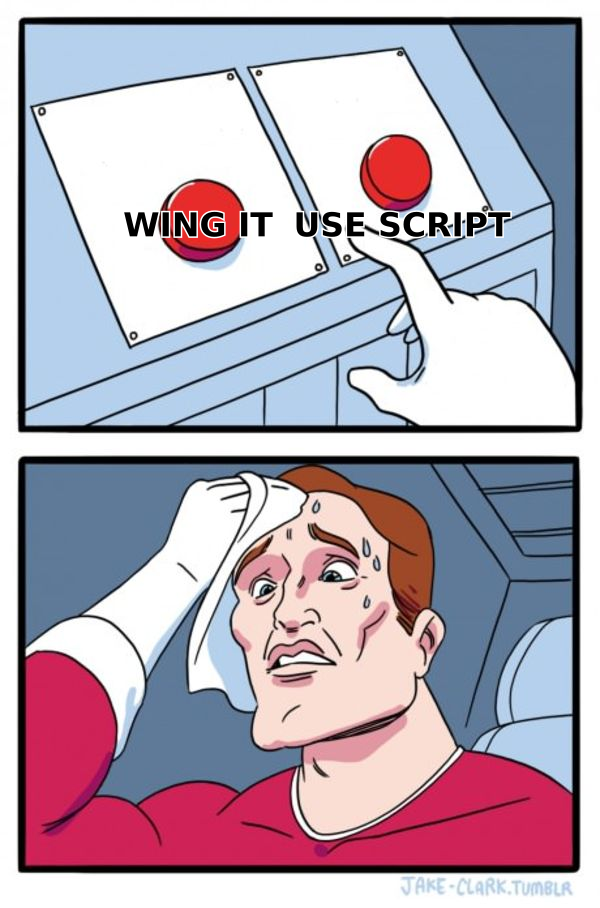
Reps resist scripts because they fear sounding robotic. But the data disagrees with the fear. Structure beats improvisation for three reasons:
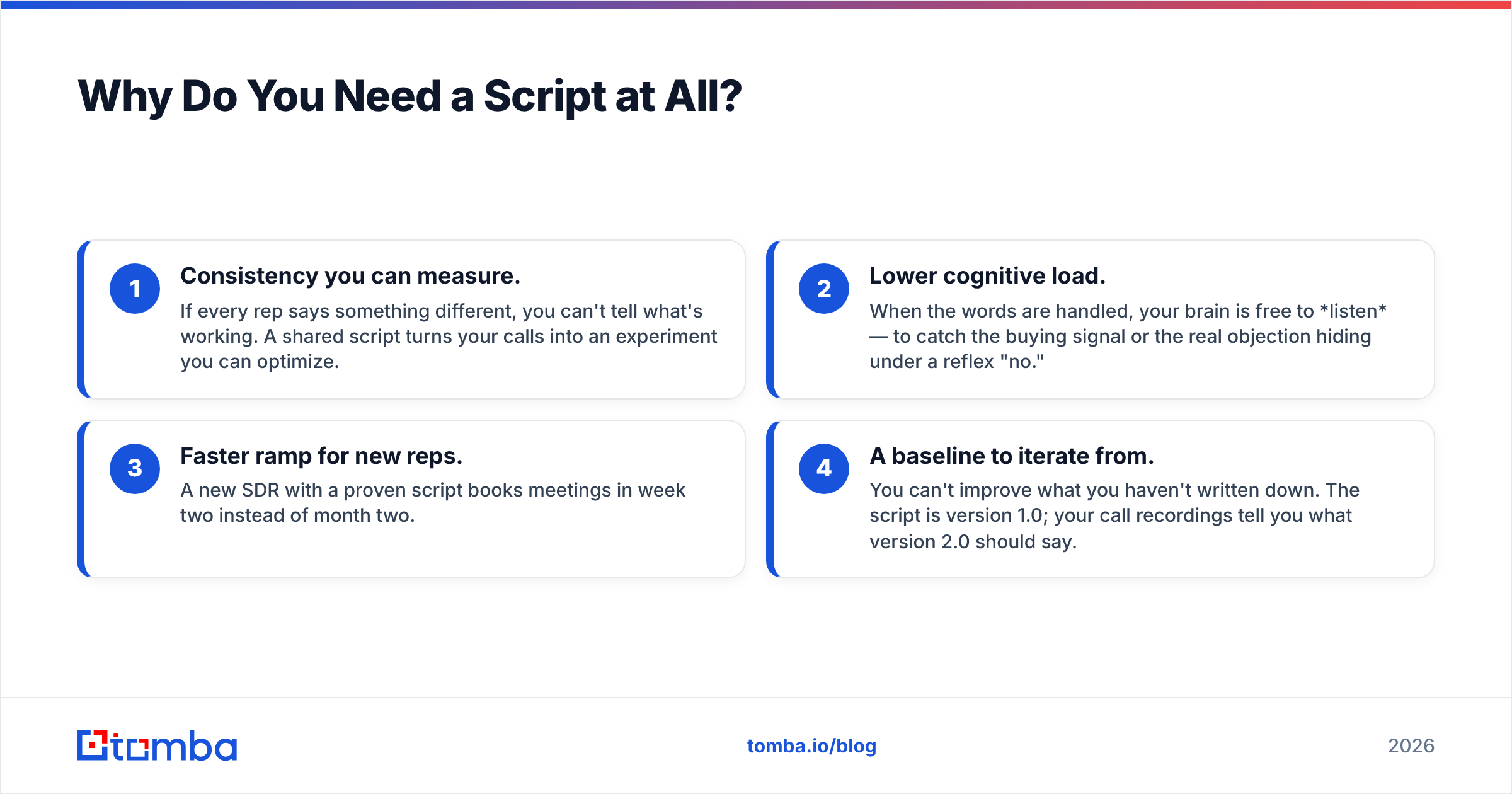
- Consistency you can measure. If every rep says something different, you can't tell what's working. A shared script turns your calls into an experiment you can optimize.
- Lower cognitive load. When the words are handled, your brain is free to listen — to catch the buying signal or the real objection hiding under a reflex "no."
- Faster ramp for new reps. A new SDR with a proven script books meetings in week two instead of month two.
- A baseline to iterate from. You can't improve what you haven't written down. The script is version 1.0; your call recordings tell you what version 2.0 should say.
The goal is not to sound scripted. The goal is to internalize the structure so thoroughly that you sound natural because you're not scrambling for words.
What Are the Five Parts of a Cold Call Appointment Setting Script?#
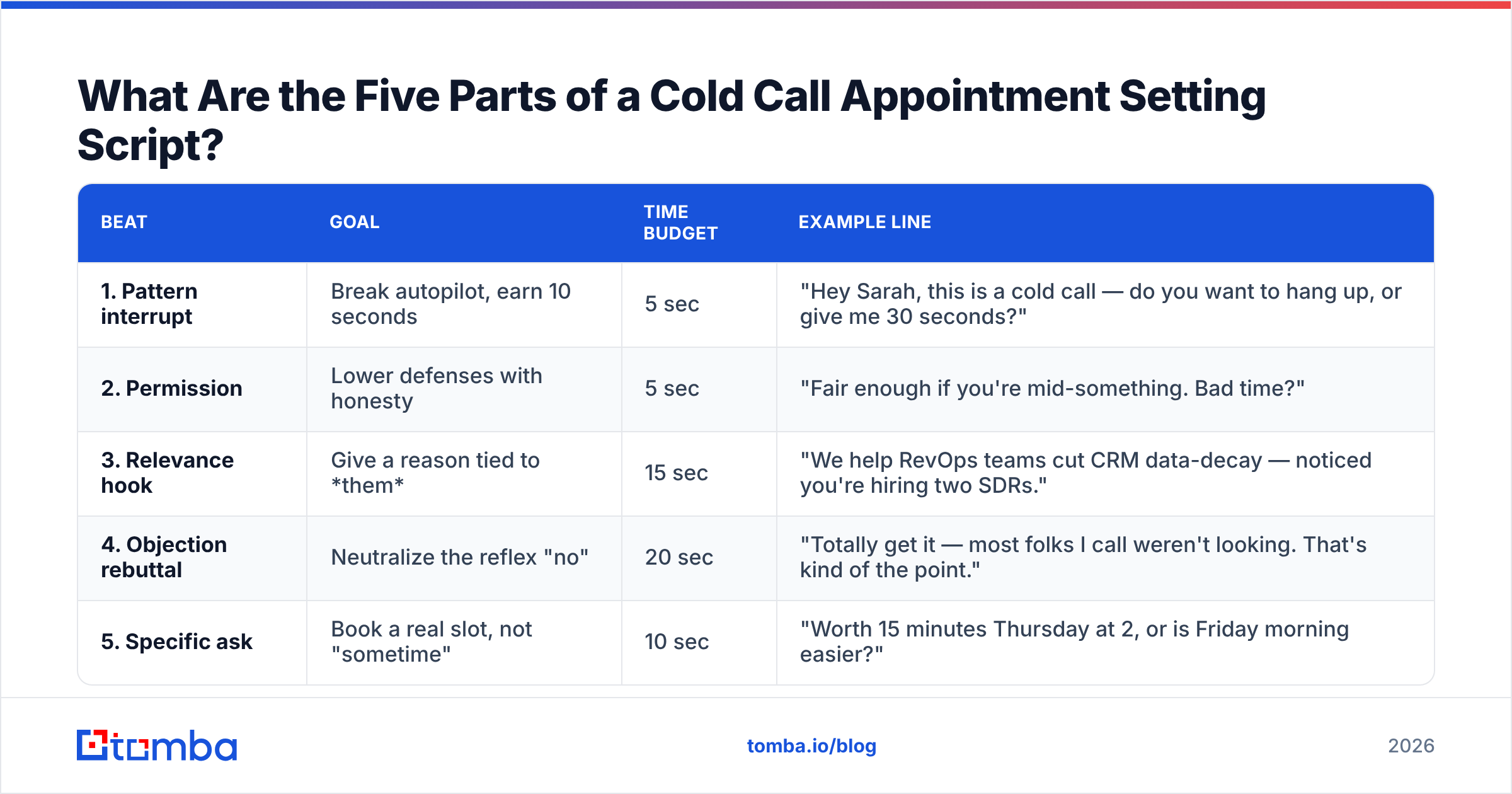
Every high-performing appointment script follows the same five-beat spine. Memorize the beats, not the sentences.
| Beat | Goal | Time budget | Example line |
|---|---|---|---|
| 1. Pattern interrupt | Break autopilot, earn 10 seconds | 5 sec | "Hey Sarah, this is a cold call — do you want to hang up, or give me 30 seconds?" |
| 2. Permission | Lower defenses with honesty | 5 sec | "Fair enough if you're mid-something. Bad time?" |
| 3. Relevance hook | Give a reason tied to them | 15 sec | "We help RevOps teams cut CRM data-decay — noticed you're hiring two SDRs." |
| 4. Objection rebuttal | Neutralize the reflex "no" | 20 sec | "Totally get it — most folks I call weren't looking. That's kind of the point." |
| 5. Specific ask | Book a real slot, not "sometime" | 10 sec | "Worth 15 minutes Thursday at 2, or is Friday morning easier?" |
Notice what's missing: no elevator pitch, no feature list, no "we're the leading platform for..." The prospect does not care yet. Your only job is to trade a genuine, relevant reason for a specific slot on the calendar.
The Full Cold Call Appointment Setting Script (Word for Word)#
Here is the complete flow you can adapt today. Bracketed text is your branch logic.
Opener:
"Hi [First Name], it's [Your Name] from [Company]. I'll be honest — this is a cold call. Do you want to hang up, or can I have thirty seconds to tell you why I called, and you decide from there?"
Most prospects will chuckle and say "go ahead." The honesty disarms them because it's the opposite of what every other caller does.
Relevance hook:
"Appreciate it. I'm reaching out because I saw [specific trigger — a hire, a funding round, a tech-stack change]. We work with [similar role/company] to [concrete outcome, e.g. 'stop paying reps to dial dead phone numbers']. Companies like [reference] saw [specific result]."
Trial close / the ask:
"I don't know yet if we're a fit — that's exactly why I'd love fifteen minutes to find out. Are you around Thursday at 2, or would Friday morning work better?"
The "or" question is deliberate. You never ask "would you be open to a meeting?" (a yes/no that invites "no"). You ask which time, presupposing the meeting.
Voicemail (because 80% of calls go to voicemail):
"Hi [First Name], [Your Name] from [Company]. I called about [specific trigger] — I have an idea I think is worth fifteen minutes for your team. I'll follow up by email, but you can reach me at [number]. Thanks, [First Name]."
Keep it under 20 seconds, name-drop the trigger, and always pair the voicemail with an email. For the written follow-up, a tested cold email template turns the voicemail into a two-channel touch instead of a one-shot miss.
How Do You Handle the Three Big Objections?#
Meetings are won in the objection handling, not the opener. Ninety percent of objections are reflexes, not real reasons. Acknowledge, reframe, and redirect to the ask.
"I'm not interested."
"That's fair — you'd have to be interested in something you've never heard of, and you haven't yet. All I'm asking for is fifteen minutes to show you what [outcome] looks like. If it's not relevant, you'll never hear from me again. Thursday at 2?"
"Just send me an email."
"Happy to — what's the best address? And so I don't send you a generic wall of text, can I ask one quick question: is [pain point] something your team's dealing with right now, or are you already sorted?"
This turns a brush-off into a two-way conversation. Whatever they answer, you've re-opened the call.
"We already use [competitor]."
"Makes sense — most teams I talk to already have something. I'm not calling to rip that out. Teams usually add us alongside it when they want [specific gap the incumbent leaves]. Worth a fifteen-minute look so you can judge for yourself?"
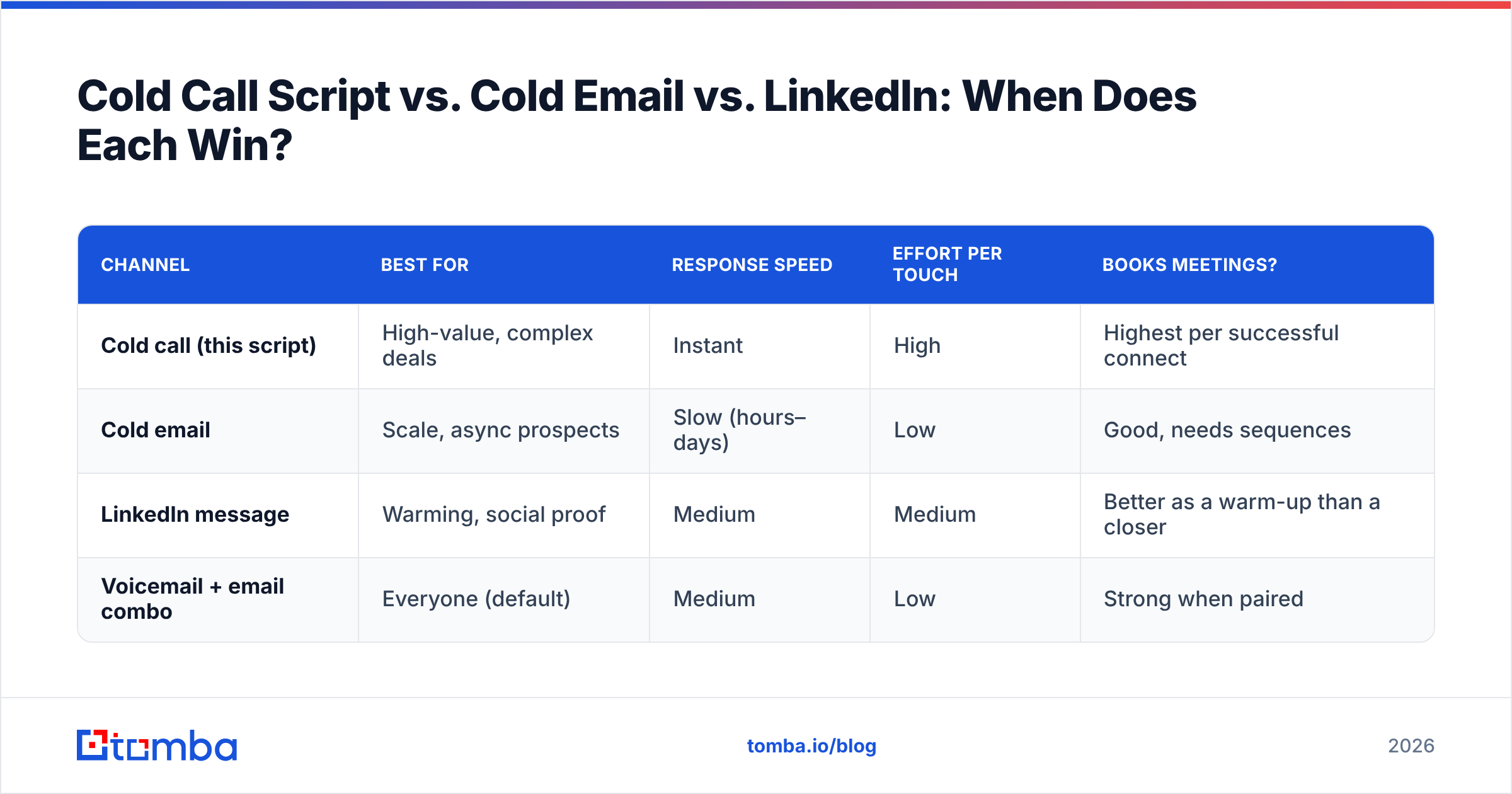
Cold Call Script vs. Cold Email vs. LinkedIn: When Does Each Win?#
Appointment setting is multichannel now. The phone script is your highest-intent tool, but it doesn't work in isolation. Here's how the channels compare for booking meetings.
| Channel | Best for | Response speed | Effort per touch | Books meetings? |
|---|---|---|---|---|
| Cold call (this script) | High-value, complex deals | Instant | High | Highest per successful connect |
| Cold email | Scale, async prospects | Slow (hours–days) | Low | Good, needs sequences |
| LinkedIn message | Warming, social proof | Medium | Medium | Better as a warm-up than a closer |
| Voicemail + email combo | Everyone (default) | Medium | Low | Strong when paired |
The winning motion in 2026 is a sequence, not a single channel: call, leave a voicemail, send the email referencing the voicemail, connect on LinkedIn, then call again. The script anchors the sequence; the other channels multiply your reach. If you want to measure how these channels stack up, track response rate per channel and double down on the winner.
What Metrics Tell You the Script Is Working?#
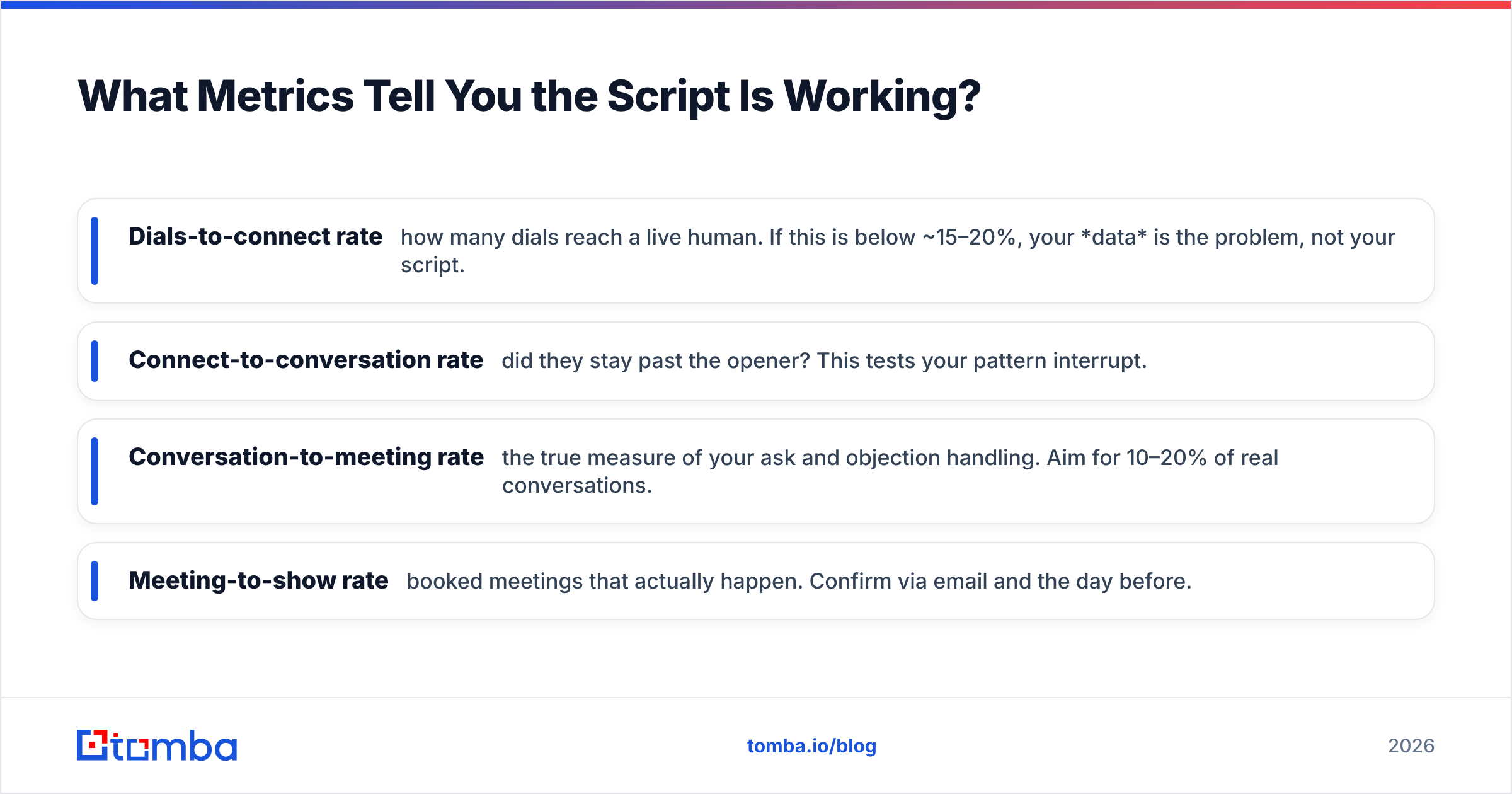
Don't guess. Track the funnel and you'll know exactly where calls break.
- Dials-to-connect rate — how many dials reach a live human. If this is below ~15–20%, your data is the problem, not your script.
- Connect-to-conversation rate — did they stay past the opener? This tests your pattern interrupt.
- Conversation-to-meeting rate — the true measure of your ask and objection handling. Aim for 10–20% of real conversations.
- Meeting-to-show rate — booked meetings that actually happen. Confirm via email and the day before.
If your connect rate is in the gutter, no script will save you — you're dialing wrong or dead numbers. That's a data problem, and it's fixable before you touch the words.
Why Does Bad Data Sabotage a Great Script?#
You can have the best cold call appointment setting script ever written and still fail if you're dialing numbers that ring nowhere. Industry analysts at Gartner have long flagged data decay as a top drag on outbound productivity — B2B contact data goes stale fast as people change roles and companies. Every disconnected number is dial time you paid for and got nothing back.
Three fixes, in order of impact:
- Verify phone numbers before the campaign. Use a phone validator to strip out disconnected and invalid lines so your reps spend time talking, not redialing.
- Source direct-dial numbers, not switchboards. A phone finder that surfaces direct B2B numbers means you skip the gatekeeper entirely.
- Enrich the record with context. Data enrichment fills in the role, company trigger, and email so your relevance hook is actually relevant — and so you can fire the email follow-up the second the voicemail ends.
Clean data doesn't just raise your connect rate. It makes every beat of the script sharper, because you're calling the right person about the right trigger with a working number.
How Do You Practice the Script Without Sounding Robotic?#
The paradox of scripts: you read them until you don't need to. Three drills:
- Record and review. Listen to ten of your own calls a week. You'll hear the exact spot where prospects check out.
- Role-play the objections, not the opener. New reps over-practice the intro and freeze on the rebuttal. Flip it.
- Vary one variable at a time. Test a new opener for a week against your control. Keep what books more meetings. This is how a script evolves from 1.0 to 3.0.
Reps on the G2 sales community consistently report the same thing: the script that felt stiff in week one feels invisible by week four — to them and to the prospect. That's the goal. The structure disappears and only the conversation remains.
Frequently Asked Questions#
How long should a cold call appointment setting script be? The call itself should run 60–90 seconds to the ask. The written script can be a full page with branches, but the spoken path to "which time works?" must be short. Every extra sentence before the ask is a chance to lose them.
Should I use the prospect's name repeatedly? Once in the opener, once in the ask. Overusing it sounds manipulative and scripted — the exact thing you're trying to avoid.
What's the best time to cold call in 2026? Mid-morning (10–11am) and late afternoon (4–5pm) in the prospect's timezone still test best, but your own connect data beats any generic benchmark. Track it per segment.
Do scripts work for inbound and warm leads too? Yes, but you compress them. Warm leads let you skip the heavy pattern interrupt and move to relevance and the ask faster, because you've already earned attention.
Start With Data That Actually Connects#
A script only earns its keep when it reaches a real, right-fit human. Before you refine a single word, fix the list underneath it: pull direct-dial numbers and verified emails so your reps spend the day in conversations, not in voicemail purgatory. Use Tomba's Email Finder to build accurate, enriched contact records — verified emails for the follow-up, company context for the relevance hook, and clean data that lifts your connect rate before you say a word. Pair it with the phone finder, plug the results into your dialer, and let the script do what it was built to do: book meetings. Check the Tomba pricing plans — start free with 25 searches, or scale to Starter at $49/mo when you're ready to run the full sequence.
Related guides#
Ready to find emails that actually work?
Join 150,000+ professionals who stopped guessing and started sending. Free credits on signup — no credit card required.
Get the Tomba newsletter
Practical outbound tactics and product updates — once every two weeks.
About the author