The Cold Call Checklist: 15 Steps to Book More Meetings
A no-fluff cold call checklist covering research, openers, objection handling, and follow-up — the exact steps top reps run before, during, and after every dial.
Most cold calls fail before the phone even rings. Not because the rep is bad on the phone, but because they dialed a wrong number, a wrong person, or a right person at the worst possible moment — with no plan for what to say next.
A cold call checklist fixes that. It turns a nerve-wracking improvisation into a repeatable process you can run on every dial, coach new reps against, and improve one step at a time.
TL;DR#
- A cold call checklist is a repeatable pre-call, on-call, and post-call routine that removes guesswork and improves your connect and conversion rates.
- Preparation is 60% of the outcome. Verified phone numbers, a one-line reason for calling, and a known trigger event matter more than your tone of voice.
- Openers should earn 30 more seconds, not pitch. Lead with relevance, ask permission, and get to a question fast.
- Objections are predictable — build a one-page rebuttal sheet for the five you hear most.
- The call isn't done when you hang up. Log the outcome, send the promised follow-up, and schedule the next touch the same day.
Why do you need a cold call checklist?#
Because consistency beats talent on the phone. The best reps aren't smoother — they're more systematic. They run the same steps every time, so their results are predictable and their weak spots are visible.
Think of a cold call checklist like a pilot's pre-flight routine. Pilots don't skip the checklist because they've flown a thousand times; they run it because they've flown a thousand times and know exactly which small miss causes a crash. A missing number, an unresearched account, or a forgotten follow-up is your equivalent of an unchecked fuel gauge.
According to HubSpot's sales research, it takes an average of multiple touchpoints to connect with a prospect, and reps who plan their calls consistently outperform those who wing it. The checklist is how you make that planning automatic instead of optional.

What goes on the pre-call checklist?#
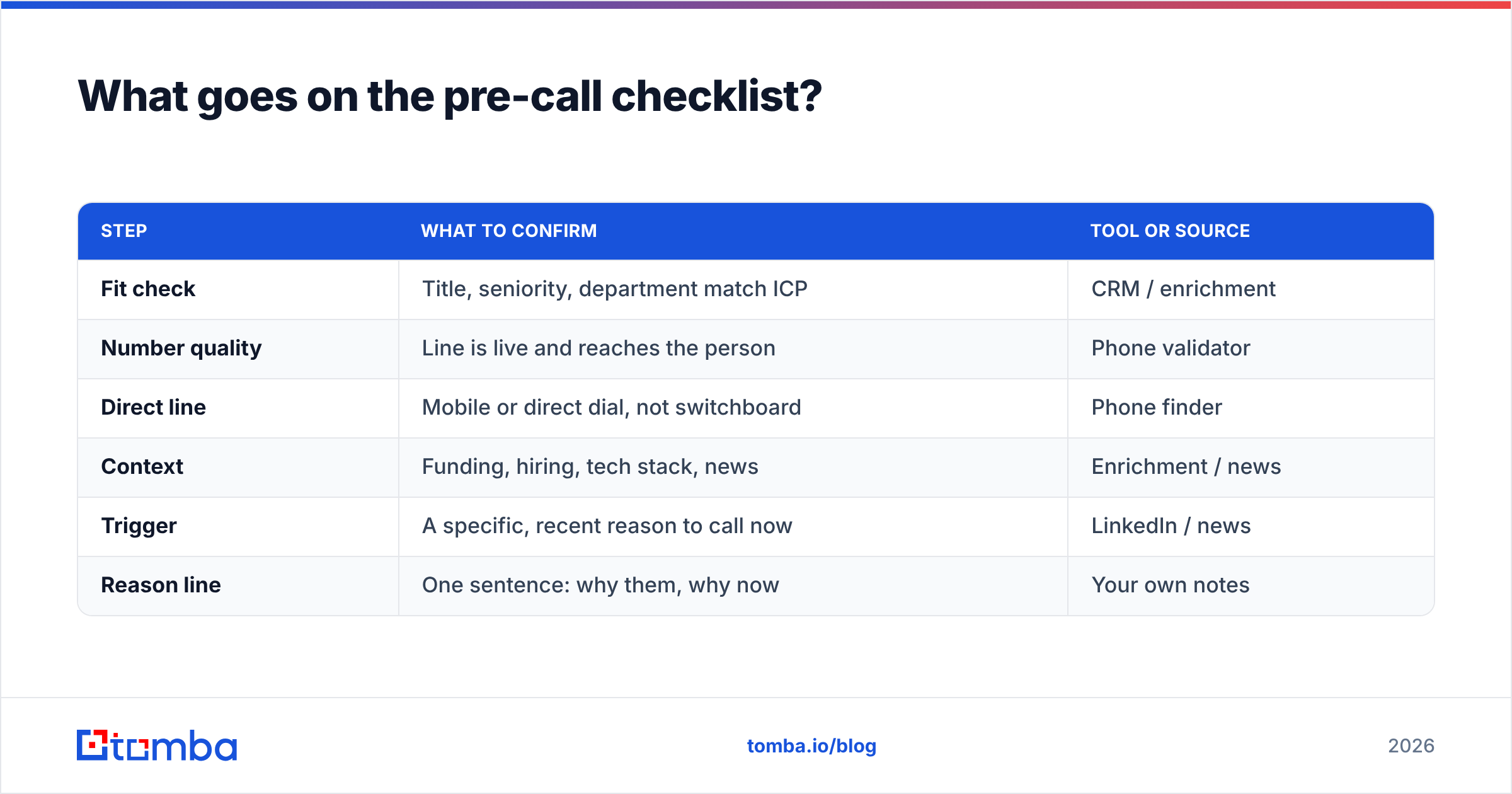
Preparation decides most of the call. If you dial a verified number, know one specific reason you're calling, and have a relevant trigger event, you've already beaten most of the reps in your prospect's voicemail.
Here's the pre-call block, step by step:
- Confirm the contact is a real fit. Title, seniority, and department should match your ideal customer profile — not just "works at a target company."
- Verify the phone number. Dialing dead numbers destroys your connect rate and your morale. Run your list through a phone validator before you start, so every dial has a chance of connecting.
- Find a direct line where possible. A direct dial or mobile beats a switchboard. A phone finder tool surfaces B2B numbers tied to the actual person, not the front desk.
- Enrich the record. Pull recent company news, funding, headcount changes, and tech stack. Data enrichment fills in the context you need to sound relevant instead of generic.
- Identify one trigger event. A new hire, a product launch, a job posting, or a funding round gives you a legitimate reason to call today.
- Write your one-line reason for calling. If you can't say why this person, why now, in a single sentence, you're not ready to dial.
Pre-call checklist at a glance#
| Step | What to confirm | Tool or source |
|---|---|---|
| Fit check | Title, seniority, department match ICP | CRM / enrichment |
| Number quality | Line is live and reaches the person | Phone validator |
| Direct line | Mobile or direct dial, not switchboard | Phone finder |
| Context | Funding, hiring, tech stack, news | Enrichment / news |
| Trigger | A specific, recent reason to call now | LinkedIn / news |
| Reason line | One sentence: why them, why now | Your own notes |
Skipping the number-quality step is the most common and most expensive mistake. You can have a perfect script, but if 40% of your list is disconnected numbers, you're spending most of your day listening to error tones.
What is the on-call checklist?#
The on-call checklist keeps you in control when adrenaline takes over. The moment a prospect picks up, your brain wants to rush. A checklist slows you down to the right speed.
Run these during the live call:
- Confirm you have the right person. "Hi, is this [Name]?" Simple, but it stops you pitching the wrong human.
- State who you are and ask for permission. "This is a cold call — do you have 30 seconds?" Honesty disarms. Trying to sound like a warm call does the opposite.
- Lead with relevance, not your product. Reference the trigger event you found. "I saw you just opened three SDR roles" beats "I'm calling from [Company]."
- Ask a question early. The goal of the opener is to start a conversation, not deliver a monologue. Get them talking within the first 20 seconds.
- Listen for the real objection. "We're all set" usually means "you haven't given me a reason to care yet."
- Aim for one clear next step. A booked meeting, a scheduled callback, or explicit permission to email — never a vague "I'll think about it."
Tools like Gong that analyze thousands of real sales calls consistently find that talk-to-listen ratio and a clear ask are stronger predictors of success than word choice. The checklist enforces both.
What are the best cold call openers?#
A good opener earns you the next 30 seconds — it doesn't try to close. Its only job is to interrupt the "who is this and how fast can I hang up" reflex and replace it with mild curiosity.
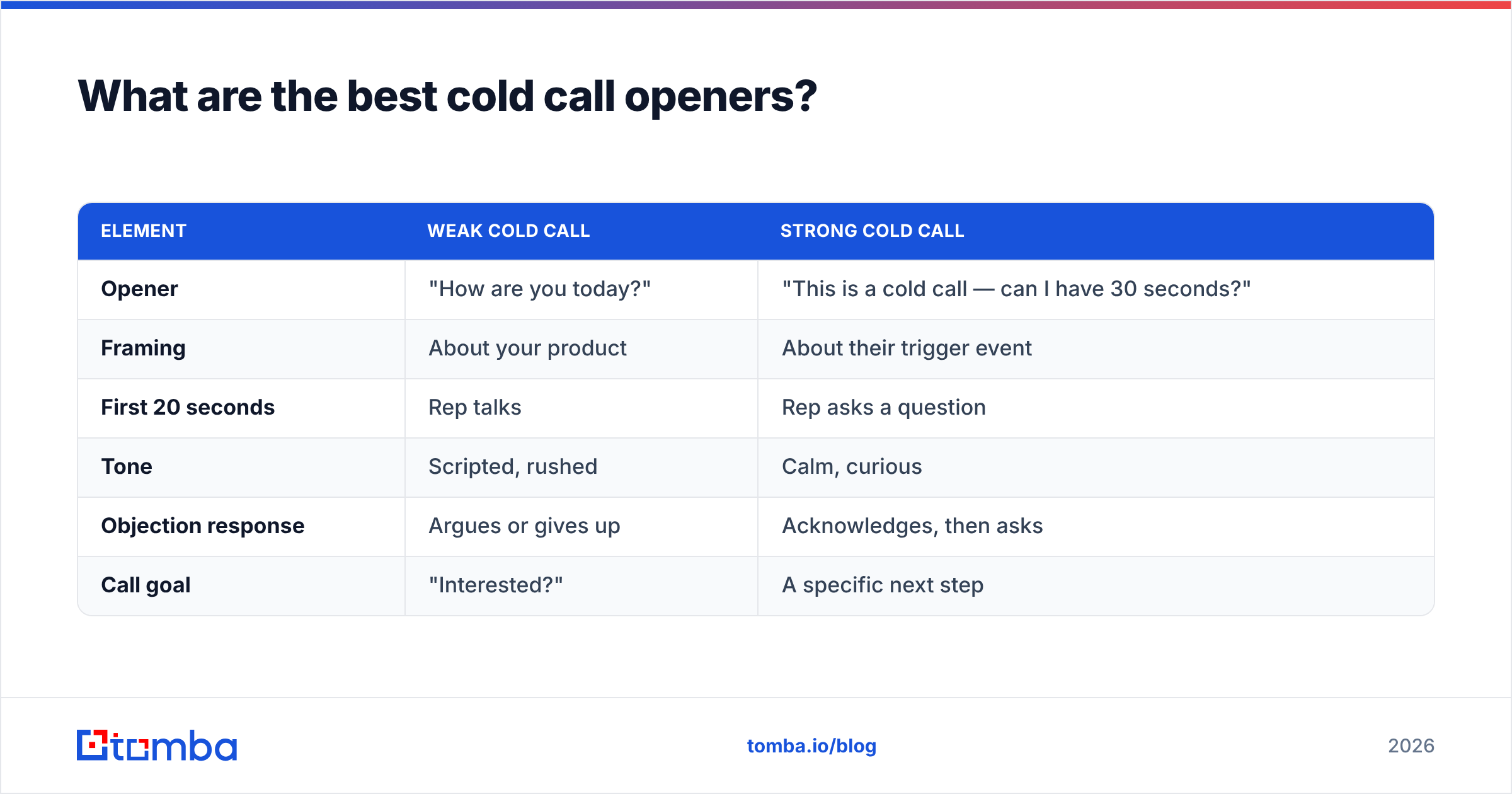
Compare two approaches side by side:
| Element | Weak cold call | Strong cold call |
|---|---|---|
| Opener | "How are you today?" | "This is a cold call — can I have 30 seconds?" |
| Framing | About your product | About their trigger event |
| First 20 seconds | Rep talks | Rep asks a question |
| Tone | Scripted, rushed | Calm, curious |
| Objection response | Argues or gives up | Acknowledges, then asks |
| Call goal | "Interested?" | A specific next step |
The strong column works because it respects the prospect's time and intelligence. Naming that it's a cold call is counterintuitive but effective: it signals confidence and honesty, and most people will give you the 30 seconds precisely because you asked instead of pretending.
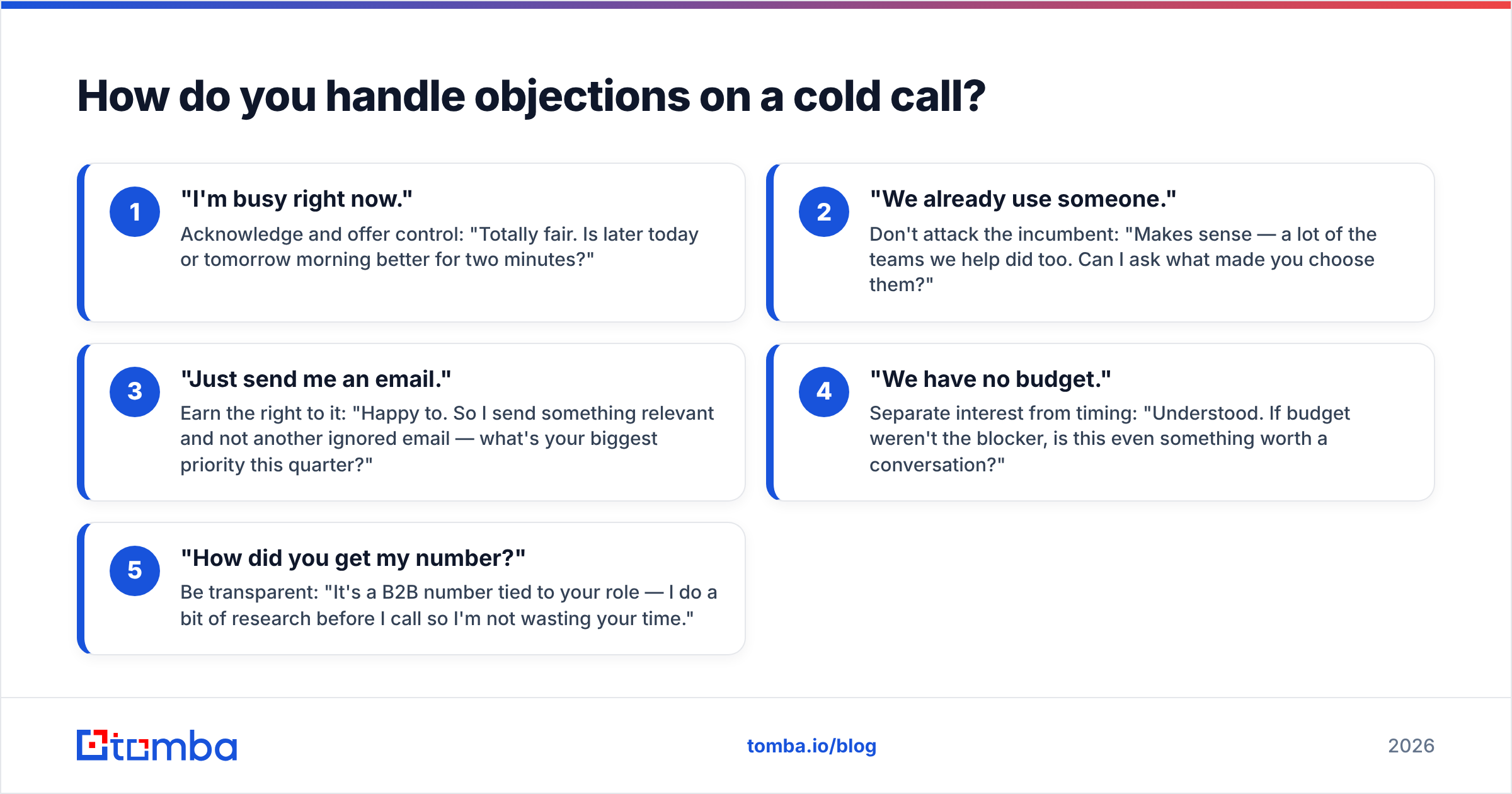
How do you handle objections on a cold call?#
Handle objections by expecting them, not reacting to them. You hear roughly the same five objections every week. Prepare a one-line response for each and you'll never be caught flat.
The most common cold call objections and a simple framework for each:
- "I'm busy right now." — Acknowledge and offer control: "Totally fair. Is later today or tomorrow morning better for two minutes?"
- "We already use someone." — Don't attack the incumbent: "Makes sense — a lot of the teams we help did too. Can I ask what made you choose them?"
- "Just send me an email." — Earn the right to it: "Happy to. So I send something relevant and not another ignored email — what's your biggest priority this quarter?"
- "We have no budget." — Separate interest from timing: "Understood. If budget weren't the blocker, is this even something worth a conversation?"
- "How did you get my number?" — Be transparent: "It's a B2B number tied to your role — I do a bit of research before I call so I'm not wasting your time."
The pattern is always the same: acknowledge, then ask a question that keeps the conversation open. You're not trying to win an argument. You're trying to earn one more exchange.
What belongs on the post-call checklist?#
The call isn't finished when you hang up — it's finished when the next step is scheduled. Most reps lose more deals in the two minutes after a call than during it, because they move straight to the next dial and forget what they promised.
Your post-call block:
- Log the outcome immediately. Connected, voicemail, gatekeeper, wrong number, or booked — while it's fresh.
- Send the promised follow-up the same hour. If you said you'd email, do it before you forget. A prospect's memory of you fades fast.
- Update the contact record. Correct the title, add the direct line, note the objection. Clean data compounds; sloppy data rots.
- Schedule the next touch. Callback, email sequence, or LinkedIn touch — put it on the calendar, don't rely on memory.
- Note what worked. One line on the opener or question that landed. This is how your script improves week over week.
If your follow-up email needs a verified address, don't guess the format — confirm it. A quick check with an email verifier means your post-call email actually lands instead of bouncing and hurting your sender reputation.
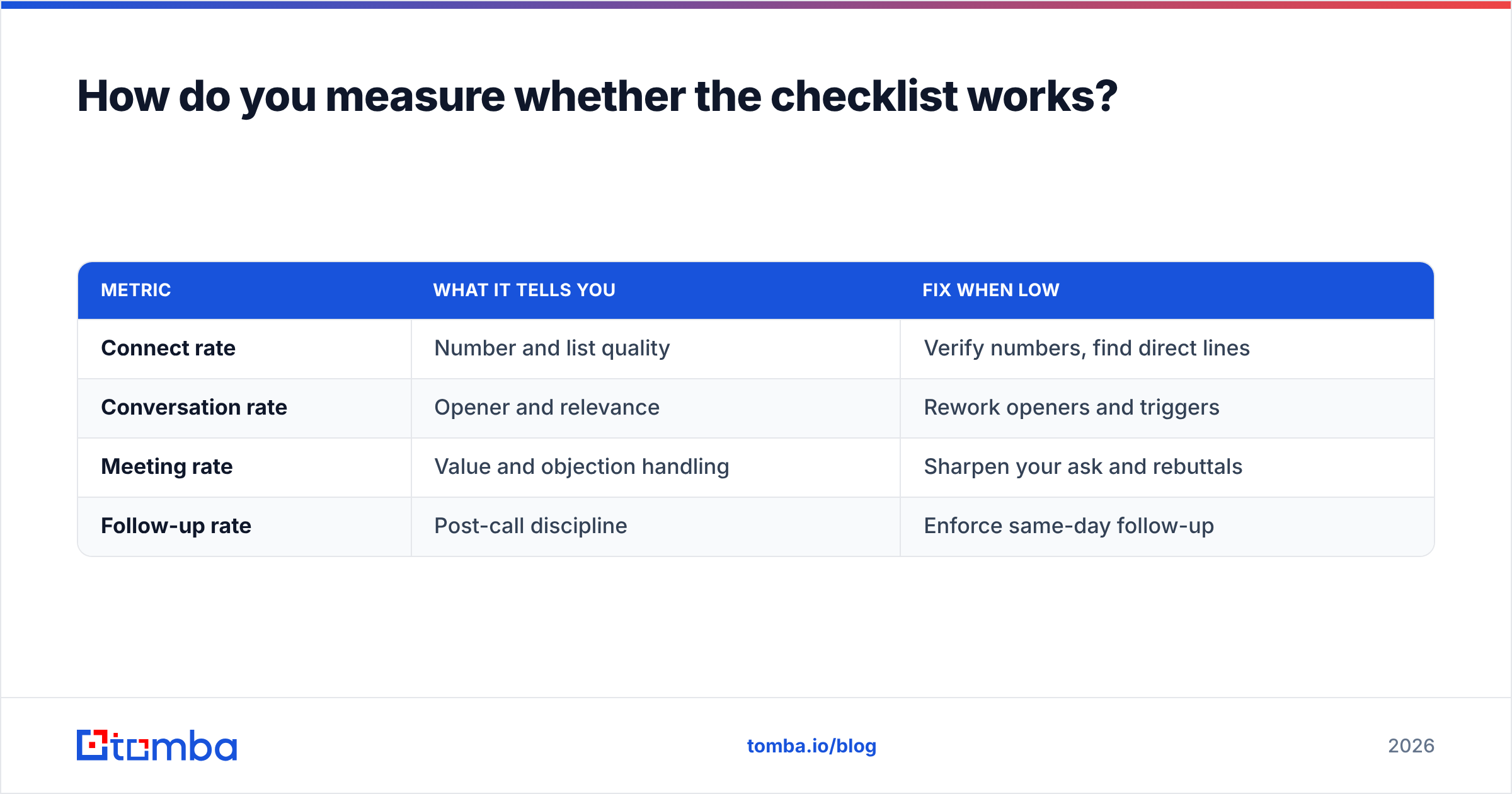
How do you measure whether the checklist works?#
Track a handful of metrics, not a dashboard of vanity numbers. The point is to see which checklist step is your weakest link and fix it.
The four numbers that matter most:
| Metric | What it tells you | Fix when low |
|---|---|---|
| Connect rate | Number and list quality | Verify numbers, find direct lines |
| Conversation rate | Opener and relevance | Rework openers and triggers |
| Meeting rate | Value and objection handling | Sharpen your ask and rebuttals |
| Follow-up rate | Post-call discipline | Enforce same-day follow-up |
If your connect rate is low, no amount of script coaching will help — the problem is upstream, in your data. If your connect rate is healthy but conversations rarely convert, the fix is in your opener and objection handling. The checklist lets you diagnose instead of guess.
You can benchmark your own numbers against public data on G2's sales tools category and vendor reports, but the trend in your metrics week over week matters far more than any industry average.
How often should you update your checklist?#
Review it monthly and revise it every quarter. A cold call checklist is a living document, not a laminated card. The objections shift, the triggers change, and the openers that worked in Q1 get stale by Q3.
A simple cadence:
- Weekly: Note one thing that worked and one that didn't on your best and worst calls.
- Monthly: Update your objection responses based on what you're actually hearing.
- Quarterly: Rewrite your opener and refresh your trigger sources.
The reps who improve fastest treat every call as data. The checklist gives that data a place to live, so your team's collective learning doesn't evaporate every time someone hangs up.
Put the checklist into practice#
A cold call checklist is only as good as the list you dial. The most disciplined openers and airtight rebuttals are wasted on disconnected numbers and wrong contacts. Start by fixing the input: build a clean, verified list of the right people with accurate direct lines and confirmed emails for follow-up.
That's where Tomba's Email Finder fits into your calling workflow. Use it to find and verify the professional contact details behind every account on your list, enrich each record with the context your opener needs, and make sure your post-call follow-up reaches a real inbox. Combined with accurate phone data, it turns your checklist from a nice idea into a repeatable, measurable process. See the Tomba pricing plans — including a free tier of 25 searches a month — and start dialing lists that actually connect.
Related guides#
// get started
Find, verify and enrich your first contacts today
Start on the free plan with 25 searches a month, then scale when your team is ready.
Free plan · No credit card required · GDPR & CCPA
// about the author