Cold Call Coaching in 2026: The Complete Rep-Coaching Playbook
Most cold call coaching is a manager guessing after a bad call. Here's a repeatable system — scorecards, call reviews, and drills — that actually moves connect and conversion rates.
Cold call coaching is the difference between a rep who improves every week and a rep who repeats the same mistake 400 times a quarter. Yet most "coaching" is a manager listening to one disaster call, saying "be more confident," and walking away. That is not coaching — it is commentary.
This guide gives you a repeatable system: what to measure, how to run call reviews, which drills fix which problems, and how to build a scorecard your reps actually trust. It is written for sales managers, enablement leads, and SDR team leads who want connect rates and meeting-booked rates to move, not just feel motivated.
TL;DR#
- Coaching is a system, not a pep talk. Score calls against a fixed rubric, review 3–5 calls per rep per week, and drill one skill at a time.
- Measure leading indicators, not just booked meetings: connect rate, opener survival, objection-handling rate, and talk-to-listen ratio.
- Bad data kills coaching. If half your dials hit wrong numbers, you are coaching noise. Clean, verified phone data comes first.
- Role-play beats call recordings for skill building — but recordings tell you what to role-play.
- One behavior change per week sticks. Ten changes at once stick to nobody.
What is cold call coaching, really?#
Cold call coaching is the structured, repeated process of observing a rep's calls, comparing them to a defined standard, and drilling the specific behaviors that close the gap. Think of it like a golf swing coach: you do not fix the whole swing in one lesson. You film it, isolate the one thing costing distance, and drill that until it is automatic — then move to the next thing.
The keyword is structured. Ad hoc feedback ("that call was rough, tighten it up") gives the rep nothing to act on. Structured coaching answers three questions every single time:
- What specifically happened? (a moment, timestamped, not a vibe)
- What should have happened instead? (the standard)
- What will we drill before the next call block? (the action)
If your feedback does not survive those three questions, it is not coaching.
Why do most cold call coaching programs fail?#
They fail for four predictable reasons:
- No rubric. Every manager grades differently, so reps get contradictory feedback week to week.
- Too much at once. A rep hears "fix your opener, your tone, your discovery, and your close" and changes nothing.
- Coaching the wrong calls. Managers cherry-pick the worst call instead of a representative sample.
- Dirty dial lists. When 30–40% of numbers are disconnected or wrong, connect-rate coaching is meaningless — the rep never reaches a human to practice on.
That last point is underrated. According to sales-engagement research summarized by Gong, the single biggest lever on outbound outcomes is reaching the right person at the right moment. You cannot coach a conversation that never happens. Before you invest in a coaching program, make sure your reps are dialing real, current numbers — a good phone finder and a phone validator pass will strip out the dead weight so coaching time is spent on live human interactions, not voicemail archaeology.
What should a cold call scorecard include?#
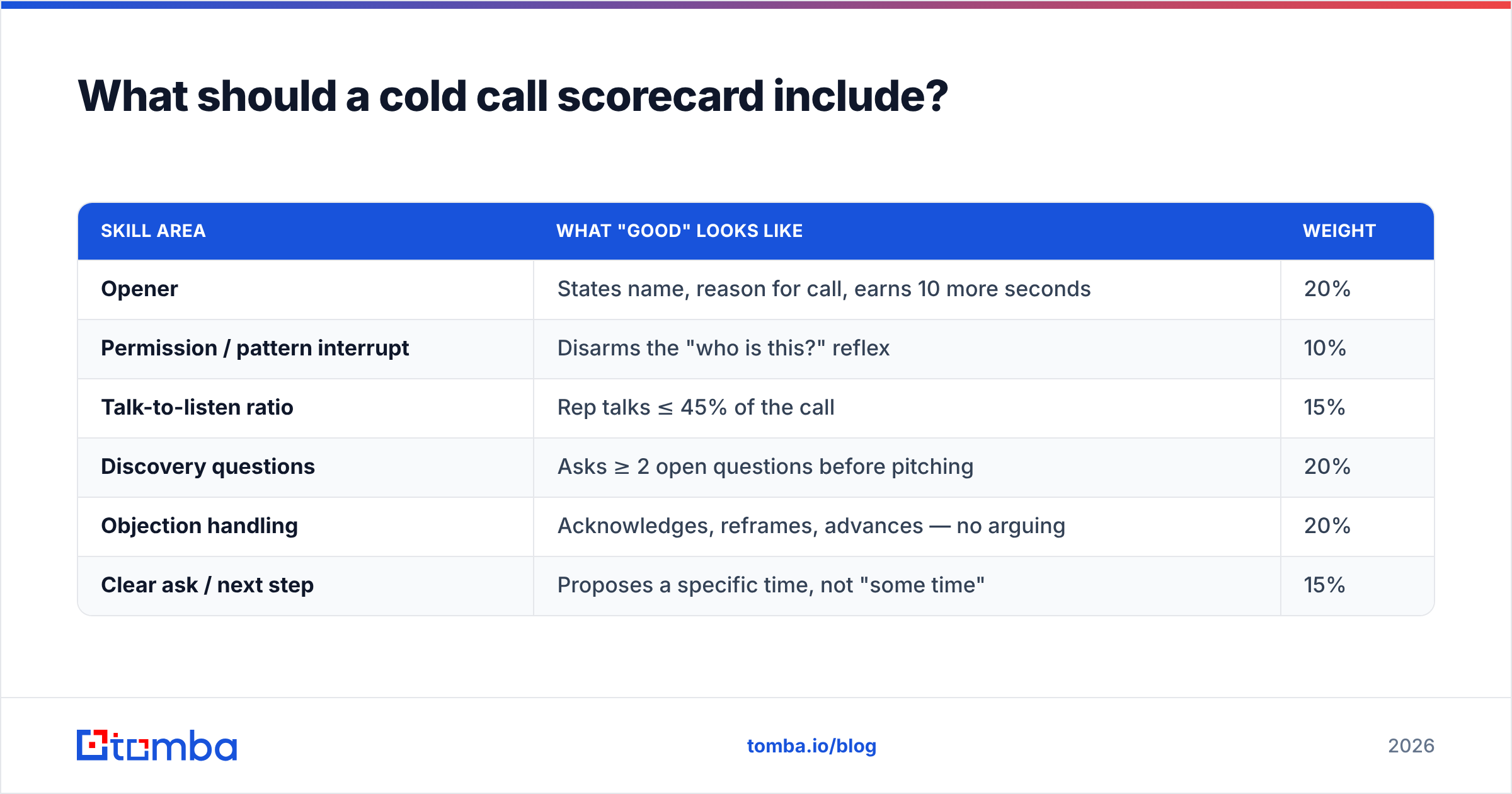
A scorecard turns opinion into a checklist. Keep it to 6–8 items so it is usable on a live call. Here is a proven starting rubric.
| Skill area | What "good" looks like | Weight |
|---|---|---|
| Opener | States name, reason for call, earns 10 more seconds | 20% |
| Permission / pattern interrupt | Disarms the "who is this?" reflex | 10% |
| Talk-to-listen ratio | Rep talks ≤ 45% of the call | 15% |
| Discovery questions | Asks ≥ 2 open questions before pitching | 20% |
| Objection handling | Acknowledges, reframes, advances — no arguing | 20% |
| Clear ask / next step | Proposes a specific time, not "some time" | 15% |
Score each area 0–2 (miss / partial / hit). The math is less important than the consistency: every rep is measured against the same bar, so improvement is visible over weeks. Store scores next to your call notes in your CRM so trends surface per rep and per team.
How often should you coach cold calls?#
Cadence matters more than duration. A tight rhythm beats occasional marathon sessions.
- Weekly 1:1 call review (30 min). Review 3–5 calls per rep against the scorecard. Pick one skill to drill.
- Daily micro-coaching (5 min). Right after a call block, one specific note while it is fresh.
- Bi-weekly group teardown (45 min). Whole team dissects one anonymized call. Reps learn faster watching peers than being critiqued alone.
- Monthly trend review (30 min). Look at scorecard trends, not individual calls — is opener survival climbing? Are objections getting handled?
The rule: one behavior change per week, per rep. Neuroscience of skill acquisition is on your side here — focused, repeated reps on a single motion build faster than scattered attention across ten.
Live coaching vs. recorded call review: which wins?#
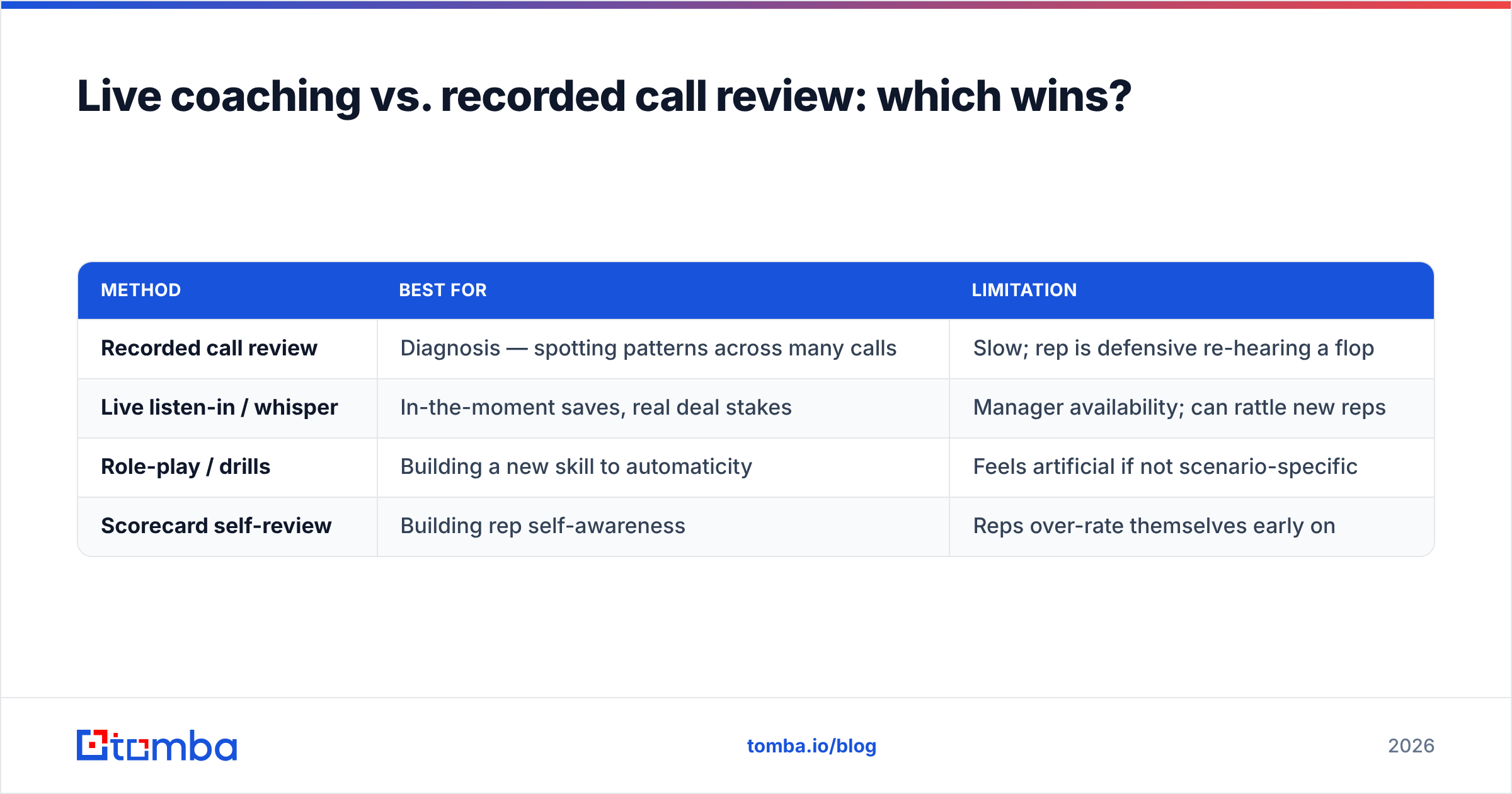
Both, for different jobs. Recorded review diagnoses; live coaching and role-play build.
| Method | Best for | Limitation |
|---|---|---|
| Recorded call review | Diagnosis — spotting patterns across many calls | Slow; rep is defensive re-hearing a flop |
| Live listen-in / whisper | In-the-moment saves, real deal stakes | Manager availability; can rattle new reps |
| Role-play / drills | Building a new skill to automaticity | Feels artificial if not scenario-specific |
| Scorecard self-review | Building rep self-awareness | Reps over-rate themselves early on |
The highest-ROI loop: review recordings to find the gap → role-play to fix it → live-listen to confirm it transferred. Recordings without drills just make reps feel judged. Drills without recordings fix imaginary problems.
What are the best cold call coaching drills?#
Drills isolate one skill and repeat it under mild pressure. Rotate these based on what the scorecard flags.
- The 15-second opener drill. Rep delivers only the opening 15 seconds, ten times, each to a different persona. Coach cuts them off the instant it drags. Builds a tight, earned-attention opener.
- Objection ping-pong. Coach fires the five most common objections rapid-fire; rep must acknowledge-reframe-advance in under 8 seconds each. Kills the freeze.
- The mute drill. Rep runs discovery but can only speak in questions. Forces listening and breaks the pitch-vomit habit.
- Voicemail in one breath. A 20-second voicemail, delivered clean, no "um." Because half of dials go to voicemail and most are wasted.
- Tone laddering. Same script, three energy levels — flat, natural, over-caffeinated — so reps feel the difference and find their natural register.
Run drills before a call block, not after. You want the skill warm when the phone is in their hand.
How do you coach cold call objections specifically?#
Objection handling is where deals are won or lost, so it deserves its own loop. Teach the Acknowledge → Reframe → Advance pattern and score against it.
- Acknowledge: "Totally fair, a lot of people say that." (Lowers the guard — never argue.)
- Reframe: Turn the objection into the reason to keep talking. "That's exactly why I called — teams already using X still lose Y."
- Advance: Move to a micro-commitment. "Worth 12 minutes Thursday to see if it even applies to you?"
The classic mistakes are arguing ("actually, that's not true") and caving ("no problem, I'll go away"). Both end the call. Coaching here means building a small, memorized library of reframes for your top five objections, then drilling them until the rep does not have to think. HubSpot's sales resources have solid objection frameworks worth adapting to your product.
What metrics prove your coaching is working?#
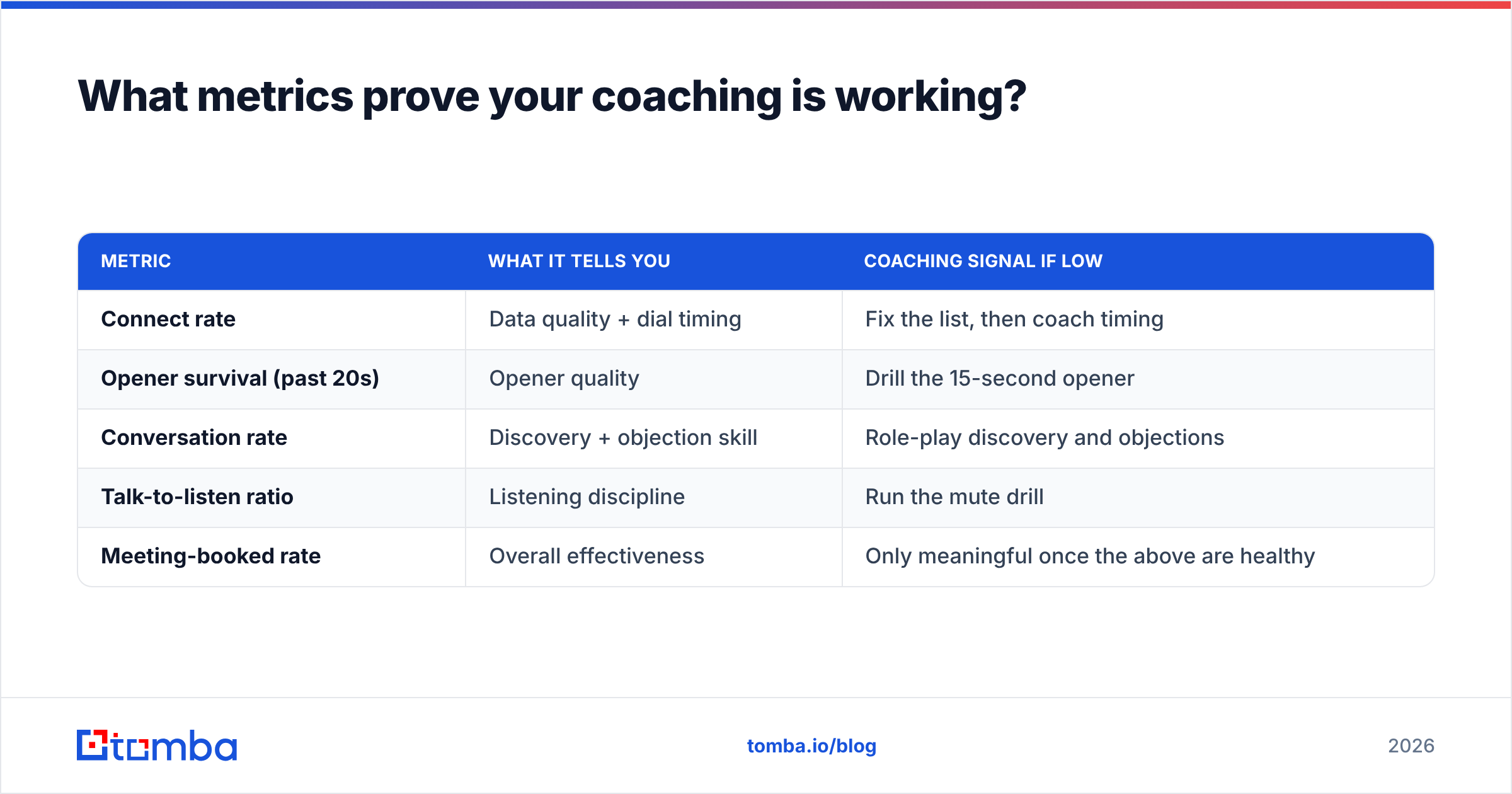
Booked meetings is a lagging indicator — it moves slowly and hides why. Coach the leading indicators and the lagging one follows.
| Metric | What it tells you | Coaching signal if low |
|---|---|---|
| Connect rate | Data quality + dial timing | Fix the list, then coach timing |
| Opener survival (past 20s) | Opener quality | Drill the 15-second opener |
| Conversation rate | Discovery + objection skill | Role-play discovery and objections |
| Talk-to-listen ratio | Listening discipline | Run the mute drill |
| Meeting-booked rate | Overall effectiveness | Only meaningful once the above are healthy |
Track these per rep over 8–12 weeks. A coaching program that works shows opener survival and conversation rate climbing first, with booked meetings following a few weeks later. If nothing moves, your problem is upstream — usually data or targeting, not skill. G2's sales coaching category is a useful reference if you decide to add dedicated coaching software to instrument this.
How does data quality change your coaching?#
It changes everything, because coaching multiplies whatever inputs you feed it. Coach a rep on a list where 40% of numbers are dead, and your best-case outcome is an excellent rep with a terrible connect rate — demoralizing and pointless.
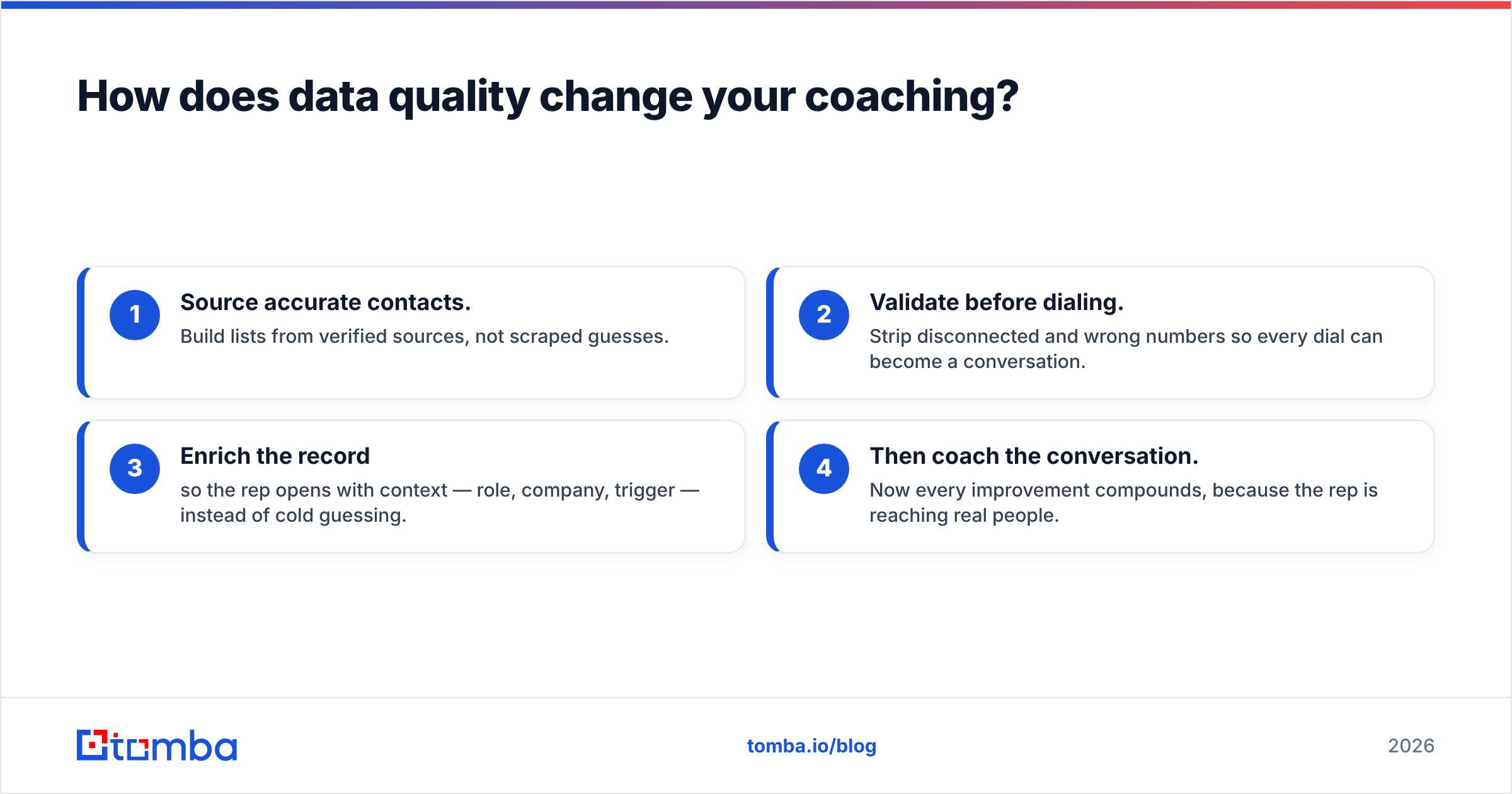
The sequence that works:
- Source accurate contacts. Build lists from verified sources, not scraped guesses.
- Validate before dialing. Strip disconnected and wrong numbers so every dial can become a conversation.
- Enrich the record so the rep opens with context — role, company, trigger — instead of cold guessing.
- Then coach the conversation. Now every improvement compounds, because the rep is reaching real people.
This is why enablement and RevOps leaders increasingly treat data hygiene as part of the coaching stack, not a separate chore. Clean data plus tight coaching is the combination; either one alone underperforms. If your team blends phone and email outreach, pairing verified numbers with a reliable email finder means a missed call becomes a warm follow-up instead of a dead end.
A 30-day cold call coaching rollout plan#
If you are starting from scratch, do not boil the ocean. Run this four-week sequence:
- Week 1 — Baseline. Build the scorecard. Record and score 5 calls per rep. Do not give feedback yet; just establish where everyone stands.
- Week 2 — One skill. Pick the lowest-scoring shared weakness (usually openers or objections). Drill it daily. Re-score.
- Week 3 — Peer teardown. Add the group call teardown. Reps start coaching each other, which cements learning.
- Week 4 — Measure and lock cadence. Compare scorecard trends to week 1. Lock the weekly 1:1 + daily micro-coaching rhythm as permanent.
By day 30 you will have a rubric, a cadence, a baseline, and — if the data underneath is clean — visible movement on opener survival and conversation rate.
Common cold call coaching mistakes to avoid#
- Coaching tone before substance. "Sound more confident" is useless if the opener has no reason-to-call. Fix structure first.
- Reviewing only losses. Review wins too — reps need to know what good felt like so they can repeat it.
- Changing the script constantly. Reps need reps. Stabilize the script, then coach the delivery.
- Ignoring data. If connect rate is the problem, no amount of talk-track coaching fixes it.
- Skipping the drill. Feedback without a drill is a wish. The drill is what makes the change stick.
The bottom line#
Cold call coaching works when it is a system: a fixed scorecard, a weekly cadence, one skill at a time, and drills that build the behavior instead of just describing it. But the best coaching in the world stalls on bad data — you cannot improve a conversation your rep never gets to have.
Start upstream. Feed your team verified, current contact data so every dial has a shot at becoming a real conversation, then layer disciplined coaching on top. Tomba's phone finder and Tomba Email Finder give your reps accurate numbers and emails to work from, and you can start free with 25 searches a month before scaling on the Starter plan at $49/mo. Clean data in, tight coaching on top — that is how connect rates and booked meetings actually move.
Related guides#
// get started
Find, verify and enrich your first contacts today
Start on the free plan with 25 searches a month, then scale when your team is ready.
Free plan · No credit card required · GDPR & CCPA
// about the author