Cold Call Email: How to Combine Calls and Emails in 2026
Cold calling and cold emailing work better together than apart. Here is the exact cold call email cadence, timing, and data stack that lifts reply and connect rates in 2026.
Most reps treat cold calling and cold emailing as rival religions. They are not. The teams hitting quota in 2026 run them as one motion — a cold call email cadence where each channel warms up the next. This guide shows you exactly how to sequence them, what to say, and how to build the contact data that keeps both channels alive.
TL;DR#
- Neither channel wins alone. A cold call email cadence beats email-only or call-only sequences on connect rate and reply rate because it hits prospects on multiple fronts within a tight window.
- Sequence matters more than volume. Lead with a short email, follow with a call referencing it, then layer in a second touch. Timing and consistency beat blasting.
- Bad data kills both channels. A wrong number wastes a dial; a bad address triggers a bounce and hurts deliverability. Verified emails and validated phone numbers are the foundation.
- Personalization is the multiplier. A relevant one-line opener lifts a cold call email far more than a clever template ever will.
- Track the pair, not the parts. Measure the combo (email opened → call connected → meeting booked), not each channel in isolation.
What is a cold call email cadence?#
A cold call email cadence is a planned sequence that alternates cold emails and cold calls to the same prospect over a set window — usually 10 to 14 business days. Think of it like a two-person sales team knocking on the same door: one leaves a note, the other rings the bell a few minutes later. Neither is annoying on its own, and together they get noticed.
The mechanics are simple. Email creates awareness and gives you a reason to call ("I sent you a note yesterday about X"). The call adds a human voice and urgency that text can't. When a prospect ignores the email but recognizes your name on the phone, the combo has already done its job.
Here is why the pairing outperforms either channel solo:
- Recognition compounds. Each touch makes the next one feel less cold. By the third contact, you are a name the prospect has seen, not a stranger.
- Channels cover each other's blind spots. Emails get filtered; calls get screened. Running both means a missed touch in one channel is caught in the other.
- Reference points create openers. "Did you get my email?" is a warmer call opener than a script from scratch.
- You match prospect preference. Some buyers read; some pick up. A combined cadence lets the prospect self-select their channel.
- Momentum survives no-shows. If a call goes to voicemail, the follow-up email keeps the thread alive instead of resetting to zero.
Is a cold call email combo better than email or calls alone?#
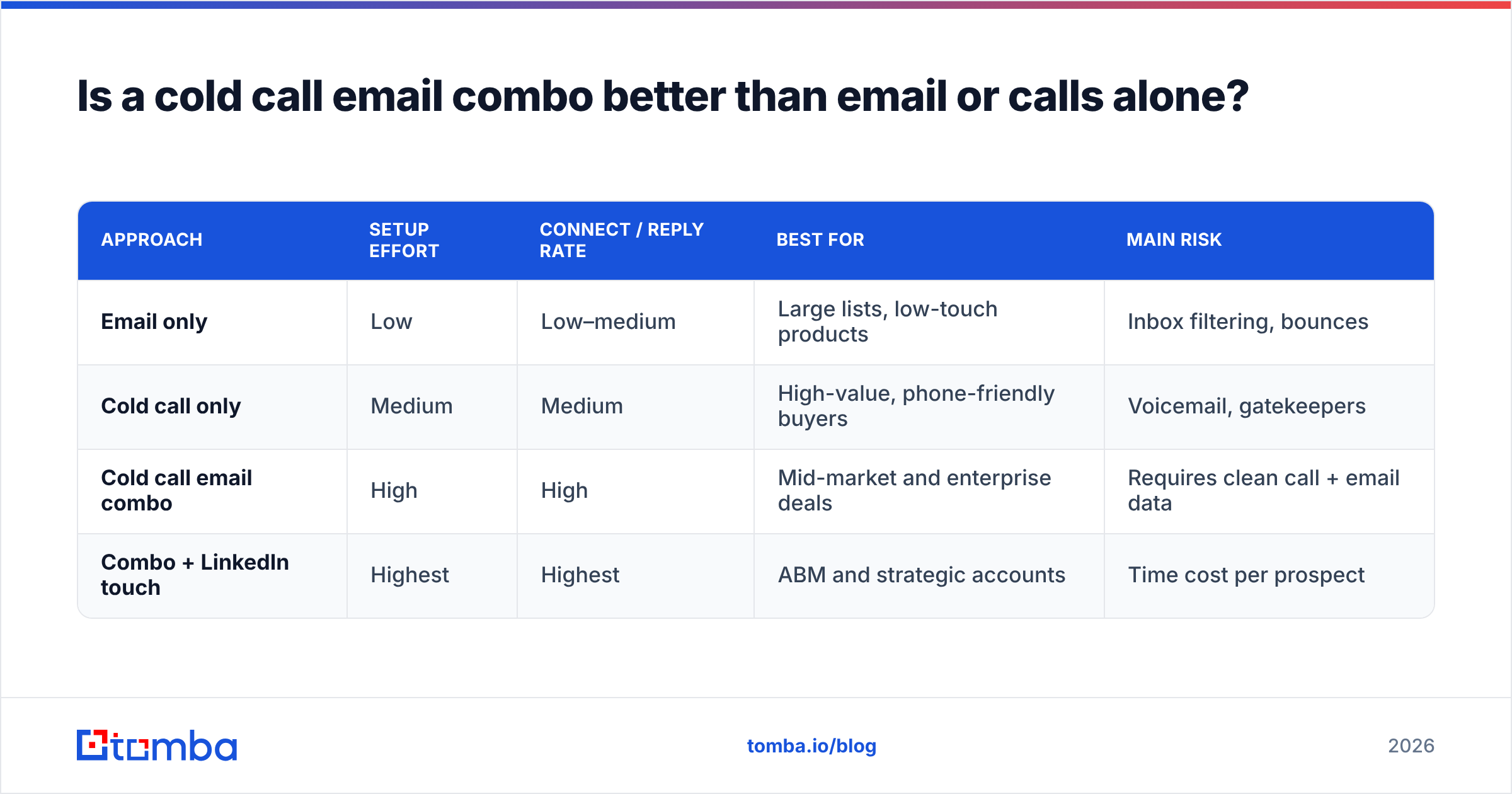
Yes — on the metrics that matter, a combined cadence beats single-channel outreach. Single-channel sequences leave gaps. Email-only outreach depends entirely on your subject line surviving a crowded inbox. Call-only outreach depends on catching someone at their desk, which is a coin flip in a hybrid-work world. The combo hedges both risks.
The trade-off is effort. A cold call email cadence takes more setup and discipline than firing off a template blast. But the return per prospect is higher, which means you can work a smaller, better-researched list instead of spraying thousands of contacts and torching your sender reputation in the process.
| Approach | Setup effort | Connect / reply rate | Best for | Main risk |
|---|---|---|---|---|
| Email only | Low | Low–medium | Large lists, low-touch products | Inbox filtering, bounces |
| Cold call only | Medium | Medium | High-value, phone-friendly buyers | Voicemail, gatekeepers |
| Cold call email combo | High | High | Mid-market and enterprise deals | Requires clean call + email data |
| Combo + LinkedIn touch | Highest | Highest | ABM and strategic accounts | Time cost per prospect |
The pattern is clear: more channels, more effort, more return. According to HubSpot's sales research, multi-touch sequences consistently outperform single-touch outreach, and buyers increasingly expect to be met on more than one channel. The combo is not a hack — it is where serious outbound has settled.
What does a 12-day cold call email cadence look like?#
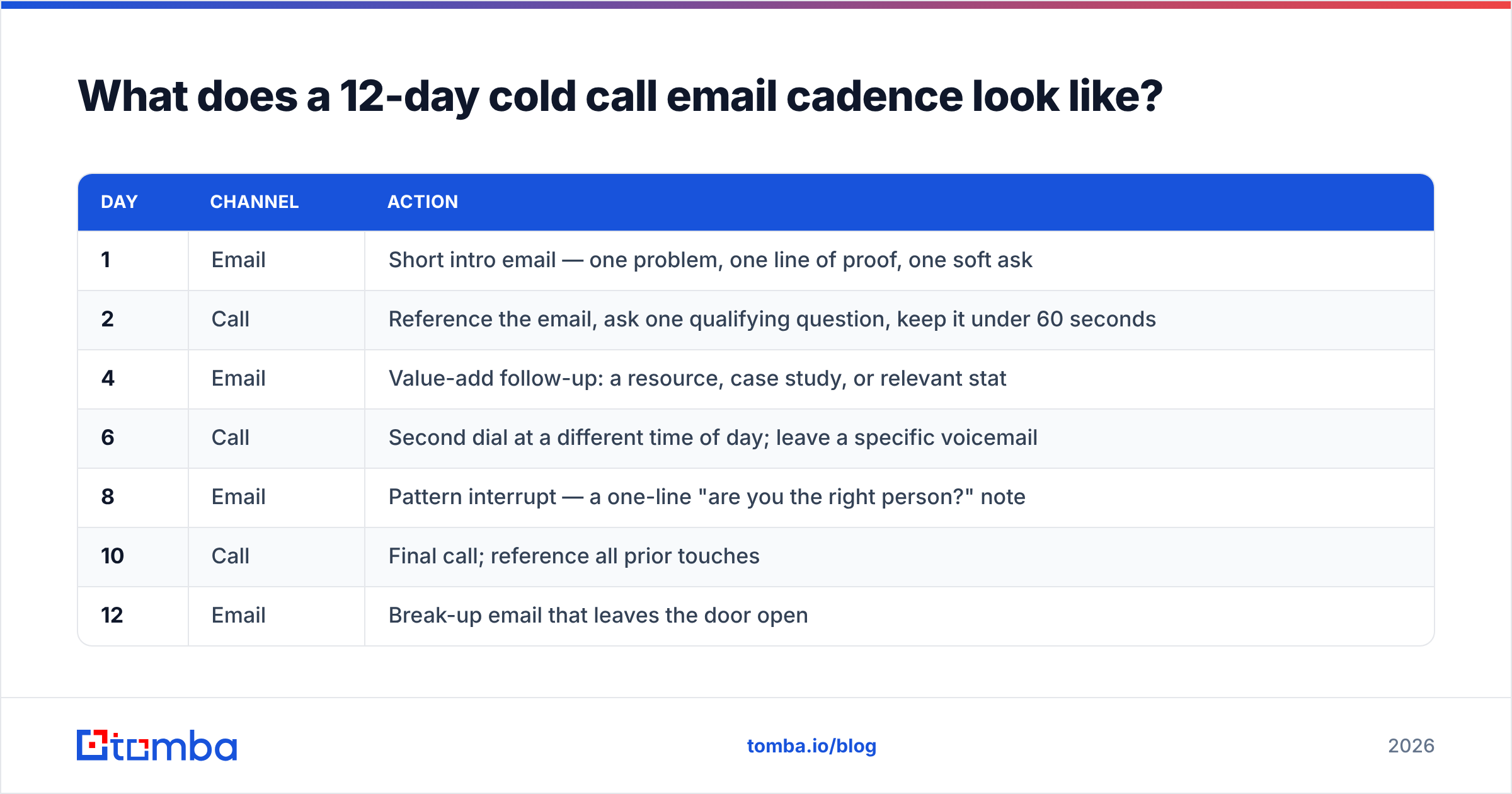
Below is a battle-tested structure you can copy. Adjust the spacing to your sales cycle, but keep the rhythm: never two touches of the same type back to back, and always give the email a beat to land before the call that references it.
| Day | Channel | Action |
|---|---|---|
| 1 | Short intro email — one problem, one line of proof, one soft ask | |
| 2 | Call | Reference the email, ask one qualifying question, keep it under 60 seconds |
| 4 | Value-add follow-up: a resource, case study, or relevant stat | |
| 6 | Call | Second dial at a different time of day; leave a specific voicemail |
| 8 | Pattern interrupt — a one-line "are you the right person?" note | |
| 10 | Call | Final call; reference all prior touches |
| 12 | Break-up email that leaves the door open |
A few rules that make this cadence work:
- Keep the first email under 90 words. Its only job is to earn the call, not close the deal.
- Vary your call times. Tuesday 8:10 a.m. and Thursday 4:40 p.m. reach different people. Never dial the same slot twice.
- Leave voicemails that reference the email. "I just sent you a note about X — call me back at this number" ties the channels together.
- Match subject lines to spoken openers. If your subject line was a question, open the call with the same question. Consistency builds recognition fast. A tool like the subject line generator helps you test angles before you commit.
Cadence is where most reps quietly fail. They send the email, skip the call because it's uncomfortable, and then wonder why "email doesn't work." The combo only pays off if you actually run both halves.
How do you write a cold call email that gets a reply?#
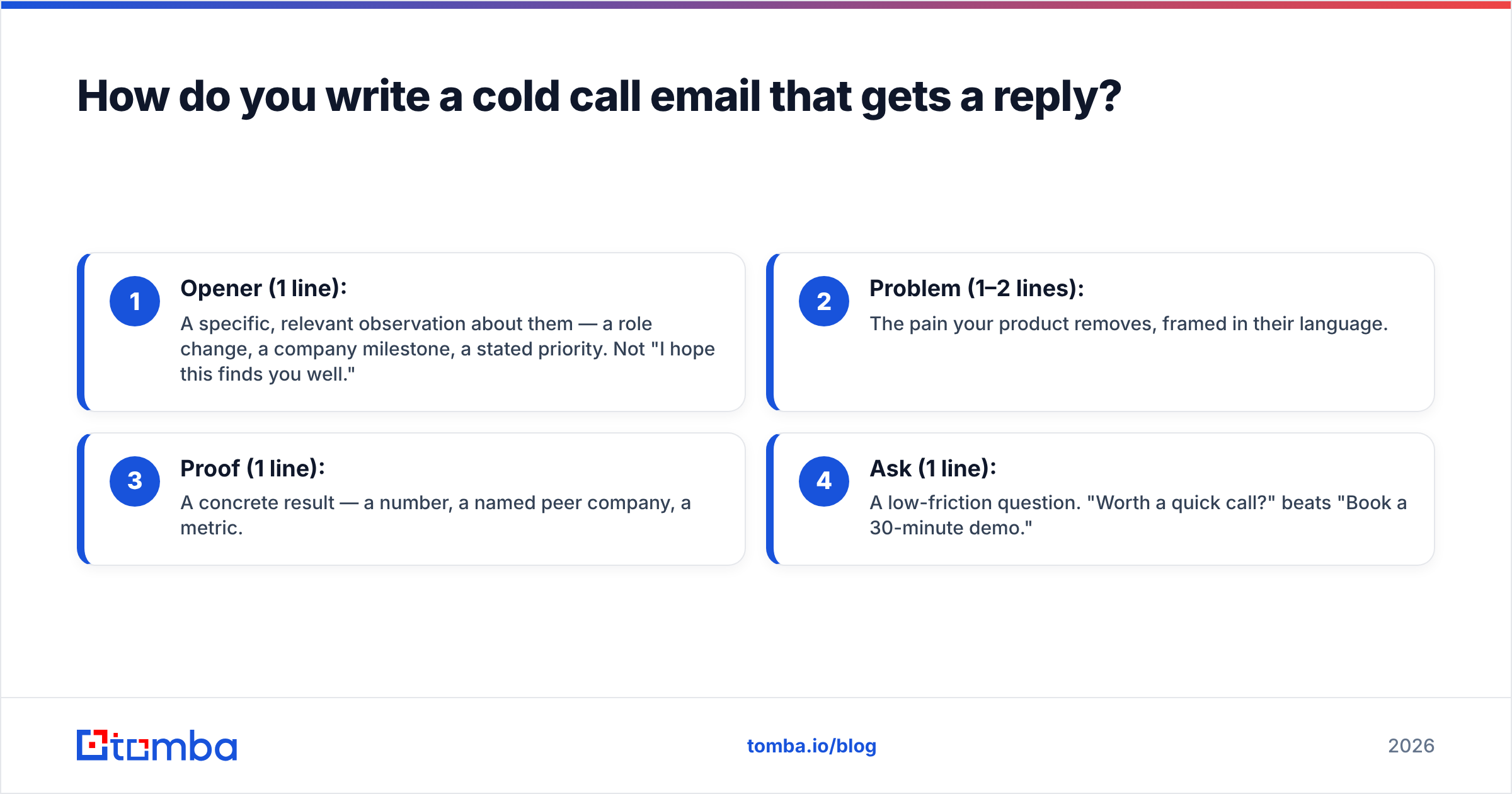
Write it like a text to a busy colleague, not a press release. The best cold call email is short, specific, and built around one idea the prospect actually cares about. If your email could be sent to a hundred people unchanged, it will perform like it.
Use this four-part skeleton:
- Opener (1 line): A specific, relevant observation about them — a role change, a company milestone, a stated priority. Not "I hope this finds you well."
- Problem (1–2 lines): The pain your product removes, framed in their language.
- Proof (1 line): A concrete result — a number, a named peer company, a metric.
- Ask (1 line): A low-friction question. "Worth a quick call?" beats "Book a 30-minute demo."
Here is a working example for a sales-tech seller:
Subject: Quick question about {{Company}}'s outbound
Hi {{First name}} — saw you're scaling the SDR team at {{Company}}. Most teams that grow that fast start burning through bad contact data and bounce rates climb. We helped {{Peer company}} cut bounces to under 2% and add ~3 hours of selling time per rep each week. Worth a quick call Thursday?
Notice what the email does not do: no five-paragraph pitch, no feature list, no calendar wall. It earns a reply or a "who is this?" — both of which give your follow-up call a reason to exist. If writing at volume slows you down, an AI cold email writer can draft the first version, but you still edit for the one detail that makes it feel human.
Why does contact data make or break the combo?#
Because a cold call email cadence dies the moment your data is wrong. A bad phone number is a wasted dial and a burned time slot. A bad email address is a hard bounce that drags down your email deliverability and pushes future messages into spam — for this prospect and everyone else on your domain. Run a combo on dirty data and you are paying double the cost for half the result.
Clean data does three things for the cadence:
- Protects your sending domain. Verifying addresses before you send keeps your bounce rate low and your inbox placement high. Use an email verifier as a standing step, not an afterthought.
- Keeps dials productive. Validated, direct-dial numbers mean your reps talk to humans instead of dead lines and wrong extensions. A phone finder that returns mobile and direct numbers is worth more than any script.
- Feeds personalization. Enriched records — title, company, seniority, recent role change — are the raw material for the specific opener that makes both the email and the call land.
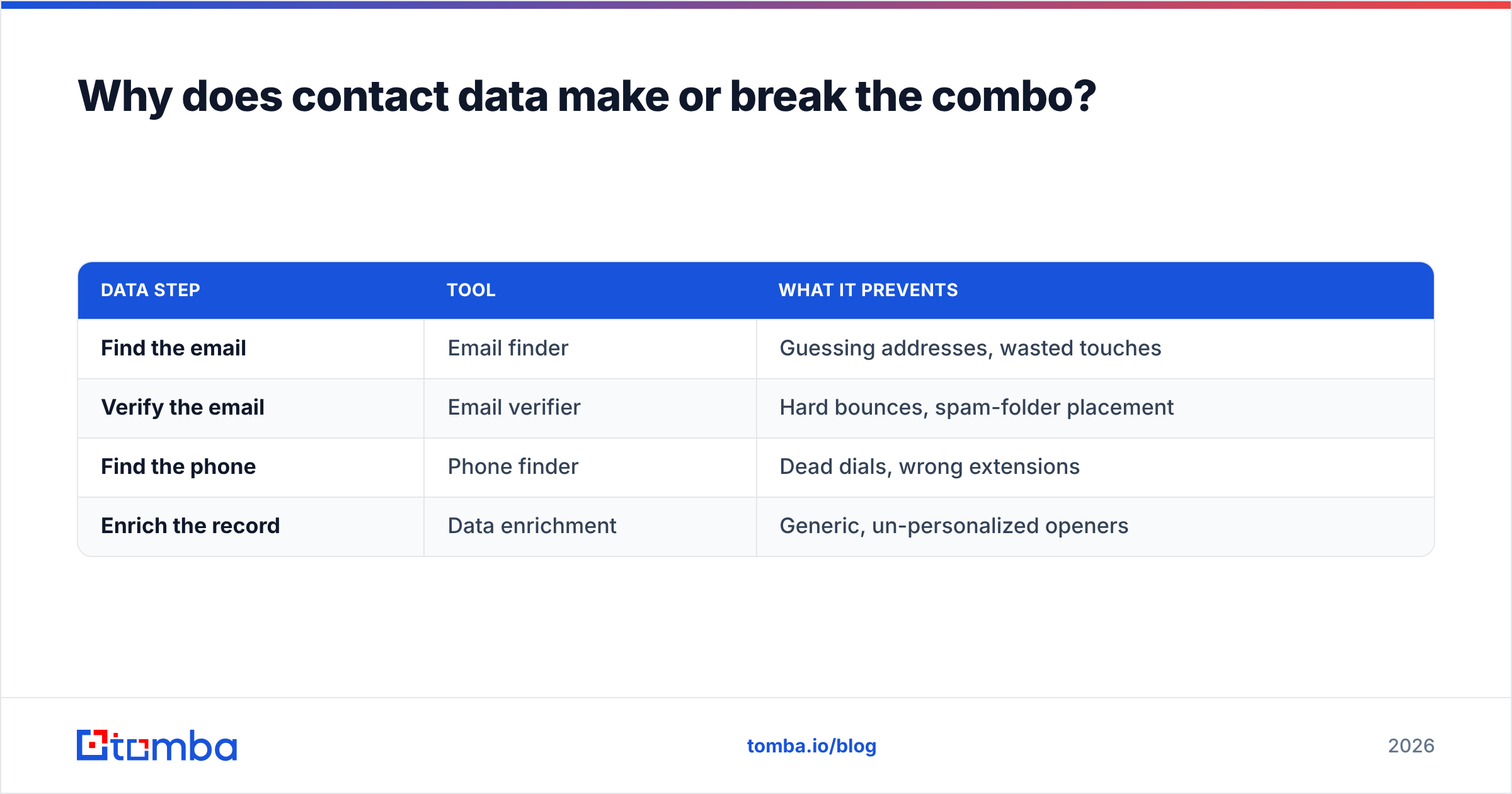
The build order is straightforward: find the right contact, verify the email, validate the phone, enrich the record, then load it into your cadence. Skip any step and the whole sequence inherits the weakness.
| Data step | Tool | What it prevents |
|---|---|---|
| Find the email | Email finder | Guessing addresses, wasted touches |
| Verify the email | Email verifier | Hard bounces, spam-folder placement |
| Find the phone | Phone finder | Dead dials, wrong extensions |
| Enrich the record | Data enrichment | Generic, un-personalized openers |
This is the unglamorous half of outbound, and it is exactly why most cold call email programs underperform. The message gets all the attention; the data gets none. Flip that ratio.
How do you measure whether the cadence is working?#
Measure the combo as a funnel, not as two separate scoreboards. The point of a cold call email cadence is that the channels assist each other, so tracking them in isolation hides the value. An email that gets opened but not answered still made the follow-up call warmer — count that.
Track these five metrics per cadence:
- Email open and reply rate — early signal that your targeting and subject lines are right.
- Call connect rate — how often a dial reaches a live human, not voicemail.
- Positive conversation rate — connects that turn into a real exchange, not a brush-off.
- Meetings booked per 100 prospects — the number that actually predicts pipeline.
- Bounce and bad-number rate — your data-quality alarm; if this creeps up, stop and clean the list.
Watch the response rate trend across the whole sequence rather than any single touch. If replies spike after the day-2 call, your email is doing its job as a warm-up. If dials only connect after the day-8 email, your voicemails are working. These cross-channel signals tell you what to double down on — insight you literally cannot get from a single-channel sequence.
Benchmark against your own baseline first, then against industry data. Peer-review sites like G2 publish category benchmarks that give you a rough sense of where healthy connect and reply rates land for your segment. Use them as guardrails, not gospel — your list quality and offer matter more than any published average.
Common mistakes that sink a cold call email cadence#
- Treating the channels as separate campaigns. If your email and your call never reference each other, you have two mediocre sequences instead of one strong one.
- Skipping the calls. The email half is comfortable; the call half is where the deals are. Reps who quietly drop the dials get email-only results and blame the strategy.
- Sending before verifying. One dirty list can spike your bounce rate and hurt deliverability for weeks. Verify first, always.
- Over-automating the voice. Automated emails are fine; robotic calls are not. Personalize the human touch.
- Giving up at touch two. Most replies and connects come after the third or fourth contact. A cadence that stops early leaves most of its pipeline on the table.
The bottom line#
Stop arguing about cold calling versus cold emailing. The winning move in 2026 is to run them as one coordinated cadence — email to warm, call to connect, repeat with discipline — on top of contact data clean enough to keep both channels healthy. The strategy is only as strong as the numbers and addresses behind it.
Start with the data. Use the Tomba Email Finder to find verified, deliverable email addresses by name, company, or domain, then layer in phone and enrichment so every touch in your cadence lands on a real, reachable person. You can test it on the free tier (25 searches a month), and paid plans start at $49/mo — see the full Tomba pricing for team-scale volume. Build the list right, and the cold call email combo does the rest.
Related guides#
Ready to find emails that actually work?
Join 150,000+ professionals who stopped guessing and started sending. Free credits on signup — no credit card required.
Get the Tomba newsletter
Practical outbound tactics and product updates — once every two weeks.
About the author