Cold Call Email Template: 9 Scripts That Get Replies in 2026
A cold call email template turns a missed dial into a booked meeting. Here are 9 proven pre-call and follow-up scripts, timing rules, and a framework you can copy today.
The phone rang out. Voicemail again. Most reps shrug and move on — and that is exactly where the deal dies. A well-built cold call email template is the difference between a dial that vanishes and a dial that turns into a reply, a callback, and eventually a booked meeting.
This guide gives you nine tested templates for the moments that actually matter: before the call, right after a missed call, after a voicemail, and after a real conversation. You also get a copy-paste framework, timing rules, and a comparison of when each type wins.
TL;DR#
- Pair every call with an email. Calls and emails work far better together than either does alone — the email gives the prospect context the voicemail can't.
- Match the template to the moment. A pre-call "warm-up," a post-voicemail nudge, and a post-conversation recap are three different jobs with three different scripts.
- Keep it under 90 words. Short, specific, one clear ask. Long emails after a cold call get ignored.
- Timing beats cleverness. Send the follow-up within an hour of the call while you're still top of mind, then space the sequence over 10–14 days.
- Reach the right inbox first. A perfect template sent to a wrong or dead address earns zero replies. Verify the address before you send.
Why send an email after a cold call at all?#
Because the call alone rarely lands. Cold call connect rates hover in the single digits, and most conversations that do happen are cut short. The email is your second channel — the one that survives after the prospect hangs up or ignores the ring.
Think of it like knocking on a door and leaving a note. The knock might go unanswered, but the note stays on the doorstep with your name, your reason for stopping by, and a simple next step. When you knock again, you're no longer a stranger.
There are three practical reasons a cold call email template outperforms improvising:
- Speed — you send within minutes instead of staring at a blank draft.
- Consistency — every rep on the team sends a message that matches your brand voice.
- Testing — a fixed template gives you a baseline you can measure and improve, one variable at a time.
Sales research from teams like HubSpot consistently shows that multi-touch, multi-channel sequences beat single-channel outreach. The email is not a consolation prize for a missed call — it's half the play.
What are the different types of cold call emails?#
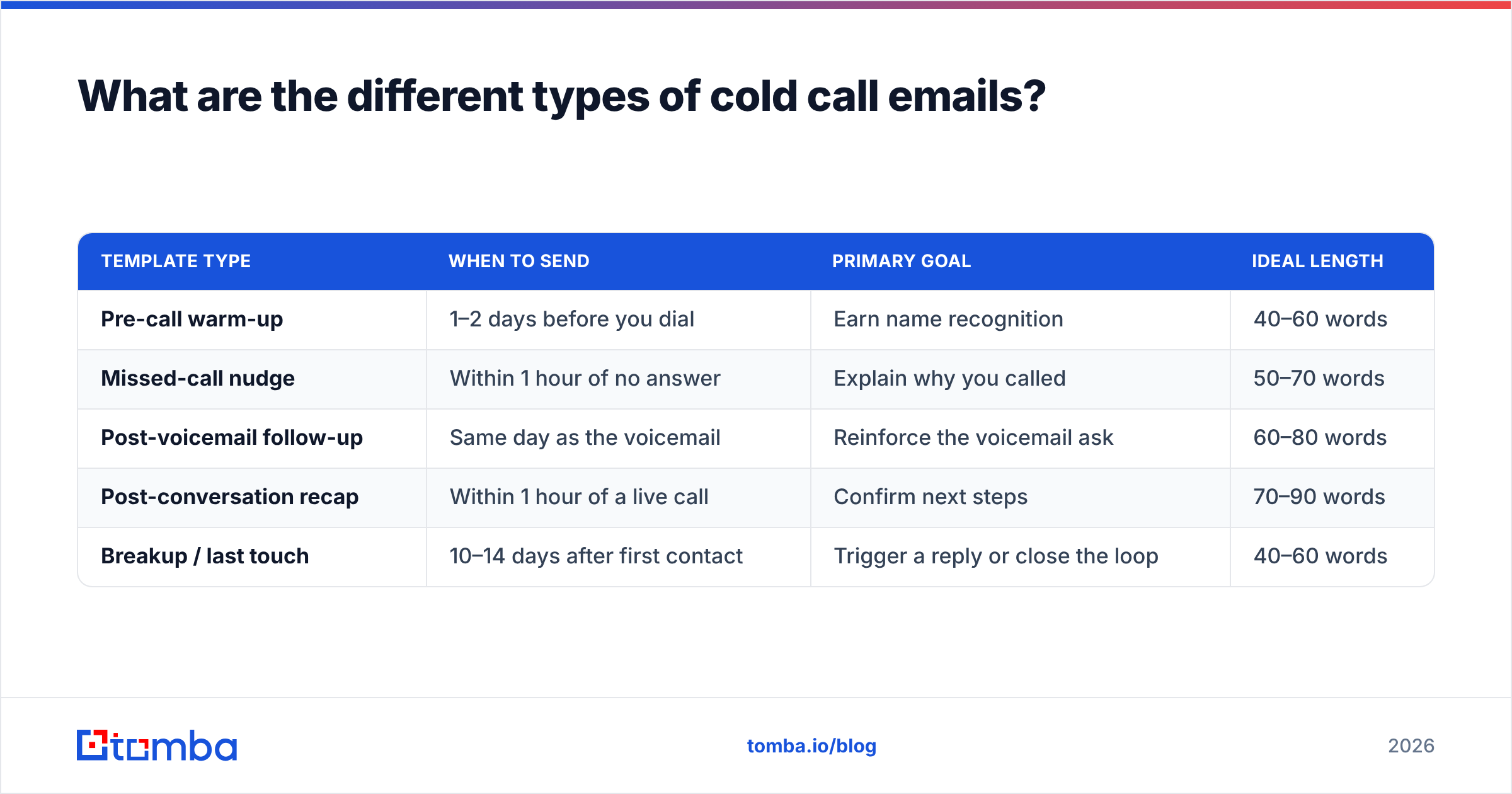
Not every post-call email does the same job. Sending a "great to connect" recap to someone who never picked up reads as tone-deaf. Match the template to the situation.
| Template type | When to send | Primary goal | Ideal length |
|---|---|---|---|
| Pre-call warm-up | 1–2 days before you dial | Earn name recognition | 40–60 words |
| Missed-call nudge | Within 1 hour of no answer | Explain why you called | 50–70 words |
| Post-voicemail follow-up | Same day as the voicemail | Reinforce the voicemail ask | 60–80 words |
| Post-conversation recap | Within 1 hour of a live call | Confirm next steps | 70–90 words |
| Breakup / last touch | 10–14 days after first contact | Trigger a reply or close the loop | 40–60 words |
Read the table top to bottom and you'll notice the goal shifts from "get noticed" to "confirm a commitment." Your language should shift with it — softer and curiosity-driven early, direct and specific once there's momentum.
What is the best cold call email template framework?#
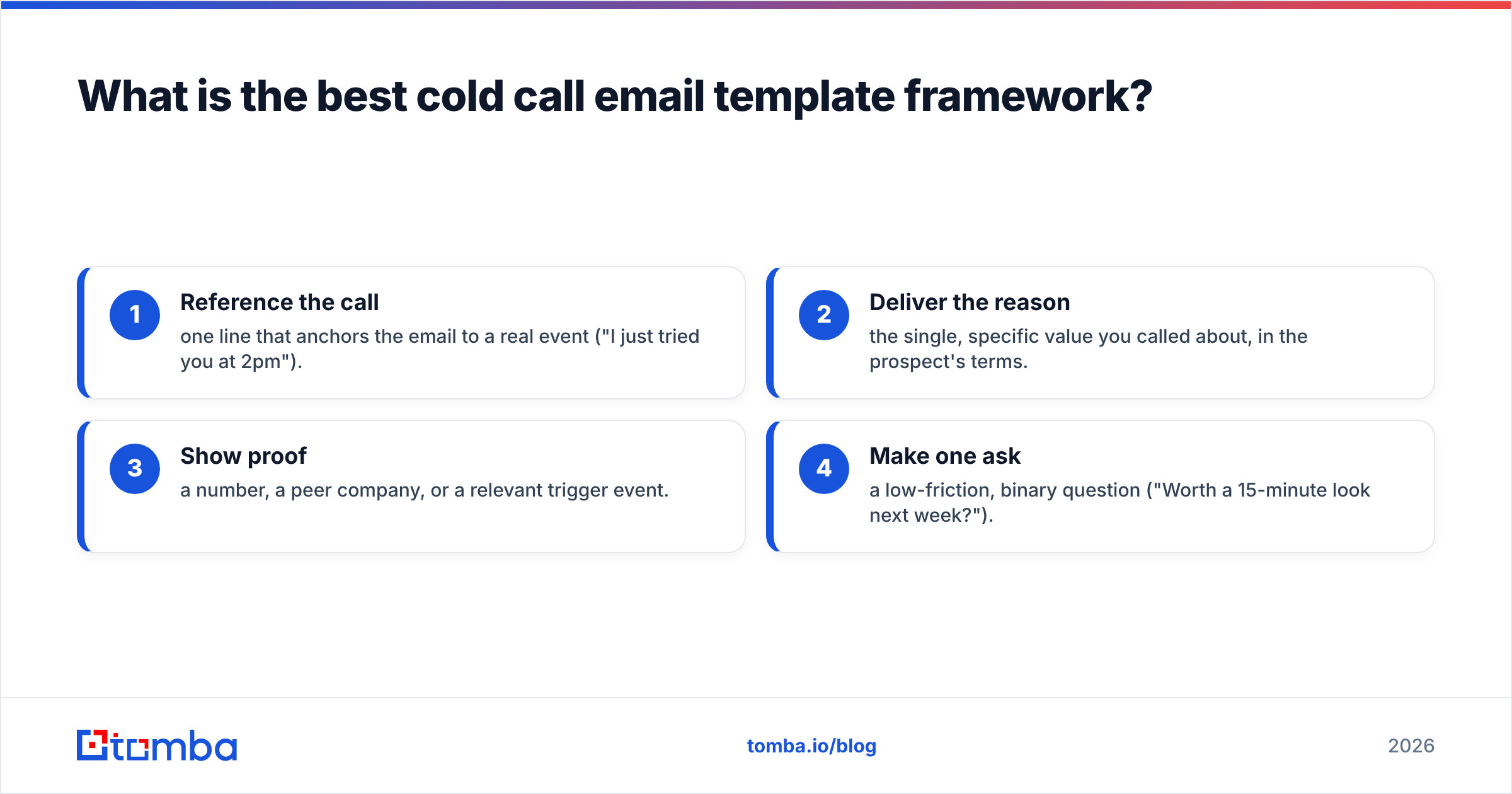
The best framework is a four-line skeleton you can fill in under two minutes. Every template below follows it.
- Reference the call — one line that anchors the email to a real event ("I just tried you at 2pm").
- Deliver the reason — the single, specific value you called about, in the prospect's terms.
- Show proof — a number, a peer company, or a relevant trigger event.
- Make one ask — a low-friction, binary question ("Worth a 15-minute look next week?").
Keep the subject line short and human. Tools like a subject line generator help, but the winners are usually plain: "Quick call attempt" or "Following up on my call." Avoid anything that smells like a mass blast.
9 cold call email templates you can copy#
Below are the scripts. Swap the brackets for real details — the more specific, the better the reply rate.
1. Pre-call warm-up#
Subject: Quick question before I call
Hi [First name],
I'm planning to reach out by phone this week about [specific outcome, e.g. cutting your data-cleanup time]. Before I do — are you the right person to talk to about [area], or should I speak with someone on your team?
Thanks,
[Your name]
2. Missed-call nudge#
Subject: Just tried you
Hi [First name],
I called a few minutes ago about [reason]. I'll keep it short: [peer company] used us to [result], and I thought it might be relevant to [their company]. Is a quick call next week worth it, or is now not the time?
[Your name]
3. Post-voicemail follow-up#
Subject: Following up on my voicemail
Hi [First name],
I left you a voicemail earlier about [reason]. In case listening is a hassle, here's the gist: teams like yours are [pain], and we help by [one-line solution]. Are you open to a 15-minute look Thursday or Friday?
[Your name]
4. Post-conversation recap#
Subject: Recap + next step
Hi [First name],
Thanks for the few minutes today. As promised, here's the one thing I'd focus on: [insight from the call]. Next step you mentioned was [action]. I've got [day/time] open — does that still work?
[Your name]
5. Trigger-event follow-up#
Subject: Saw [event] — congrats
Hi [First name],
I tried calling after seeing [funding round / new hire / product launch]. Companies at that stage usually hit [specific challenge]. We've helped [peer] get past it in [timeframe]. Want the two-minute version?
[Your name]
6. Referral bridge#
Subject: [Colleague] suggested I reach out
Hi [First name],
[Colleague] mentioned you own [area], so I tried you by phone today. The short reason: [value]. If it's easier, reply here and I'll send times — no call required to start.
[Your name]
7. Value-add, no-ask#
Subject: Thought this might help
Hi [First name],
No pitch here — I called earlier but figured I'd just share this: [resource / benchmark relevant to them]. If it's useful and you want to talk through it, I'm around. If not, no worries at all.
[Your name]
8. Second-attempt nudge#
Subject: Round two
Hi [First name],
Tried you again today — I know timing is everything, so I'll stop guessing. Would [Tuesday 10am] or [Wednesday 2pm] be easier for a quick call about [reason]?
[Your name]
9. Breakup / last touch#
Subject: Closing the loop
Hi [First name],
I've reached out a couple of times about [reason] and haven't caught you — which usually means it's not a priority right now. I'll stop here. If that changes, my line's open. All the best.
[Your name]
You'll notice none of these run long or lean on adjectives. That restraint is the point. If you want more structures to test, a library of cold email templates is a good place to pull variations without starting from scratch.
How do you write cold call follow-up emails that get replies?#
Follow one rule above all: make the reply easy. A binary question ("Worth a look, or not right now?") gets answered more often than an open-ended "let me know your thoughts." The prospect can respond in three words.
A few field-tested habits:
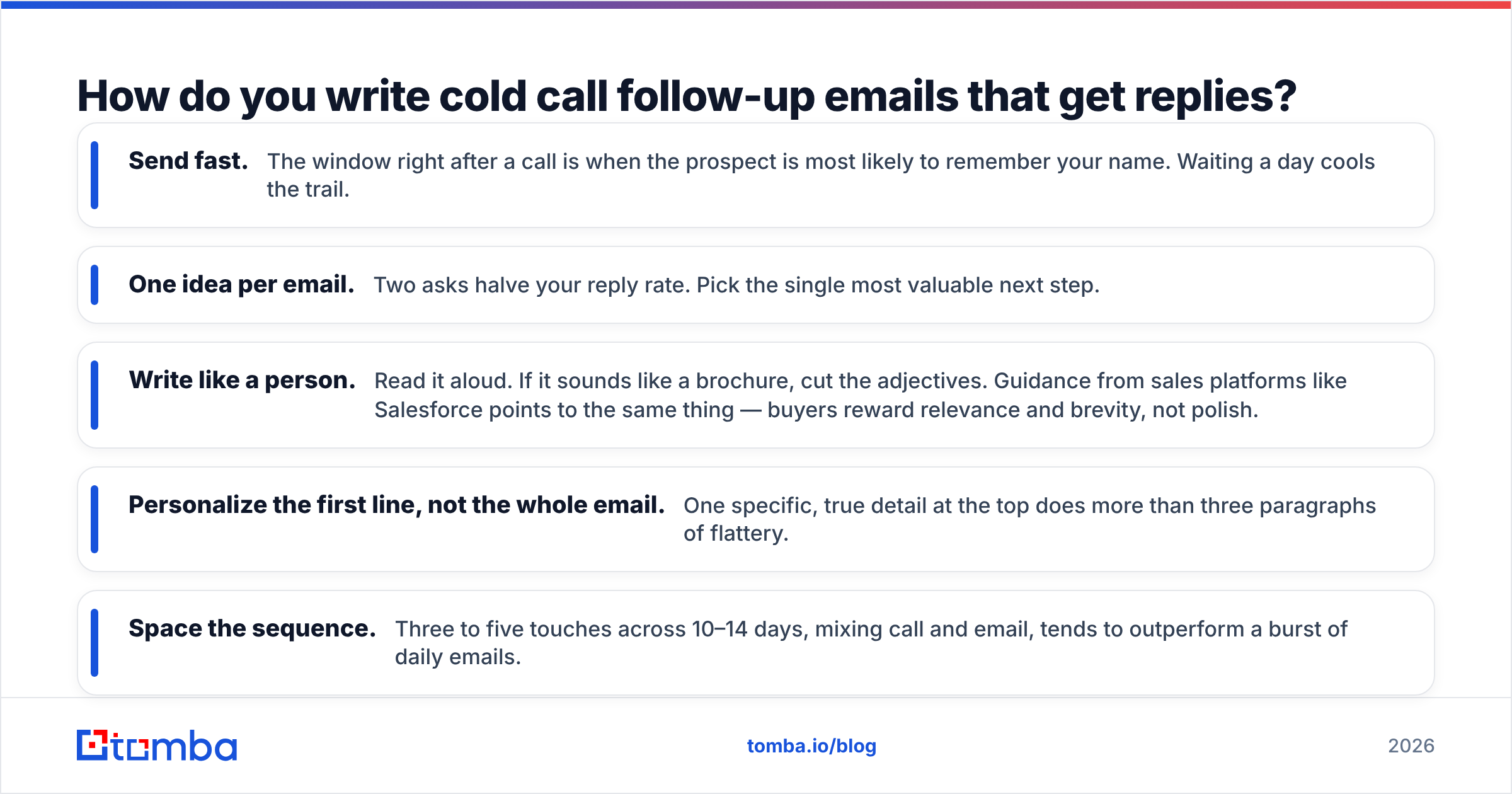
- Send fast. The window right after a call is when the prospect is most likely to remember your name. Waiting a day cools the trail.
- One idea per email. Two asks halve your reply rate. Pick the single most valuable next step.
- Write like a person. Read it aloud. If it sounds like a brochure, cut the adjectives. Guidance from sales platforms like Salesforce points to the same thing — buyers reward relevance and brevity, not polish.
- Personalize the first line, not the whole email. One specific, true detail at the top does more than three paragraphs of flattery.
- Space the sequence. Three to five touches across 10–14 days, mixing call and email, tends to outperform a burst of daily emails.
For the actual copy, an AI cold email writer can draft a first pass you then trim to fit the framework above. Treat it as a starting draft, never a send-as-is.
Why do great templates still get zero replies?#
Because the message reached the wrong inbox — or no inbox at all. This is the quiet killer of cold outreach: you can nail the script, the timing, and the ask, and still get silence because the email address was a guess.
Two things separate a template that converts from one that bounces:
- Accurate contact data. If you're pulling numbers and emails from a stale list, half your sequence is dead on arrival. A reliable email finder gets you the real professional address tied to the person you actually called.
- Verified deliverability. Even a real-looking address can be a dead mailbox or a spam trap. Running the list through an email verifier before you send protects your sender reputation and keeps your bounce rate low.
Pairing the call with a verified email — and, where the deal warrants it, a direct line pulled from a phone finder — is what turns a template into a repeatable channel instead of a coin flip. You can compare tools on independent sites like G2 if you want third-party benchmarks before committing.
How often should you follow up after a cold call?#
Three to five touches over two weeks, then stop. Persistence works up to a point; past it, you're training the prospect to ignore you.
A simple, humane cadence:
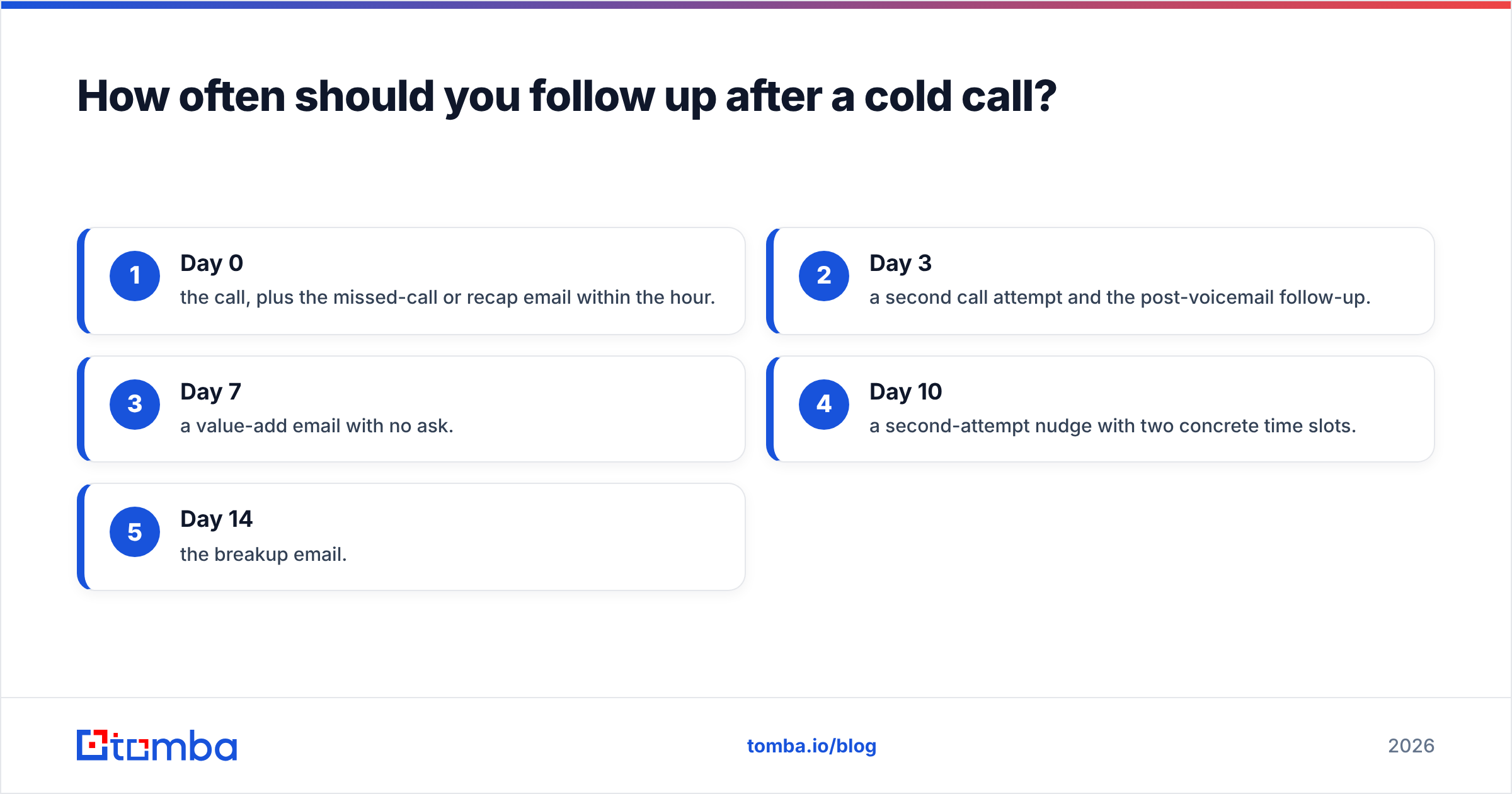
- Day 0 — the call, plus the missed-call or recap email within the hour.
- Day 3 — a second call attempt and the post-voicemail follow-up.
- Day 7 — a value-add email with no ask.
- Day 10 — a second-attempt nudge with two concrete time slots.
- Day 14 — the breakup email.
Space matters more than volume. If you crowd five emails into three days, you look desperate; spread across two weeks, you look consistent. And every touch should carry a slightly different angle — a new proof point, a new time slot, a new resource — so you never send the same message twice.
Which template should you start with?#
Start with the missed-call nudge (template 2). It's the highest-leverage moment: you just dialed, the prospect didn't answer, and a 50-word email sent within the hour catches them while your name is still fresh. Get that one working, measure the reply rate, then layer in the voicemail and recap templates.
Once your reply rate stabilizes, test one variable at a time — subject line, first sentence, or the ask — so you always know what moved the number.
Put your cold call email templates to work#
Templates are only as good as the contacts they reach. Before your next sequence, make sure every name on the list maps to a real, verified inbox — otherwise your best script is talking to no one.
Start with Tomba's Email Finder. Drop in a name and company, get the verified professional email, and pair it with the templates above. The free tier includes 25 searches a month, and paid Tomba plans start at $49/mo when you're ready to scale outreach across the whole team. Fewer bounces, more replies, more meetings booked from calls that used to end in voicemail.
Related guides#
// get started
Find, verify and enrich your first contacts today
Start on the free plan with 25 searches a month, then scale when your team is ready.
Free plan · No credit card required · GDPR & CCPA
// about the author