The Cold Call Framework That Books More Meetings in 2026
A repeatable cold call framework beats a clever script every time. Here are the seven stages, the exact openers, and the data prep that turns dials into booked meetings.
Most cold calls fail before the rep says a word. Not because the pitch is weak, but because there is no framework underneath it — just a rep improvising against a stranger who already has a hand on the "not interested" button. A cold call framework fixes that. It gives every call the same skeleton so you can measure what works, coach what doesn't, and repeat what books meetings.
This guide breaks down a seven-stage cold call framework you can run today, with the exact language for each stage, the objections you'll hit, and the pre-call data work that separates a 3% connect rate from a 12% one.
TL;DR#
- A cold call framework is a repeatable structure — opener, permission, reason, discovery, pitch, objection handling, close — not a word-for-word script.
- The opener decides the call: earn the next 30 seconds before you pitch anything.
- Talk less than you think. Top reps let the prospect speak ~55% of the time.
- Objections are buying signals in disguise; acknowledge, reframe, then ask.
- The framework only works on good data. Wrong number, wrong person, wasted dial — verify contacts before you call.
What is a cold call framework?#
A cold call framework is a fixed sequence of stages that every call moves through, regardless of who picks up. Think of it like a pilot's pre-flight checklist: the pilot has done a thousand takeoffs, but they still run the list every time because skipping a step is how things crash. The framework isn't there to make you robotic — it's there to free up your attention for the human on the other end.
The difference between a script and a framework matters. A script tells you exactly what to say. A framework tells you what each part of the call needs to accomplish, and lets you adapt the words to the person. Scripts break the moment a prospect goes off-rails. Frameworks bend.
Here are the seven stages every strong cold call framework shares:
- Opener — earn attention and disarm the reflex to hang up.
- Permission — get a micro-yes to keep talking.
- Reason for the call — a one-sentence, prospect-centered why.
- Discovery — two or three sharp questions to surface a problem.
- Value pitch — connect their problem to your outcome, not your features.
- Objection handling — acknowledge, reframe, re-ask.
- Close — ask for one specific next step (usually a 15-minute meeting).
Why do most cold calls fail?#
Because reps skip straight to stage five. They open with a pitch instead of earning the right to give one. The prospect's brain reads "sales call," the shutters come down, and the next 20 seconds are a polite race to hang up.
The other big failure is data. According to research compiled by HubSpot, the average sales rep makes dozens of dials to book a single meeting — and a large share of those dials never connect at all because the number is wrong, the direct dial is actually a switchboard, or the contact left the company months ago. No framework survives contact with bad data.
The third failure is talk ratio. Reps who dominate the call convert worse. Conversation-intelligence data from Gong consistently shows top performers listen more than they talk. A framework helps here too: discovery is a stage, so you're structurally forced to shut up and ask.
The 7-stage cold call framework, step by step#
Stage 1 — The opener (first 10 seconds)#
Your only job is to sound like a person, not a pitch. Use the prospect's name, introduce yourself plainly, and be honest that it's a cold call. Pattern interrupts work because they're unexpected.
"Hi Sarah, it's Alex from Tomba. I'll be honest — this is a cold call. Do you want to hang up, or can I take 30 seconds to tell you why I called?"
That honesty disarms the reflex. Most people say "go on" because you gave them control.
Stage 2 — Permission#
Never barrel forward. The micro-yes ("sure, 30 seconds") is a commitment device — the prospect has now agreed to listen, so they listen. Skipping permission is the single most common framework mistake.
Stage 3 — Reason for the call#
One sentence, framed around them. Not "we're an email-finder platform." Instead: "I called because teams like yours are burning half their dials on bad numbers, and I had a hunch that might be happening to you too."
Stage 4 — Discovery#
Ask two or three questions that surface a real problem. Keep them open:
- "How are you sourcing direct dials for outbound right now?"
- "What's your connect rate looking like this quarter?"
- "When a number bounces, who eats that time — the rep or an ops person?"
Discovery is where the meeting actually gets booked. The pitch just names the problem they admitted to.
Stage 5 — Value pitch#
Now — and only now — connect their answer to an outcome. Tie it to a number: "Reps we work with go from roughly a 4% connect rate to double digits because every number is verified before they dial." Outcomes sell. Features don't.
Stage 6 — Objection handling#
Objections aren't rejection; they're the prospect telling you what's in the way. Use Acknowledge → Reframe → Re-ask:
- "We already have a data provider." → "Totally fair — most teams do. The ones who switch usually do it because their old list decays faster than they refresh it. Out of curiosity, when did you last check your bounce rate?"
Stage 7 — The close#
Ask for one specific, low-friction next step. Not "does that sound interesting?" — that invites a no. Instead: "How's Thursday at 2pm for a 15-minute walkthrough?" Specific asks book meetings.
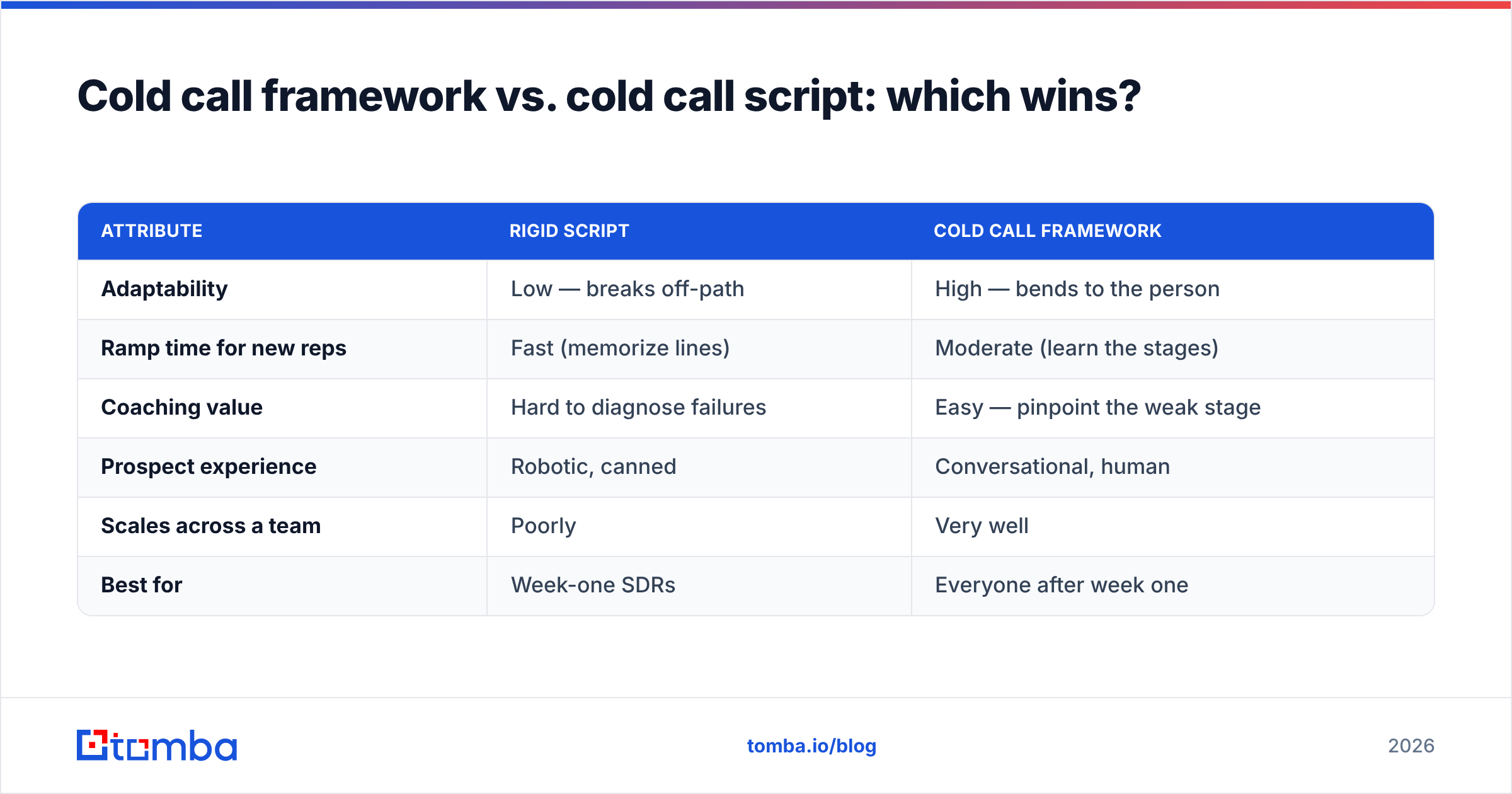
Cold call framework vs. cold call script: which wins?#
Both have a place, but they solve different problems. A script is training wheels; a framework is how you actually ride.
| Attribute | Rigid Script | Cold Call Framework |
|---|---|---|
| Adaptability | Low — breaks off-path | High — bends to the person |
| Ramp time for new reps | Fast (memorize lines) | Moderate (learn the stages) |
| Coaching value | Hard to diagnose failures | Easy — pinpoint the weak stage |
| Prospect experience | Robotic, canned | Conversational, human |
| Scales across a team | Poorly | Very well |
| Best for | Week-one SDRs | Everyone after week one |
New reps should start with a light script inside the framework, then drop the exact wording as they gain reps. The framework never goes away.
What data does a cold call framework need to work?#
Everything above assumes you're dialing the right person at the right number. Skip that and the best framework on earth just leaves better voicemails for the wrong contact.
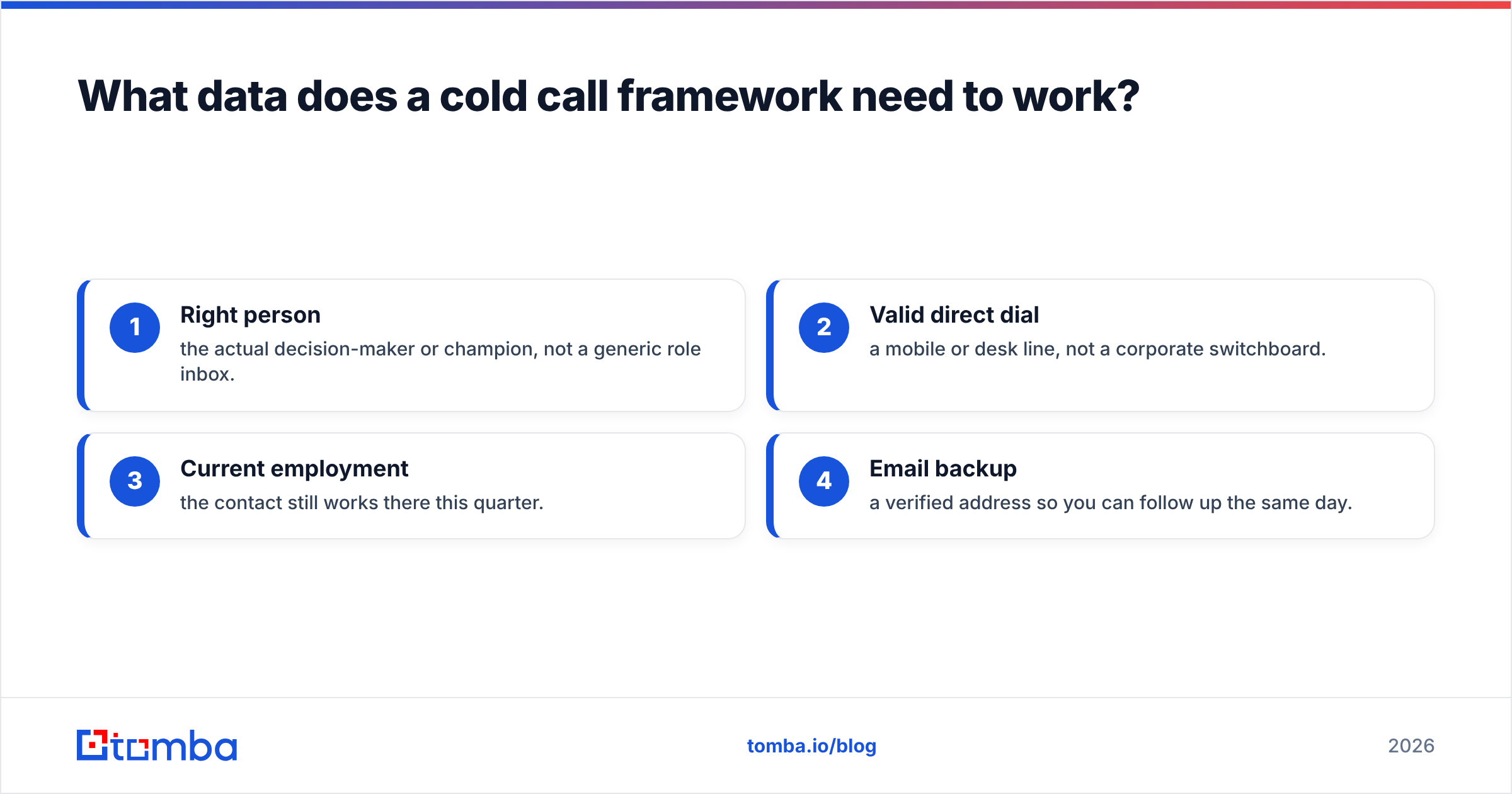
Before a single dial, your list should be cleaned for four things:
- Right person — the actual decision-maker or champion, not a generic role inbox.
- Valid direct dial — a mobile or desk line, not a corporate switchboard.
- Current employment — the contact still works there this quarter.
- Email backup — a verified address so you can follow up the same day.
This is where your prep stack matters. Use a phone finder to source B2B direct dials, run them through a phone validator so you're not burning dials on dead lines, and keep a verified email finder result on hand for the "send me something" close. Ten minutes of data prep changes your connect rate more than any opener tweak.
You can compare tooling costs on the Tomba pricing page — the free tier is enough to test the workflow before you commit.
How do you measure if the framework is working?#
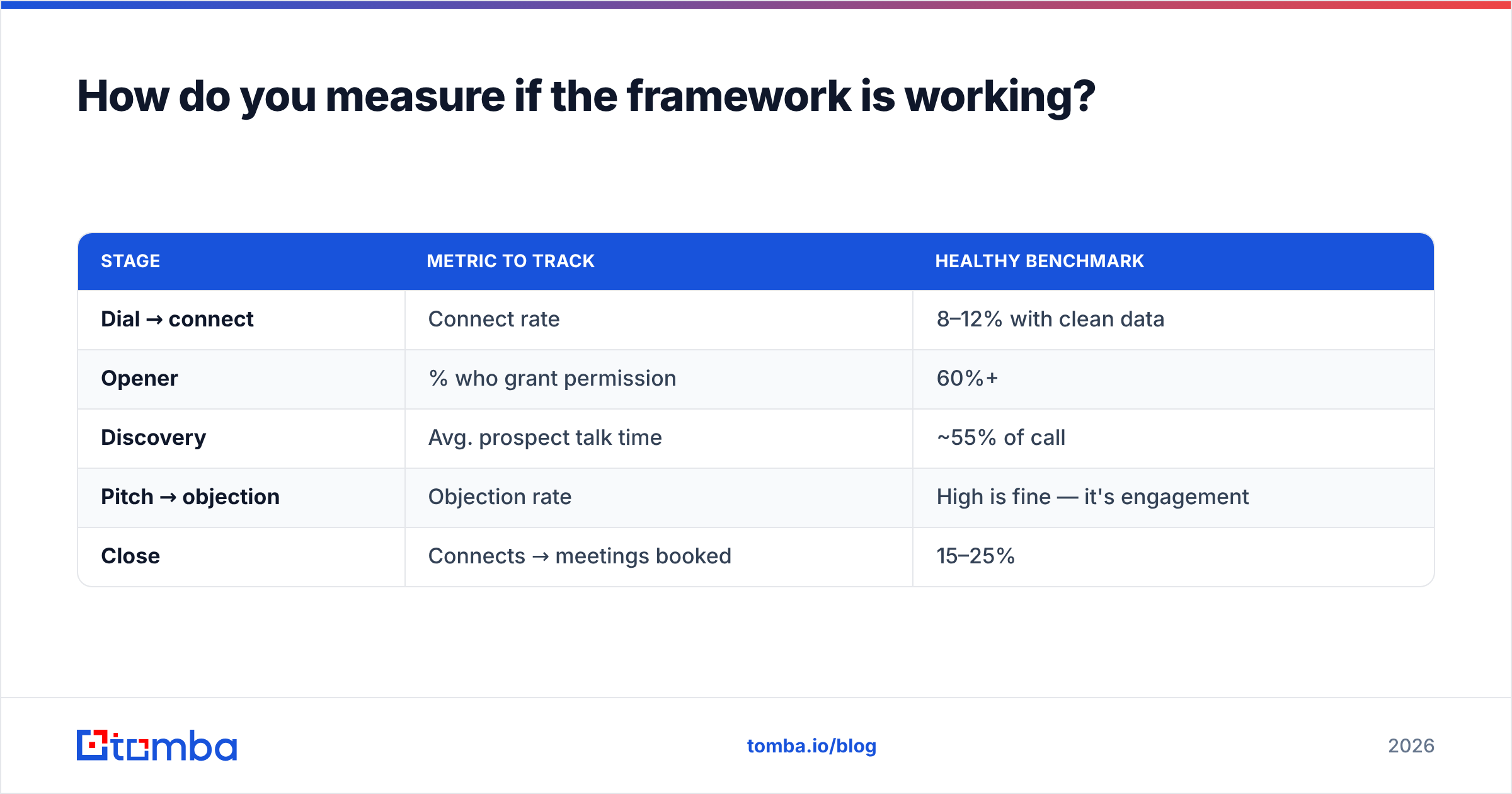
You measure per stage, not just the final meeting count. That's the whole point of a framework — each stage is a metric you can isolate and coach.
| Stage | Metric to track | Healthy benchmark |
|---|---|---|
| Dial → connect | Connect rate | 8–12% with clean data |
| Opener | % who grant permission | 60%+ |
| Discovery | Avg. prospect talk time | ~55% of call |
| Pitch → objection | Objection rate | High is fine — it's engagement |
| Close | Connects → meetings booked | 15–25% |
If your connect rate is under 5%, the problem is data, not delivery — fix the list before you touch the script. If people grant permission but never book, your discovery is too shallow. Isolating the leak is only possible because the framework named the stages for you.
Third-party review sites like G2 are useful for benchmarking which data tools reps actually rate for direct-dial accuracy, so you're not guessing when you build the stack.
Common mistakes that break the framework#
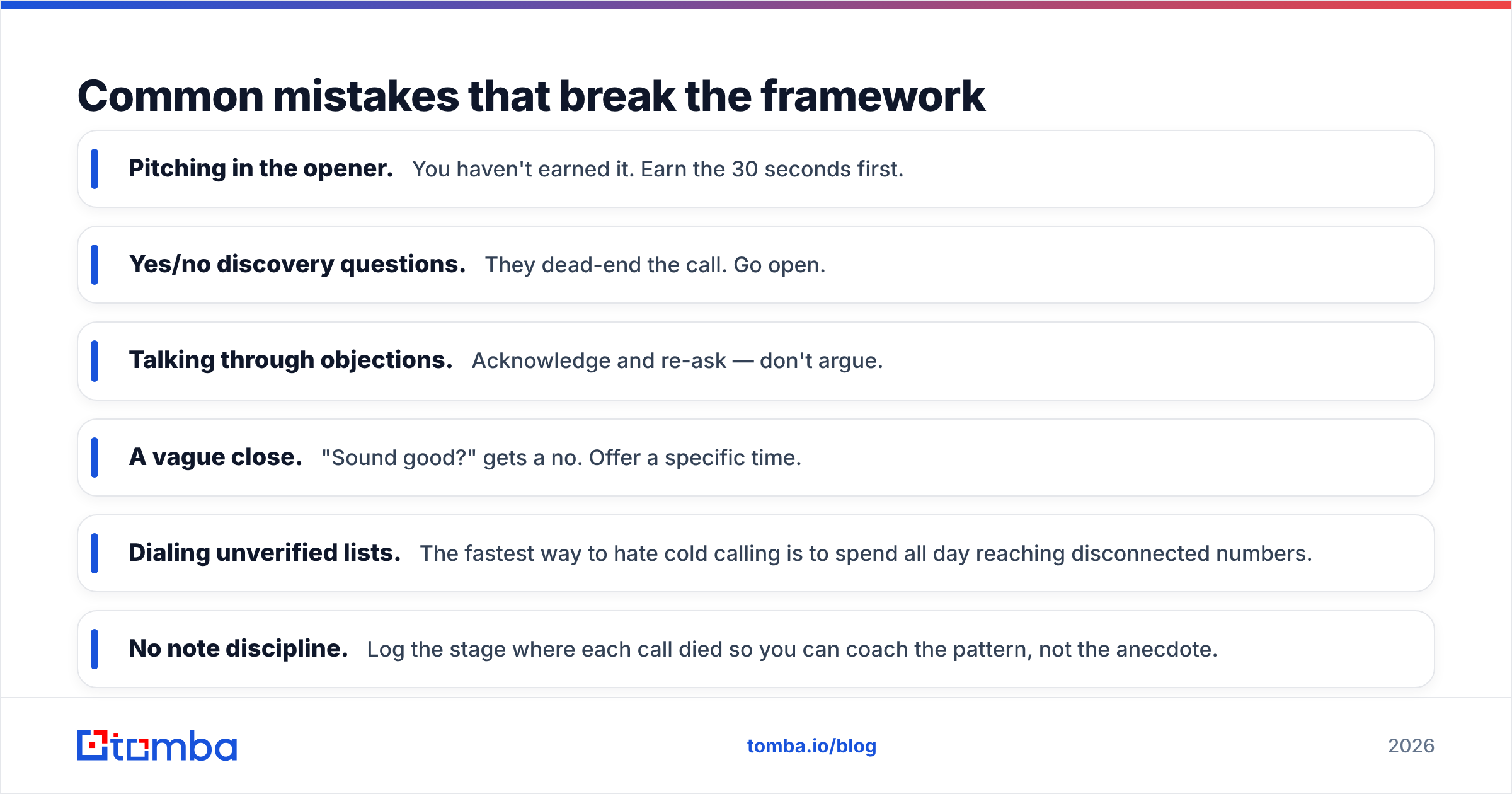
- Pitching in the opener. You haven't earned it. Earn the 30 seconds first.
- Yes/no discovery questions. They dead-end the call. Go open.
- Talking through objections. Acknowledge and re-ask — don't argue.
- A vague close. "Sound good?" gets a no. Offer a specific time.
- Dialing unverified lists. The fastest way to hate cold calling is to spend all day reaching disconnected numbers.
- No note discipline. Log the stage where each call died so you can coach the pattern, not the anecdote.
How long until a cold call framework produces results?#
Give it two full weeks of consistent volume before you judge it. Frameworks reward reps because they compound — every call feeds the per-stage data, and the data tells you exactly what to fix next week. A rep winging it never gets that feedback loop; they just get a different bad call every time.
The teams that win at outbound aren't the ones with the smoothest voice. They're the ones running the same seven stages on clean data, day after day, until the pattern is muscle memory.
Start with the data, then run the framework#
A cold call framework turns a nerve-wracking cold dial into a repeatable process you can measure and improve. But it only pays off when every number you dial is real and every contact is current. Prep the list, verify the direct dials, and keep a verified email ready for follow-up — then run the seven stages until they're second nature.
Ready to stop wasting dials on dead numbers? Use the Tomba Email Finder to build verified, decision-maker contact lists — with direct dials and backup emails — before your next calling block. Start on the free tier and give your framework the clean data it needs to actually book meetings.
Related guides#
Ready to find emails that actually work?
Join 150,000+ professionals who stopped guessing and started sending. Free credits on signup — no credit card required.
Get the Tomba newsletter
Practical outbound tactics and product updates — once every two weeks.
About the author