How to Write a Cold Call Introduction Email That Converts
A cold call introduction email warms the line before you dial. Here are 7 proven templates, subject lines, and a timing playbook that lift connect and reply rates.
TL;DR
- A cold call introduction email is a short message sent before or right after a cold call to give the prospect context, build recognition, and lower the wall before you dial.
- The best ones are under 90 words, lead with relevance (not your pitch), and make one clear ask.
- Pairing an intro email with a call lifts connect and reply rates because familiarity beats a cold, unknown number.
- Templates below cover pre-call warm-ups, post-voicemail follow-ups, and "sorry I missed you" recovery notes.
- Deliverability is the silent killer: a wrong or unverified address means your intro never lands, so verify before you send.
What is a cold call introduction email?#
A cold call introduction email is a brief, personalized email you send around a cold call to create recognition before or after you speak. Think of it like knocking before you walk into a room. Instead of a stranger's number lighting up a prospect's phone, they've already seen your name, understood why you're reaching out, and formed a first impression on their own terms.
It is not a full pitch. It is not a newsletter. It is a bridge between "who is this?" and "oh, that person." The email does one job: reduce friction so the call gets answered, or the voicemail gets returned.
There are three common moments to use one:
- Pre-call warm-up — sent 1–2 days before you dial so your name is familiar when the phone rings.
- Post-voicemail follow-up — sent minutes after a missed call to reinforce the message you just left.
- "Sorry I missed you" recovery — sent when a call goes unanswered, giving the prospect an easy async path to respond.
According to HubSpot's sales research, multi-channel sequences that combine email and phone consistently outperform single-channel outreach. The intro email is the connective tissue that makes the whole sequence feel coordinated rather than random.
Why does a cold call introduction email work better than a cold dial alone?#
Because recognition changes behavior. A prospect who has seen your name is measurably more likely to pick up, and far more likely to give you 30 seconds instead of a reflexive "not interested."
Cold dialing from zero context forces the prospect to make a snap judgment in the first two seconds. An intro email spreads that decision across two channels and two moments, which lowers the pressure on any single interaction. Research summarized by Gong's revenue analytics repeatedly shows that framing and relevance early in an interaction drive whether the conversation continues at all.
Here's the practical difference:
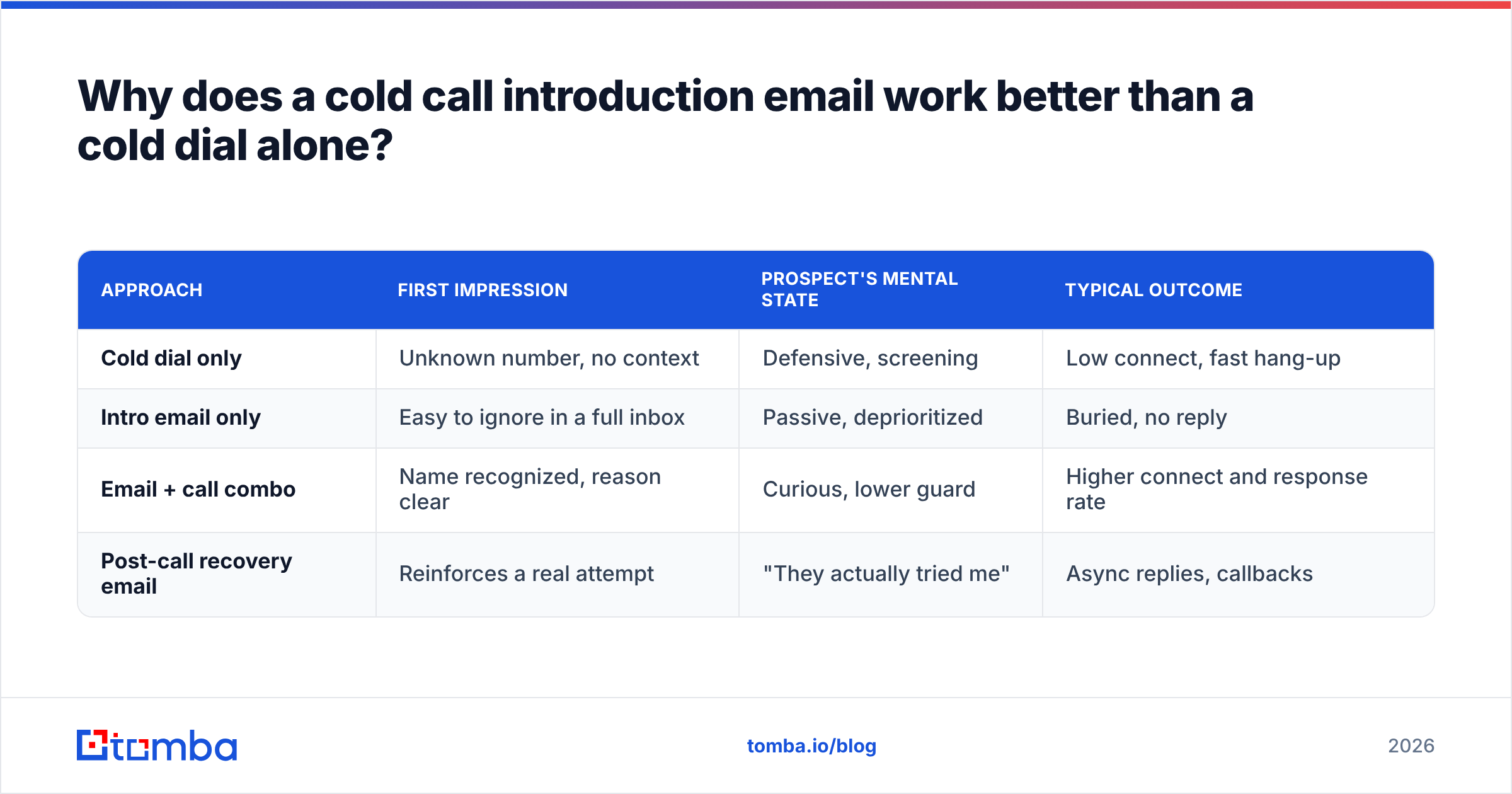
| Approach | First impression | Prospect's mental state | Typical outcome |
|---|---|---|---|
| Cold dial only | Unknown number, no context | Defensive, screening | Low connect, fast hang-up |
| Intro email only | Easy to ignore in a full inbox | Passive, deprioritized | Buried, no reply |
| Email + call combo | Name recognized, reason clear | Curious, lower guard | Higher connect and response rate |
| Post-call recovery email | Reinforces a real attempt | "They actually tried me" | Async replies, callbacks |
The combo wins because each channel covers the other's weakness. Email gives context that a 15-second call can't. The call gives urgency and a human voice that email can't. Used together, they compound.
What are the core elements of a high-converting intro email?#
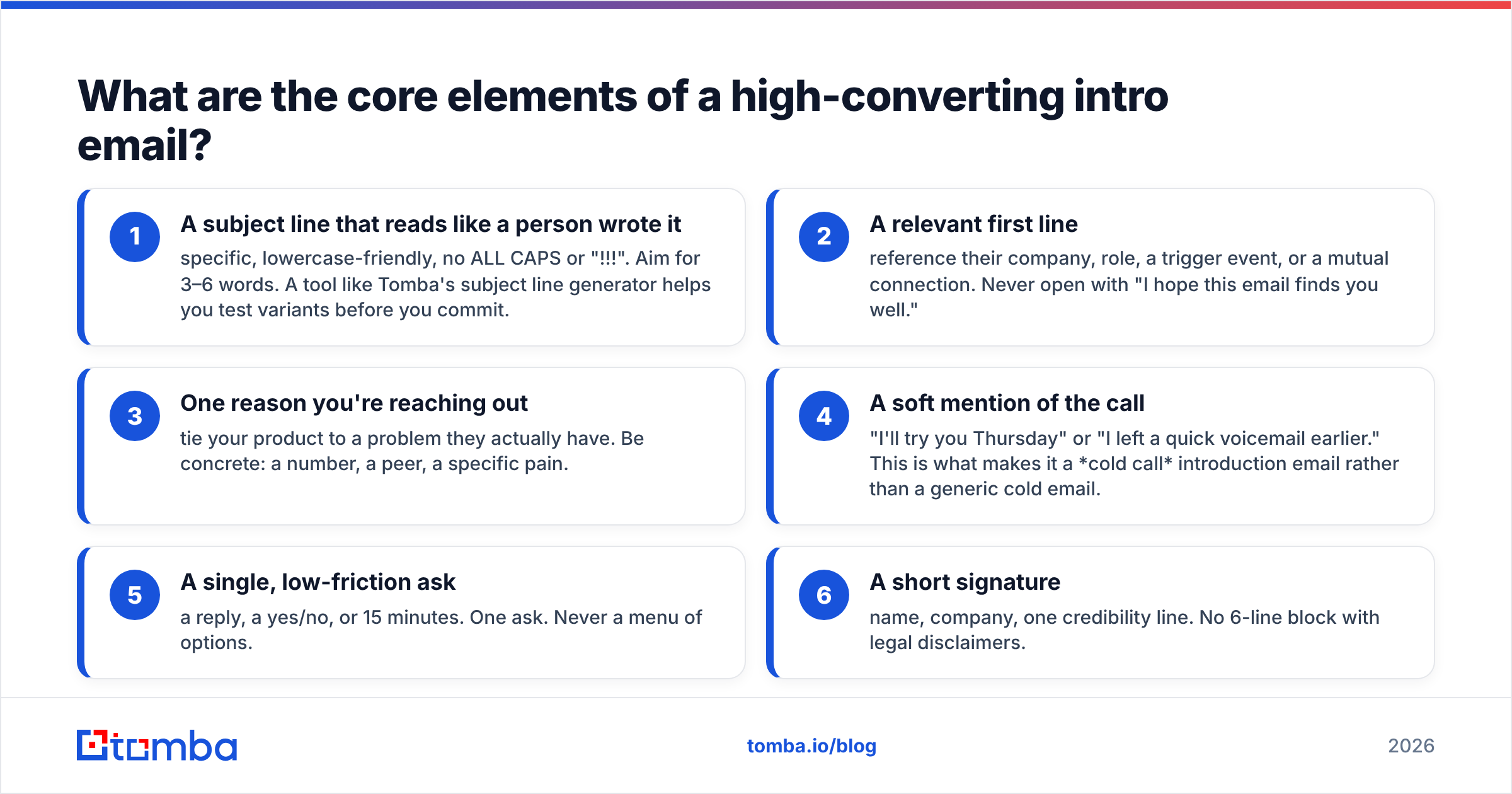
Every intro email that earns a reply shares the same skeleton. Miss one part and the whole thing feels like spam.
- A subject line that reads like a person wrote it — specific, lowercase-friendly, no ALL CAPS or "!!!". Aim for 3–6 words. A tool like Tomba's subject line generator helps you test variants before you commit.
- A relevant first line — reference their company, role, a trigger event, or a mutual connection. Never open with "I hope this email finds you well."
- One reason you're reaching out — tie your product to a problem they actually have. Be concrete: a number, a peer, a specific pain.
- A soft mention of the call — "I'll try you Thursday" or "I left a quick voicemail earlier." This is what makes it a cold call introduction email rather than a generic cold email.
- A single, low-friction ask — a reply, a yes/no, or 15 minutes. One ask. Never a menu of options.
- A short signature — name, company, one credibility line. No 6-line block with legal disclaimers.
Keep the whole thing under 90 words. If a prospect has to scroll, you've already lost. For more structural patterns, browse Tomba's library of cold email templates and adapt the framework to your voice.
Which cold call introduction email templates should you steal?#
Below are seven templates mapped to real moments in an outbound sequence. Swap the brackets, keep them short.
Template 1 — Pre-call warm-up (sent 1–2 days before dialing)
Subject: quick question about [team] at [Company]
Hi [First name],
I noticed [Company] is [trigger — hiring SDRs / expanding into EU / launched X]. Teams doing that usually hit [specific problem].
I'll try you Thursday around 10am — if that's a bad time, just reply here and I'll work around you.
[Your name], [Company]
Template 2 — Post-voicemail follow-up (sent within 5 minutes of the call)
Subject: just left you a voicemail
Hi [First name],
Just tried your line and left a quick message. Short version: we help [role]s at companies like [peer] cut [metric] by [number]. Worth a 12-minute look?
Reply here or I'll try again Friday.
[Your name]
Template 3 — "Sorry I missed you" recovery
Subject: missed you today
Hi [First name],
Tried reaching you earlier — no worries, I know the calendar is brutal.
The reason I called: [one-line relevance]. If email is easier, does [specific outcome] sound useful enough for 15 minutes next week?
[Your name]
Template 4 — Referral-anchored intro
Subject: [Mutual name] suggested I reach out
Hi [First name],
[Mutual name] mentioned you own [area] at [Company] and might care about [problem]. I'll call you Wednesday, but wanted to give you context first so it's not a surprise.
[Your name]
Template 5 — Trigger-event intro
Subject: congrats on [funding / launch / role]
Hi [First name],
Saw the news about [event] — congrats. Companies at that stage usually start feeling [pain]. I'll try your line this week; happy to send specifics first if you'd rather.
[Your name]
Template 6 — Value-first, no-ask intro
Subject: a [resource] for [Company]'s [team]
Hi [First name],
No pitch here — I put together [benchmark / teardown] for teams like yours and thought it might be useful. I'll call Thursday to see if it's relevant, but the doc is yours either way: [link].
[Your name]
Template 7 — Persistence-without-pressure (4th touch)
Subject: should I close the loop?
Hi [First name],
I've reached out a couple times and don't want to be a pest. If [problem] isn't a priority right now, just reply "not now" and I'll check back next quarter. If it is, I'll call tomorrow.
[Your name]

How do you time the email and the call together?#
Timing is where most reps fumble a good template. The goal is a rhythm the prospect experiences as coordinated persistence, not stalking.
A reliable 8-day, multi-touch cadence looks like this:
- Day 1 — Pre-call email (Template 1). Plant your name.
- Day 2 — First call. If no answer, leave a 15-second voicemail.
- Day 2 — Post-voicemail email (Template 2), sent within 5 minutes so the two land together.
- Day 4 — Second call, different time of day than Day 2.
- Day 5 — Recovery email (Template 3).
- Day 8 — Final call + persistence email (Template 7).
Two rules make this work. First, vary the time of day you call — someone unreachable at 9am may answer at 4pm. Second, never send the email and place the call at the exact same minute unless it's the post-voicemail follow-up; you want the prospect to feel pursued by a human, not blasted by a machine.
This cadence also respects the prospect. By touch four you're explicitly offering an exit ("not now"), which paradoxically raises reply rates because it hands control back to them.
What kills a cold call introduction email before it's read?#
Three things, in order of damage: bad data, bad subject lines, and bad length.
Bad data is the number-one silent killer. If the email address bounces or the number is wrong, none of your craft matters. Sending to an unverified list also torches your sender reputation, which quietly buries even your good emails in spam. Before any sequence, run your list through an email verifier so you're only dialing and mailing real, reachable people. And if you're still hunting down contacts, an accurate email finder beats guessing at firstname@company.com patterns that bounce.
Bad subject lines get you ignored. Avoid "Touching base," "Following up," and anything with a dollar sign or exclamation point. Write like you'd text a colleague.
Bad length loses the reader. If your intro email is longer than a phone screen, cut it in half, then cut it again.
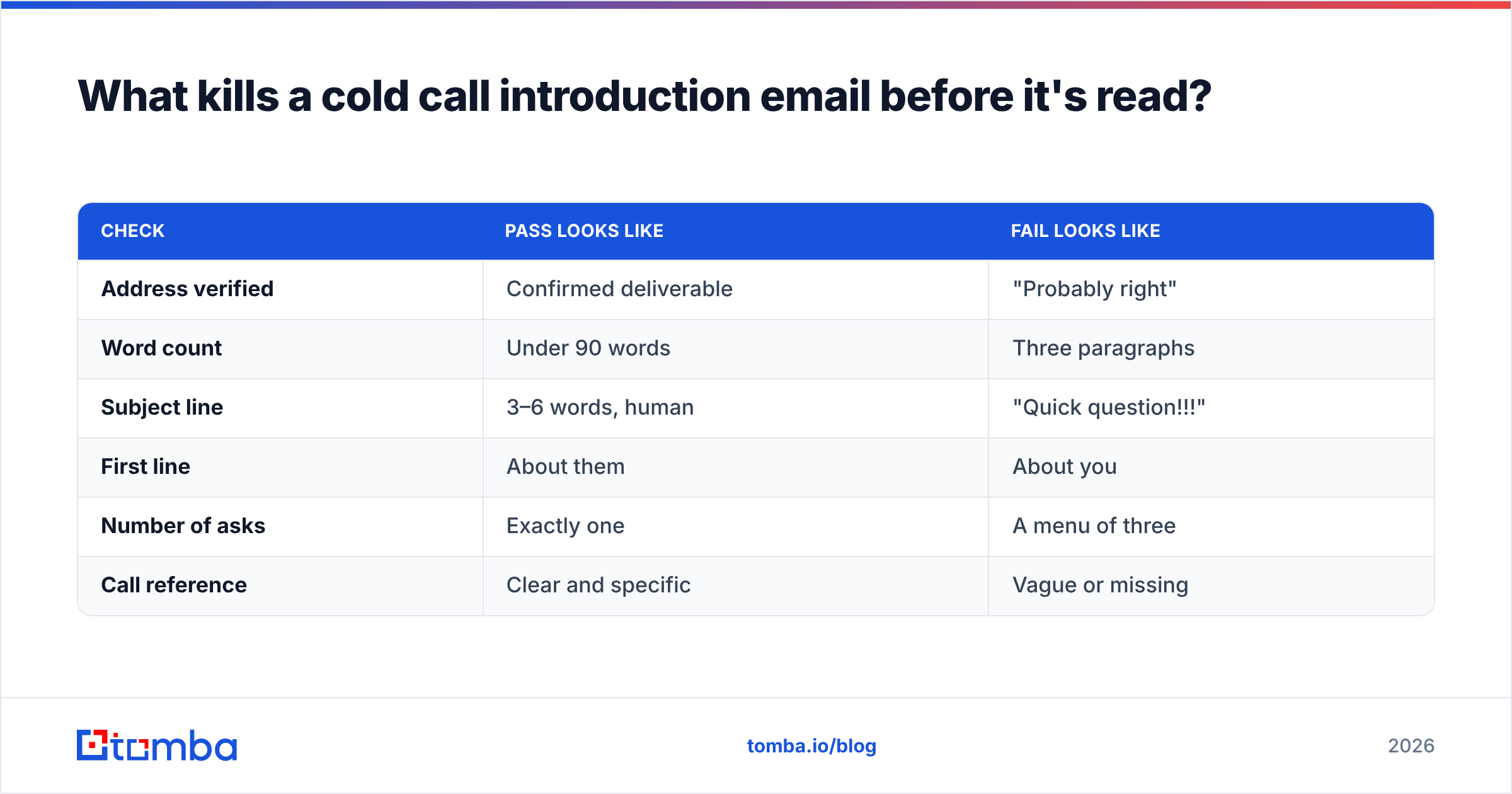
Here's a quick self-audit before you hit send:
| Check | Pass looks like | Fail looks like |
|---|---|---|
| Address verified | Confirmed deliverable | "Probably right" |
| Word count | Under 90 words | Three paragraphs |
| Subject line | 3–6 words, human | "Quick question!!!" |
| First line | About them | About you |
| Number of asks | Exactly one | A menu of three |
| Call reference | Clear and specific | Vague or missing |
How does data quality change your reply rate?#
Directly and dramatically. Every metric in your sequence — connect rate, open rate, reply rate — is capped by the accuracy of the contact data underneath it. You can A/B test subject lines all day, but if 20% of your list is invalid, you've throttled your ceiling before the first send.
This is where the "boring" part of outbound pays off. Reps love writing clever copy; they hate cleaning lists. But a verified, enriched list means:
- Fewer bounces, so your domain stays trusted and your good emails inbox.
- Accurate phone numbers, so your calls reach humans instead of dead extensions.
- Better personalization, because enriched records carry role, seniority, and company context you can reference in line one.
If you're building lists at scale, Tomba's bulk email finder and data enrichment turn a raw company list into a verified, call-ready contact sheet. Compared with buying stale lists — see reviews across G2 for how quickly purchased data decays — sourcing and verifying fresh contacts keeps your whole sequence healthy.
The uncomfortable truth: the best cold call introduction email in the world, sent to the wrong address, converts at exactly zero percent. Fix the data first, then obsess over the copy.
Should you personalize every email or use templates?#
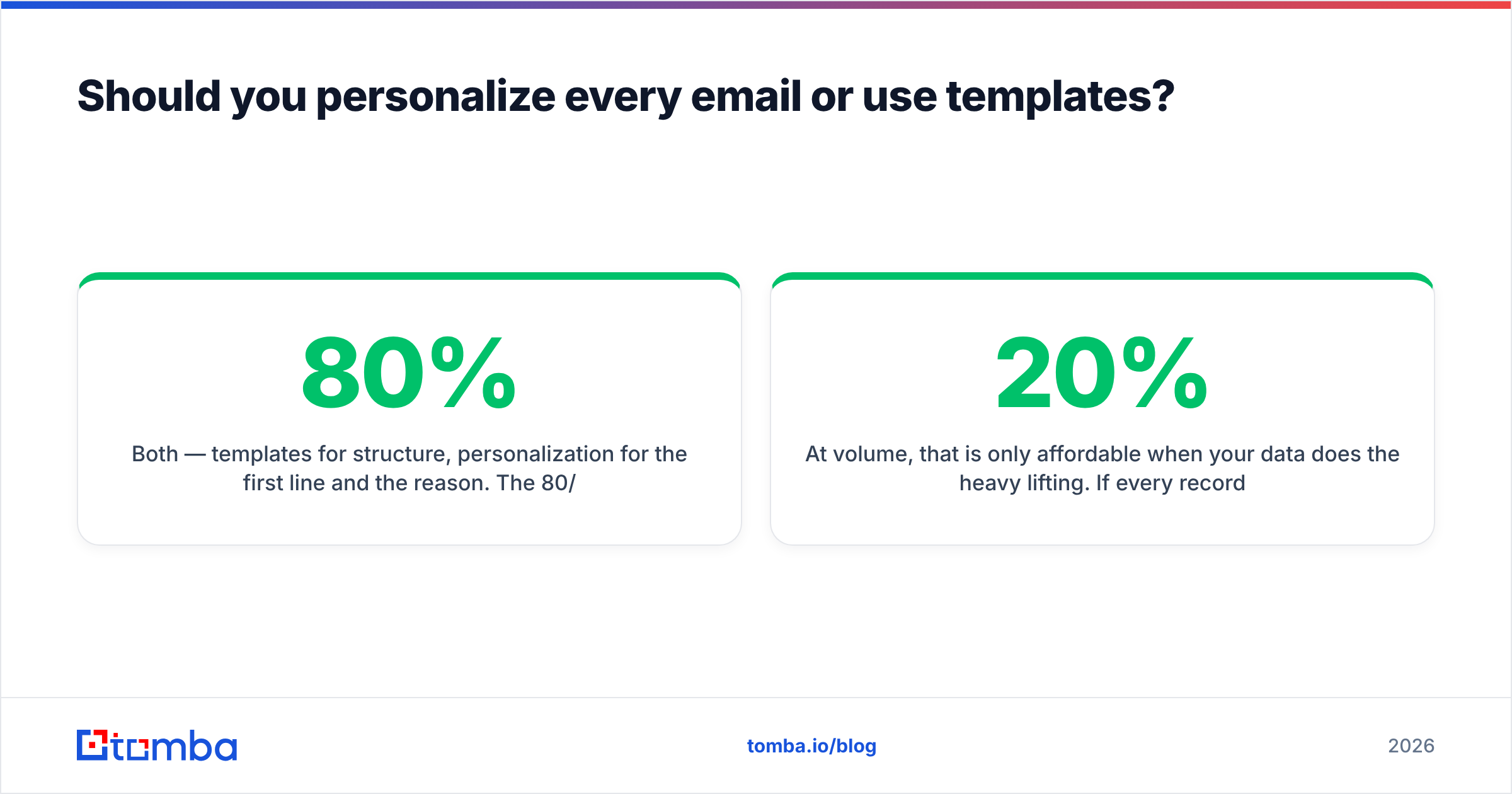
Both — templates for structure, personalization for the first line and the reason. The 80/20 rule applies: keep 80% of the email as a reusable frame, and pour your effort into the 20% that proves you know who they are.
At volume, that 20% is only affordable when your data does the heavy lifting. If every record already tells you the prospect's role, their company's recent trigger event, and a verified way to reach them, personalization takes 30 seconds instead of five minutes of manual research. That's the entire argument for enriching before you write: it makes real personalization scalable.
Templates without personalization feel like spam. Personalization without templates doesn't scale past 20 prospects a day. The winners do both, backed by clean data.
Final takeaway and next step#
A cold call introduction email is the cheapest lever you have to lift connect and reply rates: it turns a cold, unknown dial into a warm, expected one. Keep it under 90 words, lead with relevance, make one ask, and time it to complement your calls rather than compete with them.
But every template here rests on one foundation — reaching the right person at a real address. If your list is guesswork, your copy is wasted. Start by finding and verifying accurate professional emails with the Tomba Email Finder, then load your best template and start warming the line before you ever pick up the phone. Check Tomba pricing to find the plan that fits your outbound volume — the free tier lets you test the whole workflow before you commit.
Related guides#
// get started
Find, verify and enrich your first contacts today
Start on the free plan with 25 searches a month, then scale when your team is ready.
Free plan · No credit card required · GDPR & CCPA
// about the author