How to Build a Cold Call List That Actually Converts in 2026
A cold call list is only as good as the data behind it. Here's how to build one that beats bad numbers, gatekeepers, and dead dials in 2026 — step by step.
Your cold call list decides your quarter before you dial a single number. A rep working a tight, verified, well-segmented list will out-book a rep with twice the hustle and a list full of dead numbers. This guide shows you how to build the first kind.
TL;DR#
- A cold call list is a structured set of qualified prospects — name, role, company, direct phone, and context — that matches your ideal customer profile (ICP).
- Bad data is the silent killer: up to 30% of B2B contact data decays every year, so an unverified list bleeds connect rate every week you sit on it.
- Build it in five steps: define ICP, source contacts, enrich with direct dials, verify numbers, then segment for sequencing.
- Verified direct dials beat switchboard numbers by a wide margin — you skip the gatekeeper and reach the decision-maker directly.
- Tools like Tomba let you find and verify contact data at scale instead of scraping numbers by hand or buying stale lists.
What is a cold call list?#
A cold call list is a curated database of prospects you intend to call who have not yet engaged with your company. Think of it like a guest list for an event: it is not just names, it is the right names, with the details you need to have a real conversation once they pick up.
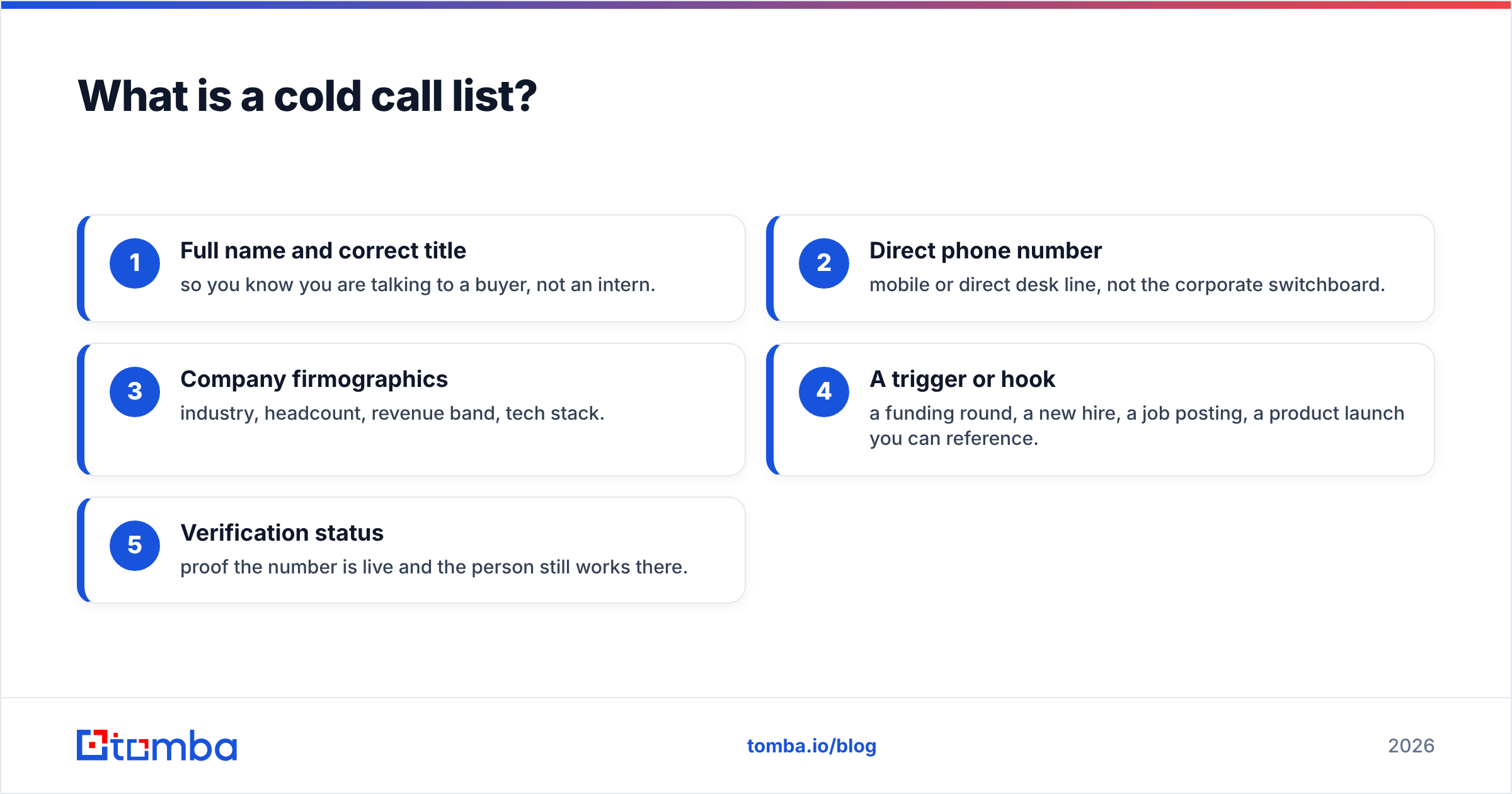
A weak list is a spreadsheet of company main lines. A strong list is a set of rows where each one contains:
- Full name and correct title — so you know you are talking to a buyer, not an intern.
- Direct phone number — mobile or direct desk line, not the corporate switchboard.
- Company firmographics — industry, headcount, revenue band, tech stack.
- A trigger or hook — a funding round, a new hire, a job posting, a product launch you can reference.
- Verification status — proof the number is live and the person still works there.
The difference between those two lists is the difference between smiling-and-dialing into voicemail all day and actually booking meetings.

Why does list quality matter more than call volume?#
Because you cannot out-dial bad data. If 40% of your numbers are wrong, you are paying a rep to listen to disconnected tones and reach the wrong people. Volume amplifies whatever quality you start with — including zero.
B2B data decays fast. People change jobs, companies get acquired, direct lines get reassigned. Industry research from vendors like HubSpot consistently pegs annual B2B database decay at roughly 22–30%. Left alone, a list you built in January is meaningfully worse by summer.
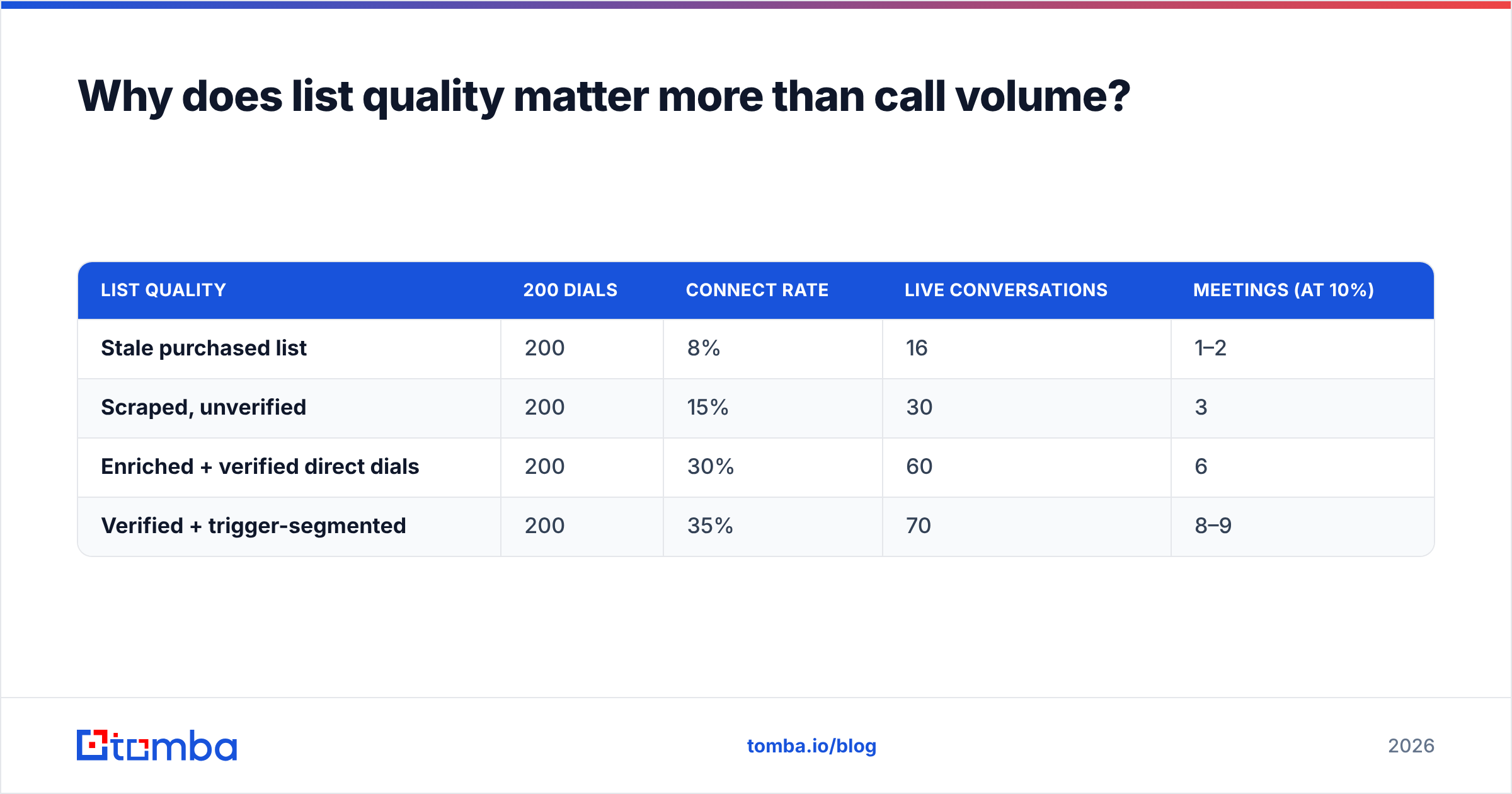
Here is the compounding effect in practice:
| List quality | 200 dials | Connect rate | Live conversations | Meetings (at 10%) |
|---|---|---|---|---|
| Stale purchased list | 200 | 8% | 16 | 1–2 |
| Scraped, unverified | 200 | 15% | 30 | 3 |
| Enriched + verified direct dials | 200 | 30% | 60 | 6 |
| Verified + trigger-segmented | 200 | 35% | 70 | 8–9 |
Same effort, same 200 dials — but the bottom row books four to eight times the meetings. That gap is entirely a data problem, not a talent problem. This is why experienced sales leaders obsess over the list before they coach the pitch.
How do you build a cold call list step by step?#
1. Define your ICP before you touch a tool#
Do not start by pulling contacts. Start by writing down exactly who you sell to: industry, company size, geography, department, seniority, and the pain your product removes. Every downstream step gets cheaper and more accurate when the target is sharp. A vague ICP produces a bloated list; a sharp ICP produces a list you can actually work.
If you already close deals, mine your CRM. Look at your last 20 closed-won accounts and reverse-engineer the pattern. That pattern is your ICP — not a guess, but evidence.
2. Source your target accounts and contacts#
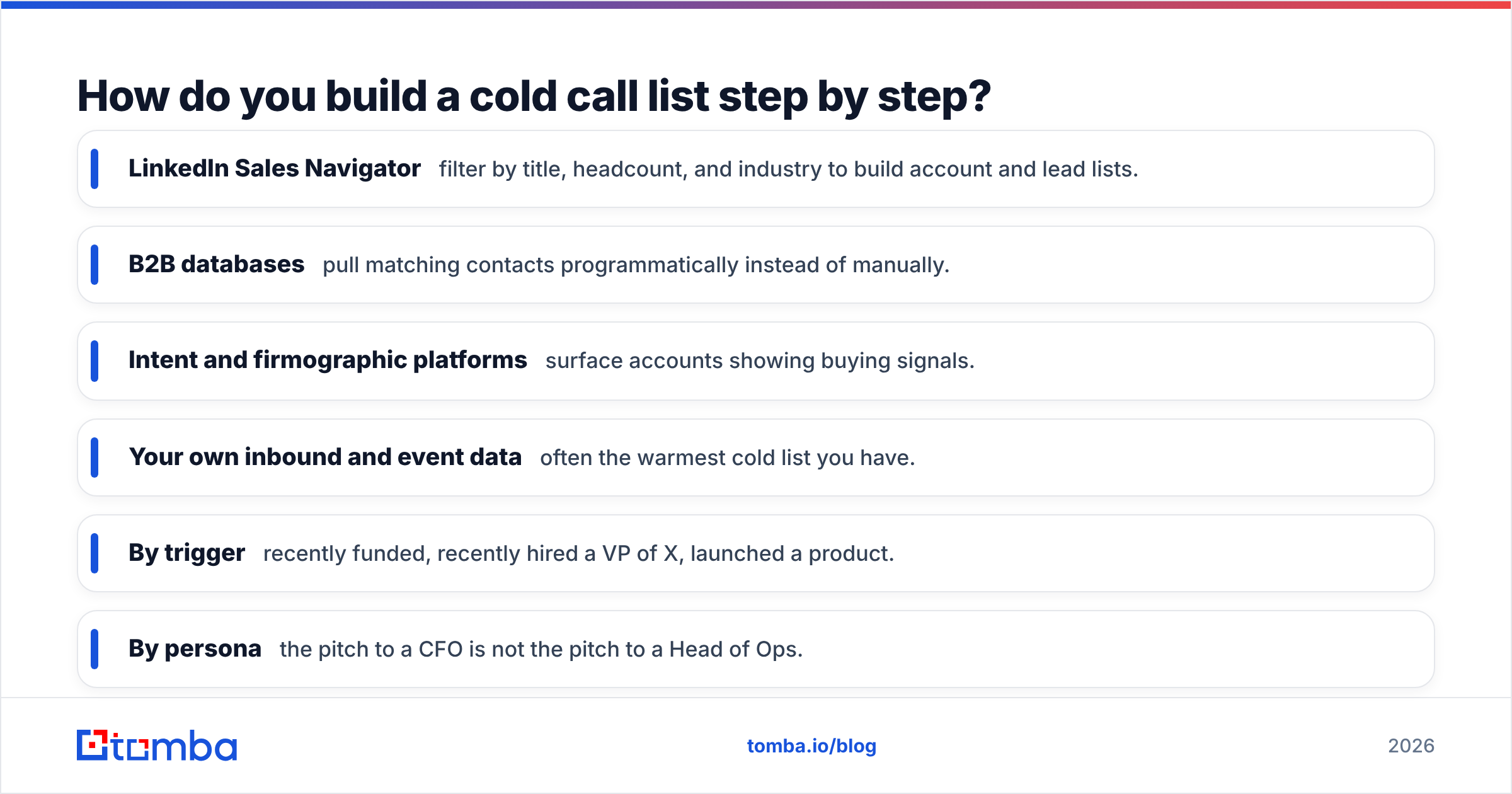
Now find companies and people that match. Common sources:
- LinkedIn Sales Navigator — filter by title, headcount, and industry to build account and lead lists.
- B2B databases — pull matching contacts programmatically instead of manually.
- Intent and firmographic platforms — surface accounts showing buying signals.
- Your own inbound and event data — often the warmest cold list you have.
At this stage you have names and companies but usually not reliable phone numbers. That is the next problem to solve.
3. Enrich contacts with direct dials#
A name without a number is a to-do, not a lead. Enrichment fills the gaps — appending direct phone numbers, verified emails, job titles, and company data to each row. Instead of hunting for one contact's mobile across five tabs, you enrich leads in bulk and get structured records back.
For calling specifically, prioritize direct dials and mobile numbers. A phone finder that returns direct lines is worth far more than a database of switchboards, because every switchboard number reintroduces the gatekeeper you are trying to skip.
4. Verify every number and contact#
This is the step most teams skip, and it is the one that separates a converting list from an expensive spreadsheet. Verification confirms the number is active and the person still holds the role before your rep wastes a dial. Run numbers through a phone validator to strip dead lines, and cross-check the contact still works there.

Verification is not a one-time event. Because data decays continuously, re-verify high-value segments before every major calling push. A list verified in Q1 should be re-checked before you hammer it in Q2.
5. Segment for sequencing#
A single undifferentiated list is a missed opportunity. Break it into segments so your reps can tailor the opener:
- By trigger — recently funded, recently hired a VP of X, launched a product.
- By persona — the pitch to a CFO is not the pitch to a Head of Ops.
- By tier — your 50 dream accounts deserve research; the long tail gets a tighter script.
Segmentation is what turns a list into a sales prospecting system rather than a pile of numbers.
Where should you get cold call list data?#
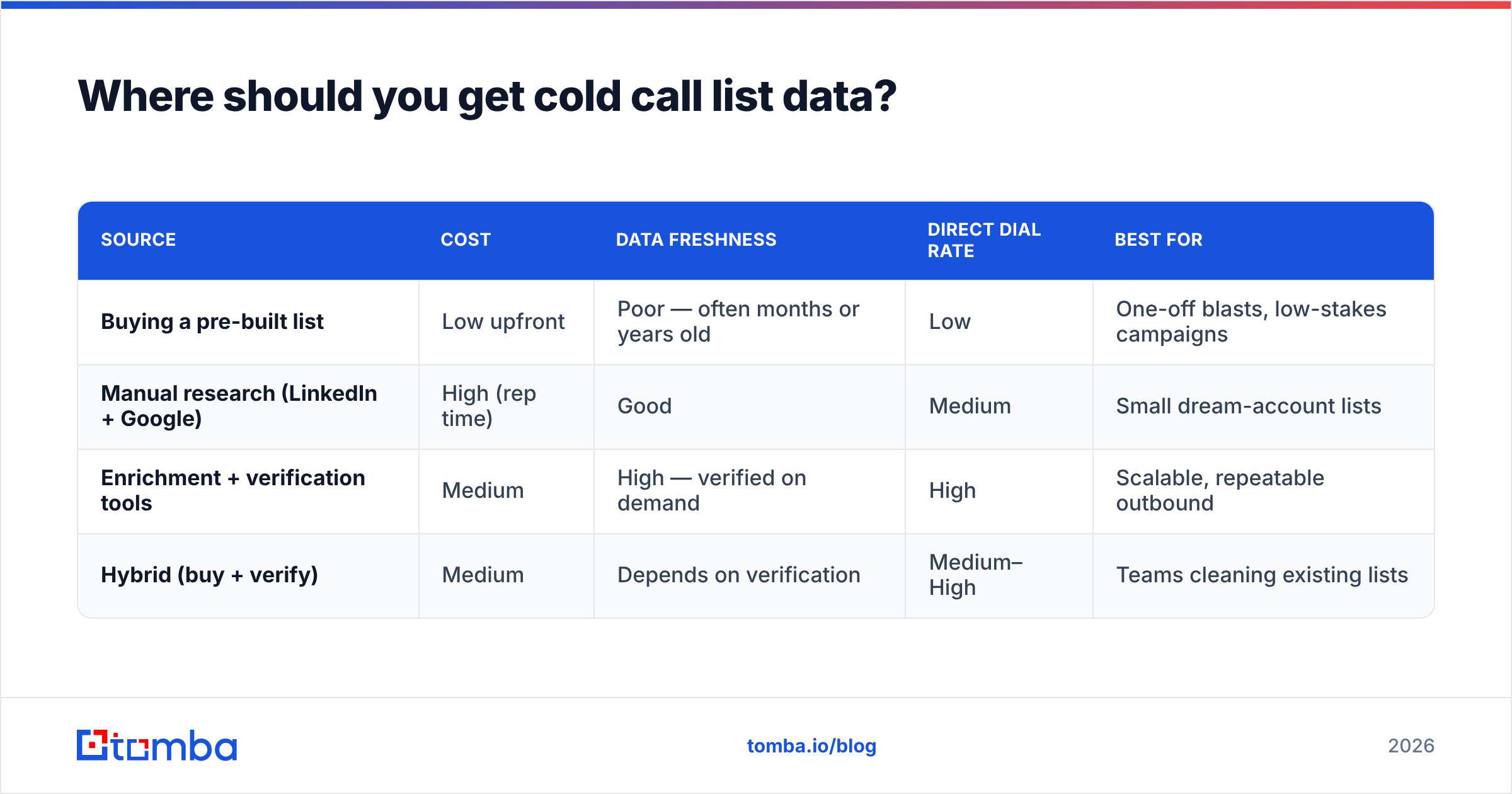
You have three realistic options, and they are not equal. Choosing wrong here is where most of the wasted budget goes.
| Source | Cost | Data freshness | Direct dial rate | Best for |
|---|---|---|---|---|
| Buying a pre-built list | Low upfront | Poor — often months or years old | Low | One-off blasts, low-stakes campaigns |
| Manual research (LinkedIn + Google) | High (rep time) | Good | Medium | Small dream-account lists |
| Enrichment + verification tools | Medium | High — verified on demand | High | Scalable, repeatable outbound |
| Hybrid (buy + verify) | Medium | Depends on verification | Medium–High | Teams cleaning existing lists |
Purchased lists are tempting because they are cheap and instant, but you are usually buying someone else's decayed data. A reputable data vendor such as BookYourData sells verified B2B contacts and is a solid option when you want a ready-made list — just confirm how recently the records were validated, because even good vendors' data ages. Manual research produces excellent data but does not scale past a few dozen accounts per rep per week.
For most teams, the winning approach is enrichment plus verification: source your ICP-matched contacts, append direct dials, verify them, and refresh on a schedule. It scales, it stays fresh, and you control quality. You can review Tomba pricing to see how per-search and bulk credits map to your list size before committing.
What data fields should a cold call list include?#
The more context each row carries, the better your opener. At minimum, every record should have these fields:
- First and last name — spelled correctly; mispronouncing a name kills rapport in the first three seconds.
- Job title and department — confirms they can buy or influence.
- Direct phone number — mobile preferred, verified live.
- Company name and website — the anchor for firmographic lookups.
- Company size and industry — so you dial the right script.
- Timezone — so you call at 10 a.m. their time, not yours.
- A recent trigger — funding, hiring, expansion, or product news to open with.
Fields six and seven are the ones amateurs leave blank and pros never do. Calling a West Coast prospect at 8 a.m. their time, or opening with a generic pitch when they just raised a Series B, wastes a good number on a bad first impression.
How do you keep a cold call list clean over time?#
Treat your list like fresh food, not canned goods — it has a shelf life, and the clock never stops. A clean list is a process, not a purchase.
- Verify on a cadence. Re-run high-value segments through validation monthly, or before any big push.
- Update on job changes. When a champion moves companies, that is a warm new lead and a stale old record. Catch both.
- Remove hard bounces and dead numbers immediately. Do not let a rep re-dial a disconnected line three times.
- Deduplicate. Merge duplicate records so two reps do not call the same prospect and burn the account.
- Log outcomes back into your CRM. Connect rates and best-time-to-call data make the next pass smarter.
A tight feedback loop between calling and cleaning is what compounds. Every cycle, your list gets a little more accurate and your connect rate climbs. Store all of this in your CRM so the intelligence survives rep turnover — a Salesforce or HubSpot record that captures call outcomes is worth far more than a static spreadsheet.
Cold call list mistakes that kill your connect rate#
Even good reps sabotage themselves with these. Watch for them:
- Dialing switchboards instead of direct lines. Every gatekeeper is a tax on your time. Prioritize direct dials.
- Never verifying. An unverified list decays quietly; you only feel it in a low connect rate you cannot explain.
- No segmentation. One script for everyone means a mediocre script for everyone.
- Ignoring timezones. Half your no-answers may just be bad timing.
- Hoarding a giant list. A focused list of 300 verified, ICP-matched contacts beats 3,000 random numbers. Quality of coverage, not raw count, drives bookings.
- Buying and forgetting. A purchased list you never re-verify is a depreciating asset from the day it lands.
You can cross-check numbers, formats, and reachability with free utilities and validators before a campaign — a quick pass through a phone validator alone can lift your connect rate noticeably by removing the dead lines dragging your average down.
Build your cold call list with verified data#
A converting cold call list comes down to one thing: accurate, verified contact data mapped to a sharp ICP. Get the data right and everything downstream — connect rate, conversation quality, booked meetings — improves without a single change to your pitch. Get it wrong and no script can save you.
That is where Tomba fits. Use the Tomba Email Finder and its companion tools to find, enrich, and verify contact data for every account on your target list — direct emails for multichannel follow-up, verified records to keep your list clean, and bulk workflows so you build in minutes instead of days. Start on the free tier (25 searches a month), then scale into the Starter plan at $49/mo when your list-building outgrows it. Build the list once, keep it verified, and let your reps spend their time talking to real buyers instead of dialing dead numbers.
Related guides#
// get started
Find, verify and enrich your first contacts today
Start on the free plan with 25 searches a month, then scale when your team is ready.
Free plan · No credit card required · GDPR & CCPA
// about the author