The Cold Call Opening Script That Books More Meetings in 2026
The first 15 seconds decide the call. Here's a cold call opening script framework — with word-for-word lines, structure, and a data table — that earns permission instead of a hang-up.
Your prospect decides whether to keep talking within the first 15 seconds. Not the first minute, not "after your pitch" — 15 seconds. A cold call opening script is the difference between a conversation and a dial tone, and most reps get it wrong by trying to sound warm when they should sound honest.
This guide gives you the structure, the word-for-word lines, and the reasoning behind each one. No motivational filler, no "just be confident" — a repeatable opener you can adapt to any B2B call in 2026.
TL;DR#
- The goal of the opener is not to pitch — it's to earn the next 30 seconds. Ask for permission, name the reason you called, and get out of your own way.
- The strongest opening line is a pattern interrupt plus a permission ask: "Hey [Name], this is a cold call — can I have 20 seconds to tell you why I picked up the phone?"
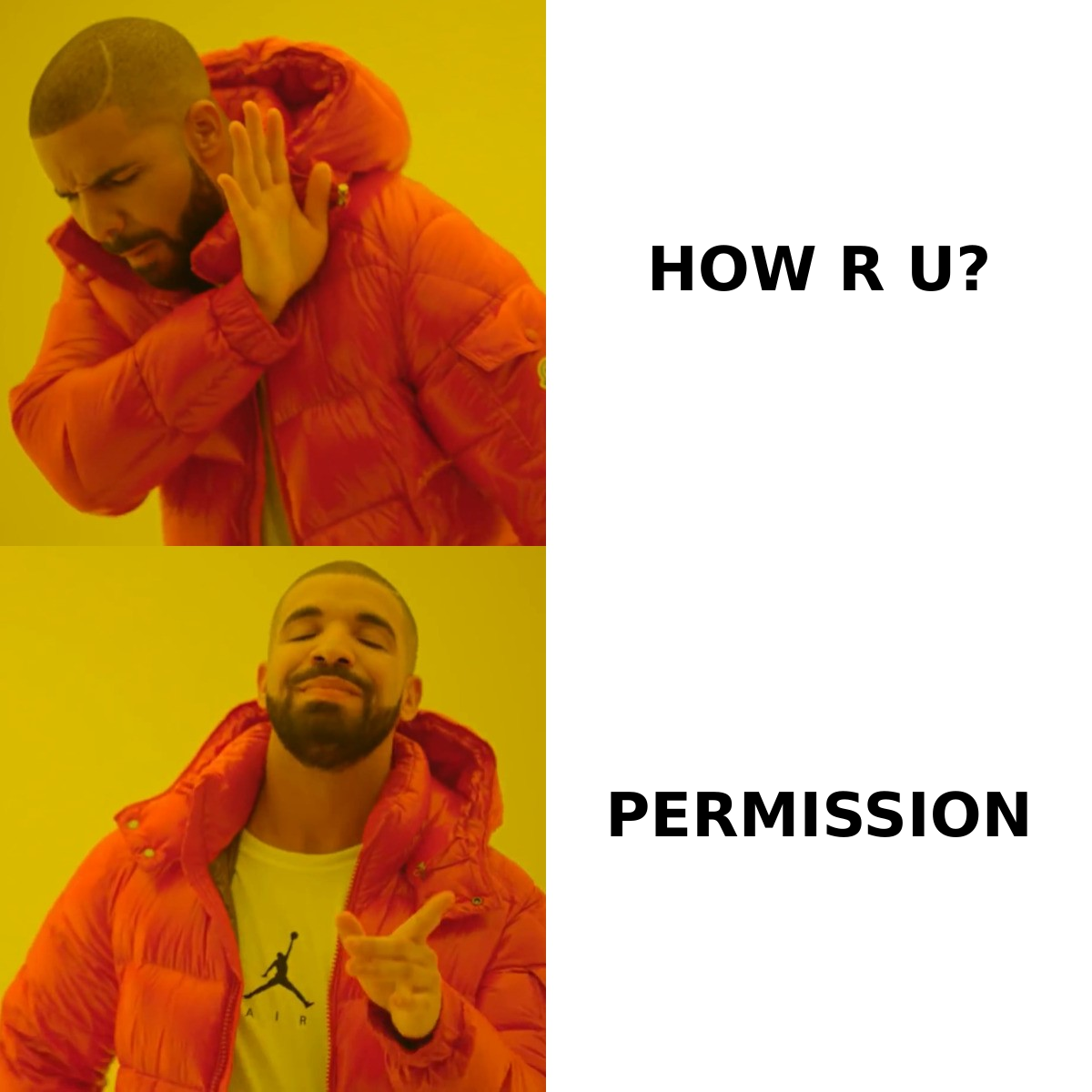
- Cut "How are you today?" It signals a script and triggers the brush-off reflex.
- Personalization beats politeness. One specific, researched reason ("I saw you're hiring three SDRs") outperforms any smooth intro.
- Your list quality caps your script quality. A perfect opener dialed at the wrong number or a stale contact still fails — accurate data is the foundation.
Why does the first 15 seconds decide the whole call?#
Because your prospect is running a fast filter: threat or not, worth my time or not. A cold call is an interruption, and their brain is primed to end interruptions. Think of it like a bouncer at a door — you have one line to prove you belong before you're waved off.
That's why the opener isn't where you sell. It's where you buy permission to keep talking. Reps who load the first 15 seconds with a value prop, a company backstory, and three features get cut off because they've asked for a commitment (attention) without offering a reason.
The math is brutal. Industry benchmarks from sources like Gong's cold call research consistently show that openers earning explicit permission or naming a specific reason correlate with meaningfully higher success rates than generic intros. The opener is high-leverage precisely because it's short.
What are the components of a cold call opening script?#
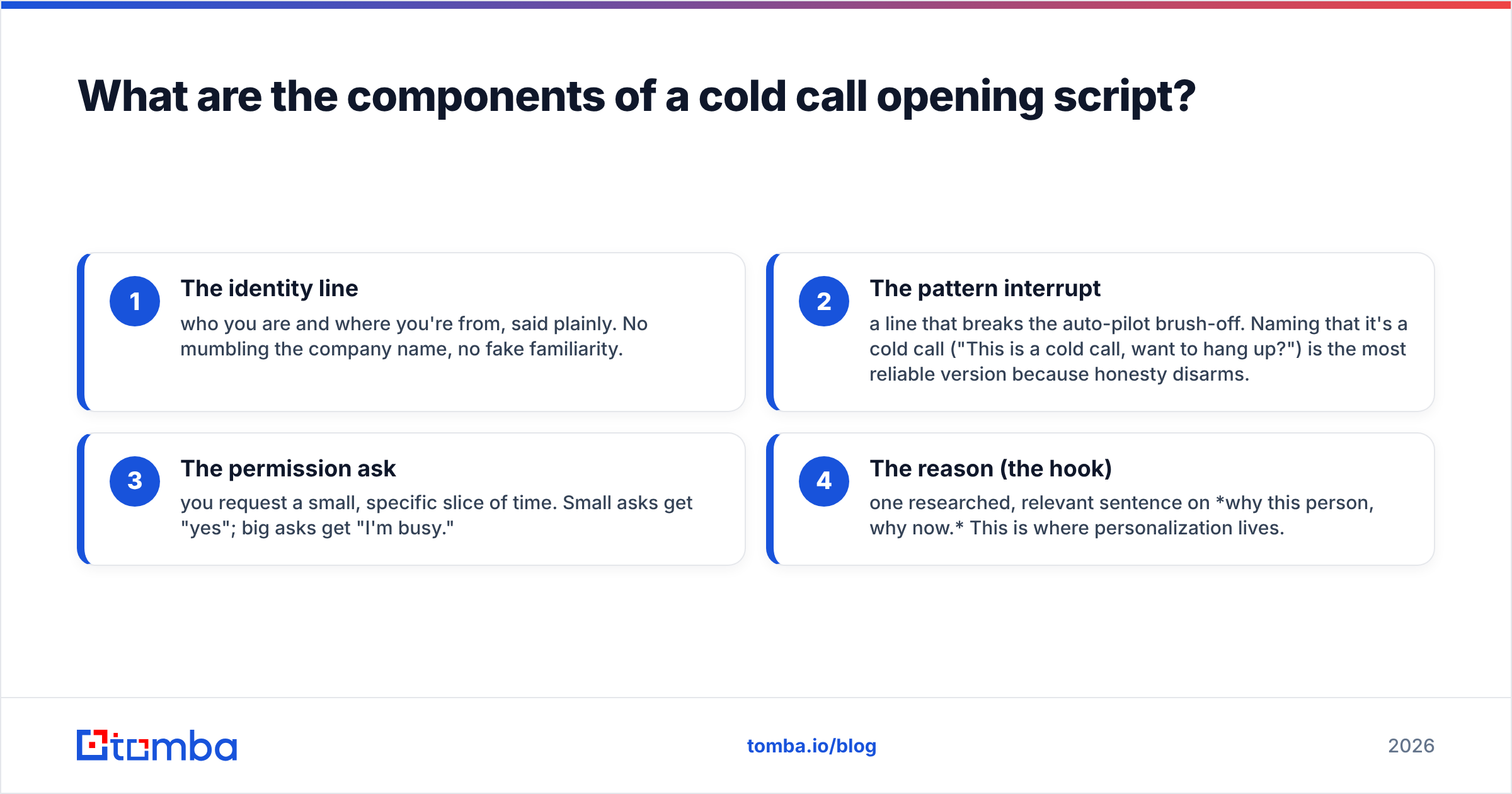
Every effective opener has four moves, in order. Skip one and the call gets harder.
- The identity line — who you are and where you're from, said plainly. No mumbling the company name, no fake familiarity.
- The pattern interrupt — a line that breaks the auto-pilot brush-off. Naming that it's a cold call ("This is a cold call, want to hang up?") is the most reliable version because honesty disarms.
- The permission ask — you request a small, specific slice of time. Small asks get "yes"; big asks get "I'm busy."
- The reason (the hook) — one researched, relevant sentence on why this person, why now. This is where personalization lives.
Notice what's missing: your product. The opener is 100% about earning attention and 0% about pitching. The pitch comes after they say "okay, go ahead."
What's a cold call opening script that actually works?#
Here's a word-for-word template you can adapt. Read it out loud — if it sounds like a human, it's right.
"Hi [First Name], this is [Your Name] calling from [Company]. I'll be honest — this is a cold call. Do you want to hang up, or give me 30 seconds and then decide?"
Nine out of ten prospects, caught off guard by the honesty, give you the 30 seconds. Then:
"Appreciate it. The reason I called specifically is [one researched reason — 'I saw your team just opened three SDR roles']. Companies I work with usually hit [specific problem] right when they scale that fast. Is that on your radar at all, or am I off base?"
That last question — "or am I off base?" — is doing heavy lifting. It gives the prospect an easy out, which paradoxically makes them more likely to engage. You're not cornering them.
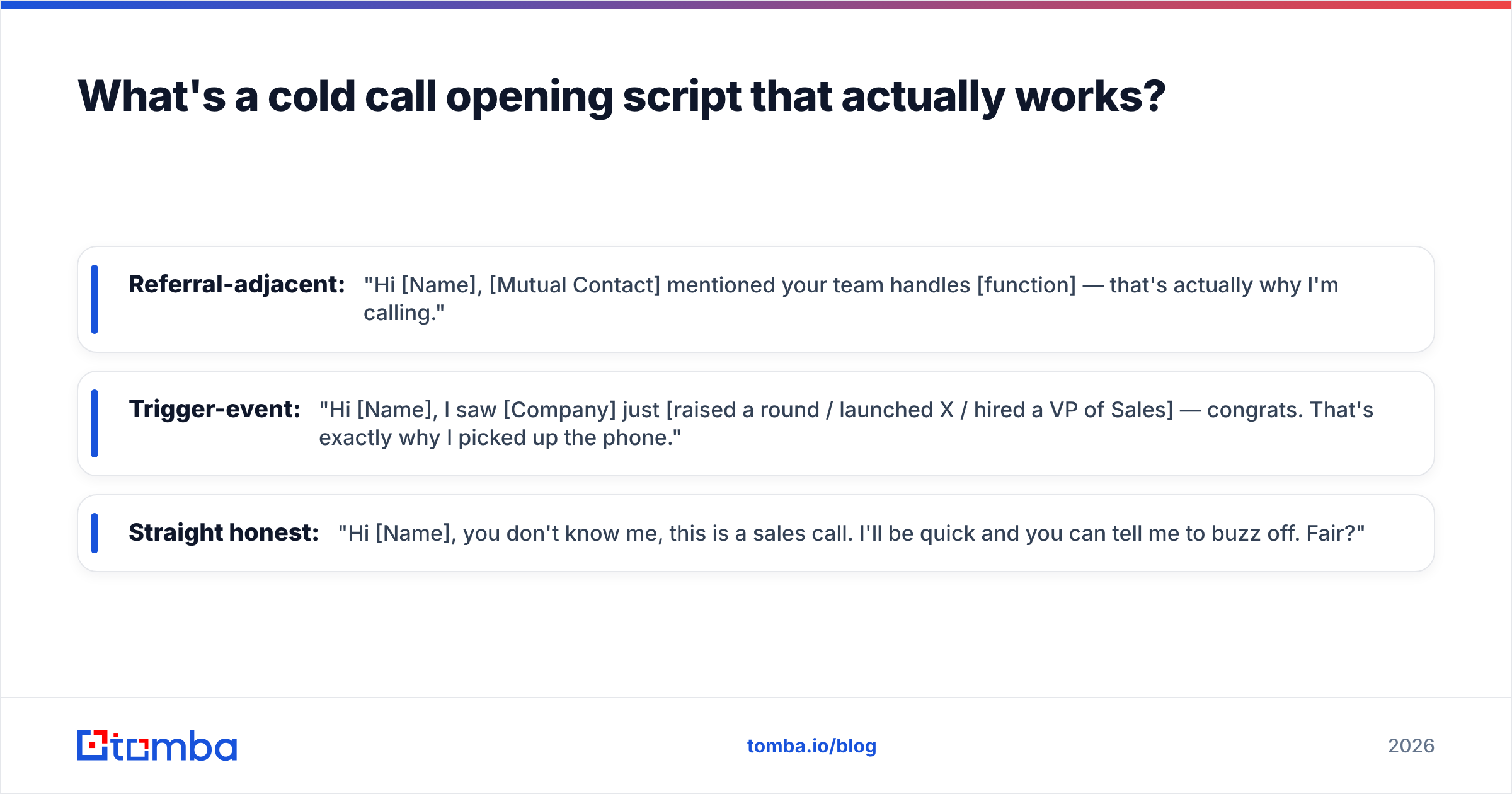
Variations by scenario#
- Referral-adjacent: "Hi [Name], [Mutual Contact] mentioned your team handles [function] — that's actually why I'm calling."
- Trigger-event: "Hi [Name], I saw [Company] just [raised a round / launched X / hired a VP of Sales] — congrats. That's exactly why I picked up the phone."
- Straight honest: "Hi [Name], you don't know me, this is a sales call. I'll be quick and you can tell me to buzz off. Fair?"
What should you never say in a cold call opener?#
Some lines are so common that prospects hear them as "salesperson detected — activate brush-off." Cut these:
- "How are you today?" — It signals a script and asks for nothing real. Prospects answer on auto-pilot and mentally check out.
- "Did I catch you at a bad time?" — You just handed them a scripted escape hatch. Most will take it.
- "I'll be quick" followed by 90 seconds — breaking a small promise in the first minute kills trust.
- "We're the leading provider of..." — nobody cares about your positioning in second five.
- Rambling company history — save it. Nobody bought because a rep recited a founding date.
Permission-based vs. pitch-first openers: which wins?#
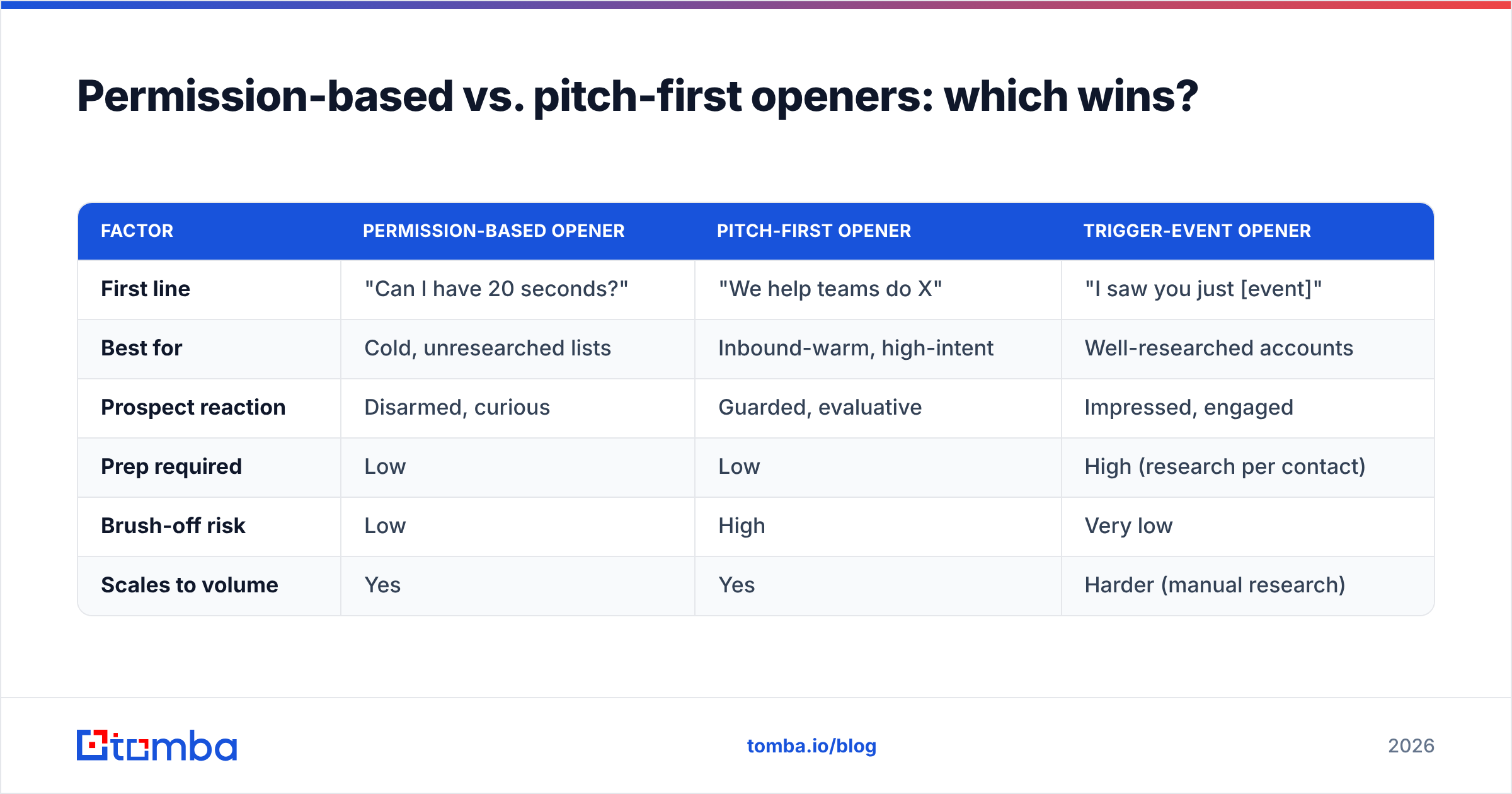
Short answer: permission-based wins for most B2B calls, but the right choice depends on your list and offer. Here's the honest comparison.
| Factor | Permission-Based Opener | Pitch-First Opener | Trigger-Event Opener |
|---|---|---|---|
| First line | "Can I have 20 seconds?" | "We help teams do X" | "I saw you just [event]" |
| Best for | Cold, unresearched lists | Inbound-warm, high-intent | Well-researched accounts |
| Prospect reaction | Disarmed, curious | Guarded, evaluative | Impressed, engaged |
| Prep required | Low | Low | High (research per contact) |
| Brush-off risk | Low | High | Very low |
| Scales to volume | Yes | Yes | Harder (manual research) |
The trigger-event opener has the highest connect-to-conversation rate but demands accurate, current data on each account. That's the trade-off: better personalization needs better inputs. If your CRM is full of stale titles and dead numbers, even a flawless script underperforms. This is why serious outbound teams pair their scripts with reliable data enrichment and a verified B2B phone numbers source before they ever dial.
How do you personalize the opener without spending an hour per call?#
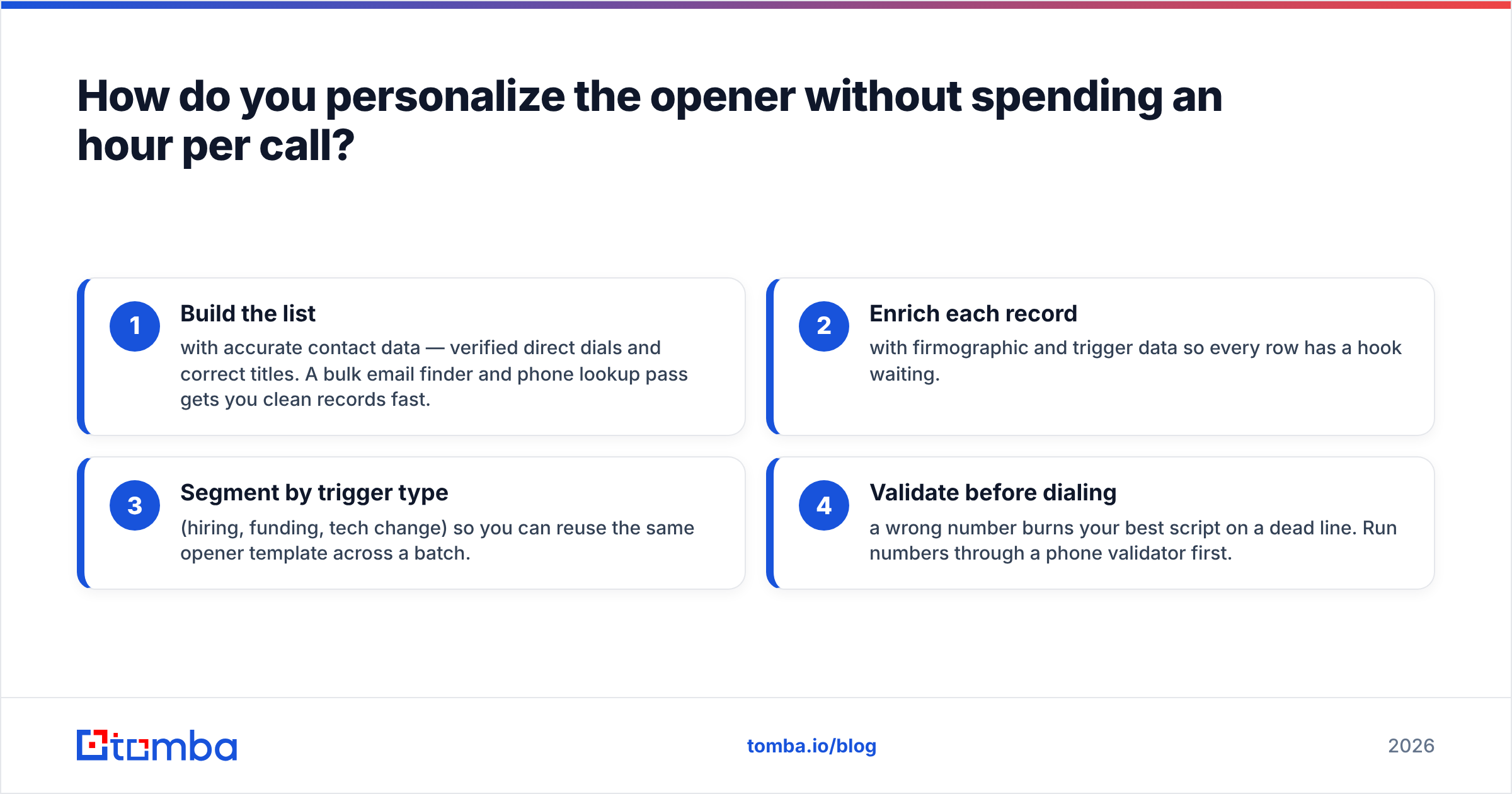
You batch the research and standardize the hook. You don't need a novel on each prospect — you need one relevant fact.
The one-fact rule: find a single, specific, recent detail per contact — a new hire, a funding round, a job posting, a product launch, a LinkedIn post. Drop it into your reason line. That's it.
To do this at volume, work in layers:
- Build the list with accurate contact data — verified direct dials and correct titles. A bulk email finder and phone lookup pass gets you clean records fast.
- Enrich each record with firmographic and trigger data so every row has a hook waiting.
- Segment by trigger type (hiring, funding, tech change) so you can reuse the same opener template across a batch.
- Validate before dialing — a wrong number burns your best script on a dead line. Run numbers through a phone validator first.
Now your rep isn't inventing personalization mid-dial; they're reading a pre-loaded hook. Fast and specific.
How should you handle the first objection after the opener?#
Expect a reflexive "I'm not interested" or "send me an email" — often before they've even processed your reason. This isn't a real objection; it's a brush-off reflex. Handle it by acknowledging and re-asking for the tiny slice of time:
"Totally fair — you don't know me yet. All I'm asking is 20 seconds to tell you the reason, then you decide if it's worth another minute. Deal?"
If they say "send me an email," you can pivot:
"Happy to. So I send something you'll actually read instead of the trash — what's the one metric your team cares about most this quarter?"
You've turned a dismissal into a discovery question. The opener's job was to get you here; now the conversation starts.
What does a full cold call opening script look like end to end?#
Putting it together, here's a complete 30-second open you can practice today:
Rep: "Hi Sarah, this is Alex from Northbeam. I'll level with you — this is a cold call. You can hang up, or give me 30 seconds and then decide. Your call."
Sarah: "...okay, 30 seconds."
Rep: "Appreciate it. I called you specifically because I saw your team posted three new SDR roles this month. When teams scale outbound that fast, ramp time and list quality are usually the first things that break. Is that anything you're wrestling with, or am I off base?"
Sarah: "Ramp is definitely a headache right now."
Rep: "That's exactly the conversation I hoped to have. Can I ask two quick questions to see if it's even worth your time?"
From dial to discovery in under a minute — because the opener earned each step instead of demanding it.
Cold call opening script: quick-reference checklist#
Before your next call block, run through this:
- Name yourself and your company clearly — no mumbling.
- Interrupt the pattern — honesty ("this is a cold call") beats fake warmth.
- Ask permission for a small, specific window — 20 to 30 seconds.
- Lead with one researched reason — the "why you, why now."
- Give them an easy out — "or am I off base?" lowers defenses.
- Skip "how are you" and every scripted-sounding filler.
- Verify your list first — right person, right number, current title.
Where does your data fit into all this?#
Your script is only as good as the contact you're dialing. The best opener in the world, aimed at a wrong number, an outdated title, or a person who left the company last quarter, still fails — and it fails silently, eating your rep's time and morale.
That's the unglamorous truth of cold calling: list quality is the ceiling on script quality. If you want your openers to land, start with contacts that are real and current.
Tomba's Email Finder and its companion phone finder help you build clean, verified prospect lists so every dial reaches a real, correctly-titled human — the exact conditions your opening script needs to work. Pair that with contact enrichment to pre-load a personalization hook for every record, and your reps stop guessing and start connecting. Check the Tomba plans — starting free with 25 searches a month and scaling to Starter at $49/mo — and give your cold call opening script the accurate data it deserves.
Write the script. Verify the list. Then dial.
Related guides#
Ready to find emails that actually work?
Join 150,000+ professionals who stopped guessing and started sending. Free credits on signup — no credit card required.
Get the Tomba newsletter
Practical outbound tactics and product updates — once every two weeks.
About the author