Cold Call Outreach in 2026: A Practical Playbook That Books Meetings
Cold calling is not dead — bad cold calling is. Here's a data-backed cold call outreach playbook: list building, scripts, timing, objection handling, and the metrics that actually predict booked meetings.
Cold call outreach still books meetings in 2026 — but only for reps who treat the phone like a precision instrument instead of a numbers-only slot machine. The gap between top dialers and everyone else is no longer effort. It's list quality, timing, and a repeatable structure for the first 30 seconds.
TL;DR#
- Cold calling isn't dead — untargeted cold calling is. Connect rates collapse when you dial stale, unverified numbers, and no script can fix a wrong contact.
- The first 8 seconds decide the call. Lead with a permission-based opener, not a pitch, and earn the next 30 seconds.
- Timing beats volume. Mid-morning and late-afternoon windows convert far better than the after-lunch dead zone.
- Cold calling works best paired with email and LinkedIn, not as a standalone channel — a multi-touch sequence lifts reply and connect rates together.
- Track connect rate, conversation rate, and meetings-per-100-dials — not raw dial count — to know what's actually working.
What is cold call outreach in 2026?#
Cold call outreach is the practice of phoning prospects who have not previously engaged with you, with the goal of starting a conversation that leads to a booked meeting. Think of it less like knocking on random doors and more like a surgeon's referral call: you already know who the person is, why they'd care, and you have a verified way to reach them.
What's changed is the surrounding context. Buyers screen unknown numbers aggressively, spam-labeling tools flag high-volume dialers, and mobile-first prospects rarely sit at a desk phone. That means the winning play in 2026 is fewer, better-targeted dials on accurate numbers, wrapped inside a multi-channel sequence. Reps who still measure success by "dials per day" are optimizing the wrong variable.
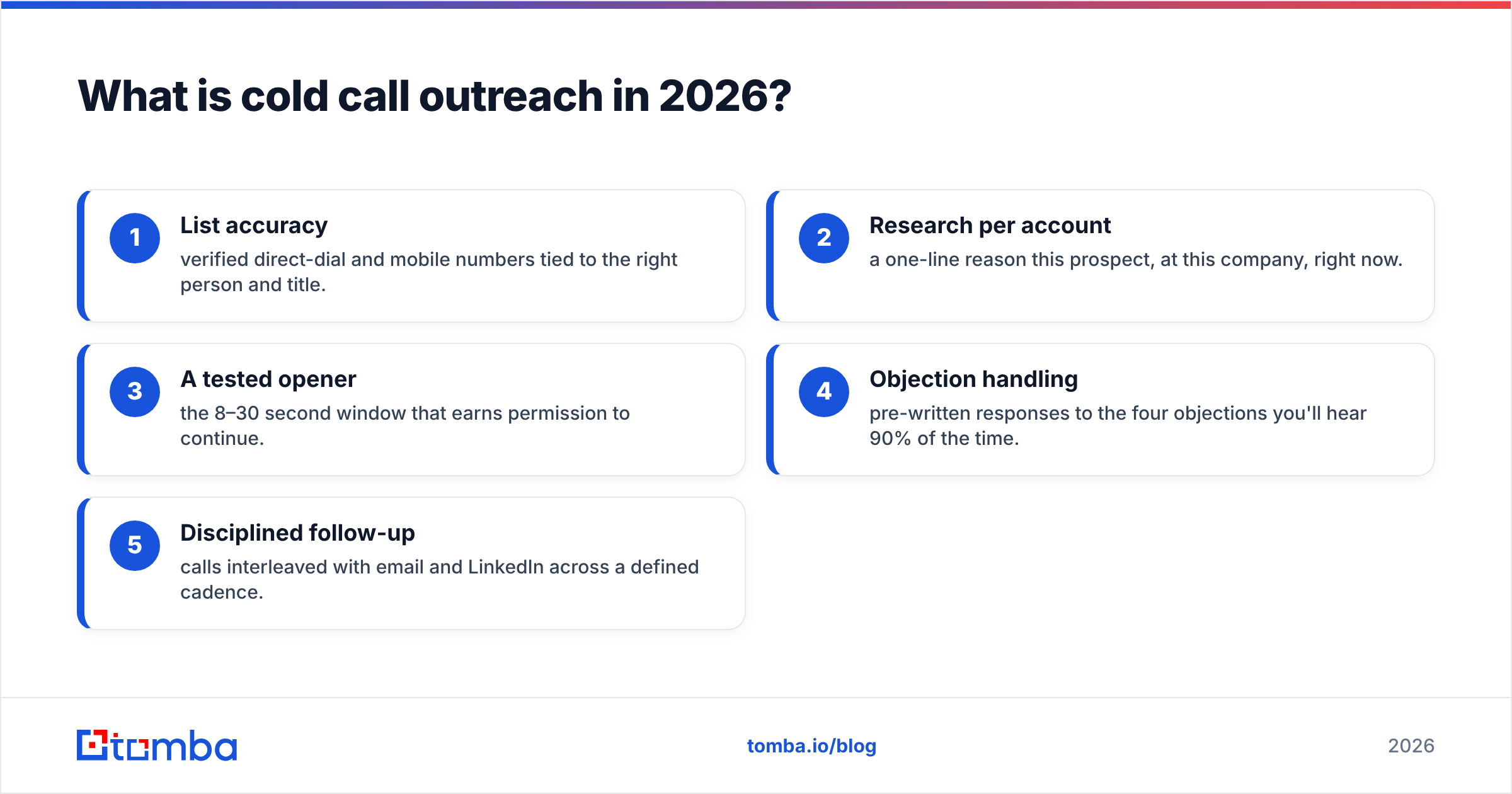
The mechanics of a strong program break down into five parts:
- List accuracy — verified direct-dial and mobile numbers tied to the right person and title.
- Research per account — a one-line reason this prospect, at this company, right now.
- A tested opener — the 8–30 second window that earns permission to continue.
- Objection handling — pre-written responses to the four objections you'll hear 90% of the time.
- Disciplined follow-up — calls interleaved with email and LinkedIn across a defined cadence.

Get all five right and cold calling remains one of the highest-intent channels available — a live human conversation is still worth ten automated emails.
Is cold calling still worth it compared to email and LinkedIn?#
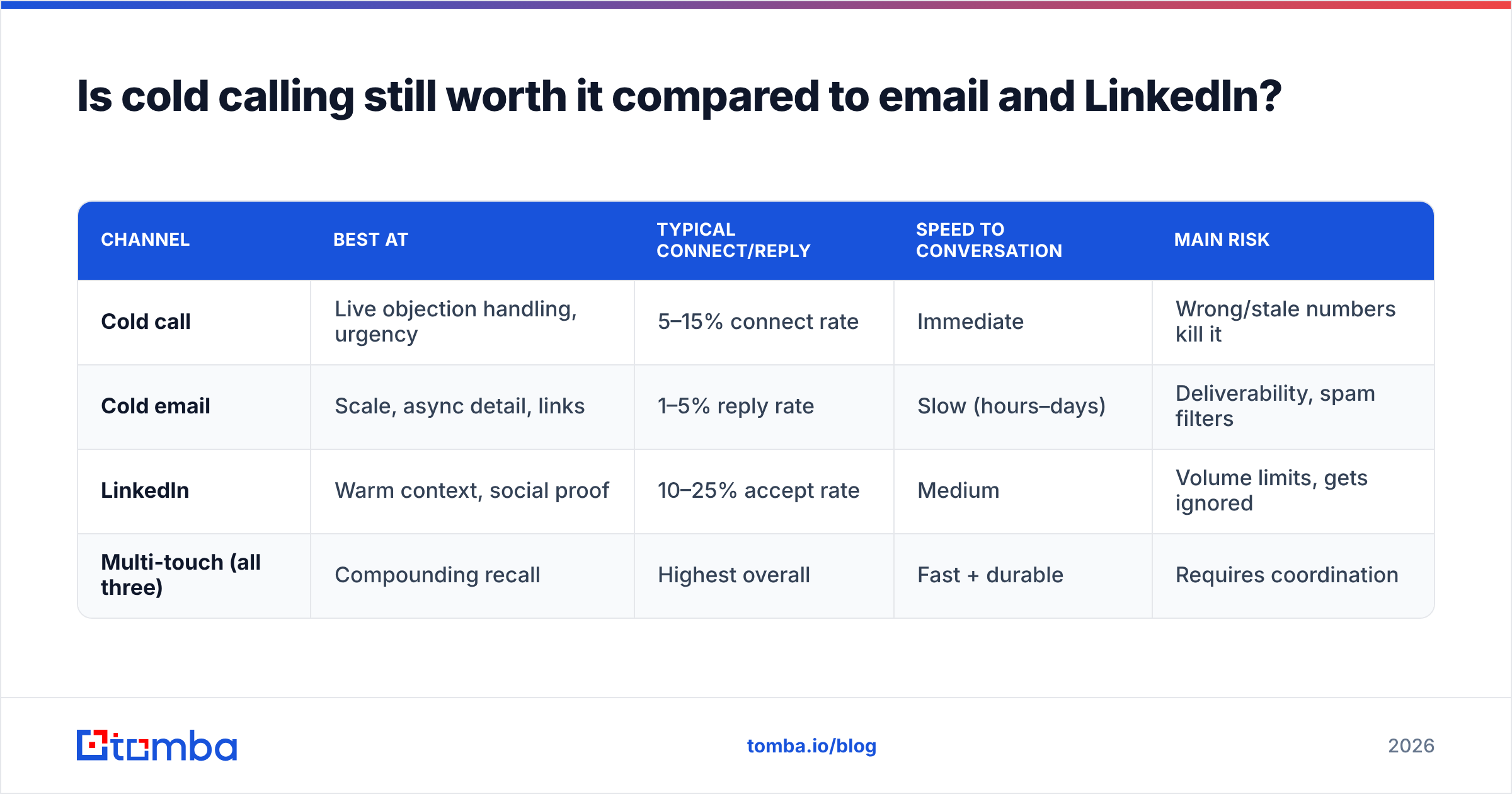
Yes — but only as part of a blended sequence, not as a solo channel. Each channel does something the others can't, and the best outbound teams run all three in parallel rather than betting on one.
| Channel | Best at | Typical connect/reply | Speed to conversation | Main risk |
|---|---|---|---|---|
| Cold call | Live objection handling, urgency | 5–15% connect rate | Immediate | Wrong/stale numbers kill it |
| Cold email | Scale, async detail, links | 1–5% reply rate | Slow (hours–days) | Deliverability, spam filters |
| Warm context, social proof | 10–25% accept rate | Medium | Volume limits, gets ignored | |
| Multi-touch (all three) | Compounding recall | Highest overall | Fast + durable | Requires coordination |
The takeaway: a prospect who ignores your email may pick up the phone, and a prospect who declines your call may accept your LinkedIn request the next day. The channels reinforce each other. If you want to build the surrounding email motion properly, our guide to email deliverability covers the reputation and authentication basics that keep your written touches landing.
Where cold calling clearly wins is intent signal and speed. According to sales research aggregated by HubSpot, a meaningful share of buyers still want to be contacted by phone at some point in the process, and a real conversation surfaces objections in minutes that email would take a week to uncover.
How do you build a cold call list that actually connects?#
Start with data quality, because everything downstream depends on it. A perfect script dialed into a disconnected number books zero meetings. The single biggest lever on connect rate is whether the number belongs to the right person and still works.
Here's the build order most high-performing teams follow:
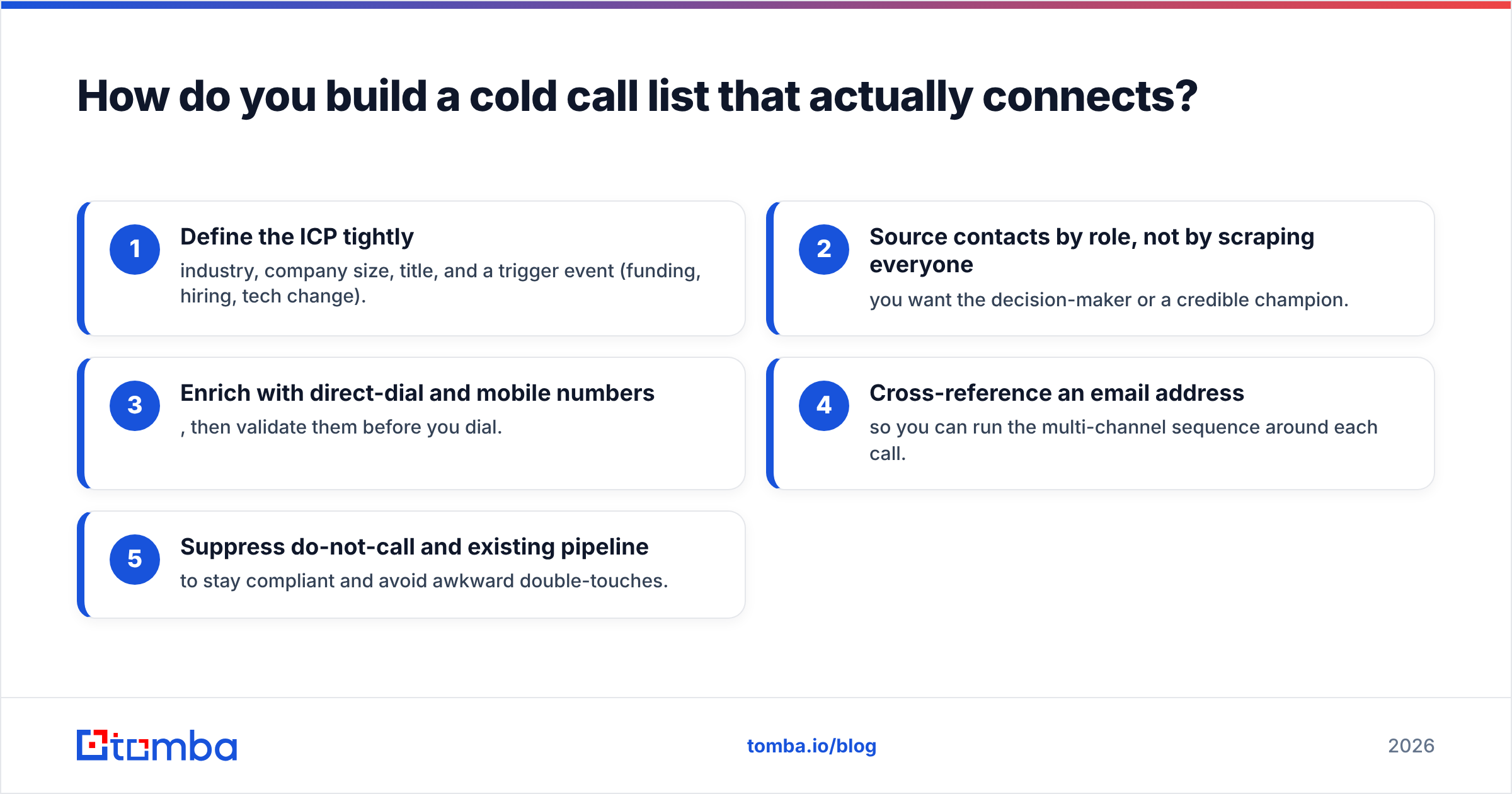
- Define the ICP tightly — industry, company size, title, and a trigger event (funding, hiring, tech change).
- Source contacts by role, not by scraping everyone — you want the decision-maker or a credible champion.
- Enrich with direct-dial and mobile numbers, then validate them before you dial.
- Cross-reference an email address so you can run the multi-channel sequence around each call.
- Suppress do-not-call and existing pipeline to stay compliant and avoid awkward double-touches.
This is where accurate B2B data earns its keep. Tools like Tomba's phone finder surface B2B phone numbers tied to a verified professional profile, and pairing that with the email finder gives you both channels for the same contact in one pass. Run the numbers through a phone validator before a campaign and you strip out the dead lines that would otherwise tank your connect rate. For teams working at scale, the bulk email finder handles list-sized enrichment in one job rather than one lookup at a time.
A quick compliance note: cold calling B2B prospects is legal in most regions, but rules like the TCPA in the US and GDPR in the EU govern consent, recording, and do-not-call lists. Check the guidance from an authority like the FTC for your market before you scale. Clean, compliant data isn't just an efficiency play — it's a risk-management one.
What does a cold call script that books meetings look like?#
A good script isn't a word-for-word cage — it's a flexible map with fixed checkpoints. The structure matters more than the exact phrasing, because you need to hit the same beats every time while sounding human.
The proven skeleton:
- The pattern-interrupt opener (0–8s): State who you are, then ask permission. "Hi Sarah, this is Alex from Tomba — I know I'm an interruption. Can I have 30 seconds to tell you why I called, and you can decide if it's worth continuing?" Honesty about the interruption disarms the reflex to hang up.
- The reason-for-call (8–25s): One sentence tying a specific observation about their company to a problem you solve. Vague relevance ("I help companies grow") gets you hung up on; specific relevance ("I saw you're hiring five SDRs") earns attention.
- The engaging question (25–45s): Ask something that gets them talking about their world, not something answerable with "no."
- The soft ask: Propose a short, specific next step — a 15-minute call Thursday — rather than an open-ended "let's connect sometime."
Notice what's missing: a monologue about features. The goal of a cold call is not to close; it's to earn the meeting. Save the demo for the calendar slot you just booked.
If you're not sure your numbers are even worth scripting for, that's the wrong order of operations — fix the list first, then the words.
When is the best time to make cold calls?#
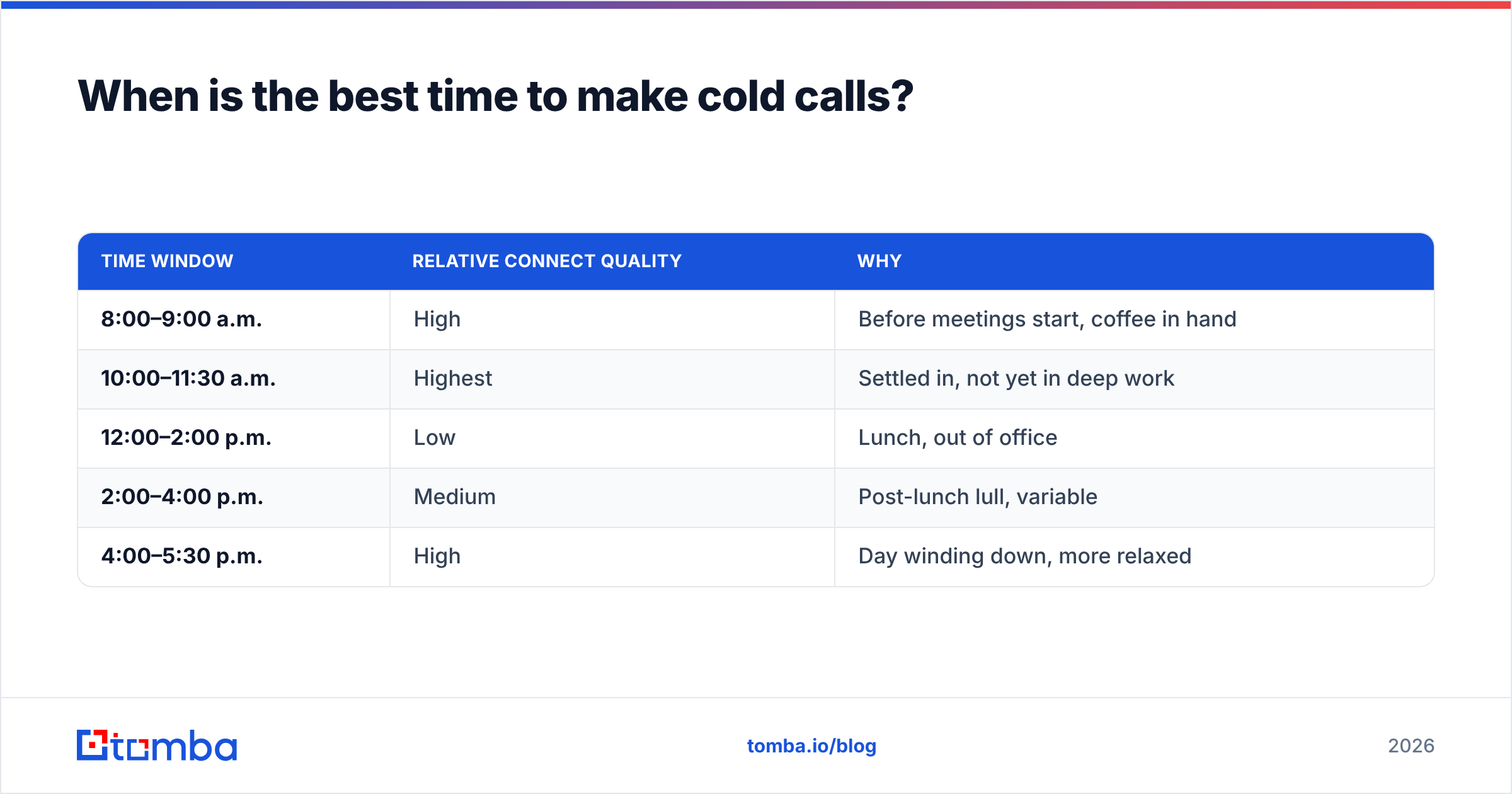
Timing is a free multiplier on connect rate, and most reps waste it. The prospect's availability, not your convenience, determines when a call lands.
| Time window | Relative connect quality | Why |
|---|---|---|
| 8:00–9:00 a.m. | High | Before meetings start, coffee in hand |
| 10:00–11:30 a.m. | Highest | Settled in, not yet in deep work |
| 12:00–2:00 p.m. | Low | Lunch, out of office |
| 2:00–4:00 p.m. | Medium | Post-lunch lull, variable |
| 4:00–5:30 p.m. | High | Day winding down, more relaxed |
Beyond the hour, the day matters: mid-week (Tuesday through Thursday) generally outperforms Monday chaos and Friday checkout. And persistence within a window pays — it often takes several attempts to reach a prospect, so a single dial to a fresh list is leaving most of your meetings on the table. Space those attempts across days and channels rather than hammering the same number twice in an hour.
How do you handle the four objections you'll always hear?#
Ninety percent of cold-call objections fall into four buckets. Pre-write your response to each and you'll never freeze mid-call.
- "I'm not interested." Don't argue. Acknowledge, then ask a permission question: "Totally fair — most people say that before they know what we do. Can I ask what you're using for [problem] today?"
- "Send me an email." Often a polite brush-off. Convert it: "Happy to — so I send something useful and not another ignored email, what's the one thing worth including?" Then actually send it and reference the call.
- "We already use [competitor]." Good — they have budget and the problem is real. "Great, a lot of our customers switched from them. Out of curiosity, if there were one thing you'd improve about it, what would it be?"
- "I don't have time." Respect it and pin a next step: "I'll be quick — can I grab 15 minutes Thursday at 10 instead?"
The through-line: every objection is met with acknowledgment plus a question, never a counter-pitch. You're keeping the conversation alive, not winning a debate. For the follow-up email that these objections almost always require, a tested cold email template shortens the gap between the call and the next touch.
What metrics tell you cold call outreach is working?#
Stop counting dials as your headline number. Dials are an input, and inputs lie — 200 dials to a garbage list looks busy and books nothing. Track the funnel instead:
- Connect rate = live conversations ÷ dials. Below ~5% and your list or timing is broken, not your script.
- Conversation rate = meaningful conversations ÷ connects. This tests your opener and relevance.
- Meetings per 100 dials = the true north-star; it compresses the whole funnel into one comparable number.
- Meeting-held rate = meetings that actually happened ÷ meetings booked. Low here signals weak qualification on the call.
The diagnostic power is in the ratios. A low connect rate points to data; a high connect but low conversation rate points to your opener; plenty of meetings booked but few held points to over-eager qualifying. Each metric isolates a different fix. Feeding accurate contact data back in — through solid data enrichment — is what keeps the top of that funnel healthy over time.
The bottom line on cold call outreach#
Cold calling in 2026 rewards precision, not volume. The reps winning on the phone aren't dialing more — they're dialing better: verified numbers, tight ICPs, a permission-based opener, smart timing, and disciplined multi-channel follow-up. Everything in this playbook compounds, and it all rests on one foundation — reaching the right person on a number that actually rings.
That foundation is a data problem before it's a sales problem. Start by fixing your list: use Tomba's Email Finder to pair a verified email with every prospect, layer in direct-dial numbers, and validate before you launch. Tomba's Free plan gives you 25 searches a month to test the accuracy yourself, and paid plans start at $49/mo when you're ready to scale. Build the clean list first — then let the phone do what it does best: turn a stranger into a conversation.
Related guides#
// get started
Find, verify and enrich your first contacts today
Start on the free plan with 25 searches a month, then scale when your team is ready.
Free plan · No credit card required · GDPR & CCPA
// about the author