Cold Call Practice: How to Drill Cold Calls That Convert
Winging cold calls is why reps freeze on the phone. Here's a concrete cold call practice system — drills, scorecards, and roleplay reps that build real confidence.
Most reps treat cold calling like a coin flip: dial, hope, hang up, repeat. Then they wonder why their connect-to-meeting rate never moves. The truth is simpler and less flattering — they never actually practiced. They performed live, on real prospects, with real pipeline on the line, and called it "getting reps."
This guide fixes that. Cold call practice is a deliberate, repeatable system you run before the phone matters — the same way a pilot logs hours in a simulator before flying passengers.
TL;DR#
- Cold call practice means drilling the call in a safe environment — roleplay, recorded self-talk, objection reps — not learning on live prospects.
- Structure beats volume. A rep who runs 30 minutes of focused drills daily outperforms one who dials blindly for hours.
- Record everything. You can't fix what you can't hear. Self-review plus peer review compounds fast.
- Score each rep against a rubric (opener, objection handling, tonality, close) so improvement is measurable, not vibes.
- Your data is half the battle. Even flawless technique fails on a wrong number — pair practice with accurate contact data like a reliable phone finder.
What Is Cold Call Practice, Really?#
Cold call practice is rehearsing the components of a cold call — the opener, the pattern interrupt, objection responses, the ask — in a controlled setting until they become automatic. Think of it like a musician running scales. Nobody pays to watch scales, but no one plays a concert without them.
The mistake almost every sales team makes is conflating doing cold calls with practicing them. Live dials are the performance. Practice is what happens off-stage: solo drills, partner roleplay, recorded review, and structured feedback. When you only ever perform, every mistake costs you a real opportunity, and every prospect becomes a training dummy who hangs up.

Deliberate practice has three traits that "just dialing" lacks:
- A specific target. You're drilling one skill — say, the price objection — not the whole call.
- Immediate feedback. You hear the recording or a partner tells you what landed and what didn't.
- Repetition past comfort. You run the same 20-second opener 15 times until it stops sounding rehearsed and starts sounding like you.
Why Do So Many Reps Skip Practice?#
Because practice feels slower than dialing, and dialing feels like progress. It isn't. Dialing without a plan is how reps spend six months plateaued at the same conversion rate, blaming the list, the product, or the market.
There's also ego. Roleplay feels awkward. Recording your own voice is uncomfortable. But the discomfort is the point — it's where the growth hides. Reps who push through it stop freezing when a prospect throws a curveball, because they've already heard that curveball 40 times in a conditioning room instead of once, live, at the worst possible moment.
What Does a Real Cold Call Practice System Look Like?#
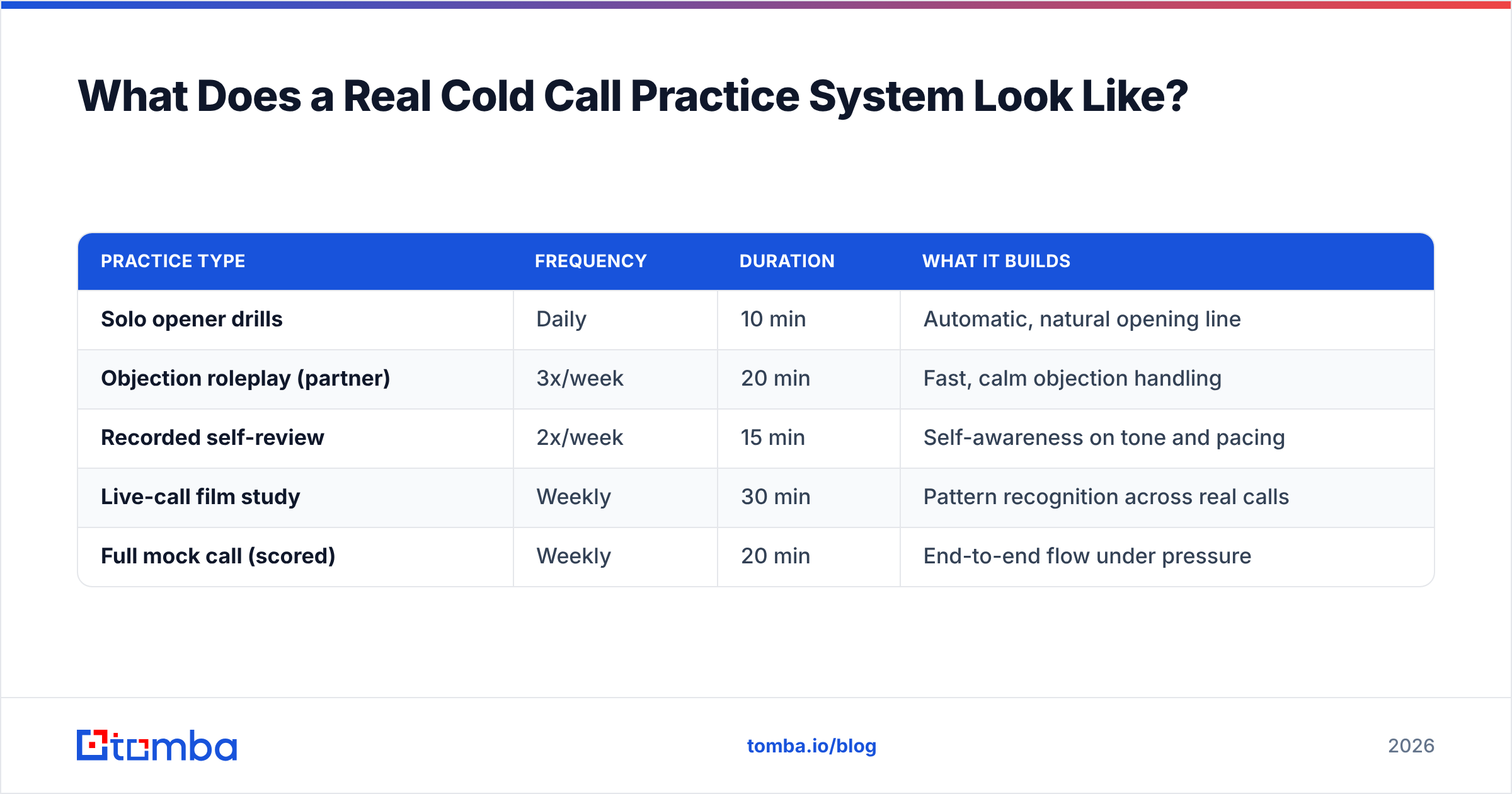
Here's a weekly structure any SDR or AE can run without special tools. The goal is consistency, not intensity.
| Practice type | Frequency | Duration | What it builds |
|---|---|---|---|
| Solo opener drills | Daily | 10 min | Automatic, natural opening line |
| Objection roleplay (partner) | 3x/week | 20 min | Fast, calm objection handling |
| Recorded self-review | 2x/week | 15 min | Self-awareness on tone and pacing |
| Live-call film study | Weekly | 30 min | Pattern recognition across real calls |
| Full mock call (scored) | Weekly | 20 min | End-to-end flow under pressure |
The magic isn't any single row — it's the stacking. Solo drills make openers effortless, so during roleplay you can focus on objections. Roleplay makes objections effortless, so during live calls you can focus on the human on the other end. Each layer frees up mental bandwidth for the next.
The four skills every drill should target#
- The opener. You have roughly seven seconds before a prospect decides whether to stay. Drill a permission-based or pattern-interrupt opener until it's muscle memory.
- Objection handling. Map your five most common objections ("not interested," "send me an email," "we already use X," "no budget," "call me next quarter") and drill a response to each.
- Tonality and pacing. Record yourself. Are you talking too fast? Rising in pitch at the end of sentences like you're asking permission to exist? Fix it in review, not live.
- The ask. Most reps talk themselves out of the meeting. Drill a clear, confident, specific ask ("Does Thursday at 2 or Friday at 10 work better?") so it comes out automatically.
How Do You Roleplay Cold Calls Without It Feeling Fake?#
Roleplay dies when it's too easy. If your partner rolls over and books the meeting after your first sentence, you learned nothing. Good roleplay is adversarial — the "prospect" should be busy, skeptical, and mildly annoyed, because that's the real thing.
Run it like this:
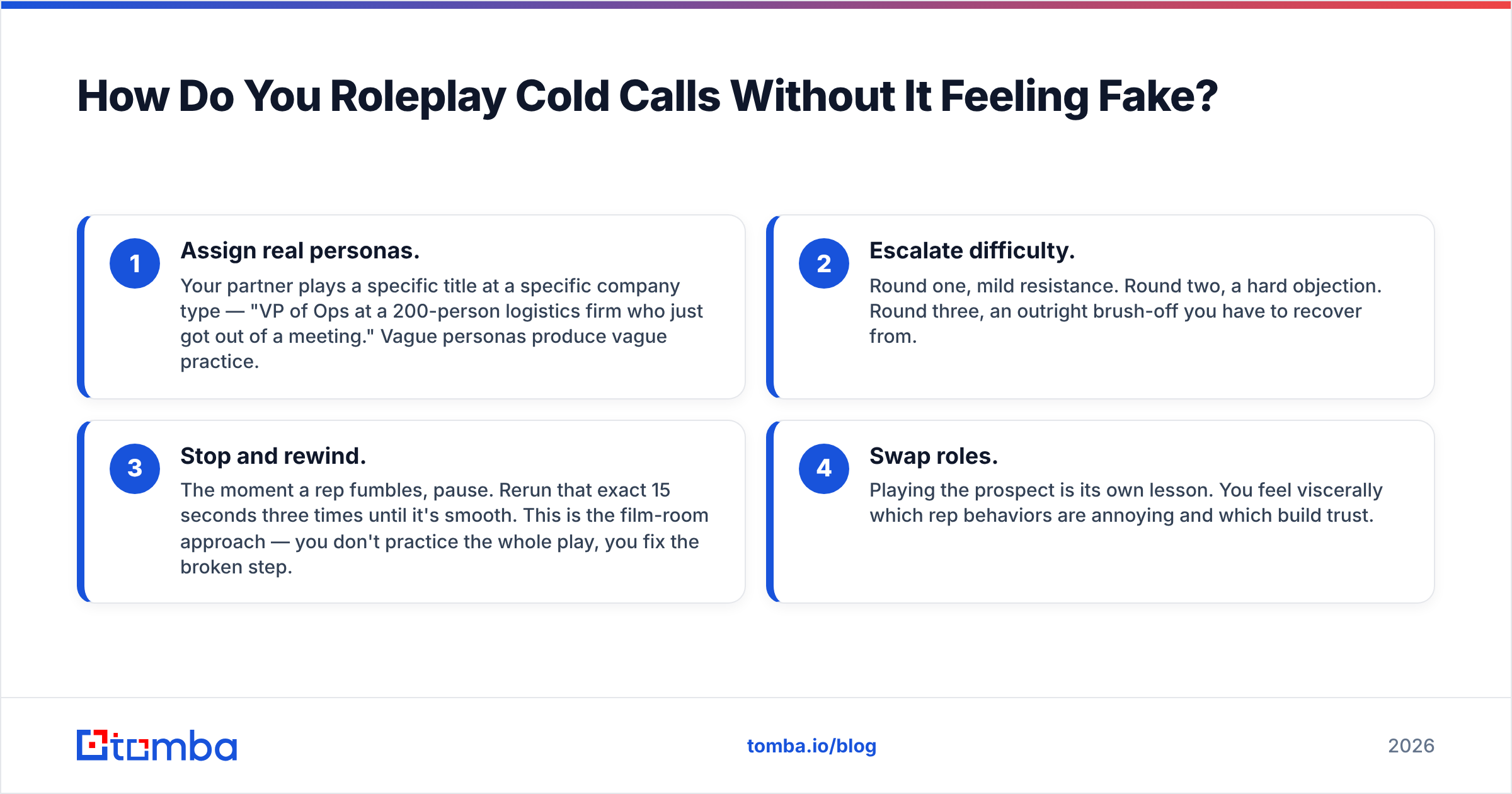
- Assign real personas. Your partner plays a specific title at a specific company type — "VP of Ops at a 200-person logistics firm who just got out of a meeting." Vague personas produce vague practice.
- Escalate difficulty. Round one, mild resistance. Round two, a hard objection. Round three, an outright brush-off you have to recover from.
- Stop and rewind. The moment a rep fumbles, pause. Rerun that exact 15 seconds three times until it's smooth. This is the film-room approach — you don't practice the whole play, you fix the broken step.
- Swap roles. Playing the prospect is its own lesson. You feel viscerally which rep behaviors are annoying and which build trust.
For teams that want structured frameworks, HubSpot's sales blog and call-coaching platforms like Gong publish solid teardown methodologies worth borrowing.
How Do You Score a Cold Call So Practice Actually Improves?#
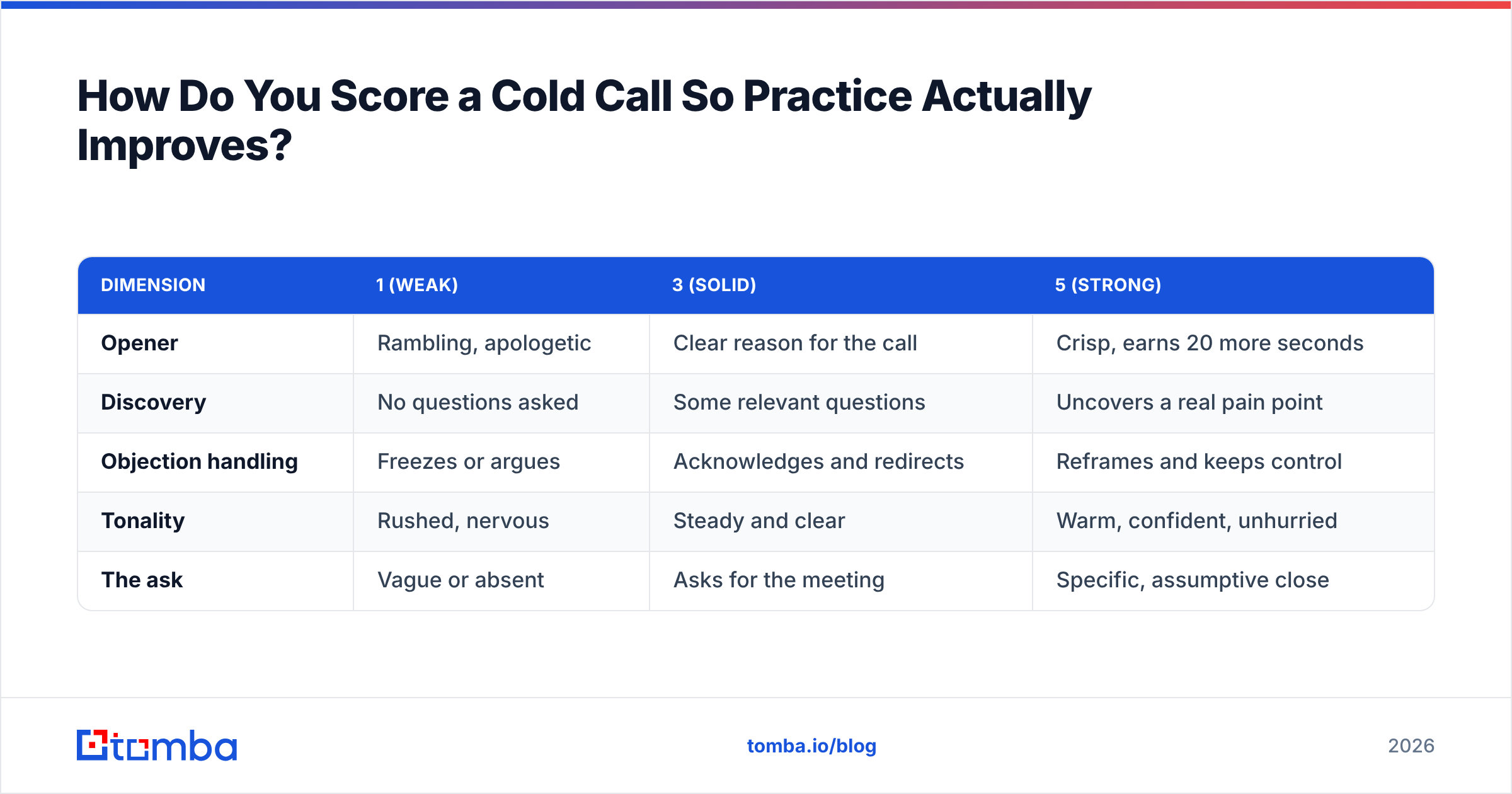
You can't improve what you don't measure. Turn subjective "that felt good" feedback into a scorecard. Rate each mock call 1–5 across five dimensions, then track the numbers over weeks.
| Dimension | 1 (weak) | 3 (solid) | 5 (strong) |
|---|---|---|---|
| Opener | Rambling, apologetic | Clear reason for the call | Crisp, earns 20 more seconds |
| Discovery | No questions asked | Some relevant questions | Uncovers a real pain point |
| Objection handling | Freezes or argues | Acknowledges and redirects | Reframes and keeps control |
| Tonality | Rushed, nervous | Steady and clear | Warm, confident, unhurried |
| The ask | Vague or absent | Asks for the meeting | Specific, assumptive close |
When you log these weekly, patterns jump out. Maybe your opener is a consistent 4 but your objection handling never breaks 2 — now you know exactly where to spend next week's drills. That's the difference between practicing hard and practicing smart.
Does Practice Matter If Your Contact Data Is Bad?#
No — and this is the part reps love to ignore. The most polished opener in the world is worthless if you're dialing a number that's been disconnected for two years or belongs to someone who left the company. Practice sharpens the how; clean data controls the who and whether the phone even rings.
Before a call block, your list should be scrubbed. Wrong numbers don't just waste dials — they wreck the rhythm you built in practice. Ten dead numbers in a row and even a well-drilled rep starts phoning it in. Feed your dialer verified direct lines using a phone finder, validate them with a phone validator, and enrich thin records so you walk into each call knowing who you're talking to. If you're building lists at scale, a solid B2B database beats scraping guesses.
Good data also lets you personalize the opener you practiced. Knowing the prospect's role, company size, and a recent trigger event turns a generic script into a relevant one — and relevance is what keeps them on the line past those first seven seconds.
How Much Cold Call Practice Is Enough?#
Enough that the mechanics disappear. You know you've practiced enough when you stop thinking about your opener and start actually listening to the prospect. That's the tell. Nervous reps are trapped in their own heads, reciting lines. Practiced reps are present, because the script runs on autopilot underneath the conversation.
A realistic ramp:
- Week 1–2: 10 minutes of solo drills daily, one 20-minute roleplay session. Expect it to feel clumsy.
- Week 3–4: Add recorded self-review. You'll cringe. That's growth.
- Week 5–8: Weekly scored mock calls. Track the scorecard trend.
- Ongoing: 15–20 minutes of practice before every real call block, forever. The best reps never stop warming up.
Compare that to the "just dial" approach and the math is brutal. A rep who burns 200 live dials learning the price objection has annoyed 200 prospects. A rep who ran that objection 200 times in a conditioning room walks into those same live calls already fluent — and converts the prospects the first rep torched.
Cold Call Practice vs. Just Dialing: The Real Difference#
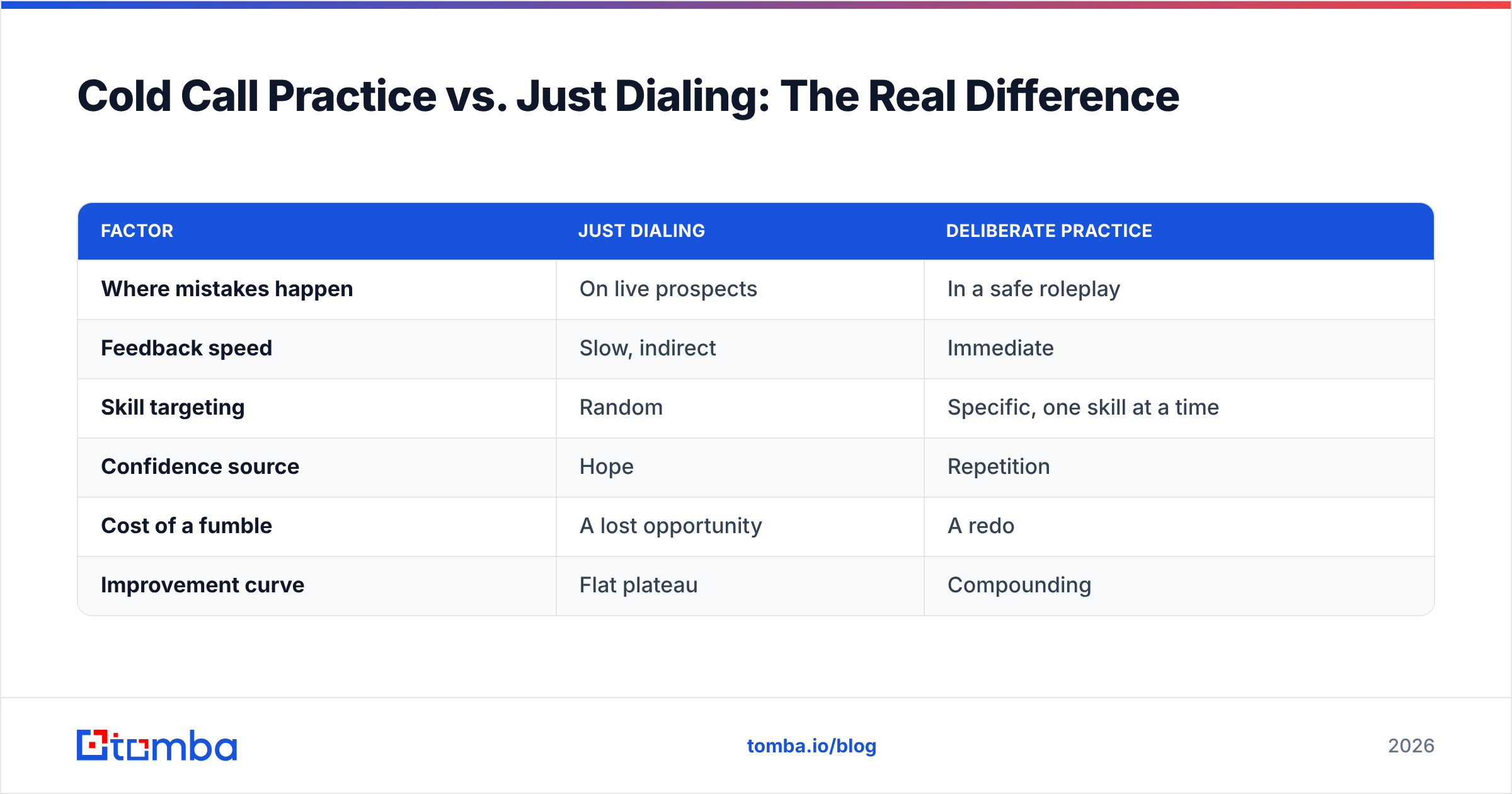
| Factor | Just dialing | Deliberate practice |
|---|---|---|
| Where mistakes happen | On live prospects | In a safe roleplay |
| Feedback speed | Slow, indirect | Immediate |
| Skill targeting | Random | Specific, one skill at a time |
| Confidence source | Hope | Repetition |
| Cost of a fumble | A lost opportunity | A redo |
| Improvement curve | Flat plateau | Compounding |
The column on the right isn't harder — it's just intentional. Same hours, radically different outcome.
Common Cold Call Practice Mistakes to Avoid#
- Practicing only the opener. Reps love drilling the first line and neglecting the middle. Objections and the close are where deals live or die.
- Easy-mode roleplay. If your partner isn't making you sweat, you're rehearsing a fantasy call that never happens in the wild.
- Skipping the recording. Your memory of a call is fiction. The recording is the truth. Listen to it.
- No scorecard. Without measurement, you'll repeat the same three habits forever and call it experience.
- Ignoring data quality. All the reps in the world can't fix a list full of dead numbers. Pair technique with a clean, verified list — and when you need email fallbacks, a reverse email lookup helps you confirm you've got the right person before you dial.
Start Drilling Before You Dial#
Cold calling stops being terrifying the moment it stops being improvised. Build the habit: ten minutes of drills, a hard roleplay partner, a recorder, and a scorecard. Do it for six weeks and you won't recognize your own connect-to-meeting rate.
Then feed that practiced skill the fuel it deserves — accurate, verified contact data so every dial lands on a real decision-maker. Start with Tomba's Phone Finder to source direct lines, layer in data enrichment so you know exactly who's picking up, and check the Tomba pricing tiers — the free plan lets you test the workflow before you commit. Practice makes you good on the phone. Good data makes sure the phone rings the right person.
Drill the call. Then let the data do the dialing.
Related guides#
// get started
Find, verify and enrich your first contacts today
Start on the free plan with 25 searches a month, then scale when your team is ready.
Free plan · No credit card required · GDPR & CCPA
// about the author