Cold Call Questions: 30 Proven Questions to Book More Meetings
The best cold call questions open real conversations instead of triggering the hang-up reflex. Here are 30 field-tested questions, organized by call stage, plus a framework for building a call list that actually connects.
Most cold calls die in the first fifteen seconds — not because the product is wrong, but because the rep opens with a pitch instead of a question. The reps who consistently book meetings aren't smoother talkers. They ask better questions, in a better order, and then they shut up and listen.
This guide gives you 30 cold call questions grouped by call stage, a table showing which question type to use when, and a practical way to make sure the numbers you're dialing actually belong to the right people. No scripts to memorize word-for-word — a question bank you can adapt to any prospect on any day.
TL;DR#
- Lead with permission and curiosity, not a pitch. The first question's only job is to earn the next 30 seconds.
- Discovery questions do the heavy lifting. Open-ended, problem-focused questions surface pain the prospect will actually act on.
- Match the question type to the call stage — opener, discovery, qualification, objection, and close each need a different shape.
- Bad data kills great questions. A perfect discovery question means nothing if you dialed the wrong person; verify contacts before you dial.
- Book the next step explicitly. The strongest close is a specific, low-friction question about calendar time.
Why Do Cold Call Questions Matter More Than Your Pitch?#
A pitch talks at someone. A question invites them in. On a cold call, the prospect didn't ask to hear from you, so every second you spend talking about yourself increases the odds of a hang-up. Every second you spend getting them to talk lowers it.
Think of a cold call like a first-date conversation. If you spend the first two minutes listing your accomplishments, the date ends early. If you ask a genuinely interesting question and actually listen, the conversation keeps going. Questions signal that you're there to understand a problem, not to unload a script.
There's data behind this instinct. Research from Gong's analysis of sales calls has repeatedly found that successful discovery calls involve the prospect doing most of the talking, with reps asking a higher number of relevant questions. The mechanism is simple: people trust conclusions they reach themselves more than conclusions you hand them.
The catch is that not all questions are equal. "Are you happy with your current provider?" invites a one-word "yes" that ends the call. "What made you choose your current provider back when you signed up?" invites a story — and stories contain the pain you can solve.
What Are the Best Cold Call Opening Questions?#
The opener has exactly one job: earn permission to keep talking. It is not the place to qualify, pitch, or discover. It's the place to be human and lower the prospect's guard.
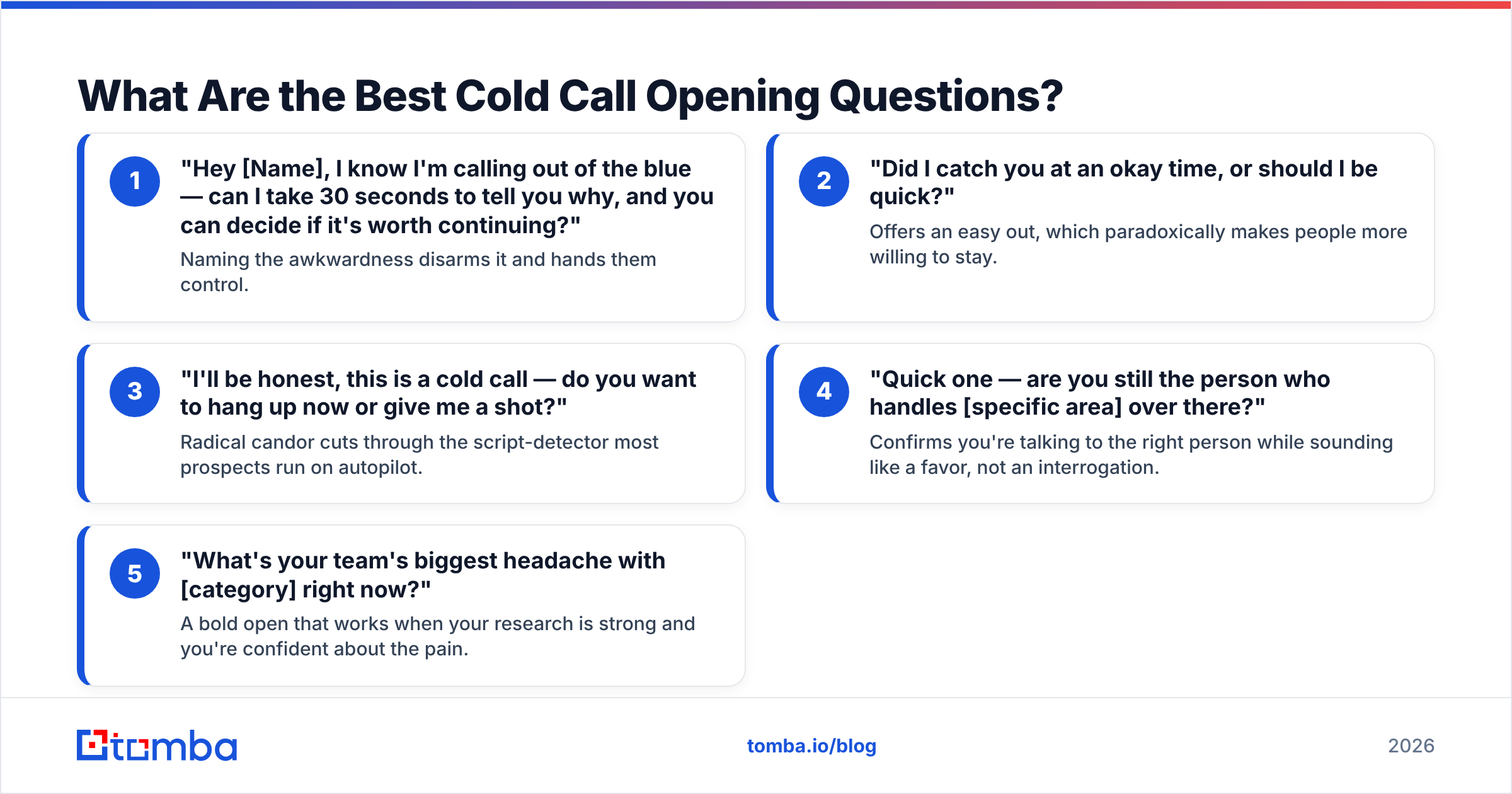
Use these five openers to get past the reflexive brush-off:
- "Hey [Name], I know I'm calling out of the blue — can I take 30 seconds to tell you why, and you can decide if it's worth continuing?" Naming the awkwardness disarms it and hands them control.
- "Did I catch you at an okay time, or should I be quick?" Offers an easy out, which paradoxically makes people more willing to stay.
- "I'll be honest, this is a cold call — do you want to hang up now or give me a shot?" Radical candor cuts through the script-detector most prospects run on autopilot.
- "Quick one — are you still the person who handles [specific area] over there?" Confirms you're talking to the right person while sounding like a favor, not an interrogation.
- "What's your team's biggest headache with [category] right now?" A bold open that works when your research is strong and you're confident about the pain.
Notice none of these mention your product. They buy you the runway to get to discovery, which is where the real call happens.
Which Discovery Questions Uncover Real Pain?#
Discovery is the heart of the call. Your goal is to get the prospect describing their situation in their own words so you can find the gap between where they are and where they want to be. Open-ended and neutral beats leading every time.
Ten discovery questions worth stealing:
- "Walk me through how your team handles [process] today."
- "What's working well with your current setup — and what isn't?"
- "When did you last run into a problem with [area], and what happened?"
- "If you could wave a wand and fix one thing about [process], what would it be?"
- "How is that affecting the rest of the team right now?"
- "What have you already tried to solve this?"
- "What made this a priority now versus six months ago?"
- "Who else feels this pain when it happens?"
- "What does 'good' look like for you a year from now?"
- "On a scale of 1 to 10, how urgent is fixing this — and why not lower?"
That last one is a favorite of experienced reps because the "why not lower" forces the prospect to argue for urgency, doing your selling for you. For more on framing questions around a prospect's actual pain rather than your feature list, HubSpot's sales blog has a deep library of discovery frameworks worth studying.
How Do You Qualify Without Sounding Like an Interrogation?#
Qualification tells you whether this deal is real. The trick is weaving budget, authority, need, and timeline questions into the conversation instead of firing them off like a form. Frame them as "help me understand your world" rather than "prove you're worth my time."
Five qualification questions that stay conversational:
- "Who else would need to weigh in on a decision like this?" (authority, softly)
- "Is there a budget already set aside for solving this, or is that still to figure out?" (budget, no pressure)
- "What would need to be true for this to become a real priority this quarter?" (timeline + need)
- "Have you evaluated anything else for this, and how did that go?" (competition + buying stage)
- "If we could show you [specific outcome], what would be your next step internally?" (process + intent)
The order matters. Ask about need and impact first — once someone has admitted a problem hurts, questions about budget and timeline feel like problem-solving rather than gatekeeping.
When Should You Ask Each Type of Question?#
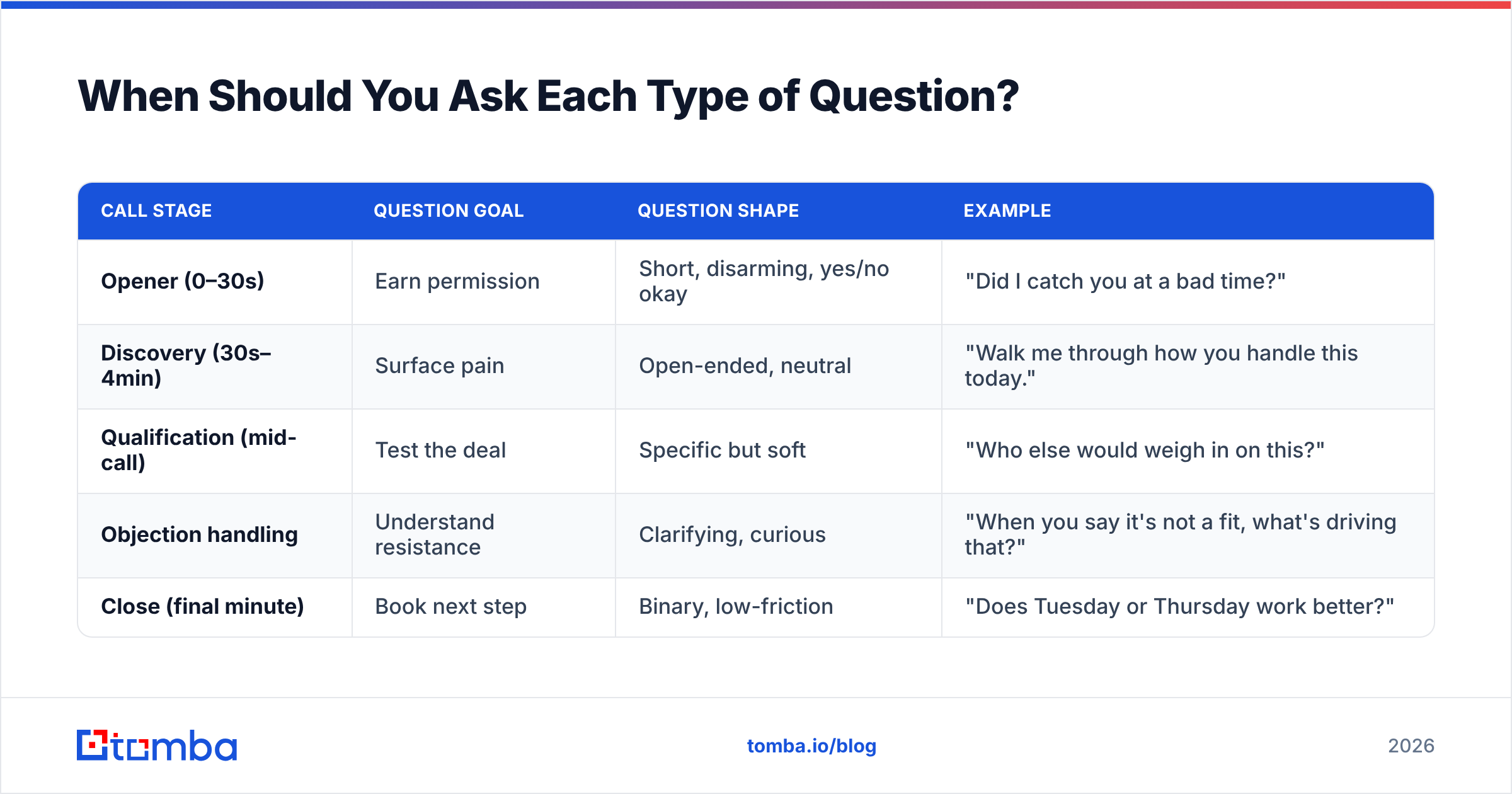
Different call stages call for different question shapes. Fire an open-ended discovery question during the close and you'll reopen a decision you already won; ask a closing question during discovery and you'll sound pushy. Use this map:
| Call stage | Question goal | Question shape | Example |
|---|---|---|---|
| Opener (0–30s) | Earn permission | Short, disarming, yes/no okay | "Did I catch you at a bad time?" |
| Discovery (30s–4min) | Surface pain | Open-ended, neutral | "Walk me through how you handle this today." |
| Qualification (mid-call) | Test the deal | Specific but soft | "Who else would weigh in on this?" |
| Objection handling | Understand resistance | Clarifying, curious | "When you say it's not a fit, what's driving that?" |
| Close (final minute) | Book next step | Binary, low-friction | "Does Tuesday or Thursday work better?" |
The reps who internalize this map stop treating a cold call as one continuous pitch and start treating it as five short conversations, each with its own question toolkit. That structure is what separates a 3% connect-to-meeting rate from a 15% one, and it's a skill that carries directly into your LinkedIn outreach and email follow-up too.
What Questions Turn Objections Into Openings?#
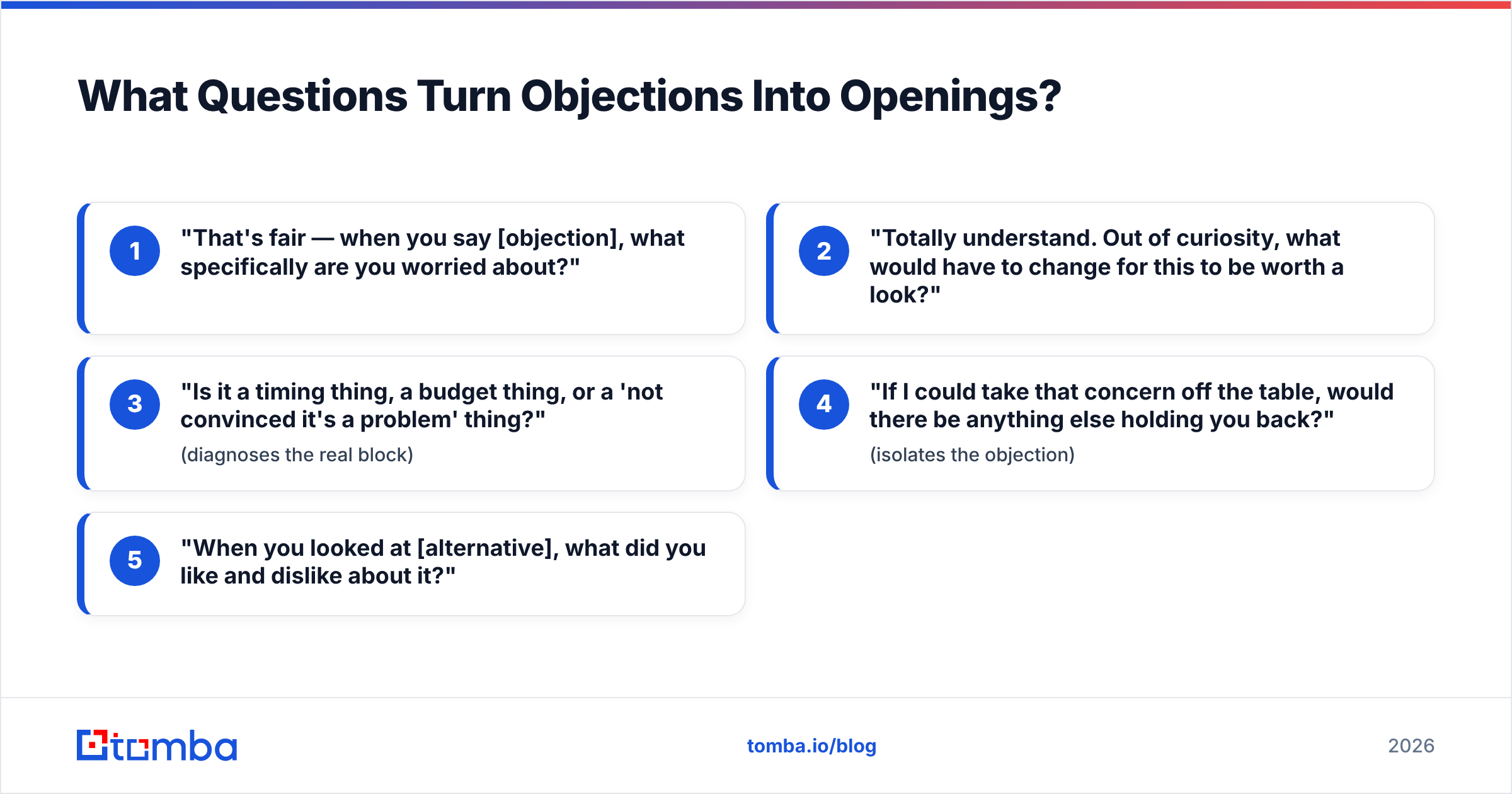
Objections aren't rejections — they're requests for more information delivered impatiently. The worst thing you can do is argue. The best thing is to ask a question that gets the prospect explaining their own hesitation, because explanations tend to soften as they're spoken aloud.
Five objection-handling questions:
- "That's fair — when you say [objection], what specifically are you worried about?"
- "Totally understand. Out of curiosity, what would have to change for this to be worth a look?"
- "Is it a timing thing, a budget thing, or a 'not convinced it's a problem' thing?" (diagnoses the real block)
- "If I could take that concern off the table, would there be anything else holding you back?" (isolates the objection)
- "When you looked at [alternative], what did you like and dislike about it?"
"Is it a timing, budget, or fit thing?" is especially powerful because it converts a vague brush-off into a specific, addressable category. Once you know which of the three it is, you know exactly which follow-up question to ask next.

How Do You Close for the Next Step?#
A cold call rarely closes a sale — it closes a meeting. So your closing question should ask for a small, specific commitment, not a big vague one. "Should we set something up?" invites a "let me think about it." A concrete choice does not.
Strong closing questions:
- "I've got Wednesday at 10 or Thursday at 2 — which is easier?" The double-bind: either answer moves you forward.
- "Makes sense to grab 20 minutes with [stakeholder] on the call too — want me to send an invite for both of you?" Expands the deal while booking it.
- "What's the best email to send a calendar invite to so this doesn't get lost?" Assumes the yes and captures contact data in one move.
That last question is deceptively important, because the meeting is only as good as the contact details behind it. Which brings us to the thing most cold-call advice ignores.
Why Does Contact Data Decide Whether Your Questions Ever Get Heard?#
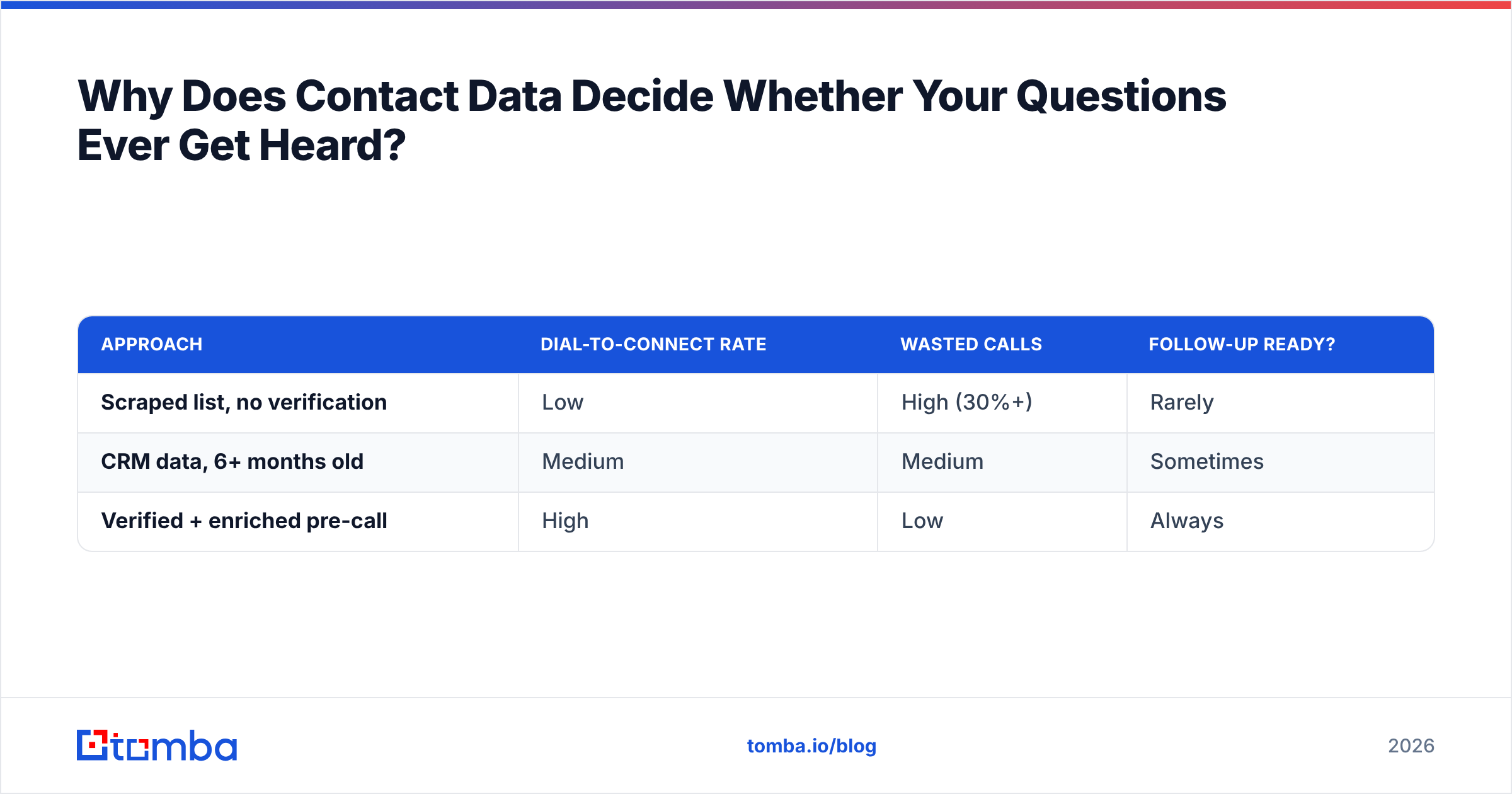
The best question bank in the world is useless if you're dialing a disconnected number or reaching the wrong person. Sales teams routinely burn 20–30% of their dialing time on bad data — wrong numbers, gatekeepers who can't help, and contacts who left the company months ago. According to Gartner's research on sales operations, data quality is one of the most consistent drivers of pipeline efficiency, and it degrades faster than most teams realize.
Here's the practical fix: verify and enrich your list before you dial, not during the call. Confirm the person still holds the role, that you have a direct line rather than a switchboard, and that you can follow up by email the moment you hang up.
| Approach | Dial-to-connect rate | Wasted calls | Follow-up ready? |
|---|---|---|---|
| Scraped list, no verification | Low | High (30%+) | Rarely |
| CRM data, 6+ months old | Medium | Medium | Sometimes |
| Verified + enriched pre-call | High | Low | Always |
Tools that help you get this right: a phone finder to source direct-dial B2B numbers, a phone validator to strip disconnected lines before they eat your morning, and an email verifier so the calendar invite you promised at the close actually lands. Better connect rates lift your response rate across every channel, not just the phone.
What Does a Full Cold Call Question Flow Look Like?#
Putting it together, a strong 4-minute call moves through the stages without feeling scripted:
- Opener: "Hey Sarah, cold call — 30 seconds and you can tell me to buzz off?"
- Permission granted → Discovery: "Walk me through how your team handles lead routing today."
- Pain surfaces → Dig deeper: "How's that affecting your reps' response times?"
- Qualify: "Who besides you would care about fixing that?"
- Objection appears → Diagnose: "Is it a timing thing or a not-convinced-it's-a-problem thing?"
- Close: "Wednesday at 10 or Thursday at 2 — and what's the best email for the invite?"
Six questions. The prospect did 70% of the talking. You booked a meeting and captured a verified email in the same breath. That's the whole game.
Frequently Asked Questions#
How many questions should I ask on a cold call? Aim for the prospect talking most of the time, which usually means 6–10 well-placed questions across a 3–5 minute call. Quality and sequence beat volume — one great discovery question outperforms five shallow ones.
Should I use a script for cold call questions? Use a question bank, not a word-for-word script. Memorize the shape and intent of each stage's questions so you can adapt to what the prospect actually says instead of steamrolling toward your next line.
What's the single most important cold call question? The urgency check — "On a scale of 1 to 10, how urgent is fixing this, and why not lower?" It forces prospects to articulate their own reasons for acting now, which is far more persuasive than anything you could tell them.
Start With a Call List That Actually Connects#
Great questions only pay off when they reach the right person on a working line. Before your next dialing session, build your list on a foundation of accurate, verified contact data. Tomba's Email Finder helps you source and confirm decision-maker contact details — email and the identity behind it — so the discovery questions you worked so hard on land with someone who can actually say yes. Pair it with verified phone data, and you'll spend your morning in real conversations instead of listening to dial tones. Check the Tomba pricing plans, start free with 25 searches, and turn a clean list into booked meetings.
Related guides#
Ready to find emails that actually work?
Join 150,000+ professionals who stopped guessing and started sending. Free credits on signup — no credit card required.
Get the Tomba newsletter
Practical outbound tactics and product updates — once every two weeks.
About the author