Cold Call Research: How to Prep B2B Calls That Convert
Most cold calls fail before the phone rings. Here's how cold call research turns anonymous dials into relevant conversations — with a repeatable pre-call checklist, the data points that matter, and the tools that make prep fast.
Cold calling still works in 2026 — but "smile and dial" doesn't. The reps who book meetings aren't calling more people; they're calling the right people with a reason. That reason comes from cold call research: the 3-to-8 minutes of prep that turns an anonymous number into a relevant, human conversation.
This guide breaks down exactly what to research before you dial, where to find it fast, and how to compress prep so it scales past a handful of calls a day.
TL;DR#
- Cold call research is pre-call intelligence — the account, contact, trigger event, and likely pain you gather before dialing so your opener earns 20 more seconds.
- Relevance beats volume. A researched call connects to a real problem; an un-researched one gets hung up on in the first 7 seconds.
- Five data layers matter: verified contact details, role and seniority, company triggers, tech stack, and a personal hook.
- Speed is the constraint. Manual research kills throughput — enrichment tools and a fixed checklist keep prep under 5 minutes per prospect.
- Accurate data is the foundation. A perfect script fails if the phone number or decision-maker is wrong, so verify before you dial.
What is cold call research?#
Cold call research is the process of gathering enough about a prospect and their company that your call is relevant on the first sentence — before you've ever spoken to them.
Think of it like a doctor reading your chart before walking into the room. If they open with "So, what brings you in?" they're guessing. If they open with "I see you're here about the knee — how's the swelling since Tuesday?" you instantly trust them. Cold call research is reading the chart. The prospect can feel, within one sentence, whether you did your homework or you're reading a list.
Technically, it means assembling a short dossier per prospect: who they are, what their company is dealing with right now, why they might care, and how to reach them on a line that actually rings. Done well, it shifts the call from an interruption to a reasonably-timed, relevant question.
Why does cold call research matter more in 2026?#
Because buyers have zero tolerance for irrelevance and every reason to hang up. Spam filtering on phones, stricter compliance, and a generation of buyers who screen unknown numbers mean your window to prove relevance is shorter than ever — roughly the first 7 to 10 seconds.
Un-researched calls fail in predictable ways:
- Wrong person. You pitch a feature to someone with no authority or budget for it.
- Wrong time. You call about a problem they solved six months ago — or won't face for a year.
- Wrong number. The direct dial is stale, so you never even reach a human.
- Wrong hook. Your opener is about you ("We help companies like yours…") instead of them.
Research fixes all four before you dial. According to widely cited benchmarks from sales research firms like Gartner, B2B buyers spend the majority of their journey doing independent research — which means when you do get them live, a generic pitch signals you've done none. Relevance is table stakes.
What should you research before a cold call?#
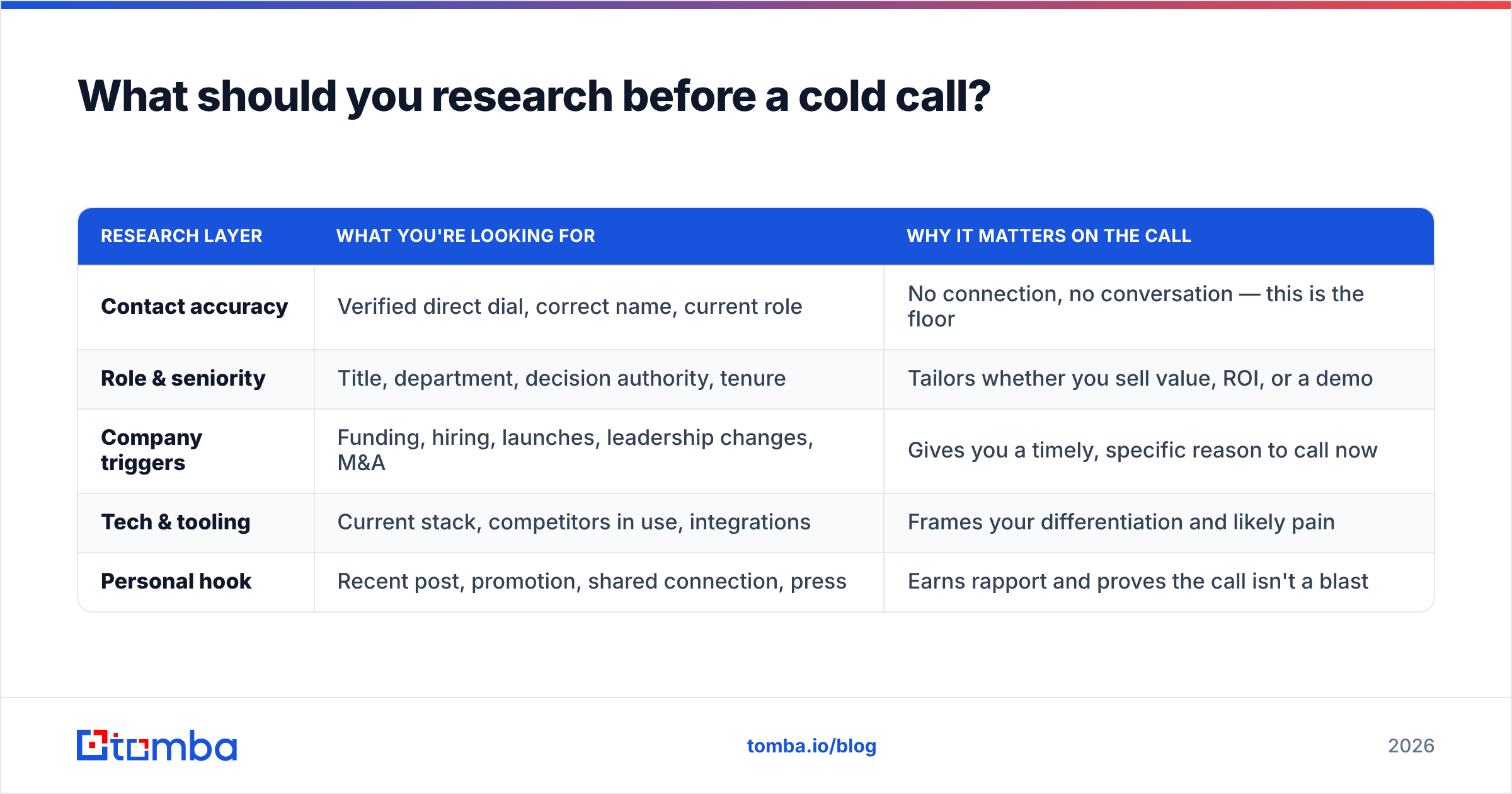
Focus on five layers. You don't need all of them for every call, but the top three are non-negotiable.
| Research layer | What you're looking for | Why it matters on the call |
|---|---|---|
| Contact accuracy | Verified direct dial, correct name, current role | No connection, no conversation — this is the floor |
| Role & seniority | Title, department, decision authority, tenure | Tailors whether you sell value, ROI, or a demo |
| Company triggers | Funding, hiring, launches, leadership changes, M&A | Gives you a timely, specific reason to call now |
| Tech & tooling | Current stack, competitors in use, integrations | Frames your differentiation and likely pain |
| Personal hook | Recent post, promotion, shared connection, press | Earns rapport and proves the call isn't a blast |
The mistake most reps make is starting with the pitch and bolting research on. Flip it: let the research decide the pitch. If you find a company just posted 12 SDR roles, your opener writes itself — you're calling about the exact scaling problem they're clearly hiring to solve.
Where do you find cold call research fast?#
The sources are everywhere; the problem is speed. Here's where each data layer actually lives, and how to pull it without spending 30 minutes per prospect.
- LinkedIn — the single best source for role, seniority, tenure, and a personal hook. Check the prospect's recent activity and the company page's "People" and updates tabs. Solid LinkedIn outreach starts here too.
- Company website & newsroom — press releases, product launches, and "About" pages reveal positioning and recent momentum.
- Job boards — open roles are a goldmine of trigger events. A surge in hiring for a function signals investment and pain in that area.
- Funding & news databases — sites like Crunchbase surface funding rounds, which correlate with new budget.
- Enrichment tools — where you get the verified phone number and email that turns research into a reachable contact.
That last one is the bottleneck. You can know everything about a prospect and still fail if the direct dial is disconnected. A phone finder that returns validated B2B numbers, paired with data enrichment that fills in role, company, and firmographics in one pull, collapses the five layers into a couple of clicks.
How much research is enough per call?#
Enough to earn the first 30 seconds — and no more. This is where reps sabotage themselves: research is comfortable, dialing is scary, so they hide in research and never pick up the phone.
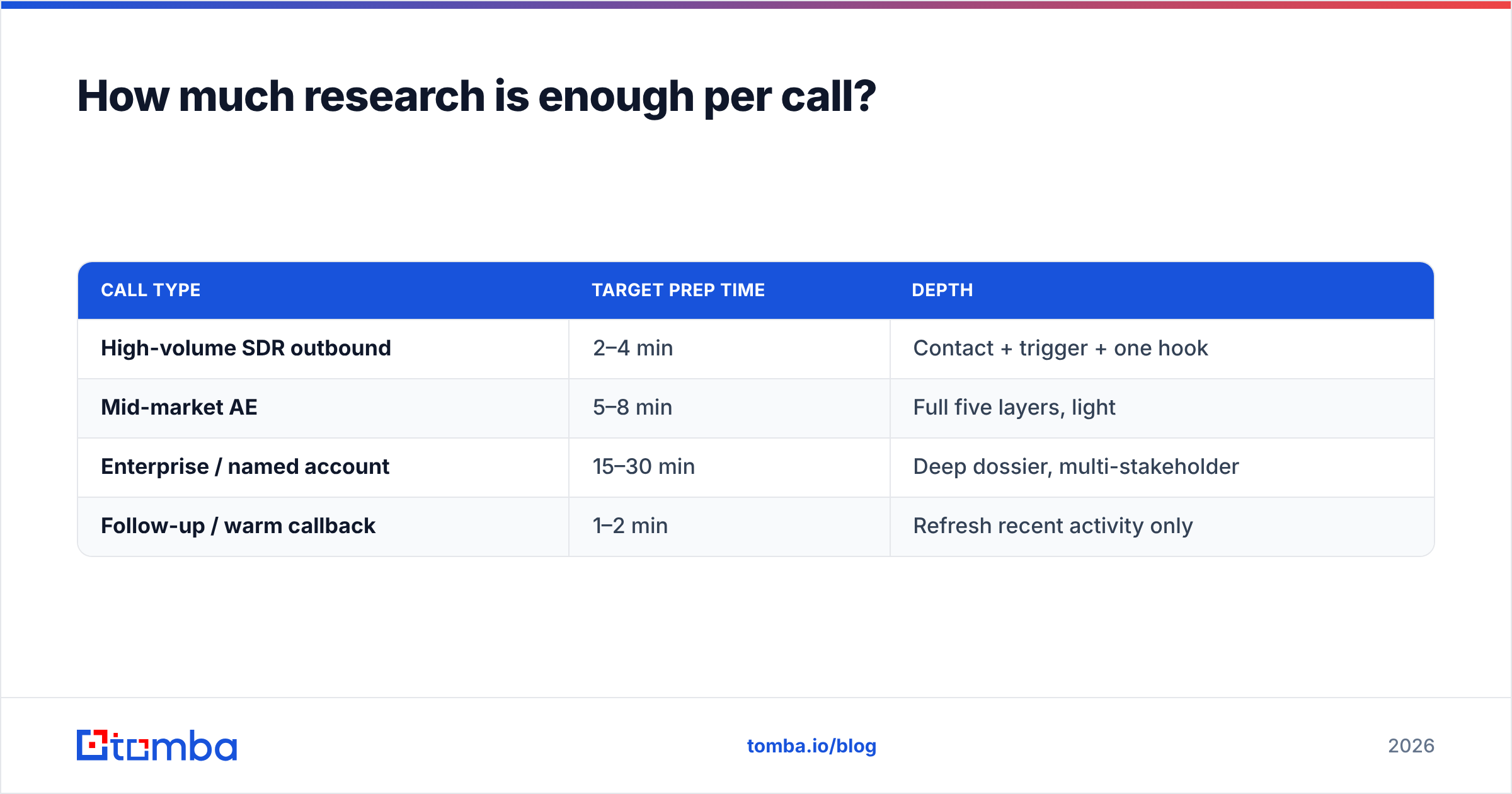
Set a hard ceiling based on deal size and call type.
| Call type | Target prep time | Depth |
|---|---|---|
| High-volume SDR outbound | 2–4 min | Contact + trigger + one hook |
| Mid-market AE | 5–8 min | Full five layers, light |
| Enterprise / named account | 15–30 min | Deep dossier, multi-stakeholder |
| Follow-up / warm callback | 1–2 min | Refresh recent activity only |
If you're spending 20 minutes researching a $2,000 deal, the math doesn't work. Match effort to opportunity, batch your research, and protect your calling blocks.
What does a cold call research checklist look like?#
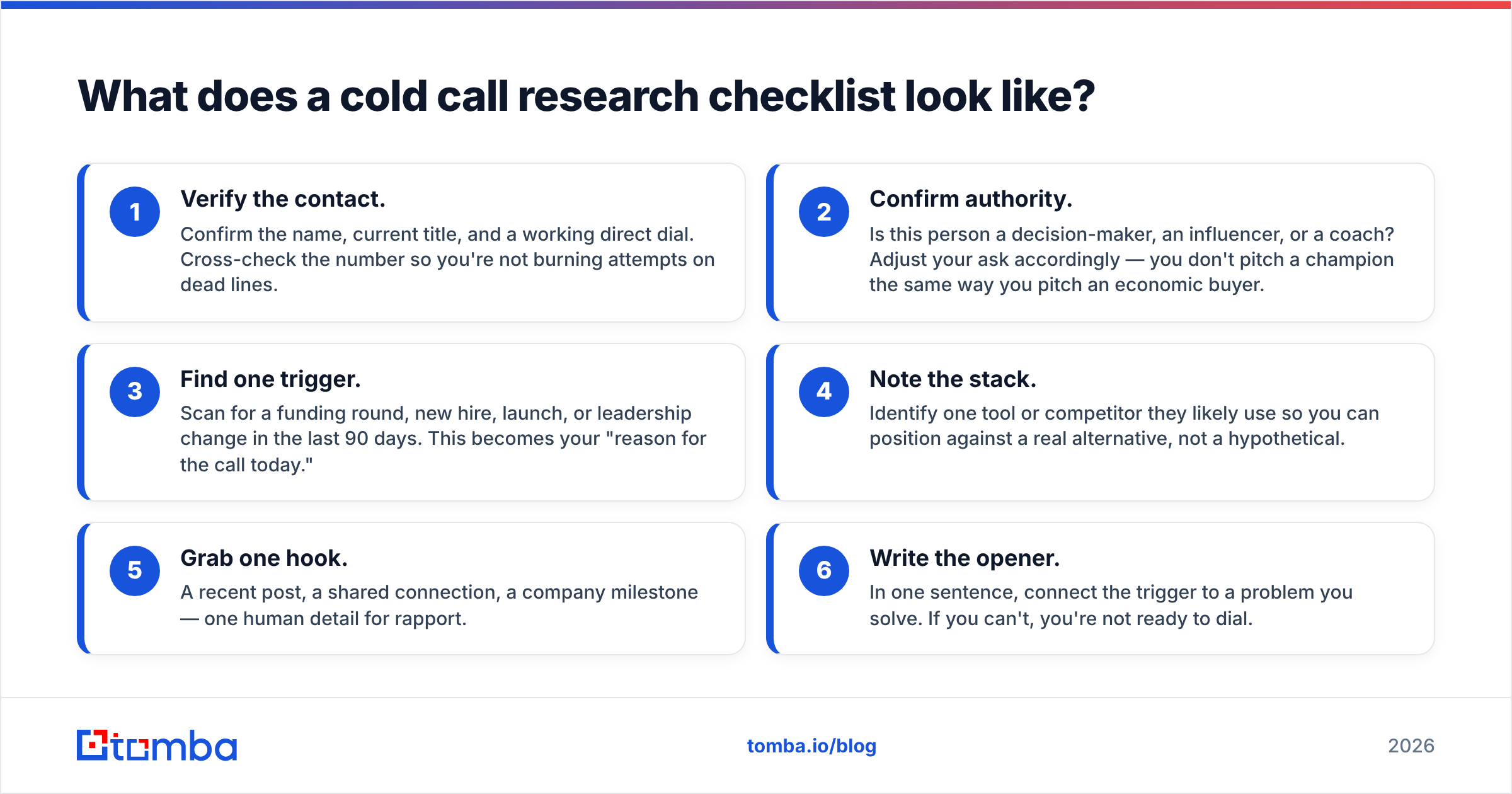
Turn the five layers into a repeatable checklist so prep is a routine, not a decision. Here's a lightweight version you can run in under five minutes:
- Verify the contact. Confirm the name, current title, and a working direct dial. Cross-check the number so you're not burning attempts on dead lines.
- Confirm authority. Is this person a decision-maker, an influencer, or a coach? Adjust your ask accordingly — you don't pitch a champion the same way you pitch an economic buyer.
- Find one trigger. Scan for a funding round, new hire, launch, or leadership change in the last 90 days. This becomes your "reason for the call today."
- Note the stack. Identify one tool or competitor they likely use so you can position against a real alternative, not a hypothetical.
- Grab one hook. A recent post, a shared connection, a company milestone — one human detail for rapport.
- Write the opener. In one sentence, connect the trigger to a problem you solve. If you can't, you're not ready to dial.
Store this as a template in your CRM or notes so every rep runs the same play. Consistency is what makes research coachable and results comparable.
What tools help with cold call research?#
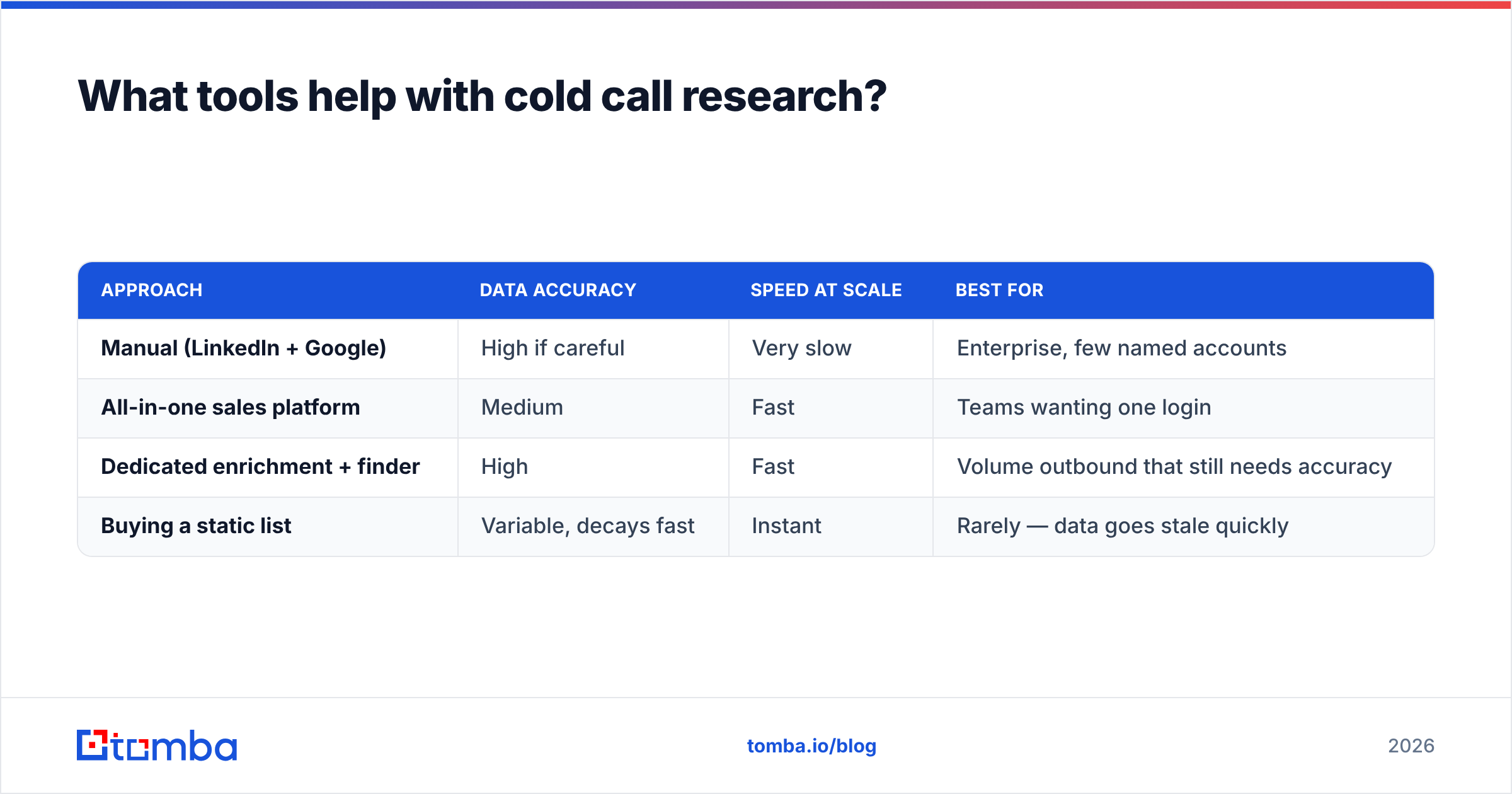
The category splits into two jobs: finding accurate contact data (so the call connects) and finding context (so the call is relevant). Most teams stitch together a few tools. Here's how common approaches compare.
| Approach | Data accuracy | Speed at scale | Best for |
|---|---|---|---|
| Manual (LinkedIn + Google) | High if careful | Very slow | Enterprise, few named accounts |
| All-in-one sales platform | Medium | Fast | Teams wanting one login |
| Dedicated enrichment + finder | High | Fast | Volume outbound that still needs accuracy |
| Buying a static list | Variable, decays fast | Instant | Rarely — data goes stale quickly |
For most outbound teams, the winning combination is a dedicated data layer plus your own research on triggers. Tools like BookYourData offer strong verified B2B contact databases, and pairing accurate contact data with fresh context is what separates a connect from a voicemail.
Where does Tomba fit? Its email finder and phone finder supply the verified contact layer, while data enrichment and domain search pull role, company, and firmographic context so you're not tab-hopping across five sites. On pricing, Tomba runs a free tier (25 searches/mo), then Starter at $49/mo and Growth at $99/mo — see full Tomba pricing for higher tiers. That keeps the "does the number even ring" question answered before you invest research time.
How do you turn research into a better opener?#
Research is worthless if it stays in your notes. The payoff is a first sentence that references them, not you. Compare:
- Un-researched: "Hi, this is Sam from Acme — we help sales teams improve productivity. Do you have a few minutes?" (Instant hang-up. Generic, about you, no reason to care.)
- Researched: "Hi Priya, I saw Northwind just opened eight new AE roles this quarter — usually when teams scale that fast, ramp time becomes the bottleneck. That's actually why I'm calling." (Specific, timely, about them, earns the next 20 seconds.)
Same product, same rep — the only difference is the research. The trigger ("eight new AE roles") does the heavy lifting because it proves you're not blasting a list. That's the entire return on cold call research: permission to keep talking.
A few rules for translating research into the opener:
- Lead with their trigger, not your value prop. The value prop comes after they've agreed to keep listening.
- Be specific enough to be credible. "I saw you're growing" is weak; "I saw the eight AE roles" is undeniable.
- Keep it a question or an observation, not a pitch. You're opening a conversation, not delivering a monologue.
- Never fake research. Getting a detail wrong is worse than no detail — it signals you're guessing.
Common cold call research mistakes to avoid#
- Over-researching low-value accounts. Cap your time. A 30-minute dossier on a $1k deal is a loss.
- Trusting stale data. Phone numbers and titles decay fast — people change jobs constantly. Verify before every push, or use a phone validator to confirm lines are live.
- Researching but not personalizing. Gathering facts you never use on the call is just procrastination.
- One-size-fits-all depth. Enterprise and SMB calls need different prep. Don't run the same playbook.
- Ignoring the multi-threading angle. For bigger accounts, research more than one stakeholder — the first person you reach is rarely the only decision-maker.
Start every call with better data#
Cold call research isn't about knowing everything — it's about knowing the one relevant thing that makes your call worth answering. Nail the five layers, cap your prep time, and let the trigger write your opener. Do that consistently and your connect-to-conversation rate climbs without dialing a single extra number.
But all of it rests on accurate contact data. The sharpest opener in the world is wasted on a disconnected line or the wrong decision-maker. Start there: use the Tomba Email Finder to confirm you've got the right person and a verified way to reach them, then layer your research on top. Prep smarter, dial fewer, and turn cold calls into conversations that actually go somewhere.
Related guides#
Ready to find emails that actually work?
Join 150,000+ professionals who stopped guessing and started sending. Free credits on signup — no credit card required.
Get the Tomba newsletter
Practical outbound tactics and product updates — once every two weeks.
About the author