Cold Call Sales Email Templates That Actually Book Meetings
A cold call opens the door; the email keeps it open. Here are seven cold call sales email templates that pair phone and inbox into one cadence that books more meetings.
The best cold email you send this quarter probably won't work on its own. It works because a call came before it, or a call comes after it. The two channels were never rivals — they are two halves of the same touch. This guide gives you the cold call sales email template library that ties them together, plus the cadence and the data hygiene that make the whole thing land.
TL;DR#
- A cold call sales email template is the written half of a phone-plus-inbox play — it references the call, lowers the reply cost, and gives the prospect an easy next step.
- Seven ready-to-steal templates below cover pre-call, voicemail follow-up, no-answer, gatekeeper, referral, breakup, and re-engagement scenarios.
- Cadence beats copy. A call + email on the same day, spaced across 8–12 touches, outperforms either channel run alone.
- Bad data kills good templates. If 30% of your addresses bounce, no subject line saves you — verify before you send.
- Personalize the first line, template the rest. One relevant sentence up top does more than a fully "custom" email that took 20 minutes to write.
Why pair a cold call with a sales email at all?#
Because each channel covers the other's blind spot. A call is interruptive and high-signal — you learn in ten seconds whether there's a pulse. An email is patient and low-pressure — it sits in the inbox until the prospect has a free minute. Run them together and you get reach and rhythm.
The mechanics are simple. You call. Whether they pick up, decline, or dodge to voicemail, you follow within minutes with an email that references the attempt. The email does three jobs: it proves you're a real person who actually tried, it hands over a written version of your pitch they can forward internally, and it gives them a reply path that costs less social energy than a phone conversation.
Sales teams that measure this see the compounding effect. According to HubSpot's sales research, multi-touch, multi-channel sequences consistently outperform single-channel blasts. The call warms the name; the email closes the loop. Neither carries the weight alone.
What makes a cold call sales email template convert?#
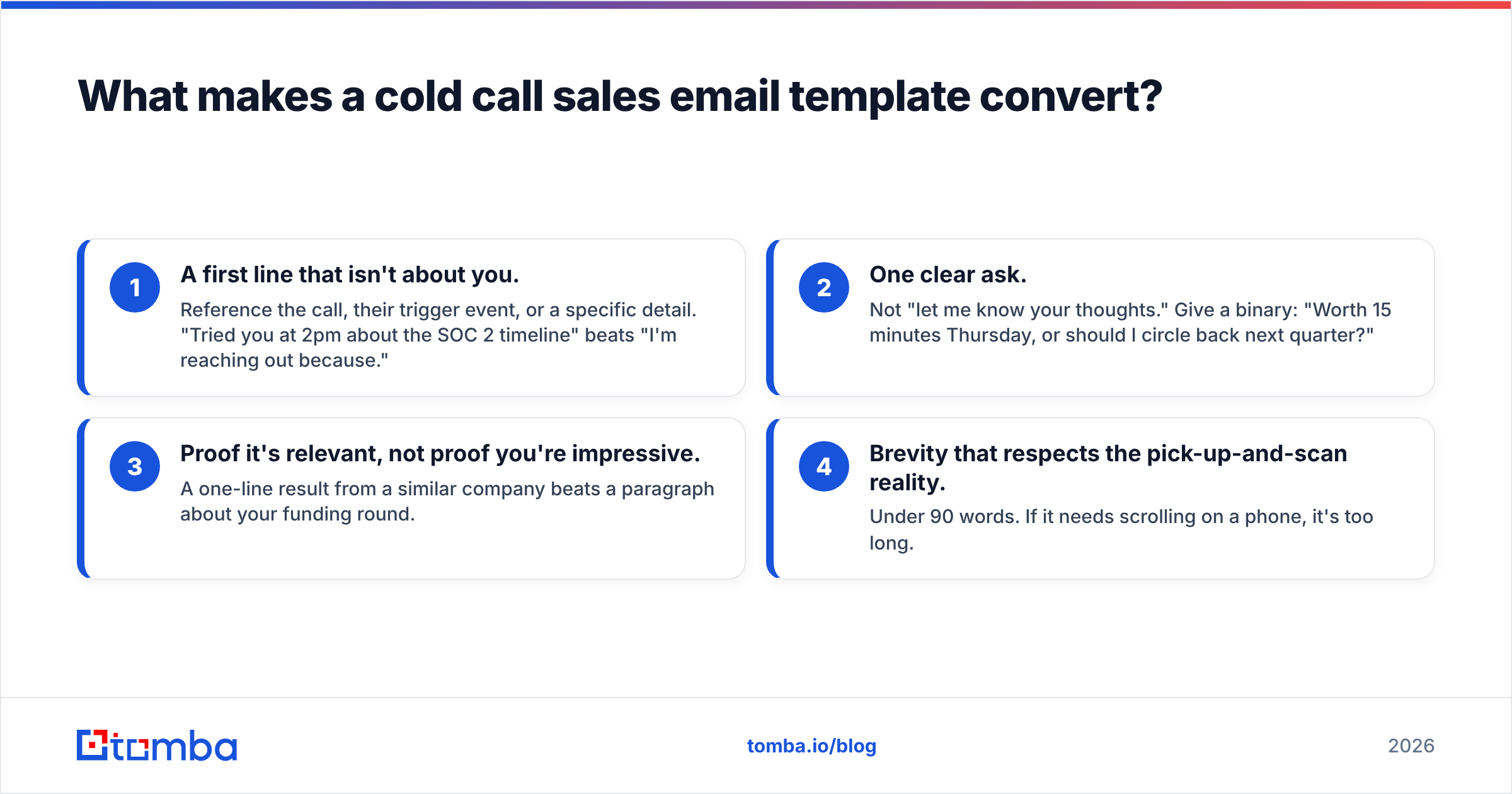
Four things, in order of impact:
- A first line that isn't about you. Reference the call, their trigger event, or a specific detail. "Tried you at 2pm about the SOC 2 timeline" beats "I'm reaching out because."
- One clear ask. Not "let me know your thoughts." Give a binary: "Worth 15 minutes Thursday, or should I circle back next quarter?"
- Proof it's relevant, not proof you're impressive. A one-line result from a similar company beats a paragraph about your funding round.
- Brevity that respects the pick-up-and-scan reality. Under 90 words. If it needs scrolling on a phone, it's too long.
Everything else — the greeting, the sign-off, the "hope you're well" — is filler you can cut. Templates give you structure so you spend your energy on the one variable that matters: the personalized opener.
The 7 cold call sales email templates#
Copy these, swap the brackets, and match each to the moment in your cadence where it fits. You can keep the whole set in a reusable cold email templates library so your reps aren't rewriting from scratch every morning.
1. The pre-call warm-up#
Send this the morning before you dial. It plants your name so the call isn't fully cold.
Subject: quick question before I call
Hi [First name] — I'll try you around [time] today about [specific problem]. If a call's a bad fit, just reply here and I'll work around your inbox. Either way, [one-line relevant result, e.g. "we cut [peer company]'s onboarding time 40%"]. — [Your name]
2. The post-voicemail follow-up#
Send within five minutes of leaving a voicemail. The email is the transcript they'll actually read.
Subject: just left you a voicemail
[First name], left you a quick message about [problem]. Short version: [one sentence on the outcome you drive]. Open to a 15-minute call [day] or [day]? Reply with a time and I'll send an invite.
3. The no-answer nudge#
They didn't pick up and you didn't leave a voicemail. Keep it light.
Subject: bad timing?
Tried reaching you today, [First name] — likely caught you mid-something. Worth a quick chat about [problem], or is this not a priority right now? A one-word reply tells me everything.
4. The gatekeeper redirect#
When you reach an assistant or the wrong person, ask for a routing, not a favor.
Subject: who owns [area] at [Company]?
Hi [First name] — I spoke with your team about [topic] and want to make sure I'm reaching the right person. Are you the best point of contact for [function], or could you point me to who is? Happy to keep this to a two-minute email.
5. The referral open#
The strongest cold email is barely cold. Name-drop with permission.
Subject: [Referrer] suggested I reach out
[First name], [Referrer] mentioned you're the person thinking about [problem] at [Company]. I called earlier to introduce myself — [one-line result]. Would a short call next week be useful, or should I send details first?
6. The breakup#
After 6–8 touches with silence, give them an easy out. It often unsticks the deal.
Subject: closing your file
[First name], I've reached out a few times about [problem] and haven't heard back — totally fair if the timing's off. I'll stop here unless you tell me otherwise. If it's worth a look later this quarter, just reply "later" and I'll reach out then.
7. The re-engagement#
For a lead that went dark months ago. Anchor to something new.
Subject: [trigger event] made me think of you
Hi [First name] — saw [Company] [recent trigger: funding, hire, launch]. Last time we talked, [problem] was on your radar. We just [relevant update]. Worth reconnecting for 15 minutes?

Notice what all seven share: a scannable subject, a first line tied to a real moment, and a single low-cost ask. That's the whole formula. If you want the subject lines to pull their weight, run them through a subject line generator before you commit.
How should you sequence calls and emails together?#
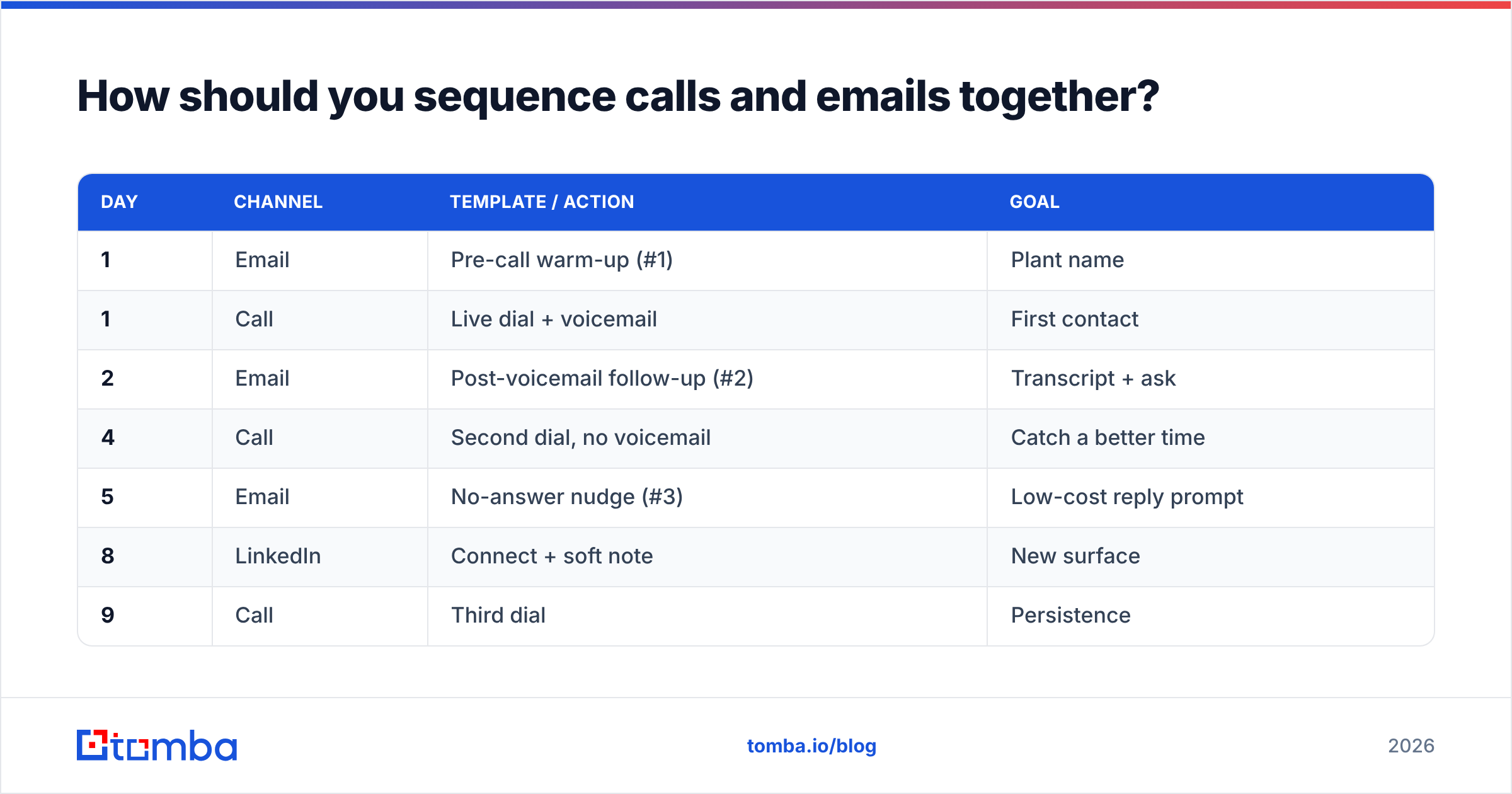
A template is one brick. The cadence is the wall. Here's a proven 12-touch, three-week structure that alternates channels so you stay present without becoming noise.
| Day | Channel | Template / action | Goal |
|---|---|---|---|
| 1 | Pre-call warm-up (#1) | Plant name | |
| 1 | Call | Live dial + voicemail | First contact |
| 2 | Post-voicemail follow-up (#2) | Transcript + ask | |
| 4 | Call | Second dial, no voicemail | Catch a better time |
| 5 | No-answer nudge (#3) | Low-cost reply prompt | |
| 8 | Connect + soft note | New surface | |
| 9 | Call | Third dial | Persistence |
| 11 | Referral or value drop (#5) | Fresh angle | |
| 15 | Call | Fourth dial | Last live attempt |
| 18 | Breakup (#6) | Unstick or close |
Two rules make this work. First, same-day call-and-email pairs hit harder than spacing them days apart — the email lands while the missed call is still fresh. Second, don't send eleven identical asks. Each touch should change the angle: a result, a referral, a trigger event, a graceful exit. Reps who track their response rate by touch number almost always find the reply spike sits at touches 4–6, not touch 1 — which is exactly why quitting early is the most common mistake.
Cold call email vs. pure cold email vs. call-only: which wins?#
None of them, in isolation. But the combined play beats each solo channel on the metrics that matter. Here's the honest comparison.
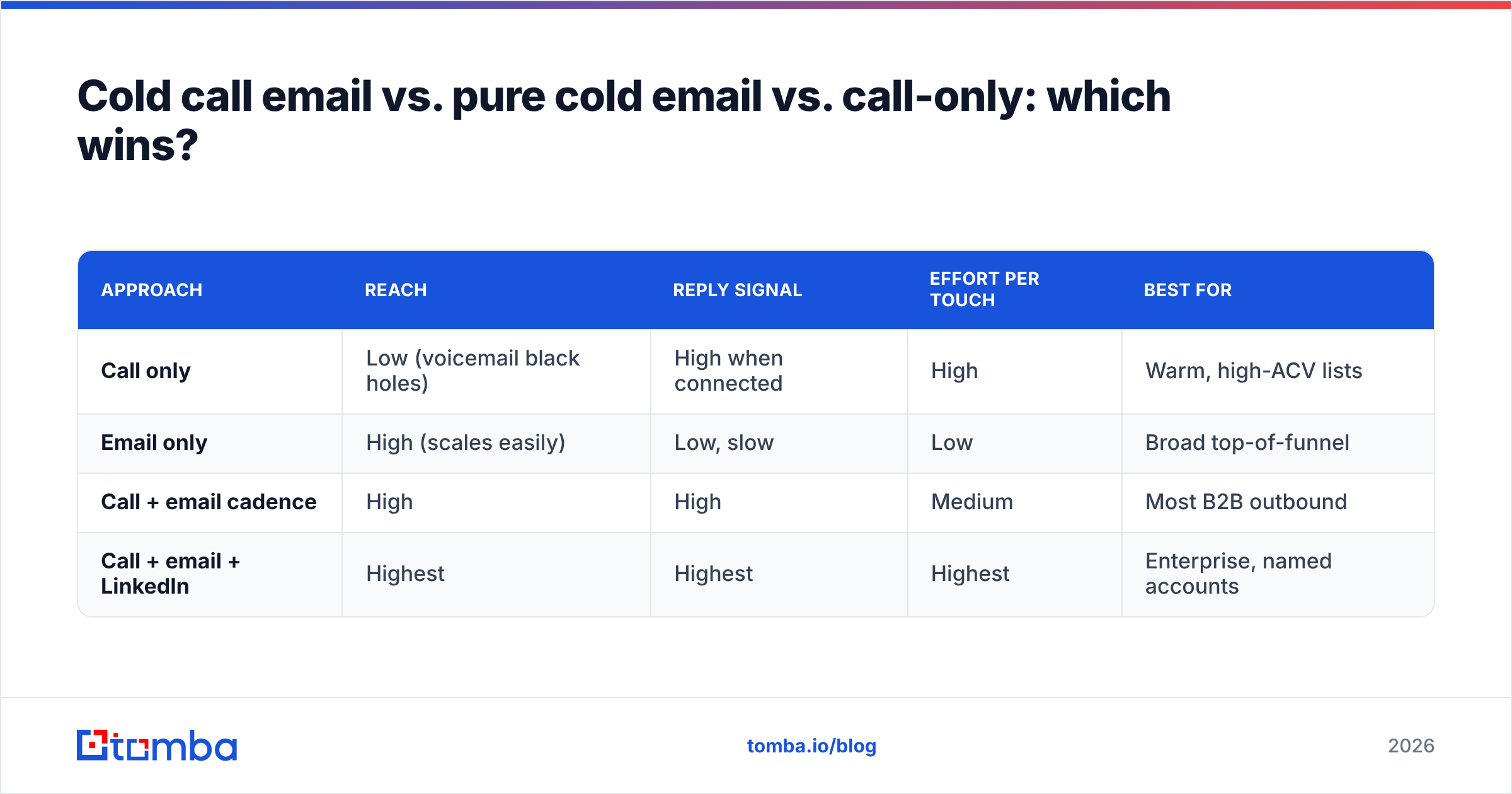
| Approach | Reach | Reply signal | Effort per touch | Best for |
|---|---|---|---|---|
| Call only | Low (voicemail black holes) | High when connected | High | Warm, high-ACV lists |
| Email only | High (scales easily) | Low, slow | Low | Broad top-of-funnel |
| Call + email cadence | High | High | Medium | Most B2B outbound |
| Call + email + LinkedIn | Highest | Highest | Highest | Enterprise, named accounts |
The pattern is clear: layering channels lifts results, but each added channel costs time. The call-plus-email cadence is the sweet spot for most teams — meaningful reach, strong reply signal, and effort you can actually sustain across a full pipeline. Independent reviews on G2 show the top-rated sales engagement tools all lean on this same multi-channel logic rather than betting on one channel.
What ruins a good cold call email template?#
Two things, and neither is your copy.
Bad data. You can write the perfect post-voicemail email, but if the address bounces, the prospect never sees it — and your sender reputation takes the hit. When a big chunk of a list is stale, every downstream metric lies to you. Before any cadence goes live, run the list through an email verifier so you're not burning your domain on dead addresses. If you're building the list from scratch, an email finder that returns a confidence score keeps the junk out at the source, and a phone finder fills the dialer side of the cadence so calls and emails hit the same verified person.
Over-personalization theater. Reps burn twenty minutes crafting a "bespoke" email that's mostly praise for the prospect's company. That's wasted effort. The data-backed move is one genuinely relevant sentence — a trigger event, a mutual connection, a specific pain — bolted onto a proven template body. You get 80% of the personalization lift for 10% of the time. Salesforce's own outbound playbooks, echoed across their sales resources, push the same discipline: relevance over flattery, brevity over bulk.
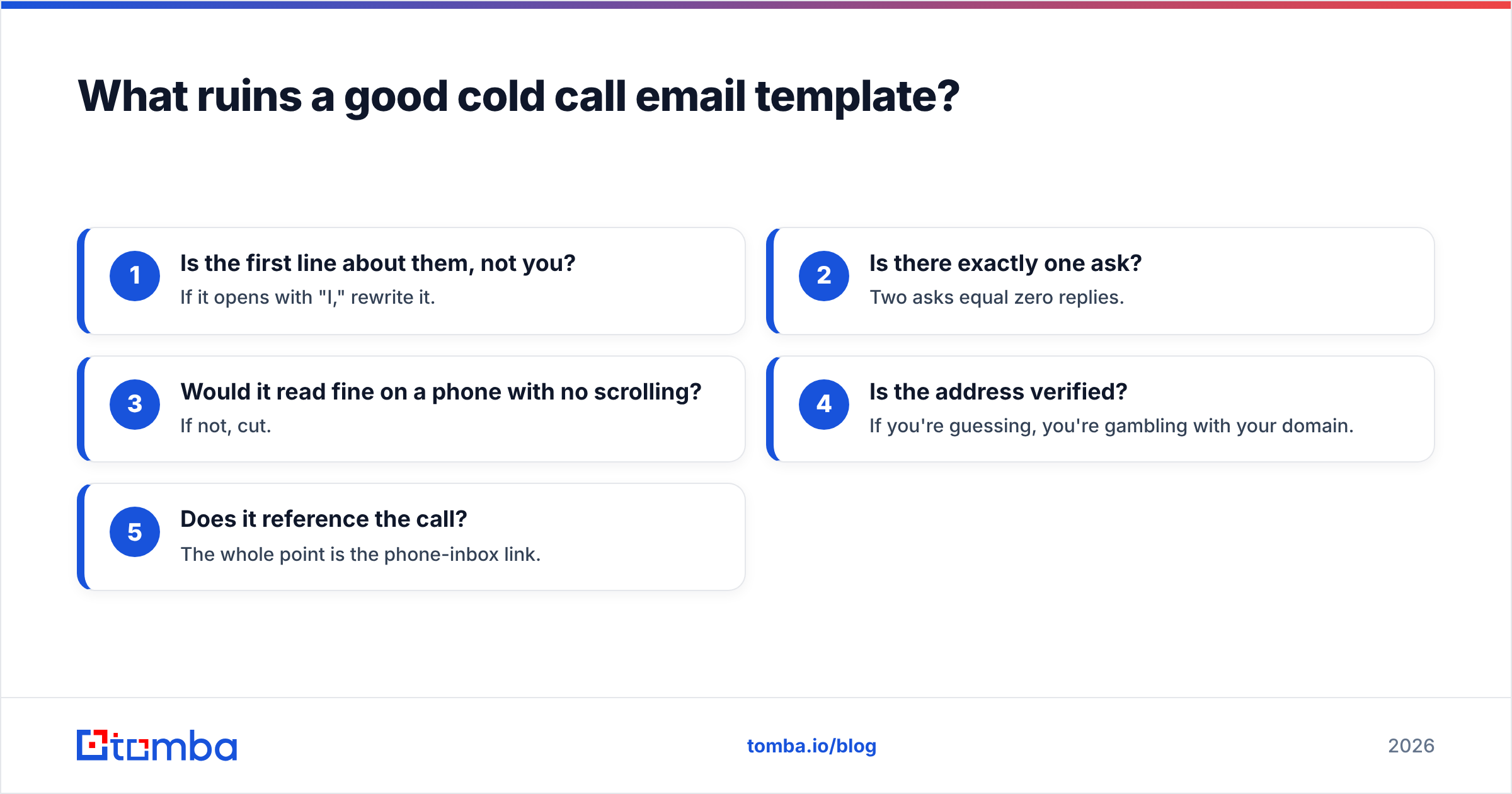
A quick gut-check before any template ships:
- Is the first line about them, not you? If it opens with "I," rewrite it.
- Is there exactly one ask? Two asks equal zero replies.
- Would it read fine on a phone with no scrolling? If not, cut.
- Is the address verified? If you're guessing, you're gambling with your domain.
- Does it reference the call? The whole point is the phone-inbox link.
How do you scale this without losing the personal touch?#
Templatize the structure, automate the delivery, and reserve your human effort for the opener and the verification. That's the leverage.
Keep your seven templates in a shared library so every rep sends the same tested copy. Build the cadence into your sequencing tool so calls and emails trigger on schedule. Then spend the time you saved on two things machines can't fake: a sharp, specific first line, and clean data underneath it. Enrich the record — title, company, recent trigger — with data enrichment so the personalized line writes itself from real facts instead of guesswork.
The teams that win outbound in 2026 aren't the ones with the cleverest copy. They're the ones who pair a call with an email, send both to a verified contact, and follow up past the point where everyone else quits.
Ready to fuel your cadence with contacts that actually reply?#
Templates and cadence only pay off when the email actually reaches a real inbox. Start every phone-plus-email play on a clean foundation: use the Tomba Email Finder to pull verified, confidence-scored business emails by name or domain, so your reps dial and send to people who exist. The free tier gives you 25 searches a month to test it against your own list, and paid plans start at $49/mo on the Starter tier when you're ready to scale the whole cadence. Fill the top of the funnel with contacts worth calling — then let these seven templates do the rest.
Related guides#
Ready to find emails that actually work?
Join 150,000+ professionals who stopped guessing and started sending. Free credits on signup — no credit card required.
Get the Tomba newsletter
Practical outbound tactics and product updates — once every two weeks.
About the author