Cold Call Scripting in 2026: Frameworks, Examples & Tips
A rep-tested guide to cold call scripting in 2026: proven frameworks, an opener that survives the first 8 seconds, objection lines, and a script template you can steal today.
Cold calling is not dead. Bad cold calling is. The difference almost always comes down to one thing: the script behind the dial. Cold call scripting is the discipline of turning a random interruption into a structured, human conversation that earns the next 30 seconds — over and over — until you have a meeting.
This guide gives you the frameworks, the exact lines, an objection-handling cheat sheet, and a full script template you can adapt before your next call block.
TL;DR#
- A cold call script is a flexible map, not a word-for-word teleprompter. The best reps memorize the structure and improvise the words.
- The first 8 seconds decide the call. Lead with a pattern interrupt and a permission-based opener, not a rambling introduction.
- Use a proven framework — the 5-part structure below (Opener → Reason → Value Hook → Discovery → Ask) works across industries.
- Objections are signals, not stop signs. Prepare 3–4 rebuttals for the objections you hear 80% of the time.
- Great scripts start with great data. The right number and a verified contact beat the smoothest pitch to a wrong-fit prospect.
What is cold call scripting?#
Cold call scripting is the process of designing a repeatable conversation flow for outbound sales calls to people who did not ask to hear from you. Think of it like a jazz musician's chord chart: the structure is fixed, but every performance sounds a little different depending on who's in the room.
A script is not a monologue you read. It's a decision tree. Each branch — "gatekeeper answers," "prospect is busy," "prospect says we already have a vendor" — has a planned next move. That preparation is exactly what makes you sound less scripted, because you're never caught flat-footed.
Done well, a script does three jobs at once:
- It removes cognitive load so you can actually listen instead of thinking about what to say next.
- It standardizes what works so your whole team benefits when one rep discovers a winning line.
- It makes coaching possible — you can't improve what you can't see, and a written script is a visible artifact.

Why do most cold call scripts fail?#
Most scripts fail for the same handful of reasons, and none of them are "cold calling doesn't work."
- They're written for the seller, not the buyer. A script stuffed with your company history and feature list ignores that the prospect only cares about their own problem.
- They sound robotic. If every sentence is a complete, polished paragraph, you sound like a recording. Real people use fragments, pauses, and "uh."
- They have no branching. The rep freezes the moment the call goes off the happy path.
- They skip permission. Barreling into a pitch without acknowledging you've interrupted someone's day triggers instant resistance.
Research from sales-intelligence platform Gong has repeatedly shown that successful cold calls look different from failed ones in measurable ways — longer monologues from the prospect, better handling of the "not interested" moment, and openers that name the interruption directly. The script's job is to engineer those moments on purpose.
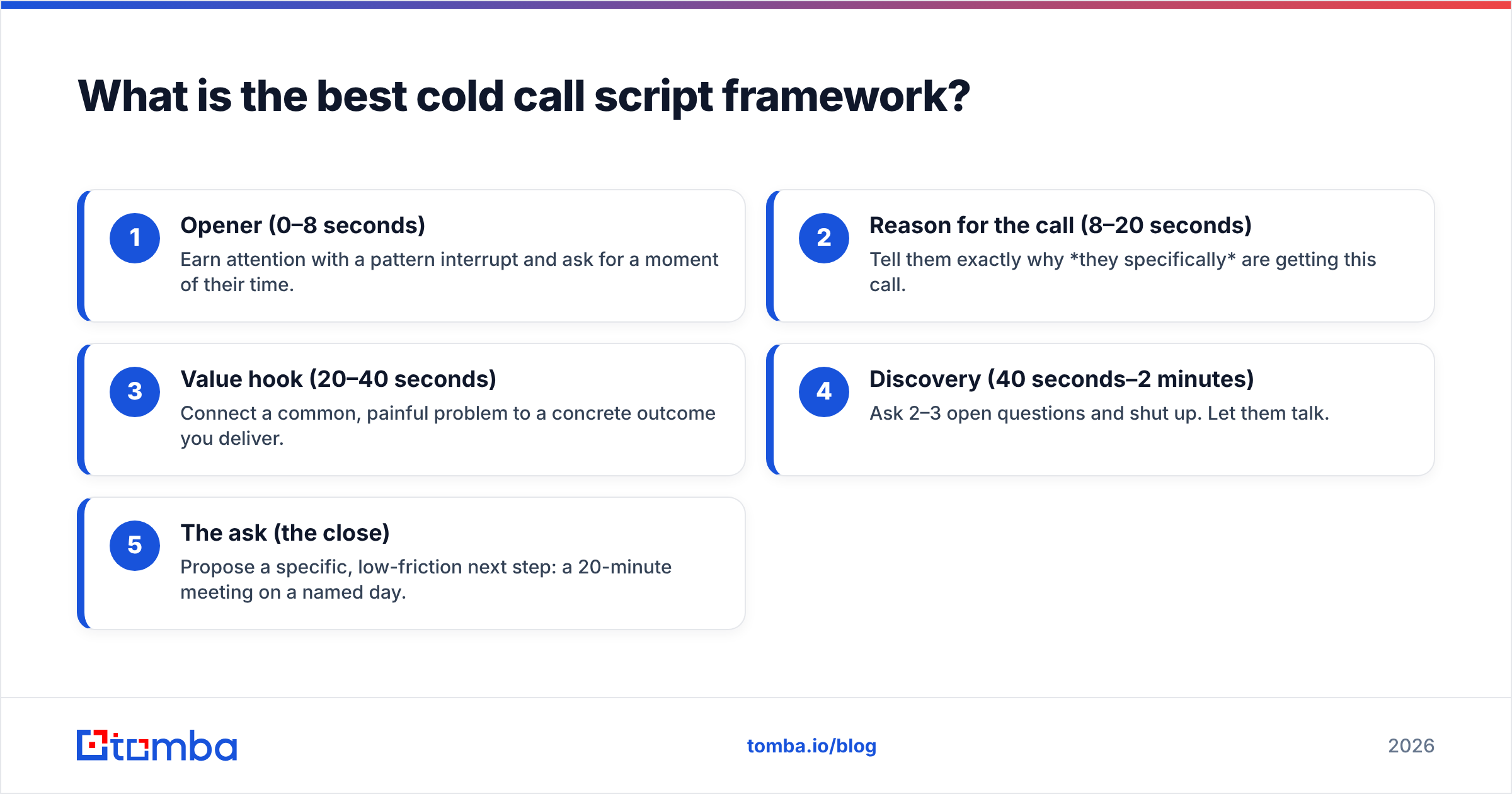
What is the best cold call script framework?#
The five-part structure below is the workhorse. It's simple enough to memorize and flexible enough to survive contact with a real human.
- Opener (0–8 seconds) — Earn attention with a pattern interrupt and ask for a moment of their time.
- Reason for the call (8–20 seconds) — Tell them exactly why they specifically are getting this call.
- Value hook (20–40 seconds) — Connect a common, painful problem to a concrete outcome you deliver.
- Discovery (40 seconds–2 minutes) — Ask 2–3 open questions and shut up. Let them talk.
- The ask (the close) — Propose a specific, low-friction next step: a 20-minute meeting on a named day.
Each stage is a gate. You don't move to discovery until the value hook lands. You don't pitch a demo until discovery reveals a real problem. This keeps you from the classic mistake of spraying features at someone who hasn't admitted they have a need.
The permission-based opener#
The opener is where 80% of calls die, so it deserves special attention. Compare two openers for the same product:
- Weak: "Hi, my name is Sarah and I'm calling from Acme Software, we're a leading provider of workflow automation solutions and I wanted to tell you about—" (click)
- Strong: "Hi Marcus — this is Sarah with Acme. I know I'm an interruption. Can I take 30 seconds to tell you why I called, and you can decide if it's worth continuing?"
The strong version names the interruption (disarming), uses the prospect's name, and hands them control. Nine times out of ten they'll say "sure, go ahead" — and now you have permission instead of resistance.
Cold call script framework comparison#
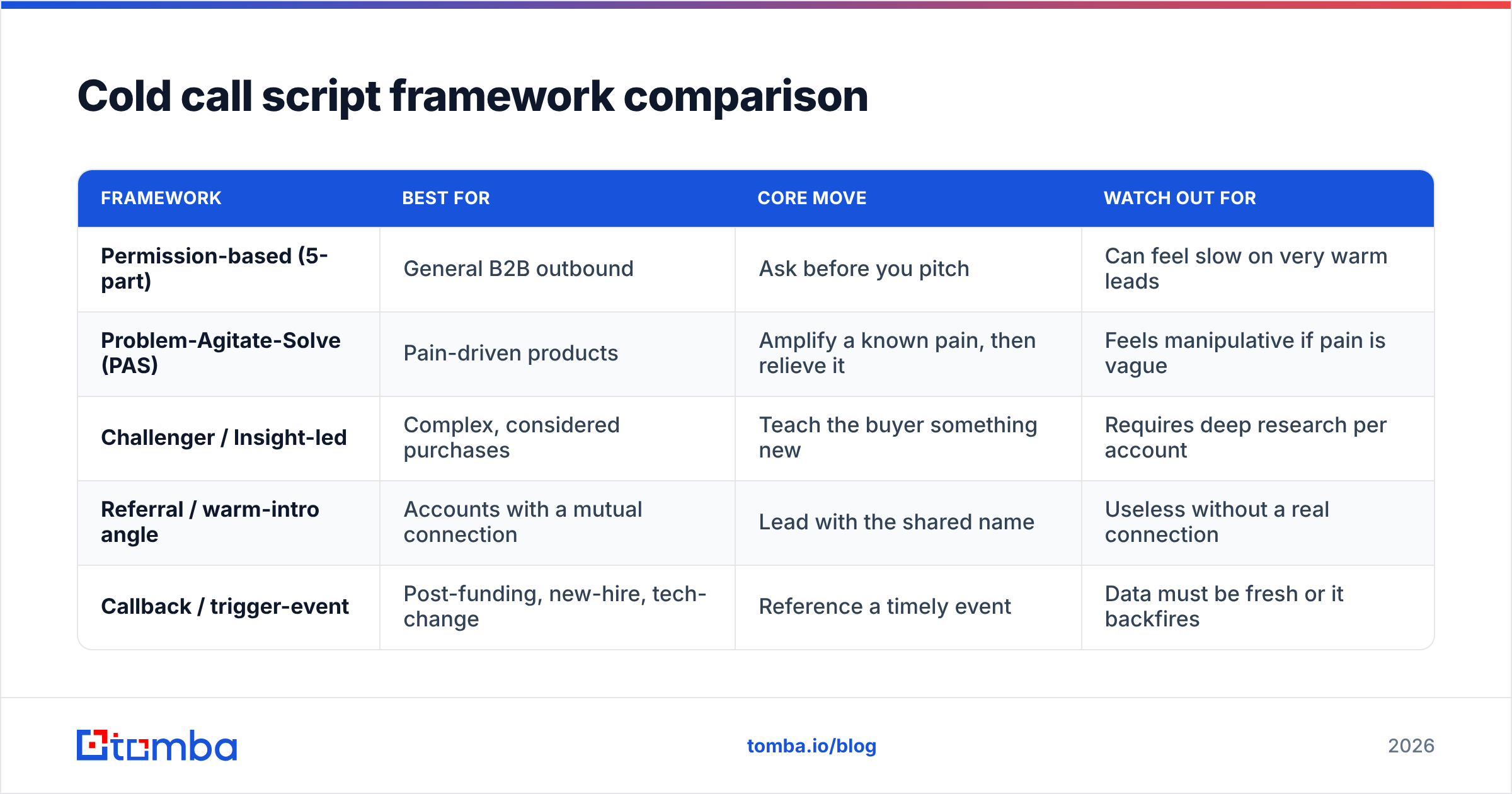
Different situations call for different structures. Here's how the most common frameworks stack up so you can pick the right tool for the call.
| Framework | Best for | Core move | Watch out for |
|---|---|---|---|
| Permission-based (5-part) | General B2B outbound | Ask before you pitch | Can feel slow on very warm leads |
| Problem-Agitate-Solve (PAS) | Pain-driven products | Amplify a known pain, then relieve it | Feels manipulative if pain is vague |
| Challenger / Insight-led | Complex, considered purchases | Teach the buyer something new | Requires deep research per account |
| Referral / warm-intro angle | Accounts with a mutual connection | Lead with the shared name | Useless without a real connection |
| Callback / trigger-event | Post-funding, new-hire, tech-change | Reference a timely event | Data must be fresh or it backfires |
Notice the last two rows depend entirely on data quality. A referral opener with the wrong mutual contact, or a "congrats on your Series B" that closed 18 months ago, does more damage than no opener at all. Which is why scripting and data are inseparable — more on that below.
What does a full cold call script look like?#
Here's a complete, adaptable template using the 5-part framework. Brackets are your variables.
Opener:
"Hi [First Name], this is [Your Name] from [Company]. I'll be honest — this is a cold call. Do you want to hang up, or can I have 30 seconds to explain why I picked up the phone?"
(Prospect: "You've got 30 seconds.")
Reason for the call:
"Fair enough. I'm reaching out because I saw [specific trigger — you just hired 3 SDRs / you posted about X / your team uses Y]. Companies at that stage usually run into [specific problem]."
Value hook:
"We help teams like [comparable company] cut [metric] by [outcome] without [common tradeoff]. I don't know yet if that's relevant to you, which is actually why I'm calling."
Discovery:
"Can I ask — how are you handling [problem area] today? … And what happens when [failure scenario]?"
(Listen. Take notes. Ask one follow-up.)
The ask:
"Based on what you just said, it sounds like it's worth a proper look. I'm not going to sell you anything on this call. Are you open to 20 minutes Thursday at 10, so I can show you exactly how [comparable company] solved this?"
The magic isn't in the exact words — it's in the sequence and the fact that you stop and listen at the discovery stage. A script that talks for two straight minutes is a voicemail, not a conversation. For more on measuring whether these calls turn into replies and meetings, see how top teams track response rate across channels.
How do you handle objections in a cold call?#
Objections are the most predictable part of any call, which means you can script rebuttals in advance. The rule: acknowledge, then redirect. Never argue.
- "I'm not interested." → "Totally fair — you don't know me yet. Most people I call feel that way in the first ten seconds. Can I give you one sentence on why I called, and if it's not relevant we hang up?"
- "We already use [competitor]." → "Great, that tells me you take this seriously. A lot of the teams I work with came from [competitor] — usually because of [specific gap]. Is that something you've bumped into?"
- "Send me an email." → "Happy to. So I don't send you something useless — what's the one thing that would make an email worth opening for you?"
- "I don't have time." → "I believe you, and I won't take it now. Is it better if I grab 15 minutes Thursday or Friday?"
Keep a living objection library. Every time a rep gets stumped, the answer they eventually found becomes the next line in the script. This is also where sales automation pays off — logging call outcomes automatically shows you which objections actually correlate with lost deals versus which are just reflexes.

Should you script every word or just the structure?#
Script the structure, memorize the transitions, improvise the words. That's the answer nearly every high-performing SDR converges on.
Word-for-word scripts have exactly one advantage: consistency for brand-new reps on day one. Beyond week two, they hurt. The prospect can hear reading. What you want to lock down are the high-leverage moments — the opener, the value hook, and the ask — and stay loose everywhere else.
A practical middle path:
- Fully scripted: opener, value hook, the meeting ask.
- Bulleted, not scripted: discovery questions (pick 2–3 from a list based on the persona).
- Improvised: everything in between, small talk, and reactions.
This mirrors how HubSpot's sales team and other high-volume outbound orgs coach: give reps rails, not a cage.
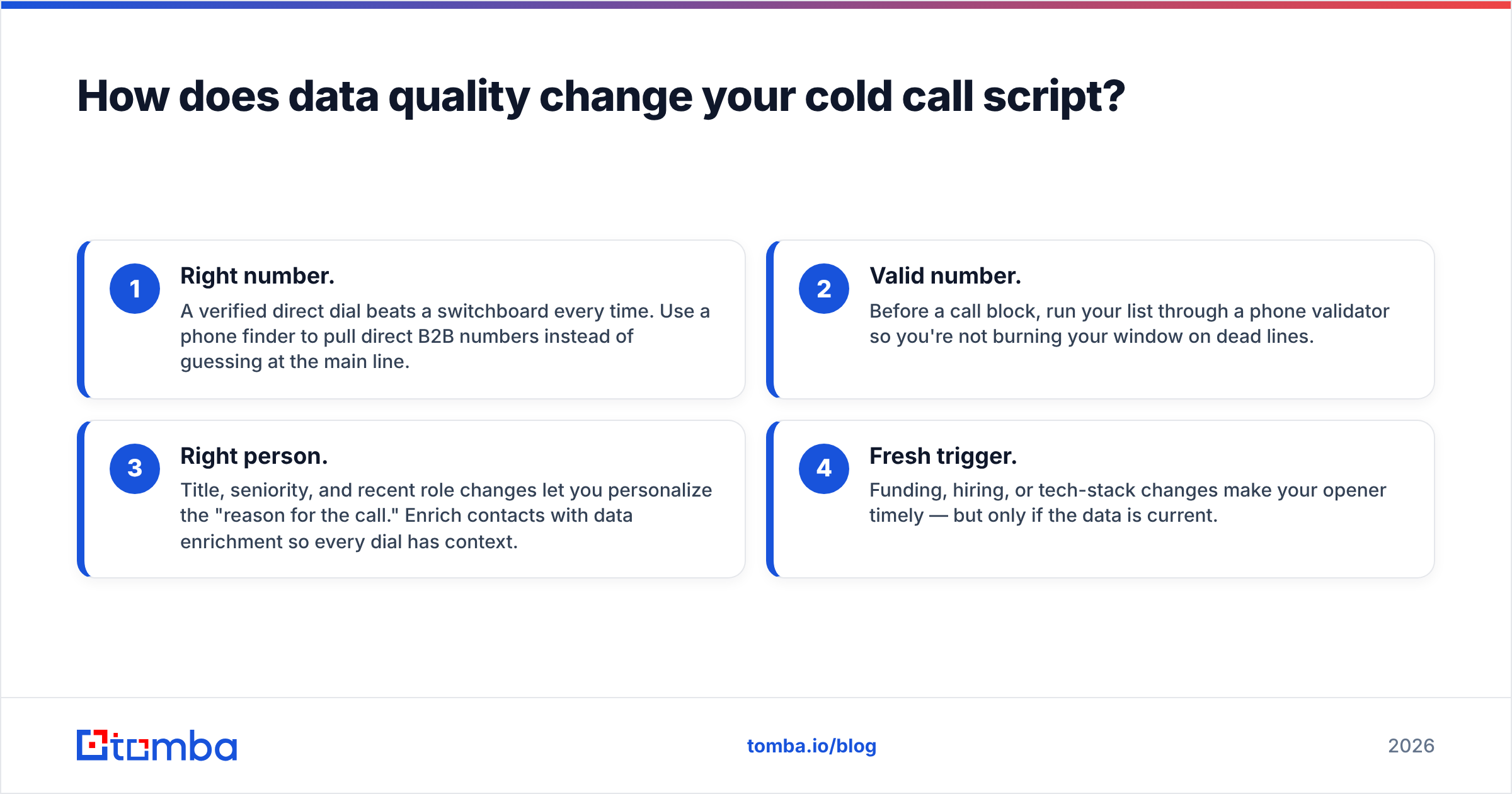
How does data quality change your cold call script?#
Your script is only as good as the number you dialed and the person on the other end. The most elegant opener in the world is wasted if you're calling a disconnected line or a contact who left the company a year ago.
This is the unglamorous half of cold call scripting, and it's where most teams silently leak pipeline:
- Right number. A verified direct dial beats a switchboard every time. Use a phone finder to pull direct B2B numbers instead of guessing at the main line.
- Valid number. Before a call block, run your list through a phone validator so you're not burning your window on dead lines.
- Right person. Title, seniority, and recent role changes let you personalize the "reason for the call." Enrich contacts with data enrichment so every dial has context.
- Fresh trigger. Funding, hiring, or tech-stack changes make your opener timely — but only if the data is current.
A quick way to see the impact: the same script, dialed against a clean, enriched list versus a scraped one, will produce dramatically different connect and conversion rates. The script didn't change. The inputs did.
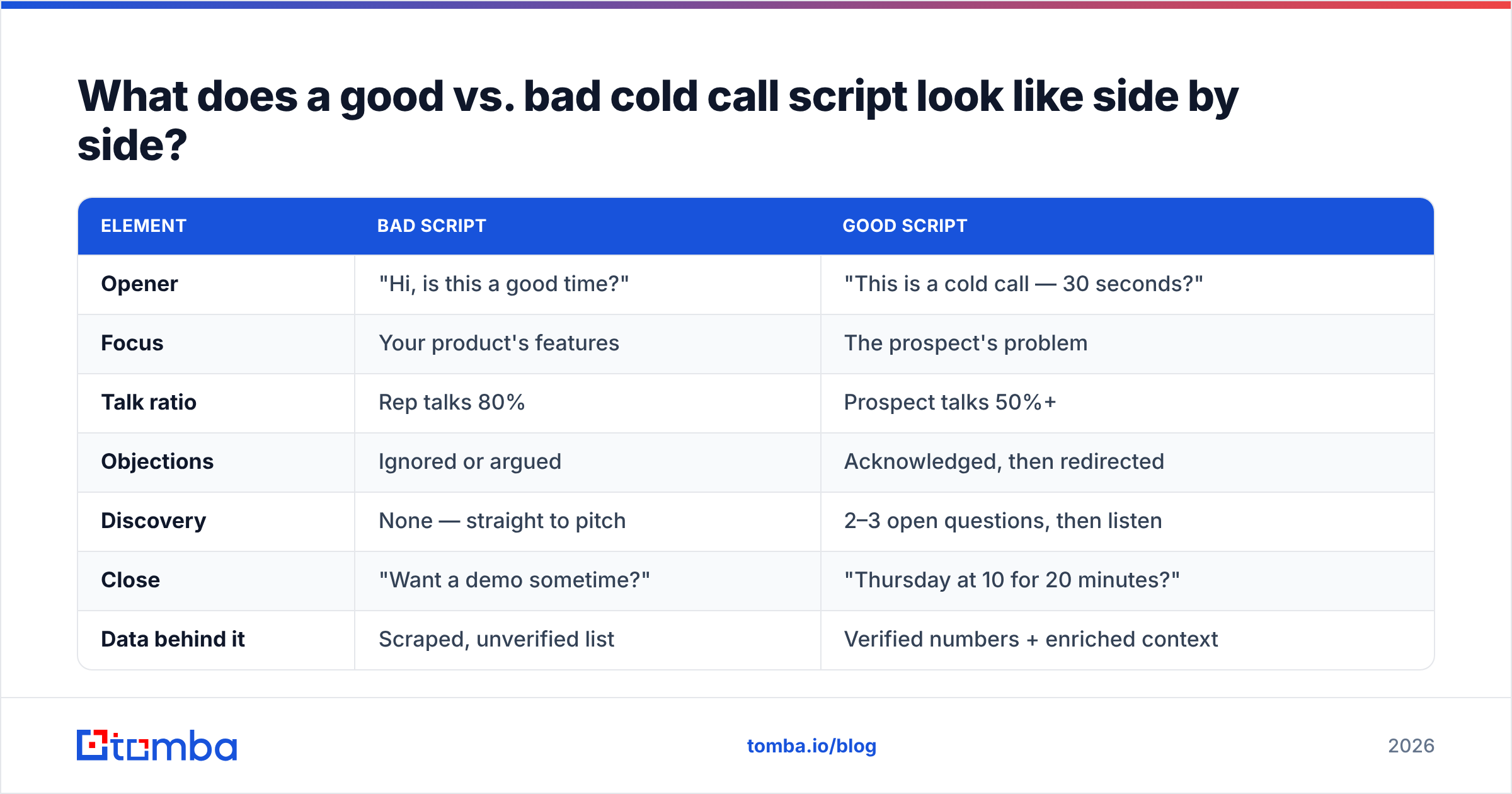
What does a good vs. bad cold call script look like side by side?#
| Element | Bad script | Good script |
|---|---|---|
| Opener | "Hi, is this a good time?" | "This is a cold call — 30 seconds?" |
| Focus | Your product's features | The prospect's problem |
| Talk ratio | Rep talks 80% | Prospect talks 50%+ |
| Objections | Ignored or argued | Acknowledged, then redirected |
| Discovery | None — straight to pitch | 2–3 open questions, then listen |
| Close | "Want a demo sometime?" | "Thursday at 10 for 20 minutes?" |
| Data behind it | Scraped, unverified list | Verified numbers + enriched context |
The right column isn't harder to say. It's harder to prepare. That preparation is the entire job.
How do you keep improving your cold call script?#
Treat your script as a product, not a document. Ship it, measure it, iterate.
- Record and review. Pull 5 calls a week and mark exactly where prospects disengaged.
- A/B test one variable at a time. Change the opener for two weeks, hold everything else constant, and compare connect-to-meeting rates.
- Track the right metric. Not calls made — meetings booked per 100 dials. Everything else is vanity.
- Feed wins back in. When a rep lands a great objection rebuttal, add it to the shared script the same day.
The teams that win at cold calling aren't the ones with the best natural talkers. They're the ones running the tightest feedback loop between what they say and what actually books meetings.
Start with the right number#
The best cold call script in the world fails against a bad list. Before you tweak another word of your opener, make sure every dial is going to a real, verified, well-researched human. Use Tomba's Phone Finder to surface direct B2B numbers, validate them so you're not wasting call blocks on dead lines, and enrich each contact with the title and trigger data that makes your opener land. Check Tomba pricing — it starts free with 25 searches a month, then $49/mo on Starter — and give your script something worth dialing.
Related guides#
// get started
Find, verify and enrich your first contacts today
Start on the free plan with 25 searches a month, then scale when your team is ready.
Free plan · No credit card required · GDPR & CCPA
// about the author