Cold Call Social Selling: The 2026 Playbook for Warm Outreach
Cold calling and social selling aren't rivals — they're a sequence. Here's how to blend the phone and LinkedIn into one warm-outreach motion that actually books meetings in 2026.
Cold calling isn't dead, and social selling isn't a replacement for it. The teams winning in 2026 stopped treating them as competing religions and started running them as a single sequence: touch a prospect on LinkedIn first, then dial with context. That's what "cold call social selling" actually means — and done right, it turns a cold list into a warm one.
TL;DR#
- Cold call social selling is a blended motion: you build familiarity on LinkedIn before you pick up the phone, so the call is never truly cold.
- Reps who pair social touches with calls see materially higher connect and reply rates than either channel run alone.
- The sequence matters more than the channel — a typical rhythm is view → engage → connect → call → follow-up.
- You need three things to run it: accurate contact data (phone + email), a light social cadence, and a way to measure per-touch influence.
- Tools like a phone finder and LinkedIn finder supply the direct dials and profiles that make the whole play possible.
What is cold call social selling?#
Think of it like knocking on a neighbor's door versus a stranger's. If you've waved at someone across the fence a few times, the knock lands differently — they open the door instead of pretending they're not home. Cold call social selling is the sales version of that fence-wave. You warm the relationship on social selling channels first, so the phone call arrives with a face already attached to your name.
Technically, it's the deliberate interleaving of two prospecting motions:
- Social touches — profile views, thoughtful comments, a connection request with context, a soft DM.
- Phone touches — the actual dial, where you reference something specific from the social layer ("saw your post on RevOps hiring — that's exactly why I'm calling").
The point isn't to do more activity. It's to make each phone call less cold by front-loading recognition. When a prospect has seen your name three times before the phone rings, your connect rate stops looking like a lottery ticket.
Why blend cold calling and social selling at all?#
Because each channel covers the other's blind spot.
Cold calling gives you a real-time conversation — objections handled live, tone read in the moment, a meeting booked in ninety seconds. But it's interruptive, and connect rates on cold, un-warmed lists keep sliding as buyers screen unknown numbers. Social selling gives you patience and credibility — you show up in the feed, you demonstrate you understand the buyer's world — but it's slow, and a "like" never booked a demo by itself.
Run them together and the math changes. According to HubSpot's sales research, multi-channel sequences consistently outperform single-channel outreach, and buyers increasingly expect reps to know something about them before making contact. LinkedIn's own Sales Navigator data points the same direction: warm intros and social familiarity lift response rates well above cold baselines.
The uncomfortable truth: dialing a list you've never touched socially is the fastest way to train prospects to send you to voicemail. Warm the list first.
How is a blended sequence different from a cold-only or social-only one?#
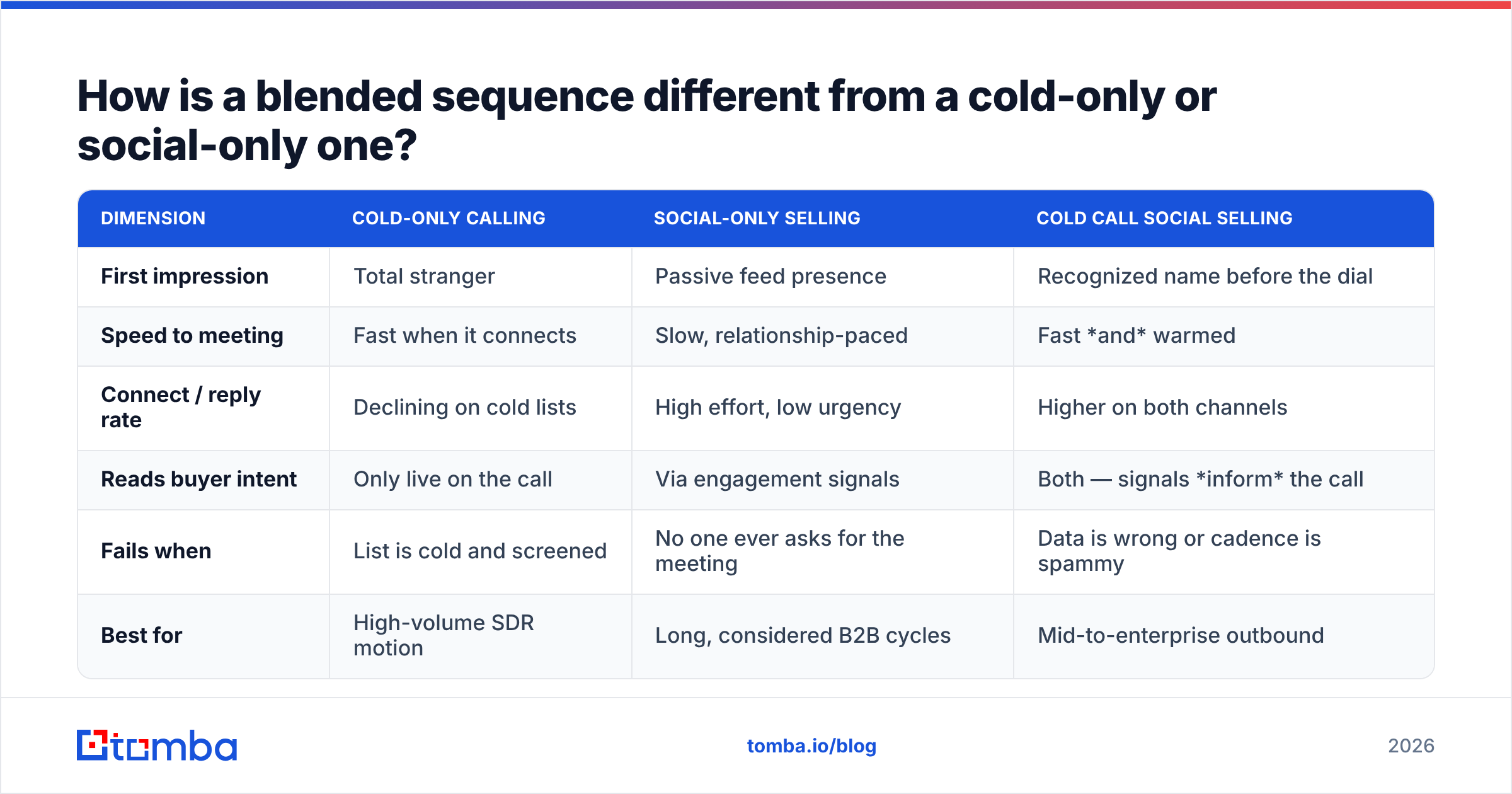
Here's the practical contrast across the three approaches.
| Dimension | Cold-only calling | Social-only selling | Cold call social selling |
|---|---|---|---|
| First impression | Total stranger | Passive feed presence | Recognized name before the dial |
| Speed to meeting | Fast when it connects | Slow, relationship-paced | Fast and warmed |
| Connect / reply rate | Declining on cold lists | High effort, low urgency | Higher on both channels |
| Reads buyer intent | Only live on the call | Via engagement signals | Both — signals inform the call |
| Fails when | List is cold and screened | No one ever asks for the meeting | Data is wrong or cadence is spammy |
| Best for | High-volume SDR motion | Long, considered B2B cycles | Mid-to-enterprise outbound |
The blended column wins on almost every row — but only if the underlying data is right. A perfect sequence pointed at a wrong number or a stale LinkedIn URL is just a slower way to fail.
What does the sequence actually look like?#
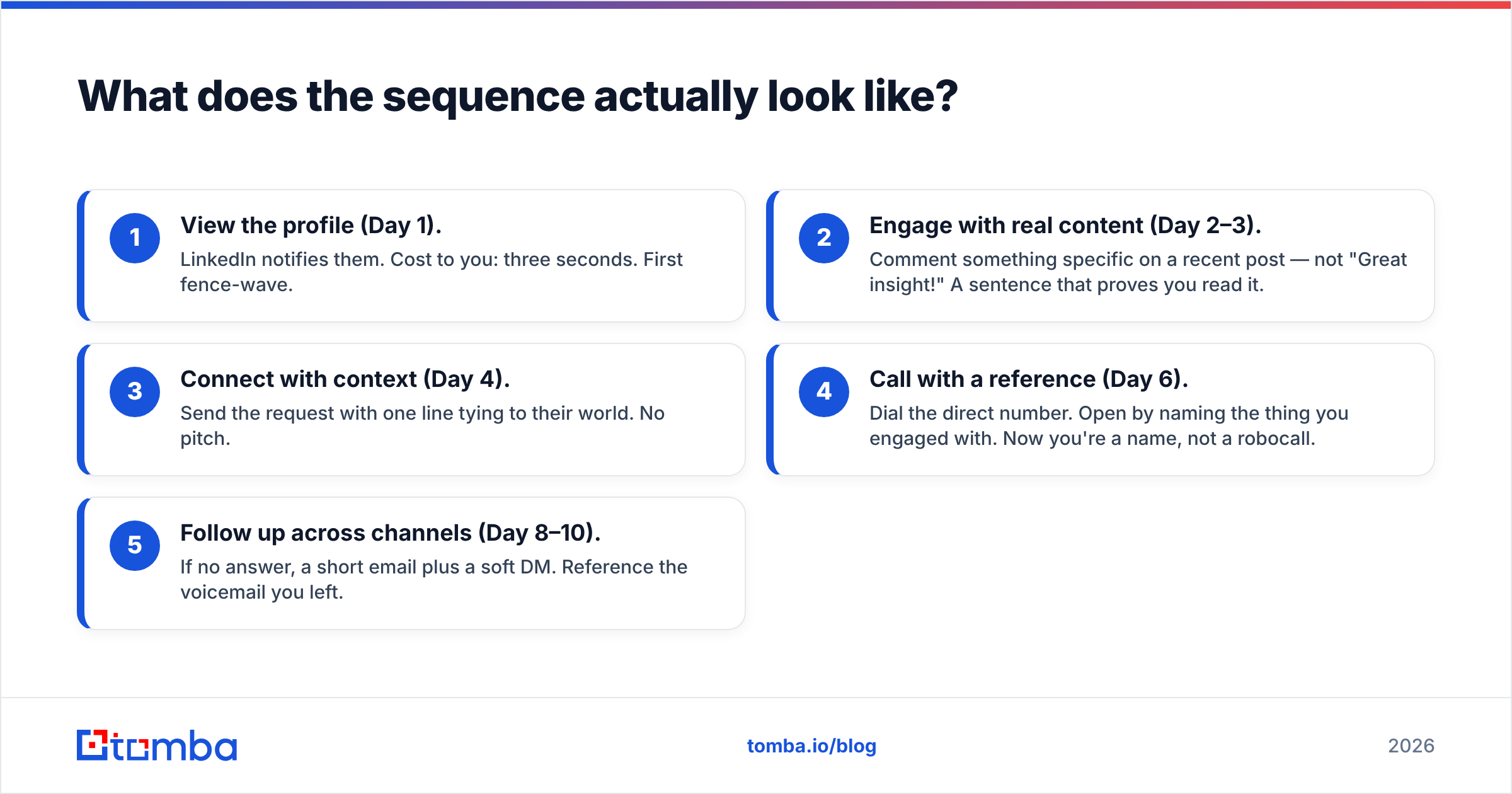
A workable five-touch rhythm over roughly 8–10 business days:
- View the profile (Day 1). LinkedIn notifies them. Cost to you: three seconds. First fence-wave.
- Engage with real content (Day 2–3). Comment something specific on a recent post — not "Great insight!" A sentence that proves you read it.
- Connect with context (Day 4). Send the request with one line tying to their world. No pitch.
- Call with a reference (Day 6). Dial the direct number. Open by naming the thing you engaged with. Now you're a name, not a robocall.
- Follow up across channels (Day 8–10). If no answer, a short email plus a soft DM. Reference the voicemail you left.
Notice the call sits in the middle, not the start. By touch four, you've earned the right to interrupt. The follow-up then stitches phone, email, and social into one thread so the prospect experiences a coherent person — not three disconnected outreach bots.
For the email leg of that follow-up, don't reinvent the wheel — start from proven cold email templates and personalize the first line with something from the social layer.
What data and tools do you need to run it?#
Three capabilities, and a data foundation under all of them.
- Accurate direct dials. Switchboard numbers kill the motion. You need mobile/direct lines, which is exactly what a phone finder is for.
- Verified email addresses. For the cross-channel follow-up, you want deliverable addresses, not guesses. Run them through an email verifier before you send.
- The right LinkedIn profile. Blended sequences break when you engage with the wrong "John Smith." Matching a person to their actual profile (and the email behind it) is where a LinkedIn finder earns its keep.
- A way to enrich at scale. When you're building the list, data enrichment fills in title, company, and contact fields so your sequence knows who it's talking to.
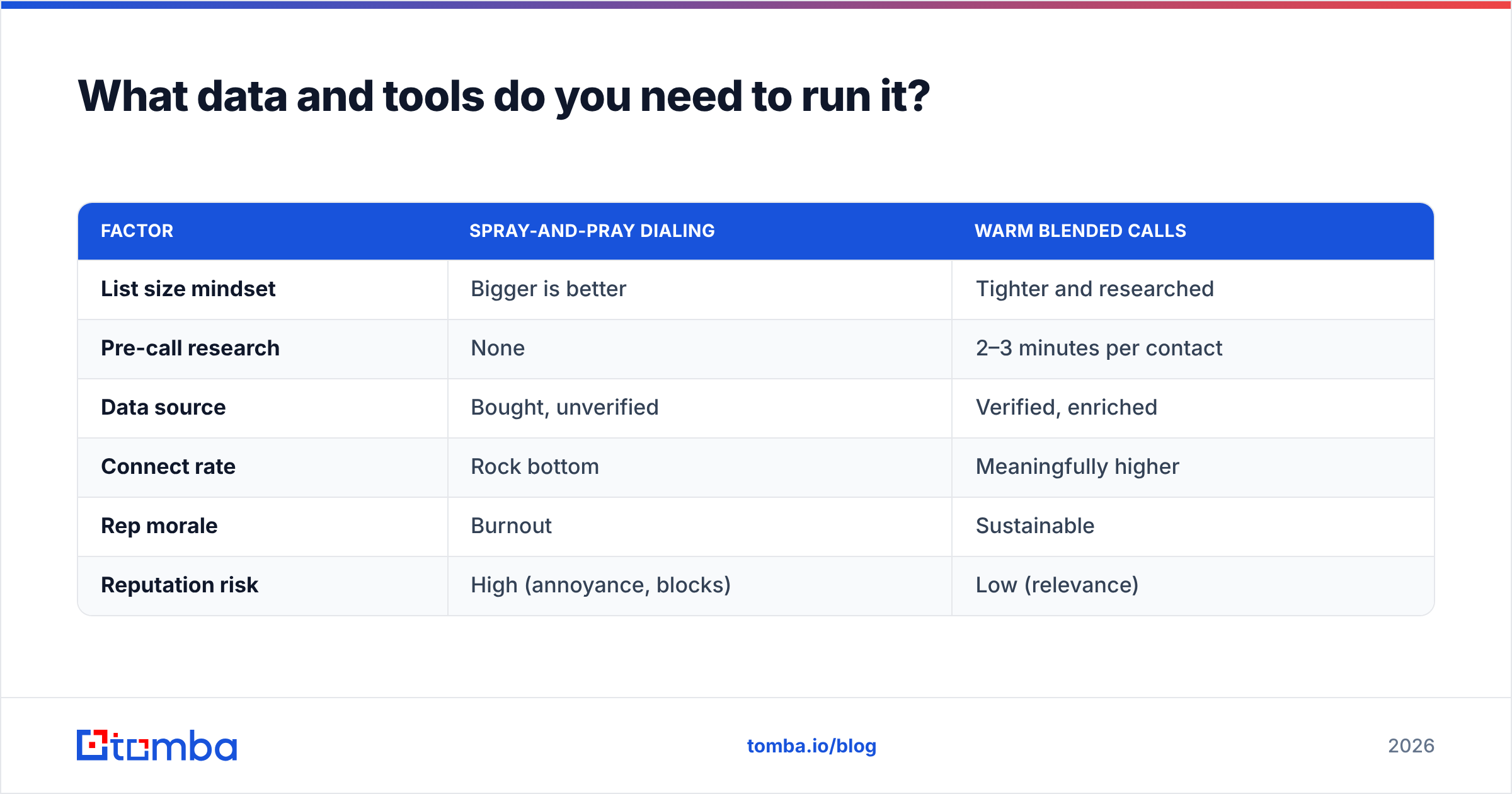
Compare the two philosophies head-on:
| Factor | Spray-and-pray dialing | Warm blended calls |
|---|---|---|
| List size mindset | Bigger is better | Tighter and researched |
| Pre-call research | None | 2–3 minutes per contact |
| Data source | Bought, unverified | Verified, enriched |
| Connect rate | Rock bottom | Meaningfully higher |
| Rep morale | Burnout | Sustainable |
| Reputation risk | High (annoyance, blocks) | Low (relevance) |
The right-hand column costs more per contact and returns far more per meeting. That's the trade you want.
How do you keep social touches from feeling spammy?#
The failure mode of social selling is obvious to everyone except the person doing it: the instant-pitch DM the moment a connection is accepted. Don't. The rule of thumb is give value across at least two touches before you ask for anything.
Practical guardrails:
- Comment before you connect. Earn recognition in the feed first.
- Reference, don't flatter. "Great post" is noise. "Your point about SDR ramp times matches what we saw at [company]" is signal.
- One ask, clearly framed. When you do pitch, name the specific reason you think it's relevant to them.
- Respect the no. A soft "not now" on LinkedIn is data — feed it back into your cadence, don't bulldoze it.
If your social touches read like a human who did their homework, the follow-up call feels like a continuation of a conversation. If they read like a bot, the call feels like an ambush. Same channels, opposite outcomes.
How do you measure whether the blend is working?#
Measure influence, not just last-touch attribution. The whole thesis is that the social layer lifts the call — so if you only credit the channel that booked the meeting, you'll undervalue the very thing making the calls warm.
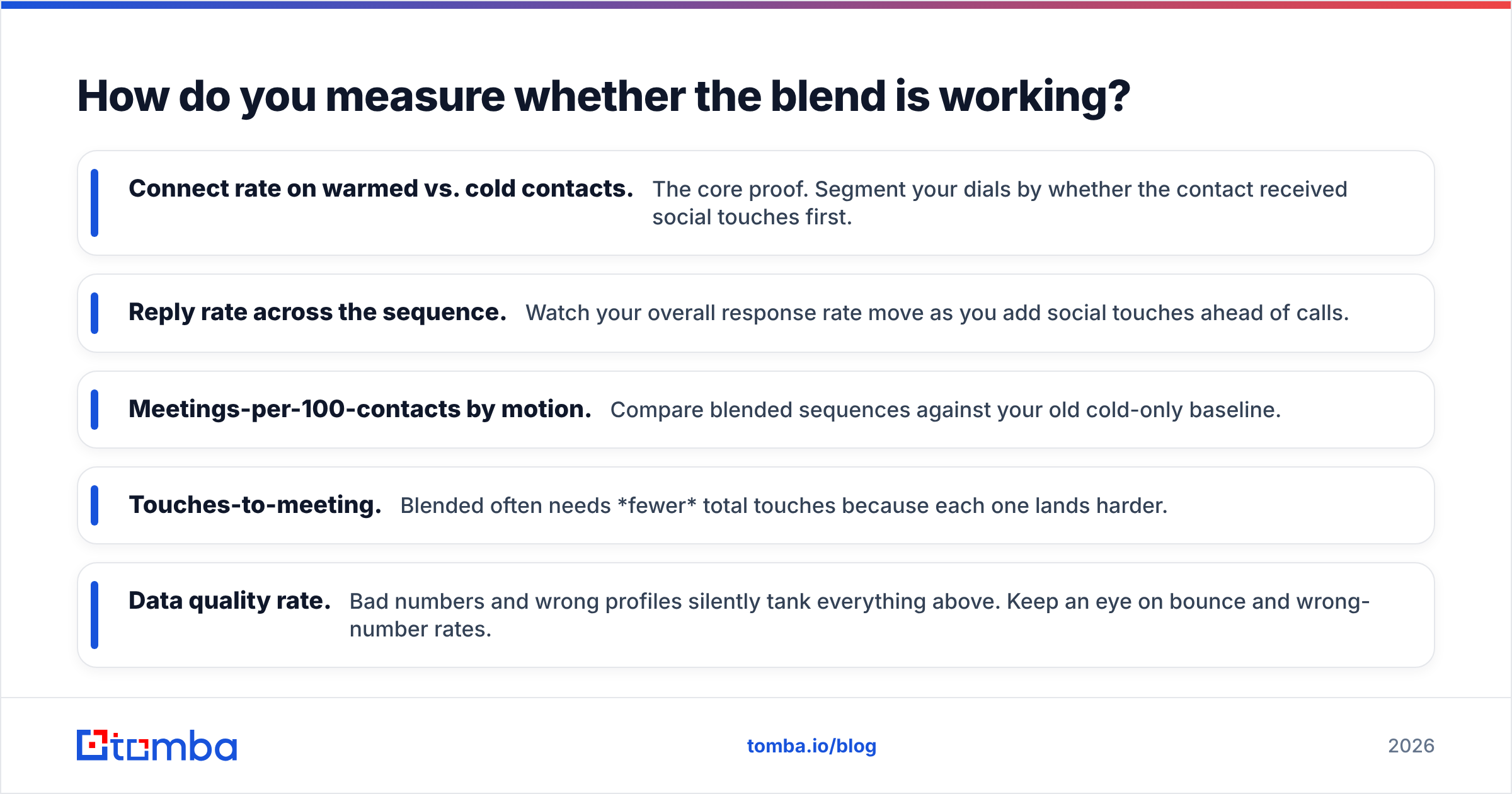
Track these:
- Connect rate on warmed vs. cold contacts. The core proof. Segment your dials by whether the contact received social touches first.
- Reply rate across the sequence. Watch your overall response rate move as you add social touches ahead of calls.
- Meetings-per-100-contacts by motion. Compare blended sequences against your old cold-only baseline.
- Touches-to-meeting. Blended often needs fewer total touches because each one lands harder.
- Data quality rate. Bad numbers and wrong profiles silently tank everything above. Keep an eye on bounce and wrong-number rates.
Run it for a full quarter before you judge it. Social warming has a lag — the contacts you're calling this week were warmed last week. Give the sequence time to fill the pipe before you compare columns.
Is cold call social selling right for every team?#
No — and pretending otherwise is how good ideas get a bad name.
- High-velocity, low-ACV SMB motion? The research cost per contact may not pay back. Lean cold-call-heavy with light social.
- Mid-market and enterprise? This is the sweet spot. Deals are considered, buying committees are real, and familiarity compounds. Blend aggressively.
- Pure inbound-led team? You may not need cold dials at all — but the social layer still warms the hand-raisers.
Match the intensity of the blend to the value and length of the deal. As industry analysts at Gartner note, B2B buyers now spend the majority of their journey not talking to sales — which is precisely why showing up credibly in their feed before the call is worth the effort for considered purchases.
What's the fastest way to start?#
Pick 25 accounts. Not 2,500. Enrich them properly, find the direct dials and the real LinkedIn profiles, and run the five-touch sequence above by hand for two weeks. Measure connect rate against your last cold-only batch. If the blend wins on a small, clean sample, then scale it with automation — never before.
The single biggest predictor of success here isn't your script or your cadence tool. It's whether the phone number rings the right person and the profile belongs to the right human. Get the data right and the sequence mostly runs itself; get it wrong and no amount of clever DMs will save you.
Start with data that makes every call warmer#
Cold call social selling only works when your contact data is accurate — the right person, the right number, the right profile. That's the foundation the whole motion sits on. Tomba's Email Finder helps you build that foundation: find verified professional emails by name, company, or domain, then pair them with direct dials and LinkedIn profiles so every touch — social or phone — lands on a real person who's ready to recognize your name. Check the Tomba pricing plans (a free tier gives you 25 searches a month to test the workflow) and warm up your list before you dial.
Related guides#
// get started
Find, verify and enrich your first contacts today
Start on the free plan with 25 searches a month, then scale when your team is ready.
Free plan · No credit card required · GDPR & CCPA
// about the author