Cold Call Techniques That Book More Meetings in 2026
Most cold calls die in the first 10 seconds. These 12 cold call techniques — openers, objection turns, and voicemail scripts — help reps book more meetings without sounding like a robot.
Cold Call Techniques That Book More Meetings in 2026
Cold calling is not dead — bad cold calling is. The reps who still hit quota on the phone in 2026 are not louder or more aggressive. They open differently, handle objections with fewer words, and dial numbers that actually connect to a decision-maker. This guide breaks down the cold call techniques that move the needle, with scripts you can steal today.
TL;DR#
- The first 10 seconds decide everything. A permission-based opener beats a rehearsed pitch almost every time.
- Objections are signals, not walls. Acknowledge, reframe in one sentence, then ask for a small next step.
- Data quality outranks call volume. Dialing verified direct lines beats blasting a stale list — connect rates are the hidden lever.
- Voicemail is a channel, not a dead end. A 12-second, curiosity-first message drives callbacks and warms your next dial.
- Measure conversations, not dials. Track connect rate, conversation-to-meeting rate, and talk-time ratio — not raw activity.
Why do most cold calls fail in 2026?#
Most cold calls fail for two boring reasons: the rep sounds like every other rep, and the number they dialed was wrong.
Think of a cold call like knocking on a stranger's door at dinnertime. If you launch into a monologue the second they open it, they close it. If you lead with respect and a reason, you get a few more seconds. That is the entire psychology of a good opener — you are buying attention, not demanding it.
The second problem is quieter but more expensive. If half your list has the wrong direct dial or routes to a disconnected extension, no technique on earth saves you. That is why the best callers treat their contact data as part of their technique, not a separate chore. Pulling accurate B2B phone numbers before you dial changes your connect rate before you say a single word.
What are the best cold call opening techniques?#
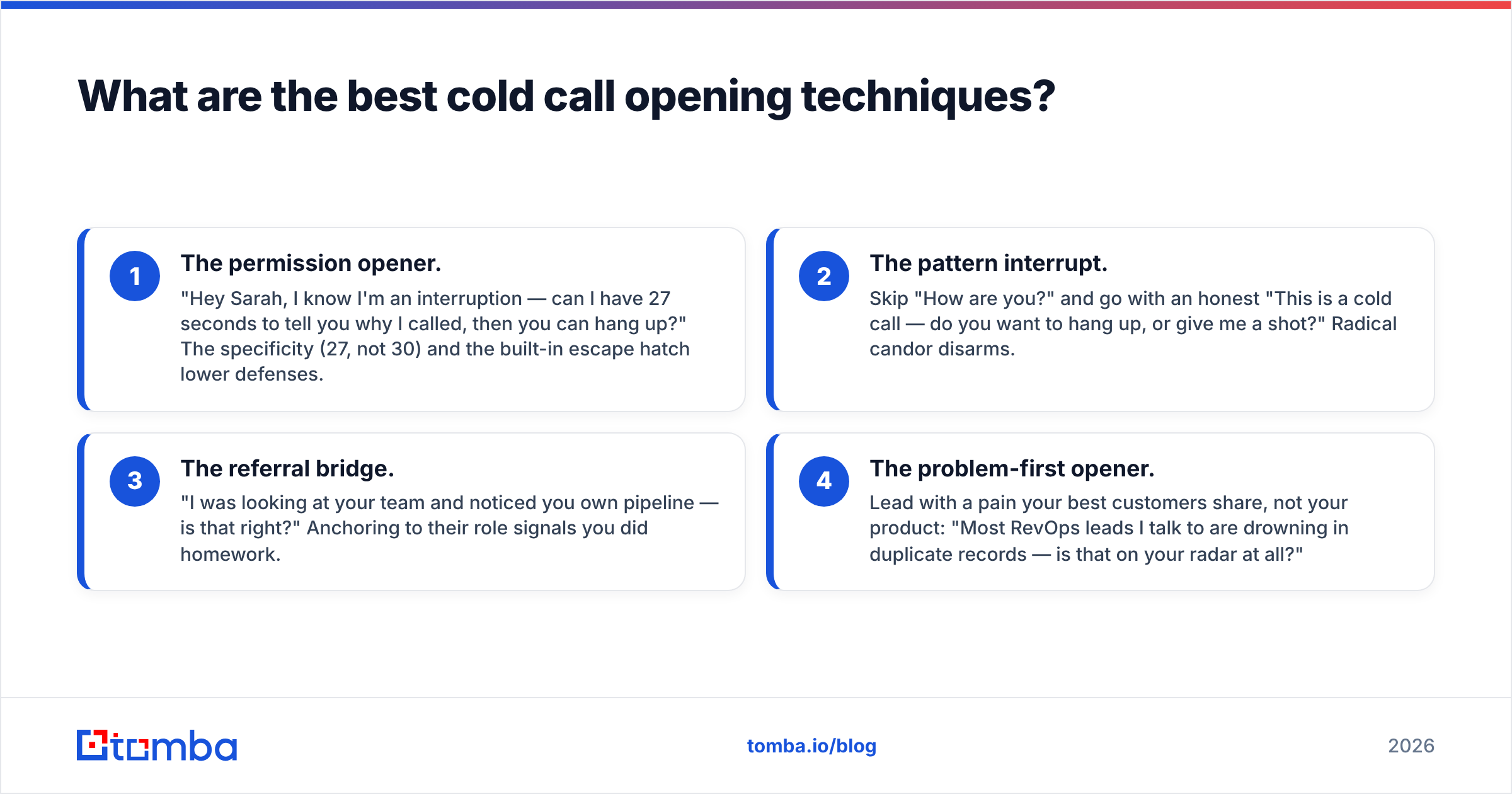
Your opener has one job: earn the next 30 seconds. Here are the four that consistently outperform the classic "How are you today?"
- The permission opener. "Hey Sarah, I know I'm an interruption — can I have 27 seconds to tell you why I called, then you can hang up?" The specificity (27, not 30) and the built-in escape hatch lower defenses.
- The pattern interrupt. Skip "How are you?" and go with an honest "This is a cold call — do you want to hang up, or give me a shot?" Radical candor disarms.
- The referral bridge. "I was looking at your team and noticed you own pipeline — is that right?" Anchoring to their role signals you did homework.
- The problem-first opener. Lead with a pain your best customers share, not your product: "Most RevOps leads I talk to are drowning in duplicate records — is that on your radar at all?"
The common thread: you talk less, and you hand control back to the prospect early. Reps who ask permission book meetings at meaningfully higher rates than reps who bulldoze — HubSpot's sales research has documented the same pattern for years.
How do you handle objections on a cold call?#
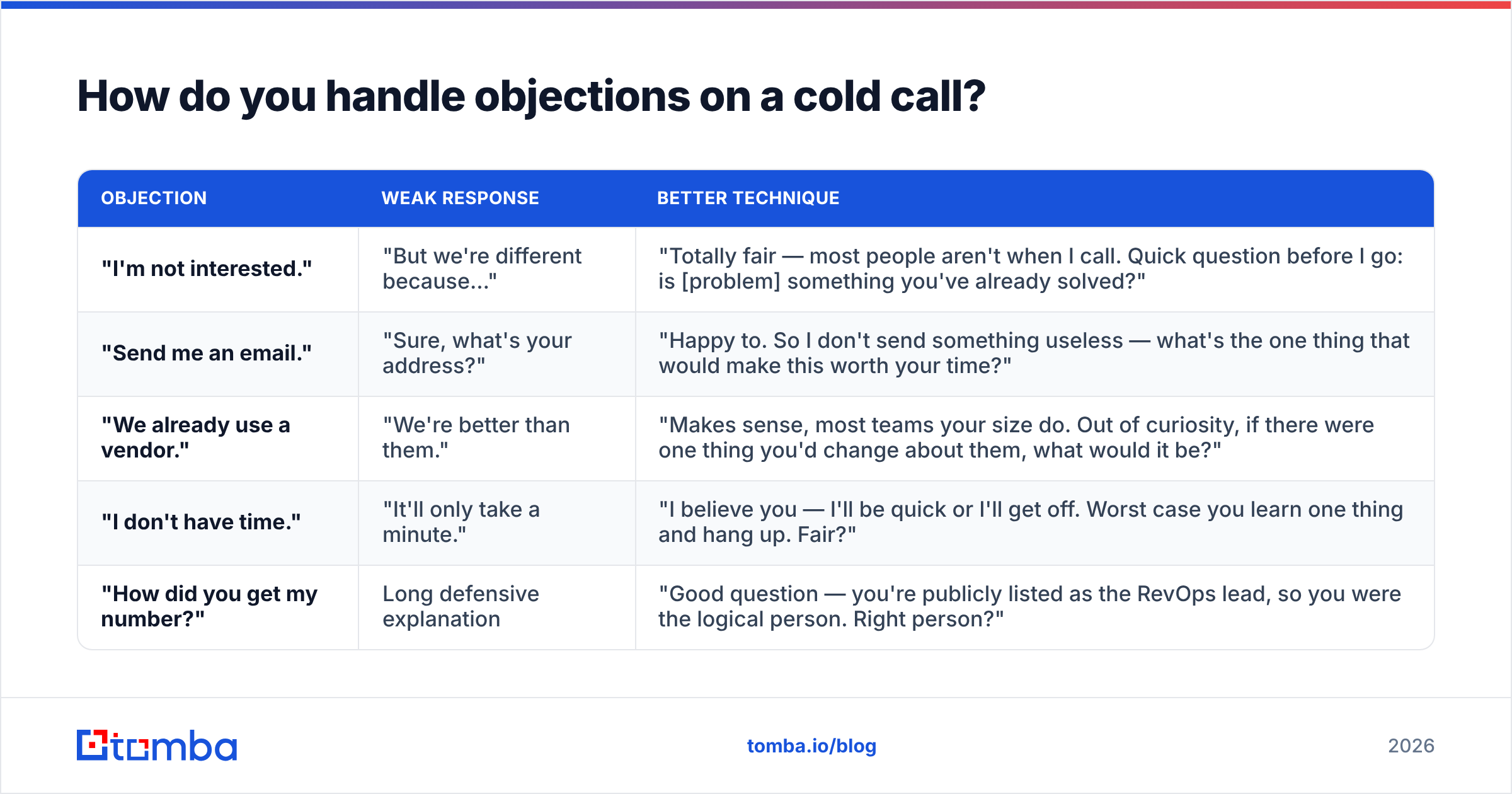
Use a three-beat rhythm: acknowledge, reframe, redirect. Never argue. Arguing tells the prospect they were right to resist.
| Objection | Weak response | Better technique |
|---|---|---|
| "I'm not interested." | "But we're different because…" | "Totally fair — most people aren't when I call. Quick question before I go: is [problem] something you've already solved?" |
| "Send me an email." | "Sure, what's your address?" | "Happy to. So I don't send something useless — what's the one thing that would make this worth your time?" |
| "We already use a vendor." | "We're better than them." | "Makes sense, most teams your size do. Out of curiosity, if there were one thing you'd change about them, what would it be?" |
| "I don't have time." | "It'll only take a minute." | "I believe you — I'll be quick or I'll get off. Worst case you learn one thing and hang up. Fair?" |
| "How did you get my number?" | Long defensive explanation | "Good question — you're publicly listed as the RevOps lead, so you were the logical person. Right person?" |
Notice every "better technique" ends with a question. A statement invites a wall; a question invites a conversation. And keep it short — the reframe should be one sentence, not a paragraph.
Which cold call techniques actually book the meeting?#
Once you have a live conversation, closing for the meeting is its own skill. These are the techniques that convert interest into a calendar hold:
- The specific ask. Never say "Can we set up a call sometime?" Say "Do you have 15 minutes Thursday at 10, or is Friday morning better?" A choice between two times beats an open yes/no.
- The micro-commitment. If they hesitate on a meeting, downgrade the ask: "How about I send a 2-minute Loom and if it's useless, ignore it?" Small yeses build to big ones.
- The assumptive recap. "So it sounds like duplicate data is costing your team hours a week — that's exactly what I'd want to show you Thursday." Mirror their pain back before you close.
- The takeaway close. "Honestly, this might not be a fit — but the only way to know is 15 minutes. Worth a look?" Removing the pressure often lowers resistance.
Does voicemail still work as a cold call technique?#
Yes — if you treat it as a teaser, not a pitch. You will hit voicemail on most dials, so a repeatable script is non-negotiable.
The formula: name, hook, no ask, callback loop. Keep it under 12 seconds.
"Hi Sarah, it's Ben from Tomba. I had a quick idea about your team's duplicate-record problem — not urgent, but I think it'll save you time. I'll try you again Thursday, or grab me back at [number]."
Notice there is no "please call me back so I can pitch you." The hook creates curiosity; the promised follow-up makes your next dial feel expected instead of cold. Pair the voicemail with a one-line email or LinkedIn touch and you turn one dial into a small sequence.
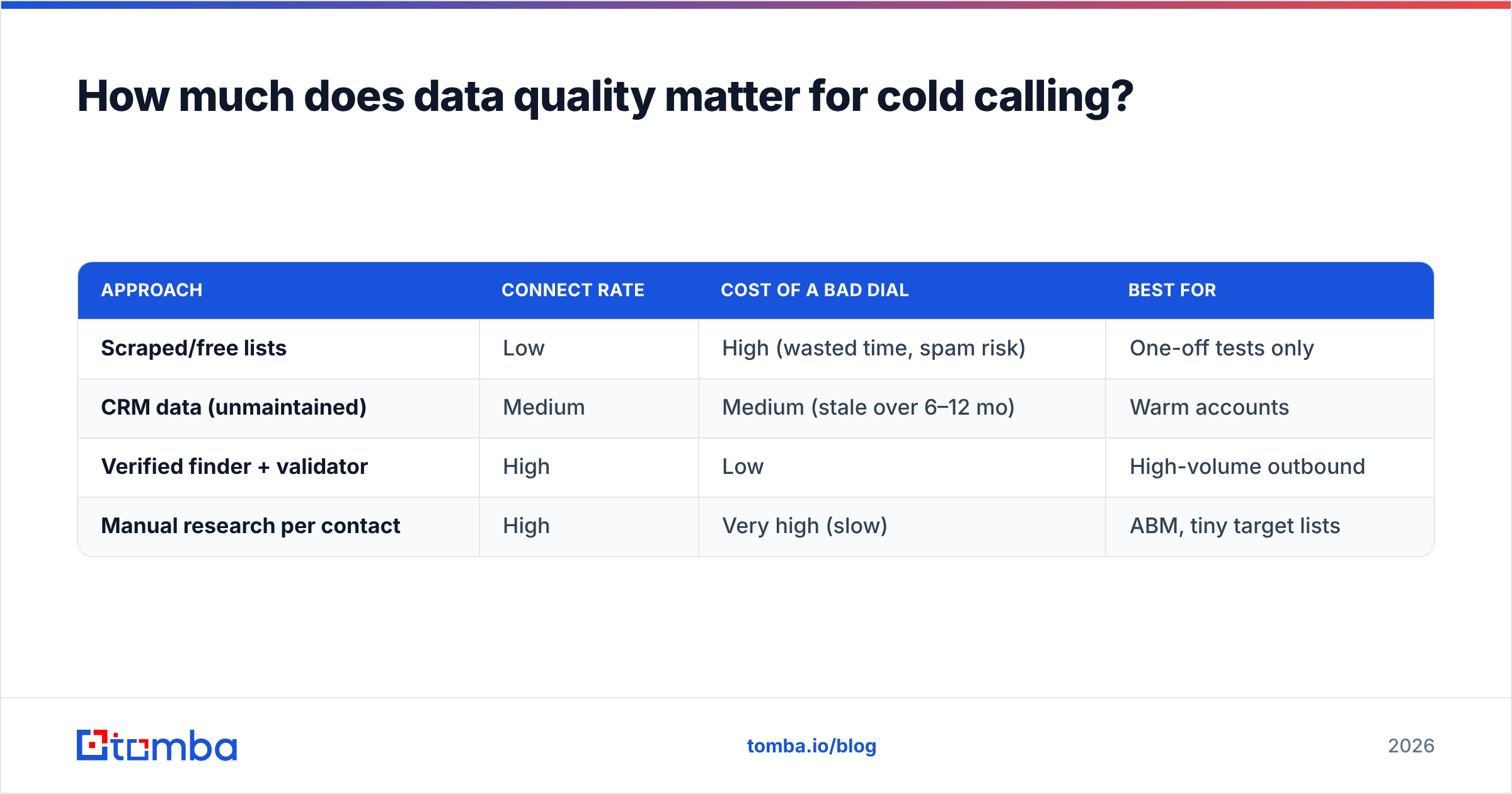
How much does data quality matter for cold calling?#
More than any script. You can run flawless technique into a dead number and book nothing.
Here is the uncomfortable math: if your list is 60% accurate and you dial 100 numbers, 40 calls are wasted before you open your mouth. Improve accuracy to 95% and you effectively add 35 real conversations to the same effort. That is why serious phone teams verify contact data upstream.
| Approach | Connect rate | Cost of a bad dial | Best for |
|---|---|---|---|
| Scraped/free lists | Low | High (wasted time, spam risk) | One-off tests only |
| CRM data (unmaintained) | Medium | Medium (stale over 6–12 mo) | Warm accounts |
| Verified finder + validator | High | Low | High-volume outbound |
| Manual research per contact | High | Very high (slow) | ABM, tiny target lists |
The winning move is combining a finder with validation. Use a phone finder to pull direct dials, then run them through a phone validator so you are not burning dials on disconnected lines. If your motion is email-plus-phone, layering in an email verifier keeps your follow-up out of the spam folder. Clean data is not glamorous, but it is the technique that multiplies every other technique on this list. You can see how the plans stack up on Tomba pricing.
What's a good cold calling framework to follow?#
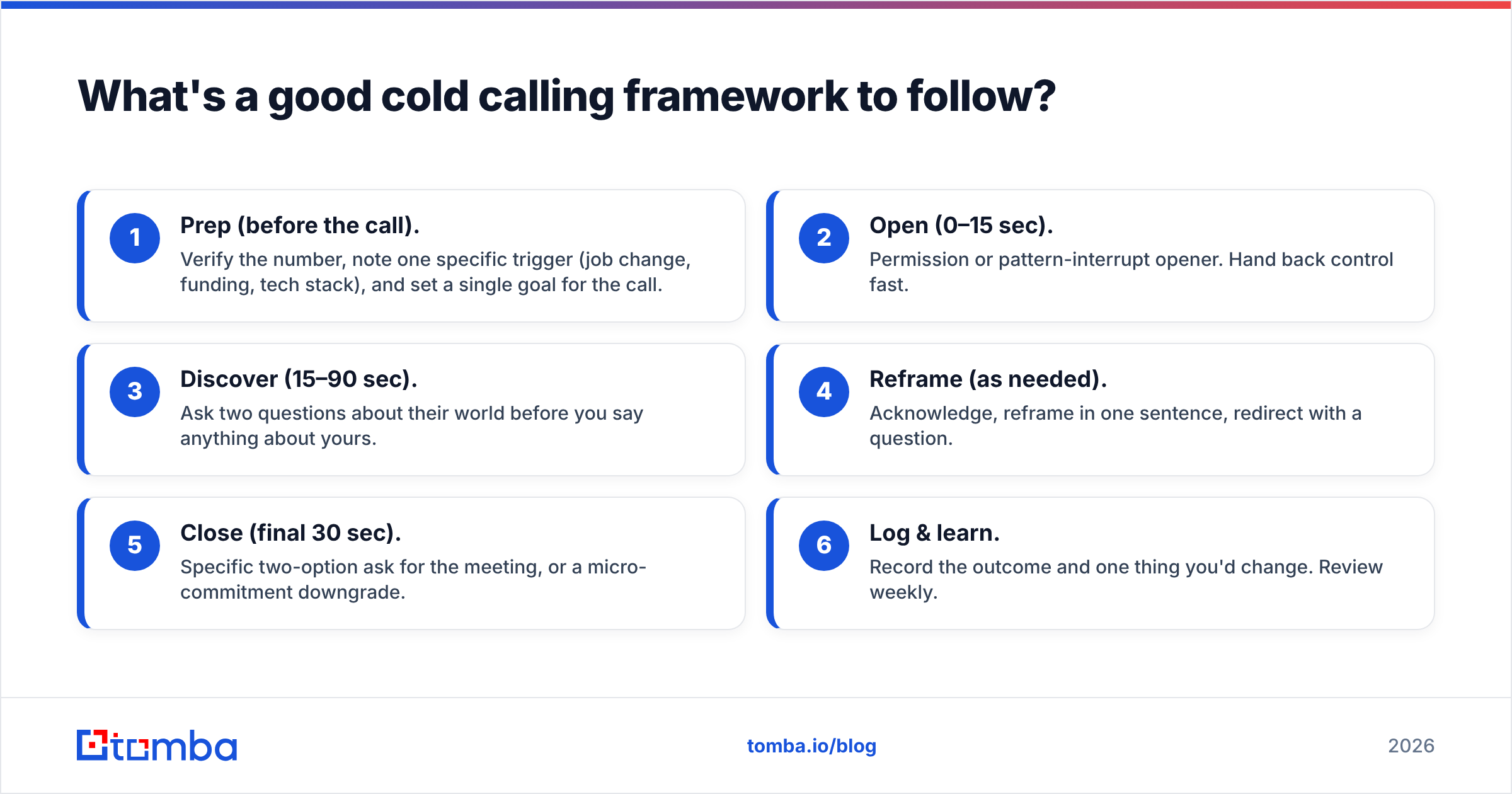
Structure keeps you from freezing. Here is a simple end-to-end flow you can run on every dial:
- Prep (before the call). Verify the number, note one specific trigger (job change, funding, tech stack), and set a single goal for the call.
- Open (0–15 sec). Permission or pattern-interrupt opener. Hand back control fast.
- Discover (15–90 sec). Ask two questions about their world before you say anything about yours.
- Reframe (as needed). Acknowledge, reframe in one sentence, redirect with a question.
- Close (final 30 sec). Specific two-option ask for the meeting, or a micro-commitment downgrade.
- Log & learn. Record the outcome and one thing you'd change. Review weekly.
Run this consistently and your calls stop being improv. For teams building a repeatable outbound engine, this framework pairs naturally with your broader sales automation stack so every connected call feeds the CRM cleanly.
What metrics should you track to improve cold call technique?#
Stop counting dials. Dials measure activity; the following measure skill:
- Connect rate — % of dials that reach a live human. Low? Your data is the problem, not your pitch.
- Conversation-to-meeting rate — % of live conversations that book. This is your true technique score.
- Talk-time ratio — how much you talk vs. the prospect. Aim for the prospect talking more, especially early.
- Objection recovery rate — % of objections that still end in a next step.
- Callback rate on voicemails — tells you if your teaser script works.
Track these weekly, change one variable at a time, and you will improve faster than any "motivational" call blitz can deliver. Tools like G2 can help you compare dialers and engagement platforms once you know which metric you are trying to move.
Common cold calling mistakes to avoid#
- Talking through the open. If you're monologuing in the first 20 seconds, you've lost.
- Winging the objection. Have your reframes written and rehearsed until they're reflex.
- Dialing unverified numbers. The fastest way to feel like cold calling "doesn't work."
- Pitching in voicemail. Tease, don't sell.
- Chasing volume over quality. 40 great conversations beat 200 bad dials.
Start with better numbers, not just better scripts#
The best script in the world can't fix a wrong number. Before your next call block, load your list into the Tomba Email Finder and phone tools to pull verified direct dials and contact details, then run them through validation so every dial has a real chance of connecting. Technique gets you the meeting — clean, accurate data gets you the conversation in the first place. Fix the data, then run the plays above, and watch your connect and booking rates climb.
Related guides#
// get started
Find, verify and enrich your first contacts today
Start on the free plan with 25 searches a month, then scale when your team is ready.
Free plan · No credit card required · GDPR & CCPA
// about the author