The Cold Call Voicemail Script That Actually Gets Callbacks
Most sales voicemails get deleted in three seconds. This guide breaks down a cold call voicemail script that earns callbacks — with templates, exact timing, and the follow-up cadence that makes it work.
Cold call voicemails have a reputation problem. Reps assume nobody listens, so they either skip them or ramble for 45 seconds and hang up embarrassed. Both are mistakes. A tight cold call voicemail script is one of the cheapest callback engines in outbound sales — you just have to treat it like a 20-second ad, not a diary entry.
This guide gives you the exact structure, plug-and-play templates, timing benchmarks, and the follow-up sequence that turns a one-way message into a two-way conversation.
TL;DR#
- Keep it under 20 seconds. After that, the recipient stops listening and hits delete.
- Lead with their name and a reason, not your pitch. Relevance earns the replay; features earn the delete.
- Say your number twice, slowly — once early, once at the end. It's the single biggest callback lever.
- The voicemail is a setup, not the close. Pair every one with a matching email so your name lands twice.
- Track and iterate. Swap one variable per week (opener, length, CTA) and keep what lifts callbacks.
Do cold call voicemails even work in 2026?#
Short answer: yes, when they're built to be skimmed by ear. The mistake is measuring a voicemail by its direct callback rate alone. Its real job is multi-touch reinforcement — it makes your next email, LinkedIn note, or second dial feel familiar instead of cold.
Think of a voicemail like a movie trailer. Nobody buys a ticket from the trailer itself, but a good one makes you recognize the film when you see it again. Your voicemail does the same for the rest of your sequence. According to HubSpot's sales research, buyers respond to sellers who show up consistently across channels — and voicemail is one of the few channels where your actual voice, tone, and confidence come through.
The caveat: an unprepared voicemail actively hurts you. A mumbled, 50-second, all-about-me message signals "untrained rep" and gets you screened out. So the question isn't whether to leave one — it's whether you leave a disciplined one.

What makes a cold call voicemail script work?#
Every high-performing voicemail hits the same five beats in the same order. Miss the order and you lose them before the point.
- The name hook (0–3s). Say their first name, then yours and your company — fast. "Hi Dana, it's Marcus over at Northbeam." Their name is the pattern-interrupt that keeps them listening.
- The relevance line (3–8s). One sentence on why them, why now. A trigger event, a peer they respect, a specific pain. This is where generic scripts die.
- The value tease (8–13s). Not your feature list — the outcome. "We helped two teams like yours cut ramp time by a third." Curiosity, not a demo.
- The clear ask (13–17s). One action. A callback, or "watch for my email." Never two asks.
- The number, twice (17–20s). Slow, digit by digit. Then stop talking. Silence is fine; over-explaining is not.
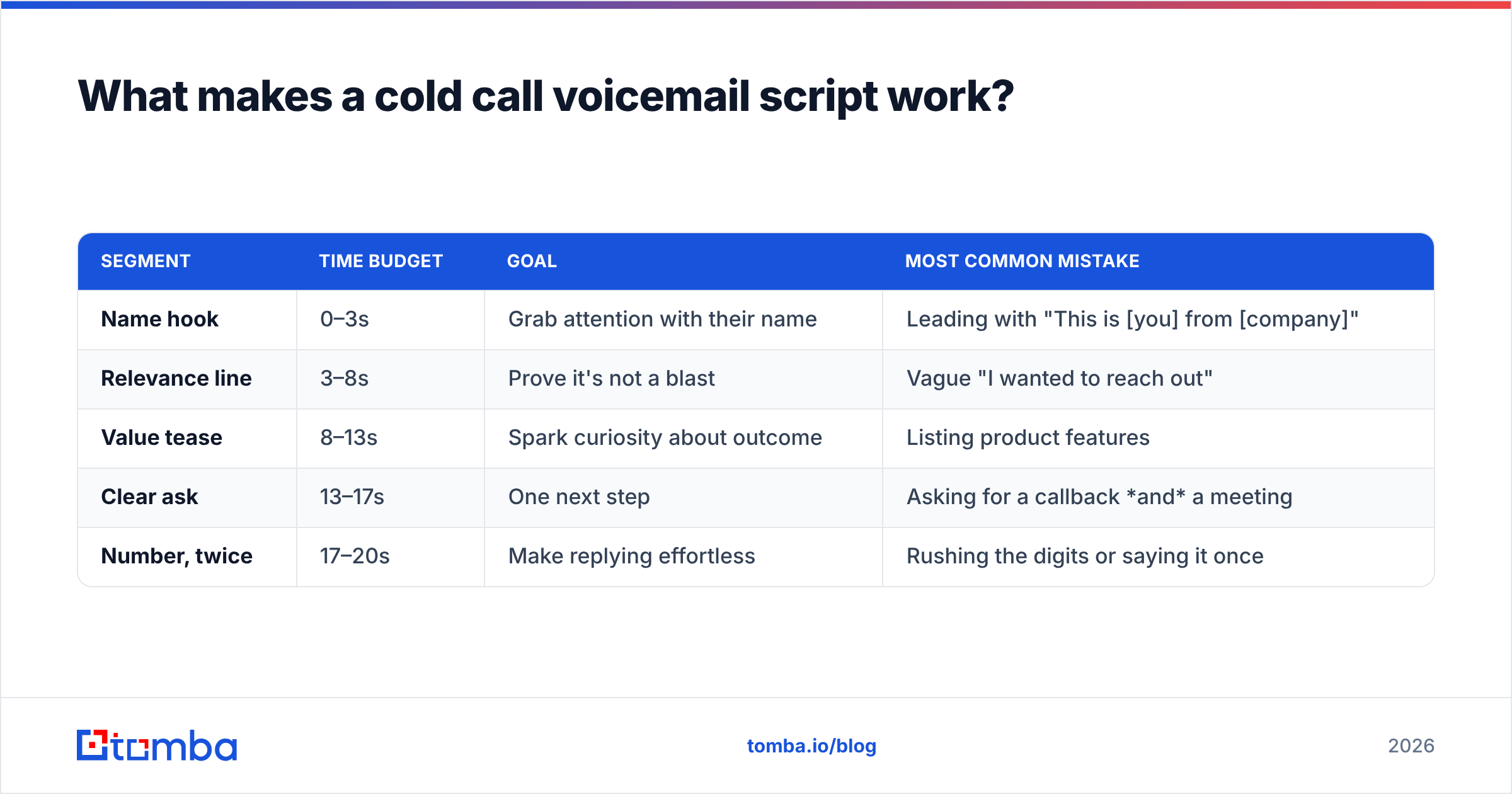
Here's how the anatomy maps to purpose and the most common failure at each step:
| Segment | Time budget | Goal | Most common mistake |
|---|---|---|---|
| Name hook | 0–3s | Grab attention with their name | Leading with "This is [you] from [company]" |
| Relevance line | 3–8s | Prove it's not a blast | Vague "I wanted to reach out" |
| Value tease | 8–13s | Spark curiosity about outcome | Listing product features |
| Clear ask | 13–17s | One next step | Asking for a callback and a meeting |
| Number, twice | 17–20s | Make replying effortless | Rushing the digits or saying it once |
Notice the whole thing fits in 20 seconds. That constraint is the feature, not a limitation — it forces you to cut everything that isn't a reason to call back.
What is the best cold call voicemail script template?#
Start with this core template, then adapt the relevance line to each prospect. The brackets are the only parts you change per call.
"Hi [First name], it's [Your name] at [Company] — my number is [xxx-xxx-xxxx].
I'm reaching out because [specific trigger or peer reference], and it's usually the point where teams like yours start [relevant pain].
We've helped [similar company/role] [specific outcome] without [common objection]. I'd love to see if it's relevant to you.
Give me a quick call back at [xxx-xxx-xxxx] — again, [Your name] at [Company]. Thanks, [First name]."
Read it aloud with a timer. If you're over 20 seconds, your relevance line is too long — tighten it, don't cut the number.
Three variations by scenario#
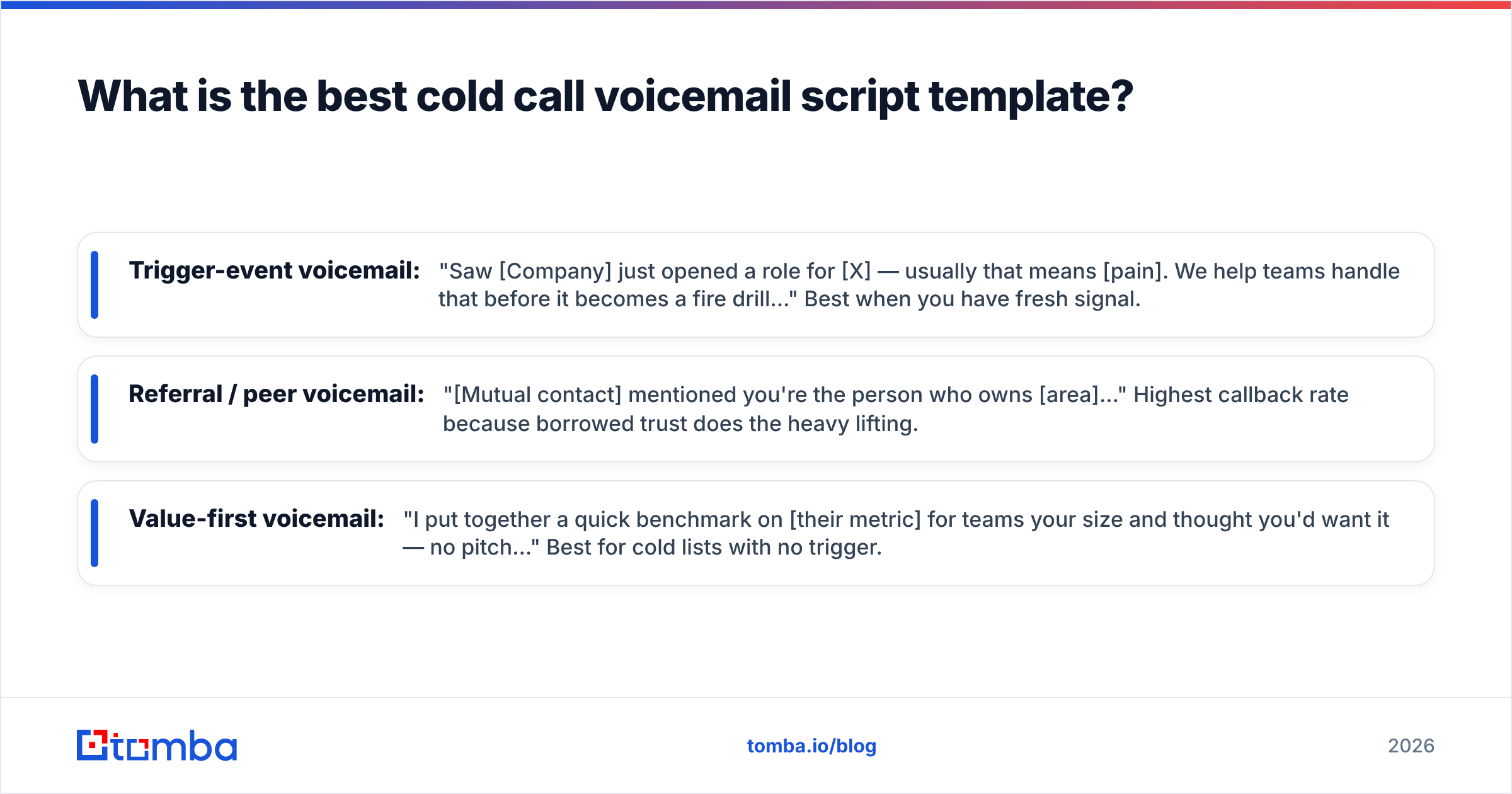
- Trigger-event voicemail: "Saw [Company] just opened a role for [X] — usually that means [pain]. We help teams handle that before it becomes a fire drill…" Best when you have fresh signal.
- Referral / peer voicemail: "[Mutual contact] mentioned you're the person who owns [area]…" Highest callback rate because borrowed trust does the heavy lifting.
- Value-first voicemail: "I put together a quick benchmark on [their metric] for teams your size and thought you'd want it — no pitch…" Best for cold lists with no trigger.
If you script cold outreach across channels, a consistent voice matters. Tools like Tomba's cold email AI can help you draft the matching email so your voicemail and inbox message reinforce the same message instead of contradicting it.
Why does the follow-up email matter more than the voicemail?#
Because a single voicemail almost never closes — the sequence does. The voicemail's job is to make the email feel warm, and the email's job is to give the prospect an easy, low-pressure way to reply. Most people would rather type than call back, so give them that lane.
The rule: every voicemail gets a same-day email with a matching subject line. If the voicemail said "watch for my email," the email had better arrive within the hour with a subject that echoes it — "The benchmark I mentioned, Dana."
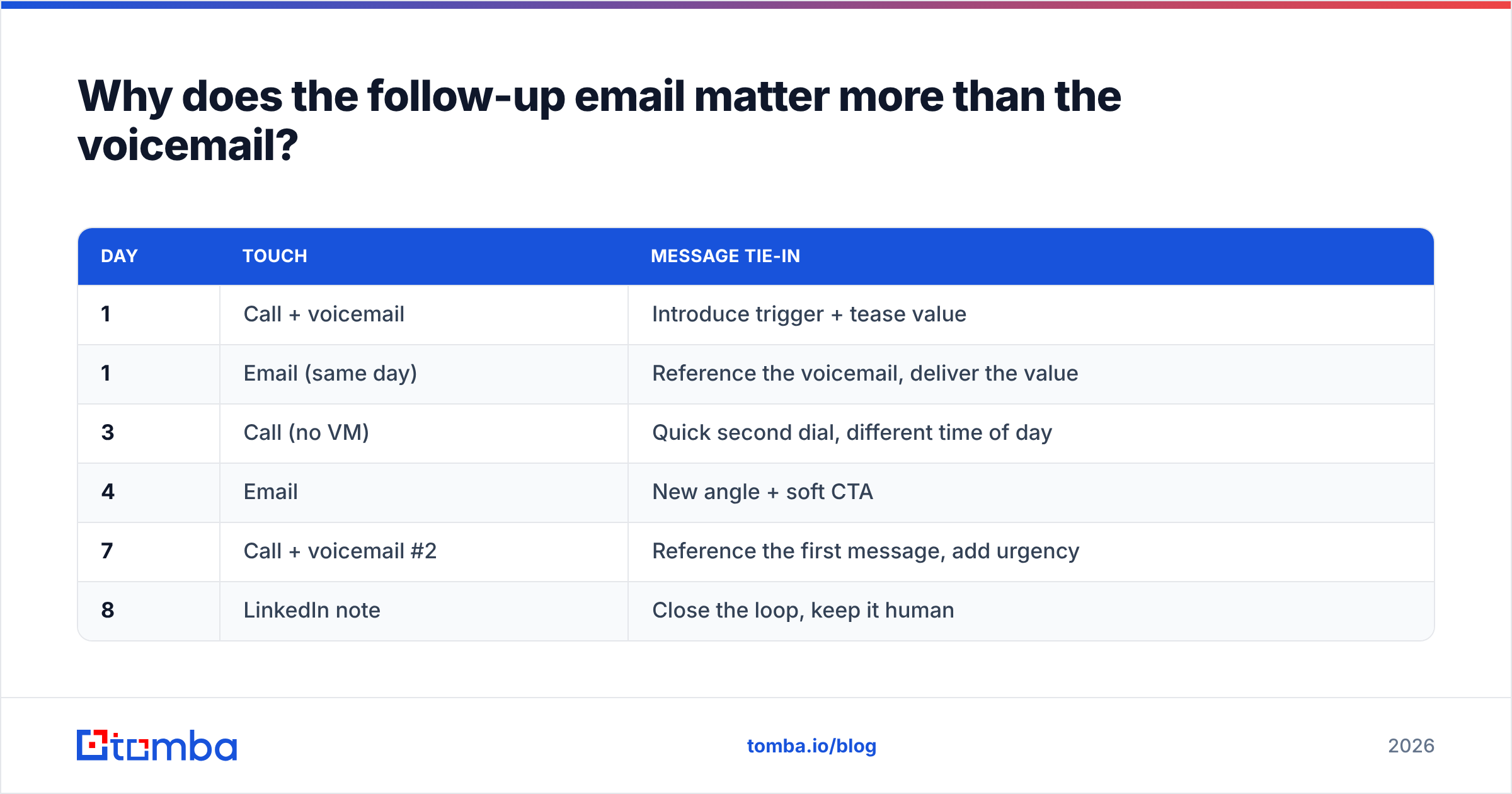
Here's a simple multi-touch cadence that pairs voice and inbox:
| Day | Touch | Message tie-in |
|---|---|---|
| 1 | Call + voicemail | Introduce trigger + tease value |
| 1 | Email (same day) | Reference the voicemail, deliver the value |
| 3 | Call (no VM) | Quick second dial, different time of day |
| 4 | New angle + soft CTA | |
| 7 | Call + voicemail #2 | Reference the first message, add urgency |
| 8 | LinkedIn note | Close the loop, keep it human |
This is where clean contact data becomes the constraint. A perfect voicemail script is worthless if the number is wrong or the email bounces. If you're building lists, pair a verified direct dial from a phone finder with a matching work email so both touches actually land. Validate the number first with a phone validator so you're not burning a voicemail on a disconnected line.

What are the biggest cold call voicemail mistakes?#
Most bad voicemails fail for boringly predictable reasons. Fix these before you touch the script wording.
- Talking too long. Anything past 20 seconds gets deleted mid-sentence. Length reads as desperation.
- Burying your number. Saying it once, fast, at the end forces a replay — most people won't bother. Say it twice, slowly.
- Leading with yourself. "This is Marcus from Northbeam and we're a platform that…" You've lost them. Lead with their name and their reason.
- Sounding scripted. Reading word-for-word kills tone. Learn the beats, then speak like a human who happens to be organized.
- No trigger, no relevance. A voicemail that could be left for anyone gets treated like it was left for no one.
- Skipping the email pairing. A voicemail with no follow-up is a coin flip. A paired sequence compounds.
Research from conversation-analytics firms like Gong consistently shows that successful outreach is concise, prospect-centric, and multi-touch — the same principles that make a voicemail work. And per Salesforce's guidance on sales productivity, reps who standardize a repeatable process outperform those improvising every call.
How do you measure if your voicemail script is working?#
Treat voicemails like any other testable asset: change one variable at a time and watch the numbers. The metric that matters most is callback + reply rate within 48 hours, since a voicemail rarely gets a same-minute call.
Track these:
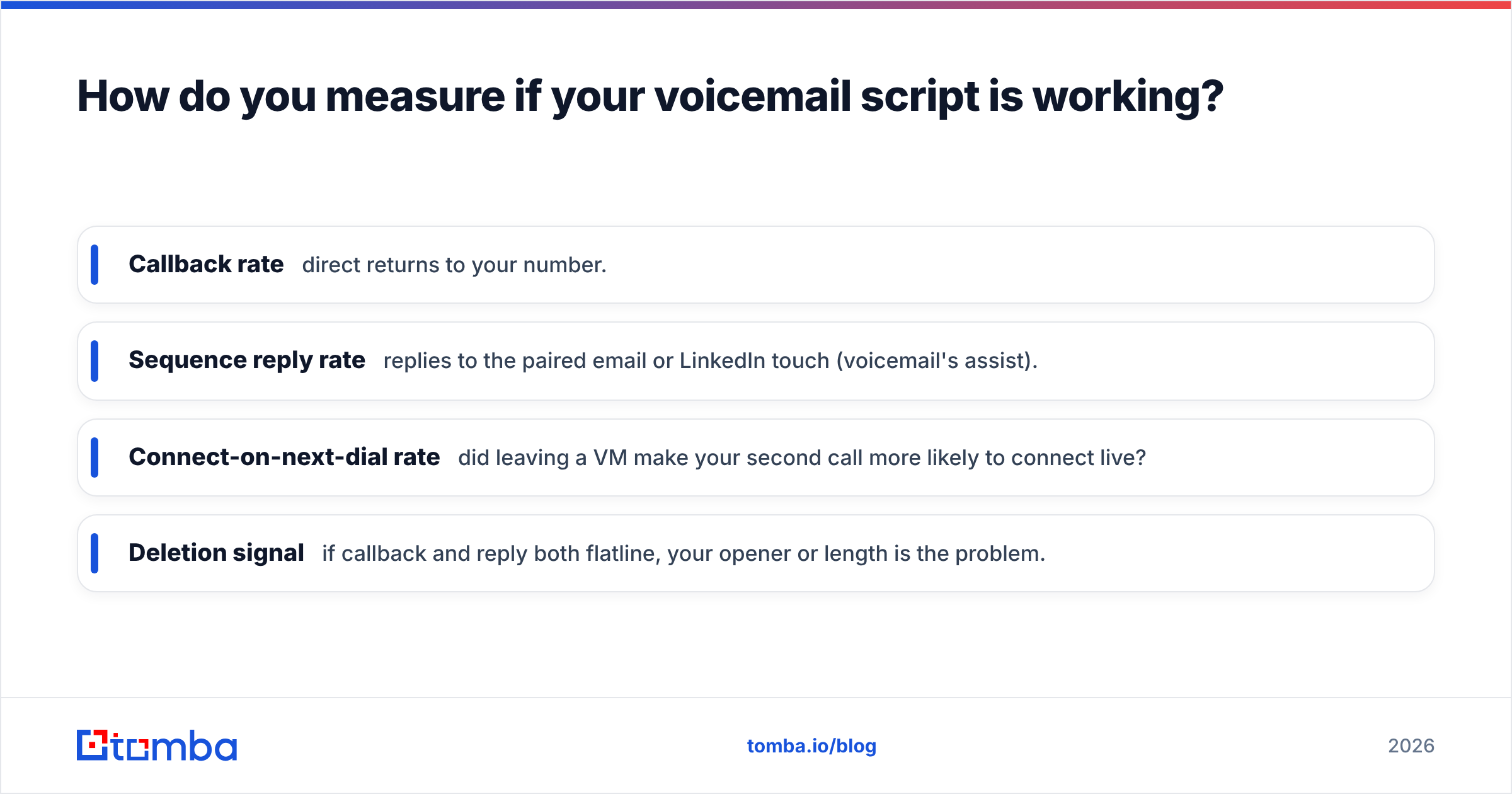
- Callback rate — direct returns to your number.
- Sequence reply rate — replies to the paired email or LinkedIn touch (voicemail's assist).
- Connect-on-next-dial rate — did leaving a VM make your second call more likely to connect live?
- Deletion signal — if callback and reply both flatline, your opener or length is the problem.
Run a two-week test: week one, your current script; week two, one change (shorter relevance line, or number said twice instead of once). Keep the winner. The compounding effect of small script wins across hundreds of dials is enormous — a lift from 4% to 7% callbacks nearly doubles your live conversations.
One more multiplier: data quality upstream. Even a great script underperforms on a stale list. Enriching contacts before you dial — verifying the direct line and the email in one pass — means more of your voicemails reach a real person who can actually call you back. That's the difference between a script problem and a data problem, and they're easy to confuse.
Cold call voicemail script: quick reference checklist#
Before you hit record on your next batch of dials, run down this list:
- Under 20 seconds, timed out loud
- Prospect's first name in the first 3 seconds
- One relevance line tied to a trigger or peer
- Outcome-focused value tease, no feature lists
- Exactly one clear ask
- Phone number said twice, slowly
- Same-day email queued with a matching subject
- Verified contact data behind the dial
Nail those eight and you're ahead of most reps on the board.
Turn better scripts into better conversations#
A sharp cold call voicemail script only pays off when it reaches the right person on a working number, backed by an email that lands in the same inbox. That upstream data is where most outbound programs quietly leak pipeline.
Tomba closes that gap. Use the Tomba Email Finder to pull verified work emails for the accounts you're dialing, layer in direct phone numbers, and enrich your list so every voicemail is paired with a deliverable follow-up. Start free with 25 searches a month, and if you're scaling outbound, the Tomba plans run from $49/mo for Starter up to Pro and Enterprise. Get the data right, keep the script tight, and the callbacks follow.
Related guides#
Ready to find emails that actually work?
Join 150,000+ professionals who stopped guessing and started sending. Free credits on signup — no credit card required.
Get the Tomba newsletter
Practical outbound tactics and product updates — once every two weeks.
About the author