Cold Call Voicemail Strategies That Actually Get Callbacks in 2026
Most sales voicemails get deleted in three seconds. Here are the cold call voicemail strategies, scripts, and timing rules that actually get prospects to call you back.
Cold calling is not dead, but the live-connect rate is brutal. Depending on the industry, you reach a human on roughly 1 in 20 dials. That means the other 19 times, you either hang up or you leave a voicemail. If you treat those voicemails as a throwaway, you are wasting 95% of your dialing effort. Good cold call voicemail strategies turn that dead air into a second, third, and fourth touch that quietly warms the prospect before you ever connect.
This guide is the no-fluff version: what to say, how long to talk, when to hit "call," and how to measure whether any of it works.
TL;DR — The fast version#
- Leave the voicemail every time. A skipped voicemail is a lost touch. Even at a 4-5% callback rate, the "brand recall" pays off on your follow-up email and next dial.
- Keep it 18-30 seconds. Longer than 30 seconds and deletion rates spike. Shorter than 8 and you sound like a robocall.
- Lead with their name and a reason, not your pitch. The first five seconds decide whether the finger moves to delete.
- Pair every voicemail with an email. The voicemail-then-email one-two punch lifts response rates far more than either alone.
- Track callback rate and connect-after-voicemail rate, not just "voicemails left." What you don't measure, you can't improve.
Do sales voicemails even work anymore?#
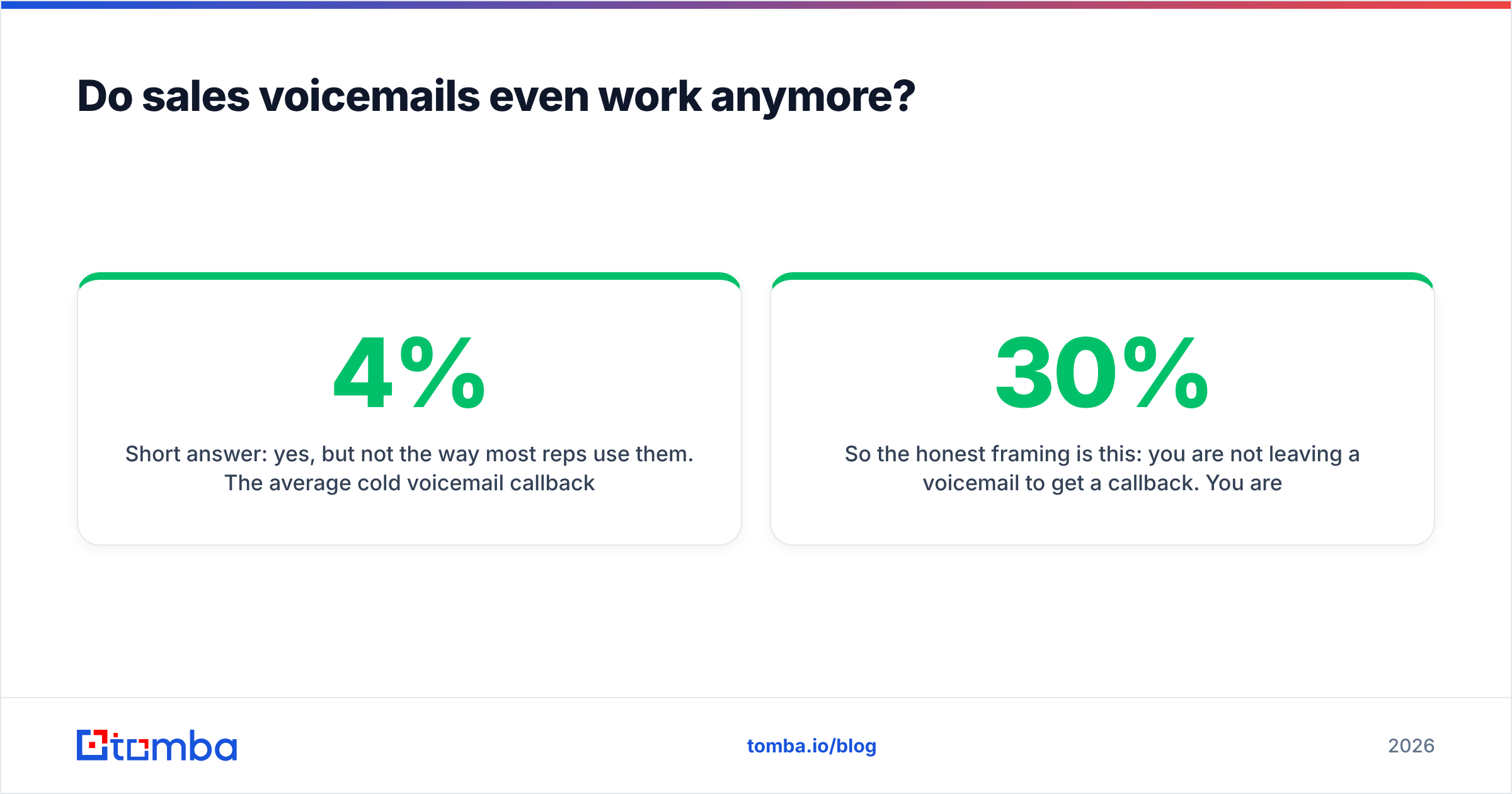
Short answer: yes, but not the way most reps use them. The average cold voicemail callback rate sits between 4% and 6%, and that number collapses toward zero when the message is a rambling monologue about your "revolutionary platform." The value of a voicemail in 2026 is rarely the callback itself. It is the repetition and recognition it creates.
Think of a voicemail like a billboard you drive past on your commute. You almost never pull over and call the number on the billboard. But after seeing it fifteen times, the brand is lodged in your head, so when a rep from that company emails you, the name feels familiar and trustworthy. Sales research from teams like Gong and HubSpot consistently shows that multi-touch sequences outperform single channels — and voicemail is one of the cheapest touches you have.

So the honest framing is this: you are not leaving a voicemail to get a callback. You are leaving it to make your next email and next dial 30% warmer. That reframe changes everything about how you write the script.
What makes a cold call voicemail get deleted?#
Before the strategies, understand the failure modes. Prospects delete voicemails for predictable reasons, and almost every bad voicemail commits at least three of these sins:
- Too long. Anything past 30 seconds signals "sales pitch" and gets killed mid-sentence.
- No name or a mangled name. If you don't say their name clearly in the first three seconds, it feels like spam spray.
- Feature-dumping. Nobody calls back to hear more about your "AI-powered synergy engine."
- No reason for the call. A voicemail without a specific, relevant hook is just noise.
- Buried or rushed contact info. If they wanted to call back but couldn't catch your number, you lost them.
- Sounding scripted. Reading robotically kills trust faster than a bad script written well.
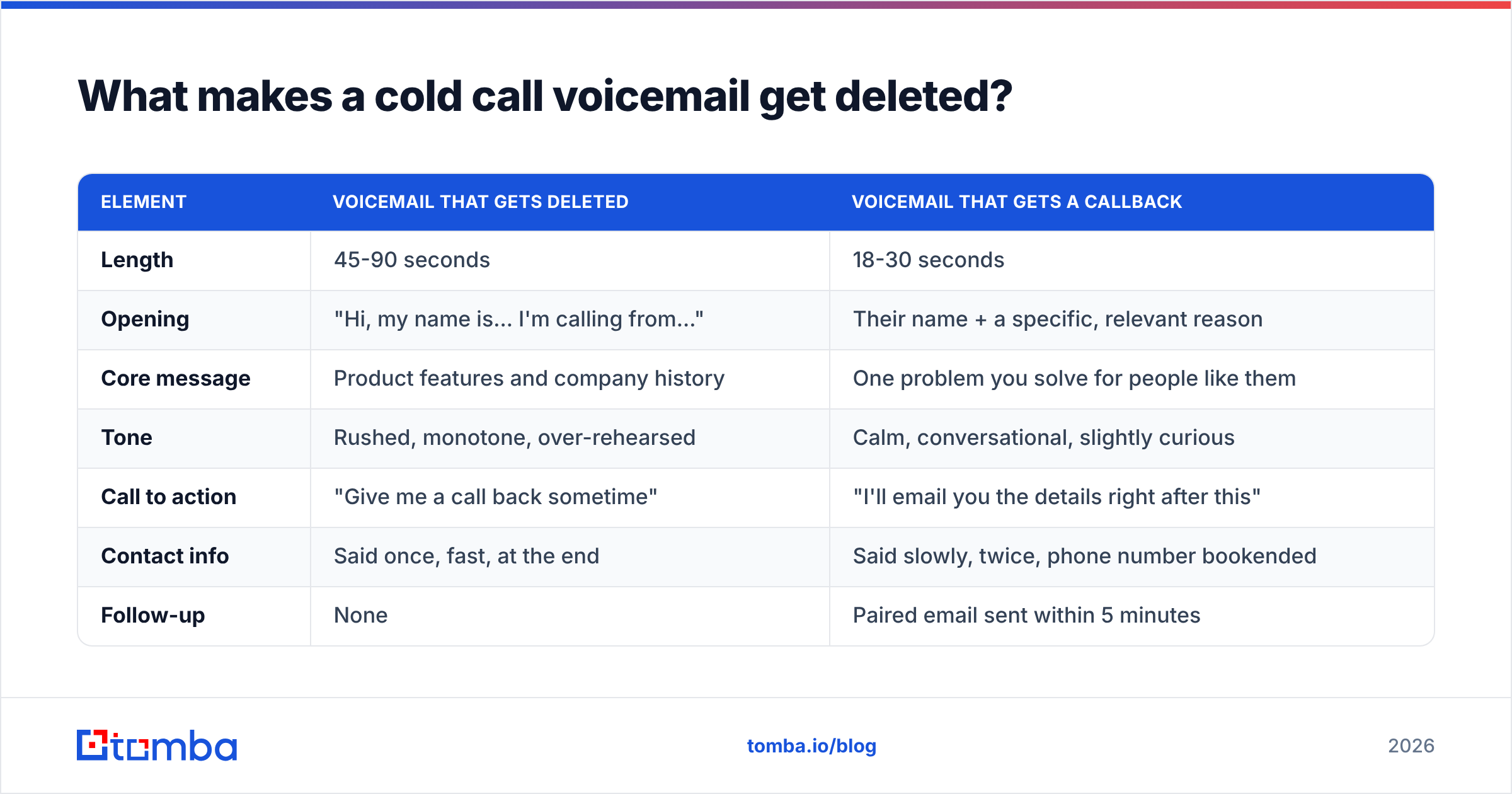
Here is how the two approaches stack up side by side.
| Element | Voicemail that gets deleted | Voicemail that gets a callback |
|---|---|---|
| Length | 45-90 seconds | 18-30 seconds |
| Opening | "Hi, my name is... I'm calling from..." | Their name + a specific, relevant reason |
| Core message | Product features and company history | One problem you solve for people like them |
| Tone | Rushed, monotone, over-rehearsed | Calm, conversational, slightly curious |
| Call to action | "Give me a call back sometime" | "I'll email you the details right after this" |
| Contact info | Said once, fast, at the end | Said slowly, twice, phone number bookended |
| Follow-up | None | Paired email sent within 5 minutes |
What are the best cold call voicemail strategies?#
These are the tactics that consistently move callback and connect rates. Adopt them in order — the first three matter most.
1. Use the 20-second problem-first script#
The highest-performing structure leads with the prospect, names a problem, and gets out fast. A reliable template:
"Hi [First Name], it's [Your Name] at [Company]. I work with [their role/industry] teams who are dealing with [specific problem]. I had one idea for [their company] I wanted to run by you. I'll send a quick email so it's easy to reply — or reach me at [number], that's [number]. Thanks [First Name]."
That is roughly 22 seconds spoken at a natural pace. Notice what it does not contain: no feature list, no company backstory, no "revolutionary." Just a name, a relevant problem, and an easy next step.
2. Anchor to a trigger event#
Generic voicemails get generic results. The single biggest callback-rate lift comes from referencing something specific: a funding round, a new executive hire, a product launch, a LinkedIn post they wrote. "I saw you just opened a second office in Austin" beats "I wanted to introduce our platform" every time. This is where good data matters — you need accurate contact and company intelligence before you dial, which is why prospecting and dialing should never be separate workflows.
3. Always send the paired email#
The voicemail's real job is to make the email land. Send it within five minutes, reference the voicemail by name ("Just left you a quick voicemail — here's the one idea in writing"), and keep it to three sentences. This one-two punch is the highest-ROI move in the entire playbook. To run it at scale you need verified email addresses that don't bounce; a quick pass through an email verifier before you send keeps your sender reputation intact.
4. Say your number slowly, twice, and bookend it#
If a prospect does want to call back, don't make them replay the voicemail four times. State your number at a human pace, repeat it, and put it near both the middle and the end so it survives a partial listen.
5. Vary the message across the sequence#
Leaving the identical voicemail five days in a row makes you sound like an automated system. Rotate: voicemail one is the problem hook, voicemail three references a case study, voicemail five is a soft "should I close your file?" breakup. Persistence with variation reads as a diligent human; repetition reads as spam.
How long should a cold call voicemail be?#
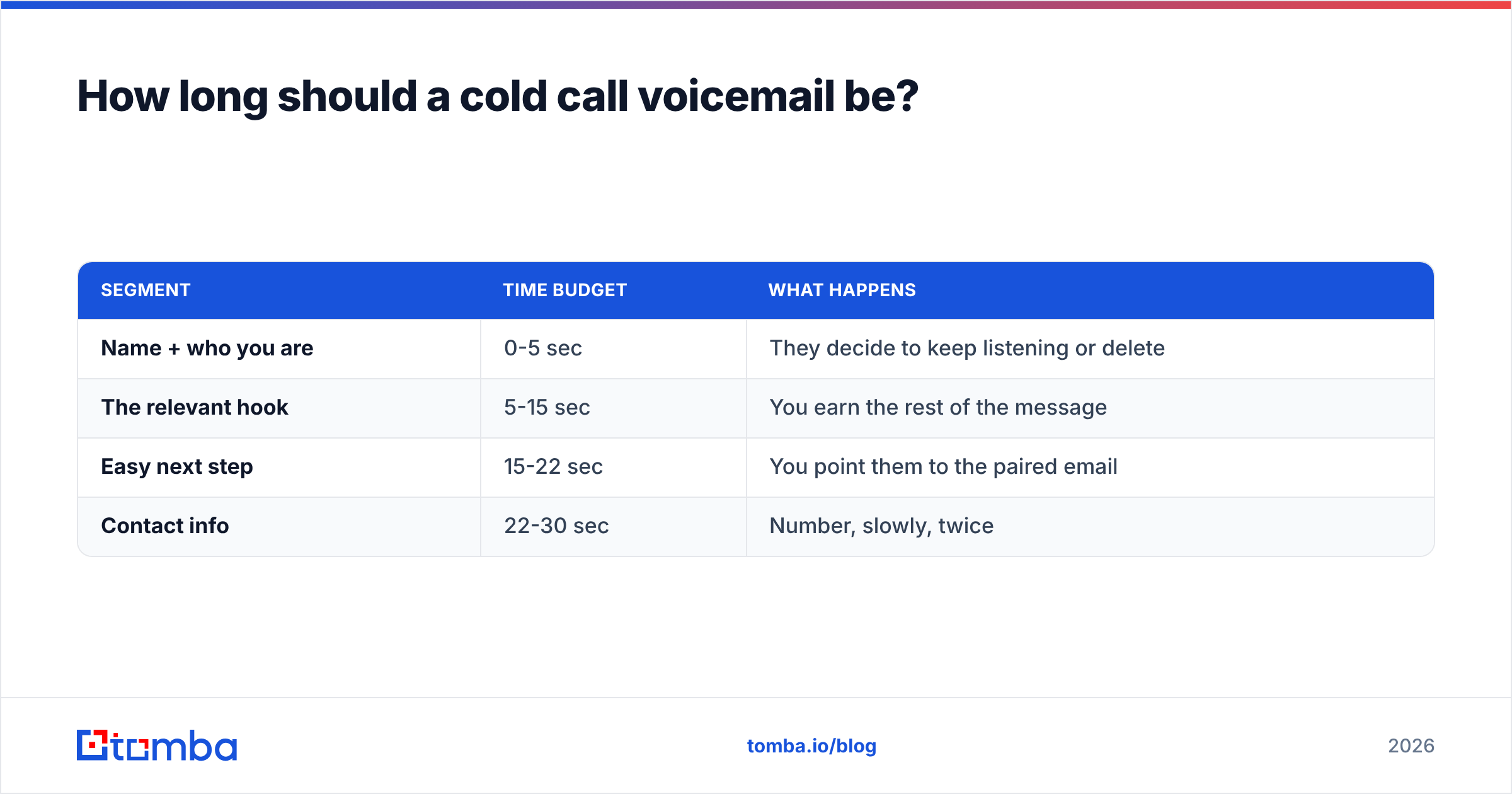
Between 18 and 30 seconds. That is the window where you say enough to be relevant but not so much that you trip the "delete" reflex. Here is a practical breakdown of the timing:
| Segment | Time budget | What happens |
|---|---|---|
| Name + who you are | 0-5 sec | They decide to keep listening or delete |
| The relevant hook | 5-15 sec | You earn the rest of the message |
| Easy next step | 15-22 sec | You point them to the paired email |
| Contact info | 22-30 sec | Number, slowly, twice |
If you find yourself past 30 seconds, you are pitching, not prospecting. Cut a sentence.
When is the best time to leave a voicemail?#
Timing affects both whether you reach a human and whether the voicemail gets heard fresh. Two patterns hold up across most B2B sales data:
- Late morning (10-11:30 a.m.) and late afternoon (4-5:30 p.m.) in the prospect's local time zone tend to catch people between meetings, when they actually check voicemail.
- Tuesday through Thursday outperform Mondays (inbox triage) and Fridays (checked-out mode).
The bigger timing lever is sequence cadence, not time of day. A voicemail on day 1, day 3, day 6, and day 10 — each paired with an email and spaced to avoid feeling frantic — beats five voicemails crammed into one week. If you want a deeper framework for spacing touches, see the fundamentals of email deliverability, since the same reputation-and-cadence logic applies to any outbound channel.
How do you measure whether your voicemail strategy works?#
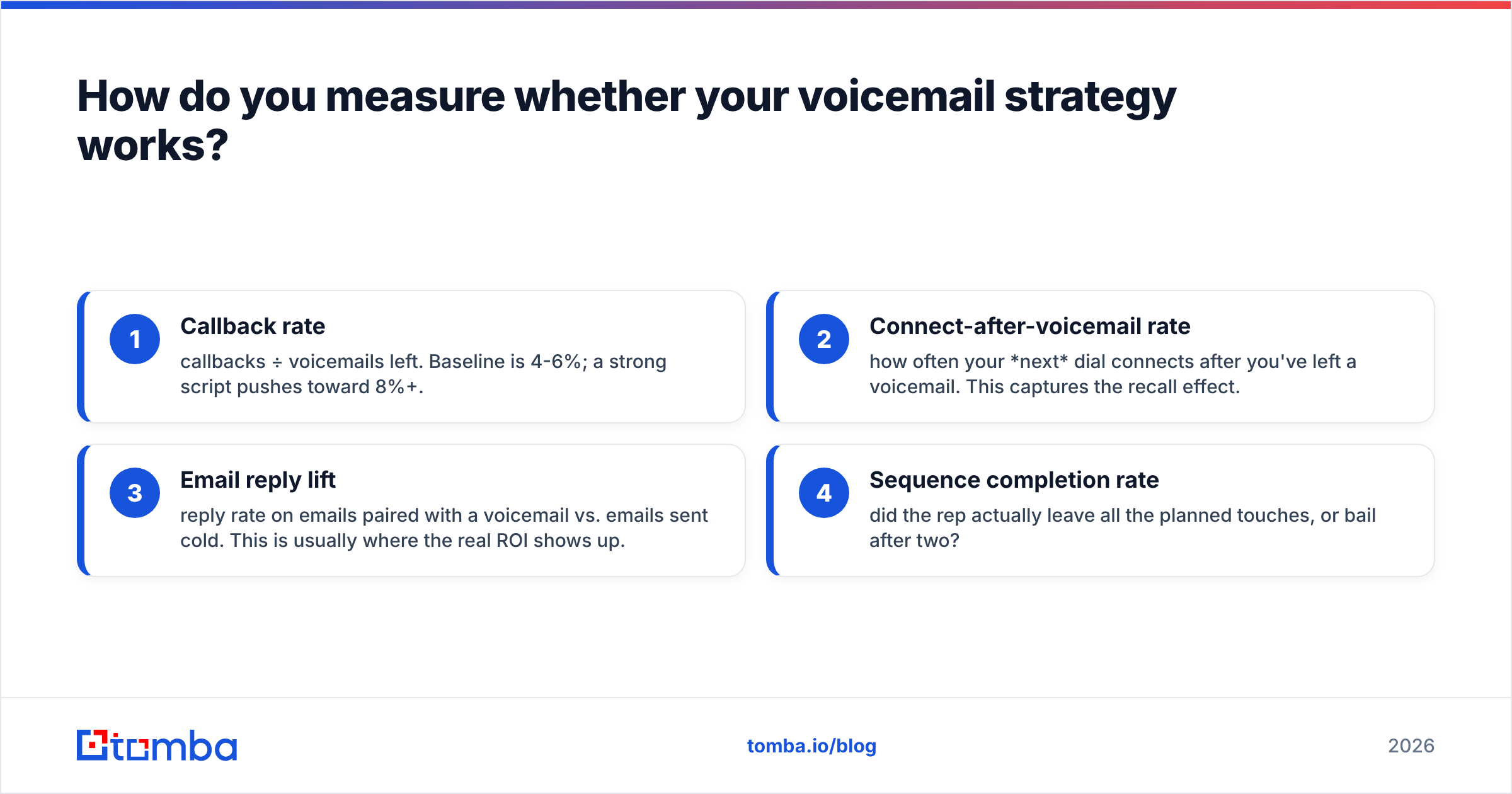
You cannot improve what you don't track. Most reps log "voicemails left" and call it a day. That is a vanity metric. Track these instead:
- Callback rate — callbacks ÷ voicemails left. Baseline is 4-6%; a strong script pushes toward 8%+.
- Connect-after-voicemail rate — how often your next dial connects after you've left a voicemail. This captures the recall effect.
- Email reply lift — reply rate on emails paired with a voicemail vs. emails sent cold. This is usually where the real ROI shows up.
- Sequence completion rate — did the rep actually leave all the planned touches, or bail after two?
A/B test one variable at a time: script A vs. script B, 20 seconds vs. 30 seconds, morning vs. afternoon. Keep the sample size honest — you need at least 100 voicemails per variant before the numbers mean anything.
Where does good data fit into this?#
Every strategy above assumes you're dialing the right number and following up at the right email. That assumption breaks constantly. Reps burn hours leaving voicemails on disconnected lines, wrong departments, or gatekeeper mainlines that never route to the buyer. And the paired-email half of the one-two punch fails silently when the address bounces.
That is the unglamorous foundation of cold calling: accurate contact data. Before a rep ever picks up the phone, the workflow should surface a verified direct number and a verified email for the same person. Tomba's phone finder pulls direct-dial B2B numbers, and its email finder finds and verifies the matching professional email so your voicemail and your follow-up land on the same buyer. When the data is clean, your 20-second script is aimed at a real target — not a dead extension.
Here's how the pieces of a complete voicemail-driven sequence fit together:
- Find the buyer — get a verified direct dial and email for the actual decision-maker, not the switchboard.
- Enrich the context — pull the trigger event (funding, hire, launch) that becomes your voicemail hook.
- Leave the voicemail — 20-second problem-first script, number said twice.
- Send the paired email — within five minutes, referencing the voicemail.
- Rotate and repeat — vary the message across a 10-day cadence and log the metrics that matter.
How does this compare to just sending emails?#
Voicemail is not a replacement for email — it is a multiplier. The reps who win use both, because different buyers respond to different channels and the combination creates recognition no single channel can. For a sense of realistic benchmarks, compare your own response rate on email-only sequences against voicemail-paired ones and you'll usually see the paired version pull ahead within a quarter.
The trap to avoid: don't let voicemail become an excuse to skip the harder work of a relevant message. A lazy voicemail plus a lazy email is still lazy outreach. A sharp, trigger-based voicemail plus a three-sentence email that references it is what actually books meetings.
Final take and next step#
Cold call voicemail strategies work when you stop treating voicemail as a place to pitch and start treating it as a recognition-building touch inside a larger sequence. Keep it under 30 seconds, lead with the prospect, anchor to a trigger, and always fire the paired email. Measure callback rate and email-reply lift, not vanity counts.
None of it matters if you're dialing dead numbers. Start with clean, verified contact data: use the Tomba Email Finder to lock down the right email for every paired follow-up, and layer in the phone finder so your voicemail and your inbox touch hit the same decision-maker. Check the Tomba pricing — there's a free tier with 25 searches a month if you want to test the workflow on your next call block before committing.
Leave the voicemail. Send the email. Track the callback. Repeat with variation. That's the whole game.
Related guides#
// get started
Find, verify and enrich your first contacts today
Start on the free plan with 25 searches a month, then scale when your team is ready.
Free plan · No credit card required · GDPR & CCPA
// about the author