What Is a Cold Caller? The 2026 Guide to Cold Calling That Works
A cold caller lives or dies by list quality, timing, and the first 10 seconds. Here's how top reps actually book meetings by phone in 2026 — scripts, metrics, and the data stack behind them.
What Is a Cold Caller? The 2026 Guide to Cold Calling That Works
TL;DR
- A cold caller is a sales rep who phones prospects with no prior relationship to open a conversation and book a meeting — success hinges far more on list quality and timing than on smooth talk.
- Cold calling is not dead in 2026; it's just less forgiving. Bad numbers, wrong contacts, and no research kill call blocks before the first "hello."
- Top cold callers hit ~5–8% connect-to-meeting rates by dialing verified direct numbers, not switchboards.
- The modern cold caller's edge is a clean data stack: accurate direct-dial phone numbers, verified emails for follow-up, and enrichment that tells you who to call and why.
- This guide covers what a cold caller does, the metrics that matter, a repeatable script framework, and the tools that make the difference.
What is a cold caller, exactly?#
A cold caller is a salesperson who initiates a phone conversation with a prospect who has never expressed interest and isn't expecting the call. The goal is rarely to close on the spot. It's to earn 20 more seconds, qualify the fit, and book a real meeting.
Think of a cold caller like a scout, not a closer. A scout's job isn't to win the battle — it's to find the right terrain and report back so the team can move. A great cold caller finds the right person, confirms there's a problem worth solving, and hands a warm-ish opportunity to the sales process.
The role shows up under many titles: Sales Development Representative (SDR), Business Development Representative (BDR), inside sales rep, or appointment setter. The mechanics are the same — dial, connect, qualify, book — but the discipline separating a good cold caller from a mediocre one lives almost entirely in preparation.
Is cold calling still worth it in 2026?#
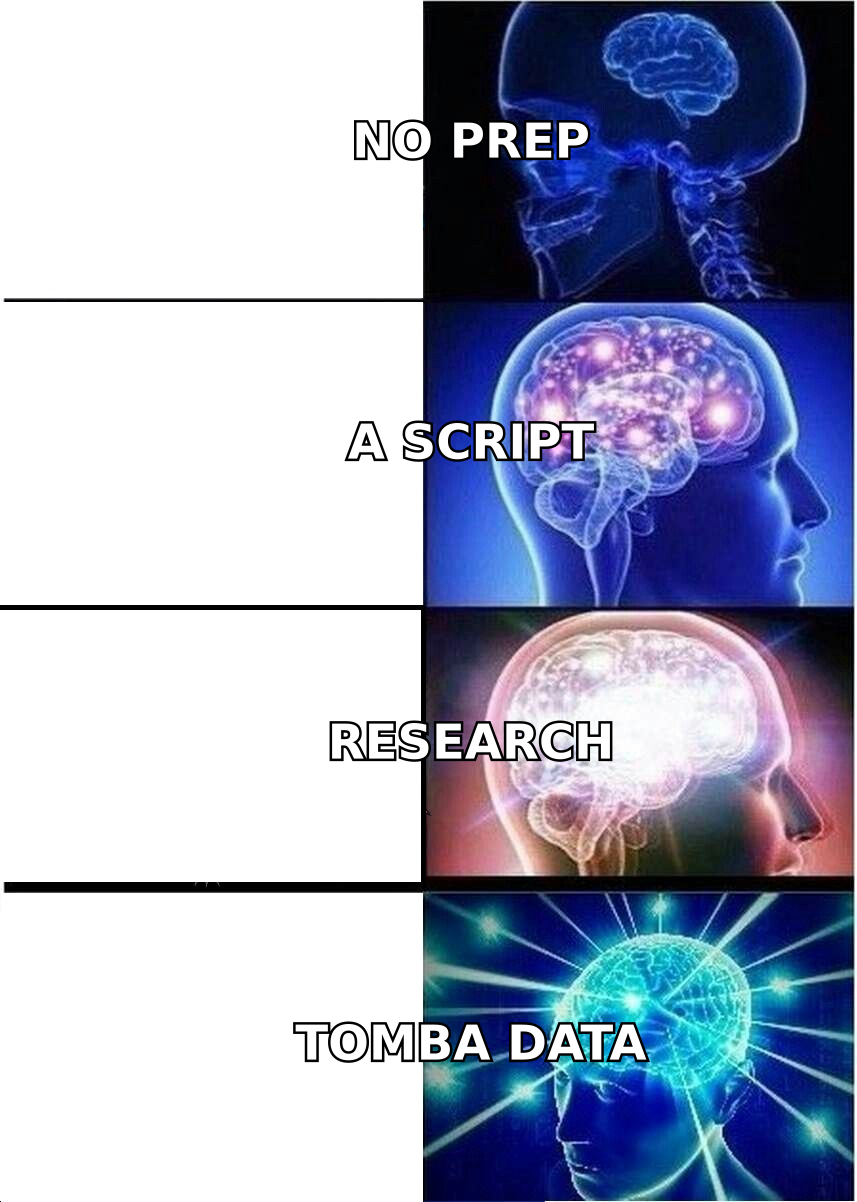
Yes — but only when the list is good. The phone still converts because it's synchronous: you get a human reaction in real time, something no cold email thread can match. The catch is that buyers screen aggressively, direct lines change often, and gatekeepers are better than ever.
Here's the honest math. If a cold caller dials 100 switchboard numbers scraped from a stale list, they might connect with 8 people and book zero. The same rep dialing 100 verified direct-dial mobile numbers of the right persona can connect with 25–30 and book 2–4 meetings. The activity looks identical on a dashboard. The outcome is not.
That gap is why the smartest teams stopped optimizing scripts first and started optimizing data first. According to HubSpot's sales research, reps spend a large chunk of their week just researching and finding contact info — time that clean data hands back to them.
What does a cold caller actually do all day?#
The day breaks into four repeating blocks. Miss any one and the numbers collapse.
- Build and prioritize the list — Segment accounts by ICP fit, gather direct-dial numbers, and confirm the contact still works there. This is where a B2B phone number source earns its keep.
- Research before dialing — Two minutes per prospect: recent trigger event, role, likely pain. A cold caller who opens with a relevant reason to call outperforms one reading a generic script.
- Dial in focused blocks — Batch 40–60 calls in a power hour. Momentum matters; stopping to research mid-block kills rhythm.
- Log, follow up, and enrich — Every call gets a next step. No-answers get an email or LinkedIn touch. CRM notes feed tomorrow's list.
The rep who treats calling as "just pick up the phone" burns their list. The rep who treats it as a research-plus-dial loop compounds results week over week.
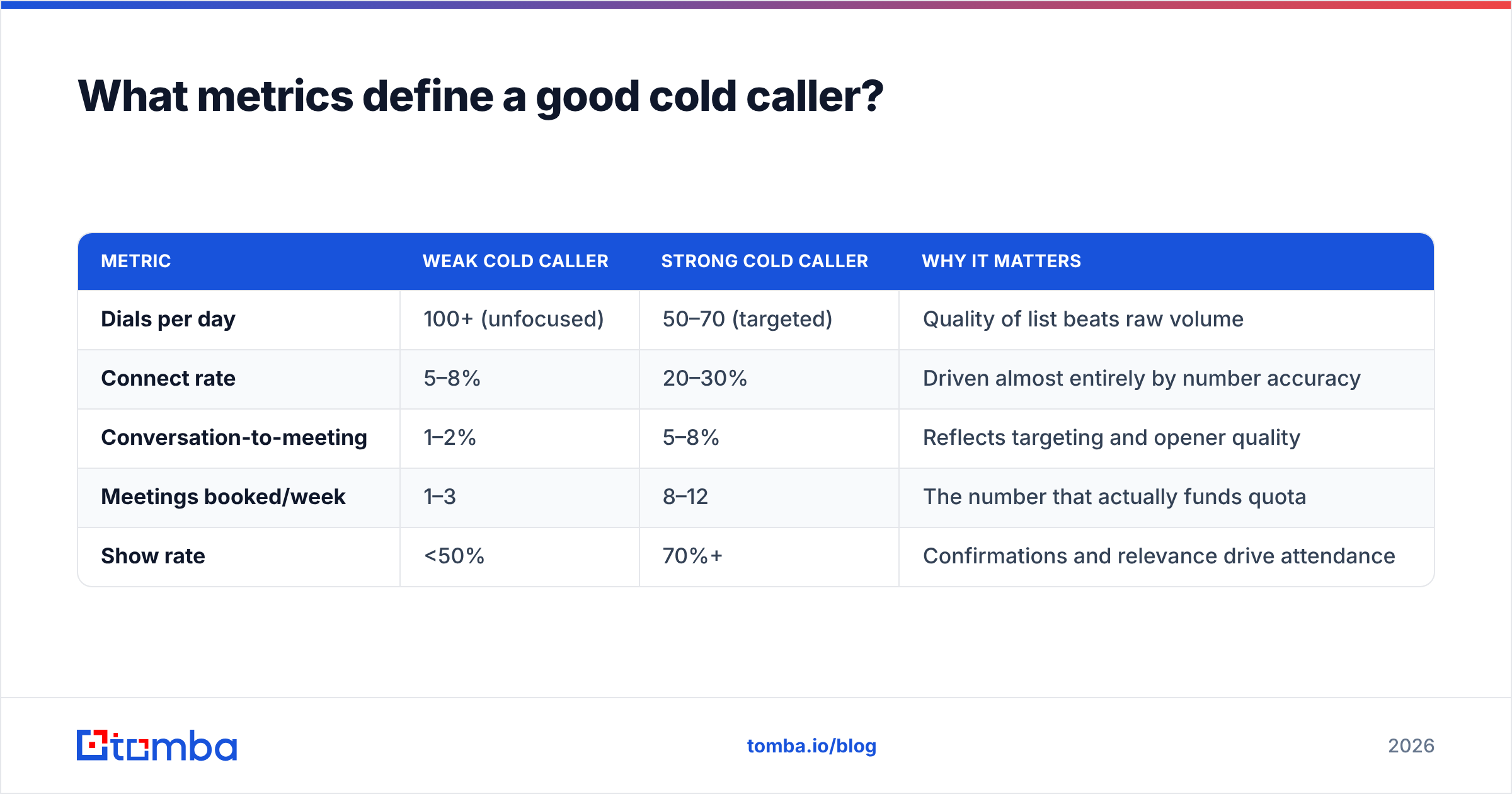
What metrics define a good cold caller?#
Activity volume is a vanity trap. Measure the funnel, not the effort.
| Metric | Weak cold caller | Strong cold caller | Why it matters |
|---|---|---|---|
| Dials per day | 100+ (unfocused) | 50–70 (targeted) | Quality of list beats raw volume |
| Connect rate | 5–8% | 20–30% | Driven almost entirely by number accuracy |
| Conversation-to-meeting | 1–2% | 5–8% | Reflects targeting and opener quality |
| Meetings booked/week | 1–3 | 8–12 | The number that actually funds quota |
| Show rate | <50% | 70%+ | Confirmations and relevance drive attendance |
Notice the pattern: the biggest lever is connect rate, and connect rate is a data problem before it's a skill problem. You cannot talk your way past a disconnected number. This is why a cold caller's toolkit now starts with verified contact data — accurate direct dials for the call, and verified emails for the follow-up sequence that catches everyone who didn't pick up.
What makes a cold call script that works?#
A good script is a flexible skeleton, not a word-for-word recital. Buyers can hear a read-aloud script instantly, and it tanks trust. Use this five-part frame and improvise the language.
- Pattern interrupt opener — "Hi Sarah, this is going to be a cold call — can I take 30 seconds and you can decide if it's worth continuing?" Honesty disarms the reflex to hang up.
- Relevant reason — Tie the call to a trigger: a new hire, a funding round, a tech-stack change. This is where pre-call research pays off.
- Problem-first pitch — Lead with the pain you solve, not your feature list. "Most VPs of Sales I talk to are frustrated their reps waste an hour a day hunting for phone numbers."
- One qualifying question — Get them talking. Their answer tells you whether to advance or exit gracefully.
- Clear, small ask — "Worth a 15-minute call Thursday?" A meeting, not a demo of your whole platform.
The best cold callers script the first 10 seconds tightly, then hold a loose map for the rest. For proven templates, browse the cold email templates library — the same messaging principles carry from email into your phone opener.
How do cold callers handle gatekeepers and objections?#
Gatekeepers aren't obstacles; they're routers. Treat them with respect and clarity: "I'm hoping you can help me — I'm trying to reach whoever owns your outbound sales process. Who would that be?" You'll get further than with a canned dodge.
For objections, don't argue — acknowledge and redirect:
- "We're not interested." → "Totally fair, most people say that before they know why I called. Can I give you one sentence?"
- "Send me an email." → "Happy to. So I send the right thing — is [specific problem] even on your radar this quarter?"
- "We already use a vendor." → "Makes sense. I'm not asking you to switch — just curious what's working and what isn't."
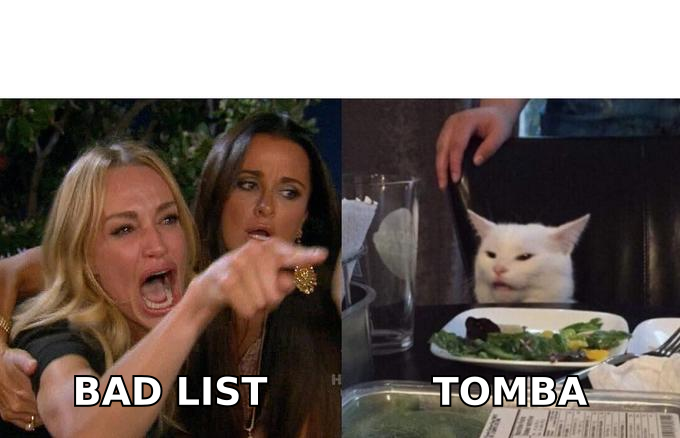
The rep who wins objections isn't the one with the cleverest comeback. It's the one who called the right person about a real problem — which loops back, again, to targeting and data.
What tools does a modern cold caller need?#
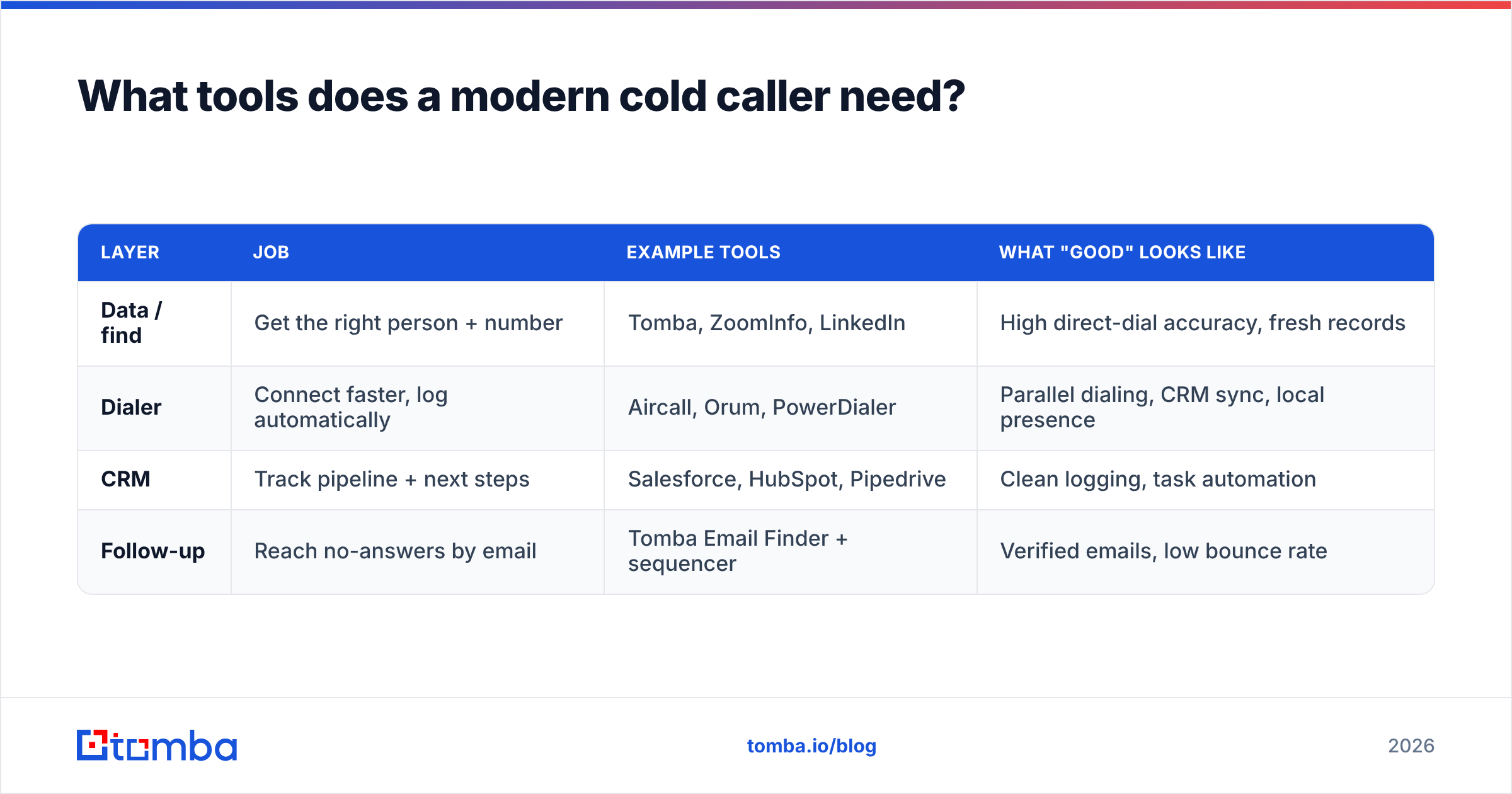
A cold caller's stack has three layers: find, dial, and follow up. Here's how the pieces fit, and where each matters.
| Layer | Job | Example tools | What "good" looks like |
|---|---|---|---|
| Data / find | Get the right person + number | Tomba, ZoomInfo, LinkedIn | High direct-dial accuracy, fresh records |
| Dialer | Connect faster, log automatically | Aircall, Orum, PowerDialer | Parallel dialing, CRM sync, local presence |
| CRM | Track pipeline + next steps | Salesforce, HubSpot, Pipedrive | Clean logging, task automation |
| Follow-up | Reach no-answers by email | Tomba Email Finder + sequencer | Verified emails, low bounce rate |
The mistake teams make is over-investing in dialers and CRMs while feeding them garbage data. A $150/seat parallel dialer pointed at bad numbers just wastes money faster. Fix the data layer first.
Tomba sits in the find-and-follow-up layers. It gives cold callers direct B2B phone numbers to dial and verified email addresses so the no-answer follow-up doesn't bounce. Compared with all-in-one platforms, it's a focused, affordable data source rather than a bundled suite you half-use. See Tomba pricing below for how the tiers line up.
How does data quality change a cold caller's results?#
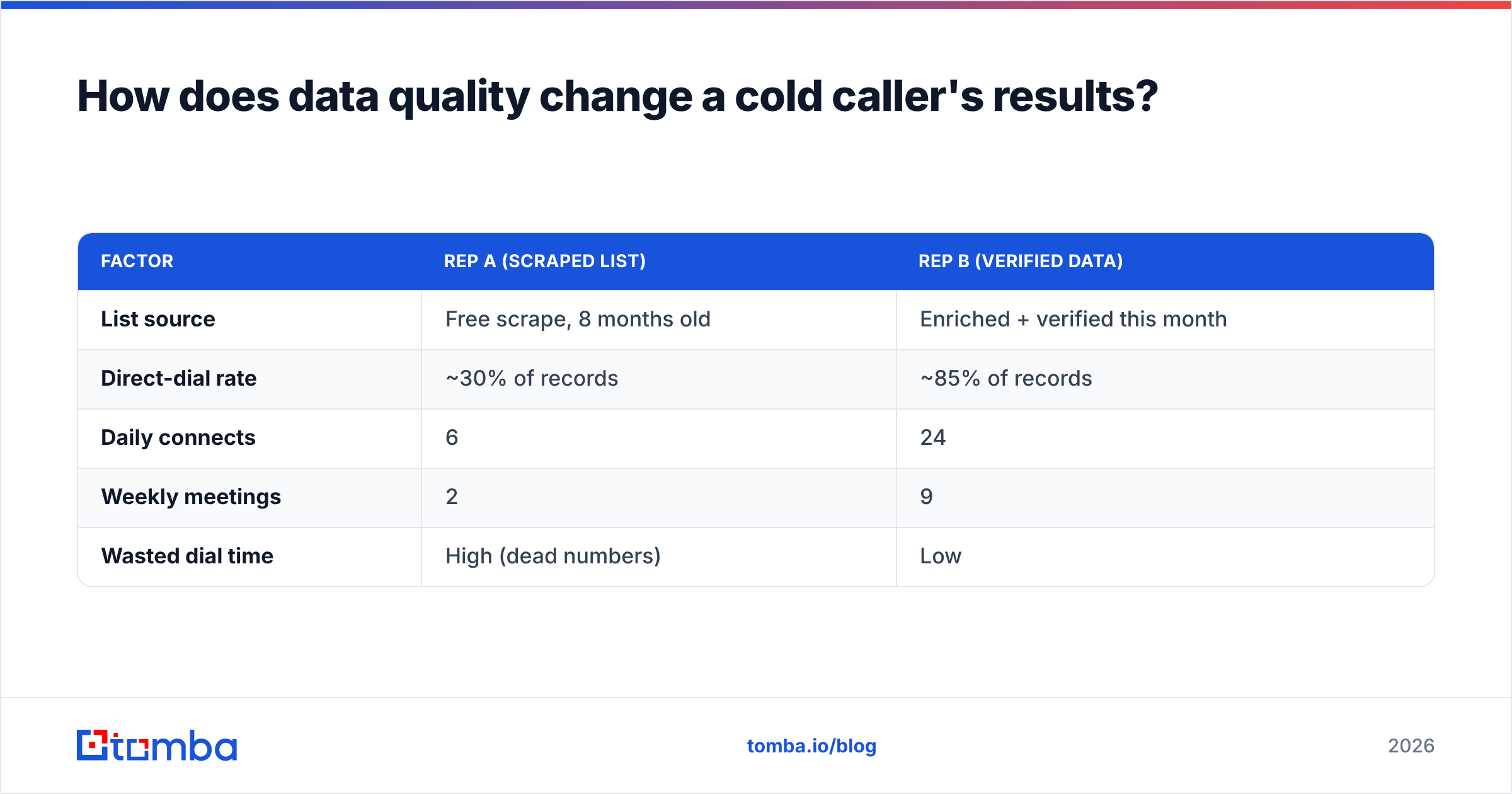
Data quality is the multiplier on every other skill. To make it concrete, compare two reps making identical effort with different inputs.
| Factor | Rep A (scraped list) | Rep B (verified data) |
|---|---|---|
| List source | Free scrape, 8 months old | Enriched + verified this month |
| Direct-dial rate | ~30% of records | ~85% of records |
| Daily connects | 6 | 24 |
| Weekly meetings | 2 | 9 |
| Wasted dial time | High (dead numbers) | Low |
Same script. Same tone. Same hours. The difference is entirely upstream. This is why a cold caller who invests in contact enrichment and phone verification will out-book a more charismatic rep working a dirty list — every single time.
If you're auditing your own numbers, start by measuring connect rate for one week. If it's under 15%, your problem isn't your pitch. It's your list.
What does a cold caller's pricing and ROI look like?#
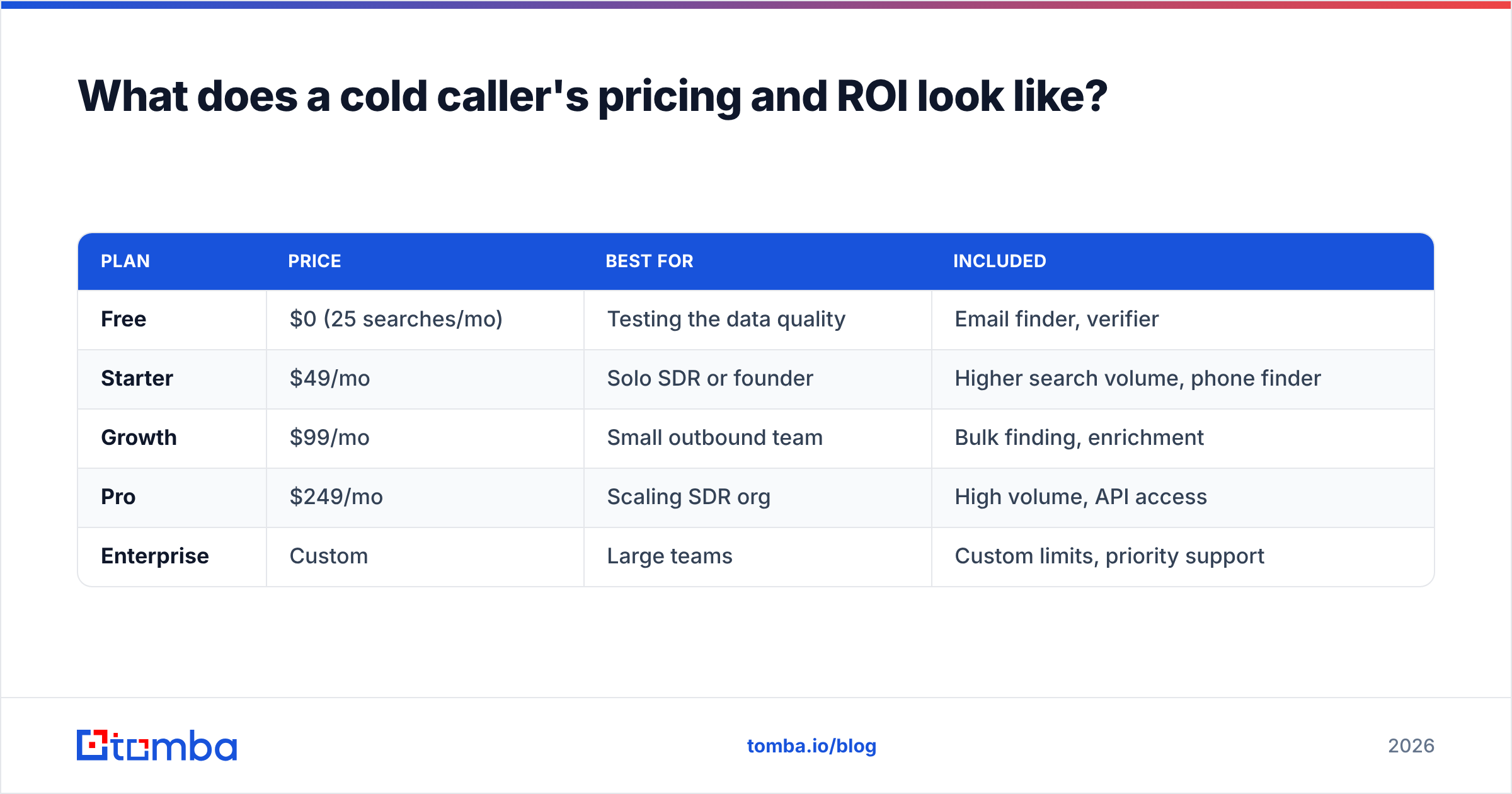
The tooling investment is small next to a rep's salary, and the ROI is easy to see once connect rate climbs. Here's how Tomba's plans map to cold-calling use, using accurate 2026 pricing.
| Plan | Price | Best for | Included |
|---|---|---|---|
| Free | $0 (25 searches/mo) | Testing the data quality | Email finder, verifier |
| Starter | $49/mo | Solo SDR or founder | Higher search volume, phone finder |
| Growth | $99/mo | Small outbound team | Bulk finding, enrichment |
| Pro | $249/mo | Scaling SDR org | High volume, API access |
| Enterprise | Custom | Large teams | Custom limits, priority support |
The math: if better data lifts a single rep from 2 to 8 meetings a week, and one in five meetings becomes a deal, the tool pays for itself many times over in the first month. For most cold callers, the Tomba plans at Starter or Growth are the sweet spot — enough volume to keep a call block fed without paying for an enterprise suite you won't fully use.
For a broader look at how vendors stack up on accuracy and value, third-party review sites like G2 are a useful, neutral starting point before you commit budget.
Common cold caller mistakes to avoid#
- Dialing without research. Two minutes of context beats twenty minutes of recovery mid-call.
- Reading the script robotically. Buyers hear it. Know your frame, then talk like a human.
- Ignoring the follow-up. Most connects happen after multiple touches. Pair calls with email and LinkedIn.
- Trusting a stale list. Records rot fast — people change jobs constantly. Re-verify before big campaigns.
- Measuring dials instead of meetings. Volume without connects is just noise.
- Skipping the CRM log. Untracked calls can't be improved or followed up.
The bottom line for cold callers in 2026#
A cold caller's success is a two-part equation: reach the right person, then say the right thing. Reps obsess over the second part and neglect the first — which is backward, because you can't deliver any pitch to a dead number. Fix your data, tighten your opener, measure connects, and the meetings follow.
Ready to feed your call block better numbers? Start with the Tomba Email Finder to build verified contact lists — and pair it with the phone finder so every cold caller on your team dials direct lines that actually ring, then follows up by verified email. The free tier lets you test the data quality on your own accounts before you commit a dollar. Better data is the cheapest performance upgrade a cold caller will ever buy.
Related guides#
// get started
Find, verify and enrich your first contacts today
Start on the free plan with 25 searches a month, then scale when your team is ready.
Free plan · No credit card required · GDPR & CCPA
// about the author