Cold Calling in 2026: Scripts, Data, and What Actually Works
Cold calling isn't dead in 2026 — but the spray-and-pray version is. Here's the data, scripts, and workflow that still book meetings, plus how to stop dialing dead numbers.
Cold calling gets declared dead every year, and every year a chunk of quota still gets closed on the phone. The truth is less dramatic than either camp wants: the tactic works, the lazy version of it doesn't, and the gap between the two is mostly about preparation and data quality — not charisma.
This guide covers what cold calling actually looks like in 2026: realistic benchmarks, a script framework you can adapt, the tech stack that supports it, and the unglamorous data work that decides whether you spend the day talking to prospects or listening to disconnected-number tones.
TL;DR#
- Cold calling is not dead — connect rates are lower than a decade ago, but a booked meeting from a call still converts better than most inbound channels.
- Bad data kills more calls than bad scripts. Wrong numbers, wrong titles, and stale records waste the majority of a rep's dial time.
- The winning motion is multi-touch: calls layered with email and LinkedIn, not calls in isolation.
- A good script is a spine, not a cage — an opener, a permission ask, a value hypothesis, and one clear next step.
- Verified contact data is the highest-leverage fix. Clean phone numbers and current titles raise connect rates before you change a single word of your pitch.
Is cold calling dead in 2026?#
Short answer: no, but the economics have shifted. You have to dial more to connect, and the prospects who pick up are more guarded than they were when a phone number meant a desk phone someone was sitting next to.
Two things changed. First, mobile replaced the desk phone, so "reaching the office" no longer means reaching the person. Second, buyers now research before they talk — by the time you call, they may already know three competitors. That doesn't remove the phone's advantage; it changes what the call is for. Cold calling in 2026 wins as a way to start a conversation and qualify fast, not to deliver a full pitch to a captive listener.
The channel also still does something email can't: it gets a real-time reaction. You learn in ninety seconds whether there's a problem worth solving, who else is involved, and what the objection will be. That intelligence feeds every other touch in your sequence.
What are realistic cold calling benchmarks?#
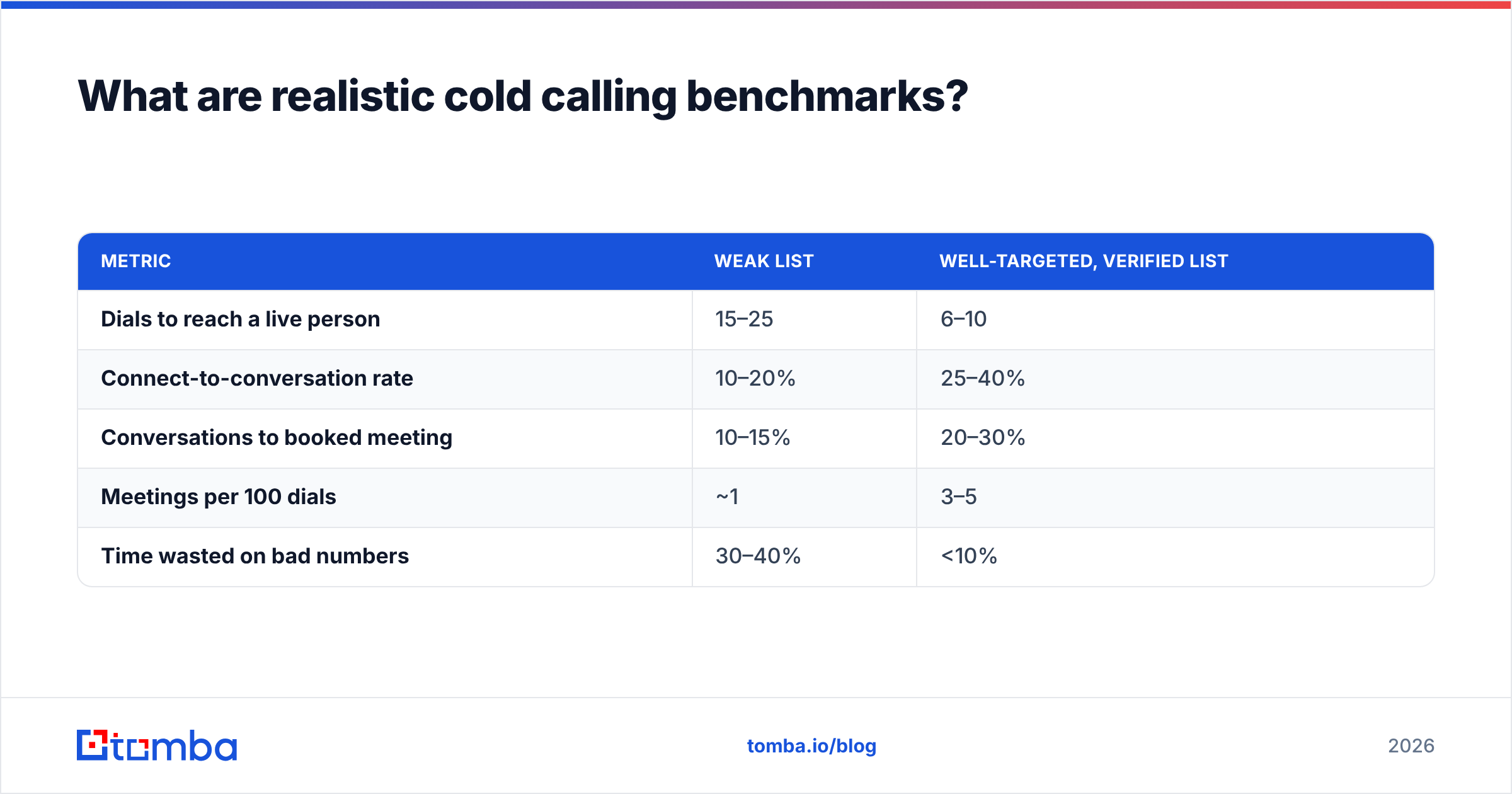
Benchmarks vary wildly by industry, seniority, and list quality, so treat any single number with suspicion. That said, here's a grounded frame for B2B SaaS-style outbound in 2026:
| Metric | Weak list | Well-targeted, verified list |
|---|---|---|
| Dials to reach a live person | 15–25 | 6–10 |
| Connect-to-conversation rate | 10–20% | 25–40% |
| Conversations to booked meeting | 10–15% | 20–30% |
| Meetings per 100 dials | ~1 | 3–5 |
| Time wasted on bad numbers | 30–40% | <10% |
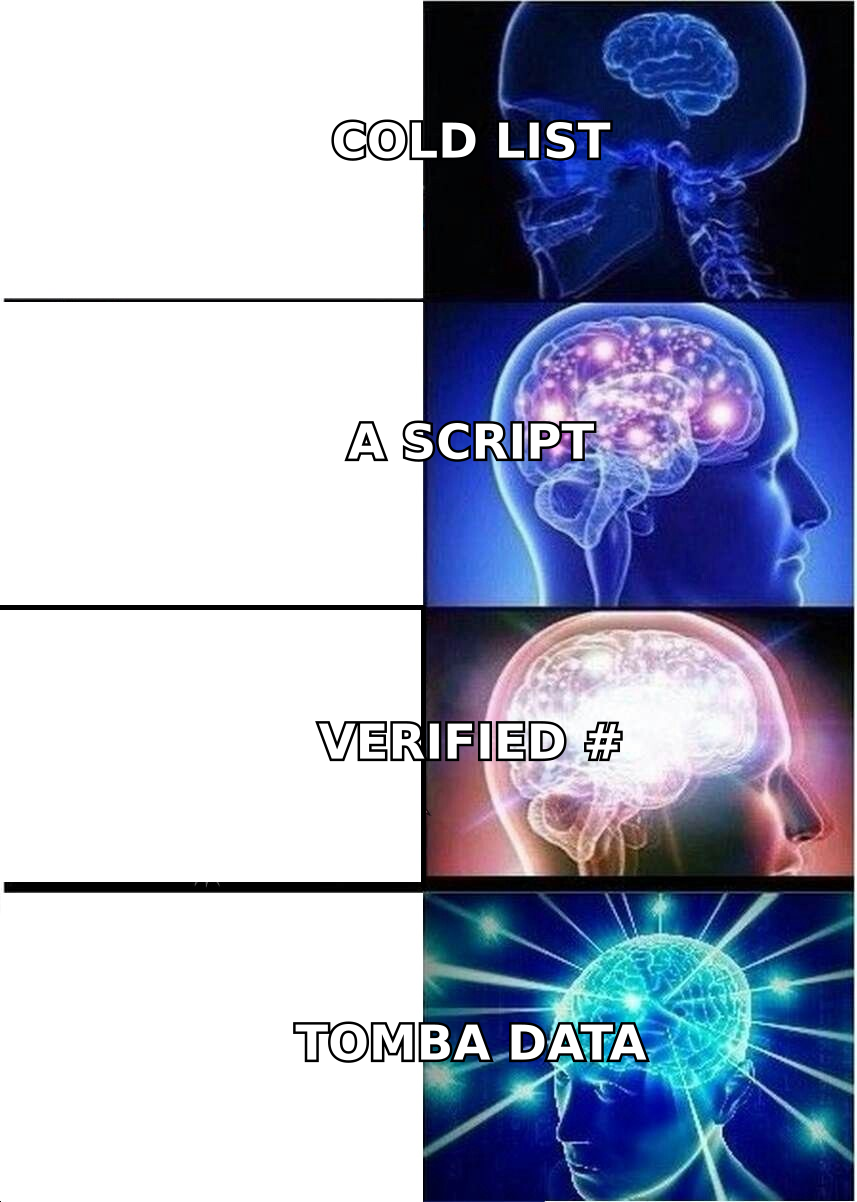
The single biggest lever in that table isn't the script — it's the difference between the two columns, which is almost entirely data quality. A rep working a verified list of the right people at the right accounts can produce three to five times the meetings per dial of a rep grinding a scraped, unverified list, using the exact same words.
That's the uncomfortable part of cold calling: the skill ceiling is real, but most teams are nowhere near it because they're spending 30–40% of their day on numbers that never had a chance. For a deeper breakdown of how outreach performance is measured, HubSpot's sales statistics collect a broad set of channel benchmarks worth calibrating against.
What does a cold calling script look like that actually works?#
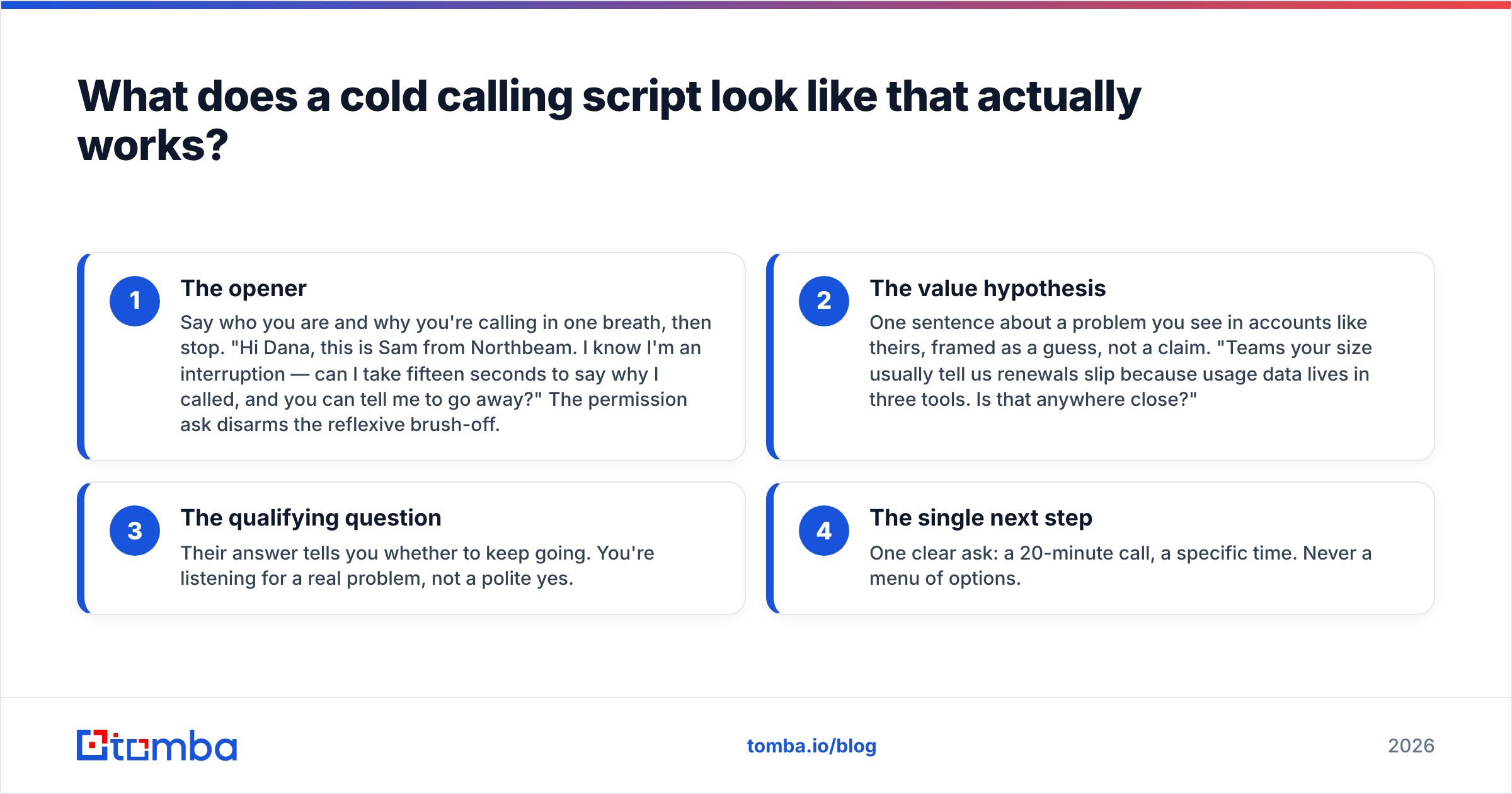
A good script is a spine you can flex, not a paragraph you read. The best ones have four moves:
- The opener — Say who you are and why you're calling in one breath, then stop. "Hi Dana, this is Sam from Northbeam. I know I'm an interruption — can I take fifteen seconds to say why I called, and you can tell me to go away?" The permission ask disarms the reflexive brush-off.
- The value hypothesis — One sentence about a problem you see in accounts like theirs, framed as a guess, not a claim. "Teams your size usually tell us renewals slip because usage data lives in three tools. Is that anywhere close?"
- The qualifying question — Their answer tells you whether to keep going. You're listening for a real problem, not a polite yes.
- The single next step — One clear ask: a 20-minute call, a specific time. Never a menu of options.
Notice what's missing: a feature dump. On a cold call you are earning the right to a second conversation, not closing. Keep the pitch small. If you want a structured way to build and test openers, tools like a cold email AI writer are useful for drafting parallel messaging that reinforces the call, since your phone opener and your email subject line should tell the same story.
How does cold calling fit with email and LinkedIn?#
The phone is one instrument, not the whole band. The teams booking the most meetings run multi-touch sequences where a call is one of six to ten touches across channels, timed so the prospect sees your name more than once before you catch them live.
A typical week-one cadence:
- Day 1 — Connection request on LinkedIn (no pitch) + a short intro email.
- Day 2 — First call attempt. If no answer, leave a 12-second voicemail referencing the email.
- Day 4 — Value email with one concrete proof point.
- Day 5 — Second call, different time of day.
- Day 8 — LinkedIn comment or DM referencing something they posted.
The calls convert better because the prospect has already seen your name three times. This is where LinkedIn outreach and phone work compound instead of competing. Salesforce's guidance on cold calling technique makes the same point: the call rarely stands alone anymore.
What's the tech stack for cold calling in 2026?#
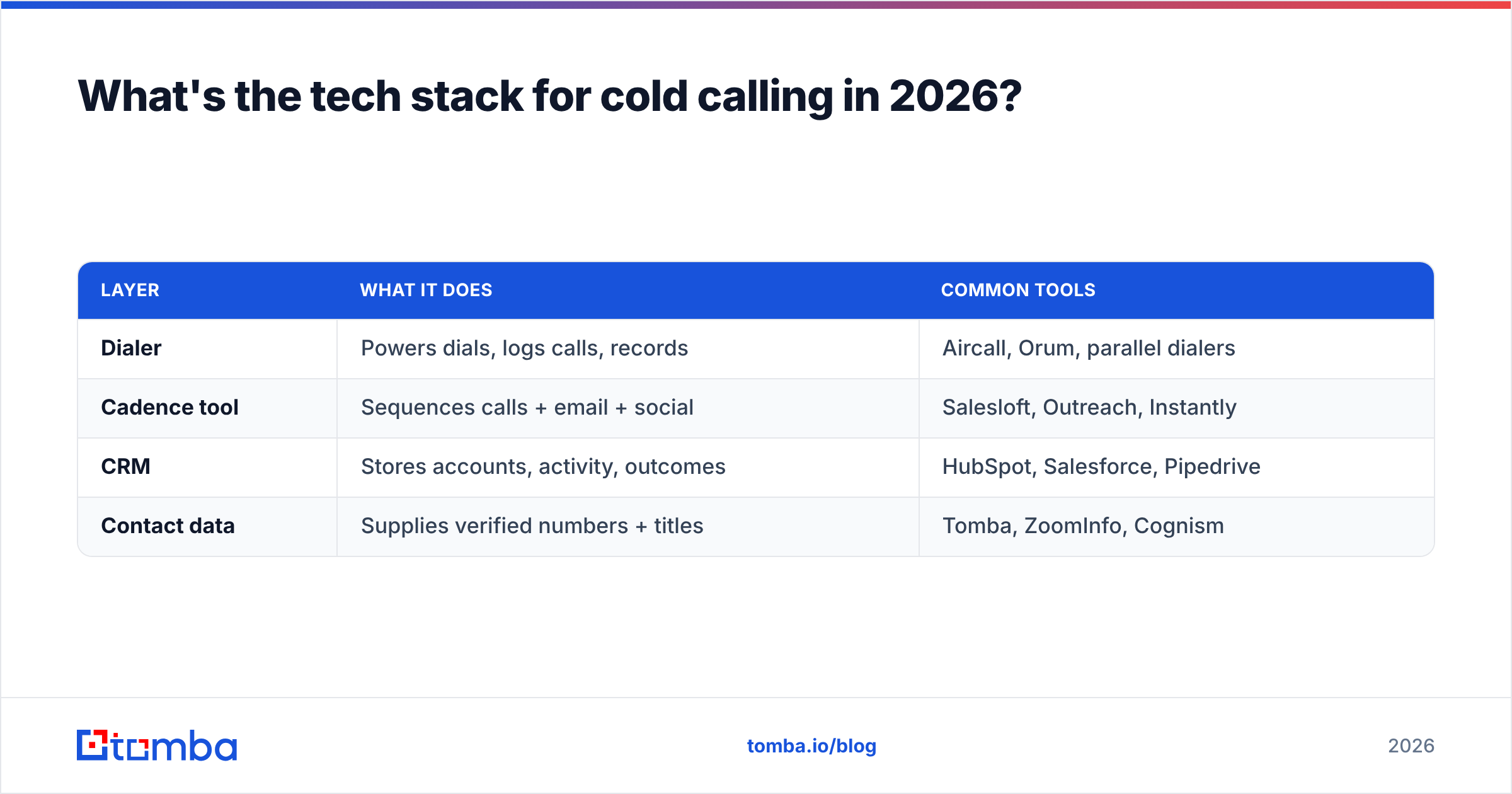
You need four layers, and most teams over-invest in the first and under-invest in the last:
| Layer | What it does | Common tools |
|---|---|---|
| Dialer | Powers dials, logs calls, records | Aircall, Orum, parallel dialers |
| Cadence tool | Sequences calls + email + social | Salesloft, Outreach, Instantly |
| CRM | Stores accounts, activity, outcomes | HubSpot, Salesforce, Pipedrive |
| Contact data | Supplies verified numbers + titles | Tomba, ZoomInfo, Cognism |
Here's the pattern worth internalizing: teams pour money into a parallel dialer to increase dial volume, then feed it a dirty list. A faster dialer pointed at bad numbers just reaches voicemail faster. The order of operations should be fix the data first, then scale the dialing. You can compare where different providers source their records — Tomba documents its data sources publicly, which is a fair question to ask any vendor before you trust a number to a rep's day. Independent reviews on G2 are a useful cross-check on accuracy claims.
How do you get accurate phone numbers for cold calling?#
This is the part most guides skip, and it's the part that actually moves your numbers. A cold calling program is only as good as the contact records feeding it, and records decay fast — people change jobs, direct lines get reassigned, and titles shift every quarter.
A practical workflow:
- Build the target list by role and account, not by "everyone at these companies." Fewer, more-relevant contacts beat a bigger dumping ground every time.
- Enrich each contact with a verified direct or mobile number. A phone finder turns a name and company into a callable number, and a phone validator confirms the line is live before a rep dials it.
- Confirm the title and company are current. Calling someone about a problem they no longer own is worse than not calling — it burns the account. Layer in data enrichment to keep records fresh.
- Pair the phone with a verified email so the multi-channel cadence above actually lands. The email finder and companion email verifier close that loop.
Do this and the "well-targeted, verified list" column of the earlier benchmark table stops being aspirational. The rep isn't smarter; they're just not wasting two-thirds of the day on numbers that were never going to connect.
How do you handle the most common cold call objections?#
Objections aren't rejections — they're the fastest data you'll get all day. Three you'll hear constantly:
- "I'm busy right now." — Believe them. "Totally fair — I'll be quick or I'll book two minutes later. Which is easier?" You're giving control back, which lowers the guard.
- "Just send me an email." — Often a soft brush-off. Convert it into a micro-commitment: "Happy to. So I send the right thing — is [specific problem] the one that matters, or is it something else?" Now you've qualified even if they hang up.
- "We already use [competitor]." — Good. They have budget and a category fit. "Makes sense, they're solid. Most teams who switch to us do it because of [one specific gap] — is that ever a headache for you?"
The through-line: never argue, always ask one more question. A cold call you "lose" gracefully still leaves the door open for the email and LinkedIn touches in your cadence.
How do you measure and improve a cold calling program?#
Track leading indicators, not just meetings booked, or you'll be flying blind for weeks at a time. The four that matter:
- Dials per connect — rising numbers usually mean list decay, not rep fatigue. Check the data first.
- Connect-to-conversation rate — this is your opener quality. Test one variable at a time.
- Conversation-to-meeting rate — this is your qualifying and next-step ask.
- Meeting show rate — a booked meeting nobody attends means you booked the wrong person, which loops back to targeting.
When dials-per-connect climbs, resist the urge to rewrite the script. Nine times out of ten the fix is upstream in the data. Refresh the list, re-verify the numbers, and re-check titles before you touch a word of the pitch. Your win rate at the top of the funnel is set long before the call connects.
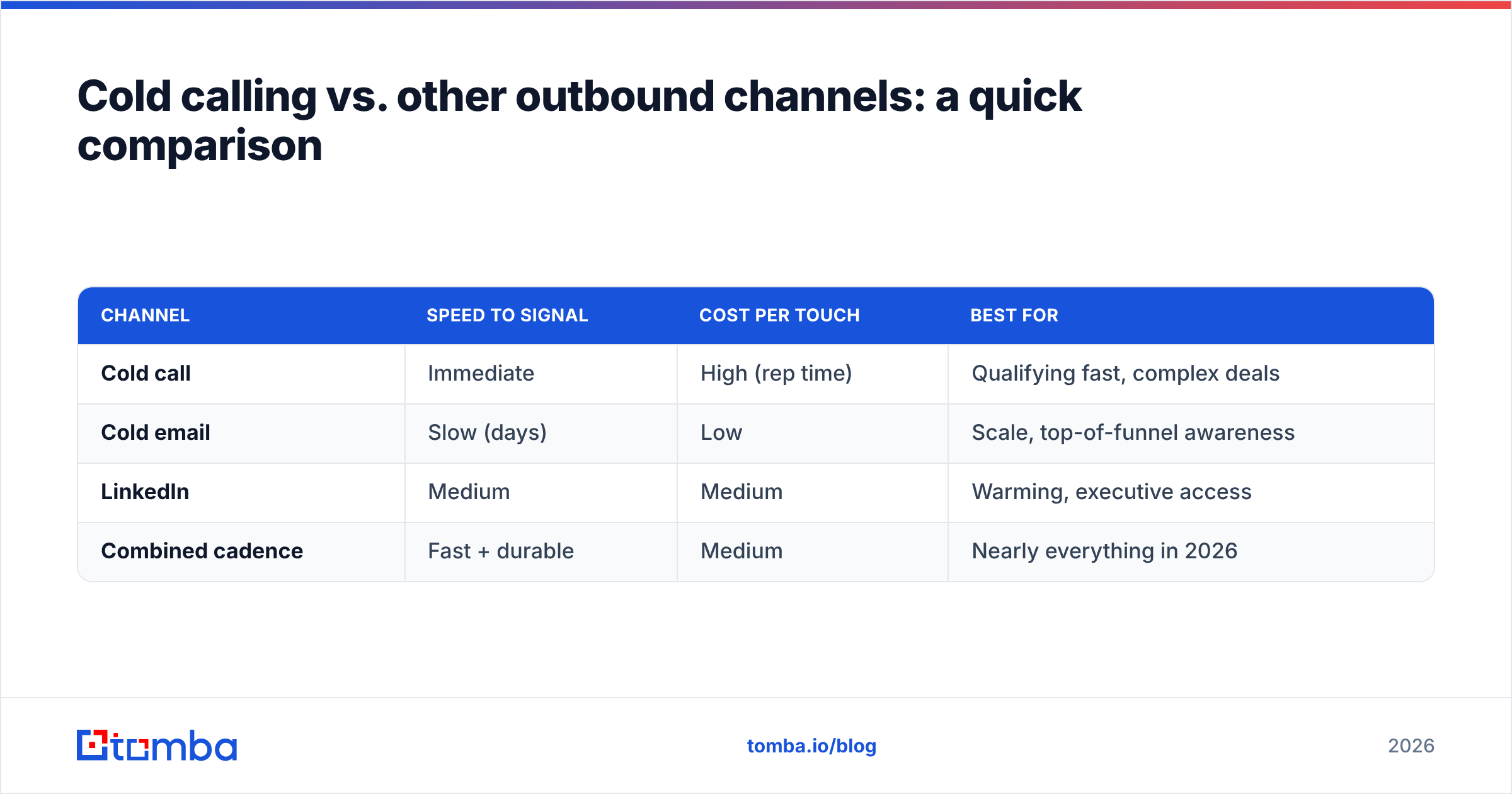
Cold calling vs. other outbound channels: a quick comparison#
| Channel | Speed to signal | Cost per touch | Best for |
|---|---|---|---|
| Cold call | Immediate | High (rep time) | Qualifying fast, complex deals |
| Cold email | Slow (days) | Low | Scale, top-of-funnel awareness |
| Medium | Medium | Warming, executive access | |
| Combined cadence | Fast + durable | Medium | Nearly everything in 2026 |
The takeaway isn't "calling beats email" or the reverse. It's that in 2026 the channels are complements, and the connective tissue between all of them is accurate contact data. Whether a rep is dialing, emailing, or messaging, they're acting on the same record — and if that record is wrong, every channel underperforms at once.
The bottom line#
Cold calling in 2026 rewards the teams that treat it as a data problem first and a talking problem second. The script matters, the objection handling matters, the cadence matters — but all of it sits on top of whether you're calling the right person at the right number about the right problem. Get that layer right and the same rep, with the same words, books three to five times the meetings.
If your reps are burning the day on dead numbers and stale titles, fix that before you buy a faster dialer. Start by building verified target lists with the Tomba Email Finder and pairing it with the phone finder so every dial reaches a live, correctly-titled prospect. You can see full plan details on the Tomba pricing page — the free tier gives you 25 searches a month to test the data quality before you commit. Clean data won't write your script, but it will make sure the person on the other end is worth the call.
Related guides#
// get started
Find, verify and enrich your first contacts today
Start on the free plan with 25 searches a month, then scale when your team is ready.
Free plan · No credit card required · GDPR & CCPA
// about the author