Cold Calling Advice for 2026: Scripts, Timing, and Data
Most cold calling advice is recycled myth. Here's what actually moves connect and conversion rates in 2026 — backed by data, scripts, and timing you can test this week.
Cold calling is not dead. Bad cold calling is dead. The reps who still book meetings on the phone in 2026 aren't smoother talkers — they prepare better, dial smarter, and treat every call as a data point instead of a coin flip. This guide is the cold calling advice that survives contact with a real dial list.
TL;DR#
- Connect rates live or die on data quality. A verified direct-dial list beats a bigger list of switchboard numbers every time. Clean your list before you touch the phone.
- The first 8 seconds decide the call. Lead with a permission-based opener, name the reason you called, and stop pitching.
- Timing is measurable, not mystical. Mid-morning and late afternoon in the prospect's local time still outperform — but your own data beats any blog's averages.
- Volume without research is noise. 40 well-prepped dials outperform 120 blind ones on meetings booked.
- Track everything. Connect rate, conversation rate, and meeting rate are three different numbers. Fix the weakest one.
Is cold calling still worth it in 2026?#
Yes — for the right motion. Cold calling remains one of the fastest ways to reach mid-market and enterprise buyers who ignore email and screen LinkedIn requests. The catch is that the phone is now a complement to a multi-channel sequence, not a standalone channel.
Buyers changed. Direct dials replaced desk phones, spam-labeling got aggressive, and gatekeepers moved from front desks to voicemail and mobile screening. That means the old "smile and dial 200 numbers" playbook burns your list and your morale. The modern version is lower-volume, higher-context, and tightly integrated with your CRM and email.
If you sell a considered B2B product with a real buying committee, cold calling still earns its place. If you sell self-serve software at $15/month, it probably doesn't. Match the channel to the deal size.
What is the biggest cold calling mistake reps make?#
Calling before they've done the two minutes of prep that make the call worth taking. The single largest lever in cold calling advice isn't tonality or objection handling — it's who you dial and what you know about them before they pick up.
Three failures show up constantly:
- Dialing bad numbers. Half of most purchased lists are wrong, disconnected, or route to a switchboard. Every bad number is a dial that could never convert.
- No pre-call research. Reps who can't name why this company, this week, sound like every other caller — and get treated like every other caller.
- Pitching in the opener. Launching into a value prop before earning 20 seconds of attention triggers the instant "not interested" reflex.
Fix data first. A rep with a verified direct-dial list and a one-line reason to call will out-book a "natural" with a garbage list, every quarter. This is where tooling matters: use a phone finder to source direct dials and a phone validator to strip dead numbers before you ever pick up the handset.
How do you write a cold call opener that works?#
Earn the next 20 seconds — don't spend them. A strong opener does three things in order: identifies you plainly, asks permission, and gives a specific, prospect-centered reason for the call.
A framework that holds up:
- Pattern interrupt, honest version: "Hi Dana, this is Sam from Acme — I know I'm an interruption, can I take 30 seconds to tell you why I called, and you can decide if it's worth continuing?" Permission openers consistently beat "How are you today?" because they respect the prospect's time and signal you're not a robocall.
- Name the trigger: Reference something real — a hire, a funding round, a job posting, a product launch. "I saw you're hiring three SDRs this quarter" beats "We help companies like yours."
- Stop talking. After your reason, ask a short question and let silence do the work.
Avoid the classic traps: no "Did I catch you at a bad time?" (you're inviting a yes-exit), no rambling value prop, no reading a script so rigidly you can't respond to a human.
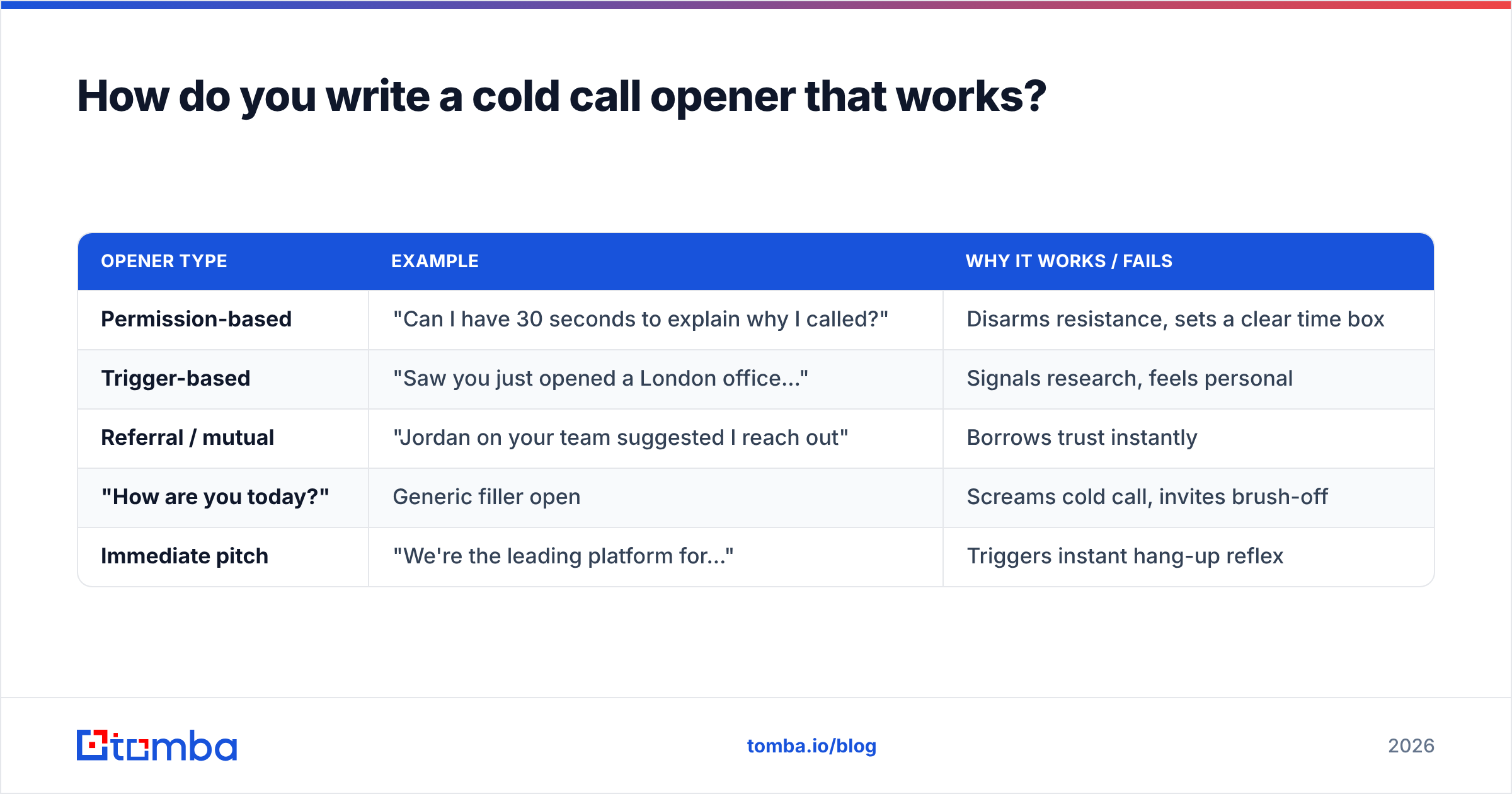
Here's a compact opener comparison you can steal:
| Opener type | Example | Why it works / fails |
|---|---|---|
| Permission-based | "Can I have 30 seconds to explain why I called?" | Disarms resistance, sets a clear time box |
| Trigger-based | "Saw you just opened a London office…" | Signals research, feels personal |
| Referral / mutual | "Jordan on your team suggested I reach out" | Borrows trust instantly |
| "How are you today?" | Generic filler open | Screams cold call, invites brush-off |
| Immediate pitch | "We're the leading platform for…" | Triggers instant hang-up reflex |
When is the best time to make cold calls?#
The best time is when your prospects actually answer — and the only reliable way to know that is to measure your own dials. That said, aggregate data gives you a sane starting point:
- Mid-morning (10–11:30 a.m. local) catches people after inbox triage but before lunch.
- Late afternoon (4–5 p.m. local) catches them winding down and more willing to talk.
- Tuesday through Thursday generally outperform Mondays (chaos) and Fridays (checked out).
- Local time zone matters more than the clock. A 9 a.m. call to a West Coast prospect from an East Coast rep lands at 6 a.m. — dead on arrival.
Treat these as hypotheses, not gospel. Log the timestamp and outcome of every dial for a month, then look at your connect rate by hour and day. Your territory, industry, and persona will shift the peaks. The rep who tracks beats the rep who guesses.
One more timing note: speed-to-lead crushes calendar optimization. A call within five minutes of an inbound signal — a demo request, a pricing-page visit, a content download — converts dramatically better than any "optimal Tuesday" cold dial. If you can catch website visitor reveal signals and call fast, do that before you touch the cold list.
How many cold calls should you make per day?#
Enough to hit your conversation target — not a vanity dial count. The right cold calling advice ties activity to outcomes, not to a round number on a whiteboard.
Work backward from meetings:
- If you need 8 meetings a week and your data says 1 in 5 conversations books, you need 40 conversations.
- If your connect rate is 20%, 40 conversations means ~200 connects' worth of dials — but with clean direct dials, connect rates climb well past 20%, cutting the dials required.
That's the whole argument for data quality in one calculation: better numbers mean fewer dials for the same meetings. A rep making 60 researched dials on verified direct lines can beat a rep making 150 dials on a switchboard list — with less burnout and a healthier phone reputation.
Set a floor for consistency (say, 50 dials or 90 talk-minutes a day), but manage to conversations and meetings. Raw dial count is a coaching input, not a goal.
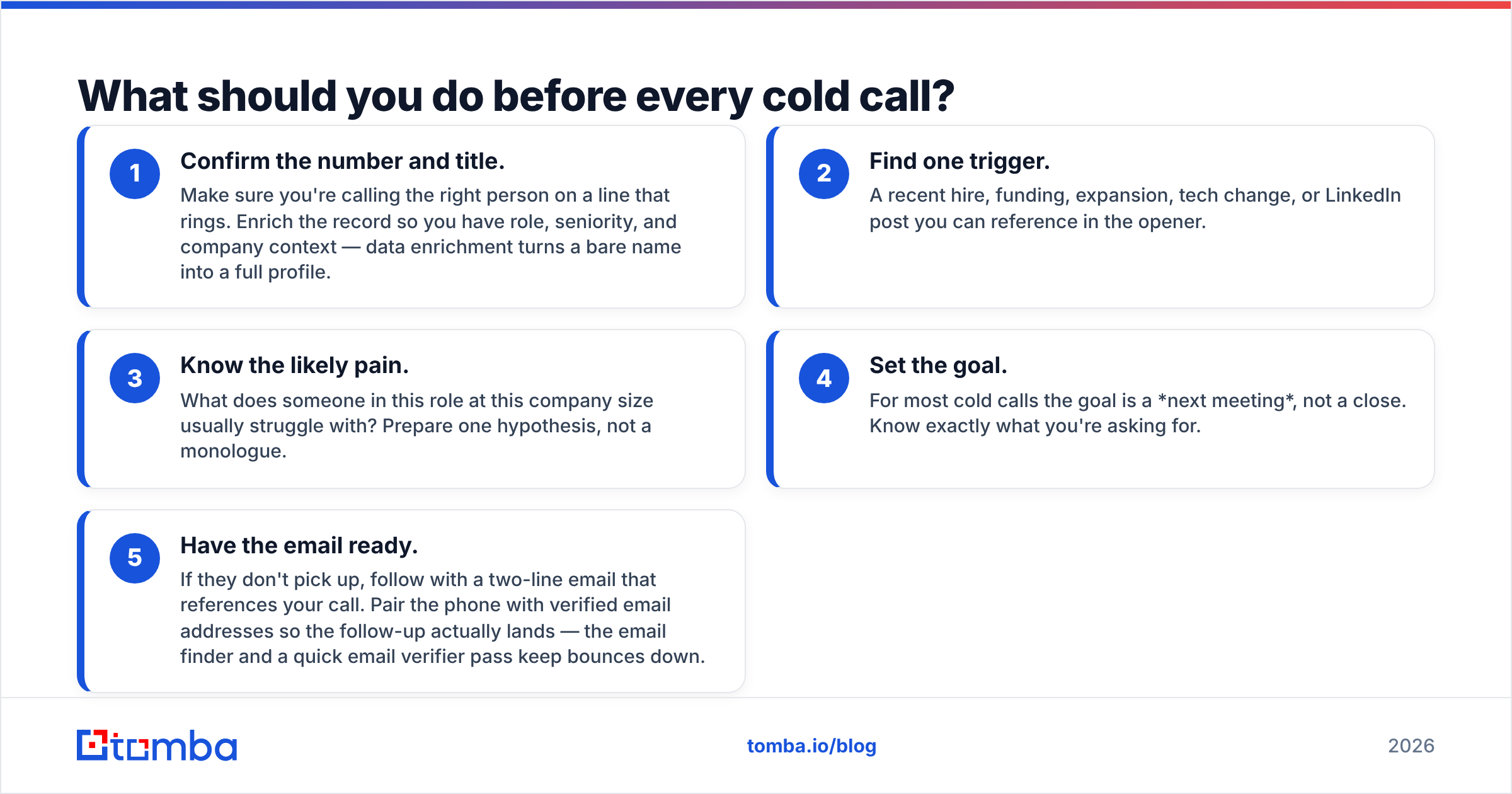
What should you do before every cold call?#
Spend two minutes turning a stranger into a specific person. Pre-call research is the difference between "spray and pray" and a conversation the prospect actually wants to have.
Your two-minute checklist:
- Confirm the number and title. Make sure you're calling the right person on a line that rings. Enrich the record so you have role, seniority, and company context — data enrichment turns a bare name into a full profile.
- Find one trigger. A recent hire, funding, expansion, tech change, or LinkedIn post you can reference in the opener.
- Know the likely pain. What does someone in this role at this company size usually struggle with? Prepare one hypothesis, not a monologue.
- Set the goal. For most cold calls the goal is a next meeting, not a close. Know exactly what you're asking for.
- Have the email ready. If they don't pick up, follow with a two-line email that references your call. Pair the phone with verified email addresses so the follow-up actually lands — the email finder and a quick email verifier pass keep bounces down.
This prep is also what makes multi-channel work. The phone, the email, and the LinkedIn touch should reference each other. A prospect who got your call, then a relevant email, then a thoughtful connection request remembers you — a prospect hit with three generic templates blocks you.
How do you handle cold call objections?#
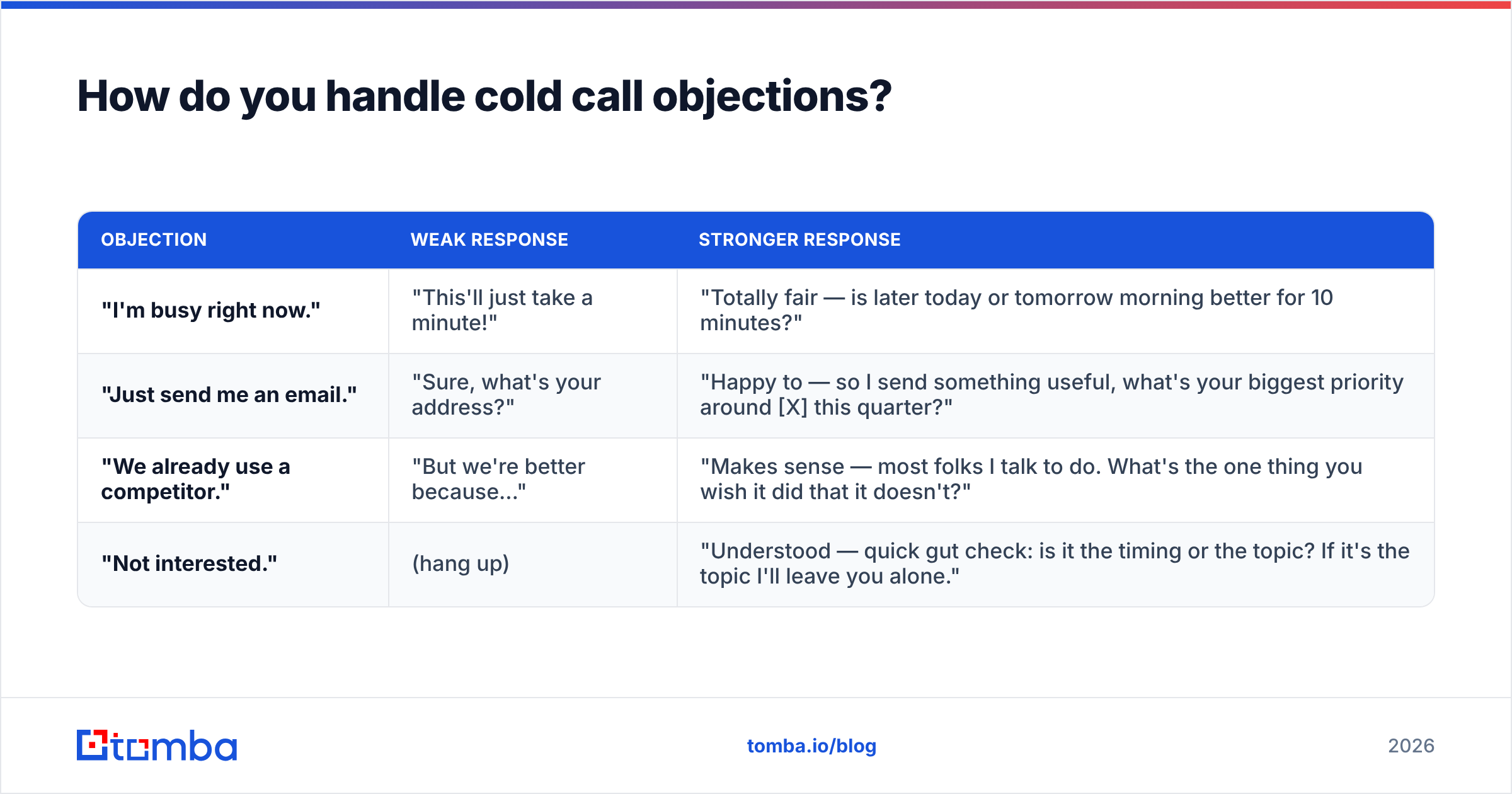
Acknowledge, reframe, and ask — don't argue. Objections in the first 20 seconds are usually reflexes, not real positions. Your job is to keep the conversation alive long enough to reach a real one.
Common early objections and clean responses:
| Objection | Weak response | Stronger response |
|---|---|---|
| "I'm busy right now." | "This'll just take a minute!" | "Totally fair — is later today or tomorrow morning better for 10 minutes?" |
| "Just send me an email." | "Sure, what's your address?" | "Happy to — so I send something useful, what's your biggest priority around [X] this quarter?" |
| "We already use a competitor." | "But we're better because…" | "Makes sense — most folks I talk to do. What's the one thing you wish it did that it doesn't?" |
| "Not interested." | (hang up) | "Understood — quick gut check: is it the timing or the topic? If it's the topic I'll leave you alone." |
Notice the pattern: every strong response validates the prospect, then asks a question that reopens the dialogue. You're not overcoming objections by force; you're finding out whether there's a real opportunity underneath the reflex.
And when there genuinely isn't — disqualify fast and move on. Time spent convincing a hard no is time stolen from your next real conversation.
What metrics should you track for cold calling?#
Track three rates, because they diagnose three different problems. Lumping them into "call activity" hides where you're actually losing deals.
- Connect rate = connects ÷ dials. Low connect rate is almost always a data problem — wrong numbers, bad timing, or switchboard lines. Fix the list.
- Conversation rate = real conversations ÷ connects. Low here is an opener problem — you're connecting but getting brushed in the first 10 seconds. Fix the script.
- Meeting rate = meetings booked ÷ conversations. Low here is a qualification or value problem — you're talking but not compelling. Fix the pitch and targeting.
Layer in talk time, best-performing time slots, and objection frequency, and you have a coaching dashboard. Review it weekly. The rep who knows their exact conversation-to-meeting ratio can improve it; the rep who only knows "I made a lot of calls" can't.
For deeper benchmarks on what "good" looks like across B2B teams, industry resources like G2 and vendor research from HubSpot publish updated cold calling and prospecting stats worth sanity-checking against your own numbers.
Cold calling advice at a glance#
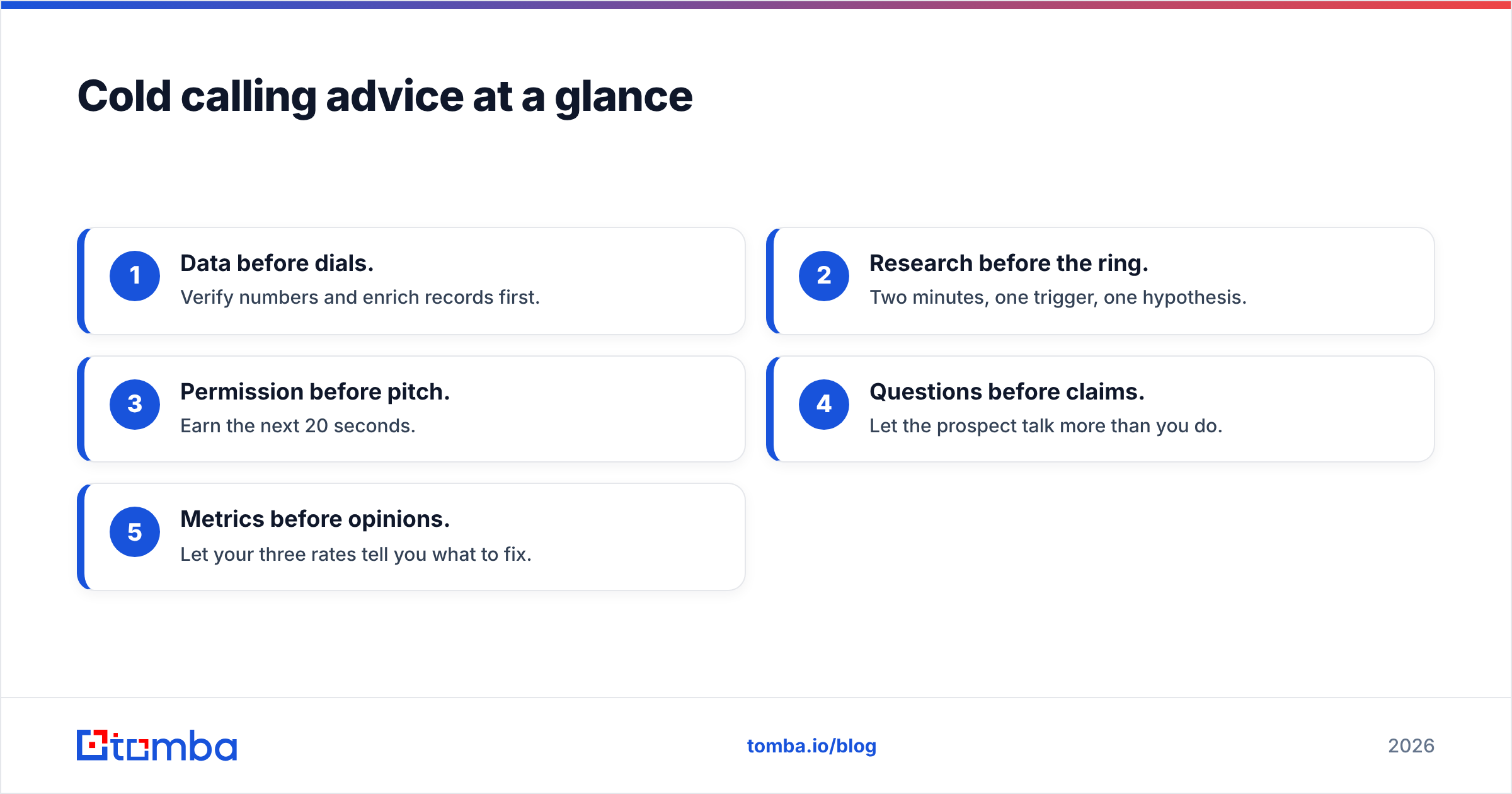
If you remember nothing else, remember this order of operations:
- Data before dials. Verify numbers and enrich records first.
- Research before the ring. Two minutes, one trigger, one hypothesis.
- Permission before pitch. Earn the next 20 seconds.
- Questions before claims. Let the prospect talk more than you do.
- Metrics before opinions. Let your three rates tell you what to fix.
Everything else — tonality, cadence, the perfect Tuesday — is optimization on top of these fundamentals. Get the fundamentals right and the rest compounds.
Where does Tomba fit in your cold calling stack?#
The phone converts when the number is right and the context is real. That starts upstream of the call. Use the Tomba Email Finder to build accurate contact records, pair it with direct dials from the phone finder, verify before you dial, and enrich each record so every opener has a trigger to reference. Clean data means higher connect rates, fewer wasted dials, and follow-up emails that actually land in the inbox.
Start on the free tier (25 searches a month), then scale to Starter at $49/mo or Growth at $99/mo as your list grows. Whatever cold calling advice you apply from this guide, apply it to a verified list — that's the multiplier that makes all the rest work.
Related guides#
Ready to find emails that actually work?
Join 150,000+ professionals who stopped guessing and started sending. Free credits on signup — no credit card required.
Get the Tomba newsletter
Practical outbound tactics and product updates — once every two weeks.
About the author