Cold Calling and Prospecting in 2026: A No-Fluff Playbook
Cold calling isn't dead — sloppy prospecting is. Here's the data, the scripts, and the exact research-to-dial workflow that books meetings in 2026 without torching your list.
Cold calling gets declared dead every year, and every year the reps who actually pick up the phone keep booking meetings. The difference in 2026 isn't the channel — it's the prep. Spray-and-pray dialing is dead. Researched, targeted cold calling backed by clean prospecting data is very much alive.
This is a practical playbook: what to do before you dial, what to say when someone answers, and how to build a repeatable research-to-dial workflow that doesn't burn your list or your morale.
TL;DR#
- Cold calling still works when it's targeted — connect rates rise sharply when you call the right person at the right account with a reason to talk.
- Prospecting is 70% of the outcome. The list, the trigger, and the phone number quality decide more than the script.
- Multi-touch beats single-channel. Pair calls with email and LinkedIn; the phone converts warm attention, it rarely creates it cold.
- Bad data kills good reps. Wrong numbers, dead lines, and gatekeeper dead-ends waste 40%+ of dialing time. Verify before you call.
- A tight workflow scales. Research → enrich → verify → sequence → dial → log. Do it the same way every time and coach on the gaps.
What is the difference between cold calling and prospecting?#
Prospecting is finding and qualifying the right people to contact. Cold calling is one of the channels you use to reach them. People conflate the two, and that confusion is exactly why so many reps struggle — they optimize the call and ignore the list.
Think of it like fishing. Prospecting is choosing the lake, reading the water, and picking the bait. Cold calling is the cast. You can have a perfect casting technique and still catch nothing if you're standing over an empty pond. Most "cold calling doesn't work" complaints are really "I prospected badly" complaints.
Here's how the two roles split in a healthy motion:
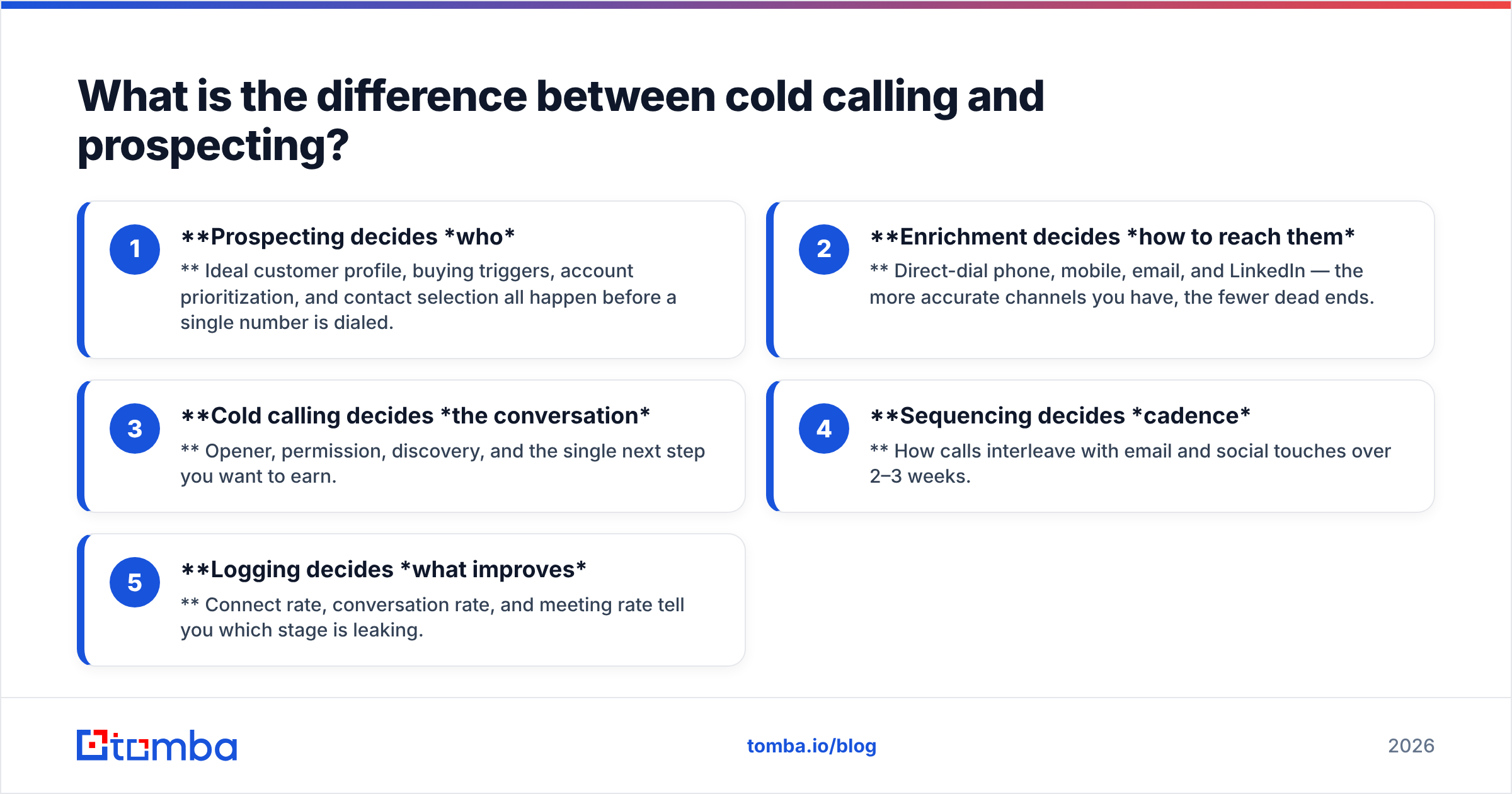
- Prospecting decides who. Ideal customer profile, buying triggers, account prioritization, and contact selection all happen before a single number is dialed.
- Enrichment decides how to reach them. Direct-dial phone, mobile, email, and LinkedIn — the more accurate channels you have, the fewer dead ends.
- Cold calling decides the conversation. Opener, permission, discovery, and the single next step you want to earn.
- Sequencing decides cadence. How calls interleave with email and social touches over 2–3 weeks.
- Logging decides what improves. Connect rate, conversation rate, and meeting rate tell you which stage is leaking.
Get the first two right and the call gets dramatically easier. That's the whole thesis of this post.
Does cold calling still work in 2026?#
Yes — but the bar is higher. Buyers screen unknown numbers, mobile carriers flag spam-likely calls, and gatekeepers are better than ever. The reps winning on the phone aren't dialing more; they're dialing smarter and pairing calls with other touches.
A few realities to design around:
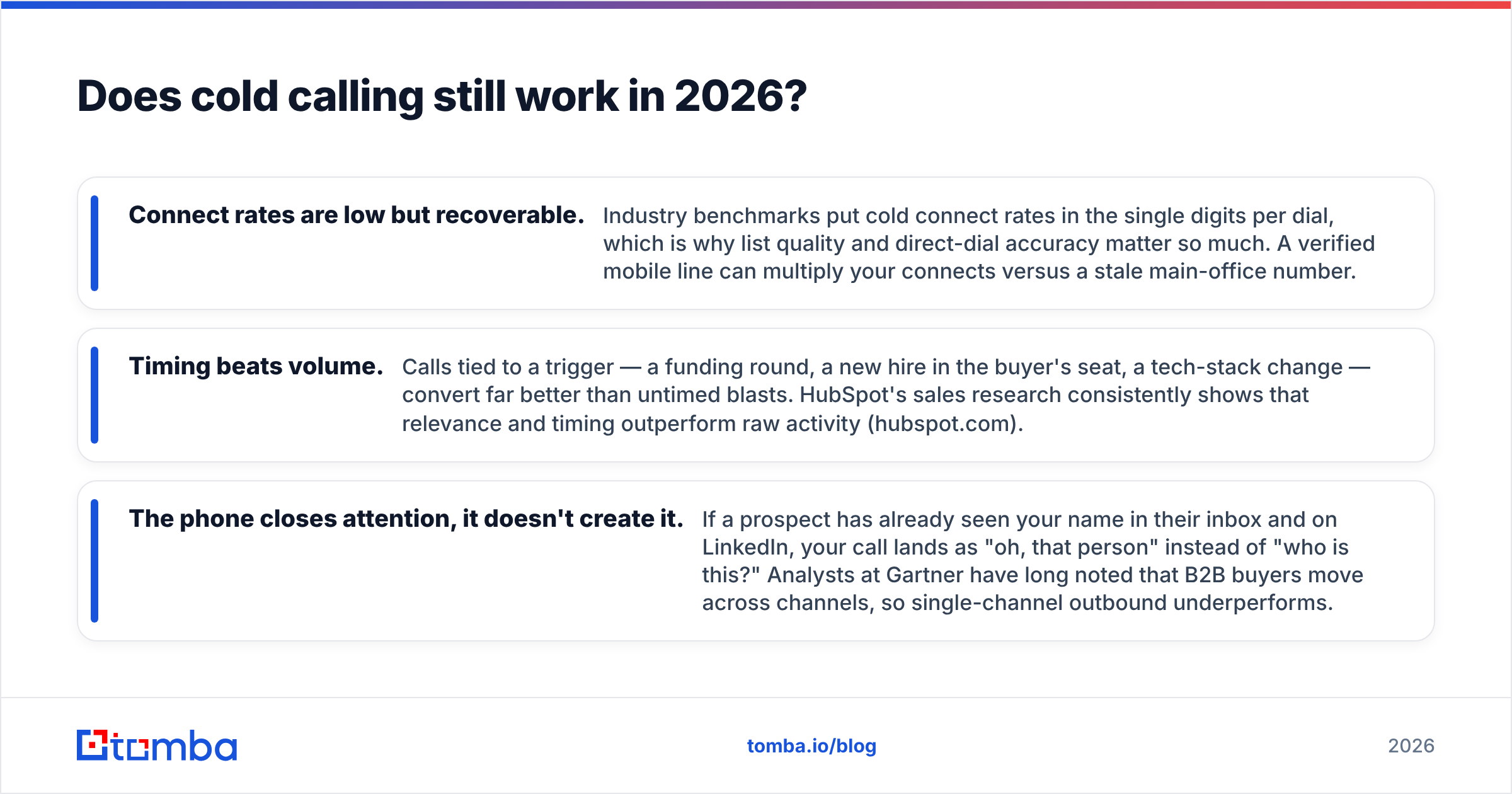
- Connect rates are low but recoverable. Industry benchmarks put cold connect rates in the single digits per dial, which is why list quality and direct-dial accuracy matter so much. A verified mobile line can multiply your connects versus a stale main-office number.
- Timing beats volume. Calls tied to a trigger — a funding round, a new hire in the buyer's seat, a tech-stack change — convert far better than untimed blasts. HubSpot's sales research consistently shows that relevance and timing outperform raw activity (hubspot.com).
- The phone closes attention, it doesn't create it. If a prospect has already seen your name in their inbox and on LinkedIn, your call lands as "oh, that person" instead of "who is this?" Analysts at Gartner have long noted that B2B buyers move across channels, so single-channel outbound underperforms.
So cold calling works, but treat it as one instrument in a coordinated set — not a solo act.
How do you prospect before you cold call?#
Build a short, sharp list before you touch the dialer. A great cold-calling day starts the day before, in a spreadsheet.
Your pre-call checklist:
- Define the trigger. Why this account, why now? No trigger, no priority.
- Identify the actual buyer and the coach. You usually need both — one signs, one lets you in.
- Pull direct contact data. A verified mobile or direct dial is worth ten switchboard numbers. Use a phone finder to pull B2B numbers, and run them through a phone validator so you're not dialing disconnected lines.
- Grab the email and LinkedIn too. You'll need them for the surrounding sequence. An accurate email finder closes the loop so every call has a follow-up path.
- Write one specific reason to call. Not "I wanted to introduce myself" — a real, account-specific hook.
Data quality is the multiplier here. If 30% of your numbers are wrong, you've silently cut a third of your effort before you say a word. This is where enrichment earns its keep: a single data enrichment pass can fill missing mobiles, titles, and company details across an entire list so your reps dial signal, not noise.
What does a good cold call script look like?#
A good script is a flexible frame, not a word-for-word cage. It gives you a strong opener, earns permission, runs light discovery, and asks for exactly one next step.
Here's a simple structure that holds up on real calls:
- Pattern interrupt + name. "Hi Sarah, it's Alex from Tomba — I know I'm an interruption. Can I take 30 seconds and you tell me if it's worth continuing?" Honesty about the interruption disarms the reflex to hang up.
- Reason for the call (the trigger). "I'm calling because I saw you just hired three SDRs — usually that means list quality is about to become someone's headache."
- One-sentence value hypothesis. "We help teams like yours dial verified direct numbers so new reps ramp faster."
- Permission-based discovery. "Is building the outbound list a problem you own, or is that someone else?" Ask, don't pitch.
- One clear ask. "Worth a 15-minute look next Tuesday?" Book the meeting; don't try to close the deal on the cold call.
Keep it conversational. The moment it sounds like reading, you've lost. Practice it enough that you can throw the script away and still hit every beat.
Cold calling vs other outbound channels: which should you use?#
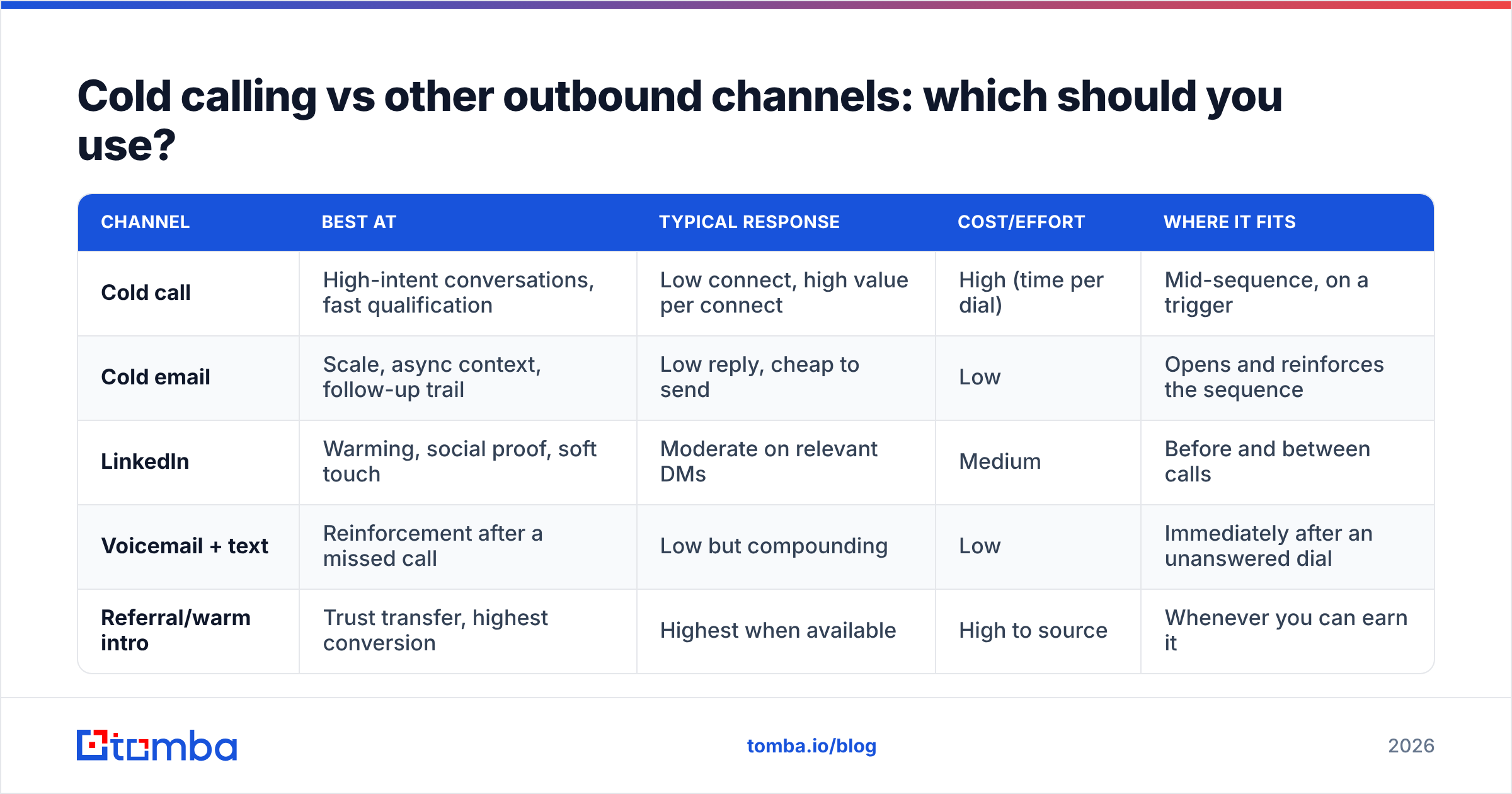
You shouldn't choose — you should sequence. Each channel has a job, and the phone does its best work alongside email and LinkedIn, not instead of them.
| Channel | Best at | Typical response | Cost/effort | Where it fits |
|---|---|---|---|---|
| Cold call | High-intent conversations, fast qualification | Low connect, high value per connect | High (time per dial) | Mid-sequence, on a trigger |
| Cold email | Scale, async context, follow-up trail | Low reply, cheap to send | Low | Opens and reinforces the sequence |
| Warming, social proof, soft touch | Moderate on relevant DMs | Medium | Before and between calls | |
| Voicemail + text | Reinforcement after a missed call | Low but compounding | Low | Immediately after an unanswered dial |
| Referral/warm intro | Trust transfer, highest conversion | Highest when available | High to source | Whenever you can earn it |
The winning play is a coordinated cadence: email lands context, LinkedIn adds familiarity, and the call converts that attention into a conversation. Reps who run all three around a single trigger consistently out-book reps who hammer one channel. Peer reviews on G2 echo this — the tools and teams rated highest are the ones that orchestrate touches rather than isolate them.
How do you get past gatekeepers and voicemail?#
Treat gatekeepers as allies, not obstacles — and treat voicemail as a setup for your next touch, not a Hail Mary.
For gatekeepers:
- Be direct and confident. Fumbling signals "cold sales call." State who you're looking for by name (which is why accurate contact data matters).
- Ask for help, genuinely. "I'm hoping you can point me in the right direction" converts better than a fake-urgent tone.
- Respect the no. If now's bad, ask when's better and actually call back then. Gatekeepers remember reps who listen.
For voicemail:
- Keep it under 20 seconds. Name, company, one reason, and that you'll follow up by email.
- Reference the email you're about to send. This is where multi-channel pays off — the voicemail and the inbox reinforce each other.
- Don't beg for a callback. Set the next touch yourself. You control the cadence.
The through-line: none of this works without knowing exactly who you're trying to reach. A verified name, title, and direct line turn a guessing game into a plan.
What metrics should you track for cold calling and prospecting?#
Track the funnel, not just the activity. "Number of dials" alone tells you nothing about why you're winning or losing.
The metrics that actually coach behavior:
- Connect rate (conversations ÷ dials) — mostly a data quality signal. Low here means bad numbers, not bad talking.
- Conversation-to-meeting rate — a script and targeting signal. Low here means your opener or list is off.
- Meetings held ÷ meetings booked — a qualification signal. No-shows mean you booked the wrong people.
- Contact accuracy rate — how many numbers were valid at all. This one quietly caps every other metric.
- Response rate across channels — measure the whole cadence, not just calls; see how it maps to response rate as a system.
If your connect rate is in the gutter, don't buy a script course — fix your data. If your connect rate is fine but conversations don't convert, then it's the message. Diagnosing the right stage is the entire game, and it's why clean data plus clean logging beats raw hustle every time.
Putting it together: the research-to-dial workflow#
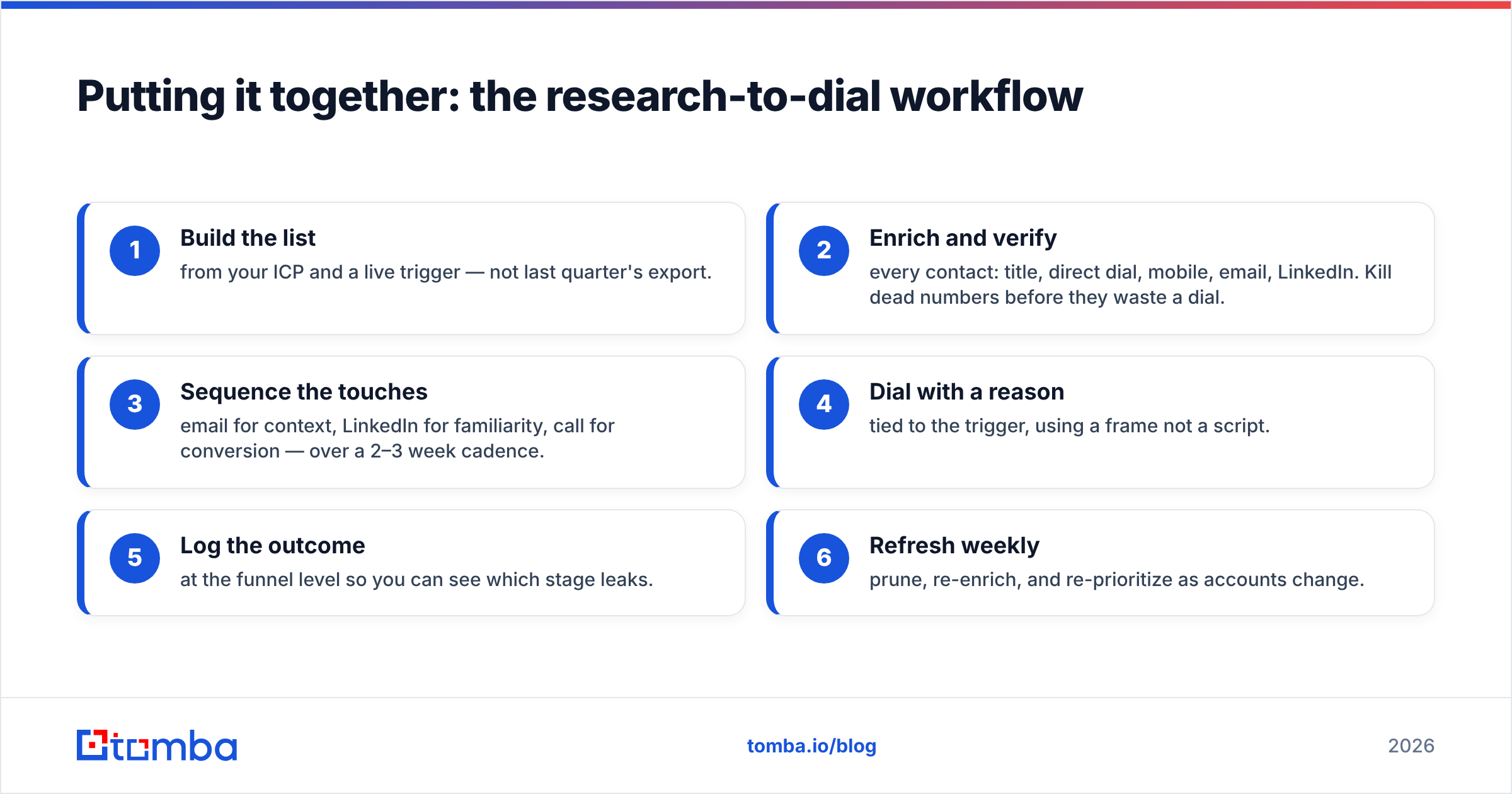
Here's the repeatable loop that ties everything above into something a team can run every day:
- Build the list from your ICP and a live trigger — not last quarter's export.
- Enrich and verify every contact: title, direct dial, mobile, email, LinkedIn. Kill dead numbers before they waste a dial.
- Sequence the touches — email for context, LinkedIn for familiarity, call for conversion — over a 2–3 week cadence.
- Dial with a reason tied to the trigger, using a frame not a script.
- Log the outcome at the funnel level so you can see which stage leaks.
- Refresh weekly — prune, re-enrich, and re-prioritize as accounts change.
Do this the same way every week and cold calling stops feeling like a lottery. It becomes a system you can measure and improve.
The bottom line#
Cold calling and prospecting still book meetings in 2026 — but only when the prep is real. The reps who win aren't the ones dialing the most; they're the ones dialing verified numbers, at the right accounts, with a reason to call and a sequence around it. The phone is a great instrument. Your list is the sheet music.
If your connect rate is the thing holding you back, start upstream. Tomba's email finder — alongside its phone finder, verifier, and enrichment tools — gives you accurate, verified contact data so every dial has a real person on the other end and a follow-up path in the inbox. Check the Tomba pricing (free tier included, Starter at $49/mo) and stop wasting dials on dead numbers. Research first, dial second — that's the whole edge.
Related guides#
Ready to find emails that actually work?
Join 150,000+ professionals who stopped guessing and started sending. Free credits on signup — no credit card required.
Get the Tomba newsletter
Practical outbound tactics and product updates — once every two weeks.
About the author